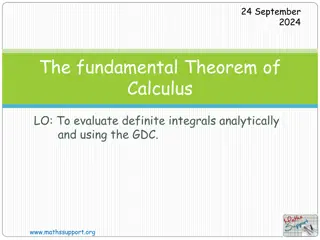
The Fundamental Theorem of Calculus, Part 2, also known as the Evaluation Theorem, allows us to evaluate definite integrals by finding antiderivatives. This theorem connects differential calculus and definite integrals, providing a powerful tool in calculus. Learn how to apply this fundamental concept through examples and explanations.
Please find below an Image/Link to download the presentation.
The content on the website is provided AS IS for your information and personal use only. It may not be sold, licensed, or shared on other websites without obtaining consent from the author. If you encounter any issues during the download, it is possible that the publisher has removed the file from their server.
You are allowed to download the files provided on this website for personal or commercial use, subject to the condition that they are used lawfully. All files are the property of their respective owners.
The content on the website is provided AS IS for your information and personal use only. It may not be sold, licensed, or shared on other websites without obtaining consent from the author.
E N D
Presentation Transcript
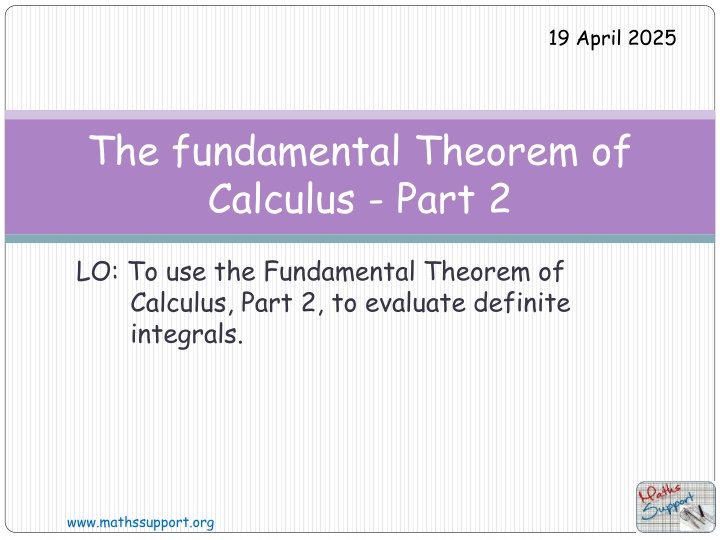
19 April 2025 The fundamental Theorem of Calculus - Part 2 LO: To use the Fundamental Theorem of Calculus, Part 2, to evaluate definite integrals. www.mathssupport.org
Fundamental theorem of calculus Sir Isaac Newton and Gottfried Wilhelm Leibniz (among others) independently came to realize that differential calculus and the definite integral are linked together. This link is called the Fundamental theorem of calculus. The beauty of this theorem is that it enables us to evaluate complicated summations. It is based on the fact that the quotient ? a secant line, gives us an approximation for the slope of a tangent line. The product ( y)( x), the area of a rectangle, gives us an approximation for the area under a curve. The Fundamental theorem of calculus has two parts. ?, the slope of www.mathssupport.org
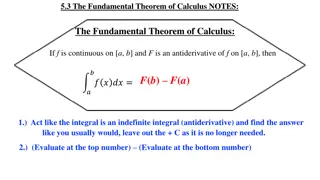
Fundamental theorem of calculus Part 2: The evaluation theorem Fundamental theorem of calculus, Part 2 Is perhaps the most important theorem in calculus. If f(x) is a continuous function on the interval a x b and the function F(x)is any antiderivative of f(x), then ? = ?(?) ?(?) ? ? ? ? We often see the notation ?(?) ?(?) ? to denote the expression ?(?)? We use this vertical bar and associated limits a and b to indicate that we should evaluate the function F(x) at the upper limit (in this case, b), and subtract the value of the function F(x) evaluated at the lower limit (in this case, a). www.mathssupport.org
Fundamental theorem of calculus Part 2: The evaluation theorem The Fundamental Theorem of Calculus, Part 2 (also known as the evaluation theorem) states that if we can find an antiderivative for the integrand, then we can evaluate the definite integral by evaluating the antiderivative at the endpoints of the interval and subtracting. When we talk about an anti-derivative for a function we are really talking about the indefinite integral for the function So, to evaluate a definite integral the first thing that we are going to do is evaluate the indefinite integral for the function. www.mathssupport.org
Fundamental theorem of calculus Part 2: The evaluation theorem (a) Evaluate the following integral This is here only to make sure that we understand the difference between an indefinite and a definite integral ?2+ ? 2 ? =?3 3 1 ?+ ? ?2+ ? 2 ? 2 (b) Evaluate the following integral All we really need here is any anti-derivative of the integrand We ll use the answer from (a) without the +C ?2+ ? 2 ? 1 2 ?3 3 1 23 3 1 = ? 1 13 3 1 Evaluate the antiderivative at x = 1 and x = 2, then find the difference = 1 2 1 =8 2 1 3+1 =17 3 6 www.mathssupport.org
Fundamental theorem of calculus Part 2: The evaluation theorem 2 (c) Evaluate the following integral ?2+ ? 2 ? 1 This integral is here to make a point. If we try to evaluate this integral over this interval it will be. 2 ?3 3 1 = ? 1 In order for us to do an integral the integrand must be continuous in the range of the limits. Zero is within the interval In this case the second term will have division by zero at y = 0 and since y = 0 is in the interval of integration, it is between the lower and upper limit, this integrand is not continuous in the interval of integration and so we can t do this integral. www.mathssupport.org
Fundamental theorem of calculus Part 2: The evaluation theorem 1 Evaluate the definite integral ? 1 ? 2 1 1 2?2 ? Find the simplest antiderivative of x - 1 2 Evaluate the antiderivative at x = 1 and x = -2, then find the difference 1 2(12) 1 1 2( 2)2 ( 2) = 1 2 1 2 + 2 = = 1 2 4 = 9 2 www.mathssupport.org
Fundamental theorem of calculus Part 2: The evaluation theorem 1 Evaluate the definite integral Recall that ?? + ?? ? = 1 ? 2? 33 ? 1 1 1 2 1 42? 34 1 ? + 1?? + ??+1 + ? 1 Evaluate the antiderivative at x = 1 and x = -1, then find the difference 1 8(2(1) ) 1 8(2( 1) ) - 34 34 = 1 8 625 = 8 = 78 www.mathssupport.org
Fundamental theorem of calculus Part 2: The evaluation theorem 5 ?2?+1 Evaluate the definite integral ?2 ? 1 5 ?2?+ ? 2 ? 1 5 Recall that ???+? ? = 1 ????+?+ ? 1 2?2? 1 ?1 Evaluate the antiderivative at x = 5 and x = 1, then find the difference 1 2(?2(5) 1 1 2(?2(1) 1 = 5 1 =1 2?10 1 2?2+4 5 =5?10 5?2+8 10 www.mathssupport.org
Thank you for using resources from A close up of a cage Description automatically generated For more resources visit our website https://www.mathssupport.org If you have a special request, drop us an email info@mathssupport.org www.mathssupport.org