In Chapter 10, explore how to use hypothesis testing to compare the means of two related or independent populations, along with proportions. Learn about confidence intervals, t-scores, margin of error, and standard error for population means. Dive into comparing means of two related populations and understanding confidence intervals for mean differences in two populations. Discover scenarios for comparing related groups and deriving confidence intervals for population mean differences.
Please find below an Image/Link to download the presentation.
The content on the website is provided AS IS for your information and personal use only. It may not be sold, licensed, or shared on other websites without obtaining consent from the author. If you encounter any issues during the download, it is possible that the publisher has removed the file from their server.
You are allowed to download the files provided on this website for personal or commercial use, subject to the condition that they are used lawfully. All files are the property of their respective owners.
The content on the website is provided AS IS for your information and personal use only. It may not be sold, licensed, or shared on other websites without obtaining consent from the author.
E N D
Presentation Transcript
STAT 206: Chapter 10 Fundamentals of Hypothesis Testing: Two-Sample Tests 1
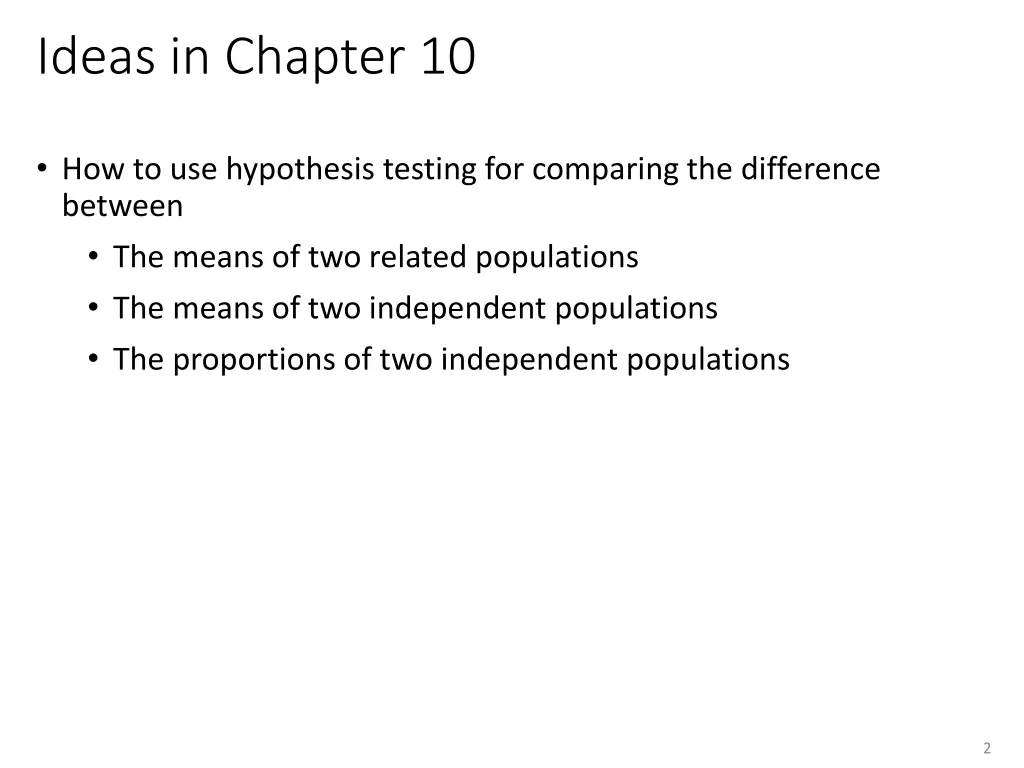
Ideas in Chapter 10 How to use hypothesis testing for comparing the difference between The means of two related populations The means of two independent populations The proportions of two independent populations 2
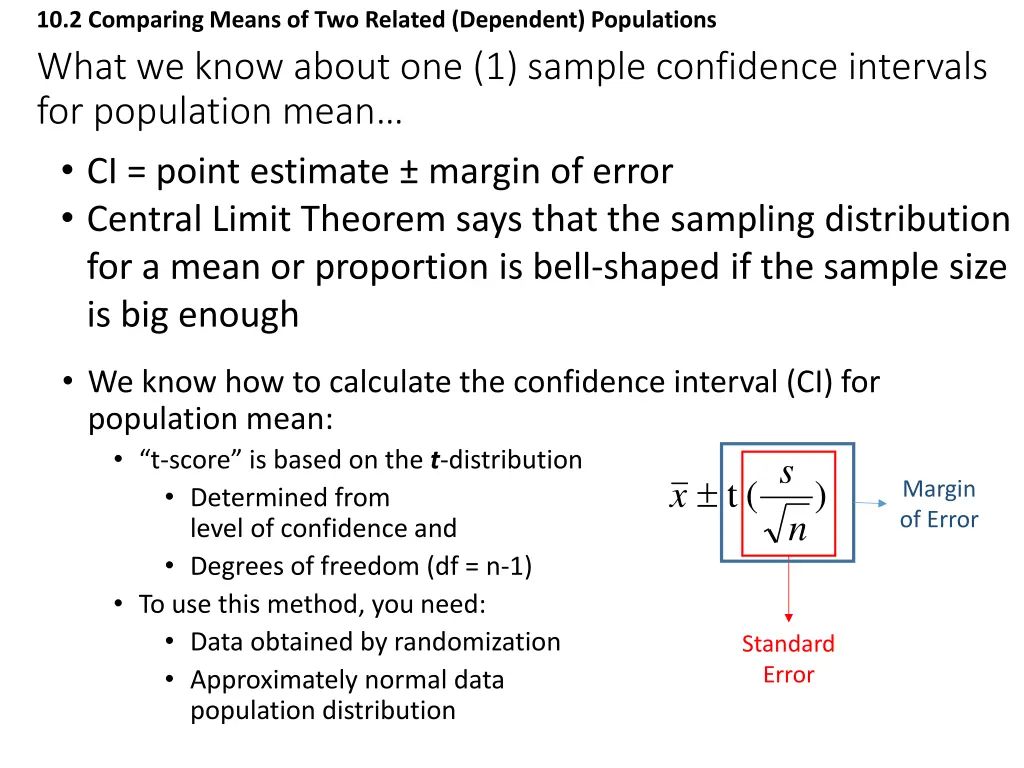
10.2 Comparing Means of Two Related (Dependent) Populations What we know about one (1) sample confidence intervals for population mean CI = point estimate margin of error Central Limit Theorem says that the sampling distribution for a mean or proportion is bell-shaped if the sample size is big enough We know how to calculate the confidence interval (CI) for population mean: t-score is based on the t-distribution Determined from level of confidence and Degrees of freedom (df = n-1) To use this method, you need: Data obtained by randomization Approximately normal data population distribution s x t ( ) Margin of Error n Standard Error
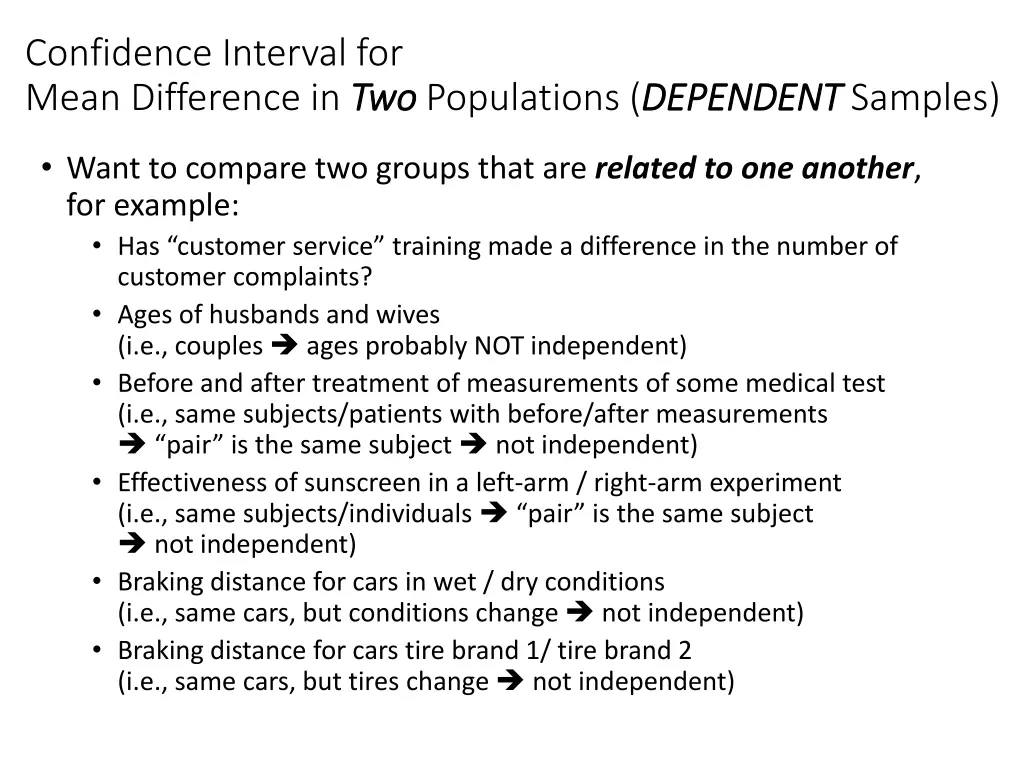
Confidence Interval for Mean Difference in Two Two Populations (DEPENDENT DEPENDENT Samples) Want to compare two groups that are related to one another, for example: Has customer service training made a difference in the number of customer complaints? Ages of husbands and wives (i.e., couples ages probably NOT independent) Before and after treatment of measurements of some medical test (i.e., same subjects/patients with before/after measurements pair is the same subject not independent) Effectiveness of sunscreen in a left-arm / right-arm experiment (i.e., same subjects/individuals pair is the same subject not independent) Braking distance for cars in wet / dry conditions (i.e., same cars, but conditions change not independent) Braking distance for cars tire brand 1/ tire brand 2 (i.e., same cars, but tires change not independent)
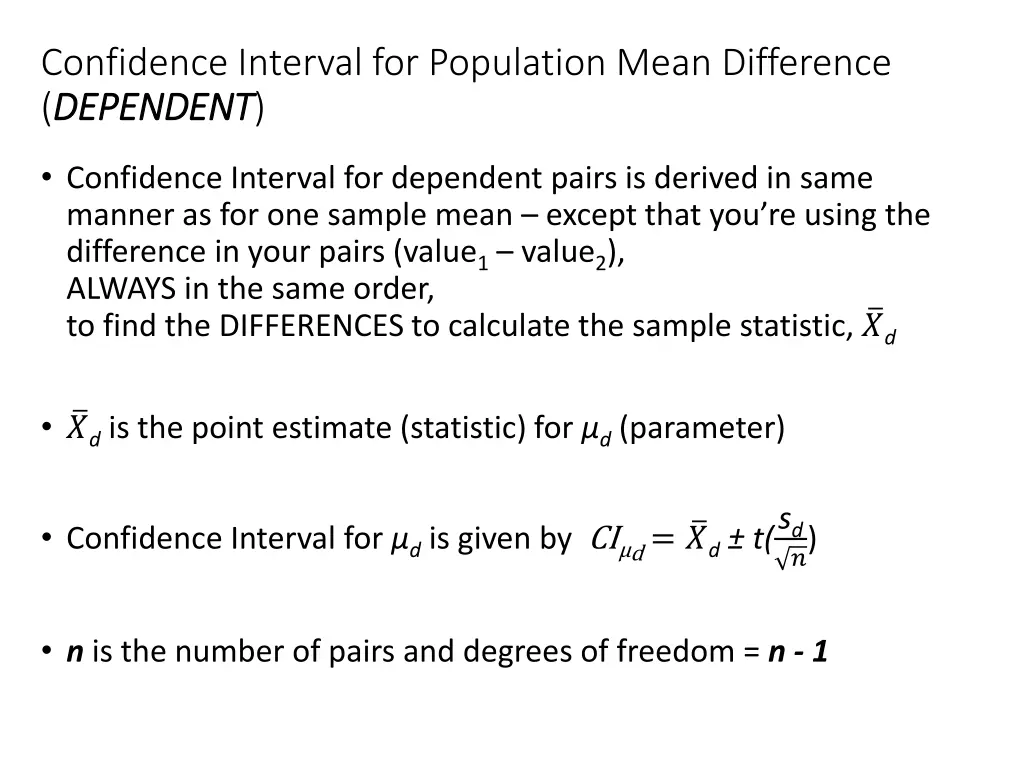
Confidence Interval for Population Mean Difference (DEPENDENT DEPENDENT) Confidence Interval for dependent pairs is derived in same manner as for one sample mean except that you re using the difference in your pairs (value1 value2), ALWAYS in the same order, to find the DIFFERENCES to calculate the sample statistic, ?d ?dis the point estimate (statistic) for d (parameter) Confidence Interval for d is given by CI d= ?d t(sd ?) n is the number of pairs and degrees of freedom = n - 1
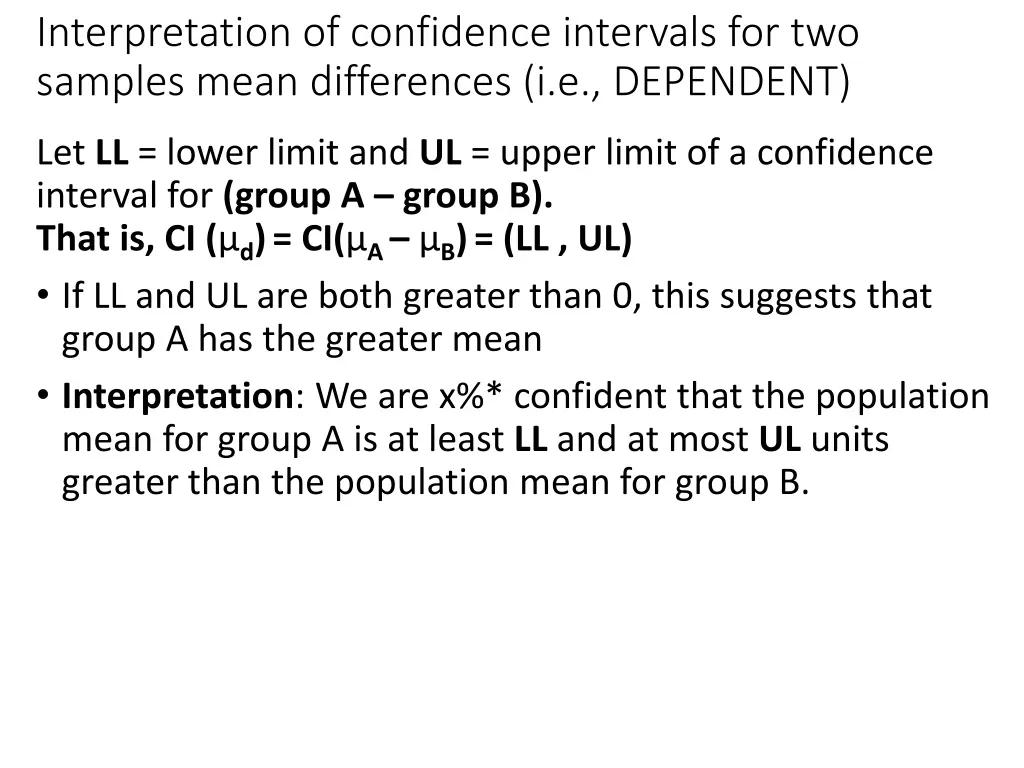
Interpretation of confidence intervals for two samples mean differences (i.e., DEPENDENT) Let LL = lower limit and UL = upper limit of a confidence interval for (group A group B). That is, CI ( d)= CI( A B)= (LL , UL) If LL and UL are both greater than 0, this suggests that group A has the greater mean Interpretation: We are x%* confident that the population mean for group A is at least LL and at most UL units greater than the population mean for group B.
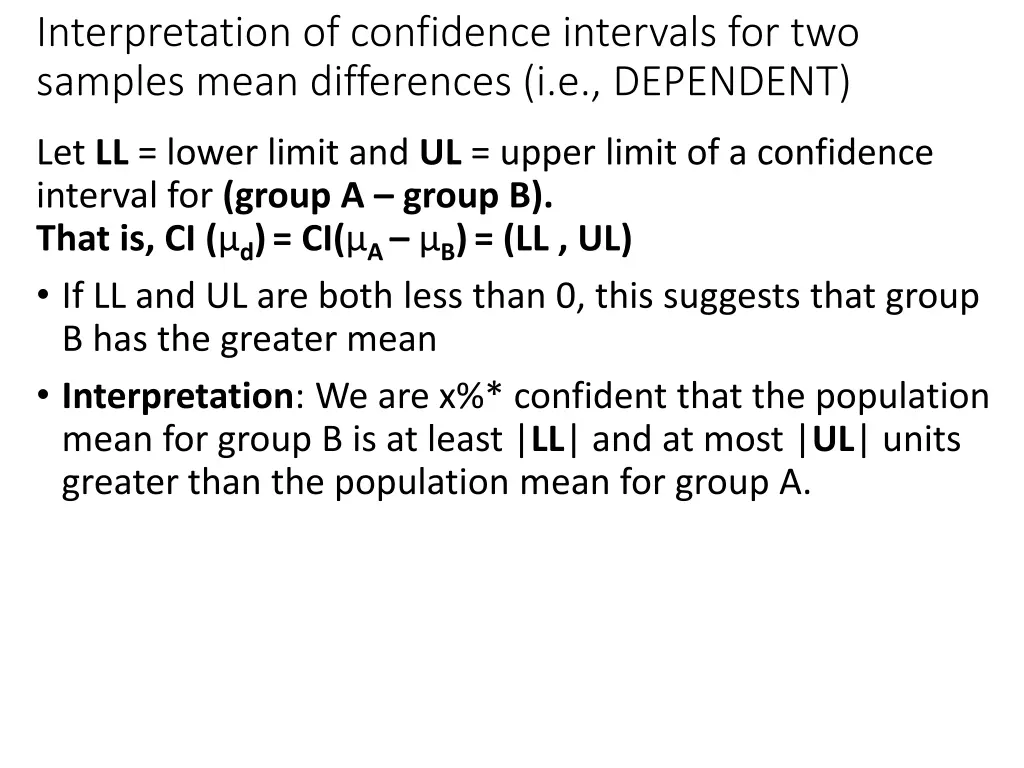
Interpretation of confidence intervals for two samples mean differences (i.e., DEPENDENT) Let LL = lower limit and UL = upper limit of a confidence interval for (group A group B). That is, CI ( d)= CI( A B)= (LL , UL) If LL and UL are both less than 0, this suggests that group B has the greater mean Interpretation: We are x%* confident that the population mean for group B is at least |LL| and at most |UL| units greater than the population mean for group A.
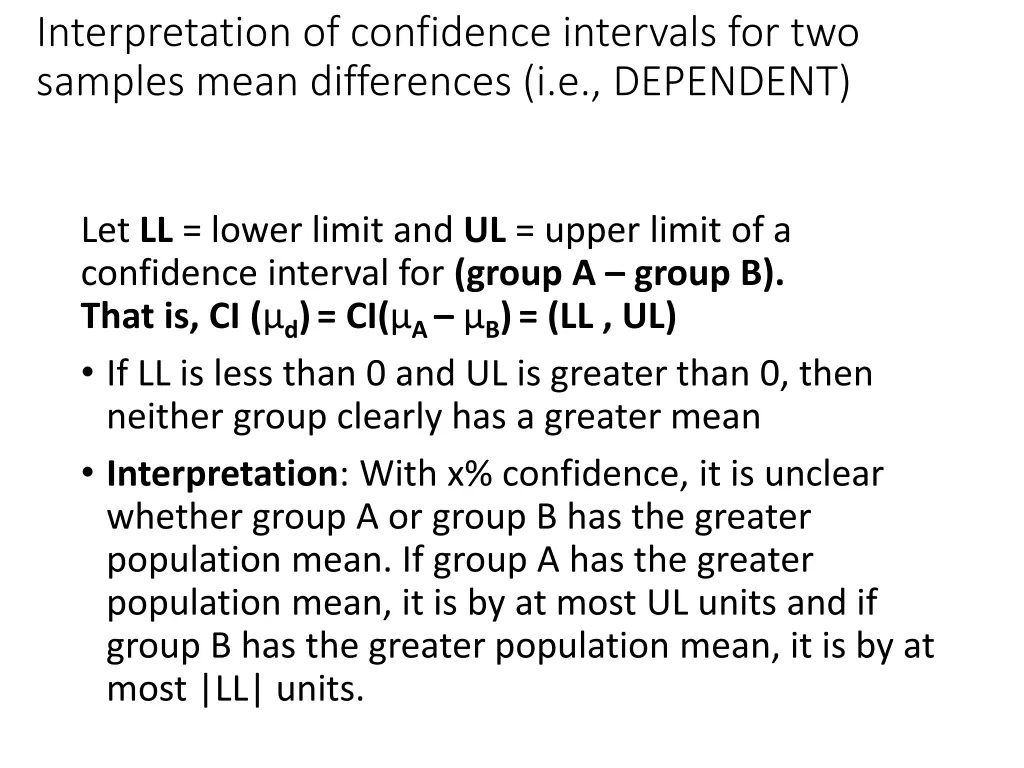
Interpretation of confidence intervals for two samples mean differences (i.e., DEPENDENT) Let LL = lower limit and UL = upper limit of a confidence interval for (group A group B). That is, CI ( d)= CI( A B)= (LL , UL) If LL is less than 0 and UL is greater than 0, then neither group clearly has a greater mean Interpretation: With x% confidence, it is unclear whether group A or group B has the greater population mean. If group A has the greater population mean, it is by at most UL units and if group B has the greater population mean, it is by at most |LL| units.
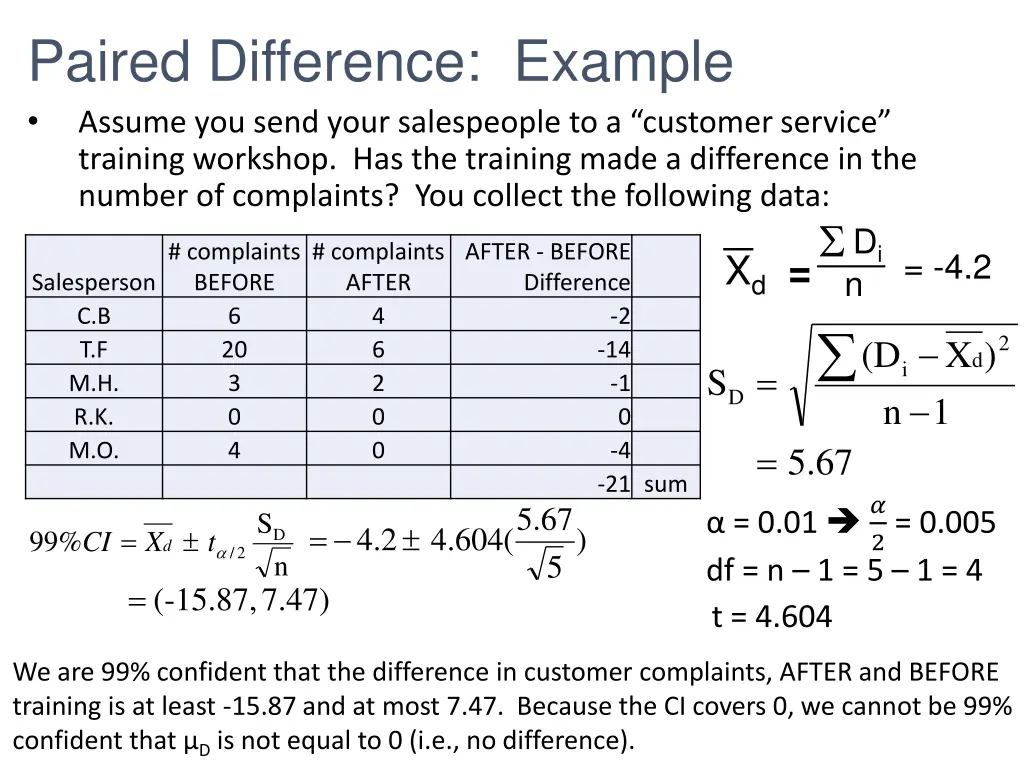
Paired Difference: Example Assume you send your salespeople to a customer service training workshop. Has the training made a difference in the number of complaints? You collect the following data: Di n # complaints BEFORE 6 20 3 0 4 # complaints AFTER 4 6 2 0 0 AFTER - BEFORE Difference = -4.2 Xd= Salesperson C.B T.F M.H. R.K. M.O. -2 = 2 (D X ) -14 -1 d i S D n 1 0 = -4 5.67 -21 sum = 0.01 ? . 5 ( 67 S 2 = 0.005 = 2 . 4 . 4 604 ) = d 99 % D CI X t / 2 5 n df = n 1 = 5 1 = 4 t = 4.604 = (-15.87, 7.47) We are 99% confident that the difference in customer complaints, AFTER and BEFORE training is at least -15.87 and at most 7.47. Because the CI covers 0, we cannot be 99% confident that D is not equal to 0 (i.e., no difference).
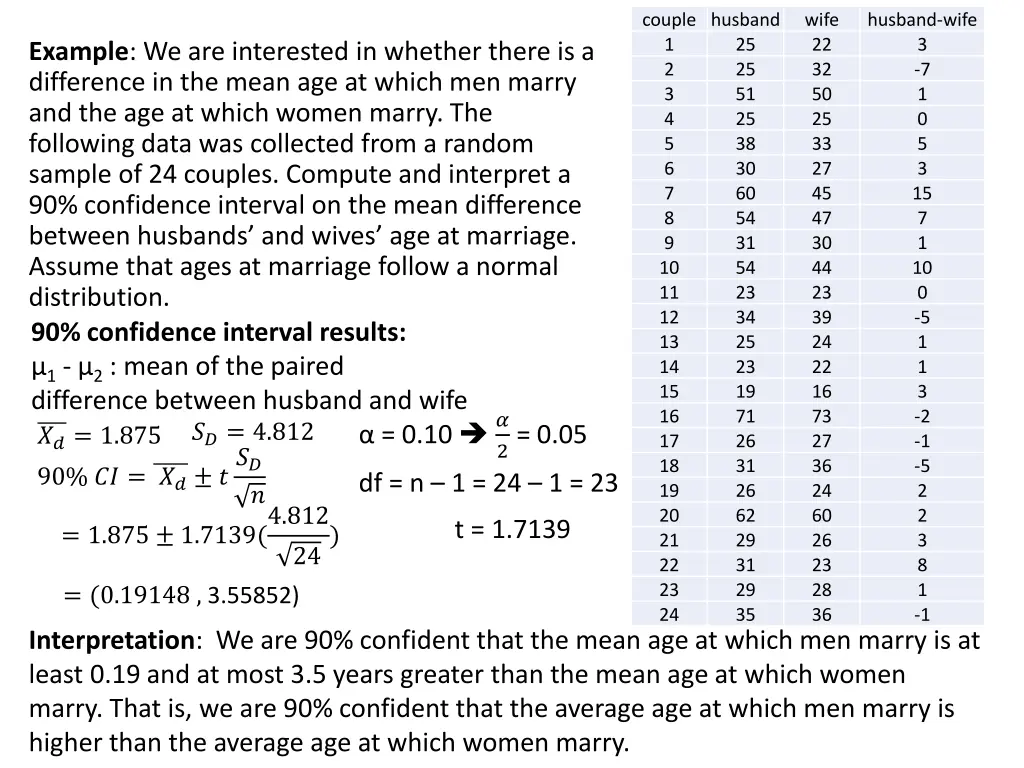
couple husband 1 2 3 4 5 6 7 8 9 10 11 12 13 14 15 16 17 18 19 20 21 22 23 wife 22 32 50 25 33 27 45 47 30 44 23 39 24 22 16 73 27 36 24 60 26 23 28 husband-wife 3 -7 1 0 5 3 15 7 1 10 0 -5 1 1 3 -2 -1 -5 2 2 3 8 1 -1 couple husband 1 2 3 4 5 6 7 8 9 10 11 12 13 14 15 16 17 18 19 20 21 22 23 24 24 wife 22 32 50 25 33 27 45 47 30 44 23 39 24 22 16 73 27 36 24 60 26 23 28 36 36 25 25 51 25 38 30 60 54 31 54 23 34 25 23 19 71 26 31 26 62 29 31 29 25 25 51 25 38 30 60 54 31 54 23 34 25 23 19 71 26 31 26 62 29 31 29 35 35 Example: We are interested in whether there is a difference in the mean age at which men marry and the age at which women marry. The following data was collected from a random sample of 24 couples. Compute and interpret a 90% confidence interval on the mean difference between husbands and wives age at marriage. Assume that ages at marriage follow a normal distribution. 90% confidence interval results: 1 - 2 : mean of the paired difference between husband and wife ??= 1.875 90% ?? = ?? ??? ? = 1.875 1.7139(4.812 24) = 0.10 ? ??= 4.812 2 = 0.05 df = n 1 = 24 1 = 23 t = 1.7139 = (0.19148 , 3.55852) Interpretation: We are 90% confident that the mean age at which men marry is at least 0.19 and at most 3.5 years greater than the mean age at which women marry. That is, we are 90% confident that the average age at which men marry is higher than the average age at which women marry.
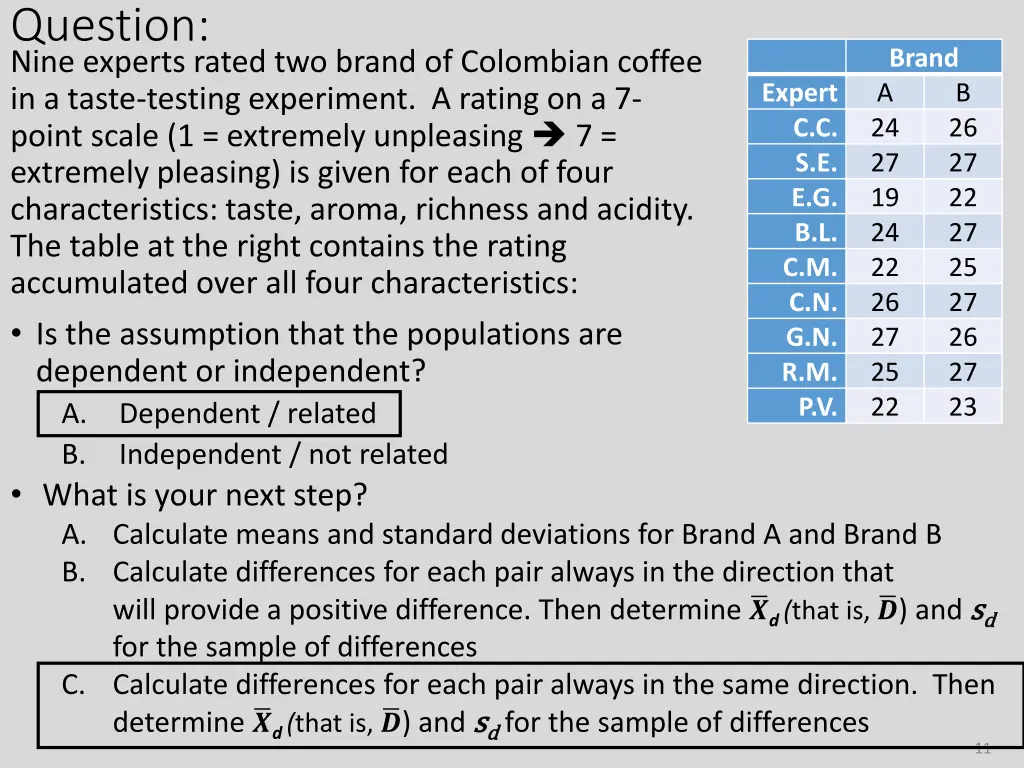
Question: Nine experts rated two brand of Colombian coffee in a taste-testing experiment. A rating on a 7- point scale (1 = extremely unpleasing 7 = extremely pleasing) is given for each of four characteristics: taste, aroma, richness and acidity. The table at the right contains the rating accumulated over all four characteristics: Is the assumption that the populations are dependent or independent? A. Dependent / related B. Independent / not related What is your next step? A. Calculate means and standard deviations for Brand A and Brand B B. Calculate differences for each pair always in the direction that will provide a positive difference. Then determine ?d (that is, ?) and s sd d for the sample of differences C. Calculate differences for each pair always in the same direction. Then determine ?d (that is, ?) and s sd d for the sample of differences Brand A 24 27 19 24 22 26 27 25 22 Expert C.C. S.E. E.G. B.L. C.M. C.N. G.N. R.M. P.V. B 26 27 22 27 25 27 26 27 23 11
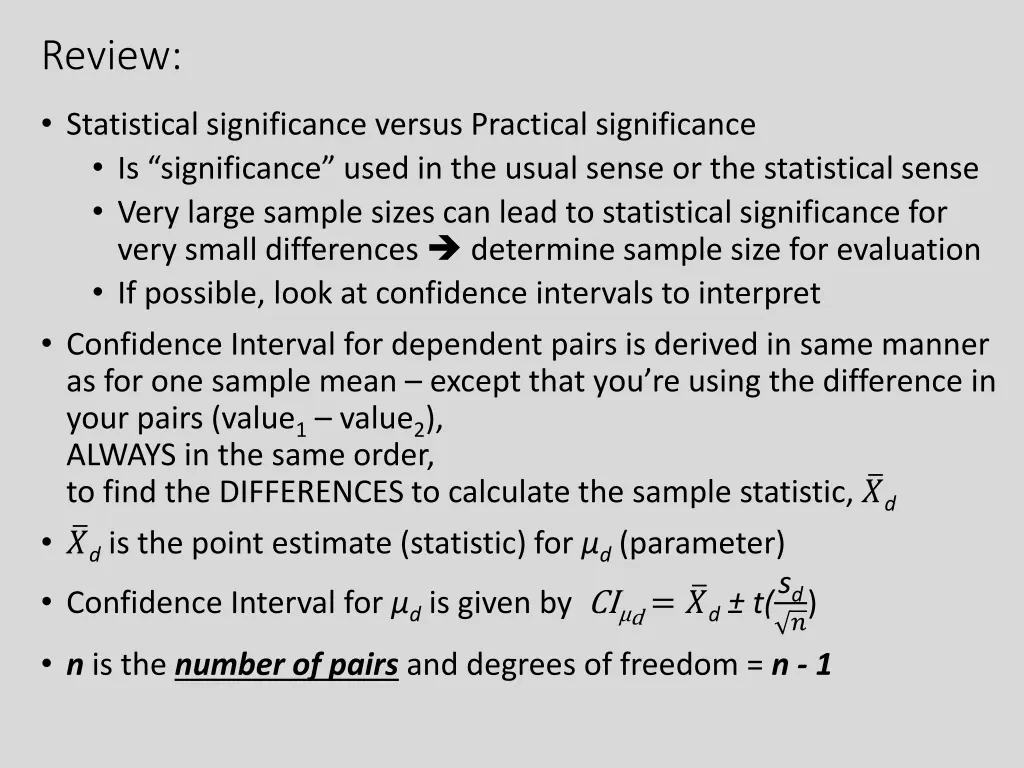
Review: Statistical significance versus Practical significance Is significance used in the usual sense or the statistical sense Very large sample sizes can lead to statistical significance for very small differences determine sample size for evaluation If possible, look at confidence intervals to interpret Confidence Interval for dependent pairs is derived in same manner as for one sample mean except that you re using the difference in your pairs (value1 value2), ALWAYS in the same order, to find the DIFFERENCES to calculate the sample statistic, ?d ?dis the point estimate (statistic) for d (parameter) Confidence Interval for d is given by CI d= ?d t(sd n is the number of pairsand degrees of freedom = n - 1 ?)
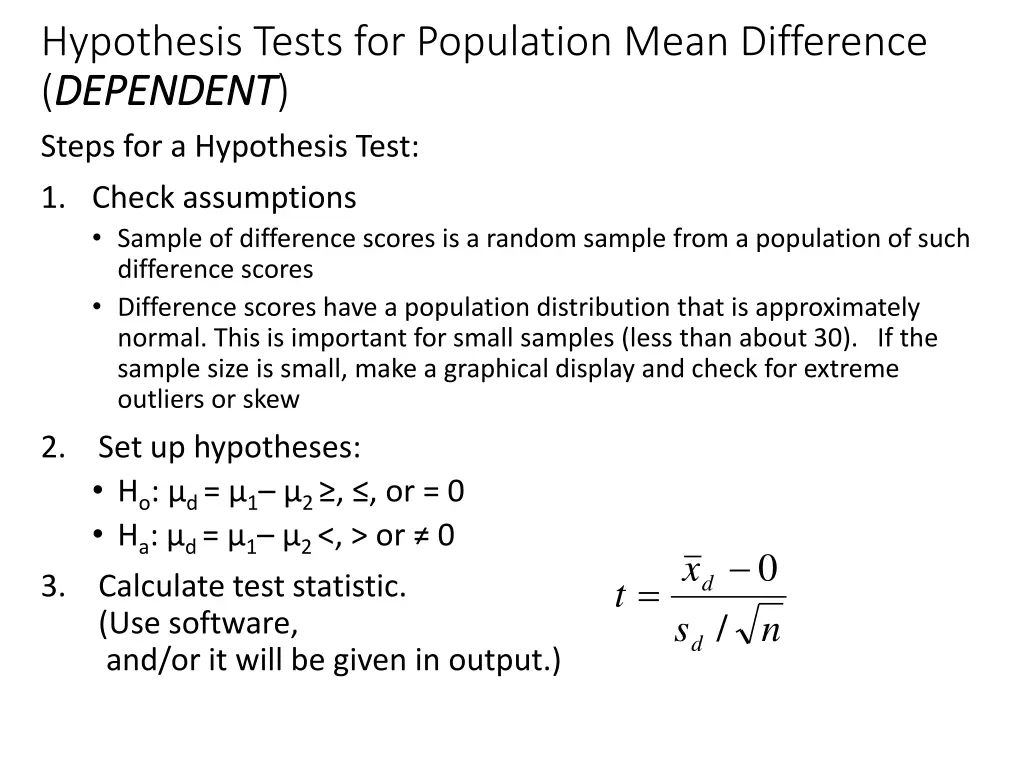
Hypothesis Tests for Population Mean Difference (DEPENDENT DEPENDENT) Steps for a Hypothesis Test: 1. Check assumptions Sample of difference scores is a random sample from a population of such difference scores Difference scores have a population distribution that is approximately normal. This is important for small samples (less than about 30). If the sample size is small, make a graphical display and check for extreme outliers or skew 2. Set up hypotheses: Ho: d = 1 2 , , or = 0 Ha: d = 1 2 <, > or 0 3. Calculate test statistic. (Use software, and/or it will be given in output.) 0 x = d t / s n d
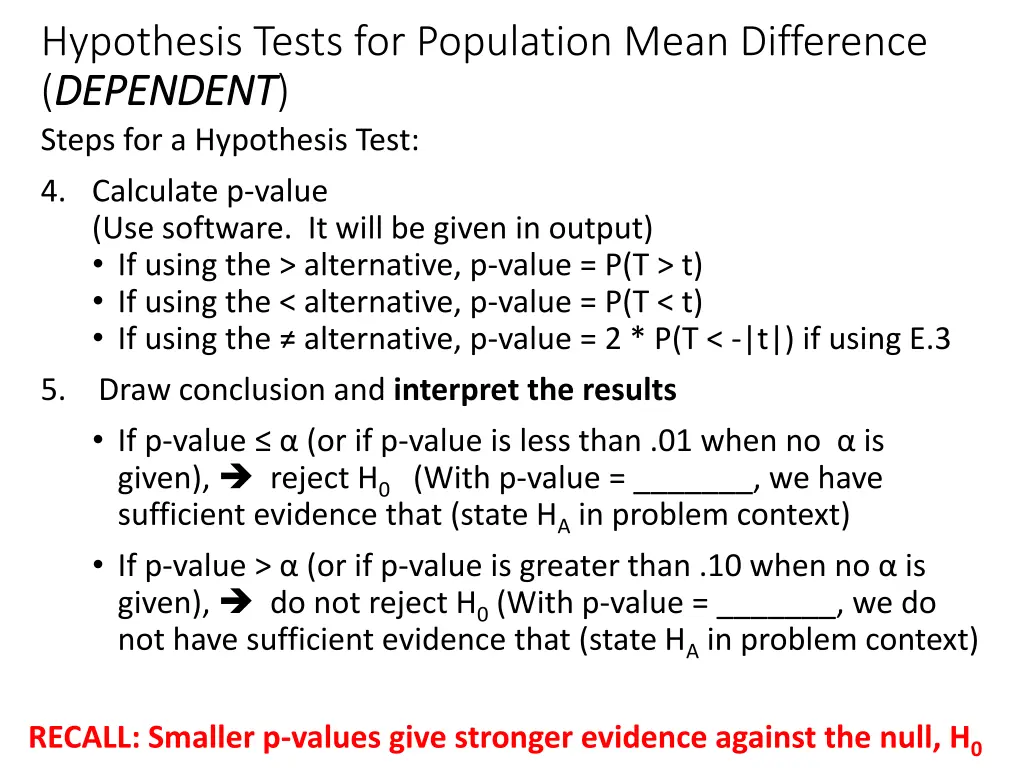
Hypothesis Tests for Population Mean Difference (DEPENDENT DEPENDENT) Steps for a Hypothesis Test: 4. Calculate p-value (Use software. It will be given in output) If using the > alternative, p-value = P(T > t) If using the < alternative, p-value = P(T < t) If using the alternative, p-value = 2 * P(T < -|t|) if using E.3 5. Draw conclusion and interpret the results If p-value (or if p-value is less than .01 when no is given), reject H0 (With p-value = _______, we have sufficient evidence that (state HA in problem context) If p-value > (or if p-value is greater than .10 when no is given), do not reject H0 (With p-value = _______, we do not have sufficient evidence that (state HA in problem context) RECALL: Smaller p-values give stronger evidence against the null, H0
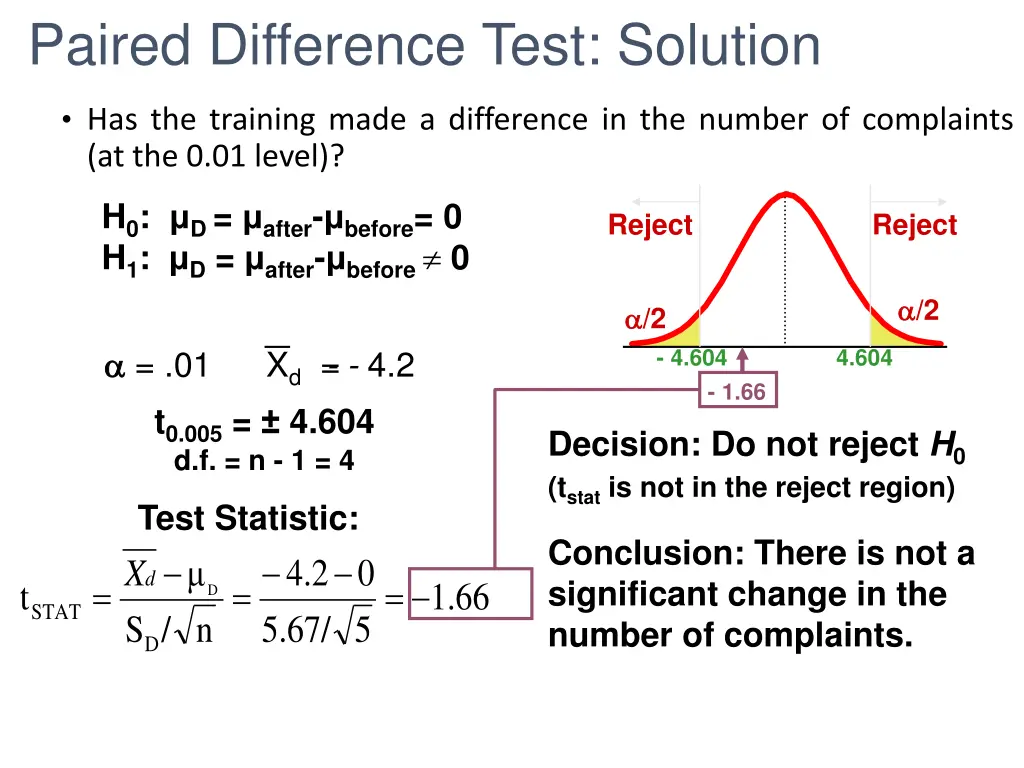
Paired Difference Test: Solution Has the training made a difference in the number of complaints (at the 0.01 level)? H0: D = after- before= 0 H1: D = after- before 0 Reject Reject /2 /2 = .01 - 4.604 4.604 - 1.66 Xd = - - 4.2 t0.005 = 4.604 d.f. = n - 1 = 4 Decision: Do not reject H0 (tstat is not in the reject region) Test Statistic: Conclusion: There is not a significant change in the number of complaints. 4.2 0 d X = = = 1.66 t D STAT S / n 5.67/ 5 D
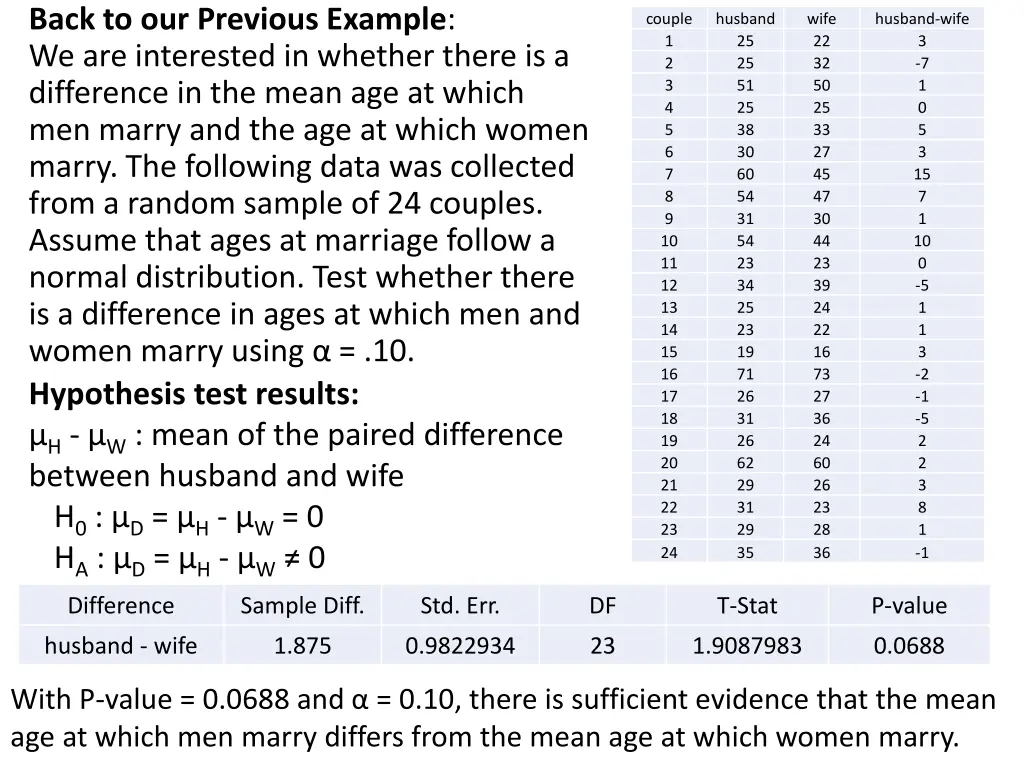
Back to our Previous Example: We are interested in whether there is a difference in the mean age at which men marry and the age at which women marry. The following data was collected from a random sample of 24 couples. Assume that ages at marriage follow a normal distribution.Test whether there is a difference in ages at which men and women marry using = .10. Hypothesis test results: H - W : mean of the paired difference between husband and wife H0 : D = H - W = 0 HA : D = H - W 0 Difference Sample Diff. couple 1 2 3 4 5 6 7 8 9 10 11 12 13 14 15 16 17 18 19 20 21 22 23 24 husband 25 25 51 25 38 30 60 54 31 54 23 34 25 23 19 71 26 31 26 62 29 31 29 35 wife 22 32 50 25 33 27 45 47 30 44 23 39 24 22 16 73 27 36 24 60 26 23 28 36 husband-wife 3 -7 1 0 5 3 15 7 1 10 0 -5 1 1 3 -2 -1 -5 2 2 3 8 1 -1 Std. Err. DF T-Stat P-value husband - wife 1.875 0.9822934 23 1.9087983 0.0688 With P-value = 0.0688 and = 0.10, there is sufficient evidence that the mean age at which men marry differs from the mean age at which women marry.
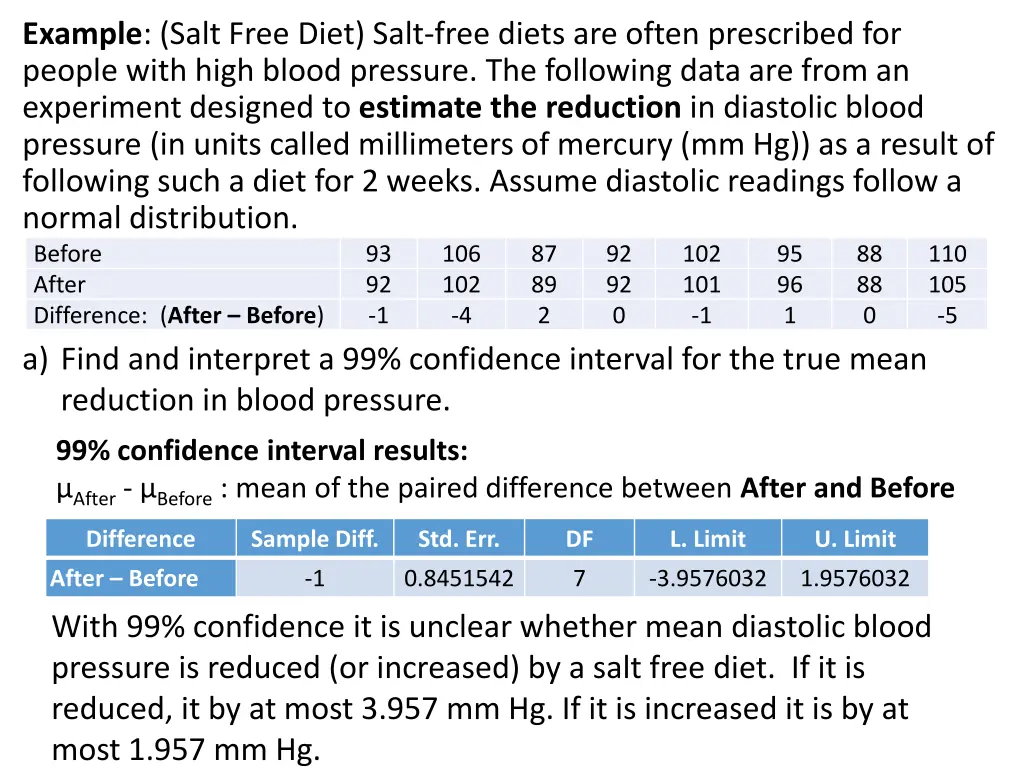
Example: (Salt Free Diet) Salt-free diets are often prescribed for people with high blood pressure. The following data are from an experiment designed to estimate the reduction in diastolic blood pressure (in units called millimeters of mercury (mm Hg)) as a result of following such a diet for 2 weeks. Assume diastolic readings follow a normal distribution. Before 93 106 After 92 102 Difference: (After Before) -1 -4 a) Find and interpret a 99% confidence interval for the true mean reduction in blood pressure. 87 89 2 92 92 0 102 101 -1 95 96 1 88 88 0 110 105 -5 99% confidence interval results: After - Before : mean of the paired difference between After and Before Difference Sample Diff. Std. Err. DF L. Limit U. Limit After Before -1 0.8451542 7 -3.9576032 1.9576032 With 99% confidence it is unclear whether mean diastolic blood pressure is reduced (or increased) by a salt free diet. If it is reduced, it by at most 3.957 mm Hg. If it is increased it is by at most 1.957 mm Hg.
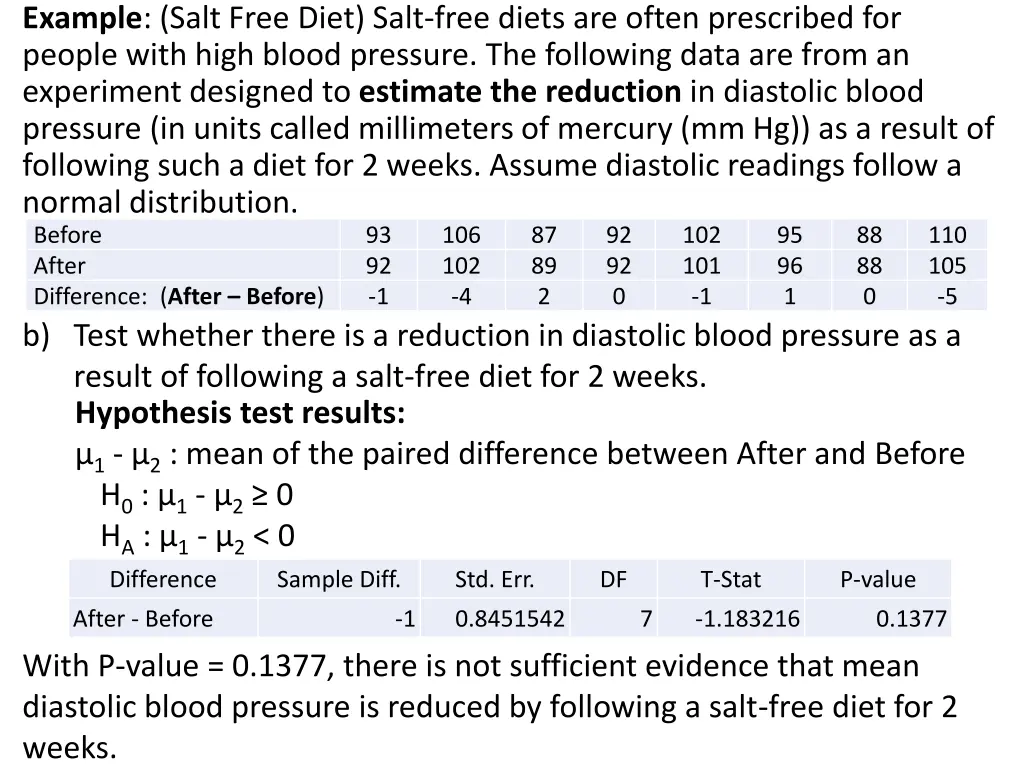
Example: (Salt Free Diet) Salt-free diets are often prescribed for people with high blood pressure. The following data are from an experiment designed to estimate the reduction in diastolic blood pressure (in units called millimeters of mercury (mm Hg)) as a result of following such a diet for 2 weeks. Assume diastolic readings follow a normal distribution. Before 93 106 After 92 102 Difference: (After Before) -1 -4 b) Test whether there is a reduction in diastolic blood pressure as a result of following a salt-free diet for 2 weeks. Hypothesis test results: 1 - 2 : mean of the paired difference between After and Before H0: 1 - 2 0 HA: 1 - 2 < 0 Difference Sample Diff. Std. Err. 87 89 2 92 92 0 102 101 -1 95 96 1 88 88 0 110 105 -5 DF T-Stat P-value After - Before -1 0.8451542 7 -1.183216 0.1377 With P-value = 0.1377, there is not sufficient evidence that mean diastolic blood pressure is reduced by following a salt-free diet for 2 weeks.
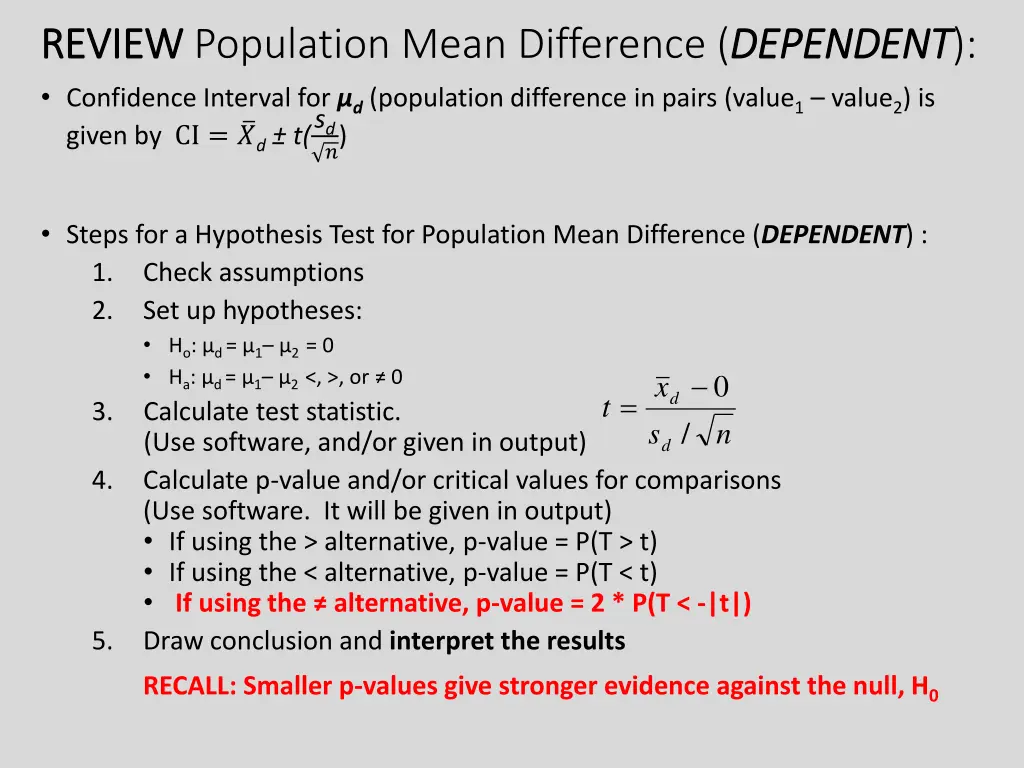
REVIEW REVIEW Population Mean Difference (DEPENDENT Confidence Interval for d (population difference in pairs (value1 value2) is given by CI = ?d t(sd DEPENDENT): ?) Steps for a Hypothesis Test for Population Mean Difference (DEPENDENT) : 1. Check assumptions 2. Set up hypotheses: Ho: d = 1 2 = 0 Ha: d = 1 2 <, >, or 0 3. Calculate test statistic. (Use software, and/or given in output) 4. Calculate p-value and/or critical values for comparisons (Use software. It will be given in output) If using the > alternative, p-value = P(T > t) If using the < alternative, p-value = P(T < t) If using the alternative, p-value = 2 * P(T < -|t|) 5. Draw conclusion and interpret the results 0 x = d t / s n d RECALL: Smaller p-values give stronger evidence against the null, H0
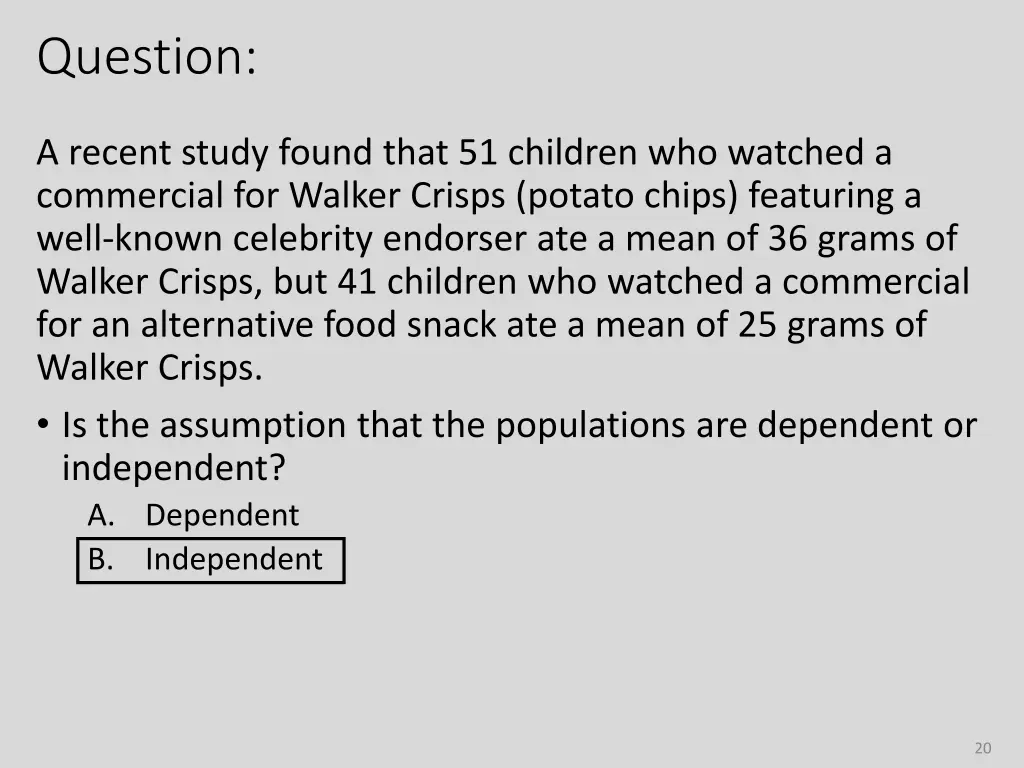
Question: A recent study found that 51 children who watched a commercial for Walker Crisps (potato chips) featuring a well-known celebrity endorser ate a mean of 36 grams of Walker Crisps, but 41 children who watched a commercial for an alternative food snack ate a mean of 25 grams of Walker Crisps. Is the assumption that the populations are dependent or independent? A. Dependent B. Independent 20
10.4 F-Test for the Ratio of Two Variances (sort of) But what if your populations are NOT dependent? Two populations Two means and two variances We must have a method to combine the variances in order to calculate our test statistics 21
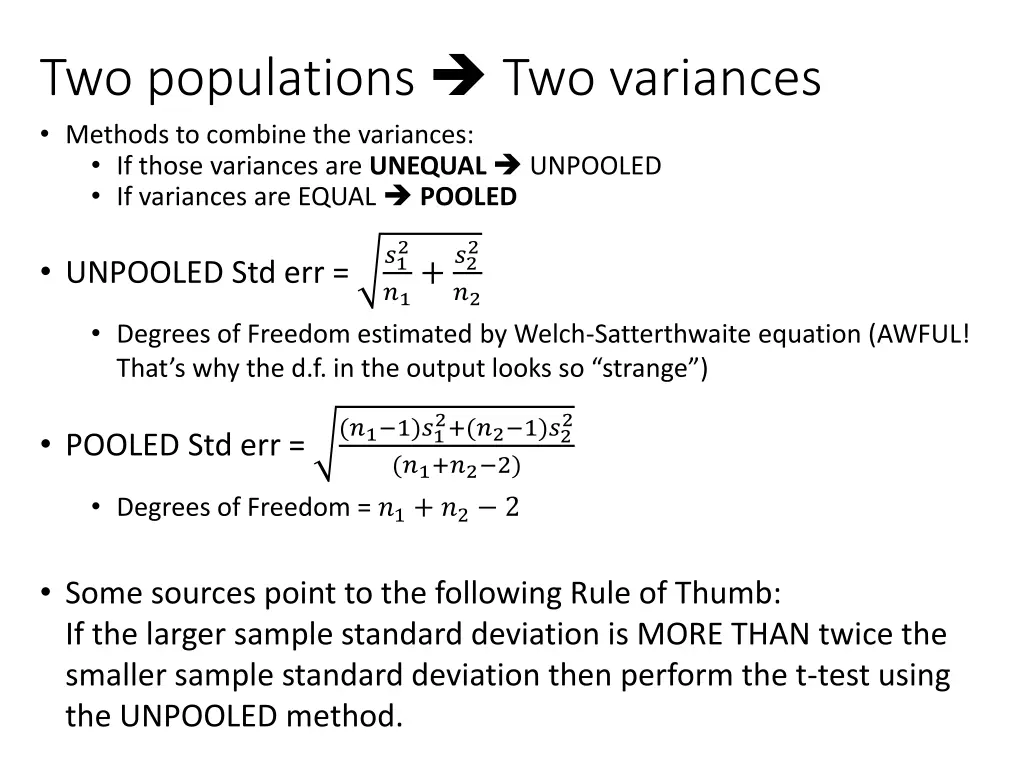
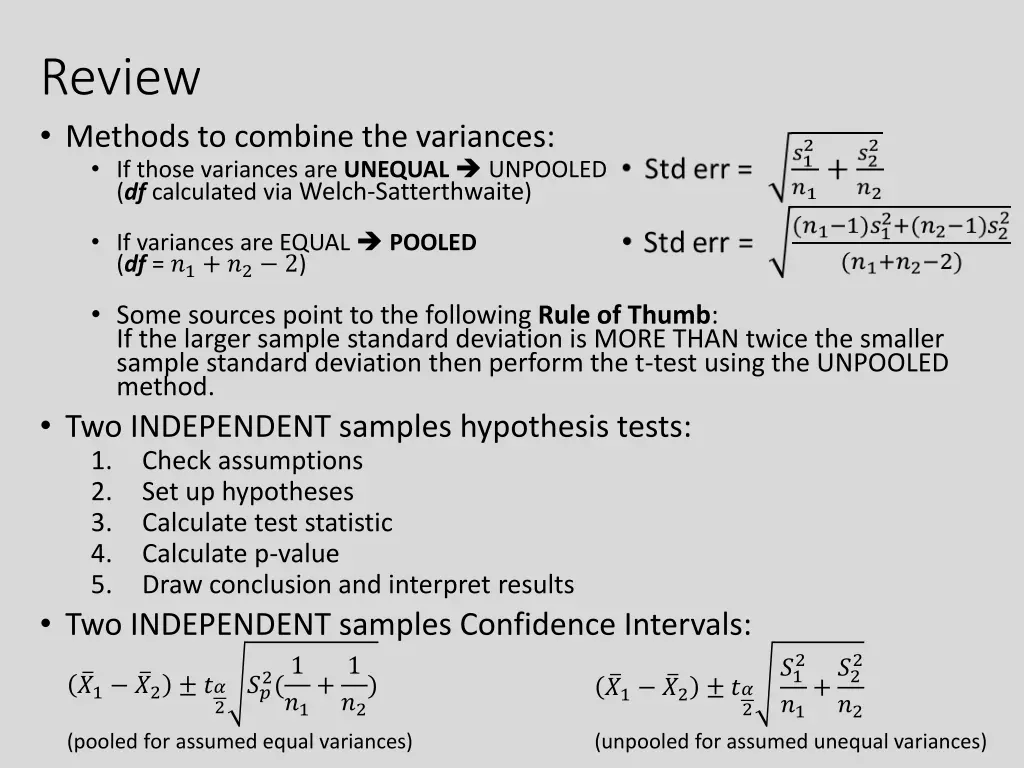
Two populations Two variances Methods to combine the variances: If those variances are UNEQUAL UNPOOLED If variances are EQUAL POOLED 2 2 ?1 ?1+?2 UNPOOLED Std err = ?2 Degrees of Freedom estimated by Welch-Satterthwaite equation (AWFUL! That s why the d.f. in the output looks so strange ) 2+(?2 1)?2 2 (?1 1)?1 (?1+?2 2) POOLED Std err = Degrees of Freedom = ?1+ ?2 2 Some sources point to the following Rule of Thumb: If the larger sample standard deviation is MORE THAN twice the smaller sample standard deviation then perform the t-test using the UNPOOLED method.
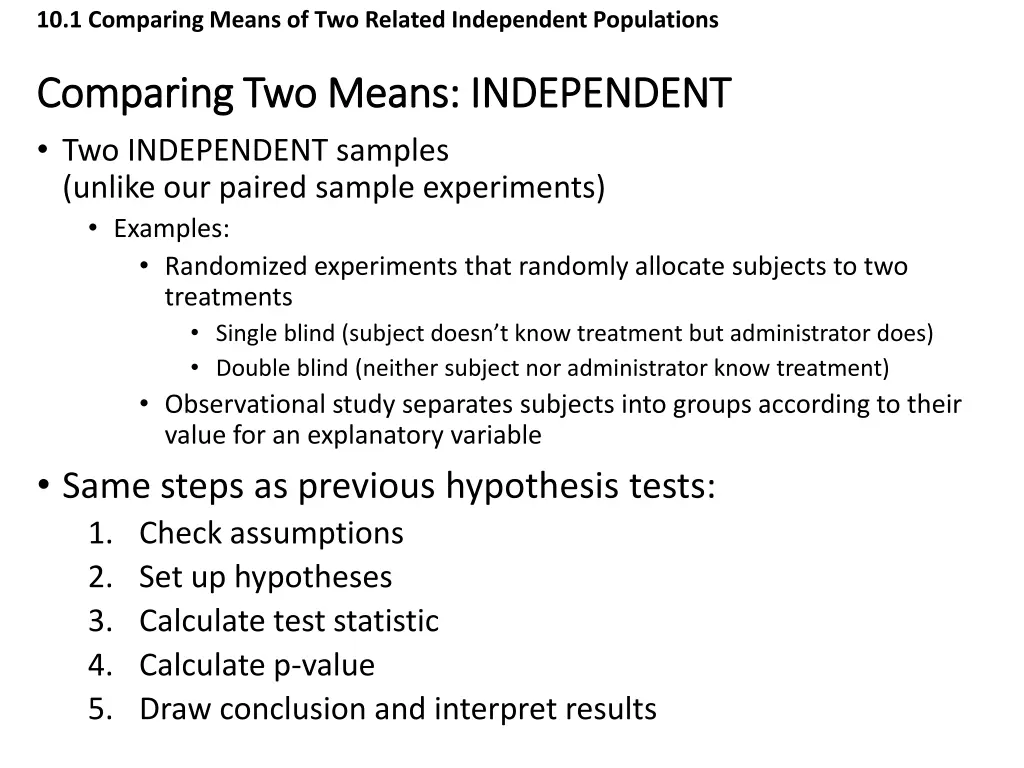
10.1 Comparing Means of Two Related Independent Populations Comparing Two Means: INDEPENDENT Comparing Two Means: INDEPENDENT Two INDEPENDENT samples (unlike our paired sample experiments) Examples: Randomized experiments that randomly allocate subjects to two treatments Single blind (subject doesn t know treatment but administrator does) Double blind (neither subject nor administrator know treatment) Observational study separates subjects into groups according to their value for an explanatory variable Same steps as previous hypothesis tests: 1. Check assumptions 2. Set up hypotheses 3. Calculate test statistic 4. Calculate p-value 5. Draw conclusion and interpret results
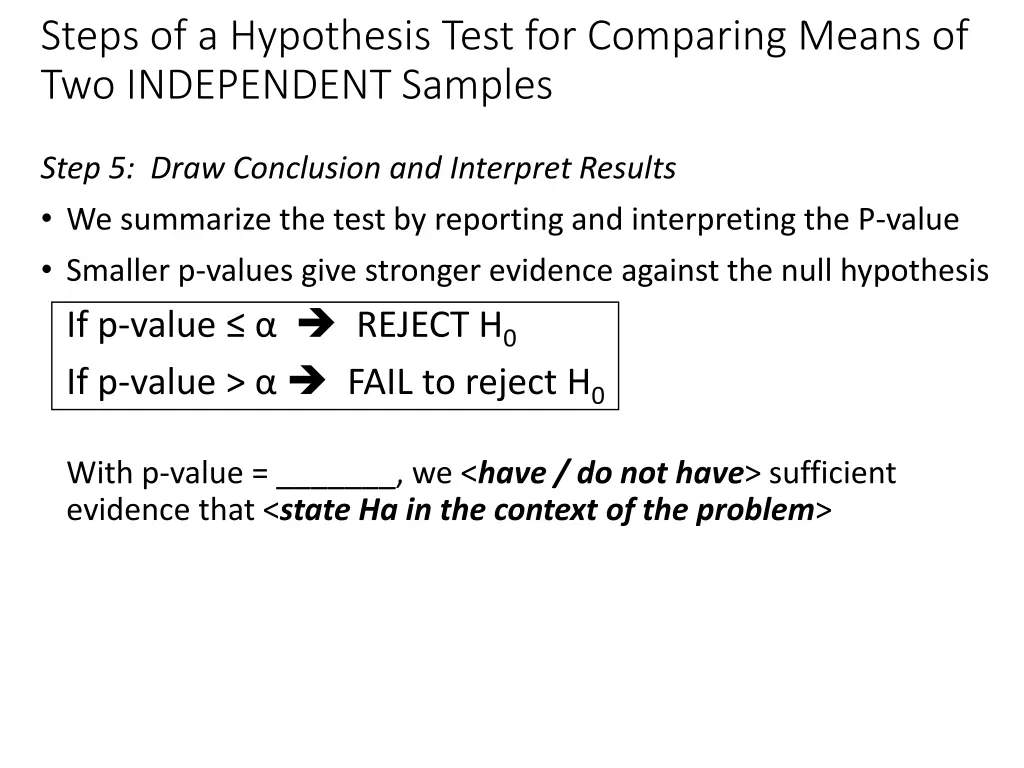
Steps of a Hypothesis Test for Comparing Means of Two INDEPENDENT Samples Step 5: Draw Conclusion and Interpret Results We summarize the test by reporting and interpreting the P-value Smaller p-values give stronger evidence against the null hypothesis If p-value REJECT H0 If p-value > FAIL to reject H0 With p-value = _______, we <have / do not have> sufficient evidence that <state Ha in the context of the problem>
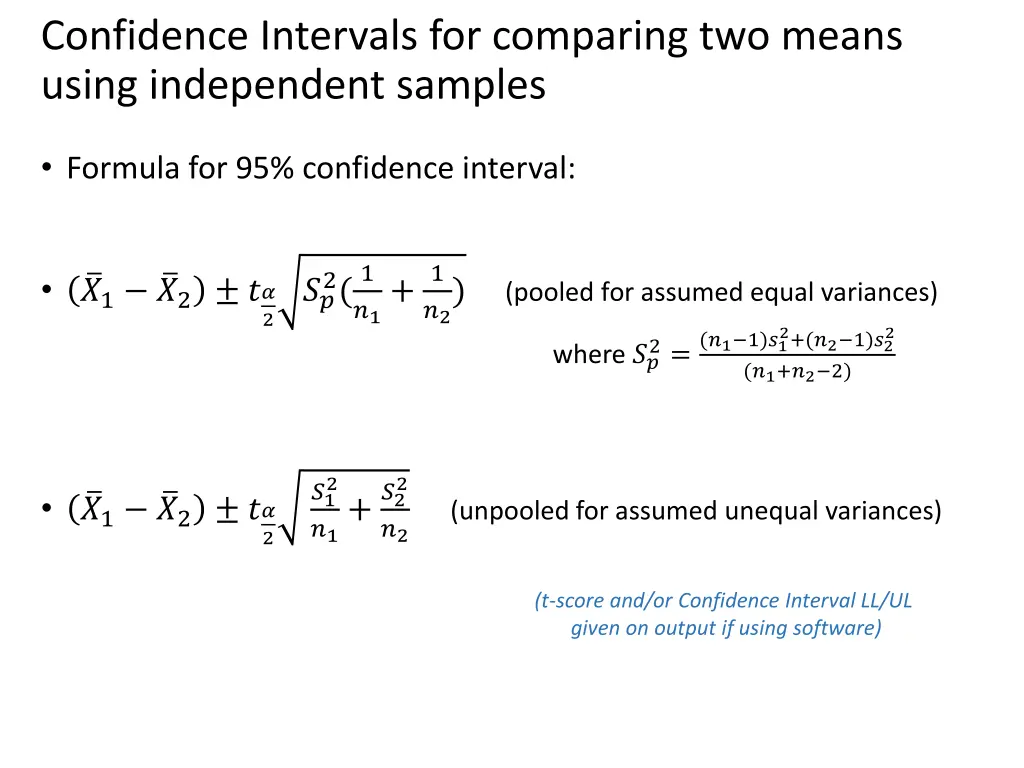
Confidence Intervals for comparing two means using independent samples Formula for 95% confidence interval: 2(1 1 ?1 ?2 ?? ?? ?1+ ?2) (pooled for assumed equal variances) 2 2+(?2 1)?2 (?1+?2 2) 2 2=(?1 1)?1 where ?? 2 2 ?1 ?1+?2 ?1 ?2 ?? ?2 (unpooled for assumed unequal variances) 2 (t-score and/or Confidence Interval LL/UL given on output if using software)
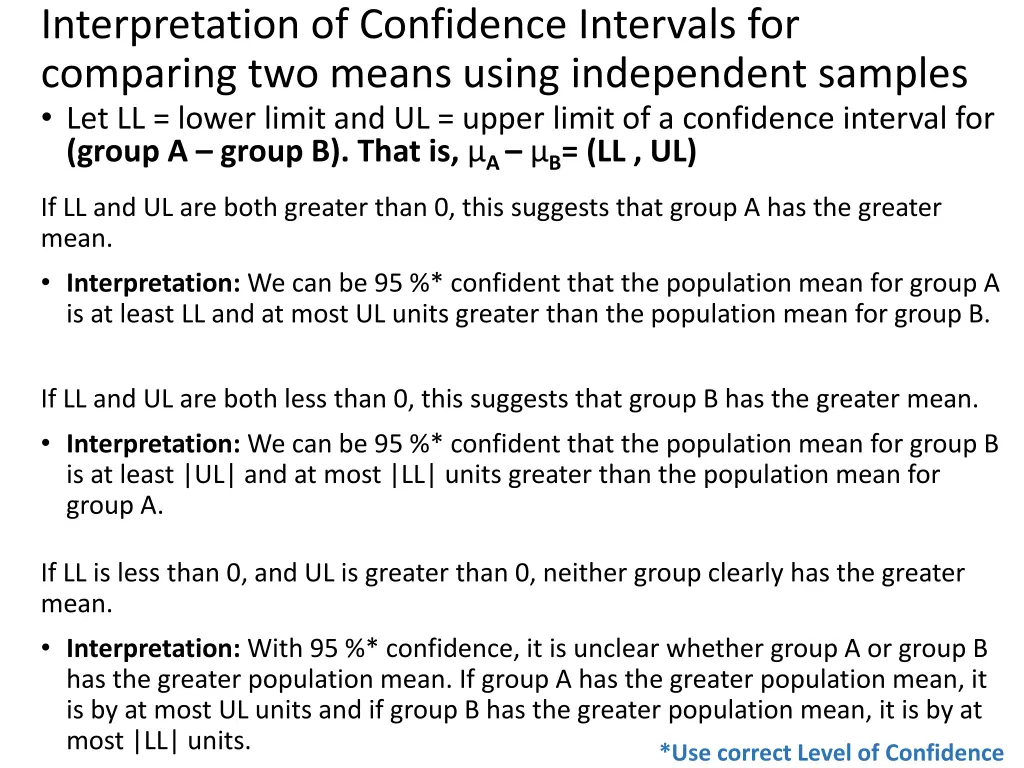
Interpretation of Confidence Intervals for comparing two means using independent samples Let LL = lower limit and UL = upper limit of a confidence interval for (group A group B). That is, A B= (LL , UL) If LL and UL are both greater than 0, this suggests that group A has the greater mean. Interpretation: We can be 95 %* confident that the population mean for group A is at least LL and at most UL units greater than the population mean for group B. If LL and UL are both less than 0, this suggests that group B has the greater mean. Interpretation: We can be 95 %* confident that the population mean for group B is at least |UL| and at most |LL| units greater than the population mean for group A. If LL is less than 0, and UL is greater than 0, neither group clearly has the greater mean. Interpretation: With 95 %* confidence, it is unclear whether group A or group B has the greater population mean. If group A has the greater population mean, it is by at most UL units and if group B has the greater population mean, it is by at most |LL| units. *Use correct Level of Confidence
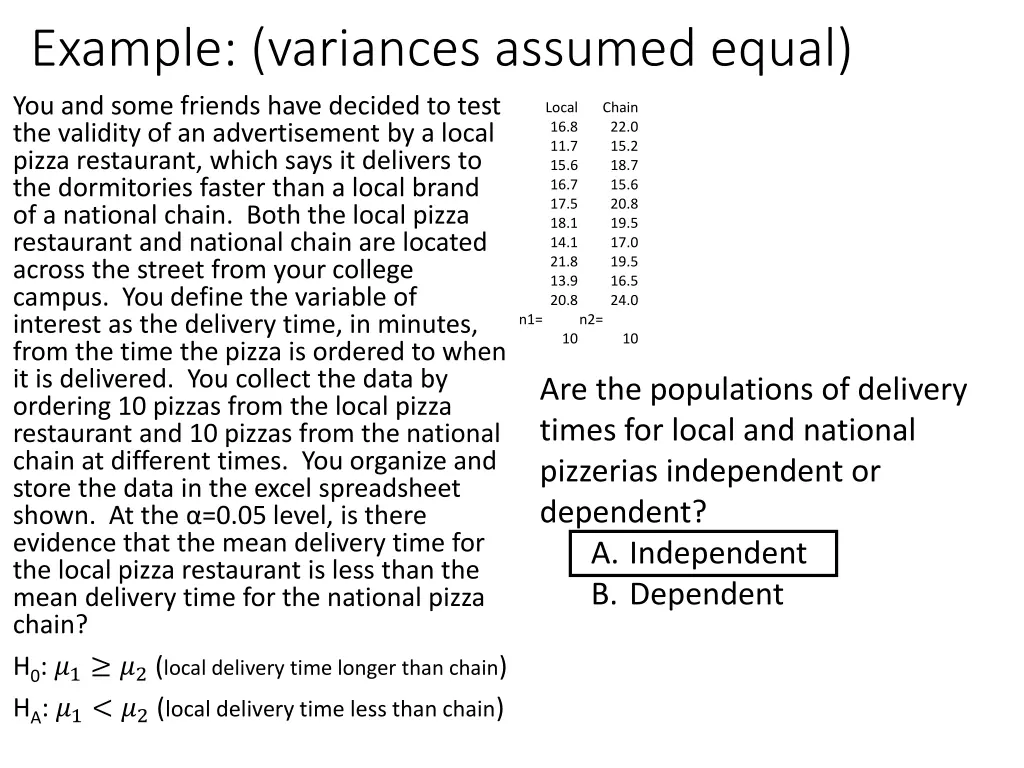
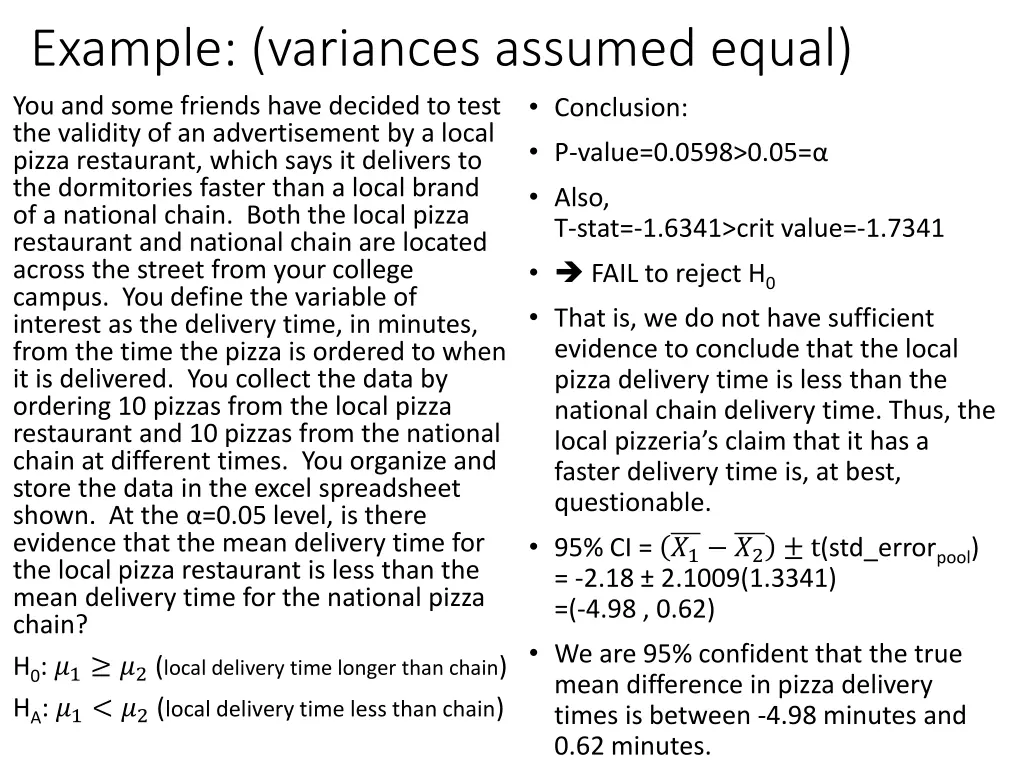
Example: (variances assumed equal) You and some friends have decided to test the validity of an advertisement by a local pizza restaurant, which says it delivers to the dormitories faster than a local brand of a national chain. Both the local pizza restaurant and national chain are located across the street from your college campus. You define the variable of interest as the delivery time, in minutes, from the time the pizza is ordered to when it is delivered. You collect the data by ordering 10 pizzas from the local pizza restaurant and 10 pizzas from the national chain at different times. You organize and store the data in the excel spreadsheet shown. At the =0.05 level, is there evidence that the mean delivery time for the local pizza restaurant is less than the mean delivery time for the national pizza chain? H0: ?1 ?2 (local delivery time longer than chain) HA: ?1< ?2 (local delivery time less than chain) Local 16.8 11.7 15.6 16.7 17.5 18.1 14.1 21.8 13.9 20.8 Chain 22.0 15.2 18.7 15.6 20.8 19.5 17.0 19.5 16.5 24.0 n1= n2= 10 10 Are the populations of delivery times for local and national pizzerias independent or dependent? A. Independent B. Dependent
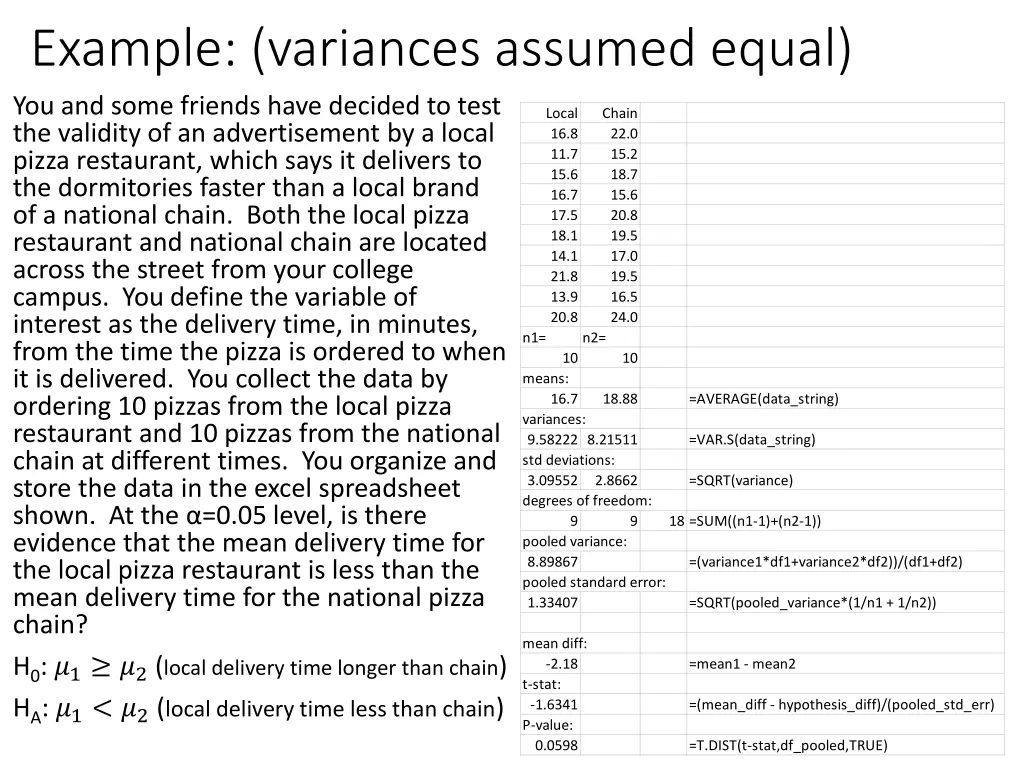
Example: (variances assumed equal) You and some friends have decided to test the validity of an advertisement by a local pizza restaurant, which says it delivers to the dormitories faster than a local brand of a national chain. Both the local pizza restaurant and national chain are located across the street from your college campus. You define the variable of interest as the delivery time, in minutes, from the time the pizza is ordered to when it is delivered. You collect the data by ordering 10 pizzas from the local pizza restaurant and 10 pizzas from the national chain at different times. You organize and store the data in the excel spreadsheet shown. At the =0.05 level, is there evidence that the mean delivery time for the local pizza restaurant is less than the mean delivery time for the national pizza chain? H0: ?1 ?2 (local delivery time longer than chain) HA: ?1< ?2 (local delivery time less than chain) Local 16.8 11.7 15.6 16.7 17.5 18.1 14.1 21.8 13.9 20.8 Chain 22.0 15.2 18.7 15.6 20.8 19.5 17.0 19.5 16.5 24.0 n1= n2= 10 10 means: 16.7 18.88 =AVERAGE(data_string) variances: 9.58222 8.21511 std deviations: 3.09552 degrees of freedom: 9 pooled variance: 8.89867 pooled standard error: 1.33407 =VAR.S(data_string) 2.8662 =SQRT(variance) 9 18 =SUM((n1-1)+(n2-1)) =(variance1*df1+variance2*df2))/(df1+df2) =SQRT(pooled_variance*(1/n1 + 1/n2)) mean diff: -2.18 t-stat: -1.6341 P-value: 0.0598 =mean1 - mean2 =(mean_diff - hypothesis_diff)/(pooled_std_err) =T.DIST(t-stat,df_pooled,TRUE)
Example: (variances assumed equal) You and some friends have decided to test the validity of an advertisement by a local pizza restaurant, which says it delivers to the dormitories faster than a local brand of a national chain. Both the local pizza restaurant and national chain are located across the street from your college campus. You define the variable of interest as the delivery time, in minutes, from the time the pizza is ordered to when it is delivered. You collect the data by ordering 10 pizzas from the local pizza restaurant and 10 pizzas from the national chain at different times. You organize and store the data in the excel spreadsheet shown. At the =0.05 level, is there evidence that the mean delivery time for the local pizza restaurant is less than the mean delivery time for the national pizza chain? H0: ?1 ?2 (local delivery time longer than chain) HA: ?1< ?2 (local delivery time less than chain) Conclusion: P-value=0.0598>0.05= Also, T-stat=-1.6341>crit value=-1.7341 FAIL to reject H0 That is, we do not have sufficient evidence to conclude that the local pizza delivery time is less than the national chain delivery time. Thus, the local pizzeria s claim that it has a faster delivery time is, at best, questionable. 95% CI = ?1 ?2 t(std_errorpool) = -2.18 2.1009(1.3341) =(-4.98 , 0.62) We are 95% confident that the true mean difference in pizza delivery times is between -4.98 minutes and 0.62 minutes.
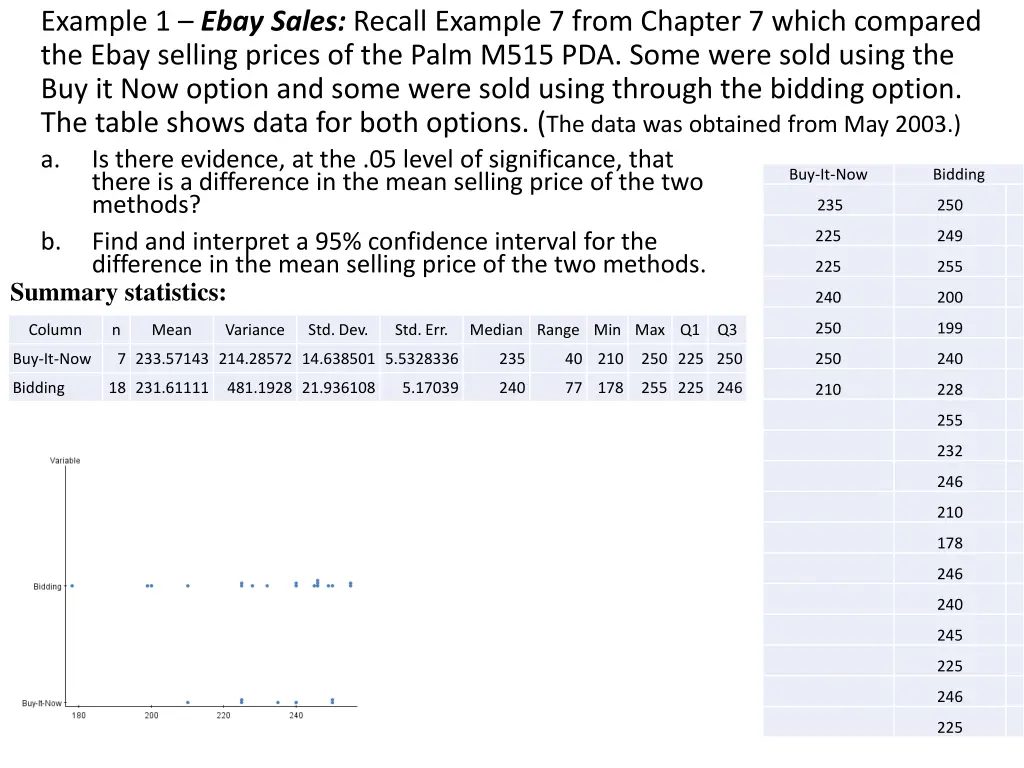
Example 1 Ebay Sales: Recall Example 7 from Chapter 7 which compared the Ebay selling prices of the Palm M515 PDA. Some were sold using the Buy it Now option and some were sold using through the bidding option. The table shows data for both options. (The data was obtained from May 2003.) Is there evidence, at the .05 level of significance, that there is a difference in the mean selling price of the two methods? Find and interpret a 95% confidence interval for the difference in the mean selling price of the two methods. Summary statistics: a. Buy-It-Now Bidding 235 250 225 249 b. 225 255 240 200 250 199 Column n Mean Variance Std. Dev. Std. Err. Median Range Min Max Q1 Q3 250 240 Buy-It-Now 7 233.57143 214.28572 14.638501 5.5328336 235 40 210 250 225 250 Bidding 18 231.61111 481.1928 21.936108 5.17039 240 77 178 255 225 246 210 228 255 232 246 210 178 246 240 245 225 246 225
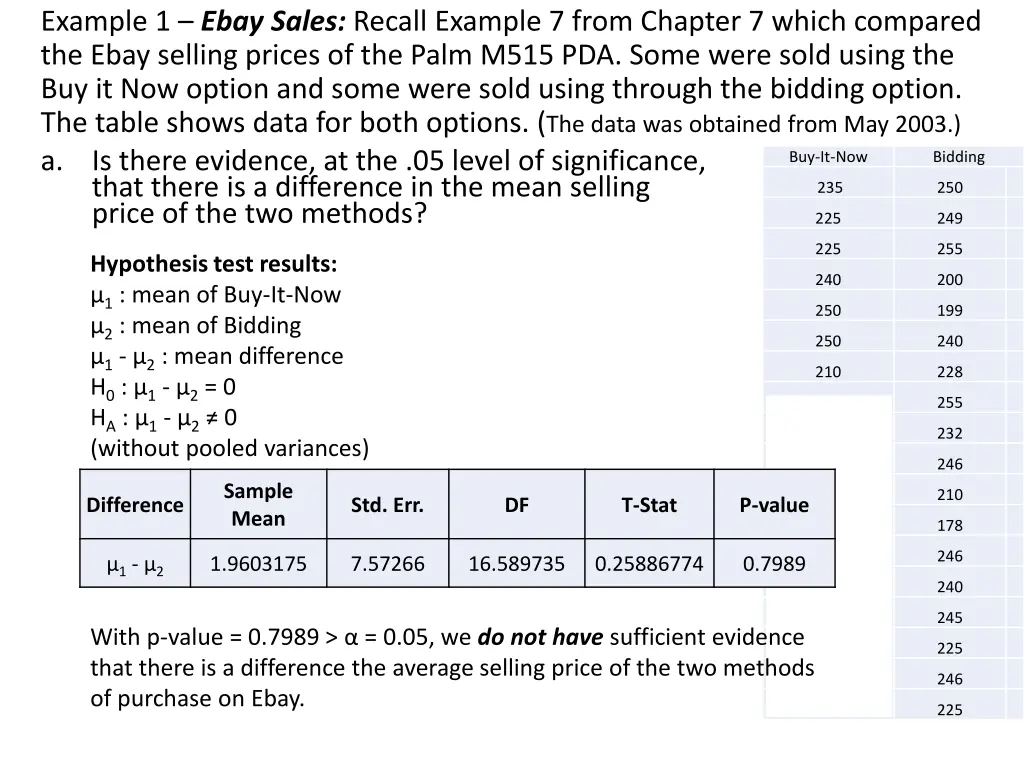
Example 1 Ebay Sales: Recall Example 7 from Chapter 7 which compared the Ebay selling prices of the Palm M515 PDA. Some were sold using the Buy it Now option and some were sold using through the bidding option. The table shows data for both options. (The data was obtained from May 2003.) a. Is there evidence, at the .05 level of significance, that there is a difference in the mean selling price of the two methods? Buy-It-Now Bidding 235 250 225 249 225 255 Hypothesis test results: 1 : mean of Buy-It-Now 2 : mean of Bidding 1 - 2 : mean difference H0: 1 - 2 = 0 HA: 1 - 2 0 (without pooled variances) 240 200 250 199 250 240 210 228 255 232 246 Sample Mean 210 Difference Std. Err. DF T-Stat P-value 178 246 1 - 2 1.9603175 7.57266 16.589735 0.25886774 0.7989 240 245 With p-value = 0.7989 > = 0.05, we do not have sufficient evidence that there is a difference the average selling price of the two methods of purchase on Ebay. 225 246 225
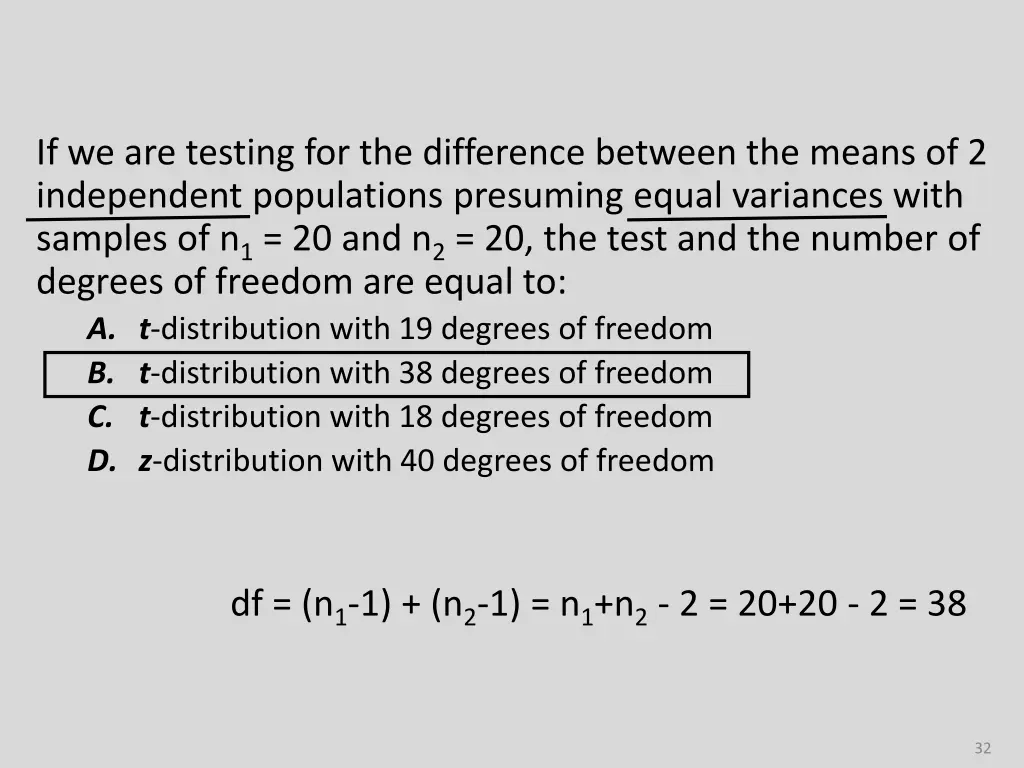
If we are testing for the difference between the means of 2 independent populations presuming equal variances with samples of n1 = 20 and n2 = 20, the test and the number of degrees of freedom are equal to: A. t-distribution with 19 degrees of freedom B. t-distribution with 38 degrees of freedom C. t-distribution with 18 degrees of freedom D. z-distribution with 40 degrees of freedom df = (n1-1) + (n2-1) = n1+n2 - 2 = 20+20 - 2 = 38 32
Review Methods to combine the variances: If those variances are UNEQUAL UNPOOLED (df calculated via Welch-Satterthwaite) If variances are EQUAL POOLED (df = ?1+ ?2 2) Some sources point to the following Rule of Thumb: If the larger sample standard deviation is MORE THAN twice the smaller sample standard deviation then perform the t-test using the UNPOOLED method. Two INDEPENDENT samples hypothesis tests: 1. Check assumptions 2. Set up hypotheses 3. Calculate test statistic 4. Calculate p-value 5. Draw conclusion and interpret results Two INDEPENDENT samples Confidence Intervals: +1 ?2) 2 2 2(1 ?1 ?1 +?2 ?1 ?2 ?? ?1 ?2 ?? ?? ?1 ?2 2 2 (pooled for assumed equal variances) (unpooled for assumed unequal variances)
10.3 Comparing Proportions of Two Related Independent Populations Comparing two proportions Comparing two proportions Same steps as previous hypothesis tests: 1. Check assumptions 2. Set up hypotheses 3. Calculate test statistic 4. Calculate p-value 5. Draw conclusion and interpret results
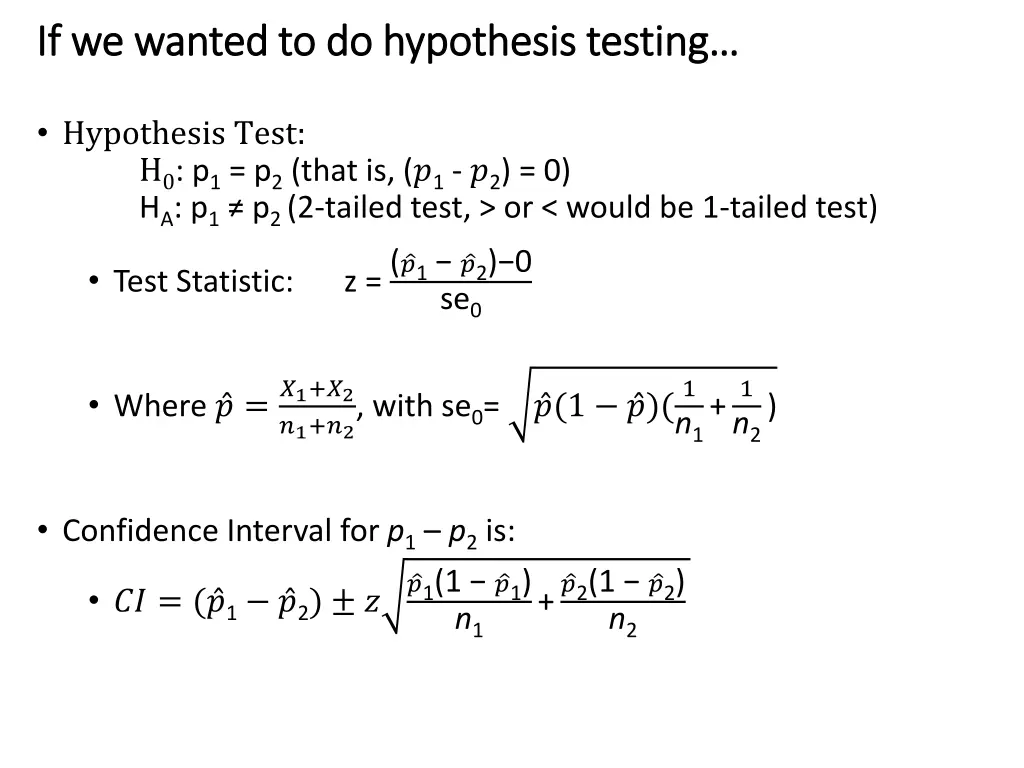
If we wanted to do hypothesis testing If we wanted to do hypothesis testing Hypothesis Test: H0: p1 = p2 (that is, (?1 - ?2) = 0) HA: p1 p2 (2-tailed test, > or < would be 1-tailed test) z = ( ?1 ?2) 0 se0 Test Statistic: Where ? =?1+?2 ?(1 ?)(1 1 ?1+?2, with se0= n1+ n2) Confidence Interval for p1 p2 is: ?1(1 ?1) n1 ?2(1 ?2) n2 ?? = ( ?1 ?2) ? +
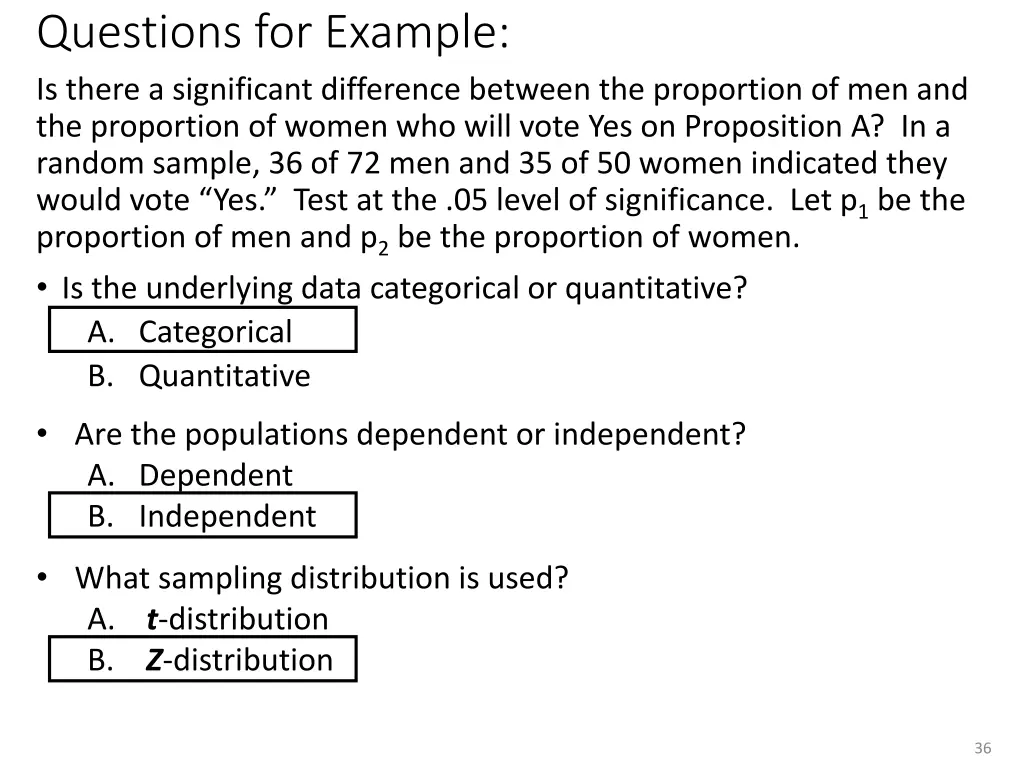
Questions for Example: Is there a significant difference between the proportion of men and the proportion of women who will vote Yes on Proposition A? In a random sample, 36 of 72 men and 35 of 50 women indicated they would vote Yes. Test at the .05 level of significance. Let p1 be the proportion of men and p2 be the proportion of women. Is the underlying data categorical or quantitative? A. Categorical B. Quantitative Are the populations dependent or independent? A. Dependent B. Independent What sampling distribution is used? A. t-distribution B. Z-distribution 36
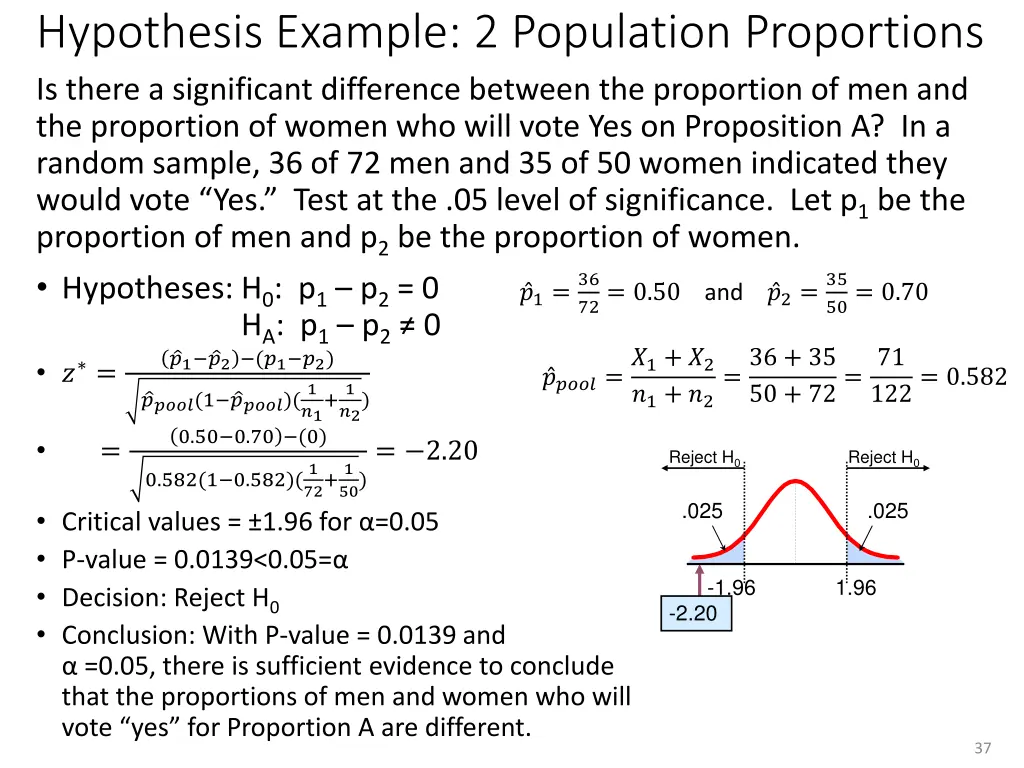
Hypothesis Example: 2 Population Proportions Is there a significant difference between the proportion of men and the proportion of women who will vote Yes on Proposition A? In a random sample, 36 of 72 men and 35 of 50 women indicated they would vote Yes. Test at the .05 level of significance. Let p1 be the proportion of men and p2 be the proportion of women. Hypotheses: H0: p1 p2 = 0 HA: p1 p2 0 ? = ?????(1 ?????)(1 ?2) = 0.582(1 0.582)(1 50) Critical values = 1.96 for =0.05 P-value = 0.0139<0.05= Decision: Reject H0 Conclusion: With P-value = 0.0139 and =0.05, there is sufficient evidence to conclude that the proportions of men and women who will vote yes for Proportion A are different. ?1=36 72= 0.50 and ?2=35 50= 0.70 ?????=?1+ ?2 =36 + 35 50 + 72= 71 122= 0.582 ?1 ?2 (?1 ?2) ?1+1 ?1+ ?2 0.50 0.70 (0) = 2.20 Reject H0 Reject H0 72+1 .025 .025 -1.96 1.96 -2.20 37
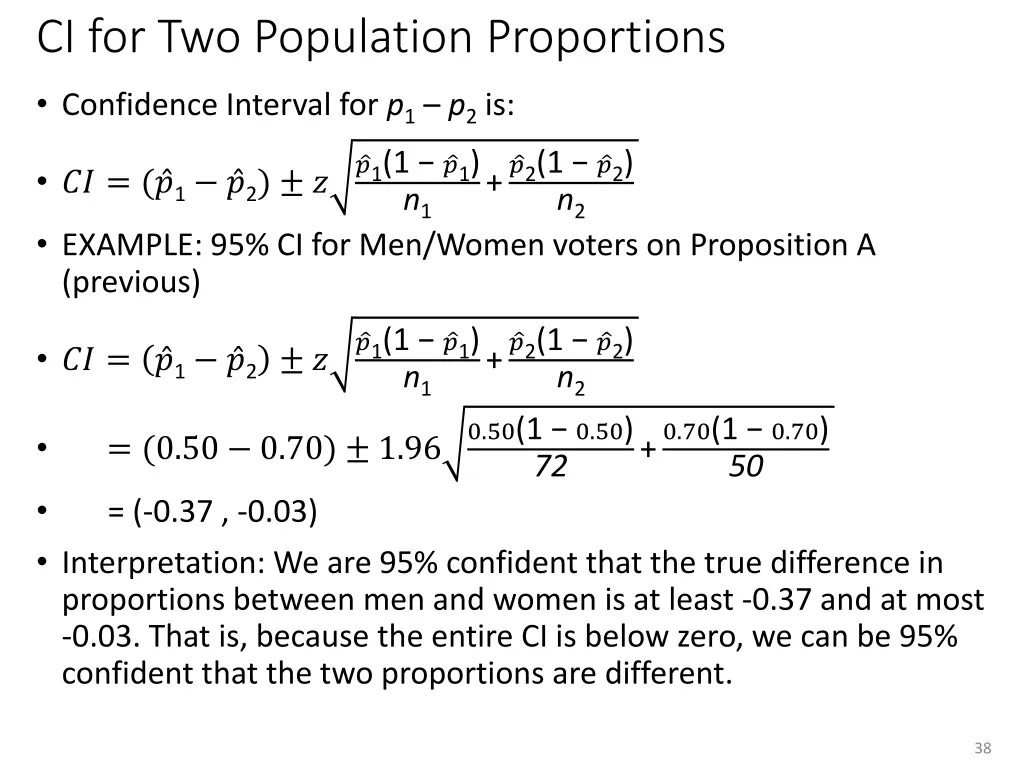
CI for Two Population Proportions Confidence Interval for p1 p2 is: ?1(1 ?1) n1 ?2(1 ?2) n2 ?? = ( ?1 ?2) ? + EXAMPLE: 95% CI for Men/Women voters on Proposition A (previous) ?1(1 ?1) n1 ?2(1 ?2) n2 0.50(1 0.50) 72 ?? = ?1 ?2 ? + +0.70(1 0.70) 50 = (0.50 0.70) 1.96 = (-0.37 , -0.03) Interpretation: We are 95% confident that the true difference in proportions between men and women is at least -0.37 and at most -0.03. That is, because the entire CI is below zero, we can be 95% confident that the two proportions are different. 38