GDP by Production Approach

This content covers topics such as measuring gross output, computing gross value added, and analyzing the output of primary industries. It explains how to assess physical output, input costs, and value added in different economic sectors. The methodology for evaluating crops and non-market goods is also discussed.

Download Presentation

Please find below an Image/Link to download the presentation.
The content on the website is provided AS IS for your information and personal use only. It may not be sold, licensed, or shared on other websites without obtaining consent from the author.If you encounter any issues during the download, it is possible that the publisher has removed the file from their server.
You are allowed to download the files provided on this website for personal or commercial use, subject to the condition that they are used lawfully. All files are the property of their respective owners.
The content on the website is provided AS IS for your information and personal use only. It may not be sold, licensed, or shared on other websites without obtaining consent from the author.
E N D
Presentation Transcript
Lecture 3. GDP by Production Approach 1 1
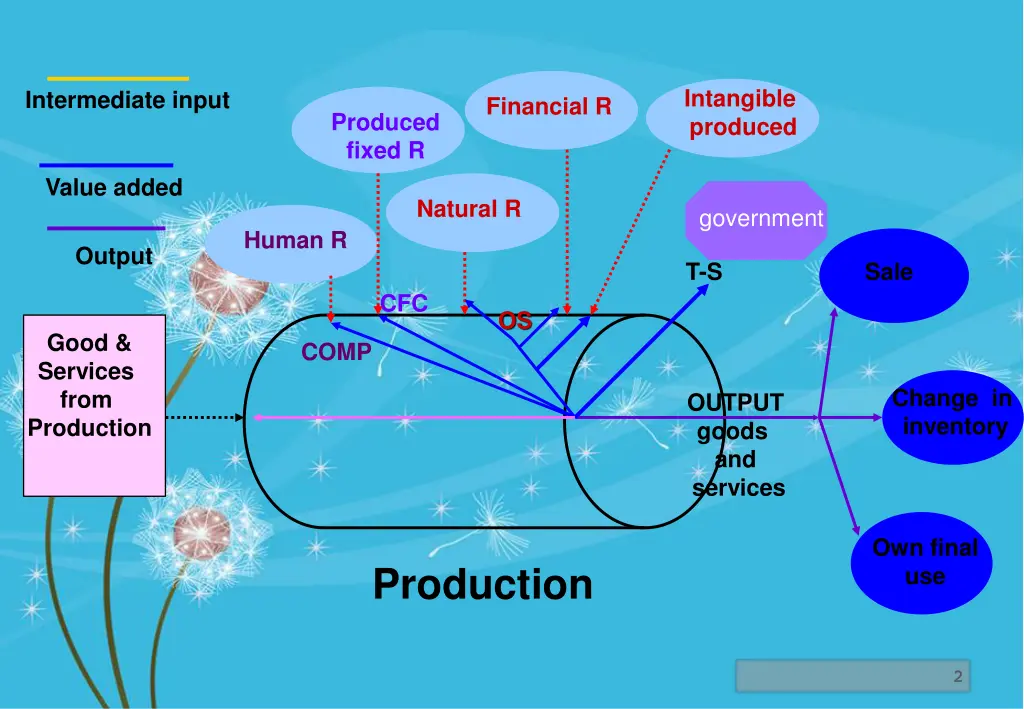
Intangible produced Intermediate input Financial R Produced fixed R Value added Natural R government Human R Output T-S Sale CFC OS Good & Services from Production COMP Change in inventory OUTPUT goods and services Own final use Production 2 2
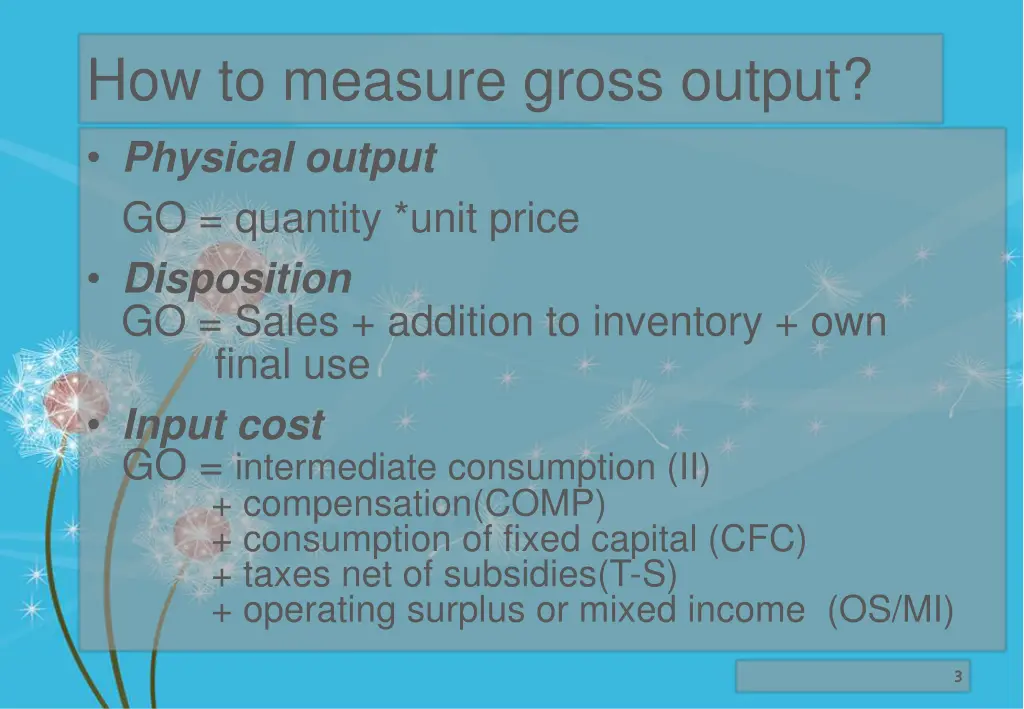
How to measure gross output? Physical output GO = quantity *unit price Disposition GO = Sales + addition to inventory + own final use Input cost GO = intermediate consumption (II) + compensation(COMP) + consumption of fixed capital (CFC) + taxes net of subsidies(T-S) + operating surplus or mixed income (OS/MI) 3 3
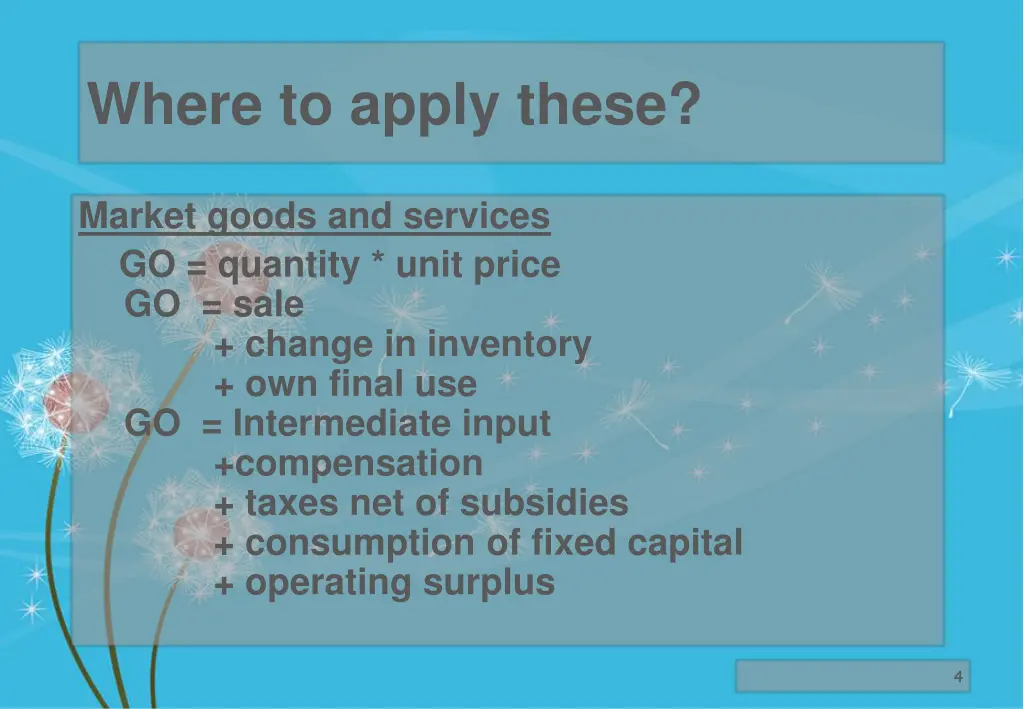
Where to apply these? Market goods and services GO = quantity * unit price GO = sale + change in inventory + own final use GO = Intermediate input +compensation + taxes net of subsidies + consumption of fixed capital + operating surplus 4 4
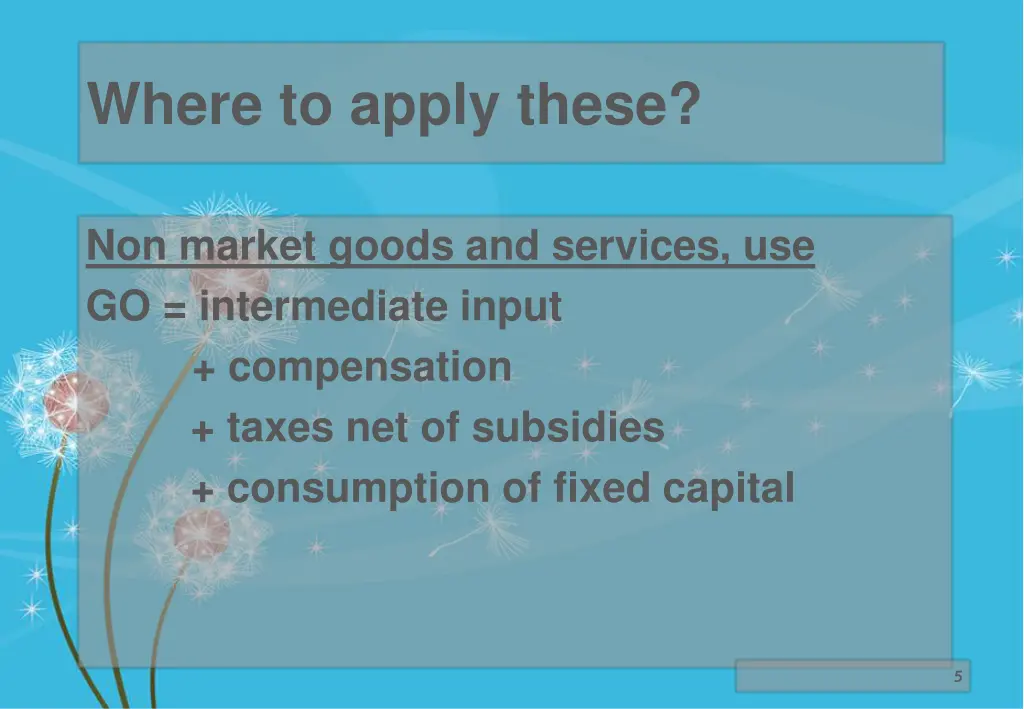
Where to apply these? Non market goods and services, use GO = intermediate input + compensation + taxes net of subsidies + consumption of fixed capital 5 5
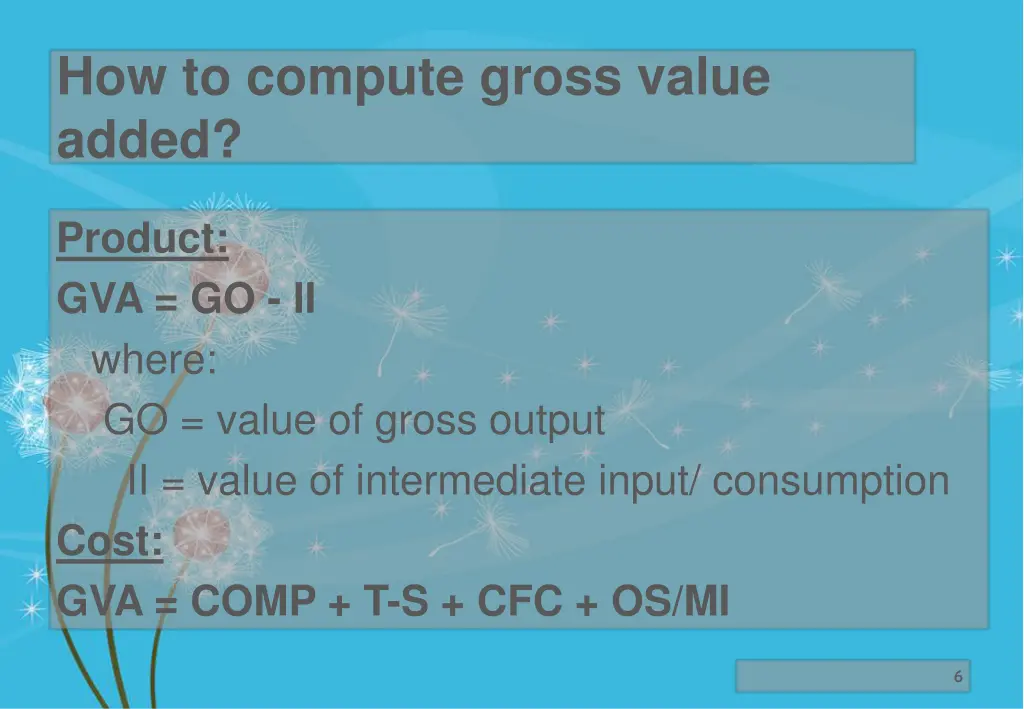
How to compute gross value added? Product: GVA = GO - II where: GO = value of gross output II = value of intermediate input/ consumption Cost: GVA = COMP + T-S + CFC + OS/MI 6 6
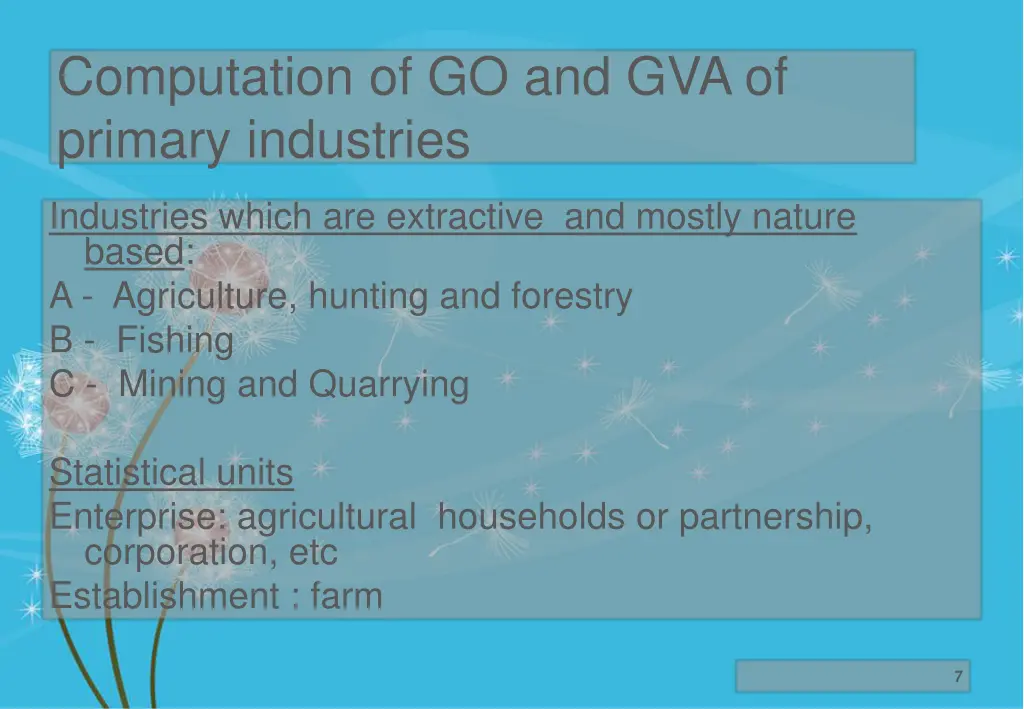
Computation of GO and GVA of primary industries Industries which are extractive and mostly nature based: A - Agriculture, hunting and forestry B - Fishing C - Mining and Quarrying Statistical units Enterprise: agricultural households or partnership, corporation, etc Establishment : farm 7 7
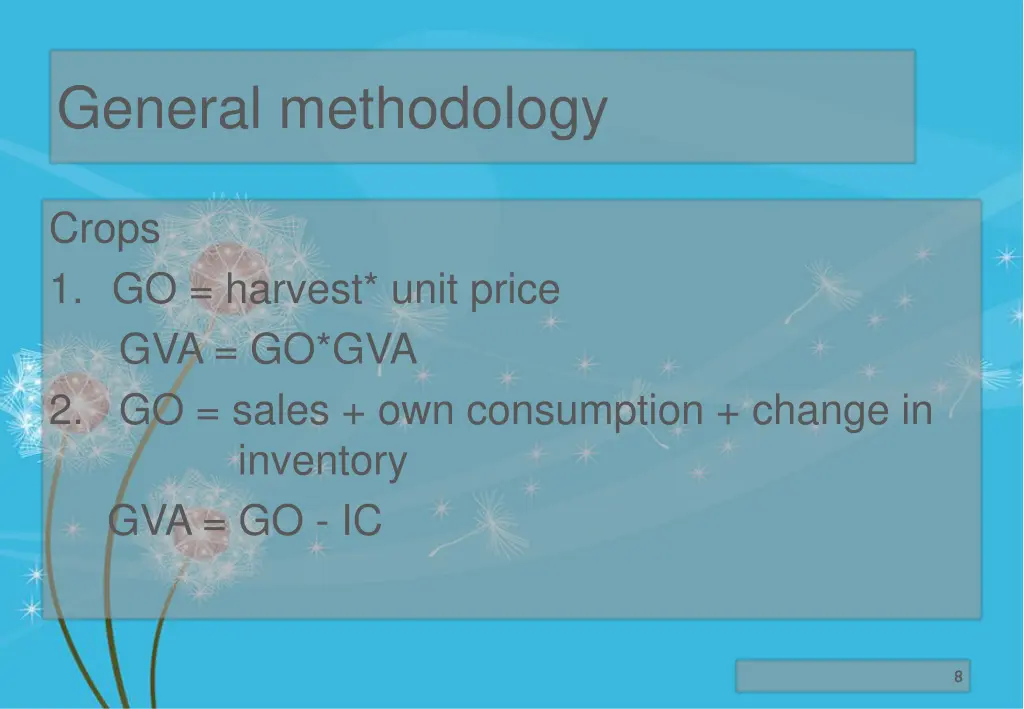
General methodology Crops 1. GO = harvest* unit price GVA = GO*GVA 2. GO = sales + own consumption + change in inventory GVA = GO - IC 8 8
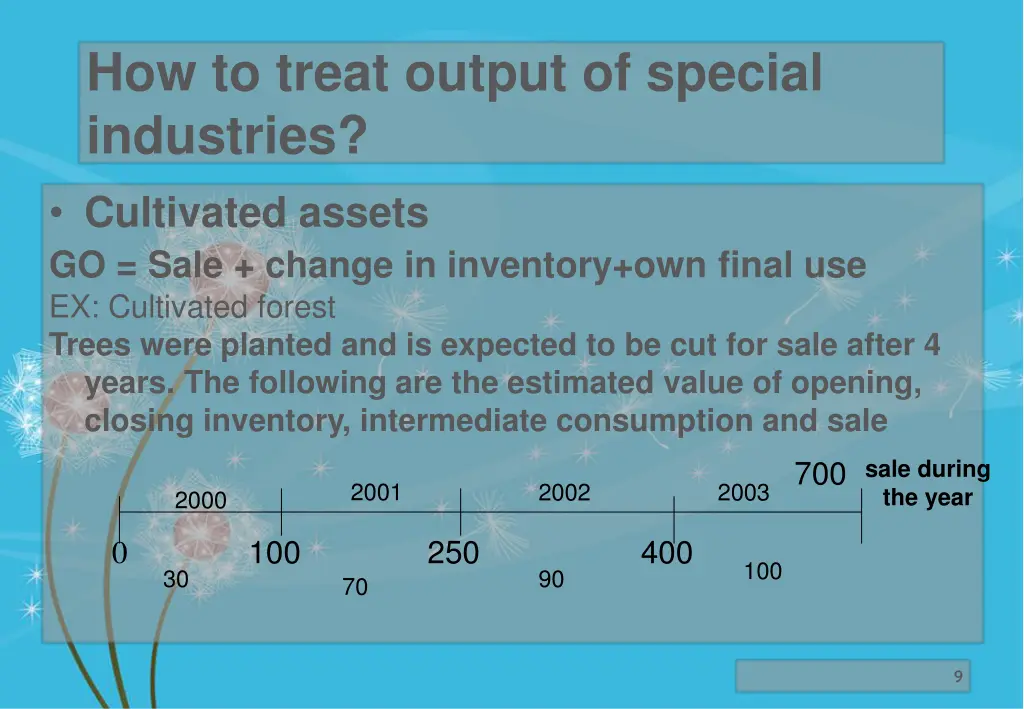
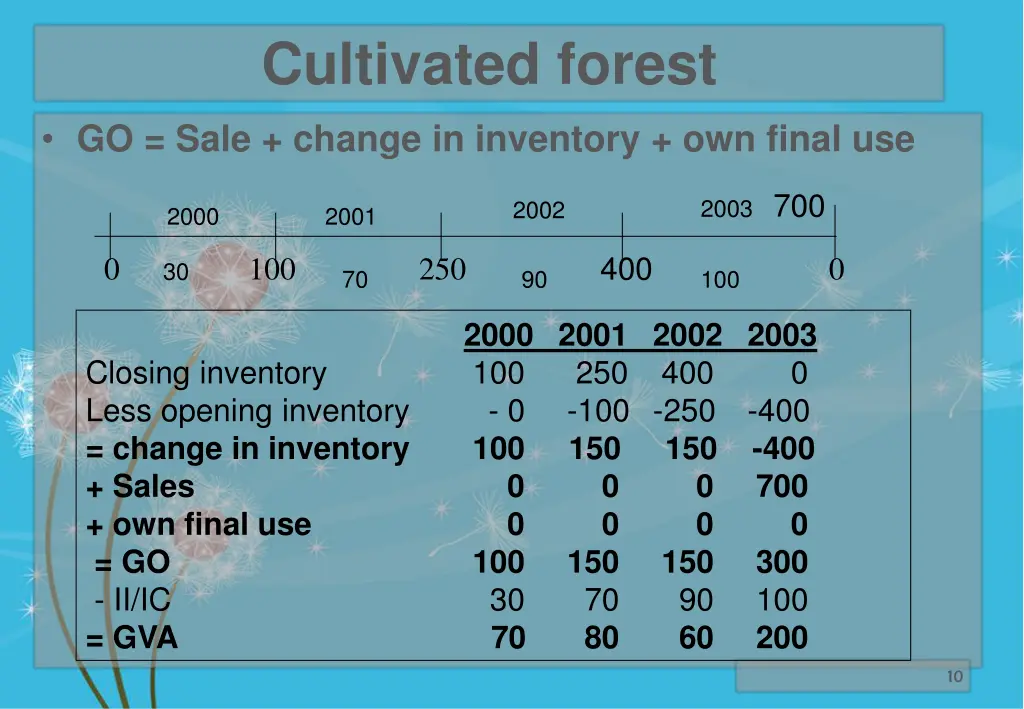
How to treat output of special industries? Cultivated assets GO = Sale + change in inventory+own final use EX: Cultivated forest Treeswere planted and is expected to be cut for sale after 4 years. The following are the estimated value of opening, closing inventory, intermediate consumption and sale 700sale during the year 2001 2002 2003 2000 100 250 400 0 100 90 30 70 9 9
Cultivated forest GO = Sale + change in inventory + own final use 700 2003 2002 2000 2001 400 0 100 250 0 30 70 90 100 2000 2001 2002 2003 100 250 400 0 Closing inventory Less opening inventory - 0 -100 -250 -400 = change in inventory + Sales + own final use = GO - II/IC = GVA 70 80 60 200 100 150 150 -400 0 0 0 700 0 0 0 0 100 150 150 300 30 70 90 100 10 10
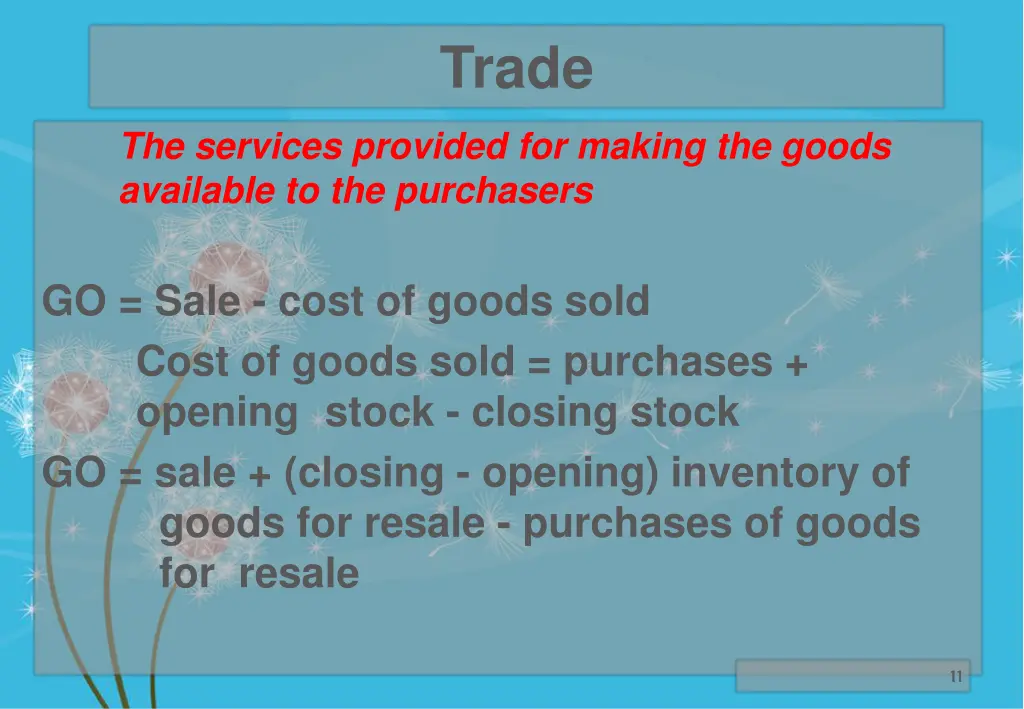
Trade The services provided for making the goods available to the purchasers GO = Sale - cost of goods sold Cost of goods sold = purchases + opening stock - closing stock GO = sale + (closing - opening) inventory of goods for resale - purchases of goods for resale 11 11
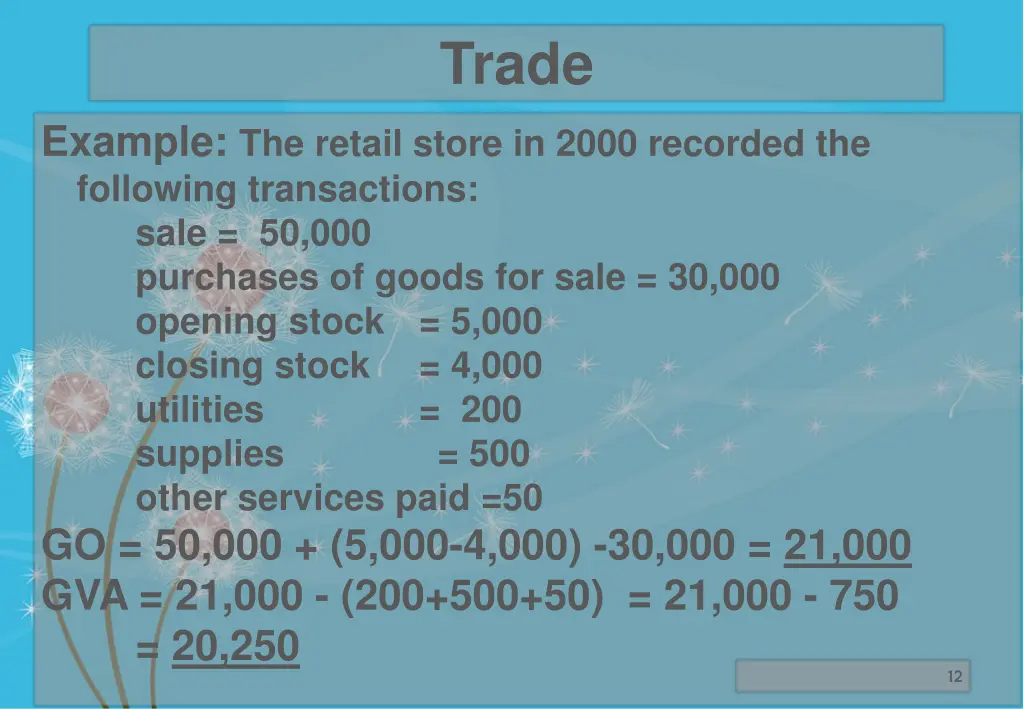
Trade Example: The retail store in 2000 recorded the following transactions: sale = 50,000 purchases of goods for sale = 30,000 opening stock = 5,000 closing stock = 4,000 utilities = 200 supplies = 500 other services paid =50 GO = 50,000 + (5,000-4,000) -30,000 = 21,000 GVA = 21,000 - (200+500+50) = 21,000 - 750 = 20,250 12 12
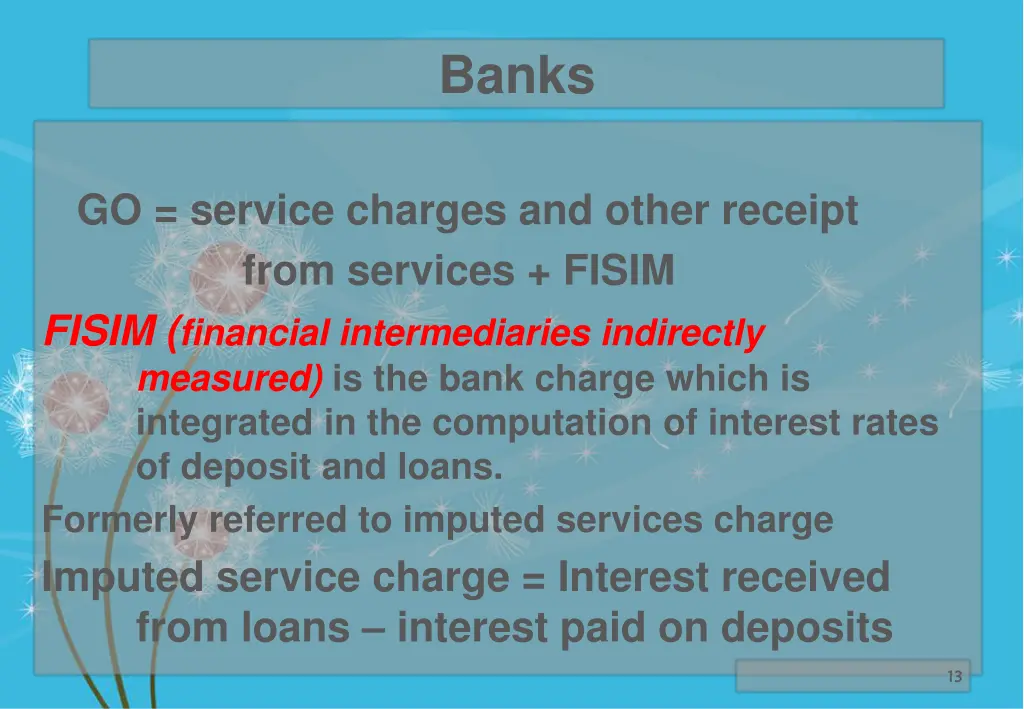
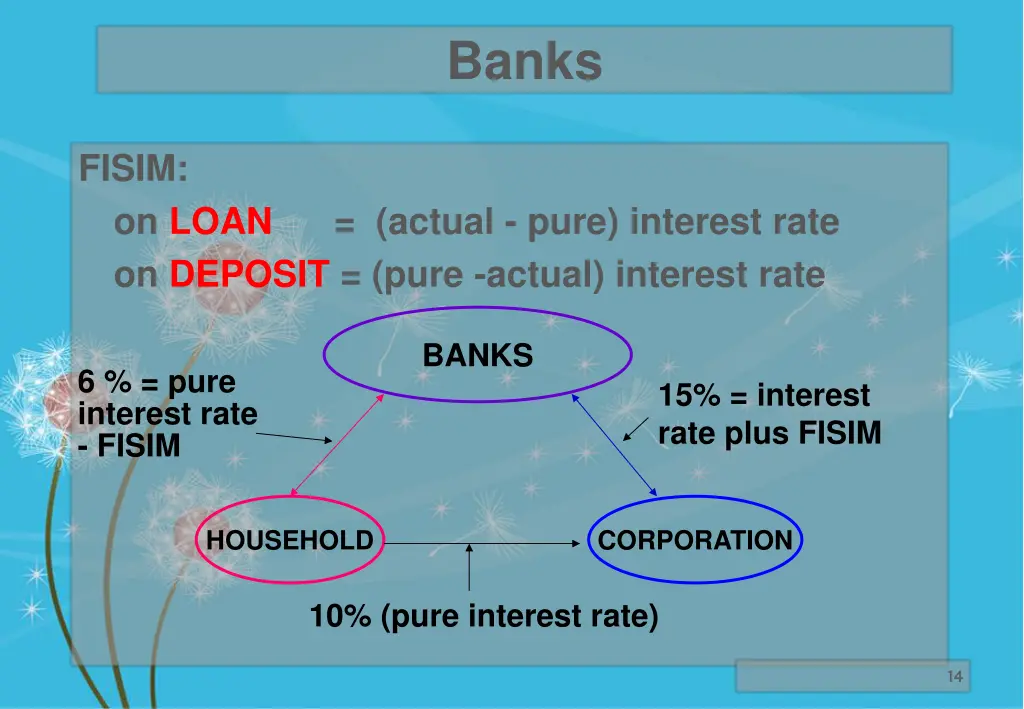
Banks GO = service charges and other receipt from services + FISIM FISIM (financial intermediaries indirectly measured) is the bank charge which is integrated in the computation of interest rates of deposit and loans. Formerly referred to imputed services charge Imputed service charge = Interest received from loans interest paid on deposits 13 13
Banks FISIM: on LOAN = (actual - pure) interest rate on DEPOSIT = (pure -actual) interest rate BANKS 6 % = pure interest rate - FISIM 15% = interest rate plus FISIM HOUSEHOLD CORPORATION 10% (pure interest rate) 14 14
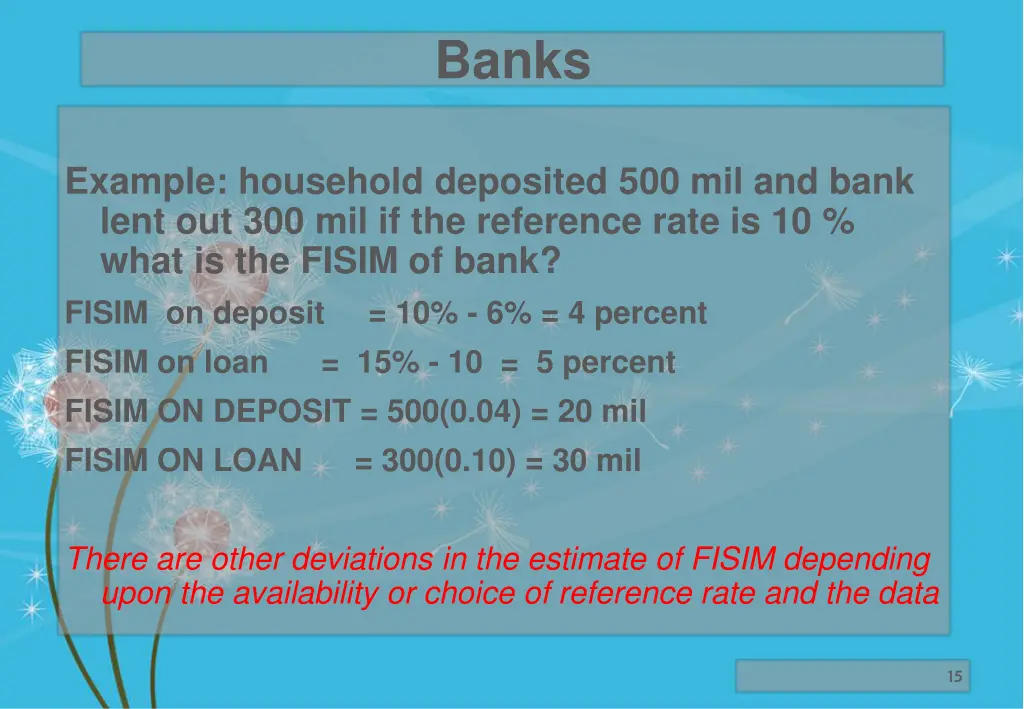
Banks Example: household deposited 500 mil and bank lent out 300 mil if the reference rate is 10 % what is the FISIM of bank? FISIM on deposit = 10% - 6% = 4 percent FISIM on loan = 15% - 10 = 5 percent FISIM ON DEPOSIT = 500(0.04) = 20 mil FISIM ON LOAN = 300(0.10) = 30 mil There are other deviations in the estimate of FISIM depending upon the availability or choice of reference rate and the data 15 15
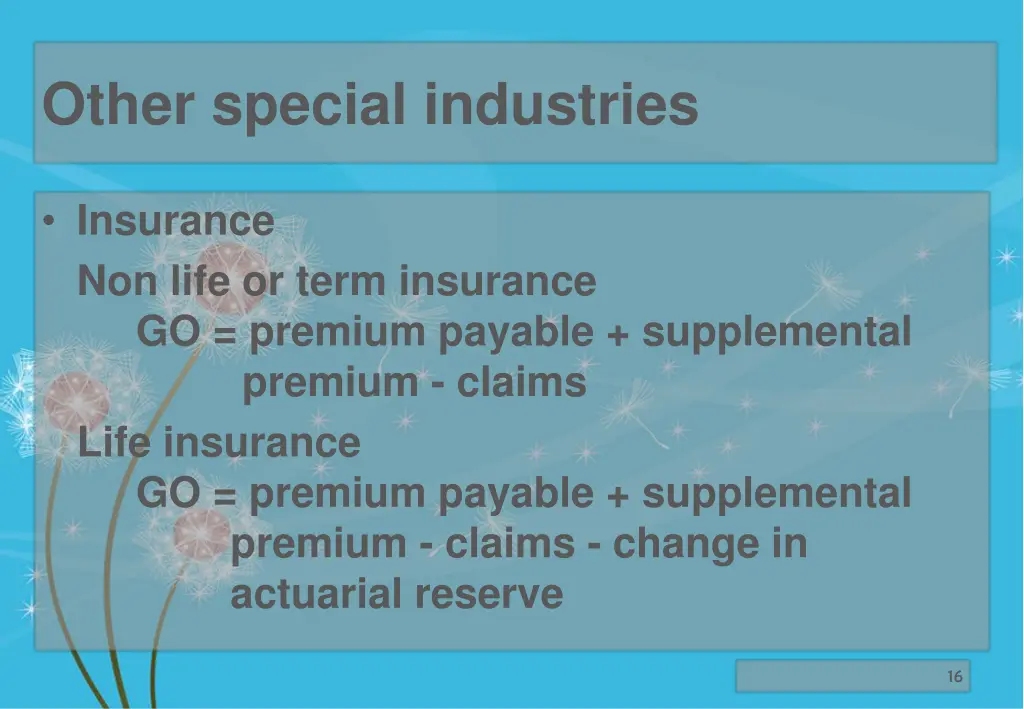
Other special industries Insurance Non life or term insurance GO = premium payable + supplemental premium - claims Life insurance GO = premium payable + supplemental premium - claims - change in actuarial reserve 16 16
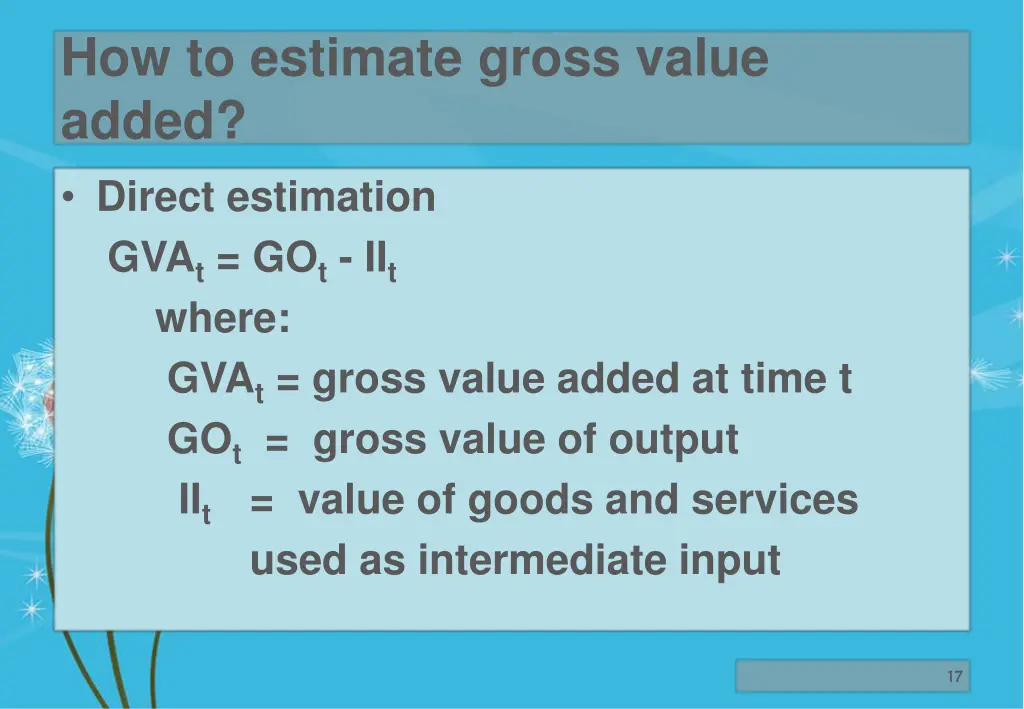
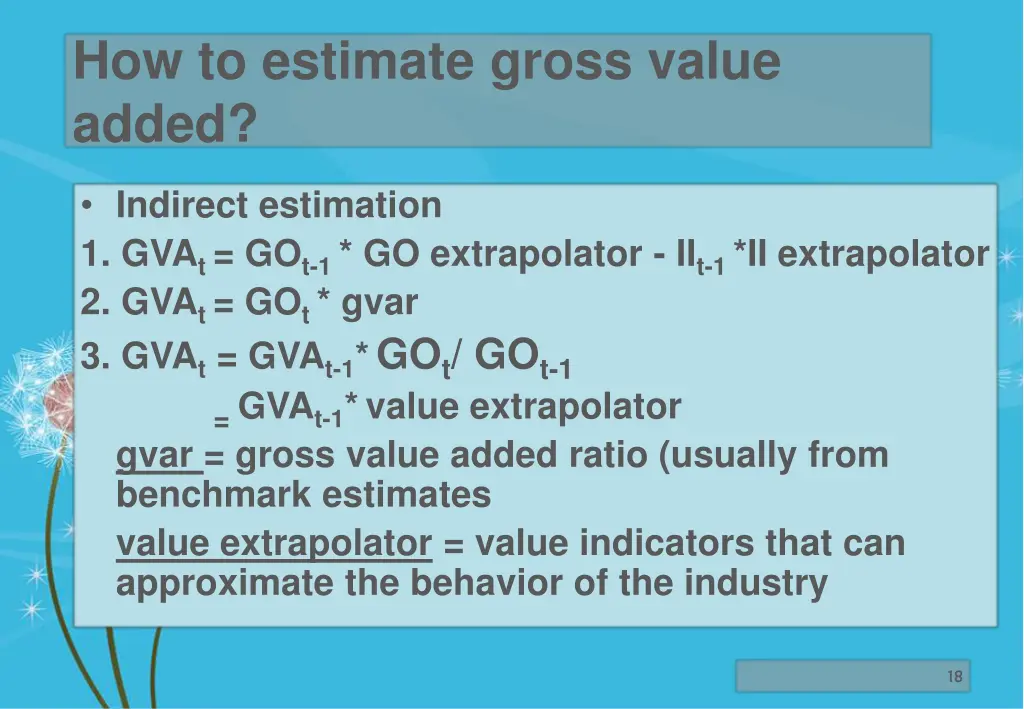
How to estimate gross value added? Direct estimation GVAt = GOt - IIt where: GVAt = gross value added at time t GOt = gross value of output IIt = value of goods and services used as intermediate input 17 17
How to estimate gross value added? Indirect estimation 1. GVAt = GOt-1 * GO extrapolator - IIt-1 *II extrapolator 2. GVAt = GOt * gvar 3. GVAt = GVAt-1*GOt/ GOt-1 = GVAt-1*value extrapolator gvar = gross value added ratio (usually from benchmark estimates value extrapolator = value indicators that can approximate the behavior of the industry 18 18
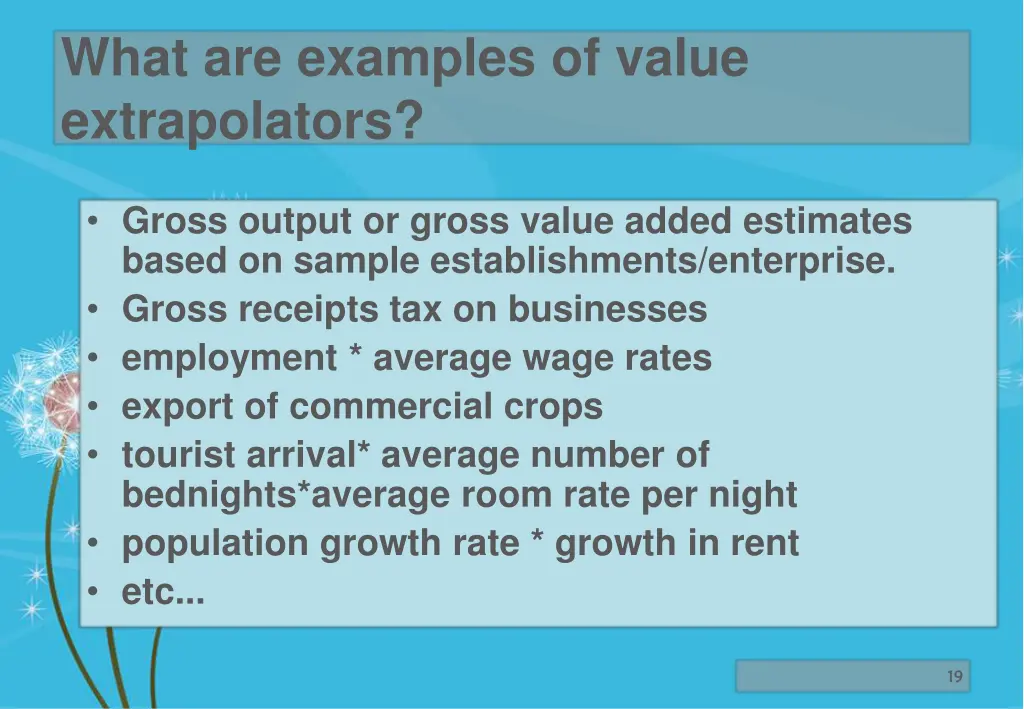
What are examples of value extrapolators? Gross output or gross value added estimates based on sample establishments/enterprise. Gross receipts tax on businesses employment * average wage rates export of commercial crops tourist arrival* average number of bednights*average room rate per night population growth rate * growth in rent etc... 19 19
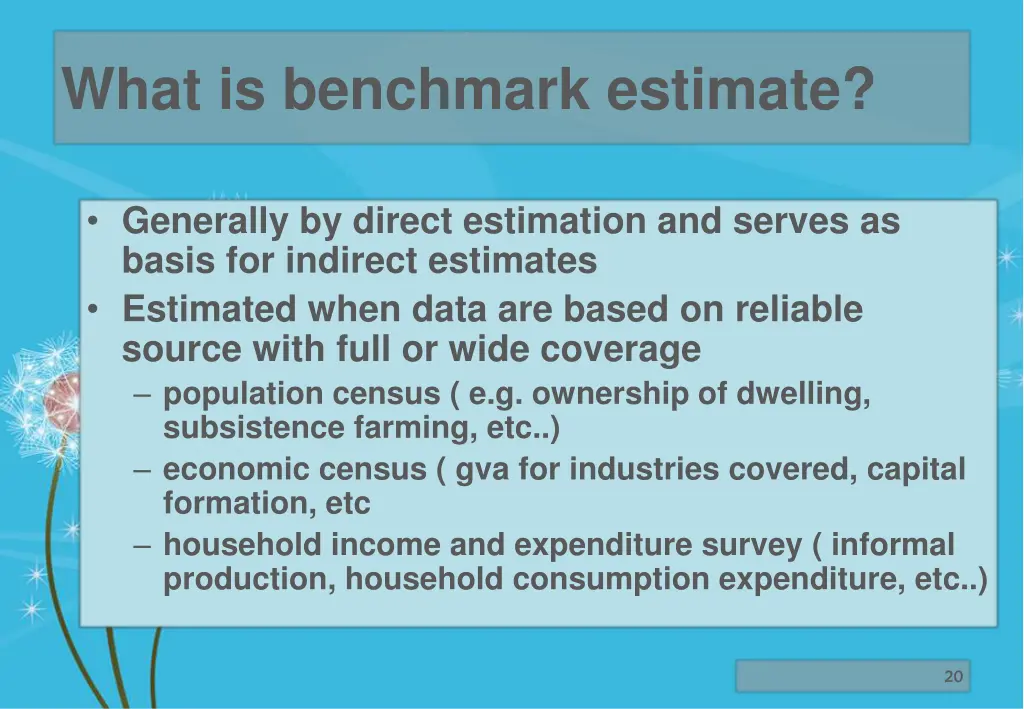
What is benchmark estimate? Generally by direct estimation and serves as basis for indirect estimates Estimated when data are based on reliable source with full or wide coverage population census ( e.g. ownership of dwelling, subsistence farming, etc..) economic census ( gva for industries covered, capital formation, etc household income and expenditure survey ( informal production, household consumption expenditure, etc..) 20 20
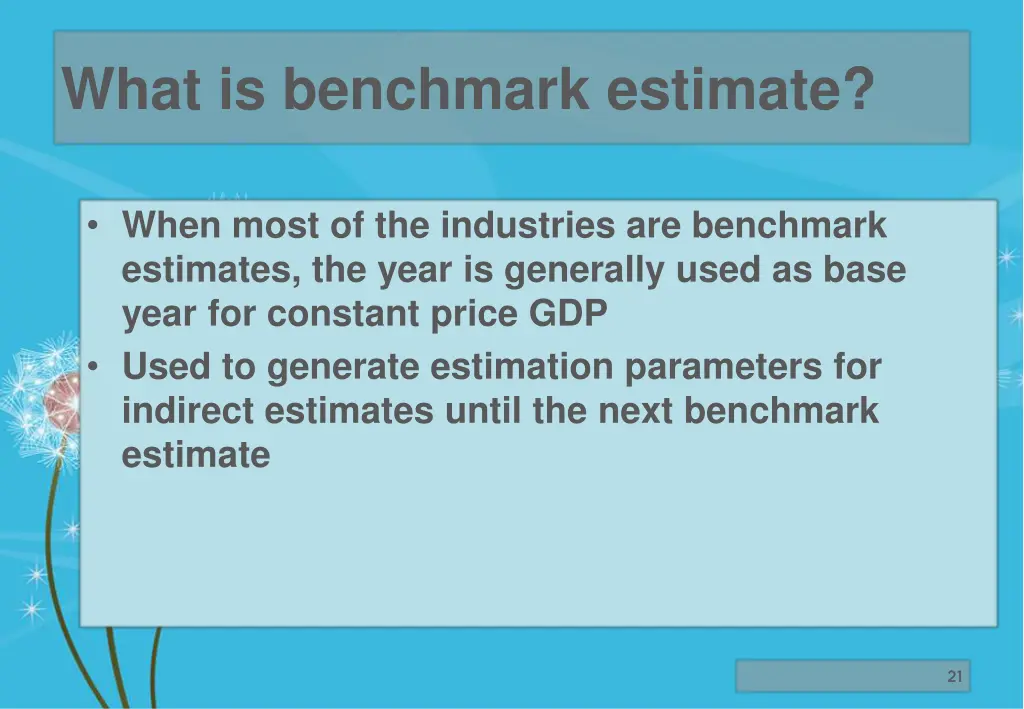
What is benchmark estimate? When most of the industries are benchmark estimates, the year is generally used as base year for constant price GDP Used to generate estimation parameters for indirect estimates until the next benchmark estimate 21 21
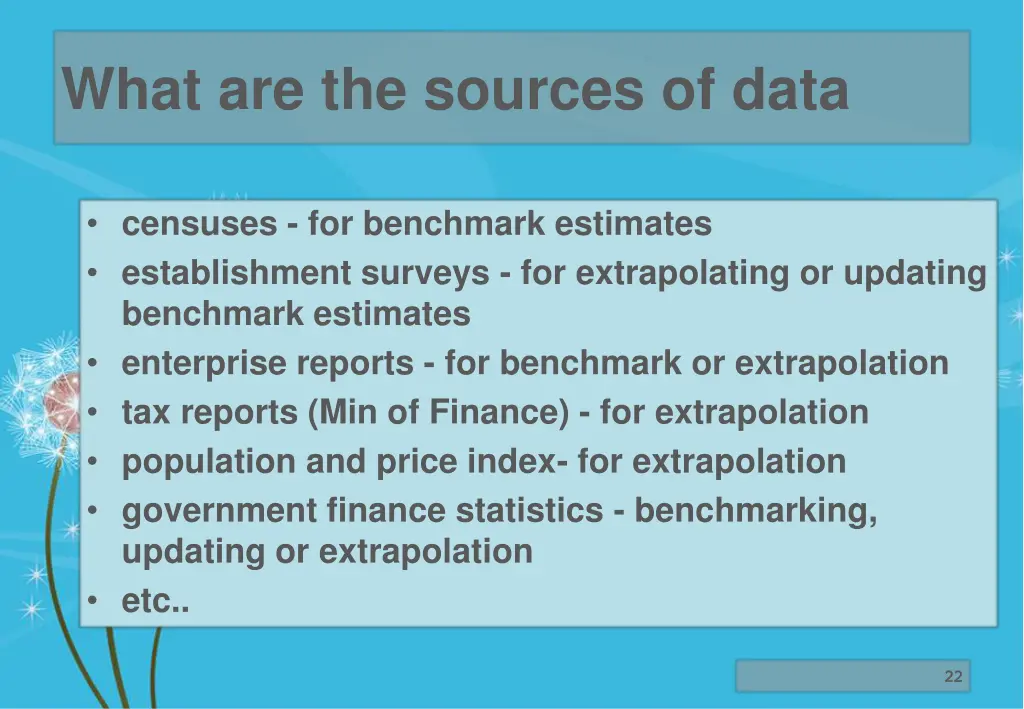
What are the sources of data censuses - for benchmark estimates establishment surveys - for extrapolating or updating benchmark estimates enterprise reports - for benchmark or extrapolation tax reports (Min of Finance) - for extrapolation population and price index- for extrapolation government finance statistics - benchmarking, updating or extrapolation etc.. 22 22
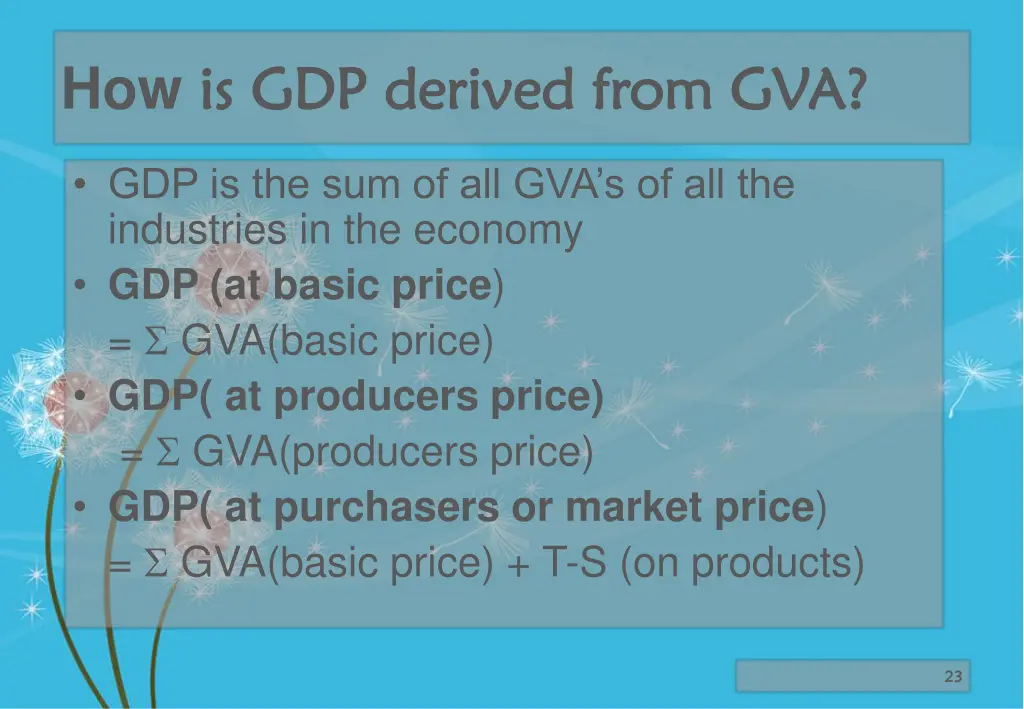
How is GDP derived from GVA? is GDP derived from GVA? GDP is the sum of all GVA s of all the industries in the economy GDP (at basic price) = GVA(basic price) GDP( at producers price) = GVA(producers price) GDP( at purchasers or market price) = GVA(basic price) + T-S (on products) 23 23
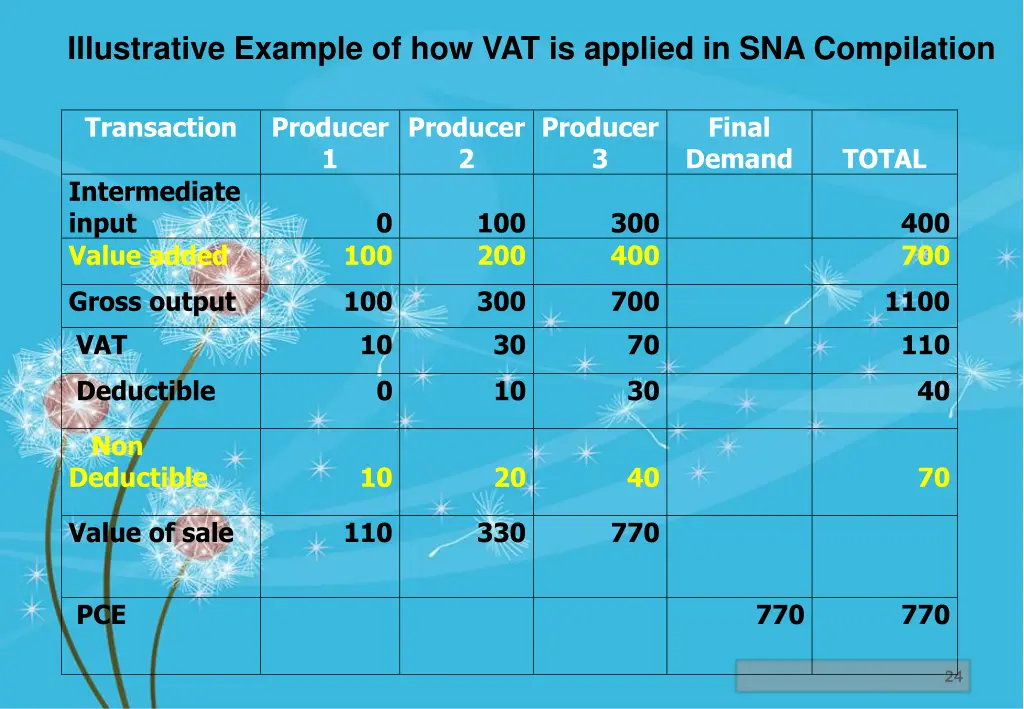
Illustrative Example of how VAT is applied in SNA Compilation Producer 3 Transaction Producer 1 Producer 2 Final Demand TOTAL Intermediate input Value added 0 100 100 200 300 400 400 700 Gross output VAT 100 10 300 30 700 70 1100 110 Deductible 0 10 30 40 Non Deductible 10 20 40 70 Value of sale 110 330 770 PCE 770 770 24 24
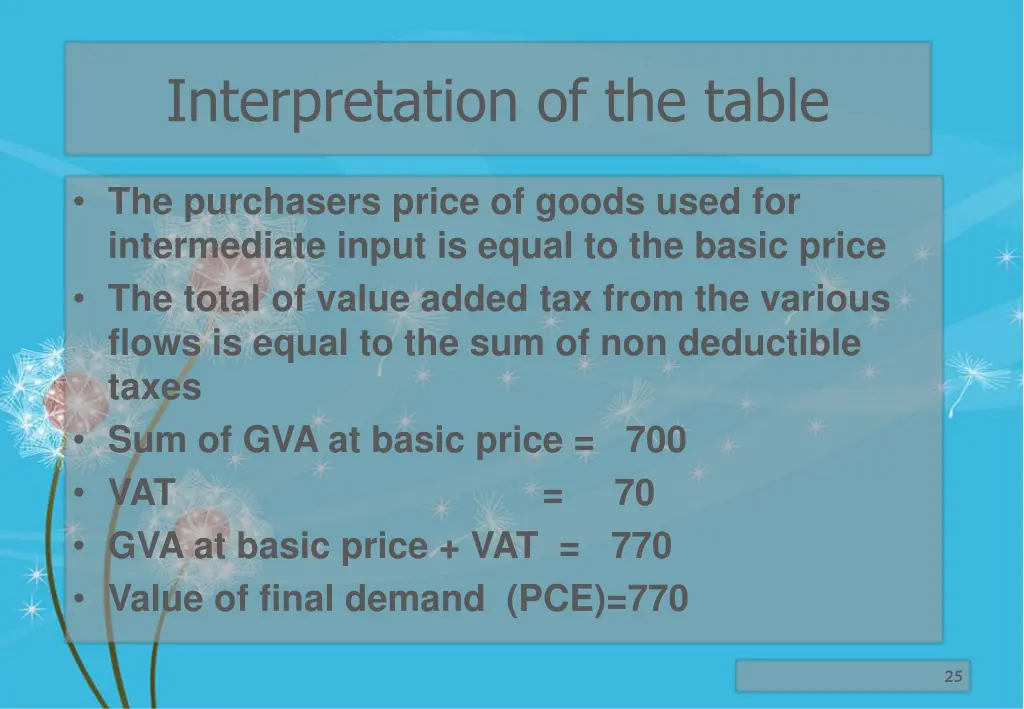
Interpretation of the table The purchasers price of goods used for intermediate input is equal to the basic price The total of value added tax from the various flows is equal to the sum of non deductible taxes Sum of GVA at basic price = 700 VAT = 70 GVA at basic price + VAT = 770 Value of final demand (PCE)=770 25 25
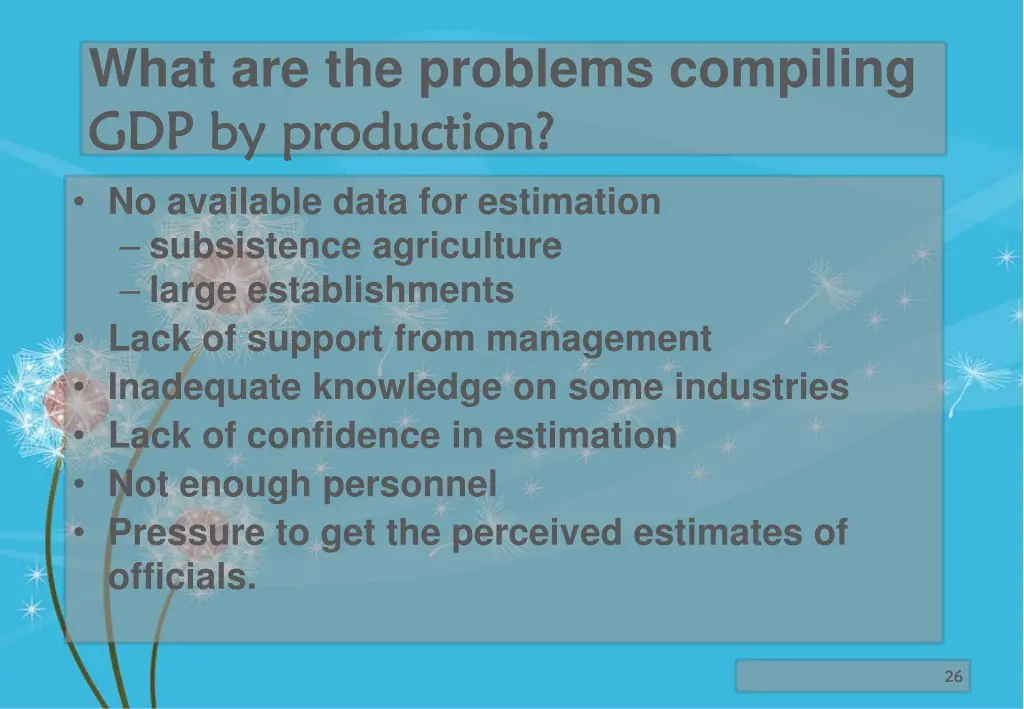
What are the problems compiling GDP by production? GDP by production? No available data for estimation subsistence agriculture large establishments Lack of support from management Inadequate knowledge on some industries Lack of confidence in estimation Not enough personnel Pressure to get the perceived estimates of officials. 26 26
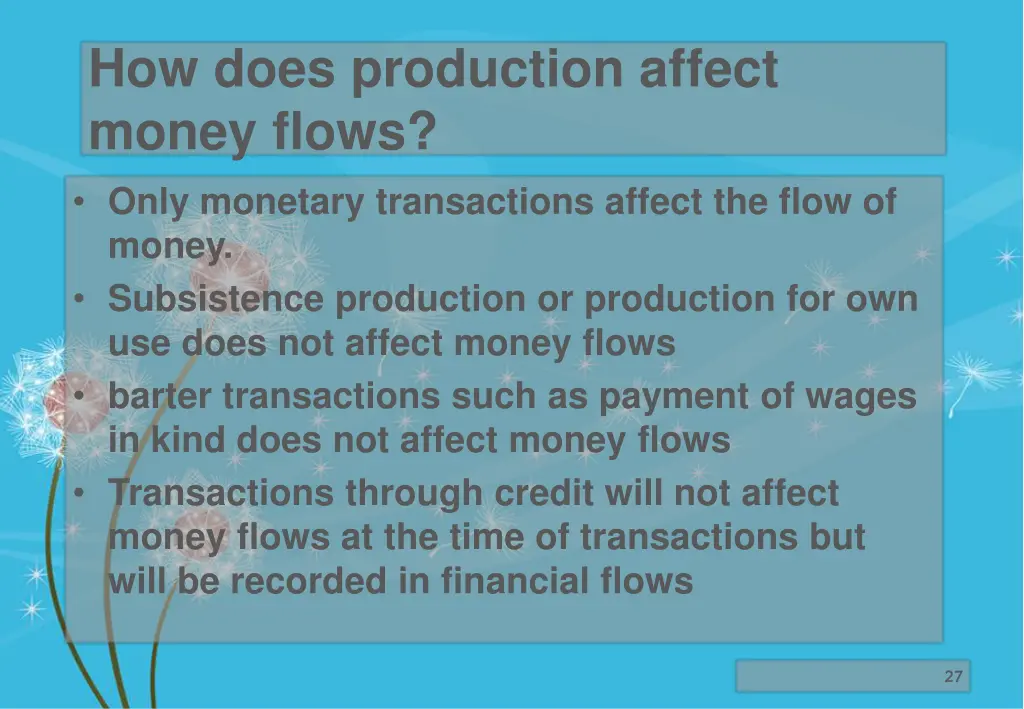
How does production affect money flows? Only monetary transactions affect the flow of money. Subsistence production or production for own use does not affect money flows barter transactions such as payment of wages in kind does not affect money flows Transactions through credit will not affect money flows at the time of transactions but will be recorded in financial flows 27 27
Thank you 28 28