General Practice Referral to Community Pharmacist Consultation Service
The NHS Community Pharmacist Consultation Service (CPCS) facilitates direct referrals from GP practices to community pharmacists for managing minor illnesses. Established nationally in November 2020 following successful pilots, this service aims to enhance patient access to care while alleviating pressure on GP practices. With collaboration among healthcare professionals in the Midlands, it supports patients' self-management and improves practice capacity, reducing appointment demand and promoting seamless healthcare delivery.

Download Presentation

Please find below an Image/Link to download the presentation.
The content on the website is provided AS IS for your information and personal use only. It may not be sold, licensed, or shared on other websites without obtaining consent from the author.If you encounter any issues during the download, it is possible that the publisher has removed the file from their server.
You are allowed to download the files provided on this website for personal or commercial use, subject to the condition that they are used lawfully. All files are the property of their respective owners.
The content on the website is provided AS IS for your information and personal use only. It may not be sold, licensed, or shared on other websites without obtaining consent from the author.
E N D
Presentation Transcript
General Practice Referral to Community Pharmacist Consultation Service (GP-CPCS) Midlands Implementation Plan NHS England and NHS Improvement
What is the General Practice Referral to Community Pharmacist Consultation Service (CPCS)? The NHS Community Pharmacist Consultation Service (NHS CPCS) is a community pharmacist led clinical service which is well established in community pharmacy across England and has been managing referrals for minor illness conditions from 111 since October 2019. There were various pilots across the country involving referrals from General Practice into CPCS (GPCPCS). Building on the success of the pilots, from 1stNovember 2020, General Practice referral into CPCS became a national service. Regional teams have been requested to roll out a soft launch of the service with a phased implementation working with PCNs who are keen to be early adopters. In The Midlands Region there are 57 GP Practices live and referring through GP CPCS and 155 GP Practices engaged for implementation. Data will be shared with the ICS named GP-CPCS Leads. PCNs will be the driving force for implementing and governing the GP referrals into CPCS. A key factor for successful delivery of this new service will be good working relationships between the NHSE&I programme team, ICS Leads, PCN Access Leads, PCN Clinical Directors, PCN Clinical Pharmacists, PCN Community Pharmacy Leads and LPCs/LMCs. Midlands region implementation team: Jackie Buxton Pharmacy Integration Lead (Midlands region)/Chief Officer, Derbyshire Local Pharmaceutical Committee (LPC) Amanda Alamanos Senior Transformation Manager (NHSE/I Midlands Region), GP CPCS Regional Implementation Lead Hayley Moore Transformation Manager (NHSE/I Midlands Region), GP CPCS Programme Manager Hayley.moore@nhs.net LPN Chairs Pallavi Dawdi, Satyan Kotecha and Samantha Travis. 2 |
Benefits of the service: GP referrals into CPCS is one of several improvement measures available to improve access and one of the easiest to implement. GP CPCS helps to free up practice capacity to see higher acuity patients, as well as from secondary care and 111 First. It will also build the platform for longer-term relationships between the pharmacy and general practice professions. GP Practices can refer patients directly in to Community Pharmacists in a way that is convenient, safe and effective. 6% - 8% of all GP & Nurse consultations can be safely transferred to a community pharmacist. This equates to referring up to 55 GP practice appointments per practice each week to pharmacists. The scheme supports patients to self-manage their health more effectively with the support of community pharmacists. Support will be offered at a local PCN footprint level to provide consistency across networks and to facilitate links with the pharmacies within the networks. GP Practices that have implemented GP CPCS have seen a reduction in repeat calls, DNA s, secondary care activity and having to turn away patients because appointment ledgers are full. GP Practices that have been referring to CPCS have also seen an improvement in the number of LD AHC s, LTC consultations and much more. 3 |
PSNC Animation Link To Animation NHS England and NHS Improvement
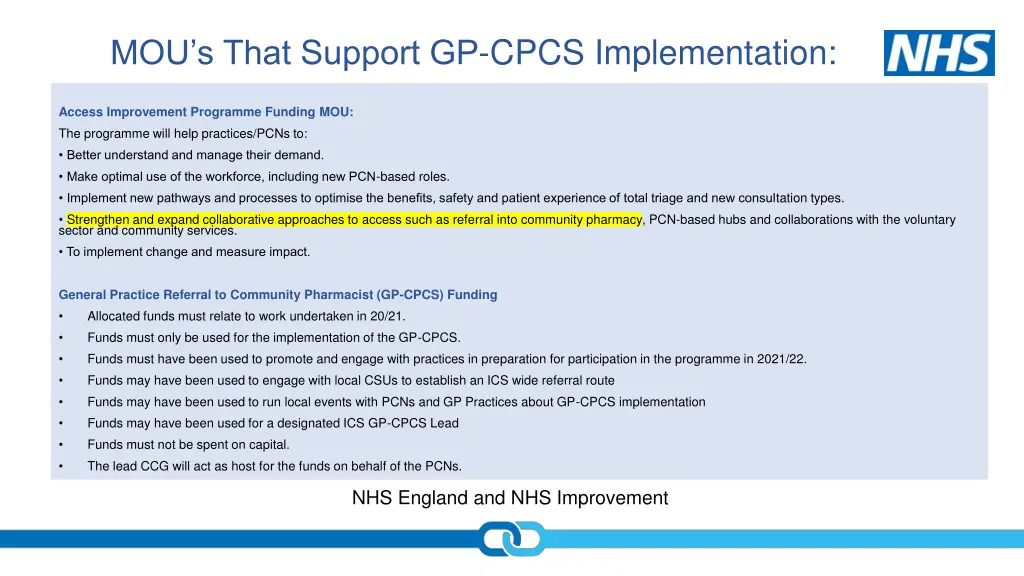
MOUs That Support GP-CPCS Implementation: Access Improvement Programme Funding MOU: The programme will help practices/PCNs to: Better understand and manage their demand. Make optimal use of the workforce, including new PCN-based roles. Implement new pathways and processes to optimise the benefits, safety and patient experience of total triage and new consultation types. Strengthen and expand collaborative approaches to access such as referral into community pharmacy, PCN-based hubs and collaborations with the voluntary sector and community services. To implement change and measure impact. General Practice Referral to Community Pharmacist (GP-CPCS) Funding Allocated funds must relate to work undertaken in 20/21. Funds must only be used for the implementation of the GP-CPCS. Funds must have been used to promote and engage with practices in preparation for participation in the programme in 2021/22. Funds may have been used to engage with local CSUs to establish an ICS wide referral route Funds may have been used to run local events with PCNs and GP Practices about GP-CPCS implementation Funds may have been used for a designated ICS GP-CPCS Lead Funds must not be spent on capital. The lead CCG will act as host for the funds on behalf of the PCNs. NHS England and NHS Improvement
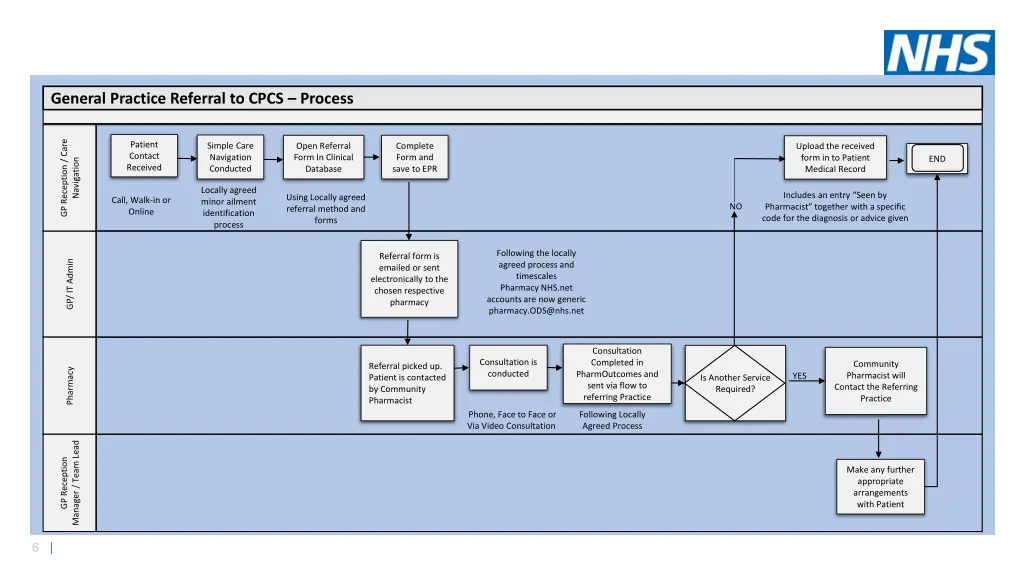
General Practice Referral to CPCS Process GP Reception / Care Patient Contact Received Simple Care Navigation Conducted Open Referral Form In Clinical Database Complete Form and save to EPR Upload the received form in to Patient Medical Record END Navigation Locally agreed minor ailment identification process Includes an entry Seen by Pharmacist together with a specific code for the diagnosis or advice given Using Locally agreed referral method and forms Call, Walk-in or Online NO Following the locally agreed process and timescales Pharmacy NHS.net accounts are now generic pharmacy.ODS@nhs.net Referral form is emailed or sent electronically to the chosen respective pharmacy GP/ IT Admin Consultation Completed in PharmOutcomes and sent via flow to referring Practice Consultation is conducted Community Pharmacist will Contact the Referring Practice Referral picked up. Patient is contacted by Community Pharmacist Pharmacy YES Is Another Service Required? Phone, Face to Face or Via Video Consultation Following Locally Agreed Process Manager / Team Lead GP Reception Make any further appropriate arrangements with Patient 6 |
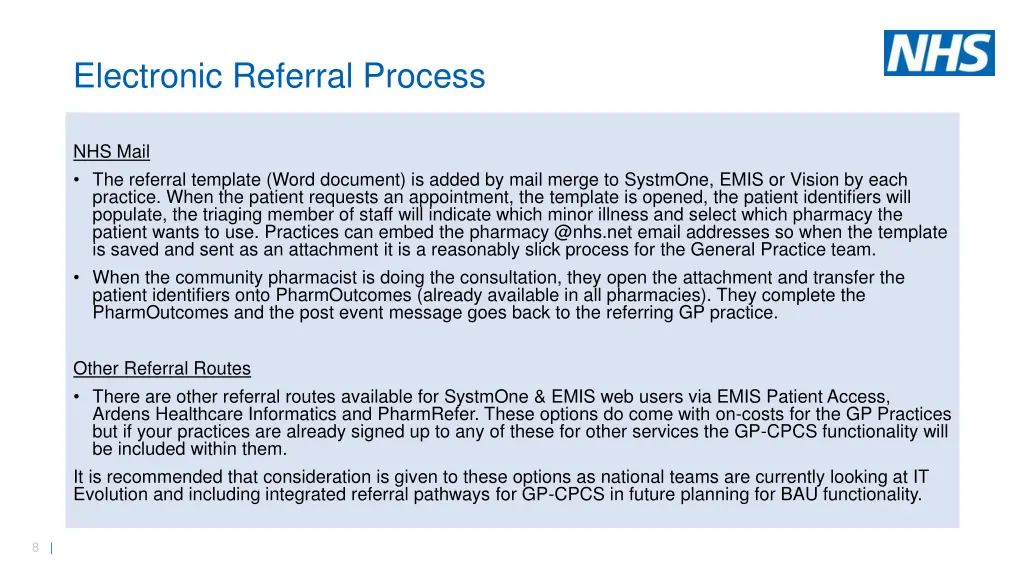
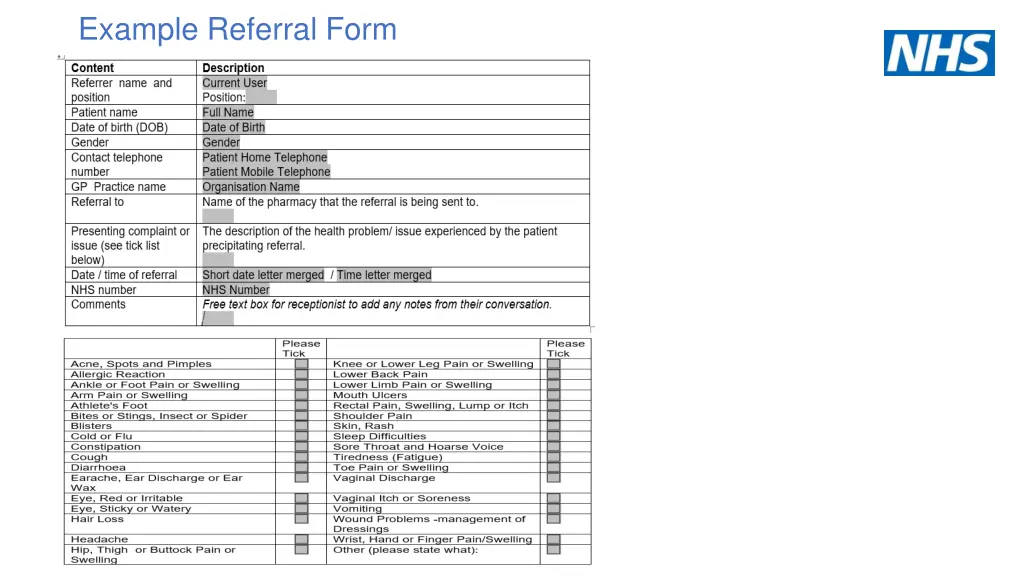
Electronic Referral Process NHS Mail The referral template (Word document) is added by mail merge to SystmOne, EMIS or Vision by each practice. When the patient requests an appointment, the template is opened, the patient identifiers will populate, the triaging member of staff will indicate which minor illness and select which pharmacy the patient wants to use. Practices can embed the pharmacy @nhs.net email addresses so when the template is saved and sent as an attachment it is a reasonably slick process for the General Practice team. When the community pharmacist is doing the consultation, they open the attachment and transfer the patient identifiers onto PharmOutcomes (already available in all pharmacies). They complete the PharmOutcomes and the post event message goes back to the referring GP practice. Other Referral Routes There are other referral routes available for SystmOne & EMIS web users via EMIS Patient Access, Ardens Healthcare Informatics and PharmRefer. These options do come with on-costs for the GP Practices but if your practices are already signed up to any of these for other services the GP-CPCS functionality will be included within them. It is recommended that consideration is given to these options as national teams are currently looking at IT Evolution and including integrated referral pathways for GP-CPCS in future planning for BAU functionality. 8 |
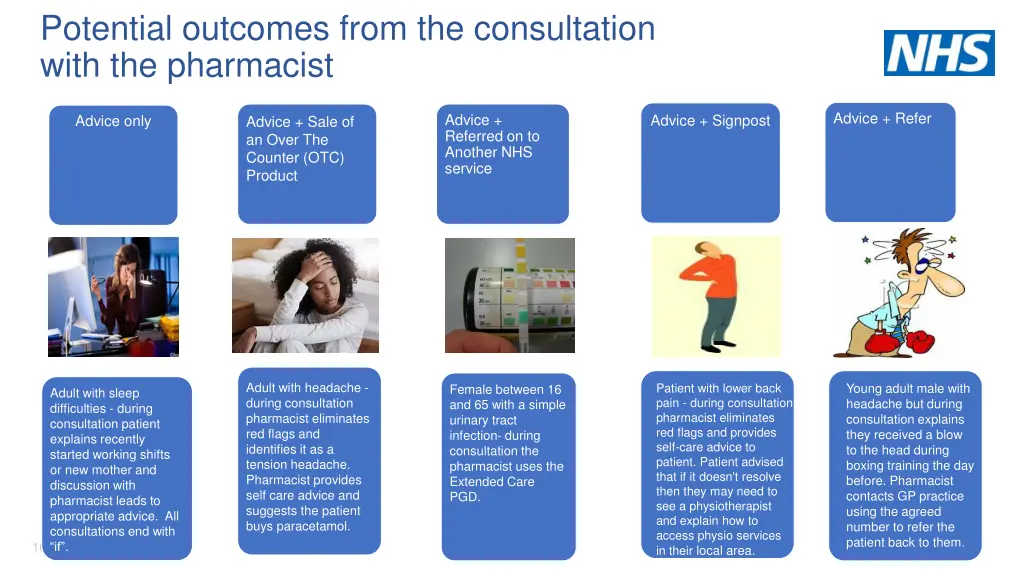
Potential outcomes from the consultation with the pharmacist Advice + Refer Advice + Referred on to Another NHS service Advice + Signpost Advice only Advice + Sale of an Over The Counter (OTC) Product Adult with headache - during consultation pharmacist eliminates red flags and identifies it as a tension headache. Pharmacist provides self care advice and suggests the patient buys paracetamol. Patient with lower back pain - during consultation pharmacist eliminates red flags and provides self-care advice to patient. Patient advised that if it doesn't resolve then they may need to see a physiotherapist and explain how to access physio services in their local area. Young adult male with headache but during consultation explains they received a blow to the head during boxing training the day before. Pharmacist contacts GP practice using the agreed number to refer the patient back to them. Female between 16 and 65 with a simple urinary tract infection- during consultation the pharmacist uses the Extended Care PGD. Adult with sleep difficulties - during consultation patient explains recently started working shifts or new mother and discussion with pharmacist leads to appropriate advice. All consultations end with if . 10 |
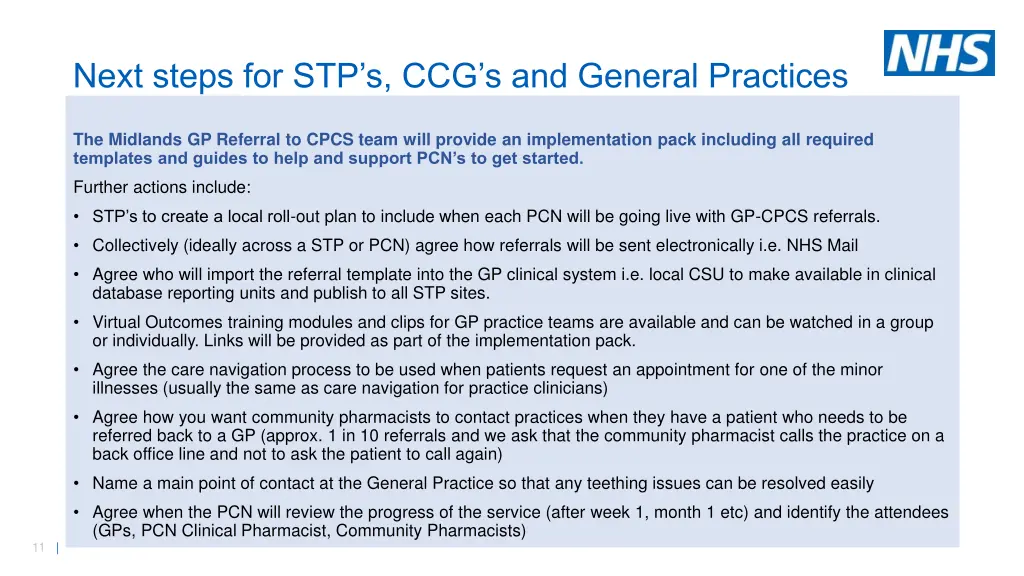
Next steps for STPs, CCGs and General Practices The Midlands GP Referral to CPCS team will provide an implementation pack including all required templates and guides to help and support PCN s to get started. Further actions include: STP s to create a local roll-out plan to include when each PCN will be going live with GP-CPCS referrals. Collectively (ideally across a STP or PCN) agree how referrals will be sent electronically i.e. NHS Mail Agree who will import the referral template into the GP clinical system i.e. local CSU to make available in clinical database reporting units and publish to all STP sites. Virtual Outcomes training modules and clips for GP practice teams are available and can be watched in a group or individually. Links will be provided as part of the implementation pack. Agree the care navigation process to be used when patients request an appointment for one of the minor illnesses (usually the same as care navigation for practice clinicians) Agree how you want community pharmacists to contact practices when they have a patient who needs to be referred back to a GP (approx. 1 in 10 referrals and we ask that the community pharmacist calls the practice on a back office line and not to ask the patient to call again) Name a main point of contact at the General Practice so that any teething issues can be resolved easily Agree when the PCN will review the progress of the service (after week 1, month 1 etc) and identify the attendees (GPs, PCN Clinical Pharmacist, Community Pharmacists) 11 |
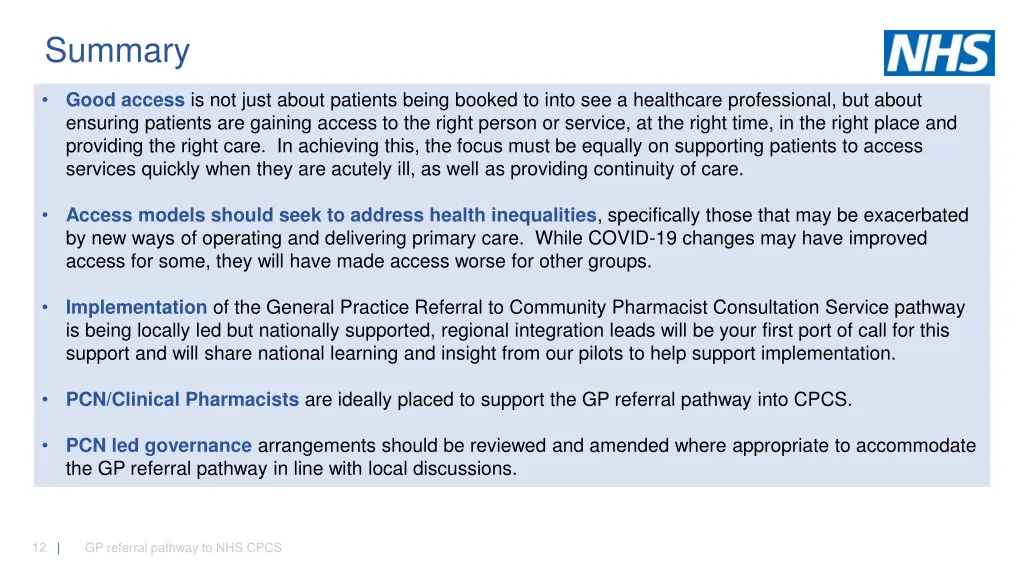
Summary Good access is not just about patients being booked to into see a healthcare professional, but about ensuring patients are gaining access to the right person or service, at the right time, in the right place and providing the right care. In achieving this, the focus must be equally on supporting patients to access services quickly when they are acutely ill, as well as providing continuity of care. Access models should seek to address health inequalities, specifically those that may be exacerbated by new ways of operating and delivering primary care. While COVID-19 changes may have improved access for some, they will have made access worse for other groups. Implementation of the General Practice Referral to Community Pharmacist Consultation Service pathway is being locally led but nationally supported, regional integration leads will be your first port of call for this support and will share national learning and insight from our pilots to help support implementation. PCN/Clinical Pharmacists are ideally placed to support the GP referral pathway into CPCS. PCN led governance arrangements should be reviewed and amended where appropriate to accommodate the GP referral pathway in line with local discussions. 12 | GP referral pathway to NHS CPCS