Generator Status During Commissioning - Jenifer Fernandes ERCOT
In this detailed resource integration guide, the status and testing procedures of generators during commissioning are outlined. It covers various scenarios from online to offline states and specific requirements for different generator types like BESS units. The process involves multiple stages of approval and testing to ensure proper operation and readiness for grid integration.

Download Presentation

Please find below an Image/Link to download the presentation.
The content on the website is provided AS IS for your information and personal use only. It may not be sold, licensed, or shared on other websites without obtaining consent from the author. If you encounter any issues during the download, it is possible that the publisher has removed the file from their server.
You are allowed to download the files provided on this website for personal or commercial use, subject to the condition that they are used lawfully. All files are the property of their respective owners.
The content on the website is provided AS IS for your information and personal use only. It may not be sold, licensed, or shared on other websites without obtaining consent from the author.
E N D
Presentation Transcript
Generator Status During Commissioning Jenifer Fernandes ERCOT Resource Integration Working Group October 24, 2024
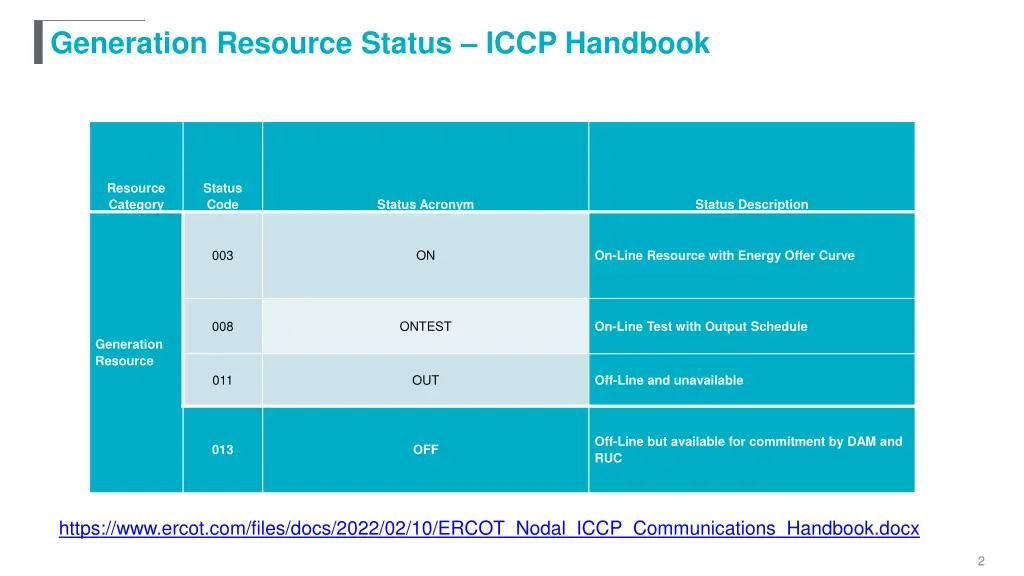
Generation Resource Status ICCP Handbook Resource Category Status Code Status Acronym Status Description 003 ON On-Line Resource with Energy Offer Curve 008 ONTEST On-Line Test with Output Schedule Generation Resource 011 OUT Off-Line and unavailable Off-Line but available for commitment by DAM and RUC 013 OFF https://www.ercot.com/files/docs/2022/02/10/ERCOT_Nodal_ICCP_Communications_Handbook.docx 2
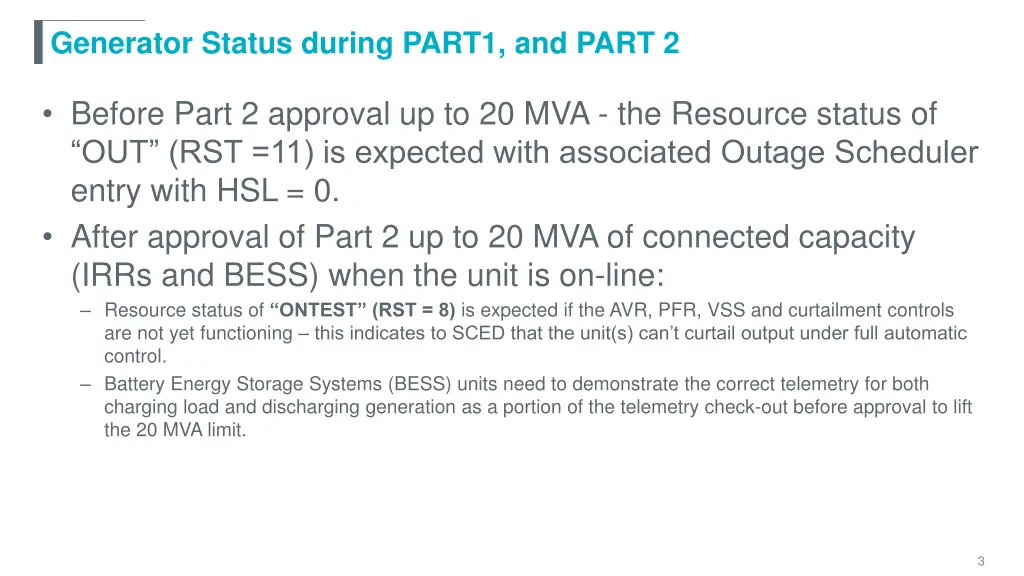
Generator Status during PART1, and PART 2 Before Part 2 approval up to 20 MVA - the Resource status of OUT (RST =11) is expected with associated Outage Scheduler entry with HSL = 0. After approval of Part 2 up to 20 MVA of connected capacity (IRRs and BESS) when the unit is on-line: Resource status of ONTEST (RST = 8) is expected if the AVR, PFR, VSS and curtailment controls are not yet functioning this indicates to SCED that the unit(s) can t curtail output under full automatic control. Battery Energy Storage Systems (BESS) units need to demonstrate the correct telemetry for both charging load and discharging generation as a portion of the telemetry check-out before approval to lift the 20 MVA limit. 3
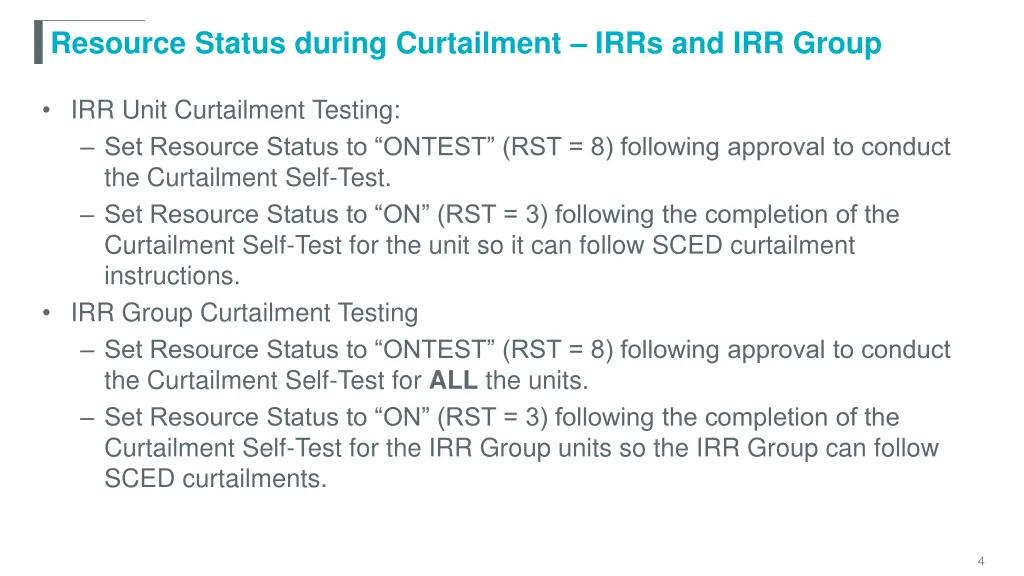
Resource Status during Curtailment IRRs and IRR Group IRR Unit Curtailment Testing: Set Resource Status to ONTEST (RST = 8) following approval to conduct the Curtailment Self-Test. Set Resource Status to ON (RST = 3) following the completion of the Curtailment Self-Test for the unit so it can follow SCED curtailment instructions. IRR Group Curtailment Testing Set Resource Status to ONTEST (RST = 8) following approval to conduct the Curtailment Self-Test for ALL the units. Set Resource Status to ON (RST = 3) following the completion of the Curtailment Self-Test for the IRR Group units so the IRR Group can follow SCED curtailments. 4
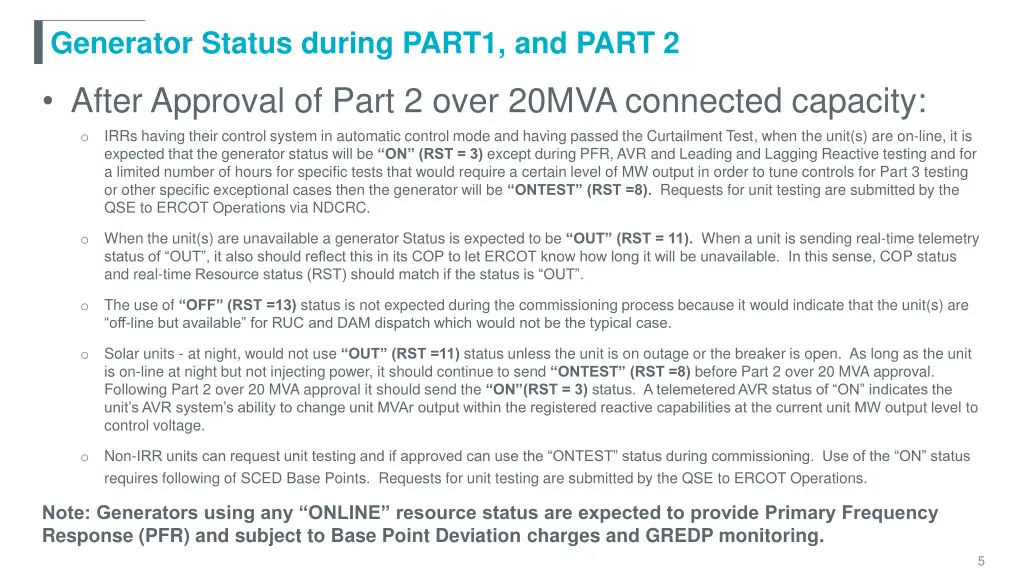
Generator Status during PART1, and PART 2 After Approval of Part 2 over 20MVA connected capacity: IRRs having their control system in automatic control mode and having passed the Curtailment Test, when the unit(s) are on-line, it is expected that the generator status will be ON (RST = 3) except during PFR, AVR and Leading and Lagging Reactive testing and for a limited number of hours for specific tests that would require a certain level of MW output in order to tune controls for Part 3 testing or other specific exceptional cases then the generator will be ONTEST (RST =8).Requests for unit testing are submitted by the QSE to ERCOT Operations via NDCRC. o When the unit(s) are unavailable a generator Status is expected to be OUT (RST = 11). When a unit is sending real-time telemetry status of OUT , it also should reflect this in its COP to let ERCOT know how long it will be unavailable. In this sense, COP status and real-time Resource status (RST) should match if the status is OUT . o The use of OFF (RST =13) status is not expected during the commissioning process because it would indicate that the unit(s) are off-line but available for RUC and DAM dispatch which would not be the typical case. o Solar units - at night, would not use OUT (RST =11) status unless the unit is on outage or the breaker is open. As long as the unit is on-line at night but not injecting power, it should continue to send ONTEST (RST =8) before Part 2 over 20 MVA approval. Following Part 2 over 20 MVA approval it should send the ON (RST = 3) status. A telemetered AVR status of ON indicates the unit s AVR system s ability to change unit MVAr output within the registered reactive capabilities at the current unit MW output level to control voltage. o Non-IRR units can request unit testing and if approved can use the ONTEST status during commissioning. Use of the ON status requires following of SCED Base Points. Requests for unit testing are submitted by the QSE to ERCOT Operations. o Note: Generators using any ONLINE resource status are expected to provide Primary Frequency Response (PFR) and subject to Base Point Deviation charges and GREDP monitoring. 5
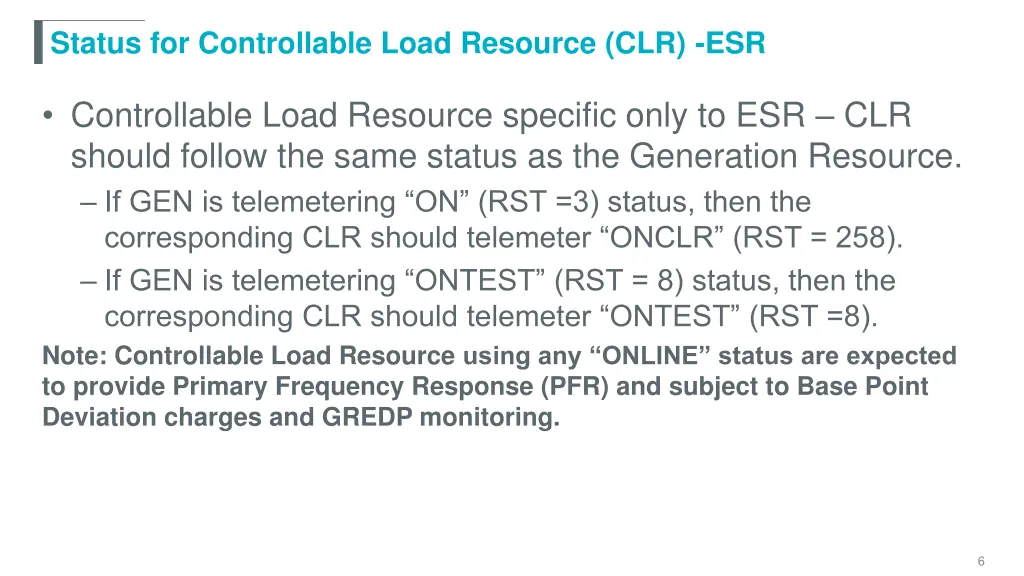
Status for Controllable Load Resource (CLR) -ESR Controllable Load Resource specific only to ESR CLR should follow the same status as the Generation Resource. If GEN is telemetering ON (RST =3) status, then the corresponding CLR should telemeter ONCLR (RST = 258). If GEN is telemetering ONTEST (RST = 8) status, then the corresponding CLR should telemeter ONTEST (RST =8). Note: Controllable Load Resource using any ONLINE status are expected to provide Primary Frequency Response (PFR) and subject to Base Point Deviation charges and GREDP monitoring. 6
Questions? Thank you!