Global Economic Outlook and Sino-Japan Trade Analysis May 2025
Stay informed with the latest updates on global economic trends, including the J.P. Morgan Global Manufacturing PMI, OECD GDP Growth, and the impact on Sino-Japan trade as outlined in the May 2025 report.

Download Presentation

Please find below an Image/Link to download the presentation.
The content on the website is provided AS IS for your information and personal use only. It may not be sold, licensed, or shared on other websites without obtaining consent from the author. If you encounter any issues during the download, it is possible that the publisher has removed the file from their server.
You are allowed to download the files provided on this website for personal or commercial use, subject to the condition that they are used lawfully. All files are the property of their respective owners.
The content on the website is provided AS IS for your information and personal use only. It may not be sold, licensed, or shared on other websites without obtaining consent from the author.
E N D
Presentation Transcript
Sino-Japan Trade Report May 2025 Released on June 1st., 2025
Outline 1. Summary 1.1 Global Economy and Merchandise Trade 1.2 China s Macro Economy 1.3 Japan s Macro Economy 1.4 Sino-Japan Merchandise Trade 2. Appendix I 2.1 GDP 2.2 PMI Sino-Japan Trade Report May 2025 2
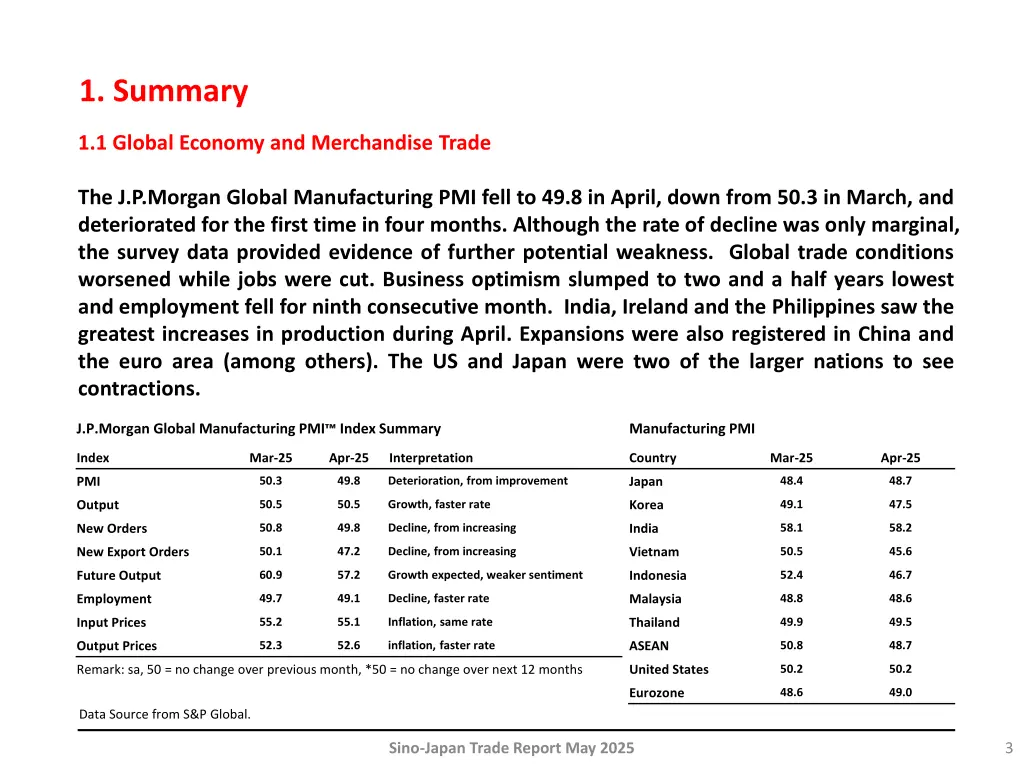
1. Summary 1.1 Global Economy and Merchandise Trade The J.P.Morgan Global Manufacturing PMI fell to 49.8 in April, down from 50.3 in March, and deteriorated for the first time in four months. Although the rate of decline was only marginal, the survey data provided evidence of further potential weakness. Global trade conditions worsened while jobs were cut. Business optimism slumped to two and a half years lowest and employment fell for ninth consecutive month. India, Ireland and the Philippines saw the greatest increases in production during April. Expansions were also registered in China and the euro area (among others). The US and Japan were two of the larger nations to see contractions. J.P.Morgan Global Manufacturing PMI Index Summary Manufacturing PMI Index Mar-25 Apr-25 Interpretation Country Mar-25 Apr-25 50.3 49.8 Deterioration, from improvement 48.4 48.7 PMI Japan Output 50.5 50.5 Growth, faster rate Korea 49.1 47.5 50.8 49.8 Decline, from increasing 58.1 58.2 New Orders India New Export Orders Vietnam 50.1 47.2 Decline, from increasing 50.5 45.6 60.9 57.2 Growth expected, weaker sentiment 52.4 46.7 Future Output Indonesia 49.7 49.1 Decline, faster rate 48.8 48.6 Employment Malaysia Input Prices 55.2 55.1 Inflation, same rate Thailand 49.9 49.5 52.3 52.6 inflation, faster rate 50.8 48.7 Output Prices ASEAN Remark: sa, 50 = no change over previous month, *50 = no change over next 12 months United States 50.2 50.2 48.6 49.0 Eurozone Data Source from S&P Global. 3 Sino-Japan Trade Report May 2025
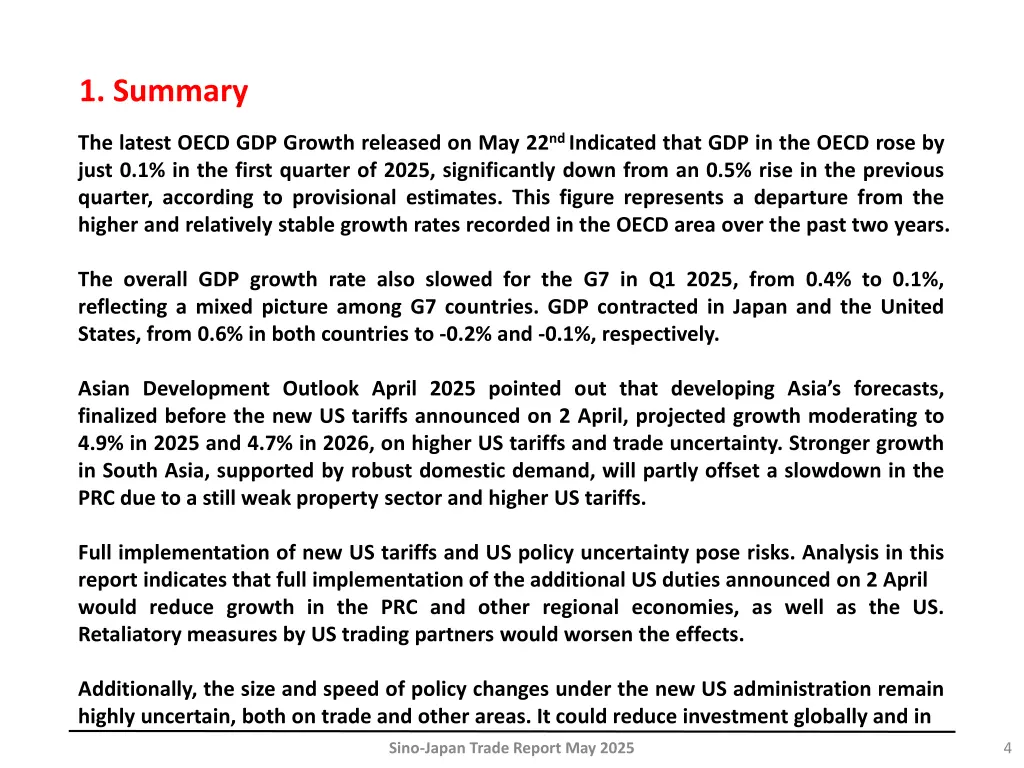
1. Summary The latest OECD GDP Growth released on May 22ndIndicated that GDP in the OECD rose by just 0.1% in the first quarter of 2025, significantly down from an 0.5% rise in the previous quarter, according to provisional estimates. This figure represents a departure from the higher and relatively stable growth rates recorded in the OECD area over the past two years. The overall GDP growth rate also slowed for the G7 in Q1 2025, from 0.4% to 0.1%, reflecting a mixed picture among G7 countries. GDP contracted in Japan and the United States, from 0.6% in both countries to -0.2% and -0.1%, respectively. Asian Development Outlook April 2025 pointed out that developing Asia s forecasts, finalized before the new US tariffs announced on 2 April, projected growth moderating to 4.9% in 2025 and 4.7% in 2026, on higher US tariffs and trade uncertainty. Stronger growth in South Asia, supported by robust domestic demand, will partly offset a slowdown in the PRC due to a still weak property sector and higher US tariffs. Full implementation of new US tariffs and US policy uncertainty pose risks. Analysis in this report indicates that full implementation of the additional US duties announced on 2 April would reduce growth in the PRC and other regional economies, as well as the US. Retaliatory measures by US trading partners would worsen the effects. Additionally, the size and speed of policy changes under the new US administration remain highly uncertain, both on trade and other areas. It could reduce investment globally and in Sino-Japan Trade Report May 2025 4
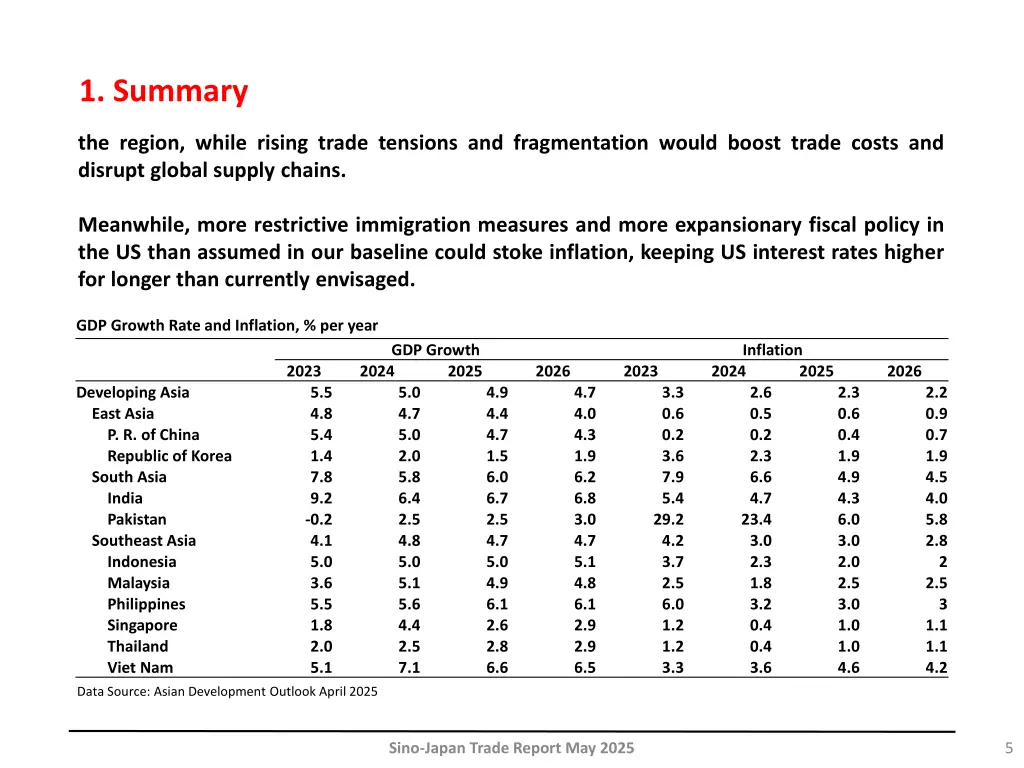
1. Summary the region, while rising trade tensions and fragmentation would boost trade costs and disrupt global supply chains. Meanwhile, more restrictive immigration measures and more expansionary fiscal policy in the US than assumed in our baseline could stoke inflation, keeping US interest rates higher for longer than currently envisaged. GDP Growth Rate and Inflation, % per year GDP Growth 2024 5.0 4.7 5.0 2.0 5.8 6.4 2.5 4.8 5.0 5.1 5.6 4.4 2.5 7.1 Inflation 2023 2025 2026 2023 2024 2025 2026 Developing Asia East Asia P. R. of China Republic of Korea South Asia India Pakistan Southeast Asia Indonesia Malaysia Philippines Singapore Thailand Viet Nam 5.5 4.8 5.4 1.4 7.8 9.2 -0.2 4.1 5.0 3.6 5.5 1.8 2.0 5.1 4.9 4.4 4.7 1.5 6.0 6.7 2.5 4.7 5.0 4.9 6.1 2.6 2.8 6.6 4.7 4.0 4.3 1.9 6.2 6.8 3.0 4.7 5.1 4.8 6.1 2.9 2.9 6.5 3.3 0.6 0.2 3.6 7.9 5.4 29.2 4.2 3.7 2.5 6.0 1.2 1.2 3.3 2.6 0.5 0.2 2.3 6.6 4.7 23.4 3.0 2.3 1.8 3.2 0.4 0.4 3.6 2.3 0.6 0.4 1.9 4.9 4.3 6.0 3.0 2.0 2.5 3.0 1.0 1.0 4.6 2.2 0.9 0.7 1.9 4.5 4.0 5.8 2.8 2 2.5 3 1.1 1.1 4.2 Data Source: Asian Development Outlook April 2025 Sino-Japan Trade Report May 2025 5
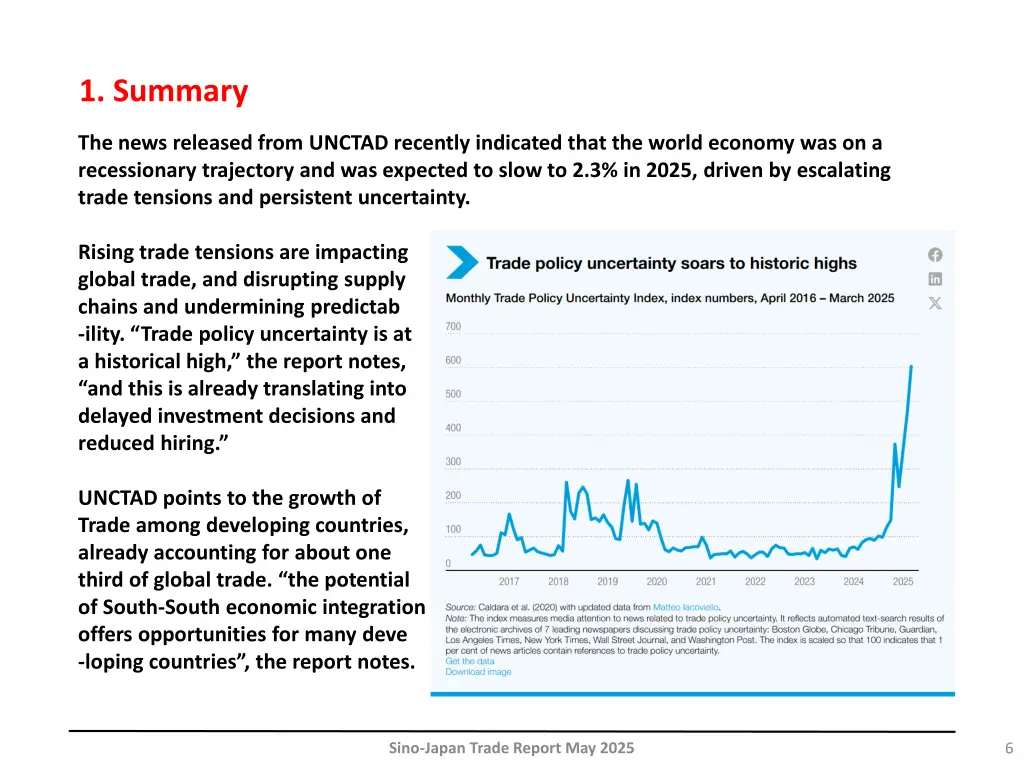
1. Summary The news released from UNCTAD recently indicated that the world economy was on a recessionary trajectory and was expected to slow to 2.3% in 2025, driven by escalating trade tensions and persistent uncertainty. Rising trade tensions are impacting global trade, and disrupting supply chains and undermining predictab -ility. Trade policy uncertainty is at a historical high, the report notes, and this is already translating into delayed investment decisions and reduced hiring. UNCTAD points to the growth of Trade among developing countries, already accounting for about one third of global trade. the potential of South-South economic integration offers opportunities for many deve -loping countries , the report notes. Sino-Japan Trade Report May 2025 6
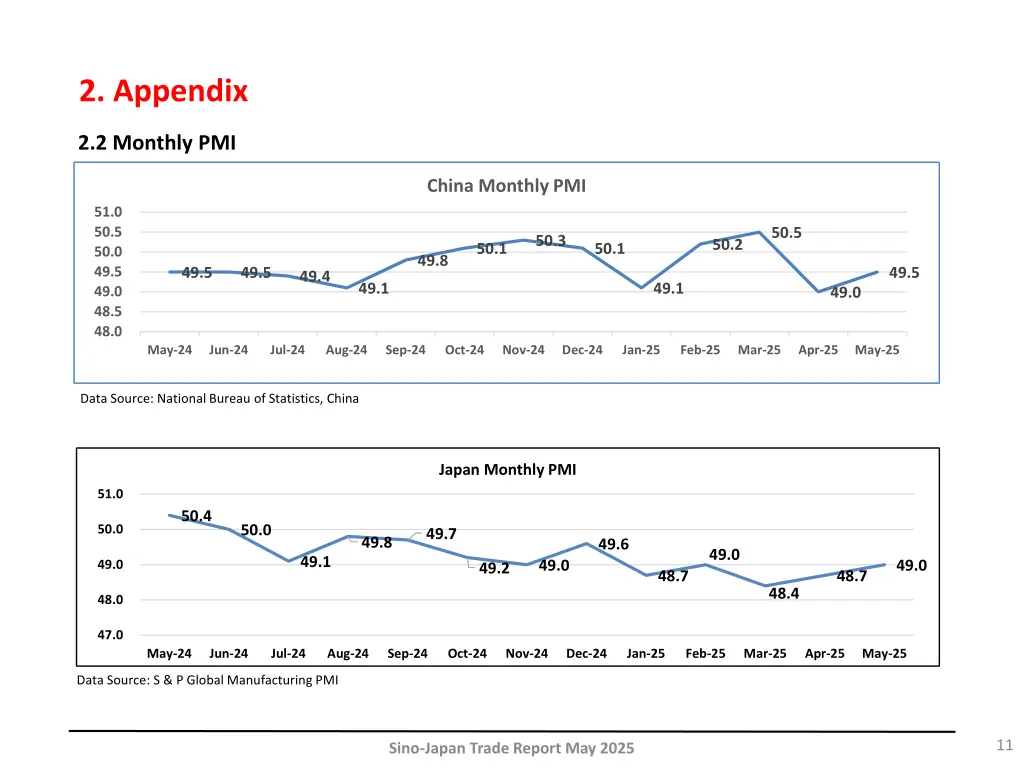
1. Summary 1.2 China s Macro Economy In China, the PMI in May rose to 49.5%, 0.5 percentage point higher than the same in April. The Production Index and the New Order Index increased 0.9 and 0.6 percentage point m-o- m though both are still in the contraction range. The New Export Order Index jumped 3.2 percentage points m-o-m to 47.9% while Import Index became 47.1%, 3.7 percentage points higher m-o-m. The major commodities import volume continuously dropped except copper concentrate, pulp and machine tools, indicating the spot demand is shrinking. However, the domestic and export sales of excavator and loader still increased, especially domestic sales volume went upward sharply, indicating the investment is improving. In May, the China steel industry PMI was 46.4, a decrease of 4.2 points m-o-m which ended upward trend in the last three consecutive months and dropped into contraction range once again. Both uncertain global trade environment and weak domestic demand quite influenced steel industry. 1.3 Japan s Macro Economy The headline AU Jibun Bank Flash Japan Manufacturing PMI was up slightly from 48.7 in April to 49.0 in May, but remained below the crucial 50.0 neutral level to signal a deteriorat 7 Sino-Japan Trade Report May 2025
1. Executive Summary -ion in business conditions for the eleventh successive month. The relative improvement in the headline index was supported by softer falls in new orders and new export business, while companies also signaled a stronger increase in employment. However, sustainable economic development cannot rely on the employment increase only demand. without solid After slipping to the weakest in nearly five years in April, optimism regarding the year -ahead outlook for output picked up in May, but overall sentiment remained among the lowest seen since the COVID-19 pandemic. 1.4 Sino-Japan Merchandise Trade Regarding Sino-Japanese merchandise trade, the trade amount of April in USD announced by the Chinese Customs increased by 4.98% y-o-y while the aggregated trade amount indicated plus 0.73% which is the first positive aggregated growth rate in 2025. The same data released in JPY by the Japanese Ministry of Finance increased by 3.59% y-o-y in April. Though the aggregated growth rate is gradually dropping, it is always positive from the beginning of 2025 and recorded 5.97% until the end of April. In general, the trade data indicated that growth rate of China s export to Japan increased more than the same of Japan s export to China in April. The most increased import goods Sino-Japan Trade Report May 2025 8
1. Executive Summary are telecom goods, petrochemical products, audio and video equipment while the most decreased export goods are semi-conductor machinery and parts as well as automobile. Meanwhile, the container freight index of Sino-Japan route in April kept stable at 980.85 points and 0.9% higher m-o-m. However, the conventional market between China and Japan was still quite now. In April, 105,965 tons of steel were exported from China to Japan, with a cumulative 404,833 tons in the first four months, an increase of 2.61% year-on-year. In the same month, 191,034 tons of steel were exported from Japan to China, with a cumulative 777,255 tons, a year-on-year decrease of 16.7%. Total steel trade volume in terms of metric ton including eastbound and westbound decreased 10.24%, in which part of cargoes were carried by conventional vessels. Meanwhile, the order data of April 2025 released by the Japan Machine Tool Builders Association showed that orders from China increased by 27.9% y-o-y, with a cumulative increase of 27.6% up to the end of April. China and the United States occupy about 67% of the overseas order. Though the growth rate of India is quite higher, the absolute order value is still one-fourth of the China s. The machinery and equipment export to China is still the main direction in the near future. 9 Sino-Japan Trade Report May 2025
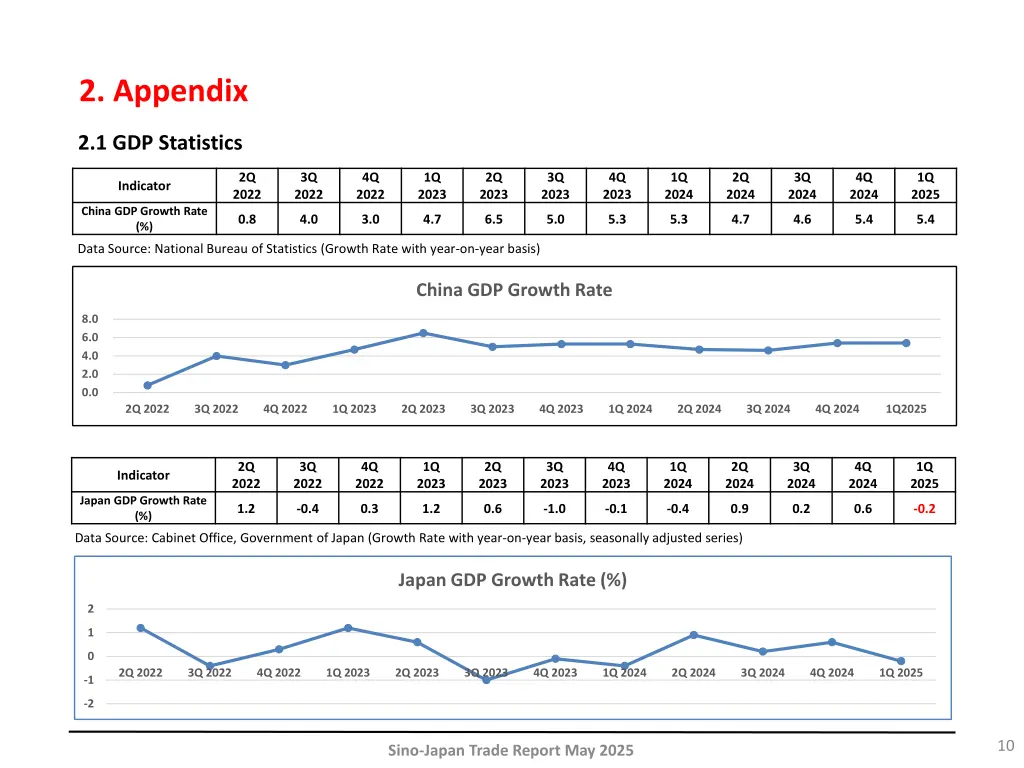
2. Appendix 2.1 GDP Statistics 2Q 2022 3Q 2022 4Q 2022 1Q 2023 2Q 2023 3Q 2023 4Q 2023 1Q 2024 2Q 2024 3Q 2024 4Q 2024 1Q 2025 Indicator China GDP Growth Rate (%) 0.8 4.0 3.0 4.7 6.5 5.0 5.3 5.3 4.7 4.6 5.4 5.4 Data Source: National Bureau of Statistics (Growth Rate with year-on-year basis) China GDP Growth Rate 8.0 6.0 4.0 2.0 0.0 2Q 2022 3Q 2022 4Q 2022 1Q 2023 2Q 2023 3Q 2023 4Q 2023 1Q 2024 2Q 2024 3Q 2024 4Q 2024 1Q2025 2Q 2022 3Q 2022 4Q 2022 1Q 2023 2Q 2023 3Q 2023 4Q 2023 1Q 2024 2Q 2024 3Q 2024 4Q 2024 1Q 2025 Indicator Japan GDP Growth Rate (%) 1.2 -0.4 0.3 1.2 0.6 -1.0 -0.1 -0.4 0.9 0.2 0.6 -0.2 Data Source: Cabinet Office, Government of Japan (Growth Rate with year-on-year basis, seasonally adjusted series) Japan GDP Growth Rate (%) 2 1 0 2Q 2022 3Q 2022 4Q 2022 1Q 2023 2Q 2023 3Q 2023 4Q 2023 1Q 2024 2Q 2024 3Q 2024 4Q 2024 1Q 2025 -1 -2 10 Sino-Japan Trade Report May 2025
2. Appendix 2.2 Monthly PMI China Monthly PMI 51.0 50.5 50.5 50.3 50.2 50.1 50.1 50.0 49.8 49.5 49.5 49.5 49.5 49.4 49.1 49.1 49.0 49.0 48.5 48.0 May-24 Jun-24 Jul-24 Aug-24 Sep-24 Oct-24 Nov-24 Dec-24 Jan-25 Feb-25 Mar-25 Apr-25 May-25 Data Source: National Bureau of Statistics, China Japan Monthly PMI 51.0 50.4 50.0 50.0 49.7 49.8 49.6 49.0 49.1 49.0 49.0 49.0 49.2 48.7 48.7 48.4 48.0 47.0 May-24 Jun-24 Jul-24 Aug-24 Sep-24 Oct-24 Nov-24 Dec-24 Jan-25 Feb-25 Mar-25 Apr-25 May-25 Data Source: S & P Global Manufacturing PMI 11 Sino-Japan Trade Report May 2025
End of Sino-Japan Trade Report May 2025 Sino-Japan Trade Report May 2025 12