Global Ozone and Surface UV Climatology Data Products for NASA Earth Observations
Tropospheric and stratospheric column ozone data products along with total column ozone and surface UV index climatologies derived from NASA observations. The data files are available for download from NASA websites and represent 12-month climatologies with a specific horizontal resolution.

Download Presentation

Please find below an Image/Link to download the presentation.
The content on the website is provided AS IS for your information and personal use only. It may not be sold, licensed, or shared on other websites without obtaining consent from the author.If you encounter any issues during the download, it is possible that the publisher has removed the file from their server.
You are allowed to download the files provided on this website for personal or commercial use, subject to the condition that they are used lawfully. All files are the property of their respective owners.
The content on the website is provided AS IS for your information and personal use only. It may not be sold, licensed, or shared on other websites without obtaining consent from the author.
E N D
Presentation Transcript
Global Ozone and Surface UV Climatology Data Products for NASA Earth Observations (NEO) and Science on the Sphere (SOS) 1) Tropospheric Column Ozone in Dobson Units 2) 3) 4) Stratospheric Column Ozone in Dobson Units Total Column Ozone in Dobson Units Surface UV-Index (These four data products represent 12-month climatologies with horizontal resolution of 1olatitude by 1.25olongitude) Contact person: Dr. Jerry Ziemke, Code 614 Ph: 301-614-6034 Email: Jerald.R.Ziemke@nasa.gov
The Data Arrays Given as both an IDL save file global_ozone_uv_climatology_data_arrays.sav and as an HDF EOS5 file (compressed using gzip command) global_ozone_uv_climatology_data_arrays.h5.gz These data files can be obtained from the following NASA websites: (1) https://acd-ext.gsfc.nasa.gov/Data_services/cloud_slice/ (2) https://avdc.gsfc.nasa.gov/pub/data/project/Ozone_Climatology/ Reference: Ziemke, J. R., S. Chandra, G. J. Labow, P. K. Bhartia, L. Froidevaux, and J. C. Witte, A global climatology of tropospheric and stratospheric ozone derived from Aura OMI and MLS measurements, Atmos. Chem. Phys., 11, 9237-9251, doi:10.5194/acp-11-9237-2011, 2011.
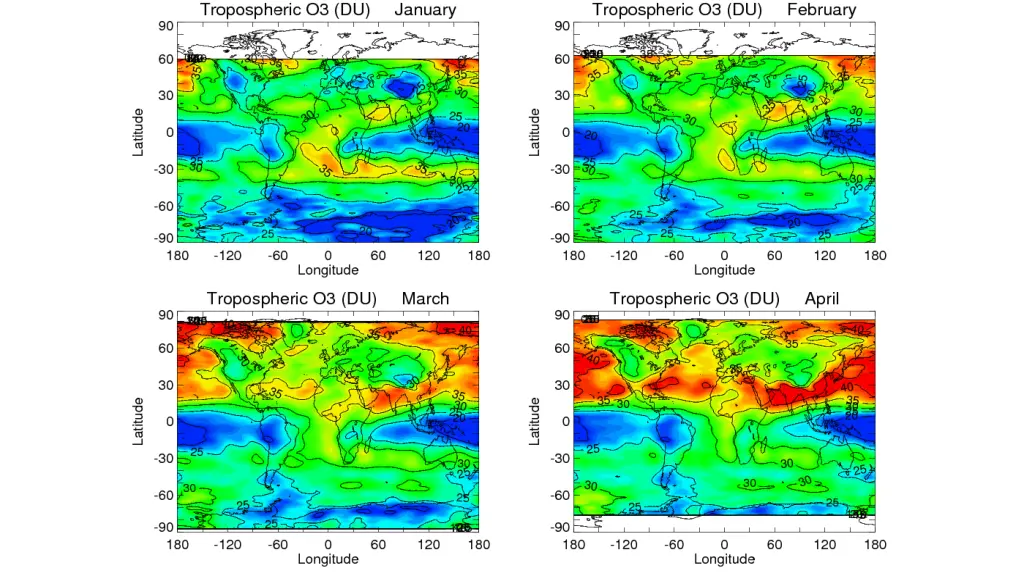
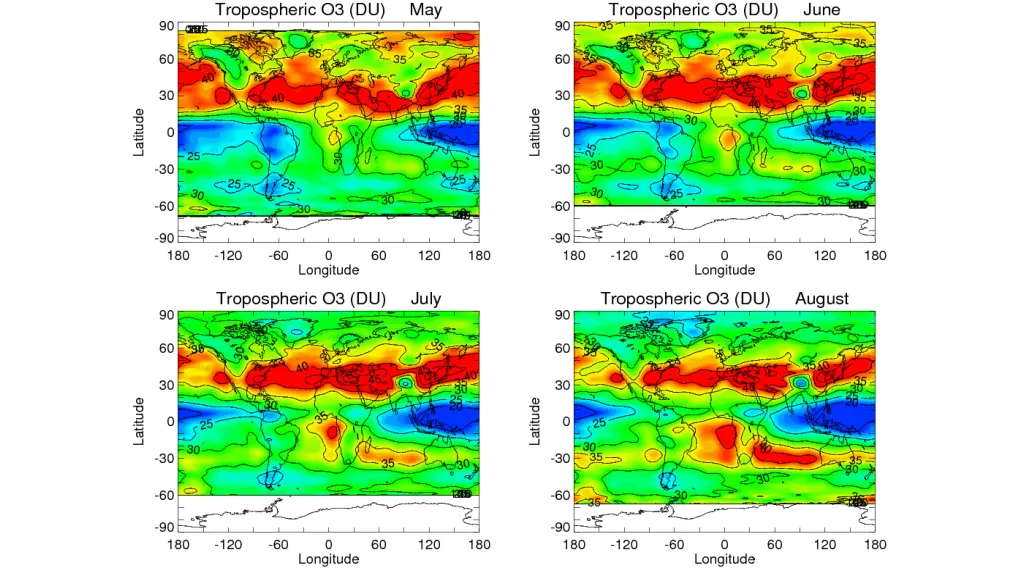
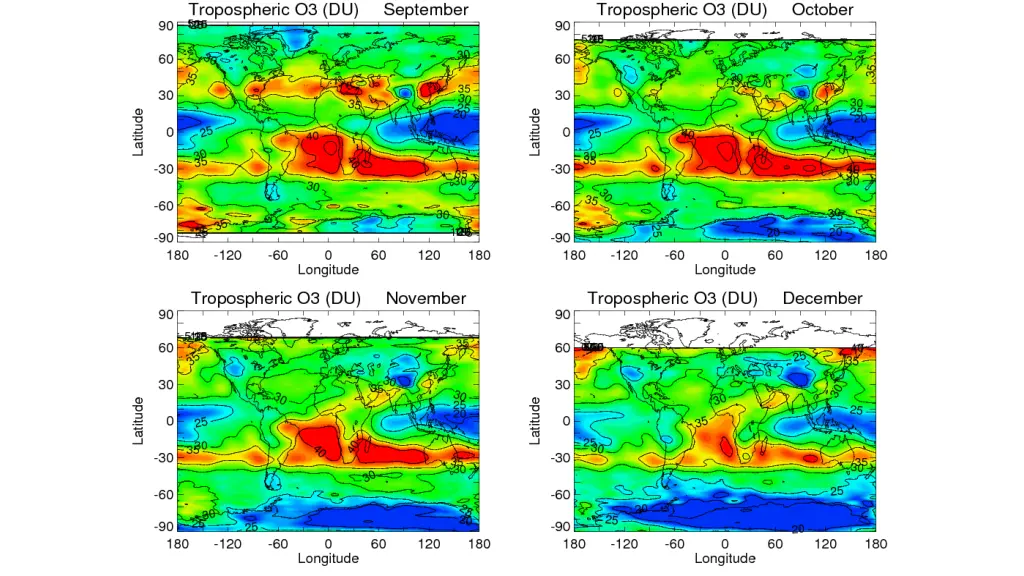
Global Tropospheric Column Ozone Climatology in Dobson Units Derived from Aura OMI v8.5 Total Column Ozone Minus Aura MLS v3.3 Stratospheric Column Ozone for Oct2004 through Jan2011 Uses WMO/NCEP 2K/km lapse rate tropopause pressure to separate tropospheric from stratospheric column ozone There is missing data in polar night latitudes including additional measurements at high latitudes/high solar zenith angles flagged as missing because of questionable data quality
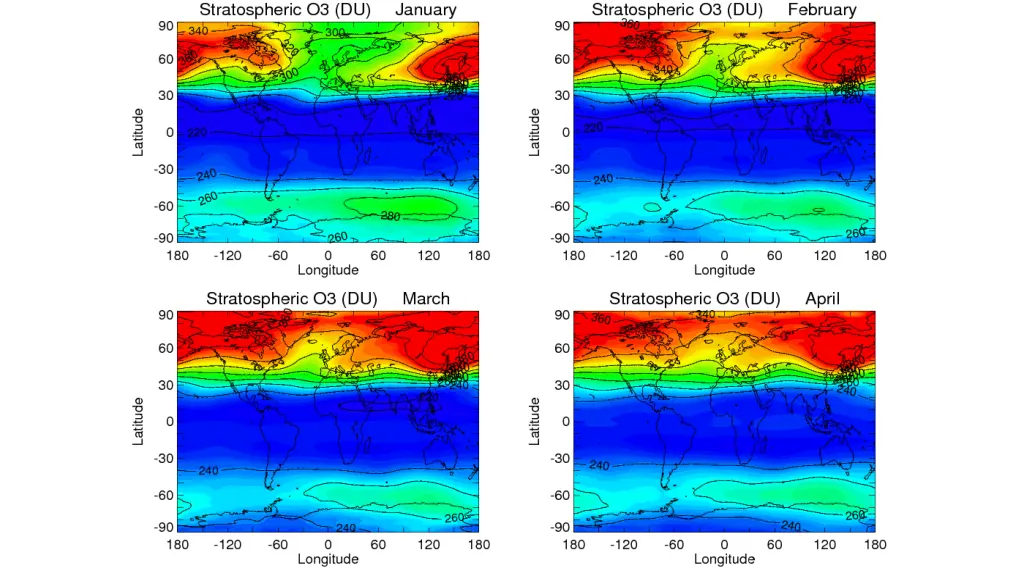
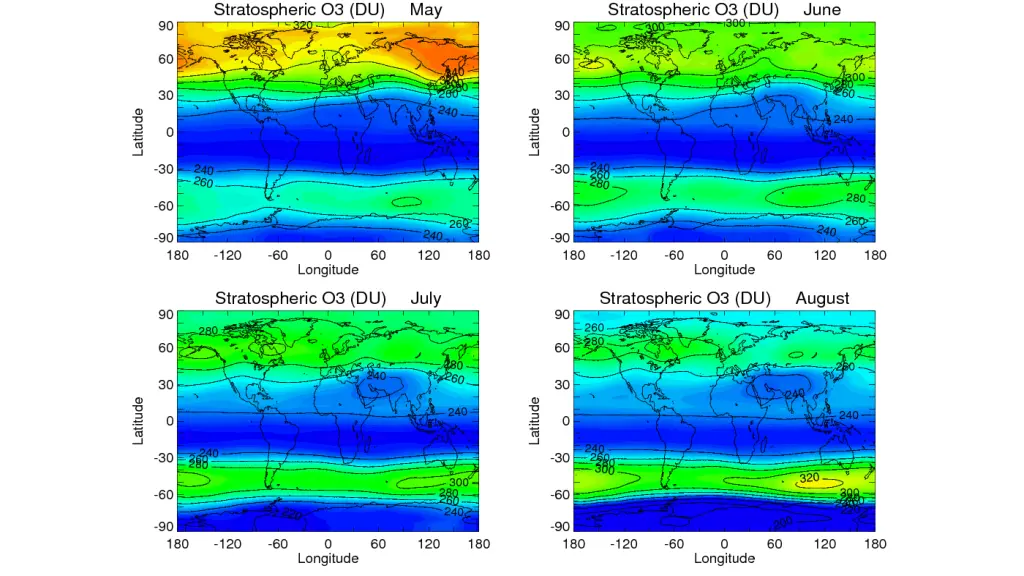
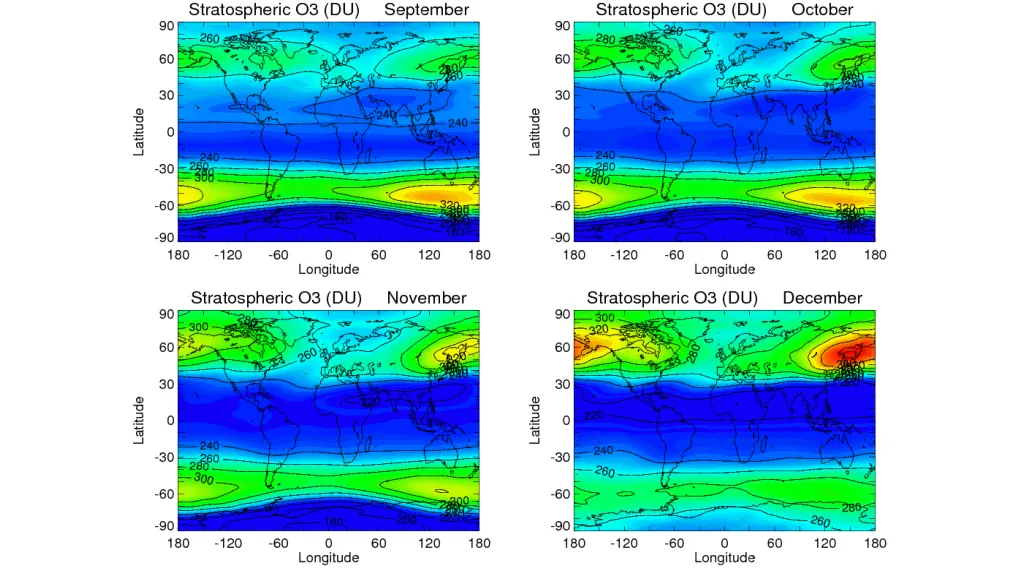
Global Stratospheric Column Ozone Climatology in Dobson Units Derived from Aura MLS v3.3 ozone profile measurements from October 2004 through January 2011 Uses WMO/NCEP 2K per km lapse rate tropopause pressure definition to derive stratospheric column ozone Missing MLS data within a few degrees of latitude from the poles are filled in using extrapolated MLS measurements from nearby lower latitudes
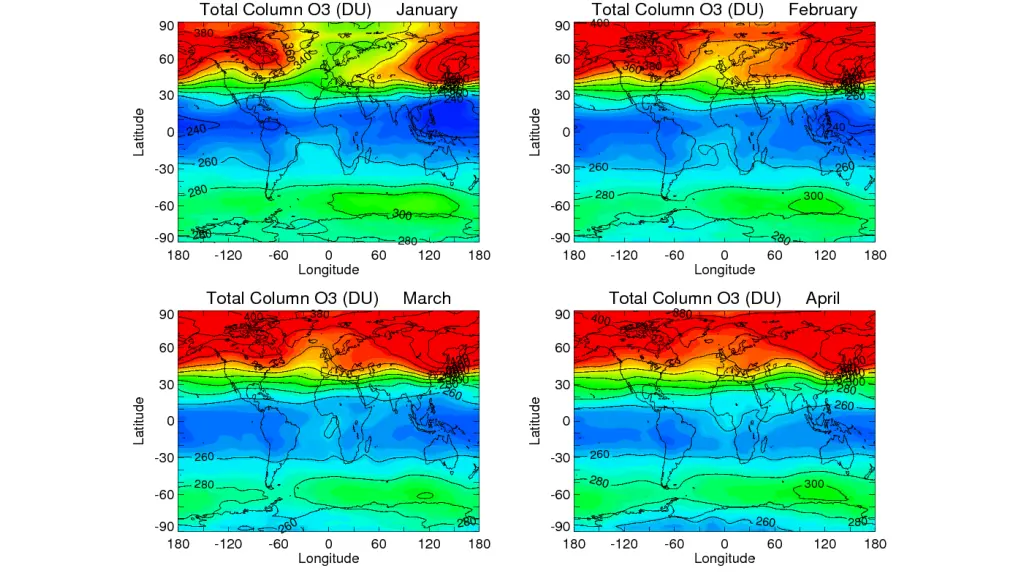
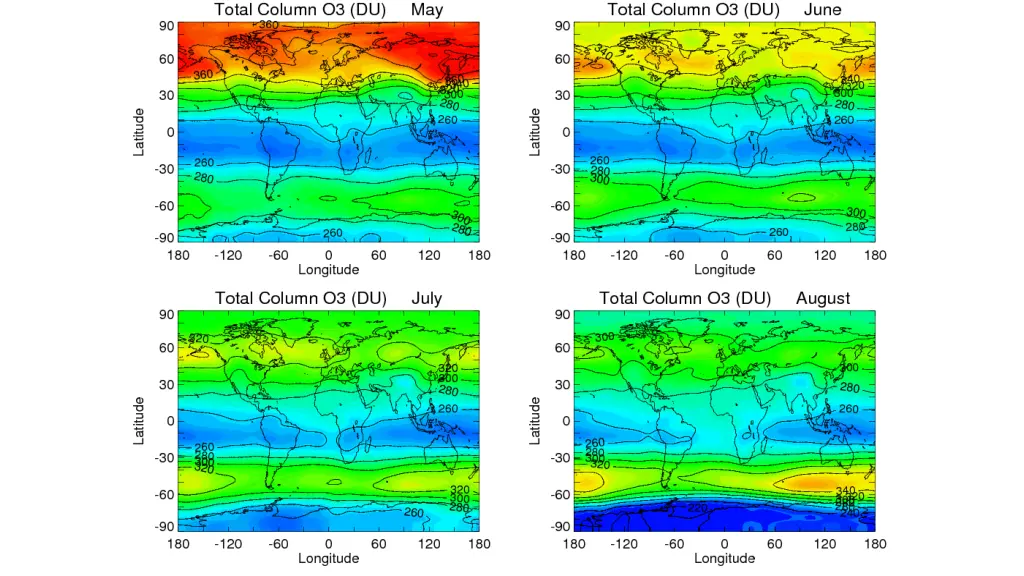
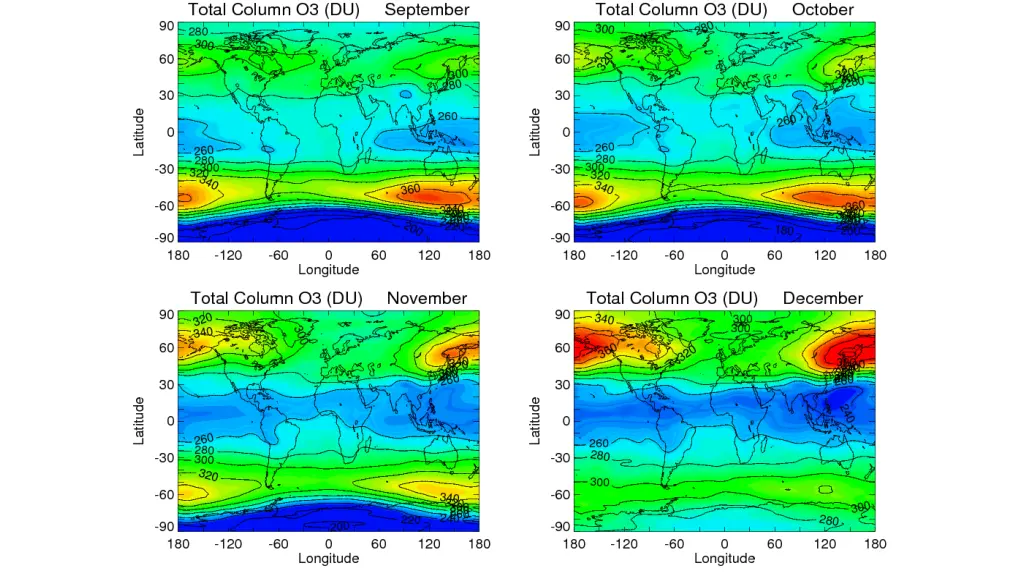
Global Total Column Ozone Climatology in Dobson Units Derived from Aura OMI v8.5 measurements everywhere except in polar night latitudes For polar night latitudes, MLS v3.3 stratospheric column ozone is about 90-95% of total column ozone the tropospheric column ozone product is extrapolated from lower latitudes and then added to MLS stratospheric column ozone to give a close estimate of total column ozone in polar night latitudes (result: total column ozone is an entire global map for each month, just like MLS stratospheric column ozone)
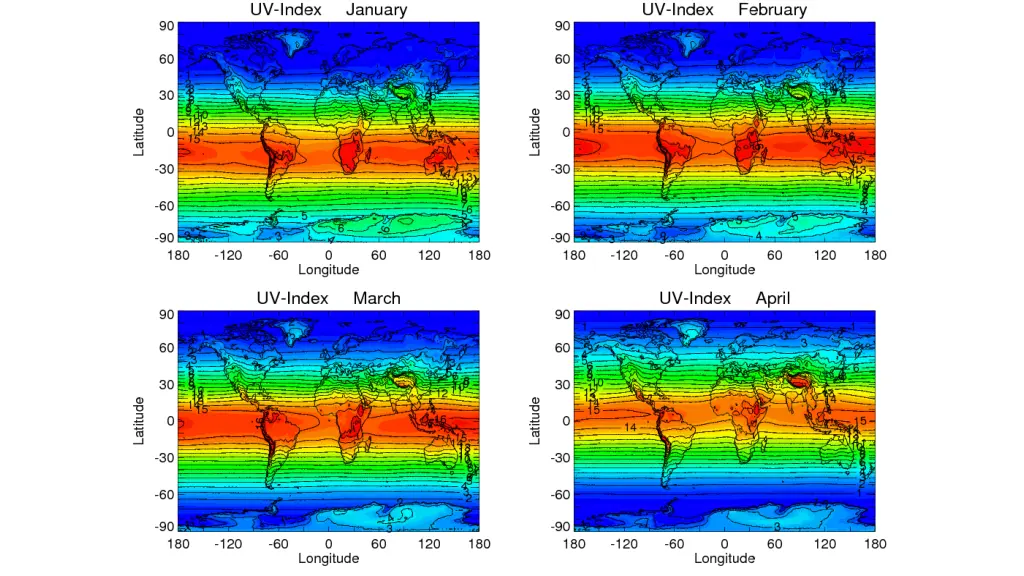
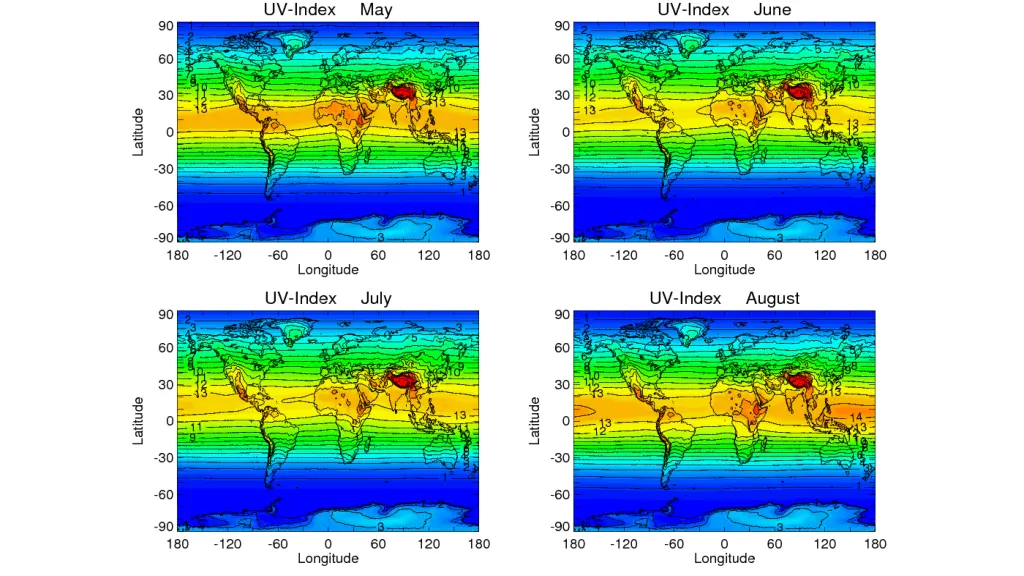
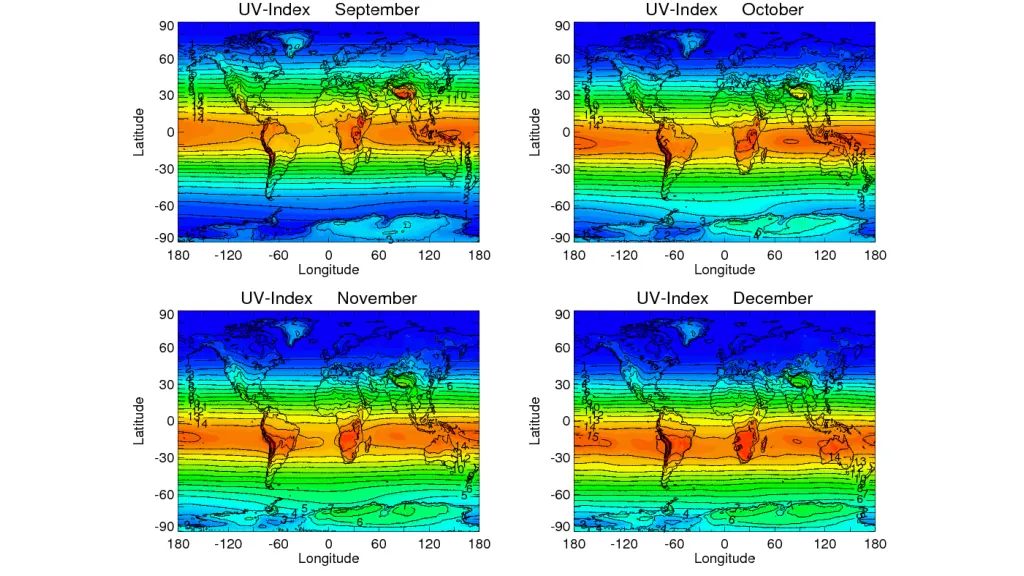
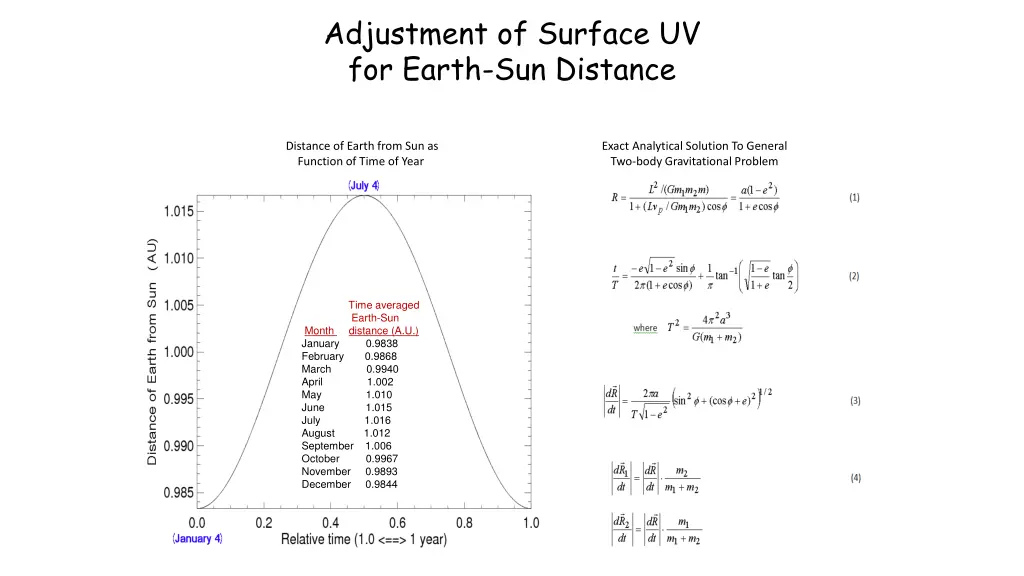
Global UV Index Climatology Derived directly from the total column ozone climatology product Derived using a UV-Index source code from P. Newman [e.g., Newman and McKenzie, 2011, Photochem. Photobiol. Sci.] which converts total column ozone and solar zenith angle at a fixed grid point to a single UV Index number The UV-Index maps include adjustments for both local terrain altitude and also the time-averaged Earth-Sun distance for each of the months of the climatology
Adjustment of Surface UV for Earth-Sun Distance Distance of Earth from Sun as Function of Time of Year Exact Analytical Solution To General Two-body Gravitational Problem Time averaged Earth-Sun Month January 0.9838 February 0.9868 March 0.9940 April 1.002 May 1.010 June 1.015 July 1.016 August 1.012 September 1.006 October 0.9967 November 0.9893 December 0.9844 distance (A.U.)