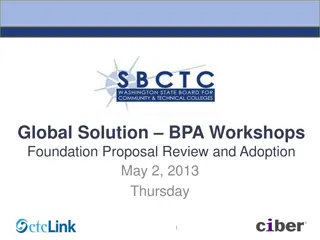
This proposal review and adoption workshop on April 30, 2013, covers the foundation decisions, system overview, integration points, and applications list related to PeopleSoft applications in a detailed manner. Explore the key terminologies, core HR functionalities, technology tools, security measures, financial management, and campus solutions discussed in this insightful workshop.
Please find below an Image/Link to download the presentation.
The content on the website is provided AS IS for your information and personal use only. It may not be sold, licensed, or shared on other websites without obtaining consent from the author. If you encounter any issues during the download, it is possible that the publisher has removed the file from their server.
You are allowed to download the files provided on this website for personal or commercial use, subject to the condition that they are used lawfully. All files are the property of their respective owners.
The content on the website is provided AS IS for your information and personal use only. It may not be sold, licensed, or shared on other websites without obtaining consent from the author.
Agenda Introductions and Welcome to PeopleSoft Application List Overview Foundation Decisions Systems Overview and Integration Points Useful Terminology 2
Applications List Human Capital Management Core Human Resources Includes Payroll Performance Management Succession Planning Time & Labor Benefits Administration eCompensation Absence Management Recruiting Solutions Talent Acquisition Management Campus Solutions (Student Administration) Recruiting and Admissions Campus Community Student Records Academic Structure Academic Advisement Financial Aid Student Financials Self-Service 3
Foundation Decisions Tests for solid foundation decisions: 1) Can we access data? Security 2) Can we run a report? Reporting 3) Does the solution create any extra or out-of-the-ordinary processing overhead? 4) What are the impacts on the integration points within each module? Intra-integration 5) What are the impacts on the integration points within each module?? Integration 6
Systems Overview and Integration Points Campus Solutions (CS) Campus Solutions provides functionality to support Student Administration business processes. This replaces the existing SMS, FAM and Degree Audit, as well as the WTS system with online Self-Service access for students and faculty. Human Capital Management (HCM) Financial Management (FSCM) Financial Management provides functionality to support Financial business processes and replaces the existing FMS, as well as providing significant additional functionality in Supply Chain Management (purchasing). Human Capital Management provides functionality to support Human Resources business processes and replaces the existing PPMS, as well as providing additional functionality around recruitment and talent management. In addition, online Self- Service access for employees. 7 7
Systems Overview and Integration Points Campus Solutions (CS) Recruiting and Admissions Human Capital Management (HCM) Financial Management (FSCM) General Ledger Accounts Payable Accounts Receivable/Billing Strategic Sourcing Budgeting Purchasing Cash Mgmt./Expense/Treasury Cashiering Fixed Assets Projects Grants/Capital Projects Contracts Grants Supplier Contracts Trust Funds HR Core Recruiting/Talent and Acquisitions Management Student Records Academic Advisement Payroll Student Financials Time and Attendance (Absence Management) Financial Aid Benefits 8 8
Systems Overview and Integration Points Human Capital Management (HCM) HR Core - Provides the foundation for your human resource management system Recruiting/Talent and Acquisitions Management - A complete, integrated system that enables organizations to effectively manage workforce acquisition across all employment categories. Whether you have a few resumes to fill hard- to-find positions or you have plenty of resumes but top candidates are scarce, Talent Acquisition Manager is ideally suited to meet your needs in any type of hiring conditions. Streams of applicants can be screened, interviewed, and hired quickly and efficiently. Payroll - Payroll for North America provides the tools to calculate earnings, taxes, and deductions efficiently; maintain balances; and report payroll data while minimizing the burden on IT managers and payroll staff. 9 9
Systems Overview and Integration Points Human Capital Management (HCM) Time and Attendance (Absence Management) Absence Management enables organizations to automate the processes for planning and compensating paid time off for their workforce. It combines employee and manager capabilities and tracks all absences in a single application. Time and Labor facilitates the management, planning, reporting, and approving of time, and calendar and schedule creation and usage, from one global web-based application. Benefits - When you implement PeopleSoft Benefits Administration, your first area of focus will be your benefit information. Using PeopleSoft terminology, benefit information includes programs, plan types, plans, rates, and calculation rules. All of this information is defined within the Manage Base Benefits business process in PeopleSoft Human Resources (HR). 10 10
Systems Overview and Integration Points Campus Solution (CS) Recruiting and Admissions - Enables the institution to plan, manage and track its admissions and recruiting activities. Provides the capability to tailor the admissions process according to the requirements and practices of the institution. It also enables you to set enrollment targets , track progress toward recruiting efforts, and analyze admissions decisions and patterns. Student Records - Enter, track, and process student academic and institution curriculum information; activate, enroll, grade, evaluate, and graduate students; create and maintain the course catalog and schedule of classes. Academic Advisement - Provides the campus wide ability to define and track graduation requirements, configure Advisement reports, evaluate student degree progress, configure reports based on student degree progress, and convey requirements, policies, and procedures by analyzing the configuration of advisement rules and the student record. 11 11
Systems Overview and Integration Points Campus Solution (CS) Student Financials - Enables the campus to manage and calculate student financial information. It provides functionality for billing and refunding student, as well as collecting past due balances. It provides functionality to set up payment plans for students. It also allows students to make payment online as well as through Cashiering. Financial Aid - Support all awarding and disbursing functions. It will replace the existing FAM system and support all the regulatory release updates (4 Oracle Bundles each year). Financial Aid draws heavily on the other CS modules for data and coordination. There will also be an interface with HCM to support work-study students employment and earnings. 12 12
Systems Overview and Integration Points Financial Management (FSCM) General Ledger Accounts Payable Accounts Receivable/Billing Strategic Sourcing Budgeting Purchasing Cash Mgmt./Expense/Treasury Cashiering 13 13
Human Capital Management Company- Information about a single company or multiple companies in your organization, from the corporate address to general ledger accounts, tax information, and payroll processing information. Business Unit - A business unit is an operational subset of an organization. Business units can be independent legal entities, or organizations that need to segregate their financial data for accounting purposes, or operational centers that segregate their operations for management purposes. Each Business Unit can have it s own business rules There must be at least one Business Unit! Department Where the person is located, attached and accounted for. In the HCM Application , a Department is equivalent to a person. 16
Human Capital Management Integration: Department table configuration integration with Financial Management. 21
Human Capital Management Key Concepts: Company Business Unit Department Integration: HCM Department HCM Department CS Academic Organization FSCM Department Integration Point with HCM: Faculty Workload EmplID 22
Campus Solutions Academic Institution - An entity, such as a university or college, which runs independently from other like entities and has its own set of rules and business processes. Academic Organization - Academic organization structure defines how an academic institution is organized from an administrative perspective. 23
Campus Solutions Academic Institution An entity, such as a university or college, which runs independently from other like entities and has its own set of rules and business processes. 24
Campus Solutions Academic Institution Each institution has its own schedule of classes, academic statistics, and academic transcript(s). 25
Campus Solutions Academic Organization Academic organization structure defines how an academic institution is organized from an administrative perspective. The Academic Organization in the CS pillar links to both the HCM and Financials pillars. Academic Organizations also assist with the security and reporting structures. 26
Campus Solutions Academic Organization FS Owner (Financial Services Owner) Business Unit - the Financial Services Dept. responsible for this Academic Organization Analysis, reporting, distribute revenue Department department in which the Business Unit resides 27
Campus Solutions Academic Organization FS Owner (Financial Services Owner) Business Unit - the Financial Services Dept. responsible for this Academic Organization Analysis, reporting, distribute revenue Department department in which the Business Unit resides 28
Campus Solutions Faculty Workload Assign and monitor the instructional and non-instructional workload for selected faculty, instructors, and staff; enables you to define workload limits for groups or individuals 29
Campus Solutions GL Interface: Student Financial accounting information links to Financial Services through the General Ledger Interface process and the Cashiering Interface process Every student financial transaction (charges, payments, refunds, waivers, financial aid, etc.) links to accounting information via an Item Type The next slide shows debit and credit chartfield information on an Item Type 30
Campus Solutions Student Financials GL Interface: The General Ledger Interface process extracts the Student Financials transaction data at the debit and credit level, and sends it to Financial Services This process is commonly scheduled to run automatically once per day 31
Campus Solutions Cashiering GL Interface The Cashiering GL Interface process runs separately from the main GL Interface. Its primary function is to send cashiering overages/shortages to the GL after the cash drawer has been counted 32
Campus Solutions Key Concepts: Academic Institution Academic Organization/Business Unit Integration: CS Academic Organization CS Academic Organization HCM Department FM Department Integration Point with HCM: Faculty Workload EmplID Integration Point with FSCM: GL Interface Cashiering AP Refunds 33
Financial Management GL - HCM Integrations From GL to HCM Ledger Definitions Calendars Journal Templates Chartfields Combination Edits SpeedTypes From HCM to GL Payroll Expense Transactions Payroll Encumbrances Payroll Encumbrance Reversals 34 34
Financial Management GL - Campus Integrations From GL to Campus Ledger Definitions Calendars Journal Templates Chartfields Combination Edits SpeedTypes From Campus to GL Student Financials Transactions Cashier Transactions 35 35
Financial Management Key Concepts: Business Unit Departments Integration: FSCM Department FSCM Department CS Academic Organization HCM Department Integration Point with CS: GL Interface Cashiering AP Refunds 37
Useful Terminology Company - Information about a single company or multiple companies in your organization, from the corporate address to general ledger accounts, tax information, and payroll processing information. Business Unit - An operational subset of an organization. Business units can be independent legal entities, or organizations that need to segregate their financial data for accounting purposes, or operational centers that segregate their operations for management purposes. Departments - Where the person is located, attached and accounted for. In the HCM Application , a Department is equivalent to a person. 40
Useful Terminology Academic Institution - An entity, such as a university or college, which runs independently from other like entities and has its own set of rules and business processes. Academic Organization - The structure that defines how an academic institution is organized from an administrative perspective. EmplID employee ID a catch all term for ID that still appears in some searches 41