Global Study on Multi-Year Funding Insights
Explore insights from a global study on multi-year funding involving signatories in September 2019. Discover trends in multi-year contributions, donor behaviors, funding allocations, and more. Gain a comprehensive view of the state of multi-year funding based on extensive research and data analysis.

Download Presentation

Please find below an Image/Link to download the presentation.
The content on the website is provided AS IS for your information and personal use only. It may not be sold, licensed, or shared on other websites without obtaining consent from the author. If you encounter any issues during the download, it is possible that the publisher has removed the file from their server.
You are allowed to download the files provided on this website for personal or commercial use, subject to the condition that they are used lawfully. All files are the property of their respective owners.
The content on the website is provided AS IS for your information and personal use only. It may not be sold, licensed, or shared on other websites without obtaining consent from the author.
E N D
Presentation Transcript
Global study on multi-year funding September 2019 GB WS 7&8 Workshop
Research context and approach Global study involving GB signatories on the state of multi-year funding Quantitative survey data collected from 11 GB members states and 10 implementers Complemented with findings from key informant interviews of 18 organisations, largely overlapping with sample from data collection The presented findings as snapshot of where we are at and where data gaps persist MYHF global study / www.devinit.org
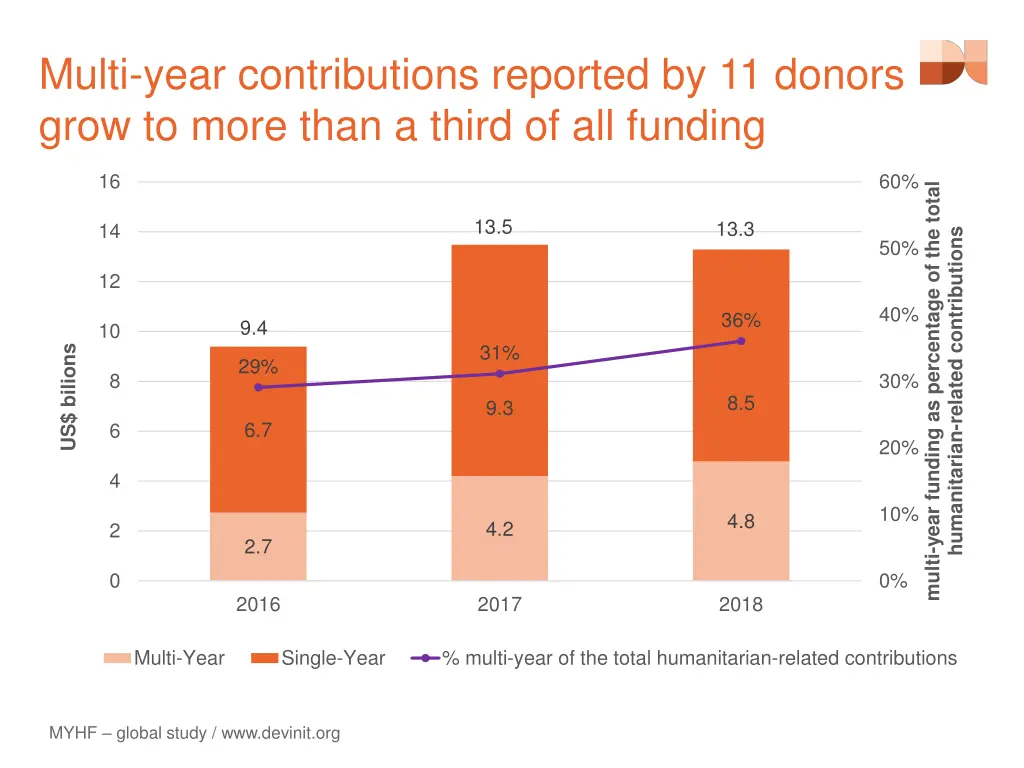
Multi-year contributions reported by 11 donors grow to more than a third of all funding 16 60% multi-year funding as percentage of the total 13.5 13.3 14 humanitarian-related contributions 50% 12 40% 36% 9.4 10 31% US$ bilions 29% 8 30% 8.5 9.3 6.7 6 20% 4 10% 4.8 4.2 2 2.7 0 0% 2016 2017 2018 Multi-Year Single-Year % multi-year of the total humanitarian-related contributions MYHF global study / www.devinit.org
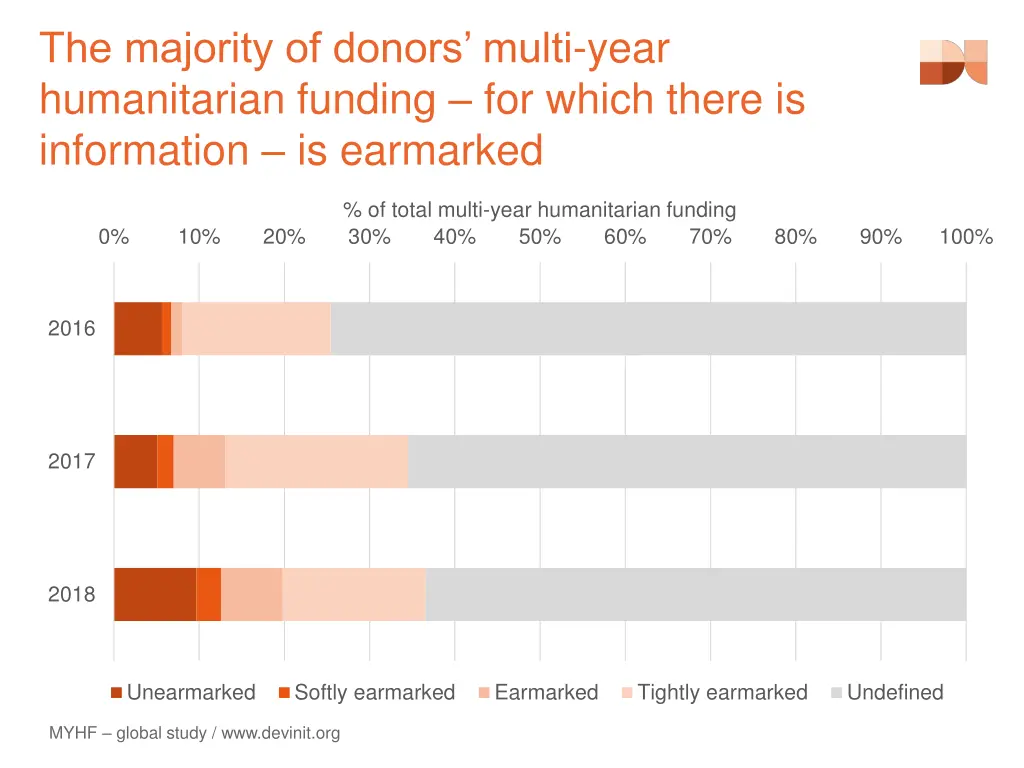
The majority of donors multi-year humanitarian funding for which there is information is earmarked % of total multi-year humanitarian funding 0% 10% 20% 30% 40% 50% 60% 70% 80% 90% 100% 2016 2017 2018 Unearmarked Softly earmarked Earmarked Tightly earmarked Undefined MYHF global study / www.devinit.org
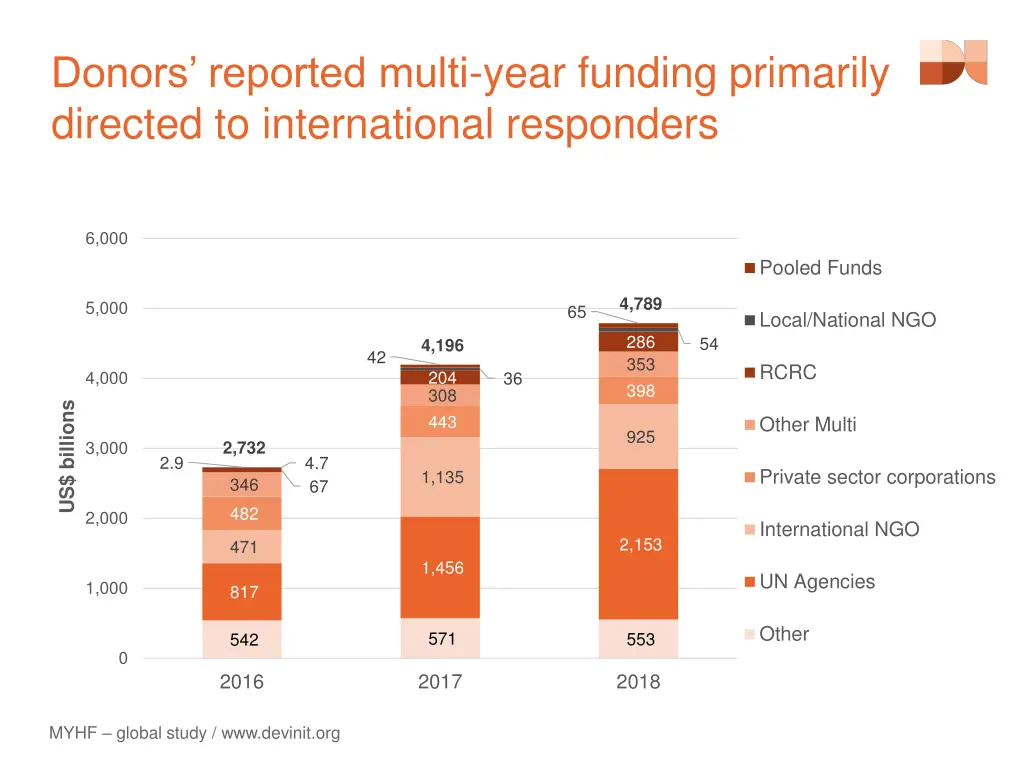
Donors reported multi-year funding primarily directed to international responders 6,000 Pooled Funds 4,789 5,000 65 Local/National NGO 286 54 4,196 42 353 RCRC 204 4,000 36 398 308 US$ billions 443 Other Multi 925 2,732 3,000 2.9 4.7 Private sector corporations 1,135 346 67 482 2,000 International NGO 2,153 471 1,456 UN Agencies 1,000 817 Other 571 553 542 0 2016 2017 2018 MYHF global study / www.devinit.org
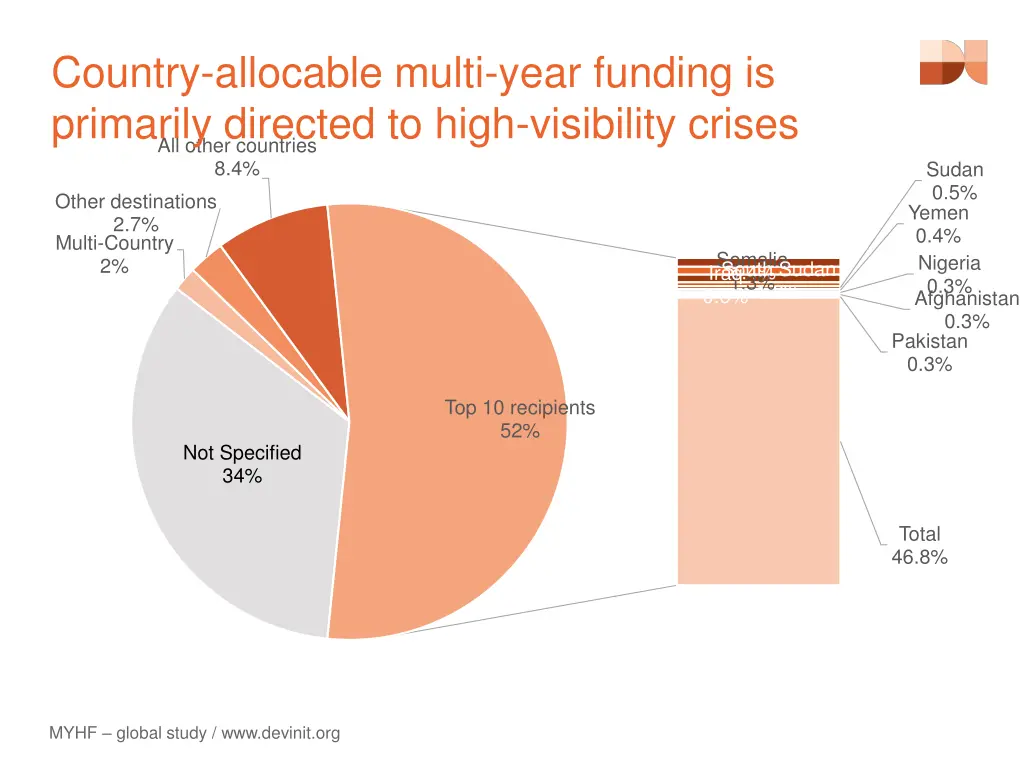
Country-allocable multi-year funding is primarily directed to high-visibility crises All other countries 8.4% Sudan 0.5% Yemen 0.4% Nigeria 0.3% Afghanistan 0.3% Pakistan 0.3% Other destinations 2.7% Multi-Country 2% Turkey 1.4% 1.3% 0.6% Somalia South Sudan 1.2% Iraq Top 10 recipients 52% Not Specified 34% Total 46.8% MYHF global study / www.devinit.org
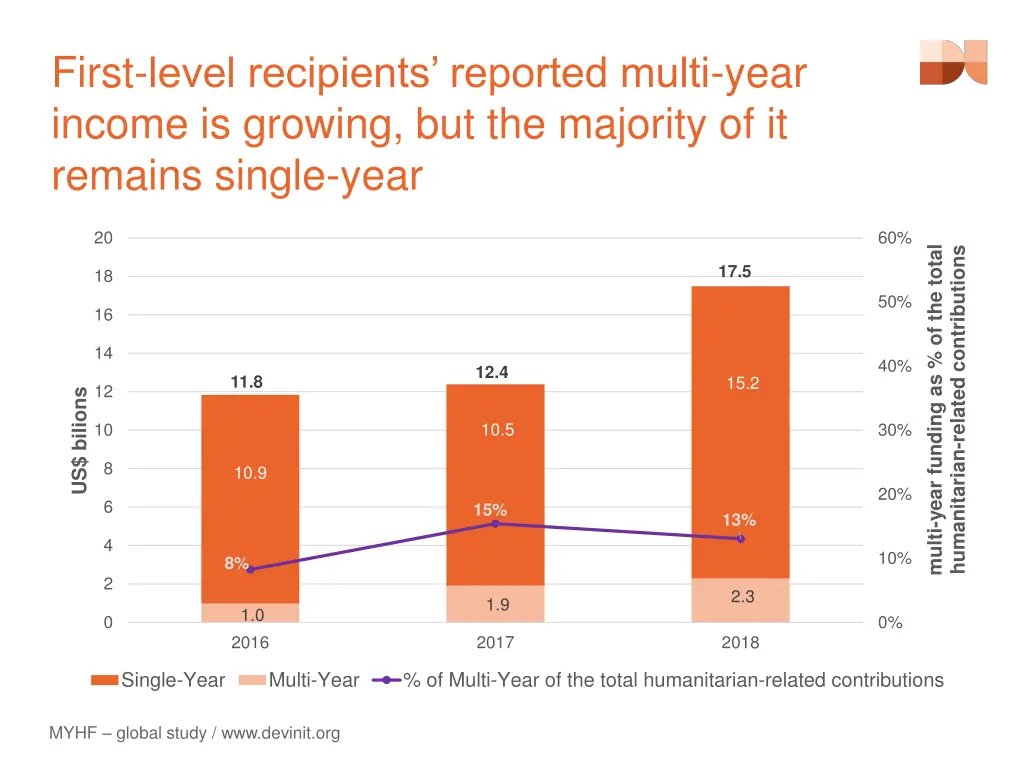
First-level recipients reported multi-year income is growing, but the majority of it remains single-year 20 60% multi-year funding as % of the total humanitarian-related contributions 17.5 18 50% 16 14 40% 12.4 11.8 15.2 12 US$ bilions 10.5 10 30% 8 10.9 20% 6 15% 13% 4 10% 8% 2 2.3 1.9 1.0 2016 0 0% 2017 2018 Single-Year Multi-Year % of Multi-Year of the total humanitarian-related contributions MYHF global study / www.devinit.org
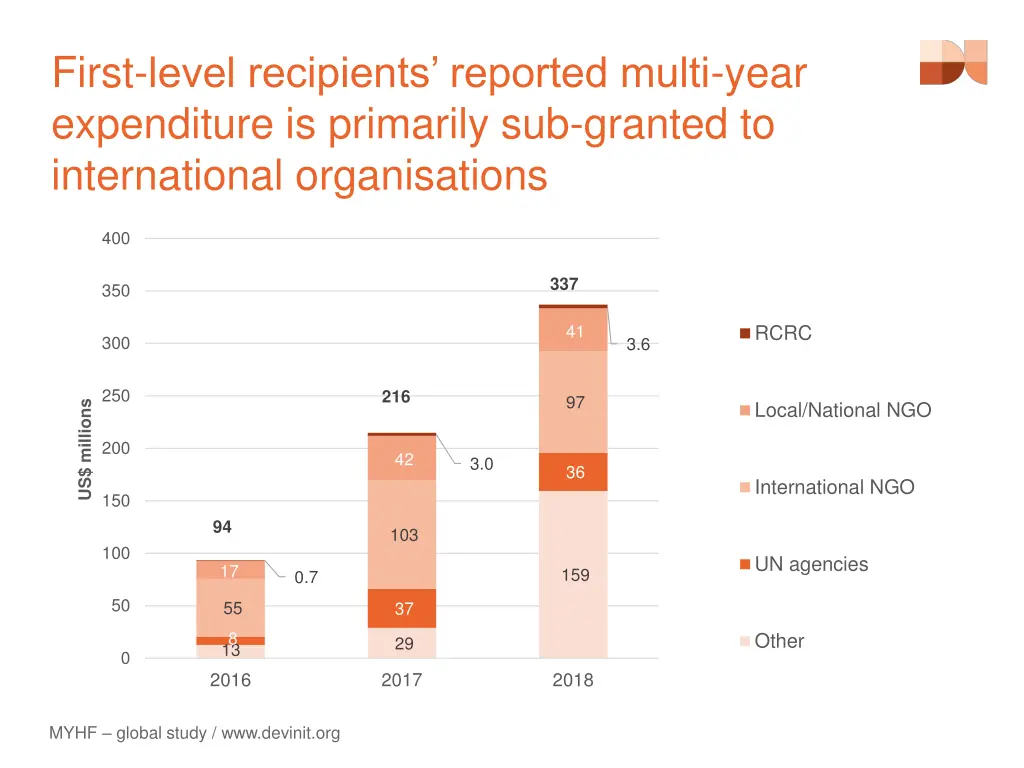
First-level recipients reported multi-year expenditure is primarily sub-granted to international organisations 400 337 350 RCRC 41 300 3.6 250 216 97 Local/National NGO US$ millions 200 42 3.0 36 International NGO 150 94 103 100 UN agencies 17 159 0.7 50 55 37 8 Other 29 13 2016 0 2017 2018 MYHF global study / www.devinit.org
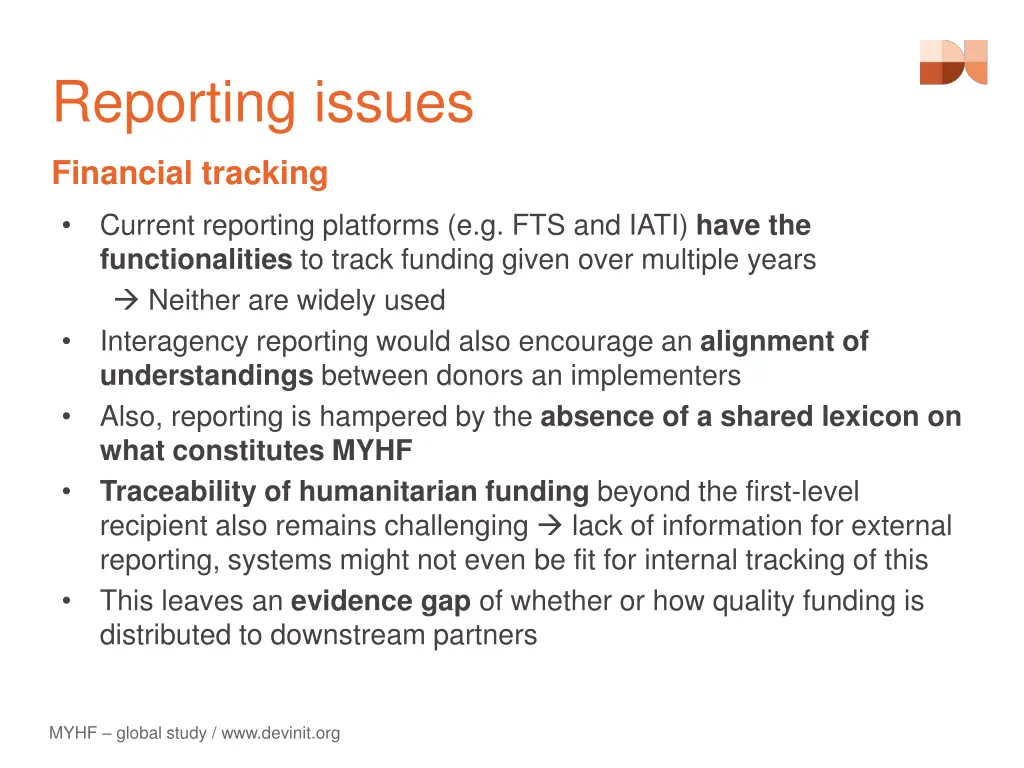
Reporting issues Financial tracking Current reporting platforms (e.g. FTS and IATI) have the functionalities to track funding given over multiple years Neither are widely used Interagency reporting would also encourage an alignment of understandings between donors an implementers Also, reporting is hampered by the absence of a shared lexicon on what constitutes MYHF Traceability of humanitarian funding beyond the first-level recipient also remains challenging lack of information for external reporting, systems might not even be fit for internal tracking of this This leaves an evidence gap of whether or how quality funding is distributed to downstream partners MYHF global study / www.devinit.org
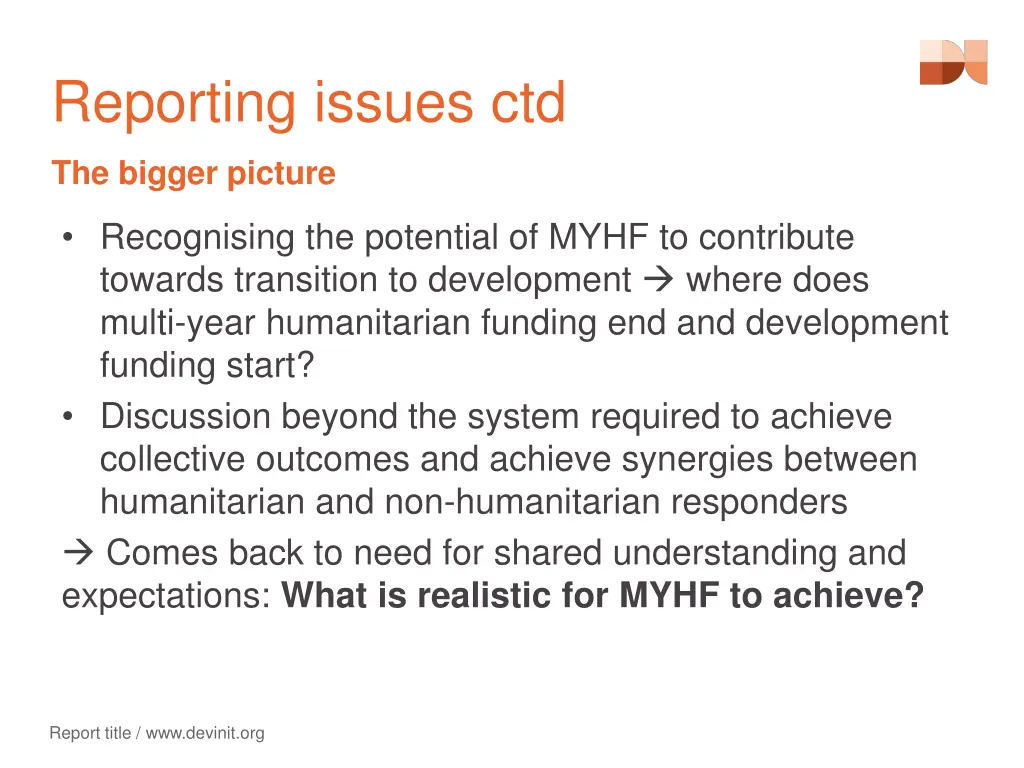
Reporting issues ctd The bigger picture Recognising the potential of MYHF to contribute towards transition to development where does multi-year humanitarian funding end and development funding start? Discussion beyond the system required to achieve collective outcomes and achieve synergies between humanitarian and non-humanitarian responders Comes back to need for shared understanding and expectations: What is realistic for MYHF to achieve? Report title / www.devinit.org
Thank you! Questions and feedback welcome Development Initiatives North Quay House Quay side Temple Back Bristol BS1 6FL United Kingdom www.devinit.org