Explore Module N.B0-84 Initial Capability for lower cost ground surveillance in the aviation industry, encompassing technologies like ADS-B OUT and Multilateration systems for enhanced safety and efficiency across various flight phases. Witness the impact of advanced surveillance techniques on operational improvements and reduction in incidents.
Please find below an Image/Link to download the presentation.
The content on the website is provided AS IS for your information and personal use only. It may not be sold, licensed, or shared on other websites without obtaining consent from the author. If you encounter any issues during the download, it is possible that the publisher has removed the file from their server.
You are allowed to download the files provided on this website for personal or commercial use, subject to the condition that they are used lawfully. All files are the property of their respective owners.
The content on the website is provided AS IS for your information and personal use only. It may not be sold, licensed, or shared on other websites without obtaining consent from the author.
E N D
Presentation Transcript
International Civil Aviation Organization SIP/2012/ASBU/Nairobi-WP/24C Aviation System Block Upgrades Module N B0-84 Initial Capability for Ground-based Cooperative Surveillance Workshop on preparations for ANConf/12 ASBU methodology (Nairobi, 13-17 August 2012)
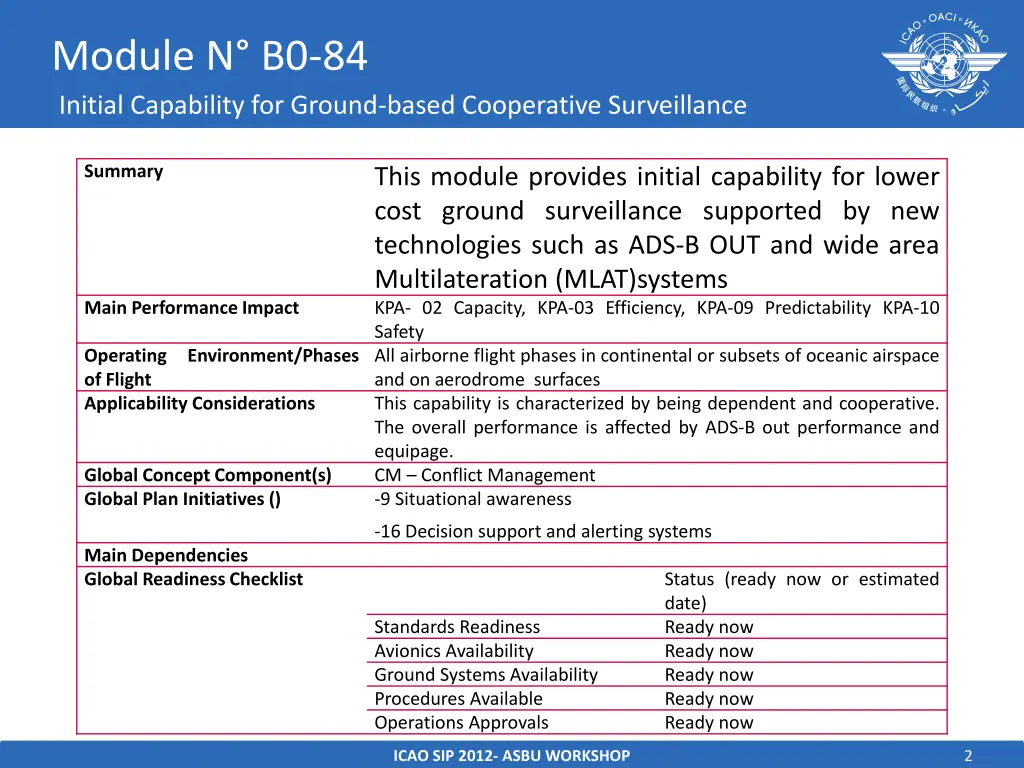
Module N B0-84 Initial Capability for Ground-based Cooperative Surveillance Summary This module provides initial capability for lower cost ground surveillance supported by new technologies such as ADS-B OUT and wide area Multilateration (MLAT)systems KPA- 02 Capacity, KPA-03 Efficiency, KPA-09 Predictability KPA-10 Safety All airborne flight phases in continental or subsets of oceanic airspace and on aerodrome surfaces This capability is characterized by being dependent and cooperative. The overall performance is affected by ADS-B out performance and equipage. CM Conflict Management -9 Situational awareness Main Performance Impact Operating Environment/Phases of Flight Applicability Considerations Global Concept Component(s) Global Plan Initiatives () -16 Decision support and alerting systems Main Dependencies Global Readiness Checklist Status (ready now or estimated date) Ready now Ready now Ready now Ready now Ready now Standards Readiness Avionics Availability Ground Systems Availability Procedures Available Operations Approvals ICAO SIP 2012- ASBU WORKSHOP 2
Module N B0-84 - Baseline Air to ground aircraft position and surveillance is accomplished Primary Radar; and Secondary Radar ICAO SIP 2012- ASBU WORKSHOP 3
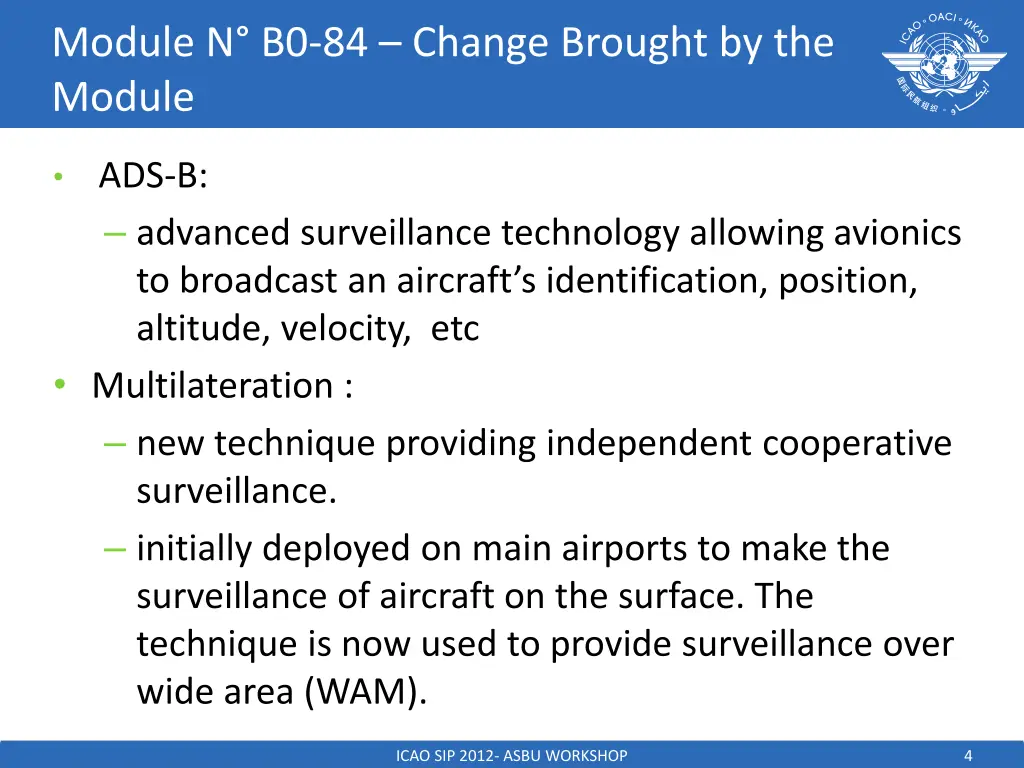
Module N B0-84 Change Brought by the Module ADS-B: advanced surveillance technology allowing avionics to broadcast an aircraft s identification, position, altitude, velocity, etc Multilateration : new technique providing independent cooperative surveillance. initially deployed on main airports to make the surveillance of aircraft on the surface. The technique is now used to provide surveillance over wide area (WAM). ICAO SIP 2012- ASBU WORKSHOP 4
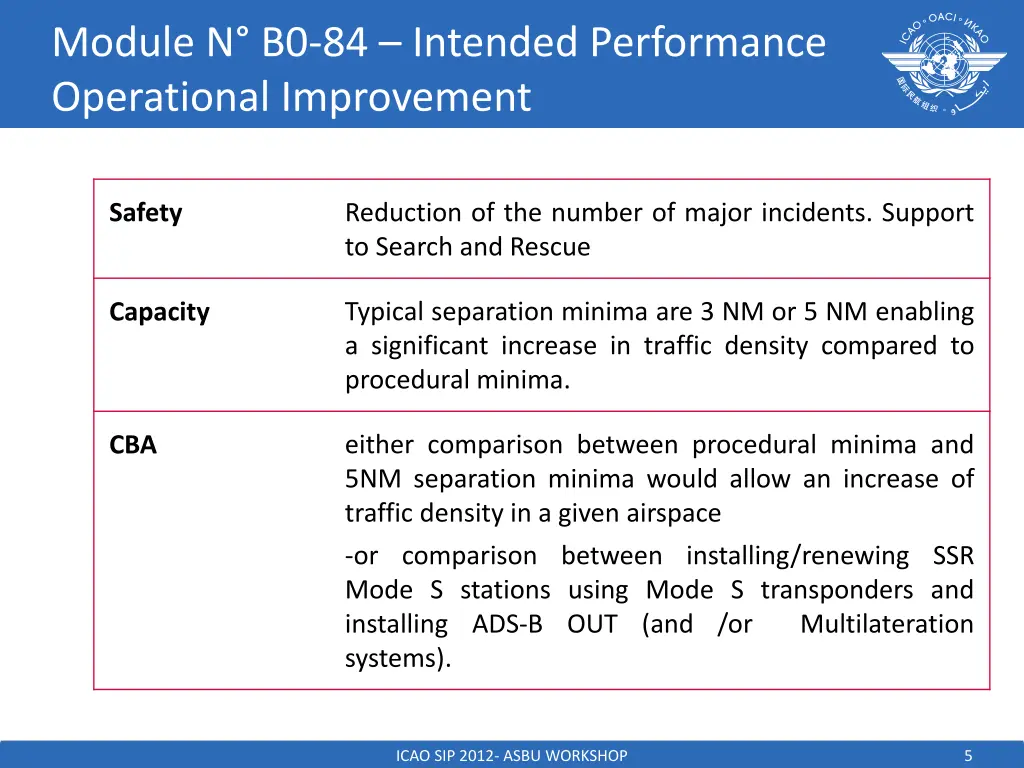
Module N B0-84 Intended Performance Operational Improvement Reduction of the number of major incidents. Support to Search and Rescue Safety Typical separation minima are 3 NM or 5 NM enabling a significant increase in traffic density compared to procedural minima. Capacity either comparison between procedural minima and 5NM separation minima would allow an increase of traffic density in a given airspace -or comparison between installing/renewing SSR Mode S stations using Mode S transponders and installing ADS-B OUT (and /or Multilateration systems). CBA ICAO SIP 2012- ASBU WORKSHOP 5
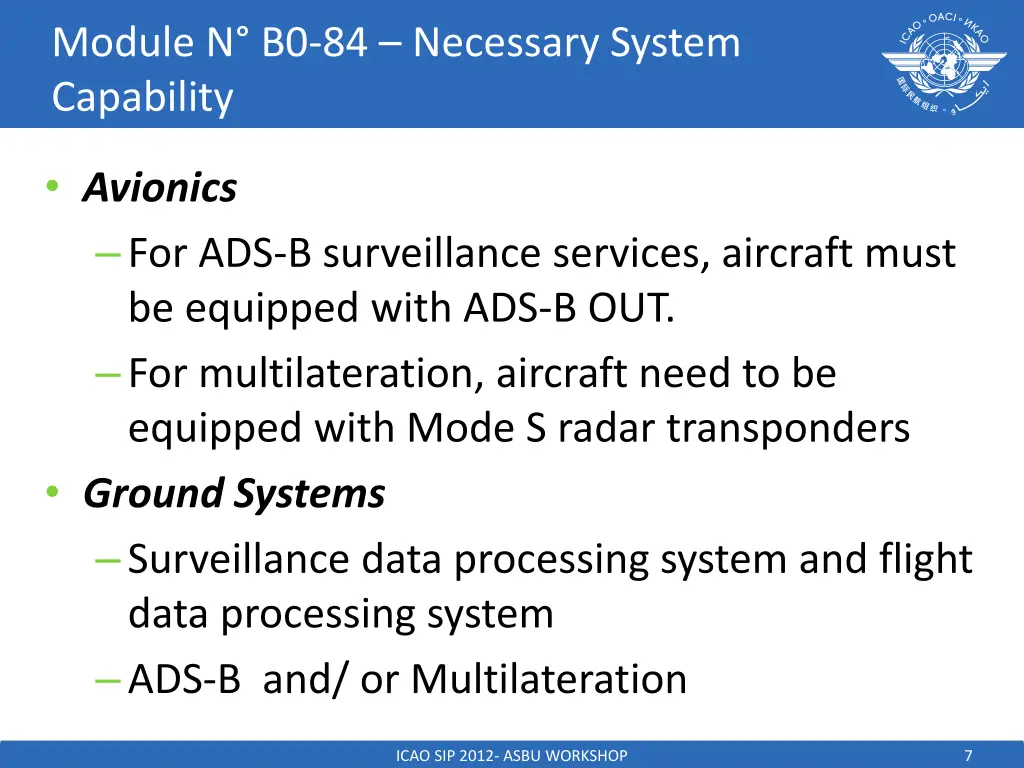
Module N B0-84 Necessary System Capability Avionics For ADS-B surveillance services, aircraft must be equipped with ADS-B OUT. For multilateration, aircraft need to be equipped with Mode S radar transponders Ground Systems Surveillance data processing system and flight data processing system ADS-B and/ or Multilateration ICAO SIP 2012- ASBU WORKSHOP 7
Module N B0-84 Training and Qualification Requirements Controllers must receive specific training for separation provision, information service and search and rescue based on the ADS-B and WAM systems in use. Training in the operational standards and procedures are required for this module Qualifications requirements are identified in the regulatory requirements ICAO SIP 2012- ASBU WORKSHOP 8
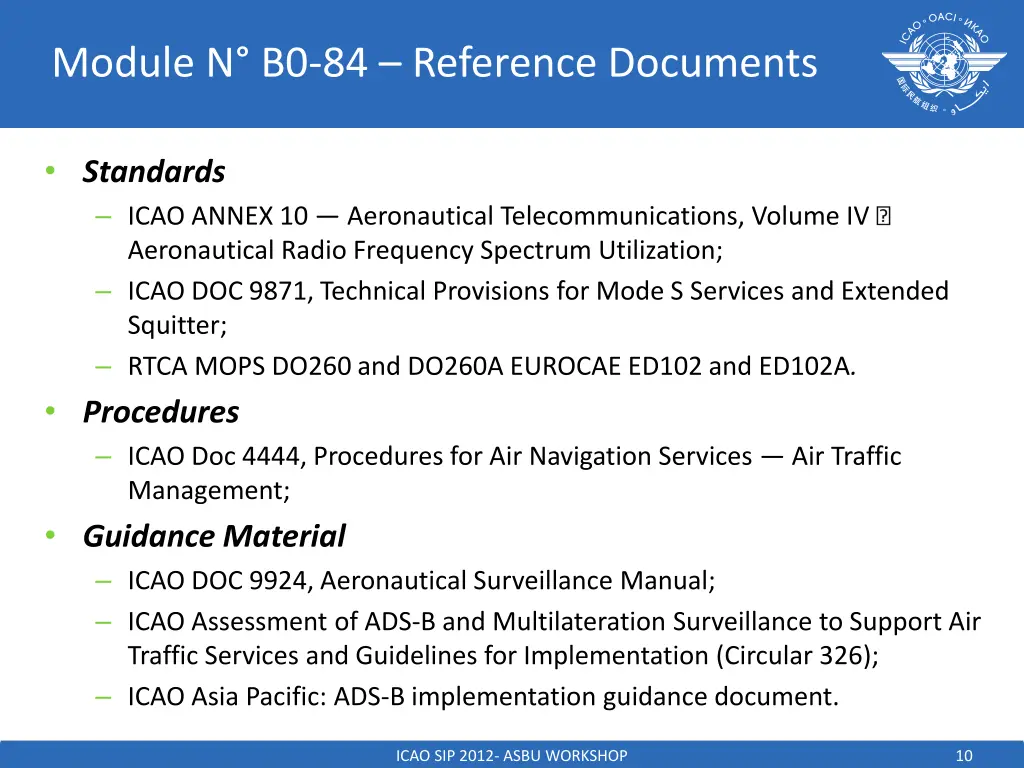
Module N B0-84 Reference Documents Standards ICAO ANNEX 10 Aeronautical Telecommunications, Volume IV Aeronautical Radio Frequency Spectrum Utilization; ICAO DOC 9871, Technical Provisions for Mode S Services and Extended Squitter; RTCA MOPS DO260 and DO260A EUROCAE ED102 and ED102A. Procedures ICAO Doc 4444, Procedures for Air Navigation Services Air Traffic Management; Guidance Material ICAO DOC 9924, Aeronautical Surveillance Manual; ICAO Assessment of ADS-B and Multilateration Surveillance to Support Air Traffic Services and Guidelines for Implementation (Circular 326); ICAO Asia Pacific: ADS-B implementation guidance document. ICAO SIP 2012- ASBU WORKSHOP 10
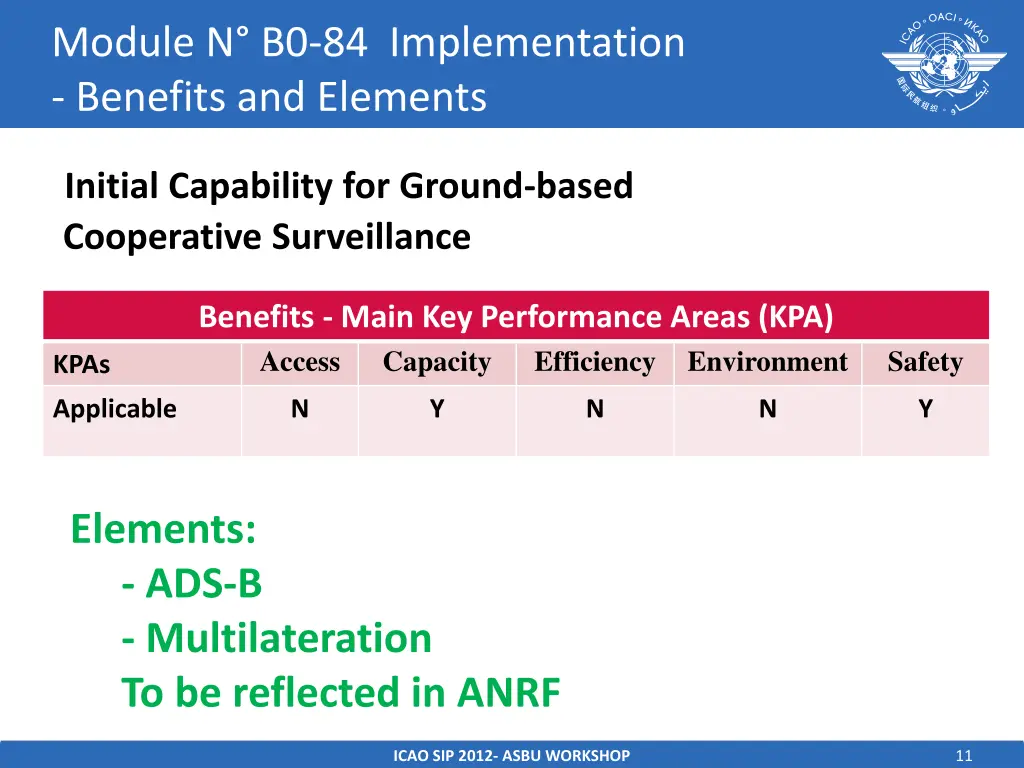
Module N B0-84 Implementation - Benefits and Elements Initial Capability for Ground-based Cooperative Surveillance Benefits - Main Key Performance Areas (KPA) Access Capacity Efficiency Environment Safety KPAs Applicable N Y N N Y Elements: - ADS-B - Multilateration To be reflected in ANRF ICAO SIP 2012- ASBU WORKSHOP 11