Handling Child Victims and Witnesses in Court
Under the Uganda Children Act, child victims and witnesses are entitled to protection in the justice system. Children are vulnerable due to their age and dependency on adults. The presentation covers the involvement of children in court matters, their vulnerability, and the challenges they face as victims or witnesses in criminal cases. It emphasizes the need for child-friendly services and best practices in court to ensure the protection and well-being of children.

Download Presentation

Please find below an Image/Link to download the presentation.
The content on the website is provided AS IS for your information and personal use only. It may not be sold, licensed, or shared on other websites without obtaining consent from the author.If you encounter any issues during the download, it is possible that the publisher has removed the file from their server.
You are allowed to download the files provided on this website for personal or commercial use, subject to the condition that they are used lawfully. All files are the property of their respective owners.
The content on the website is provided AS IS for your information and personal use only. It may not be sold, licensed, or shared on other websites without obtaining consent from the author.
E N D
Presentation Transcript
INDUCTION COURSE FOR NEWLY INDUCTION COURSE FOR NEWLY APPOINTED CHIEF MAGISTRATES AND APPOINTED CHIEF MAGISTRATES AND MAGISTRATES GRADE ONE MAGISTRATES GRADE ONE HANDLING OF CHILD VICTIMS AND WITNESSES PRESENTED BY:- JUSTICE DAMALIE N. LWANGA 5thMARCH 2025
PRESENTATION OUTLINE INTRODUCTION CHILDREN INVOLVEMENT IN COURT BUSINESS THE VULNERABILITY OF CHILDREN PROTECTION OF CHILD VICTIMS BY THE LAW THE NEED FOR CHILD FRIENDLY SERVICES BEST CHILD FRIENDLY PRACTICES BY COURT CONCLUSION
INTRODUCTION Under the Uganda Children Act a child is a person below the age of 18 years. Uganda is a party to several International and RegionalInstruments/ Standards for protection of children. Accordingly Uganda has enacted child friendly laws with a view to promote the rights of children. Just like the rights of children in conflict with the law are protected under the Children Act, child victims and witnesses are also entitled to protection in the justice system, including the courts.
HOW ARE CHILDREN INVOLVED IN COURT MATTERS? Children appear in court: - When they get in conflict with the law (juvenile offenders); - When they get in contact with the law to testify in civil cases e.g custody; - When they get in contact with the law as victims or witnesses in criminal cases like murder, child sexual or physical abuse, property related crimes, or in crimes relating to mental/psychological harm e.g pornography. Children are often victims and witnesses in crimes committed by people close to them e.g parents, guardians, relatives, teachers or child care personnel.
THE VULNERABILITY OF CHILDREN All children are vulnerable by virtue of their age: - Children depend on adults for their welfare - A child s brain is not fully developed - Child development process and needs In addition to the above, child victims and witnesses in criminal cases are vulnerable witnesses because of the nature/effects/circumstances of the offences or evidence involved; and The nature of the justice delivery process.
VULNERABILITY OF CHILD VICTIMS Where the child is a victim or witness to violent crime this may result into emotional pressure, intimidation or threats (direct or otherwise) by the offender or his/her family, or the community. Due to the trauma and stigma resulting from the offence the child may develop long term fear, low self esteem, loss of trust, anger, depression, shame, powerlessness, dissociation, embarrassment etc. The child might develop feelings of guilt even where he/she is the victim of crime e.g sexual abuse.
VULNERABILITY OF CHILD VICTIMS CONTD The child might fear/hate seeing/facing the abuser or testifying against him/her due to threats/nature of the offence/relationship. The child might lose trust in certain people, or lose interest in activities that are necessary for their development. The child might wish to simply forget the incident(s) rather than be reminded of it over and over (secondary trauma). The child might lose interest in the case due to unfriendly/poor handling during the legal process.
PROTECTION OF CHILD VICTIMS BY THE LAW The law protects children mainly for morality reasons e.g defilement: - Article 28(2) of the Constitution which provides for exclusion of the public at trials generally Nothing in clause (1) of this article shall prevent the court or tribunal from excluding the press or the public from all or any proceedings before it for reasons of morality, public order or national security, as may be necessary in a free and democratic society.
PROTECTION OF CHILD VICTIMS CONT The law specifically provides for protection of victims of sexual offences by court in cases of ordinary (simple) defilement: - Sec. 40(1)(1a) of the MCA In particular, the court shall, when conducting a trial of the offence of defilement, consider the need, in the interest of the child, to exercise its power under article 28(2) of the Constitution, to exclude the press and the public from the proceedings before the court for reasons of morality and to protect the victim of the offence . Unfortunately there is no similar provision in the Trial on Indictments Act, which governs trials in the High Court.
PROTECTION OF CHILD VICTIMS Judiciary ICT Innovations Including the Judicature (Visual Audio Link) Rules. The Rules permit the use of technology in conducting court proceedings relating to Sexual or violent offences Rule 5(b); hence victims do not necessarily have to be physically present in court, or even the accused person(s). Rule 15(1) Court to adopt child friendly procedures, including examination being done through an intermediary if necessary. Rule 15(2) Court may direct that examination be done in a manner appropriate for the age or mental ability of the child.
THE NEED FOR CHILD FRIENDLY SERVICES Child friendly services are central in the Protection, Assistance and Access to justice for child victims of offences, and child witnesses: To promote children rights protection from harm e.g secondary trauma, mitigating the effects of child abuse, and to address their development needs. Ensuring the children s cooperation throughout the legal process, for successful trials of their abusers or other offenders; it is essential that the child appreciates and trusts the system and the players in the system.
ATTITUDE AND UNDERSTANDING It is important for all actors in cases where children are involved to have a positive attitude and understanding: - A traumatised child victim/witness may not behave or conduct him/herself as expected. - A victim may fear to report in time due to fear of the perpetrator, or the reaction of the parents, community or law enforcement. - Children must be protected from unnecessary public exposure to sexual matters, due to tender age and morality reasons. * Each case should however, be handled on its own merits.
BEST CHILD FRIENDLY PRACTICES BY COURT/PROCEDURAL JUSTICE Practitioners have over time developed Best Child Friendly Practices for handling of child victims and witnesses, to fill the gap: At court the child should be kept in child friendly environment/waiting room, depending on his/her age. Choose the best position for the child in court, for him/her to feel safe and protected. Do not keep the child waiting for long before his/her testimony. Ensure that the child has eaten before giving his/her testimony. The child s attention span and pace should be taken into account.
BEST CHILD FRIENDLY PRACTICES CONT Proceedings should be held in camera or through Visual Audio Link. Encourage the use of Anatomical Dolls in sexual offences, for morality reasons. Avail drinking water and tissues when necessary. Apply a trauma informed approach, to ensure the child feels safe and that his/her concerns are taken care of. Trauma could manifest through Agitation, Hostility, Difficulty sitting or standing still, Withdrawal or indifference, Lack of eye contact, Inattentiveness, Memory loss or Fragmentation of memory.
BEST CHILD FRIENDLY PRACTICES CONTD Allow the child to be accompanied by a support person in court, to maintain his/her confidence and a feeling of security, and to take care of the child s other concerns. Let the child know his/her role and that of court; and the value of his/her testimony to the court. Develop rapport with the child victim/witness to build her/his trust/confidence, in the court. Refer the child for psychosocial or other support if necessary.
BEST CHILD FRIENDLY PRACTICES CONTD Avoid intimidating commands to the child or to other people in the presence of the child. Protect the child from unfair and embarrassing questions. Disallow victim blaming statements or questions to the child. Conduct court in a child friendly/ordinary attire for a conducive court environment; do away with the court robes. Ensure use of age appropriate language and questions in court, including during the voire dire.
CONDUCT OF A VOIRE DIRE In cases of young children the voire dire is a good opportunity for court to develop rapport with the child victim/witness. Court must conduct a voire dire before a child of tender years (a child below 14 years) testifies, for the purpose of determining whether: - The child understands the nature of the oath; or - The child understands the duty of telling the truth; and - The child is possessed with sufficient intelligence to justify the reception of his/her evidence.
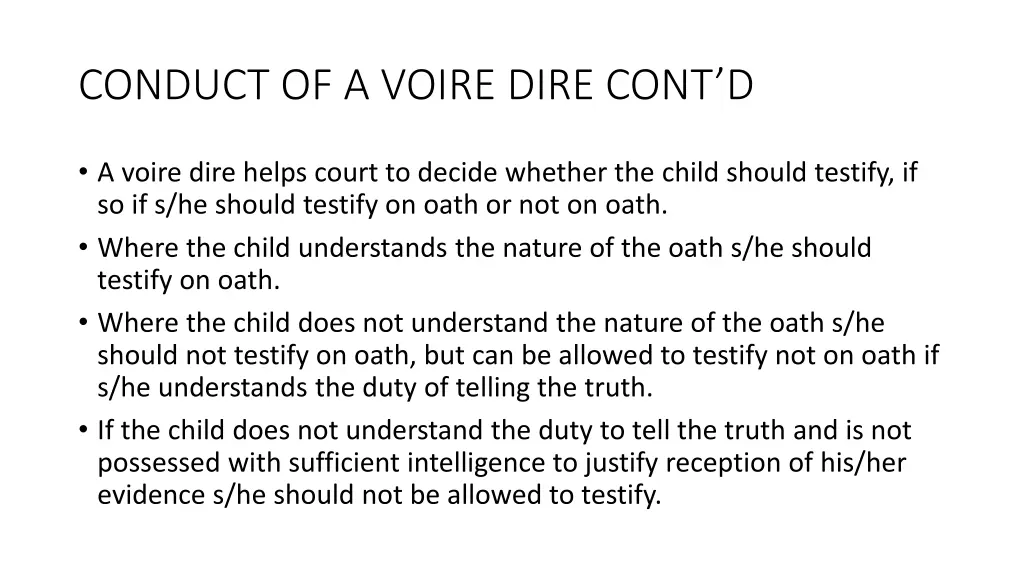
CONDUCT OF A VOIRE DIRE CONTD A voire dire helps court to decide whether the child should testify, if so if s/he should testify on oath or not on oath. Where the child understands the nature of the oath s/he should testify on oath. Where the child does not understand the nature of the oath s/he should not testify on oath, but can be allowed to testify not on oath if s/he understands the duty of telling the truth. If the child does not understand the duty to tell the truth and is not possessed with sufficient intelligence to justify reception of his/her evidence s/he should not be allowed to testify.
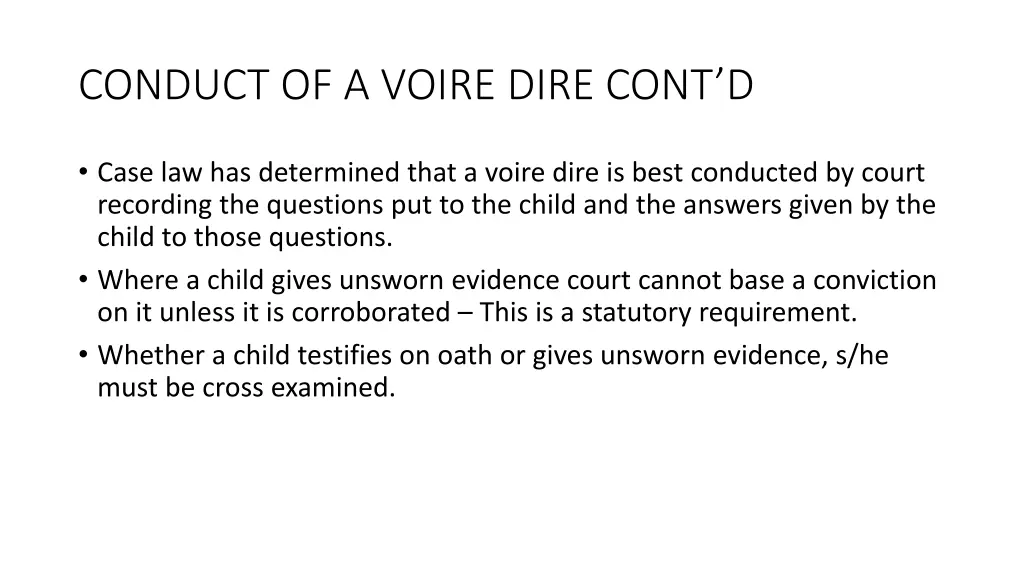
CONDUCT OF A VOIRE DIRE CONTD Case law has determined that a voire dire is best conducted by court recording the questions put to the child and the answers given by the child to those questions. Where a child gives unsworn evidence court cannot base a conviction on it unless it is corroborated This is a statutory requirement. Whether a child testifies on oath or gives unsworn evidence, s/he must be cross examined.
CONCLUSION The handling of child victims and witnesses in court plays a vital role in the success of the cases in which they are involved; by addressing their unique needs, and ensuring protection of their rights. A judicial officer must always endeavor to apply the best practices, making use of available resources, according to the peculiar circumstances of each case, as launch of the guidelines in this area is awaited.







![Briefing on the Criminal Procedure Amendment Bill [B12-2021] to the Portfolio Committee on Justice and Correctional Services](/thumb/157093/briefing-on-the-criminal-procedure-amendment-bill-b12-2021-to-the-portfolio-committee-on-justice-and-correctional-services.jpg)