Heat Capacities and Specific Heats in Thermodynamics
Heat capacities and specific heats play a crucial role in thermodynamics, impacting the amount of heat required to raise the temperature of a substance. Explore the factors affecting heat capacities, the relation between specific heats, and their significance in ideal gases. Delve into the first law of thermodynamics for ideal gases and enhance your understanding through practical exercises.

Download Presentation

Please find below an Image/Link to download the presentation.
The content on the website is provided AS IS for your information and personal use only. It may not be sold, licensed, or shared on other websites without obtaining consent from the author.If you encounter any issues during the download, it is possible that the publisher has removed the file from their server.
You are allowed to download the files provided on this website for personal or commercial use, subject to the condition that they are used lawfully. All files are the property of their respective owners.
The content on the website is provided AS IS for your information and personal use only. It may not be sold, licensed, or shared on other websites without obtaining consent from the author.
E N D
Presentation Transcript
The Course of Fundamentals of Thermodynamics MUSTANSIRIYAH UNIVERSITY COLLEGE OF SCIENCES DEPARTMENT OF ATMOSPHERIC SCIENCES 2021-2022 Dr. Sama Khalid Mohammed SECOND STAGE LECTURE 7
Welcome Students Welcome Students In In The The Seventh Seventh Lecture Lecture
This lecture including the following items Heat capacities and specific heats Relation between cv and cp Specific heats for ideal gases The first law of thermodynamics for ideal gases Exercises
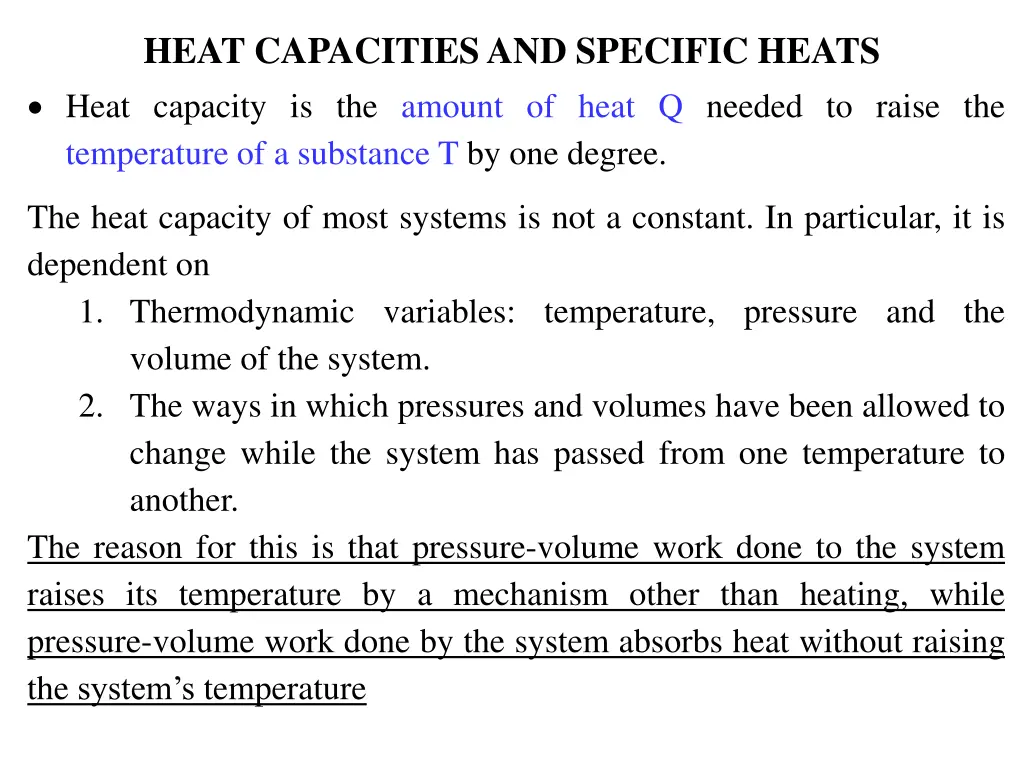
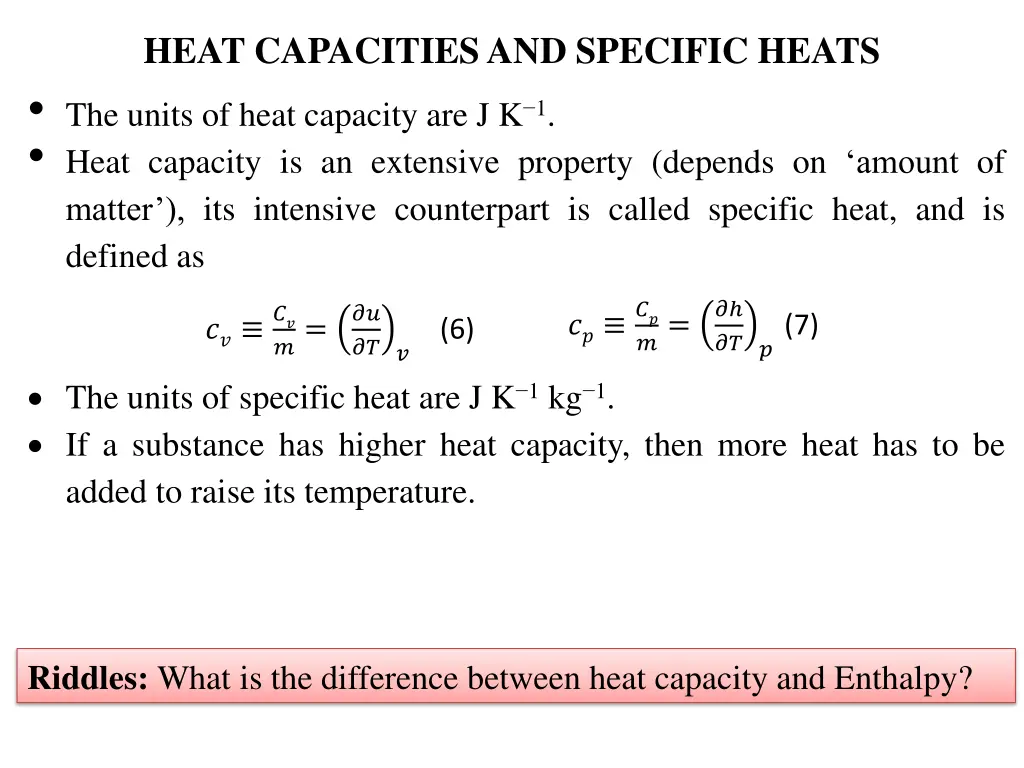
HEAT CAPACITIES AND SPECIFIC HEATS Heat capacity is the amount of heat Q needed to raise the temperature of a substance T by one degree. The heat capacity of most systems is not a constant. In particular, it is dependent on 1. Thermodynamic variables: temperature, pressure and the volume of the system. 2. The ways in which pressures and volumes have been allowed to change while the system has passed from one temperature to another. The reason for this is that pressure-volume work done to the system raises its temperature by a mechanism other than heating, while pressure-volume work done by the system absorbs heat without raising the system s temperature
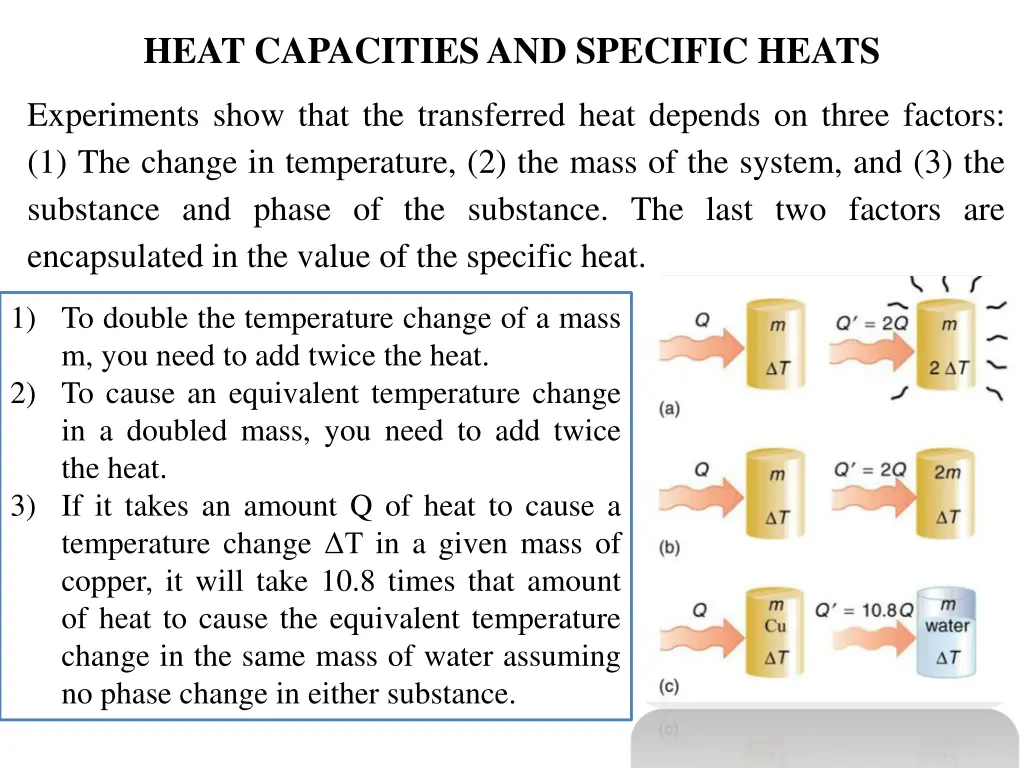
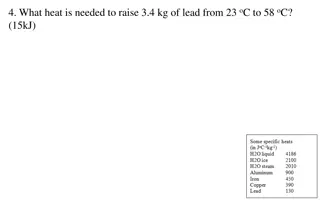
HEAT CAPACITIES AND SPECIFIC HEATS Experiments show that the transferred heat depends on three factors: (1) The change in temperature, (2) the mass of the system, and (3) the substance and phase of the substance. The last two factors are encapsulated in the value of the specific heat. 1) To double the temperature change of a mass m, you need to add twice the heat. 2) To cause an equivalent temperature change in a doubled mass, you need to add twice the heat. 3) If it takes an amount Q of heat to cause a temperature change T in a given mass of copper, it will take 10.8 times that amount of heat to cause the equivalent temperature change in the same mass of water assuming no phase change in either substance.
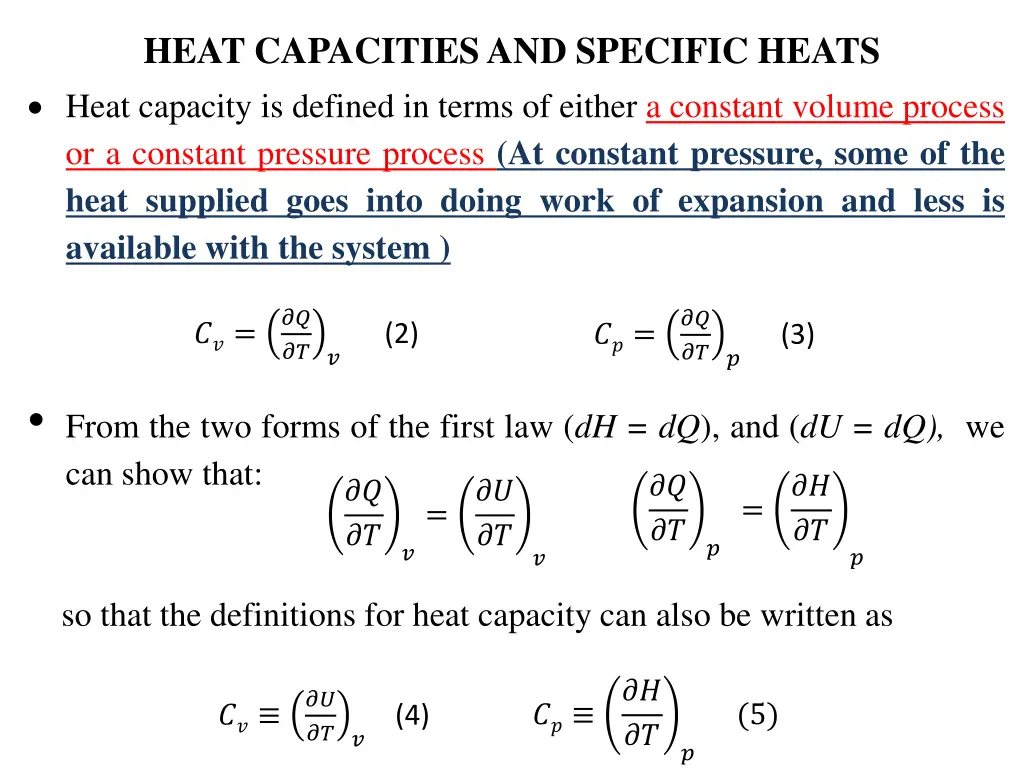
HEAT CAPACITIES AND SPECIFIC HEATS Heat capacity is defined in terms of either a constant volume process or a constant pressure process (At constant pressure, some of the heat supplied goes into doing work of expansion and less is available with the system ) ?? ??? (2) ?? ???(3) ??= ??= From the two forms of the first law (dH = dQ), and (dU = dQ), we can show that: ?? ?? ? ?? ?? ?? ?? ?? ?? = = ? ? ? so that the definitions for heat capacity can also be written as ?? ?? ?? ???(4) ?? (5) ?? ?
HEAT CAPACITIES AND SPECIFIC HEATS The units of heat capacity are J K 1. Heat capacity is an extensive property (depends on amount of matter ), its intensive counterpart is called specific heat, and is defined as ?? ?? ? ???(7) ?? ?? ?? ???(6) ?= ?= The units of specific heat are J K 1 kg 1. If a substance has higher heat capacity, then more heat has to be added to raise its temperature. Riddles: What is the difference between heat capacity and Enthalpy?
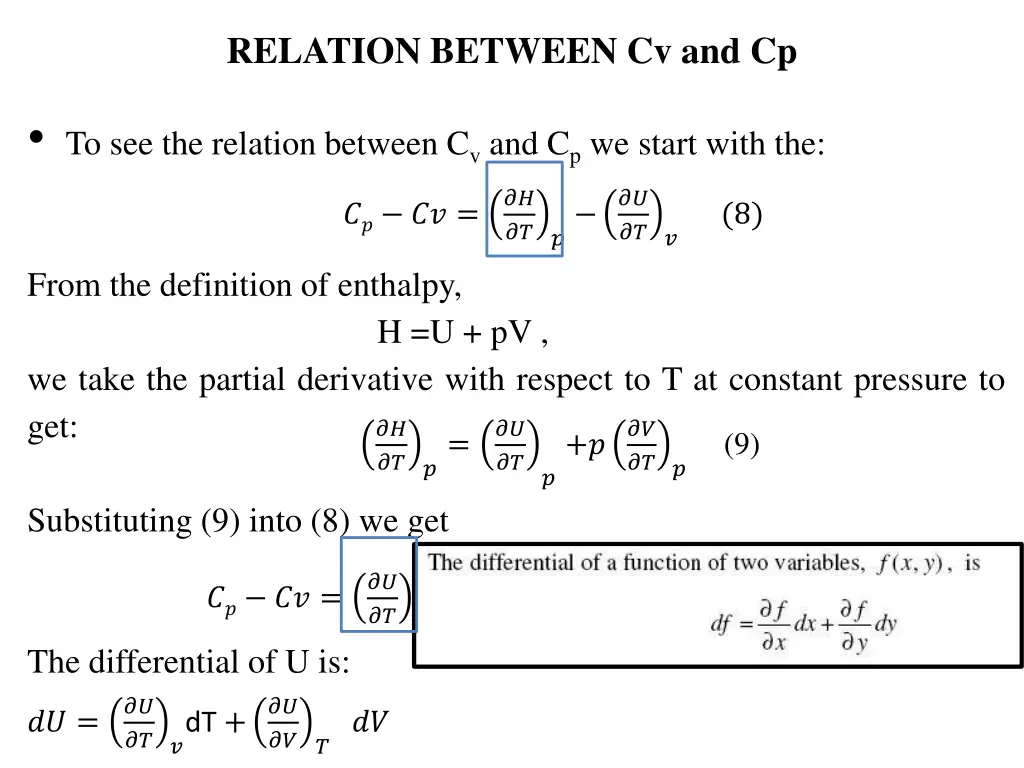
RELATION BETWEEN Cv and Cp To see the relation between Cv and Cp we start with the: ?? ??? ?? ??? ?? ?? = (8) From the definition of enthalpy, H =U + pV , we take the partial derivative with respect to T at constant pressure to get: ?? ???= ?? ?? ?? ???(9) +? ? Substituting (9) into (8) we get ?? ???+ ? ?? ?? ?? ???(10) ?? ?? = ? The differential of U is: ?? ???dT + ?? ??? ?? ?? =
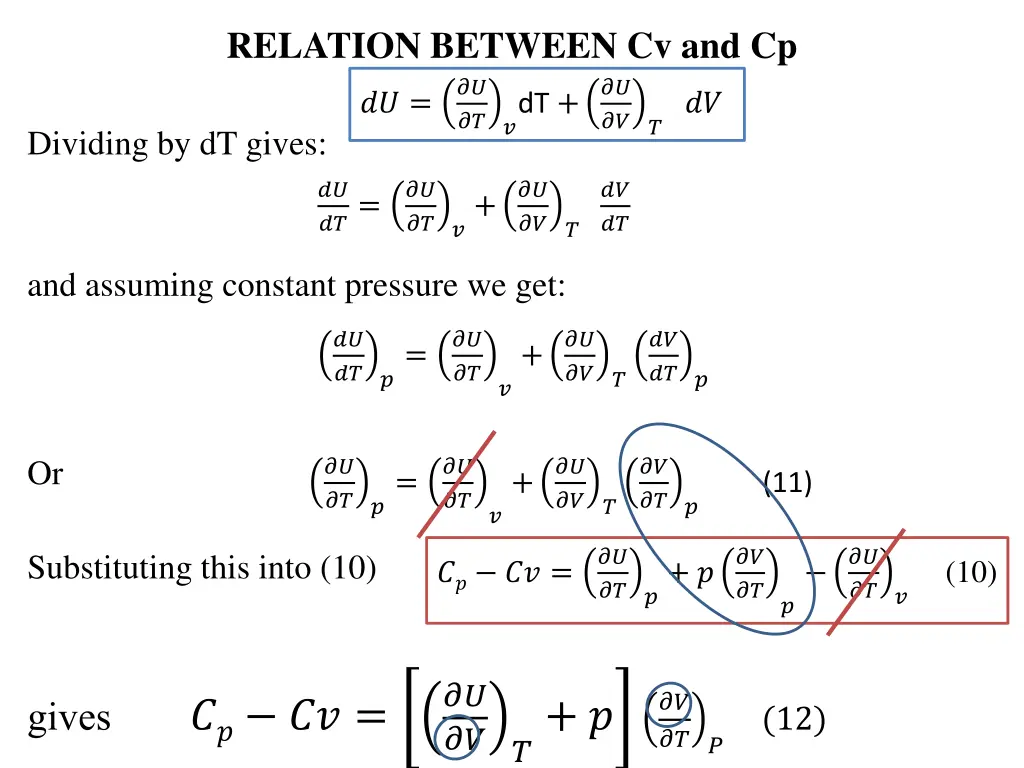
RELATION BETWEEN Cv and Cp ?? ???dT + ?? ??? ?? ?? = Dividing by dT gives: ?? ??= ?? ???+ ?? ??? ?? ?? and assuming constant pressure we get: ?? ???= ?? ?? ?? ??? ?? ??? + ? Or ?? ???= ?? ?? ?? ??? ?? ???(11) + ? ?? ???+ ? ?? ?? ?? ???(10) Substituting this into (10) ?? ?? = ? ?? ???+ ? ?? ??? (12) ?? ?? = gives
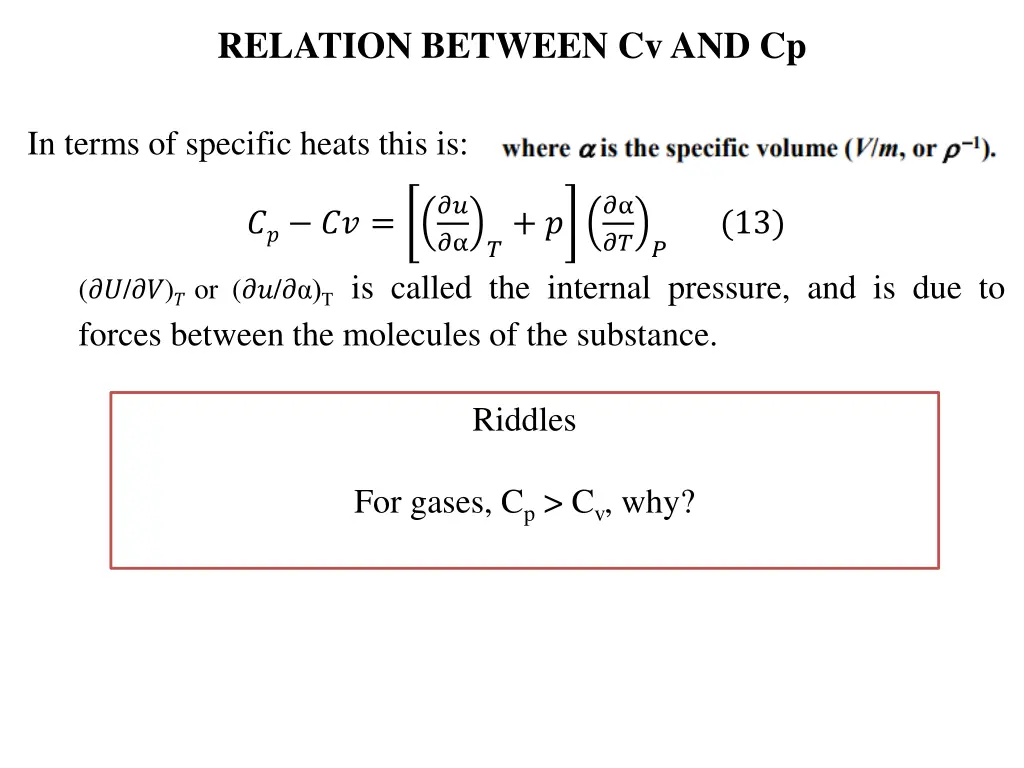
RELATION BETWEEN Cv AND Cp In terms of specific heats this is: ?? ? ?+ ? ? ??? ?? ?? = (13) (??/??)?or (??/? )T is called the internal pressure, and is due to forces between the molecules of the substance. Riddles For gases, Cp > Cv, why?
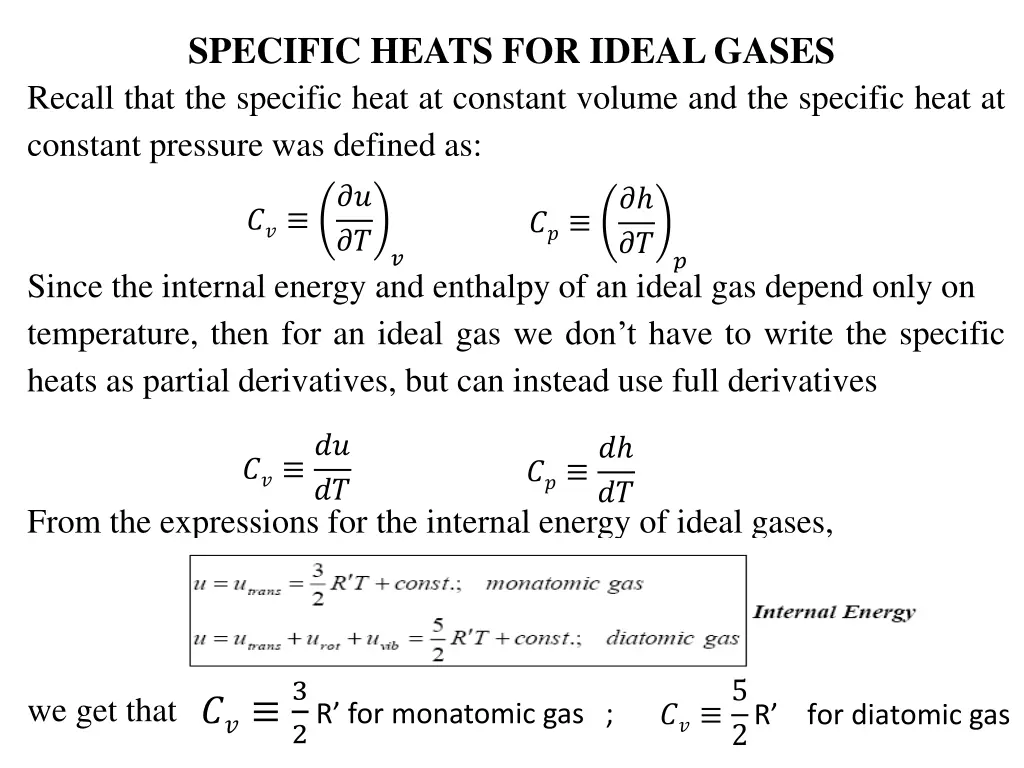
SPECIFIC HEATS FOR IDEAL GASES Recall that the specific heat at constant volume and the specific heat at constant pressure was defined as: ?? ?? ? ?? ?? ?? ? ? Since the internal energy and enthalpy of an ideal gas depend only on temperature, then for an ideal gas we don t have to write the specific heats as partial derivatives, but can instead use full derivatives ?? ?? ?? ? ?? ?? From the expressions for the internal energy of ideal gases, ?? 5 ?? 3 we get that 2R for monatomic gas ; 2R for diatomic gas
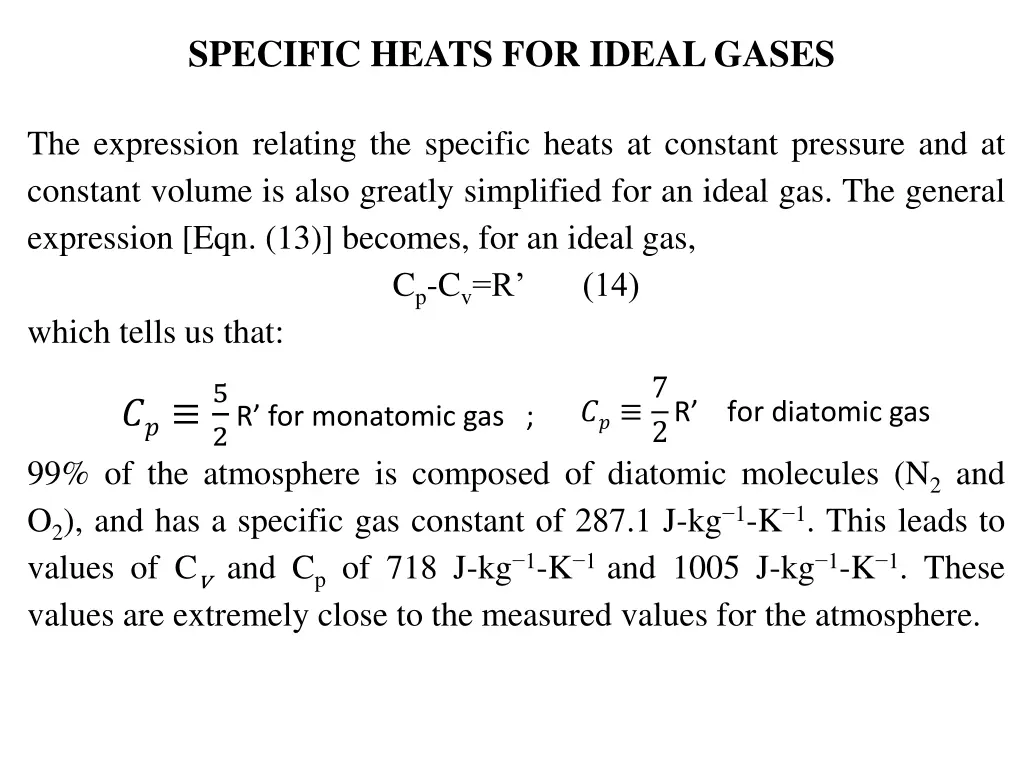
SPECIFIC HEATS FOR IDEAL GASES The expression relating the specific heats at constant pressure and at constant volume is also greatly simplified for an ideal gas. The general expression [Eqn. (13)] becomes, for an ideal gas, Cp-Cv=R (14) which tells us that: ?? 7 ?? 5 2R for diatomic gas 2R for monatomic gas ; 99% of the atmosphere is composed of diatomic molecules (N2 and O2), and has a specific gas constant of 287.1 J-kg 1-K 1. This leads to values of Cv and Cp of 718 J-kg 1-K 1 and 1005 J-kg 1-K 1. These values are extremely close to the measured values for the atmosphere.
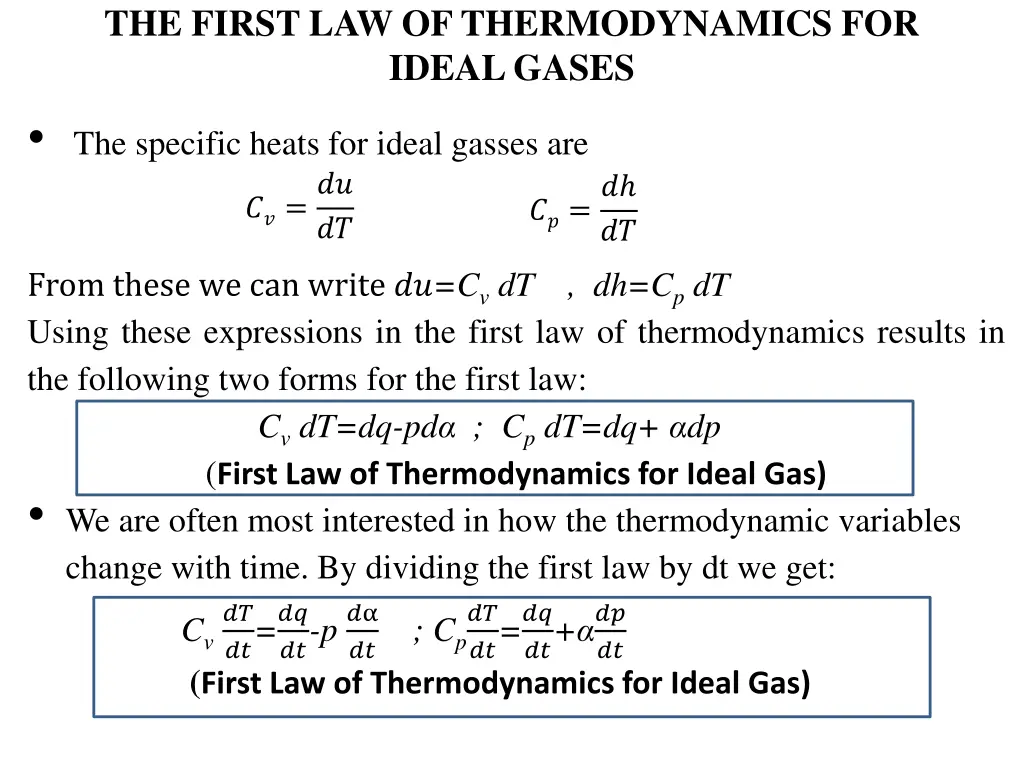
THE FIRST LAW OF THERMODYNAMICS FOR IDEAL GASES The specific heats for ideal gasses are ??=?? ?? ??=? ?? From these we can write ??=Cv dT , dh=Cp dT Using these expressions in the first law of thermodynamics results in the following two forms for the first law: Cv dT=dq-pd ; Cp dT=dq+ dp (First Law of Thermodynamics for Ideal Gas) We are often most interested in how the thermodynamic variables change with time. By dividing the first law by dt we get: ?? ??=?? ??-p? ?? ??=?? ??+ ?? Cv (First Law of Thermodynamics for Ideal Gas) ?? ; Cp ??
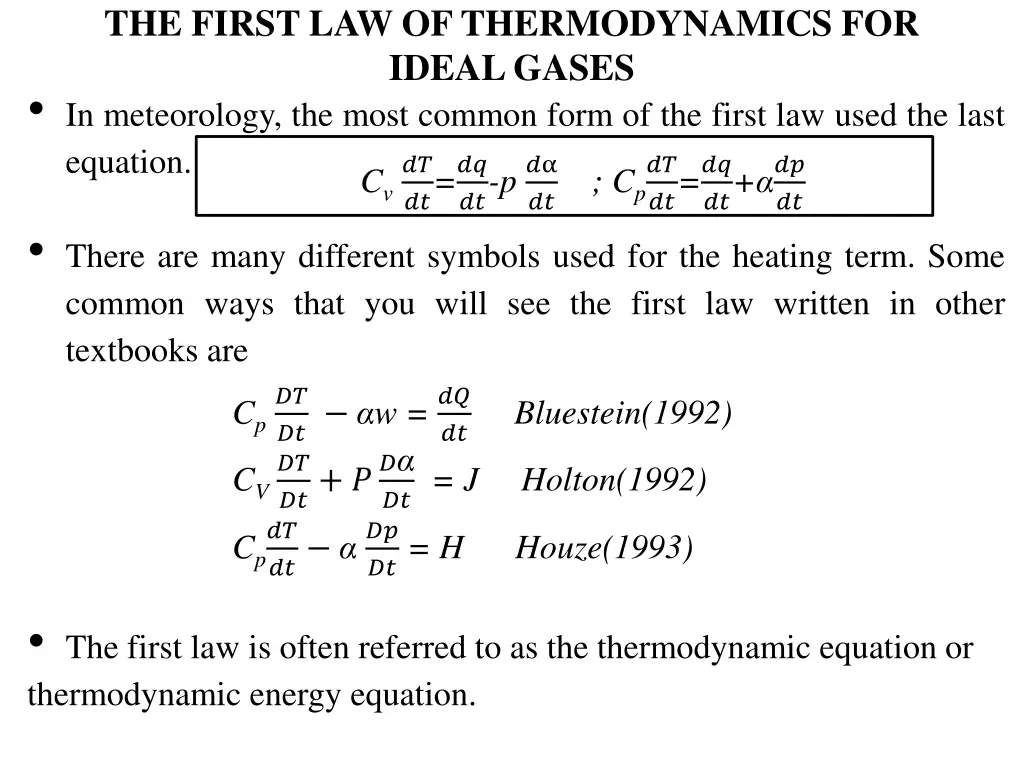
THE FIRST LAW OF THERMODYNAMICS FOR IDEAL GASES In meteorology, the most common form of the first law used the last equation. Cv ?? ??=?? ??-p? ?? ??=?? ??+ ?? ?? ; Cp ?? There are many different symbols used for the heating term. Some common ways that you will see the first law written in other textbooks are ?? ?? w =?? ?? ??+ ?? ?? ?? ?? Cp ?? Bluestein(1992) CV ?? = J Holton(1992) Cp ?? = H Houze(1993) The first law is often referred to as the thermodynamic equation or thermodynamic energy equation.