High-Level Customer Requirement Formulation in Design Projects
Delve into the essence of formulating high-level customer requirements for design projects, emphasizing the importance of customer-centric design thinking. Learn how to identify and address the critical needs of customers through clear and concise statements, ensuring successful project outcomes.

Download Presentation

Please find below an Image/Link to download the presentation.
The content on the website is provided AS IS for your information and personal use only. It may not be sold, licensed, or shared on other websites without obtaining consent from the author. If you encounter any issues during the download, it is possible that the publisher has removed the file from their server.
You are allowed to download the files provided on this website for personal or commercial use, subject to the condition that they are used lawfully. All files are the property of their respective owners.
The content on the website is provided AS IS for your information and personal use only. It may not be sold, licensed, or shared on other websites without obtaining consent from the author.
E N D
Presentation Transcript
1. High-level requirement 2. R & V table Prof. JingJiang, SohpieLiu
Problem statement & High-level requirements
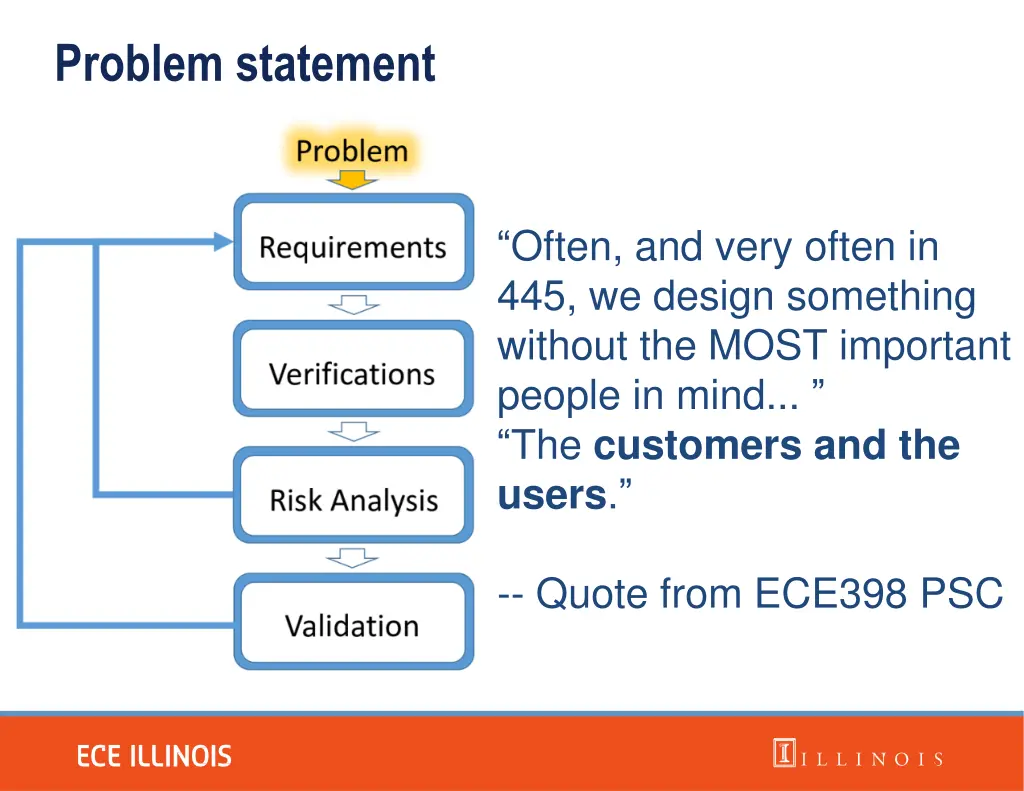
Problem statement Often, and very often in 445, we design something without the MOST important people in mind... The customers and the users. -- Quote from ECE398 PSC
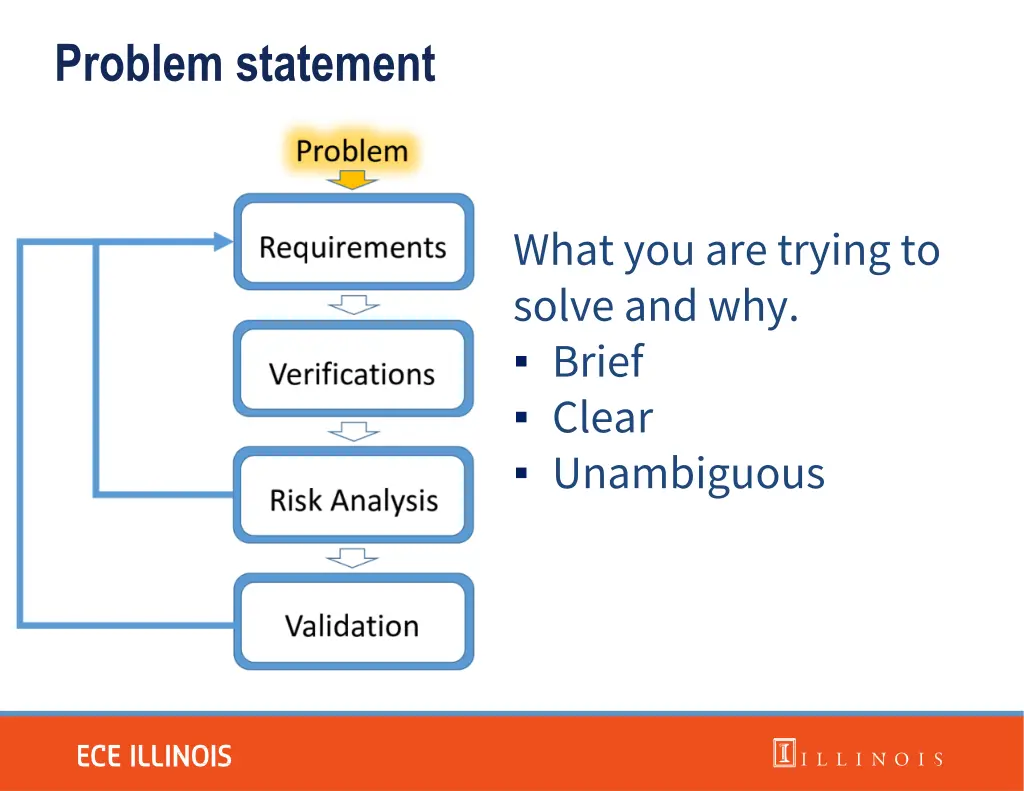
Problem statement What you are trying to solve and why. Brief Clear Unambiguous
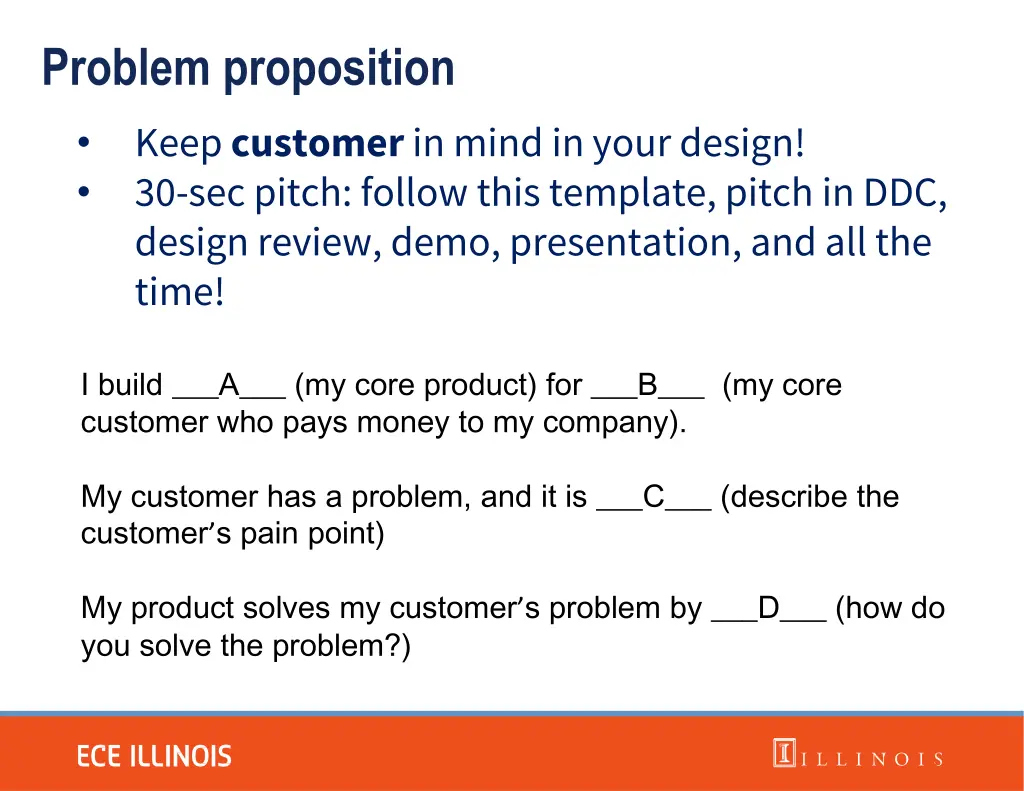
Problem proposition Keep customerin mind in your design! 30-sec pitch: follow this template, pitch in DDC, design review, demo, presentation, and all the time! I build ___A___ (my core product) for ___B___ (my core customer who pays money to my company). My customer has a problem, and it is ___C___ (describe the customer s pain point) My product solves my customer s problem by ___D___ (how do you solve the problem?)
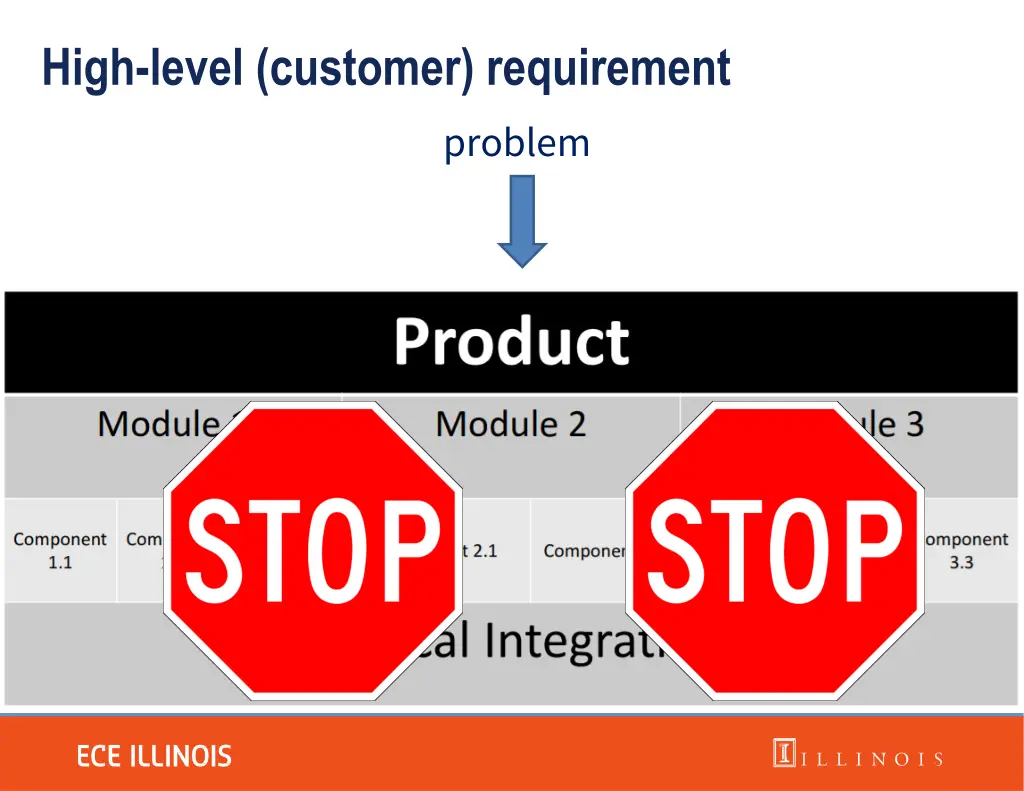
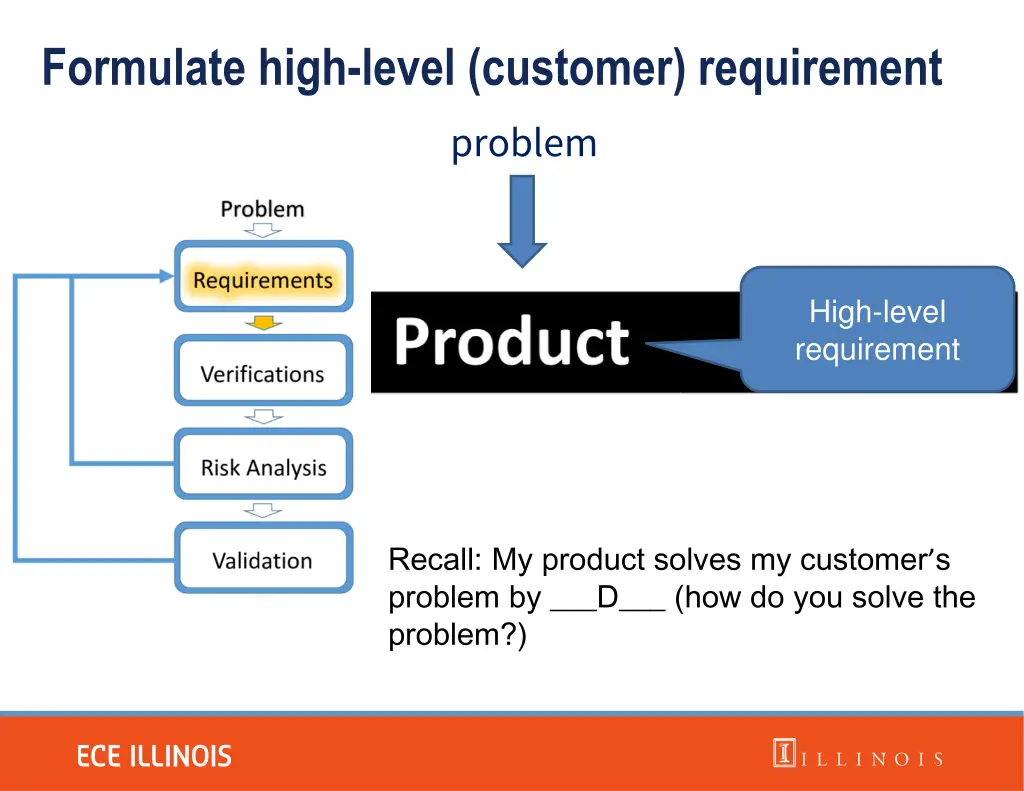
Formulate high-level (customer) requirement problem High-level requirement Recall: My product solves my customer s problem by ___D___ (how do you solve the problem?)
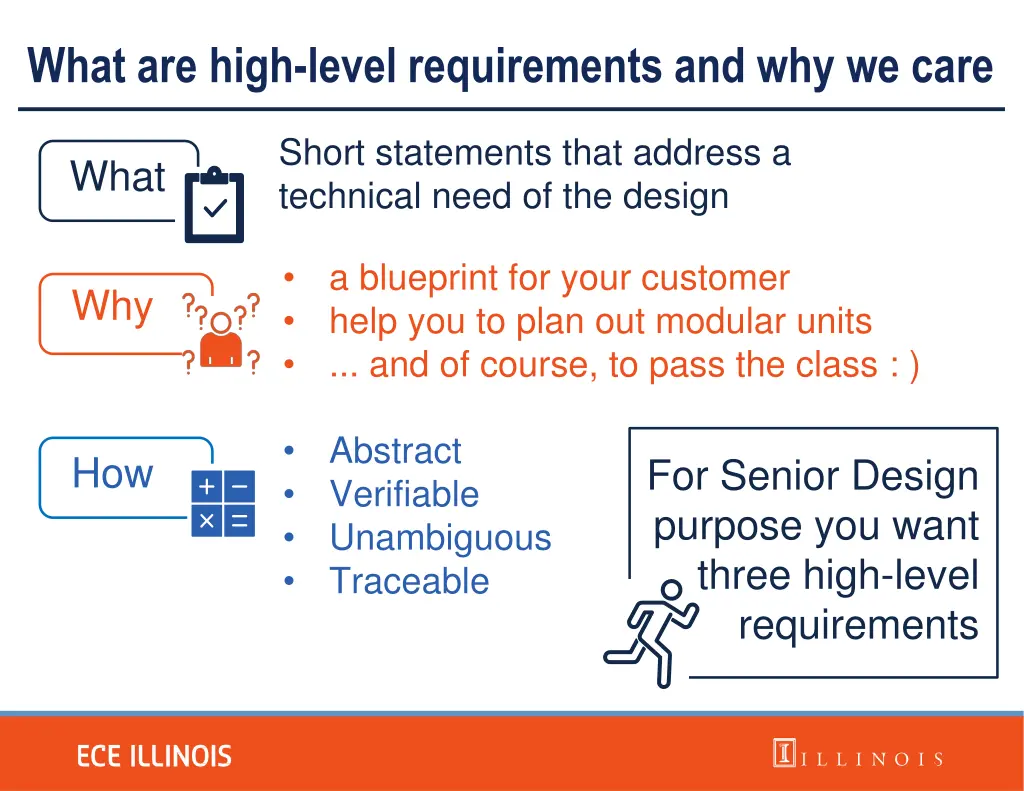
What are high-level requirements and why we care Short statements that address a technical need of the design What a blueprint for your customer help you to plan out modular units ... and of course, to pass the class : ) Why Abstract Verifiable Unambiguous Traceable How For Senior Design purpose you want three high-level requirements
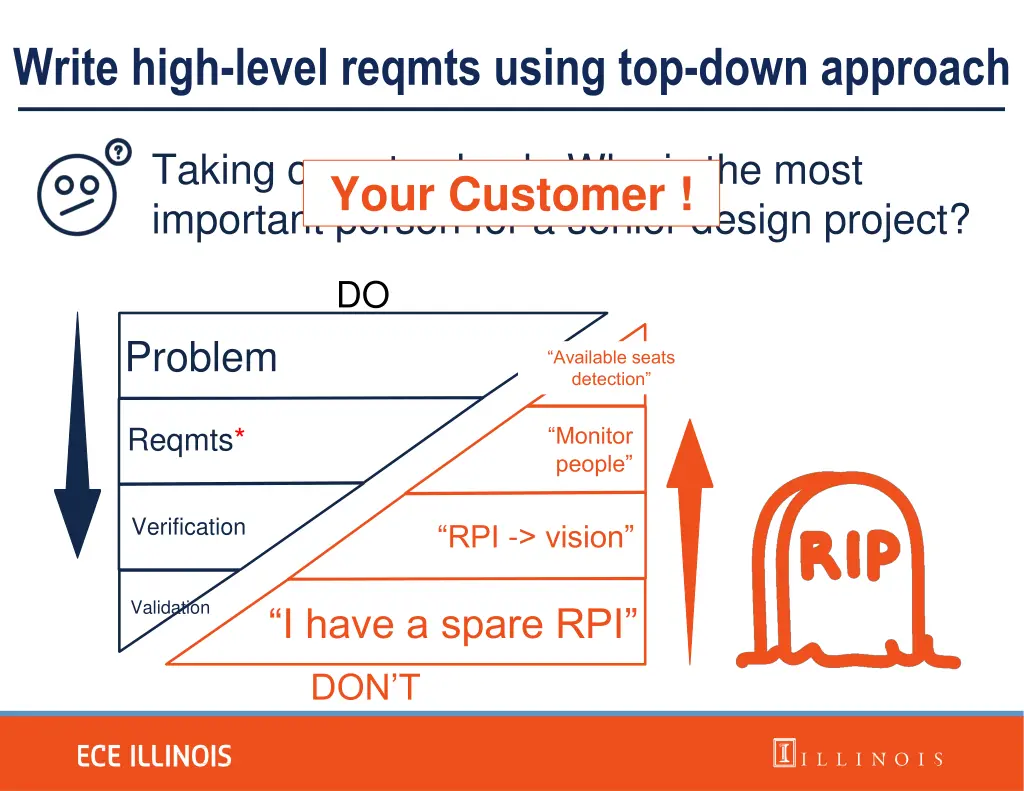
Write high-level reqmts using top-down approach Taking one step back: Who is the most important person for a senior design project? Your Customer ! DO Problem Available seats detection Reqmts* Monitor people Verification RPI -> vision Validation I have a spare RPI DON T
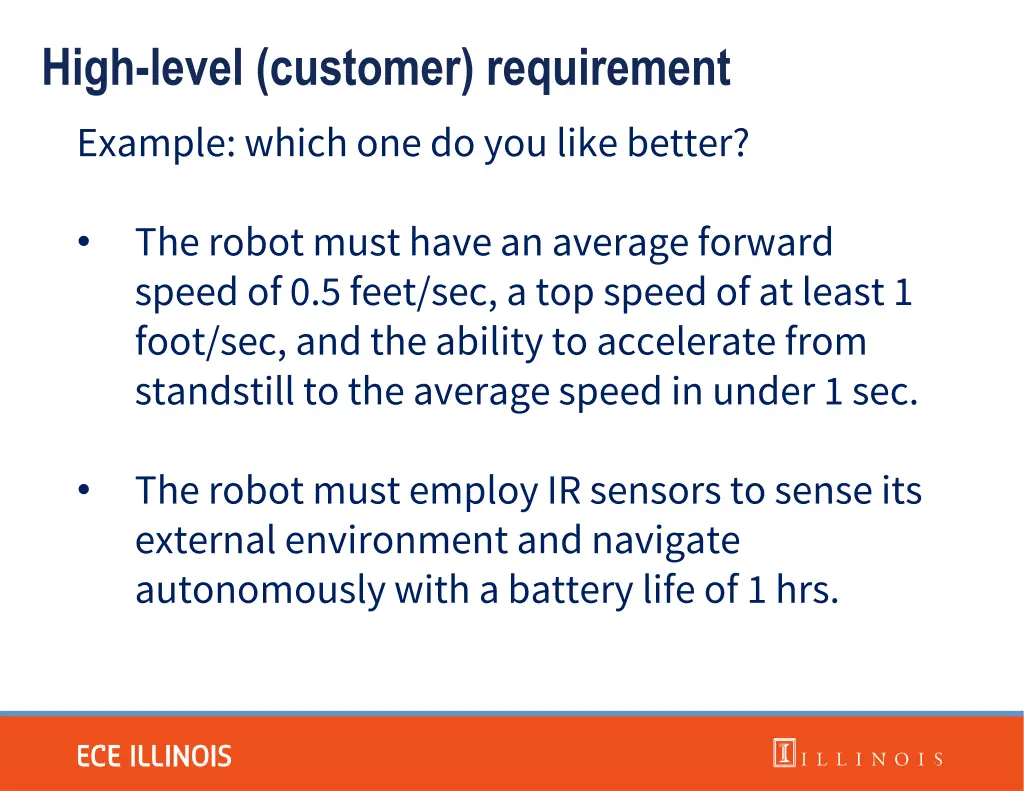
High-level (customer) requirement Example: which one do you like better? The robot must have an average forward speed of 0.5 feet/sec, a top speed of at least 1 foot/sec, and the ability to accelerate from standstill to the average speed in under 1 sec. The robot must employ IR sensors to sense its external environment and navigate autonomously with a battery life of 1 hrs.
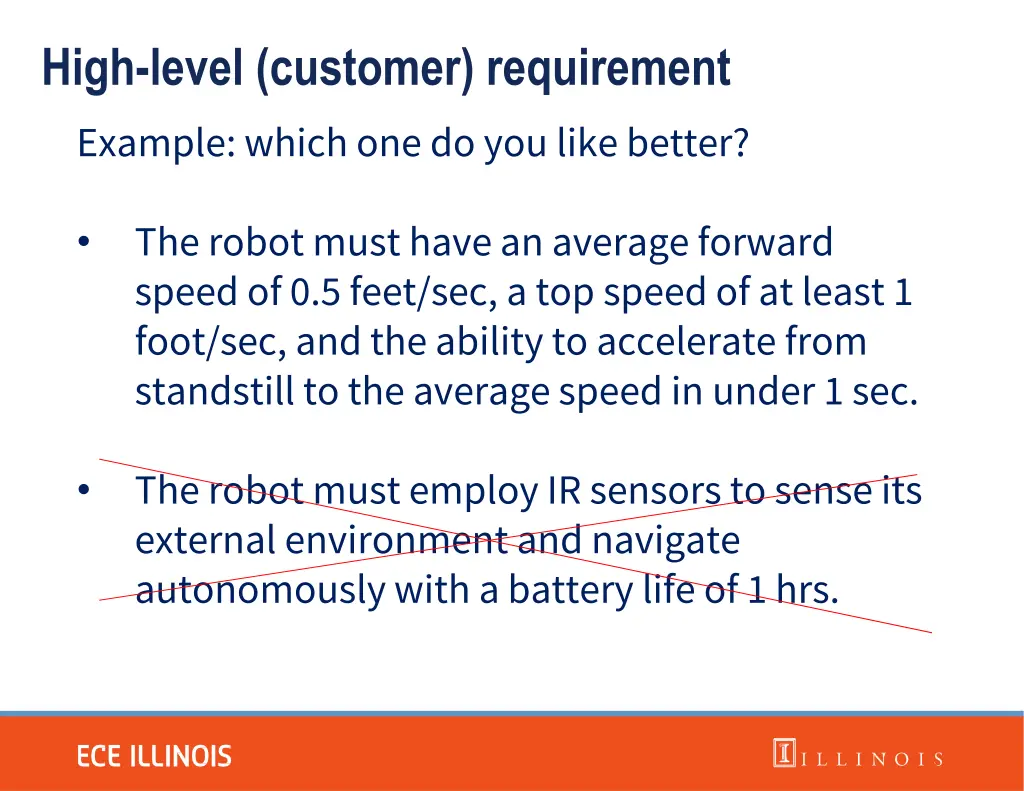
High-level (customer) requirement Example: which one do you like better? The robot must have an average forward speed of 0.5 feet/sec, a top speed of at least 1 foot/sec, and the ability to accelerate from standstill to the average speed in under 1 sec. The robot must employ IR sensors to sense its external environment and navigate autonomously with a battery life of 1 hrs.
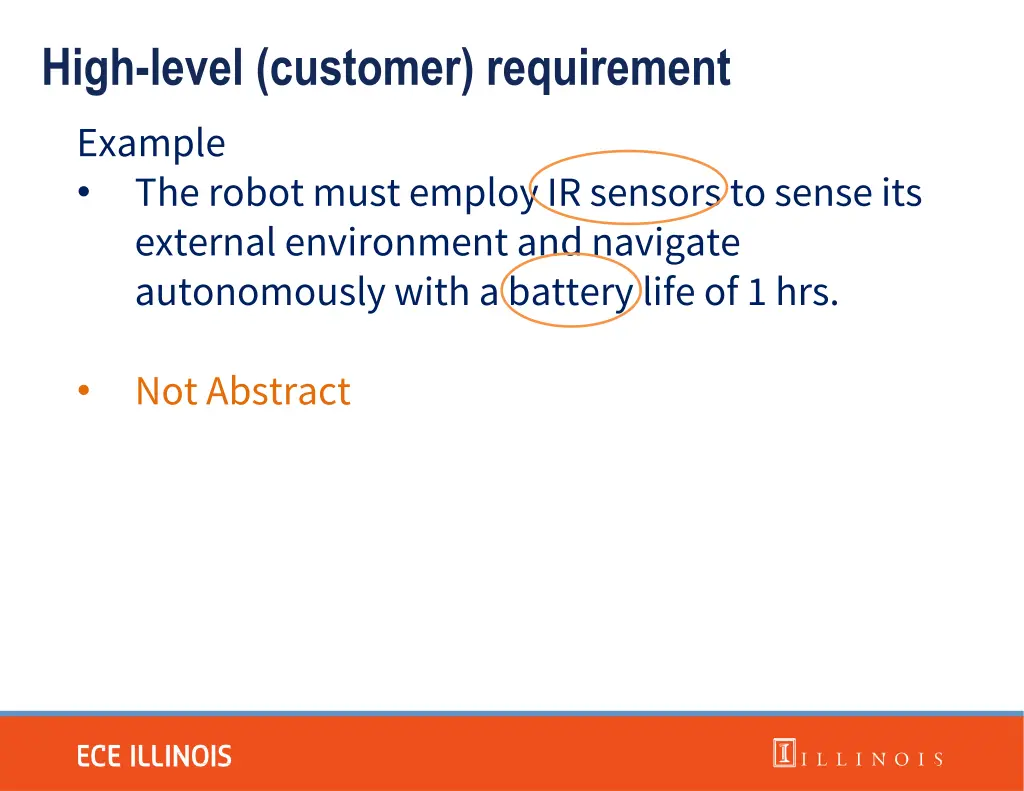
High-level (customer) requirement Example The robot must employ IR sensors to sense its external environment and navigate autonomously with a battery life of 1 hrs. Not Abstract
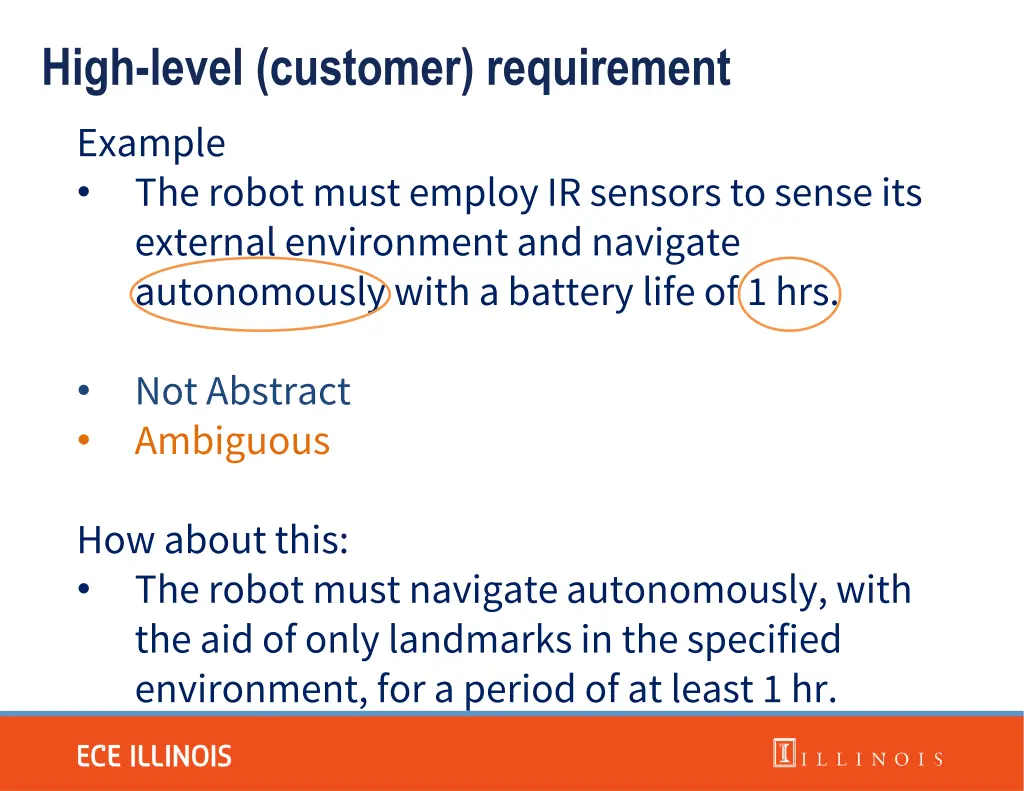
High-level (customer) requirement Example The robot must employ IR sensors to sense its external environment and navigate autonomously with a battery life of 1 hrs. Not Abstract Ambiguous How about this: The robot must navigate autonomously, with the aid of only landmarks in the specified environment, for a period of at least 1 hr.
High-level (customer) requirement If you don t satisfy your all your high-level requirements (in the demo): As a company, you ll lose money. As a product manager, you ll lose job. As an ECE445 student, you ll
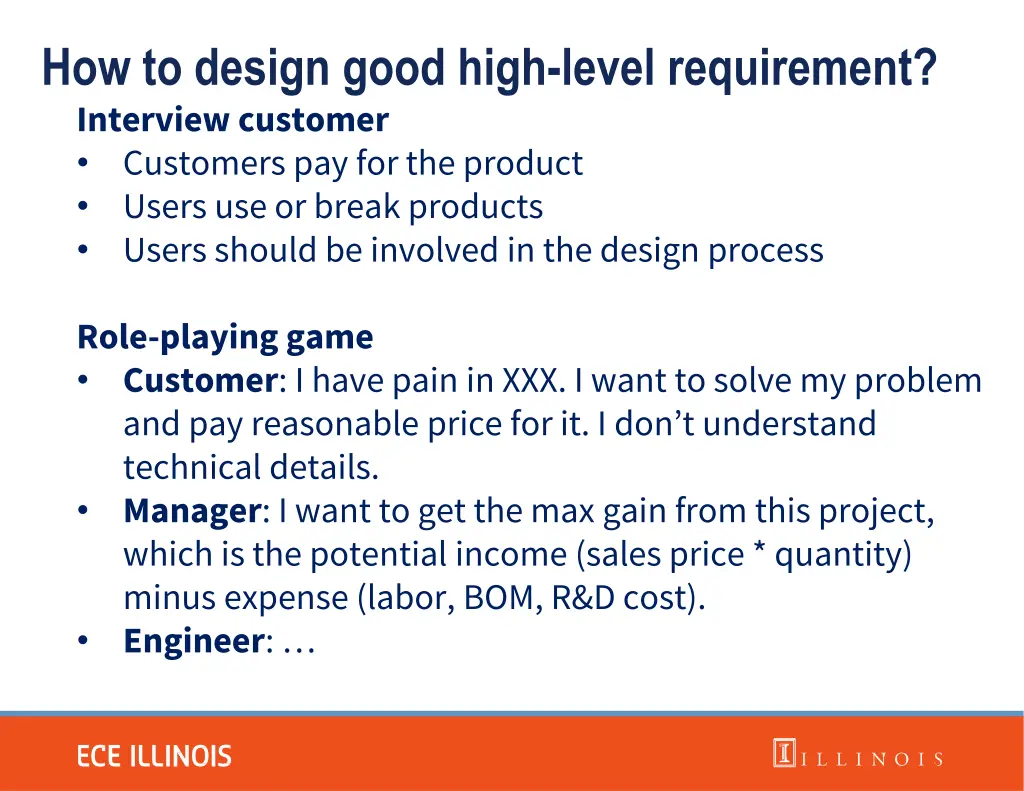
How to design good high-level requirement? Interview customer Customers pay for the product Users use or break products Users should be involved in the design process Role-playing game Customer: I have pain in XXX. I want to solve my problem and pay reasonable price for it. I don t understand technical details. Manager: I want to get the max gain from this project, which is the potential income (sales price * quantity) minus expense (labor, BOM, R&D cost). Engineer:
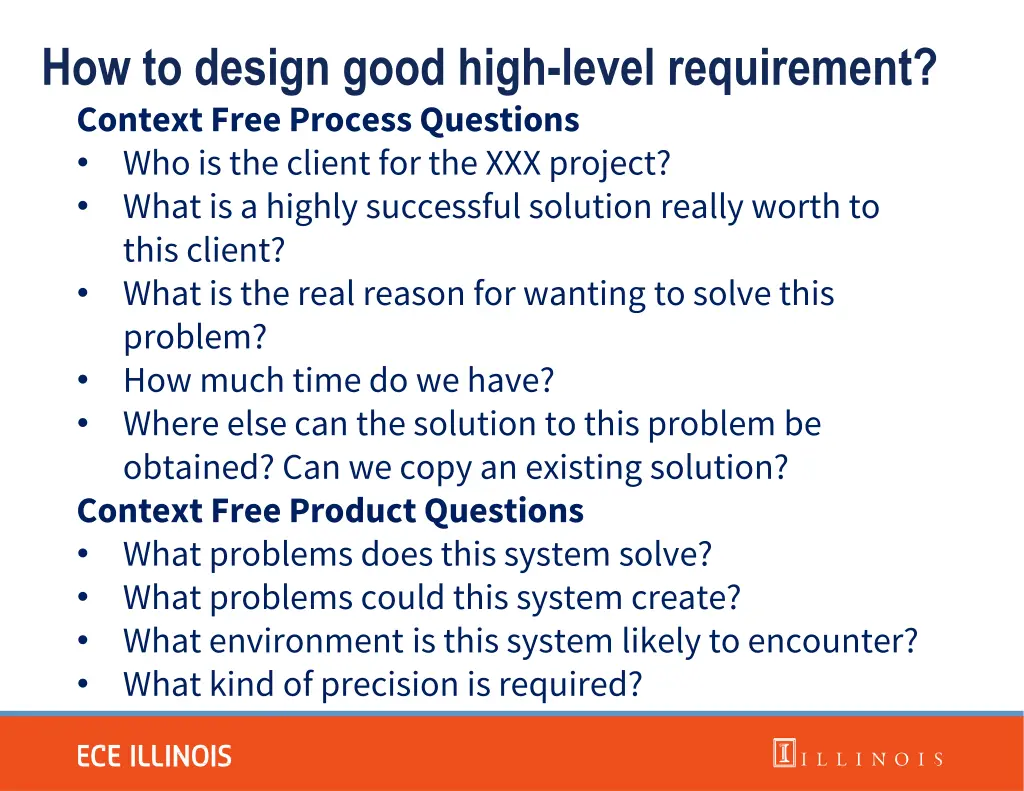
How to design good high-level requirement? Context Free Process Questions Who is the client for the XXX project? What is a highly successful solution really worth to this client? What is the real reason for wanting to solve this problem? How much time do we have? Where else can the solution to this problem be obtained? Can we copy an existing solution? Context Free Product Questions What problems does this system solve? What problems could this system create? What environment is this system likely to encounter? What kind of precision is required?
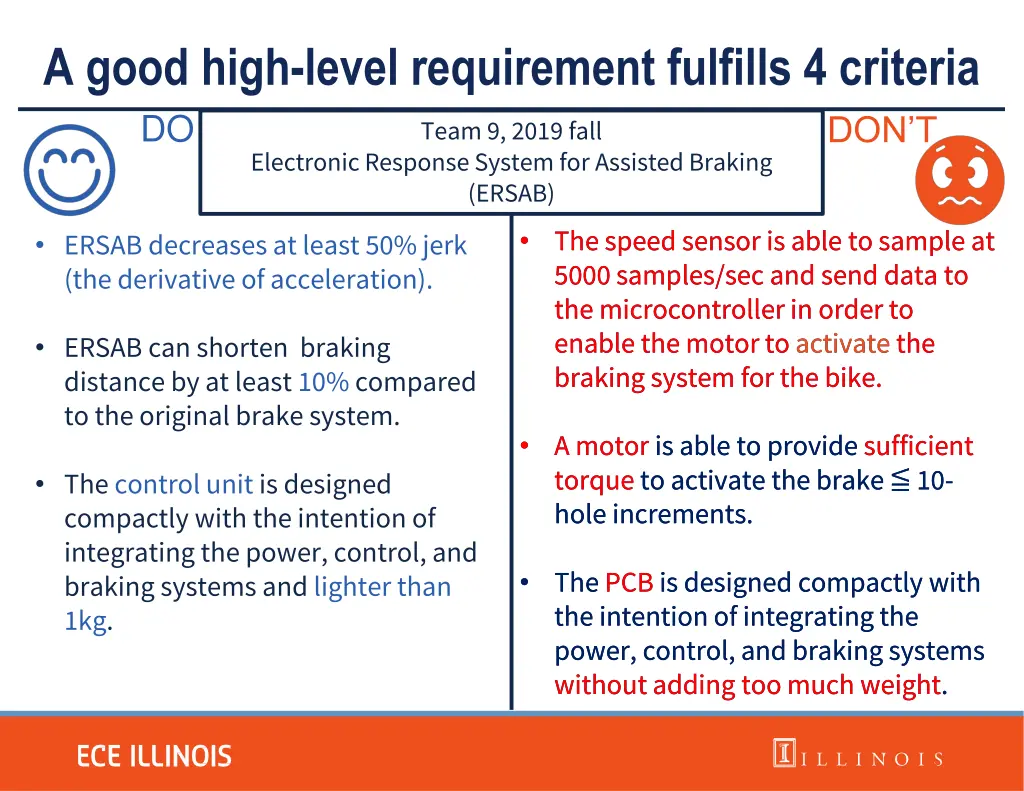
A good high-level requirement fulfills 4 criteria DO DON T Team 9, 2019 fall Electronic Response System for Assisted Braking (ERSAB) The speed sensor is able to sample at 5000 samples/sec and send data to the microcontroller in order to enable the motor to activate the braking system for the bike. braking system for the bike. The speed sensor is able to sample at 5000 samples/sec and send data to the microcontroller in order to enable the motor to activate the ERSAB decreases at least 50% jerk (the derivative of acceleration). (the derivative of acceleration). ERSAB decreases at least 50% jerk ERSAB has shorter or equal braking distance compared to the original brake system (50-100%). to the original brake system. ERSAB can shorten braking distance by at least 10% compared A motor is able to provide sufficient torque to activate the brake 10- hole increments. hole increments. A motoris able to provide sufficient torqueto activate the brake 10- The control unit is designed compactly with the intention of integrating the power, control, and braking systems and lighter than 1kg. 1kg. The control unitis designed compactly with the intention of integrating the power, control, and braking systems and lighter than The PCB is designed compactly with the intention of integrating the power, control, and braking systems without adding too much weight. without adding too much weight. The PCBis designed compactly with the intention of integrating the power, control, and braking systems
R & V table (Requirements and Verification)
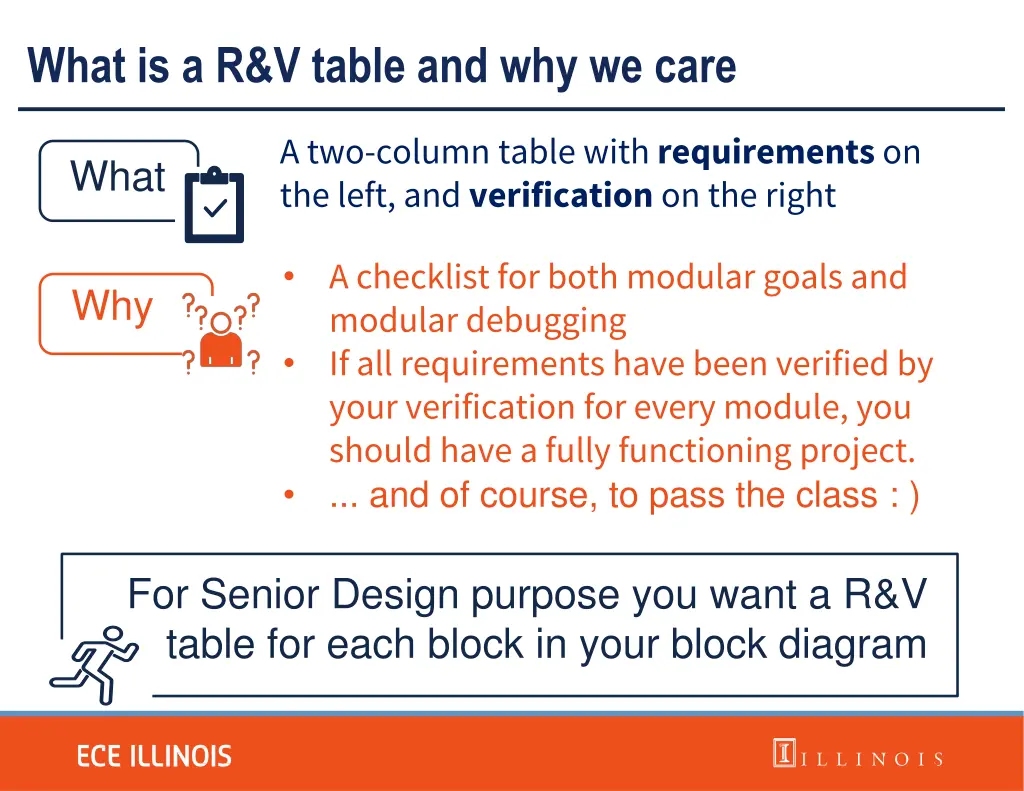
What is a R&V table and why we care A two-column table with requirements on the left, and verification on the right What A checklist for both modular goals and modular debugging If all requirements have been verified by your verification for every module, you should have a fully functioning project. ... and of course, to pass the class : ) Why For Senior Design purpose you want a R&V table for each block in your block diagram
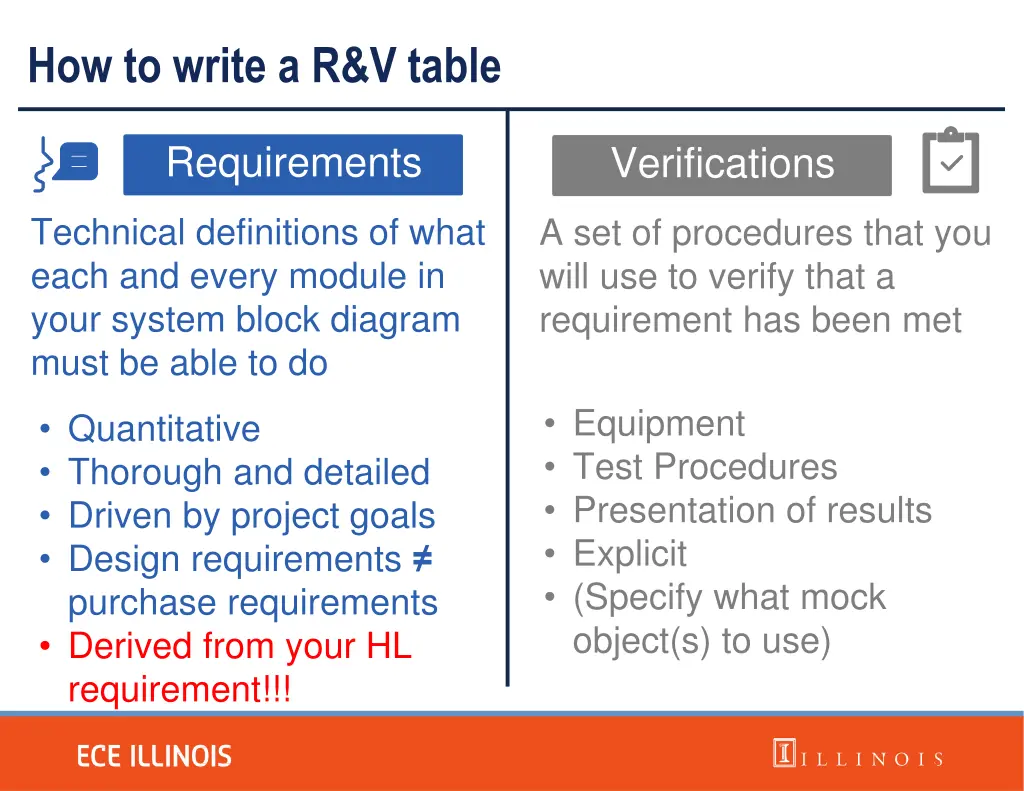
How to write a R&V table Requirements Verifications Technical definitions of what each and every module in your system block diagram must be able to do A set of procedures that you will use to verify that a requirement has been met Equipment Test Procedures Presentation of results Explicit (Specify what mock object(s) to use) Quantitative Thorough and detailed Driven by project goals Design requirements purchase requirements Derived from your HL requirement!!!
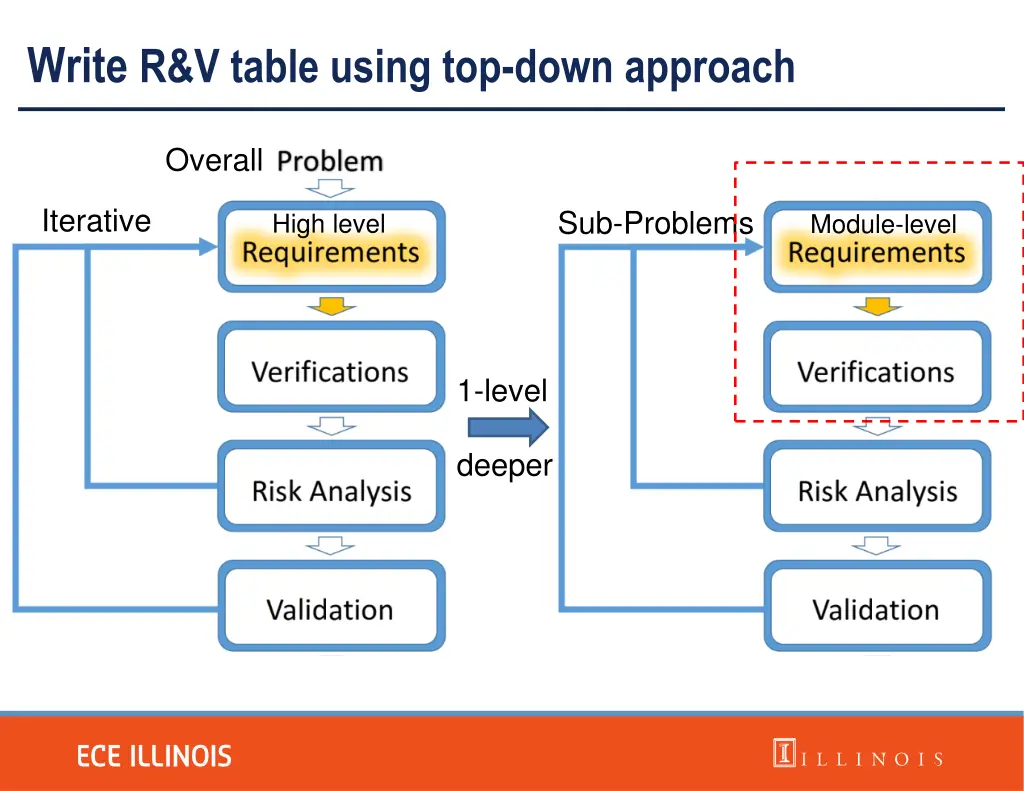
Write R&V table using top-down approach Overall Iterative Sub-Problems High level Module-level 1-level deeper
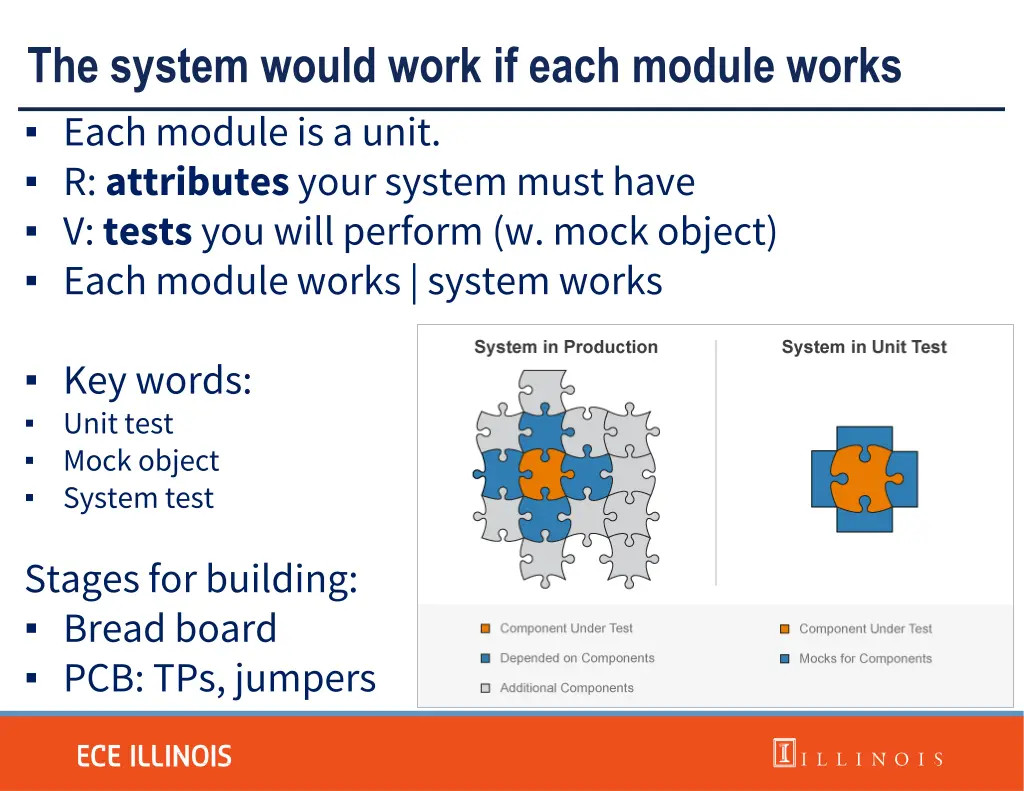
The system would work if each module works Each module is a unit. R: attributesyour system must have V: tests you will perform (w. mock object) Each module works | system works Key words: Unit test Mock object System test Stages for building: Bread board PCB: TPs, jumpers
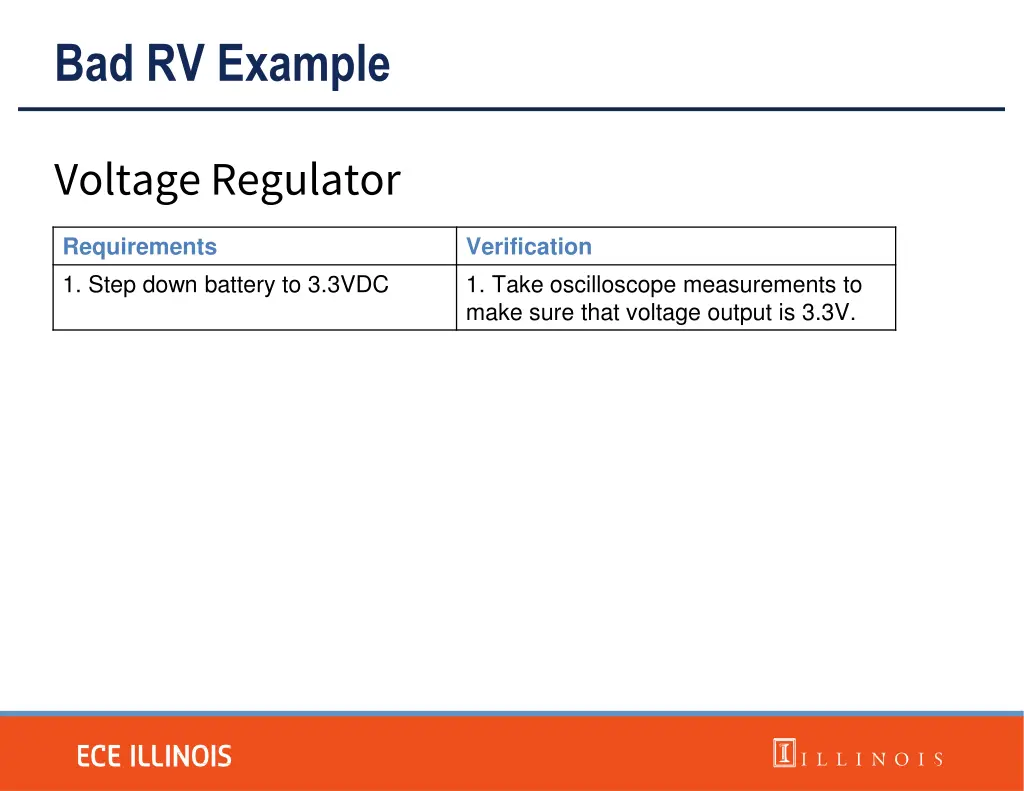
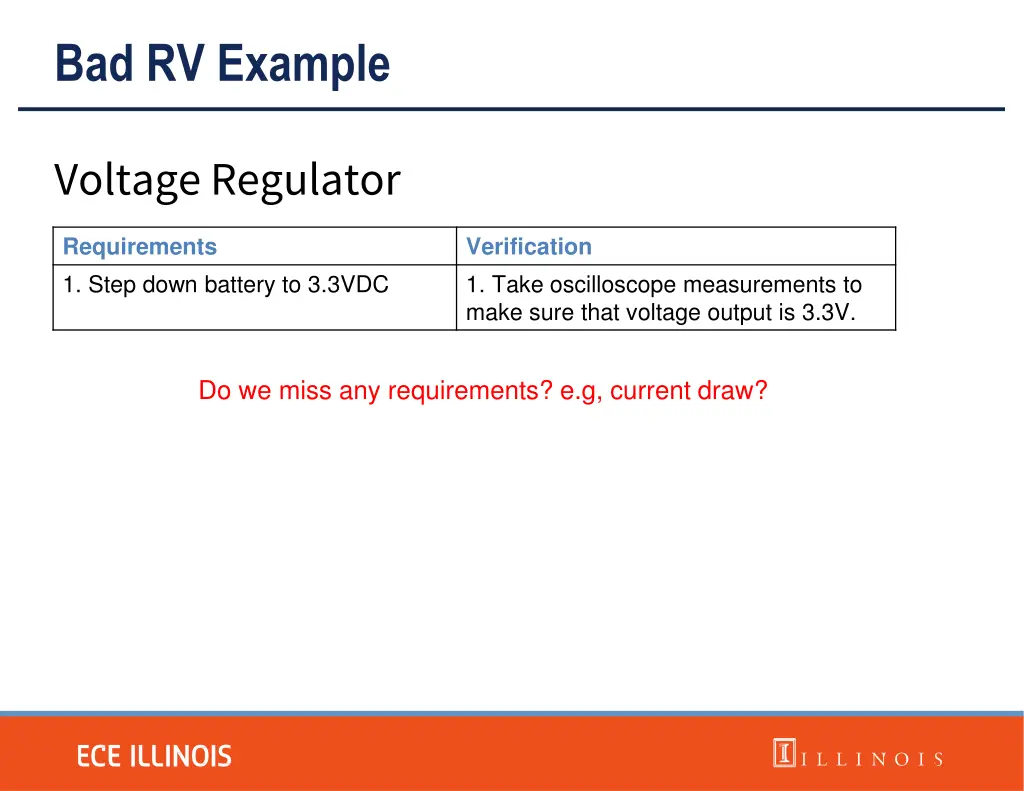
Bad RV Example Voltage Regulator Requirements 1. Step down battery to 3.3VDC Verification 1. Take oscilloscope measurements to make sure that voltage output is 3.3V.
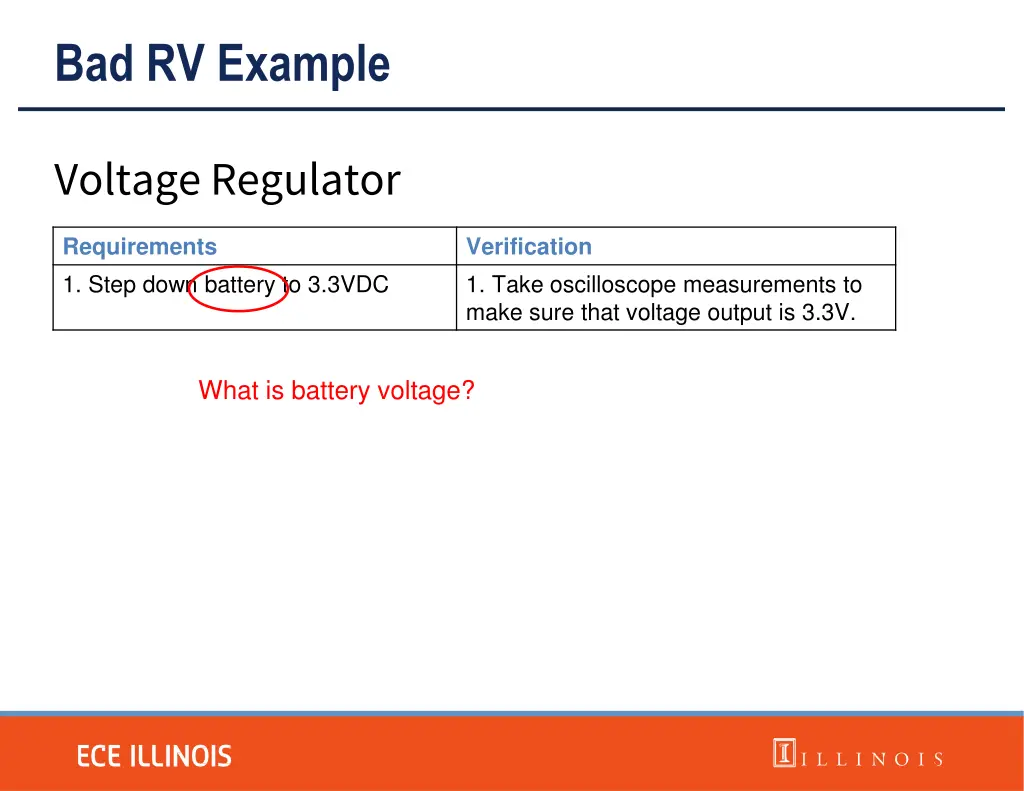
Bad RV Example Voltage Regulator Requirements 1. Step down battery to 3.3VDC Verification 1. Take oscilloscope measurements to make sure that voltage output is 3.3V. What is battery voltage?
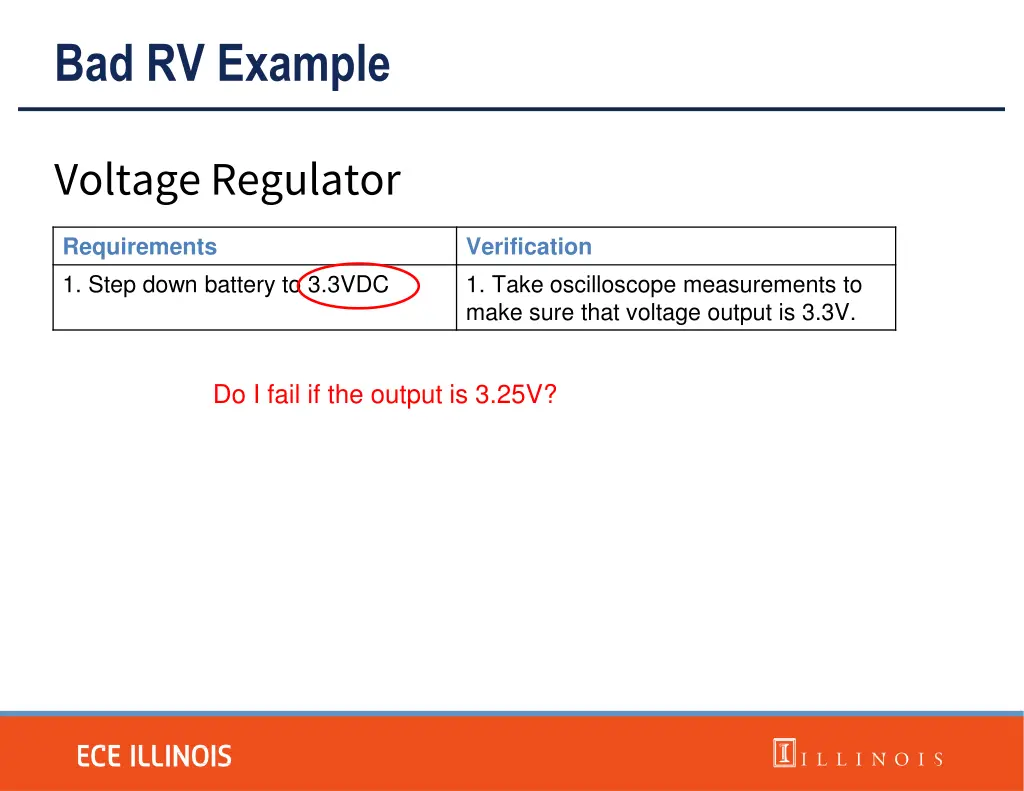
Bad RV Example Voltage Regulator Requirements 1. Step down battery to 3.3VDC Verification 1. Take oscilloscope measurements to make sure that voltage output is 3.3V. Do I fail if the output is 3.25V?
Bad RV Example Voltage Regulator Requirements 1. Step down battery to 3.3VDC Verification 1. Take oscilloscope measurements to make sure that voltage output is 3.3V. Do we miss any requirements? e.g, current draw?
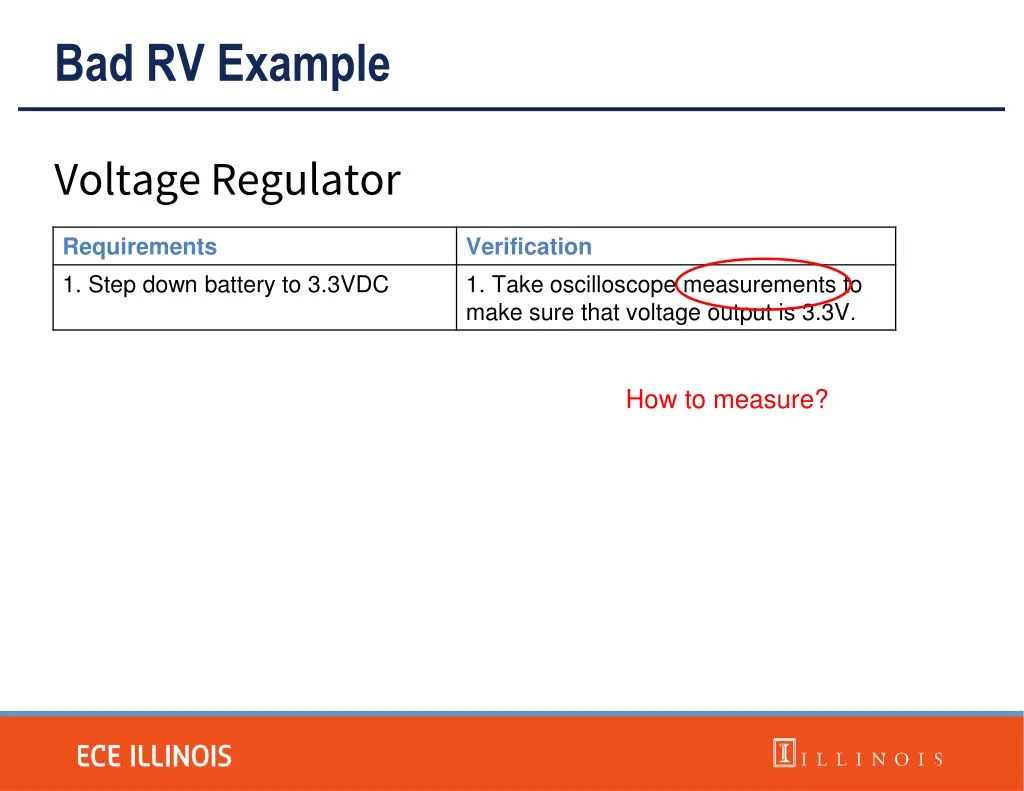
Bad RV Example Voltage Regulator Requirements 1. Step down battery to 3.3VDC Verification 1. Take oscilloscope measurements to make sure that voltage output is 3.3V. How to measure?
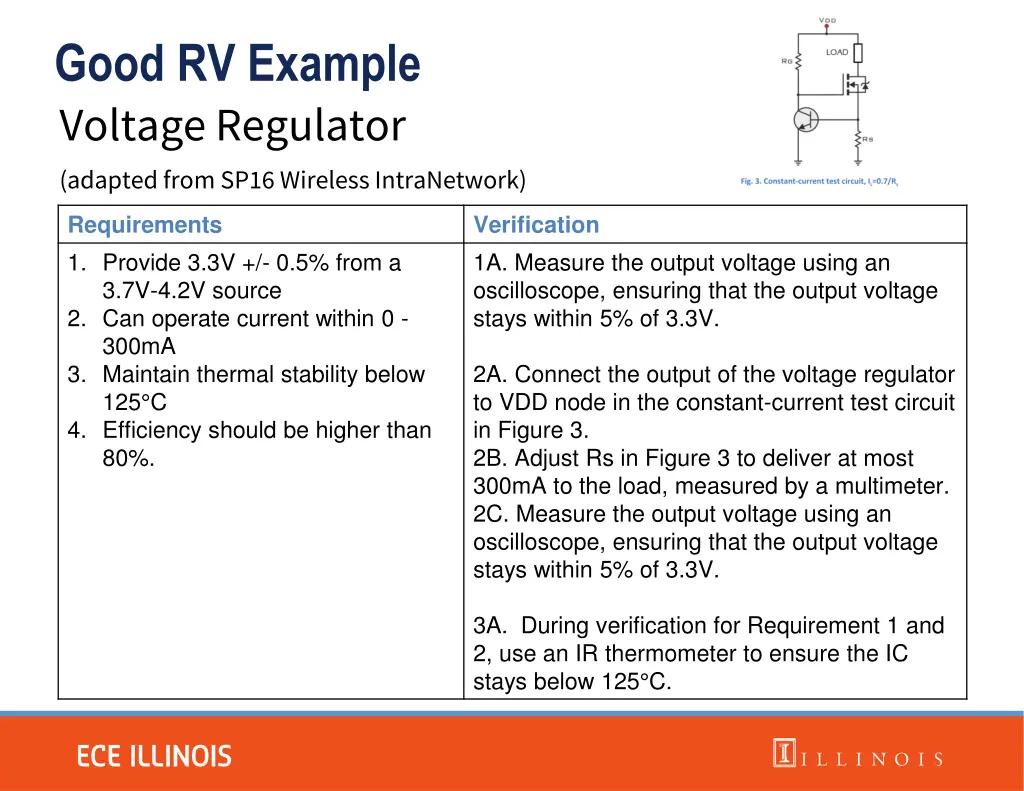
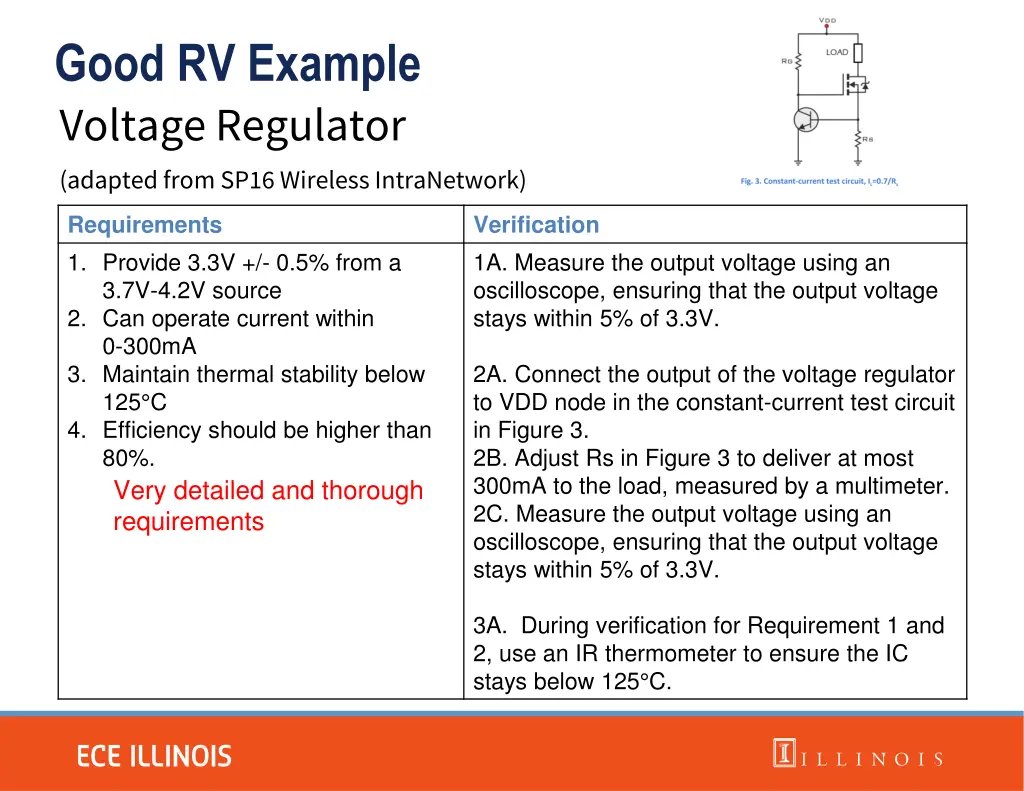
Good RV Example Voltage Regulator (adaptedfrom SP16WirelessIntraNetwork) Requirements 1. Provide 3.3V +/- 0.5% from a 3.7V-4.2V source 2. Can operate current within 0 - 300mA 3. Maintain thermal stability below 125 C 4. Efficiency should be higher than 80%. Verification 1A. Measure the output voltage using an oscilloscope, ensuring that the output voltage stays within 5% of 3.3V. 2A. Connect the output of the voltage regulator to VDD node in the constant-current test circuit in Figure 3. 2B. Adjust Rs in Figure 3 to deliver at most 300mA to the load, measured by a multimeter. 2C. Measure the output voltage using an oscilloscope, ensuring that the output voltage stays within 5% of 3.3V. 3A. During verification for Requirement 1 and 2, use an IR thermometer to ensure the IC stays below 125 C.
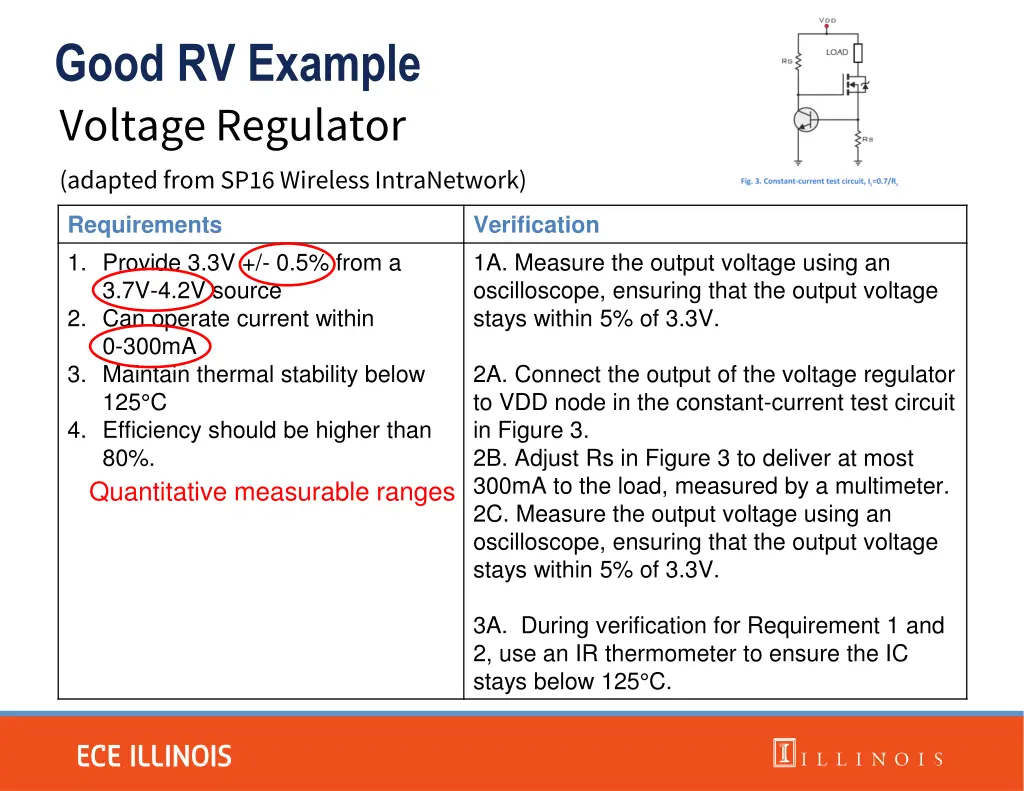
Good RV Example Voltage Regulator (adaptedfrom SP16WirelessIntraNetwork) Requirements 1. Provide 3.3V +/- 0.5% from a 3.7V-4.2V source 2. Can operate current within 0-300mA 3. Maintain thermal stability below 125 C 4. Efficiency should be higher than 80%. Quantitative measurable ranges Verification 1A. Measure the output voltage using an oscilloscope, ensuring that the output voltage stays within 5% of 3.3V. 2A. Connect the output of the voltage regulator to VDD node in the constant-current test circuit in Figure 3. 2B. Adjust Rs in Figure 3 to deliver at most 300mA to the load, measured by a multimeter. 2C. Measure the output voltage using an oscilloscope, ensuring that the output voltage stays within 5% of 3.3V. 3A. During verification for Requirement 1 and 2, use an IR thermometer to ensure the IC stays below 125 C.
Good RV Example Voltage Regulator (adaptedfrom SP16WirelessIntraNetwork) Requirements 1. Provide 3.3V +/- 0.5% from a 3.7V-4.2V source 2. Can operate current within 0-300mA 3. Maintain thermal stability below 125 C 4. Efficiency should be higher than 80%. Very detailed and thorough requirements Verification 1A. Measure the output voltage using an oscilloscope, ensuring that the output voltage stays within 5% of 3.3V. 2A. Connect the output of the voltage regulator to VDD node in the constant-current test circuit in Figure 3. 2B. Adjust Rs in Figure 3 to deliver at most 300mA to the load, measured by a multimeter. 2C. Measure the output voltage using an oscilloscope, ensuring that the output voltage stays within 5% of 3.3V. 3A. During verification for Requirement 1 and 2, use an IR thermometer to ensure the IC stays below 125 C.
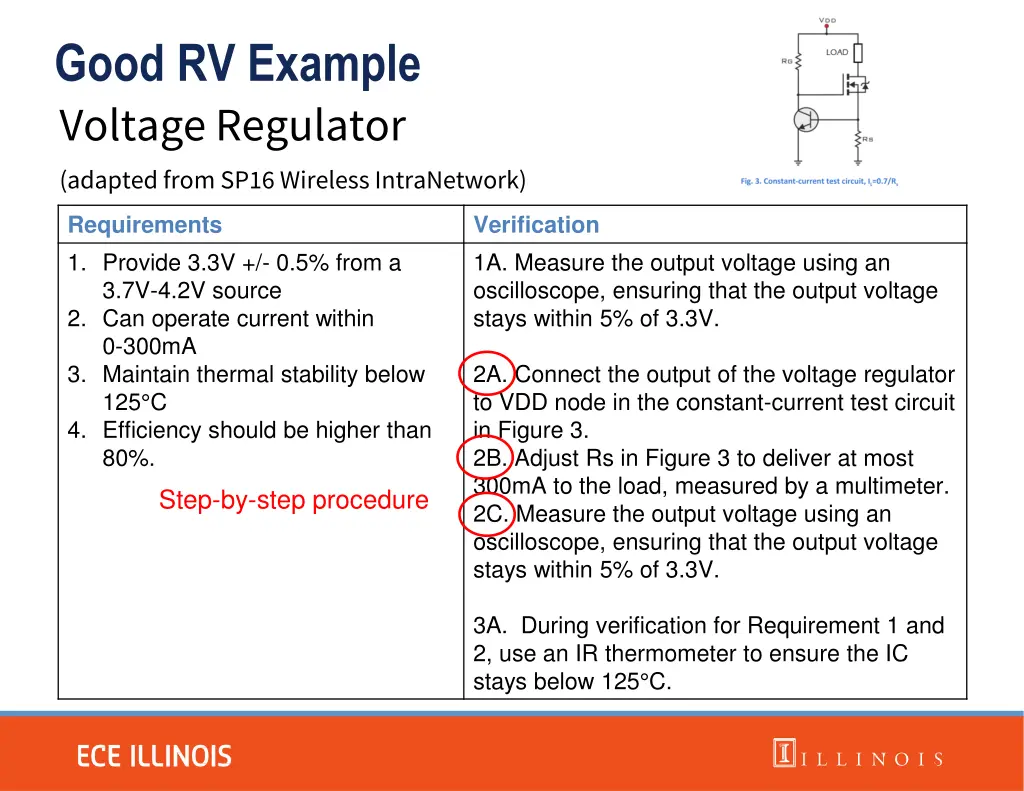
Good RV Example Voltage Regulator (adaptedfrom SP16WirelessIntraNetwork) Requirements 1. Provide 3.3V +/- 0.5% from a 3.7V-4.2V source 2. Can operate current within 0-300mA 3. Maintain thermal stability below 125 C 4. Efficiency should be higher than 80%. Step-by-step procedure Verification 1A. Measure the output voltage using an oscilloscope, ensuring that the output voltage stays within 5% of 3.3V. 2A. Connect the output of the voltage regulator to VDD node in the constant-current test circuit in Figure 3. 2B. Adjust Rs in Figure 3 to deliver at most 300mA to the load, measured by a multimeter. 2C. Measure the output voltage using an oscilloscope, ensuring that the output voltage stays within 5% of 3.3V. 3A. During verification for Requirement 1 and 2, use an IR thermometer to ensure the IC stays below 125 C.
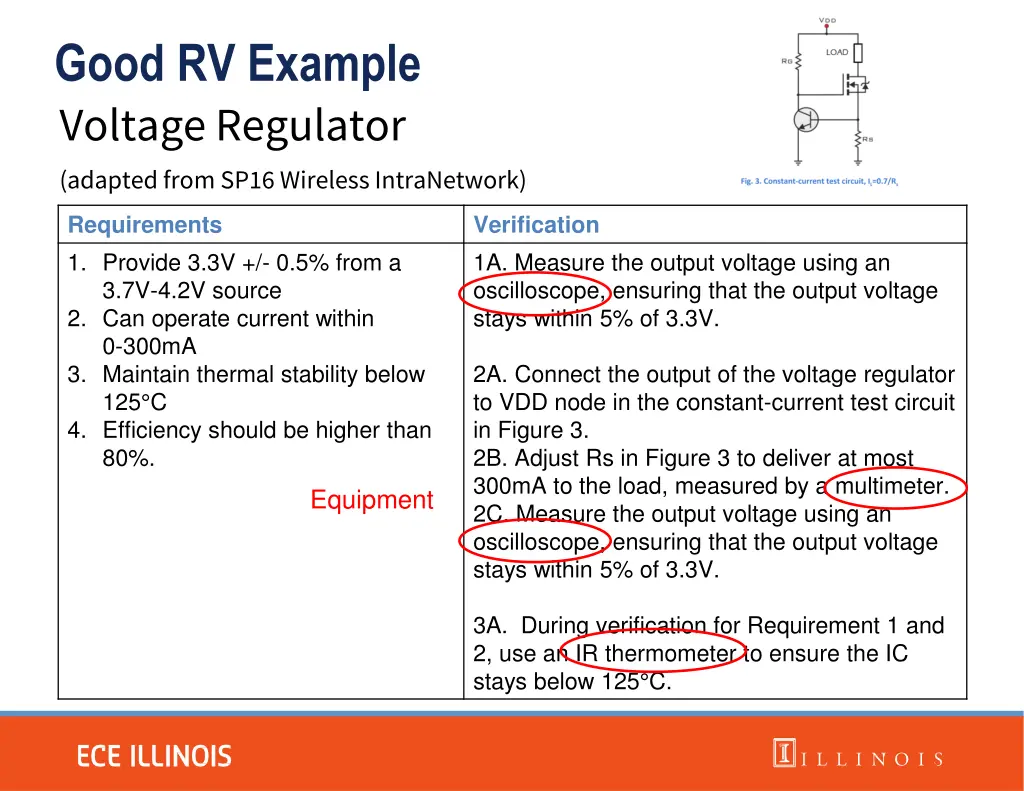
Good RV Example Voltage Regulator (adaptedfrom SP16WirelessIntraNetwork) Requirements 1. Provide 3.3V +/- 0.5% from a 3.7V-4.2V source 2. Can operate current within 0-300mA 3. Maintain thermal stability below 125 C 4. Efficiency should be higher than 80%. Verification 1A. Measure the output voltage using an oscilloscope, ensuring that the output voltage stays within 5% of 3.3V. 2A. Connect the output of the voltage regulator to VDD node in the constant-current test circuit in Figure 3. 2B. Adjust Rs in Figure 3 to deliver at most 300mA to the load, measured by a multimeter. 2C. Measure the output voltage using an oscilloscope, ensuring that the output voltage stays within 5% of 3.3V. Equipment 3A. During verification for Requirement 1 and 2, use an IR thermometer to ensure the IC stays below 125 C.
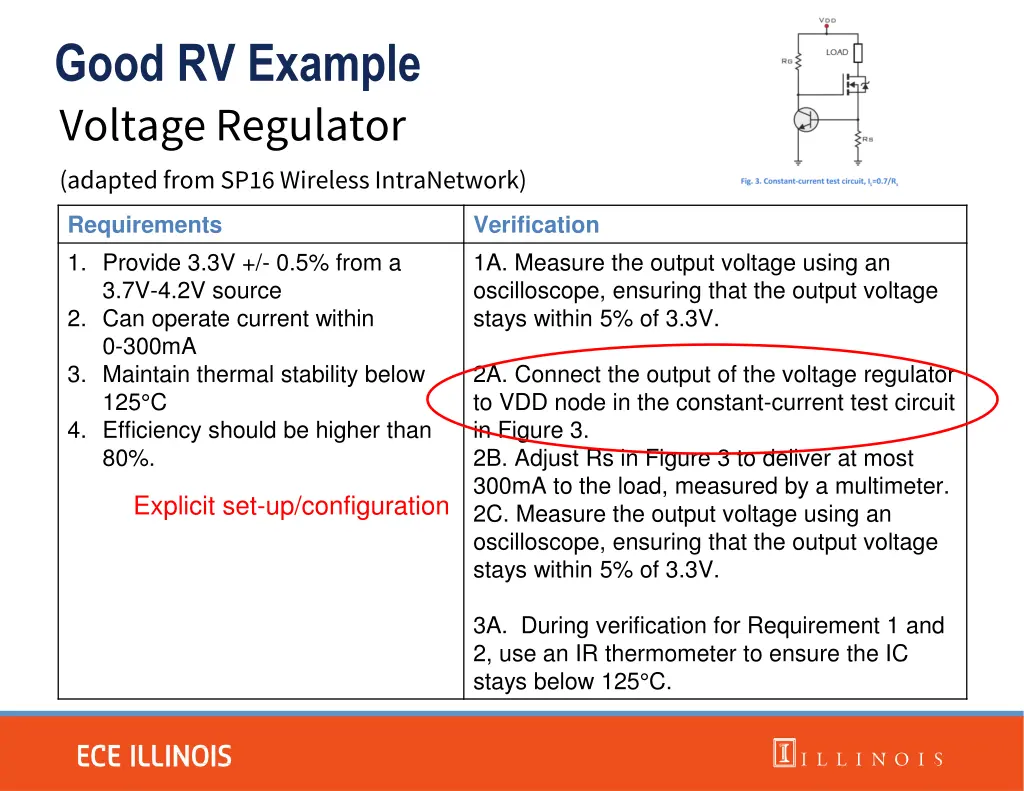
Good RV Example Voltage Regulator (adaptedfrom SP16WirelessIntraNetwork) Requirements 1. Provide 3.3V +/- 0.5% from a 3.7V-4.2V source 2. Can operate current within 0-300mA 3. Maintain thermal stability below 125 C 4. Efficiency should be higher than 80%. Verification 1A. Measure the output voltage using an oscilloscope, ensuring that the output voltage stays within 5% of 3.3V. 2A. Connect the output of the voltage regulator to VDD node in the constant-current test circuit in Figure 3. 2B. Adjust Rs in Figure 3 to deliver at most 300mA to the load, measured by a multimeter. 2C. Measure the output voltage using an oscilloscope, ensuring that the output voltage stays within 5% of 3.3V. Explicit set-up/configuration 3A. During verification for Requirement 1 and 2, use an IR thermometer to ensure the IC stays below 125 C.
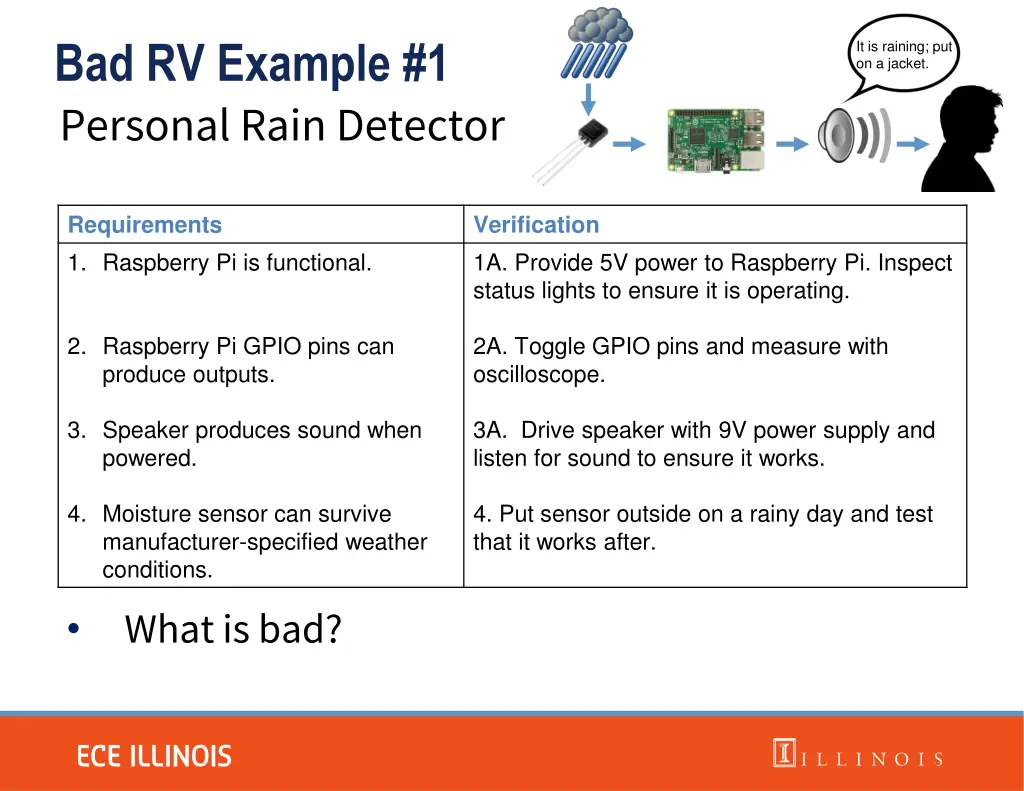
Bad RV Example #1 Personal Rain Detector It is raining; put on a jacket. Requirements 1. Raspberry Pi is functional. Verification 1A. Provide 5V power to Raspberry Pi. Inspect status lights to ensure it is operating. 2. Raspberry Pi GPIO pins can produce outputs. 2A. Toggle GPIO pins and measure with oscilloscope. 3. Speaker produces sound when powered. 3A. Drive speaker with 9V power supply and listen for sound to ensure it works. 4. Moisture sensor can survive manufacturer-specified weather conditions. What is bad? 4. Put sensor outside on a rainy day and test that it works after.
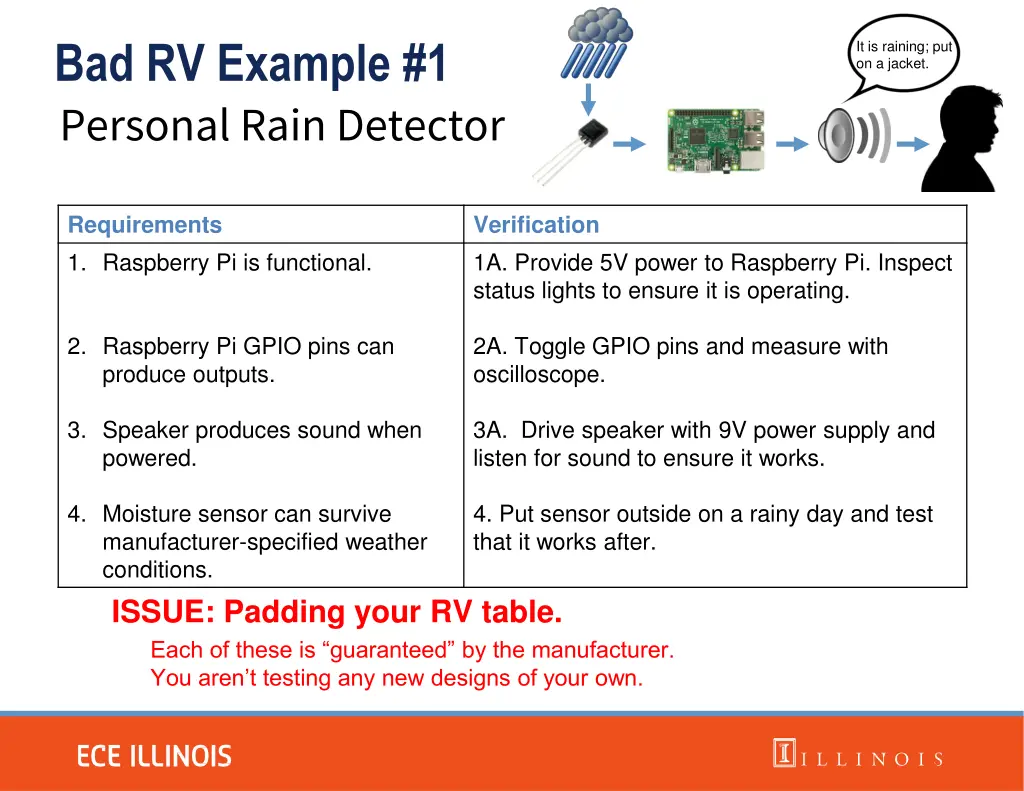
Bad RV Example #1 Personal Rain Detector It is raining; put on a jacket. Requirements 1. Raspberry Pi is functional. Verification 1A. Provide 5V power to Raspberry Pi. Inspect status lights to ensure it is operating. 2. Raspberry Pi GPIO pins can produce outputs. 2A. Toggle GPIO pins and measure with oscilloscope. 3. Speaker produces sound when powered. 3A. Drive speaker with 9V power supply and listen for sound to ensure it works. 4. Moisture sensor can survive manufacturer-specified weather conditions. ISSUE: Padding your RV table. Each of these is guaranteed by the manufacturer. You aren t testing any new designs of your own. 4. Put sensor outside on a rainy day and test that it works after.
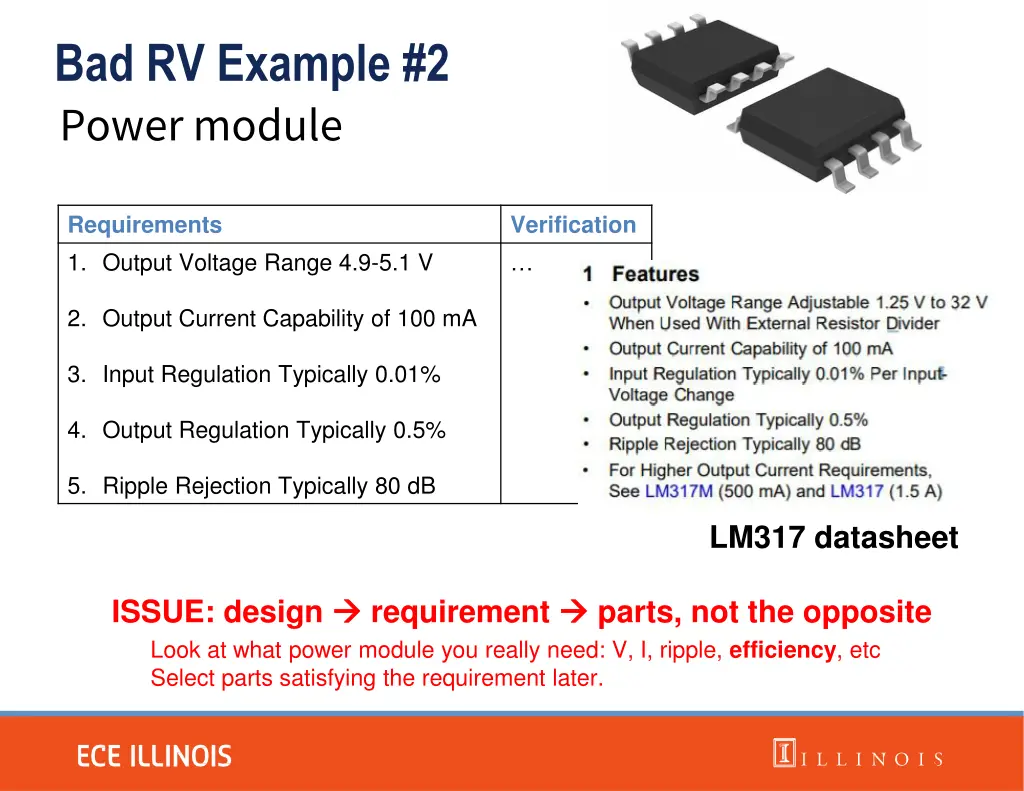
Bad RV Example #2 Power module Requirements 1. Output Voltage Range 4.9-5.1 V Verification 2. Output Current Capability of 100 mA 3. Input Regulation Typically 0.01% 4. Output Regulation Typically 0.5% 5. Ripple Rejection Typically 80 dB LM317 datasheet ISSUE: design Look at what power module you really need: V, I, ripple, efficiency, etc Select parts satisfying the requirement later. requirement parts, not the opposite
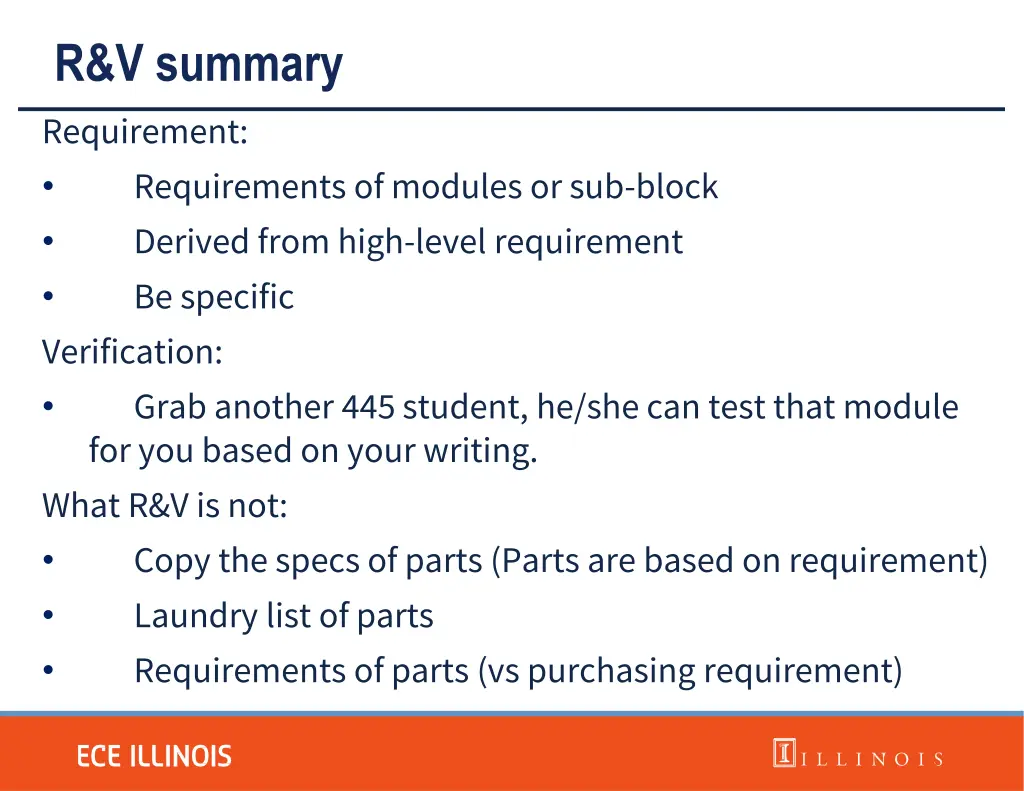
R&V summary Requirement: Requirements of modules or sub-block Derived from high-level requirement Be specific Verification: Grab another 445 student, he/she can test that module for you based on your writing. What R&V is not: Copy the specs of parts (Parts are based on requirement) Laundry list of parts Requirements of parts (vs purchasing requirement)
Tips to succeed 1. Top-down approach 2. Check out good projects from previous semesters 3. Ask your TAs