HTCondor Provisioning and Scheduling Overview
Explore the important aspects of HTCondor architecture, focusing on provisioning, scheduling, user priorities, and negotiation cycles. Discover how the Central Manager and Schedd play crucial roles in job allocation and management within HTCondor. Learn about job priority, job rank, and concurrency limits to optimize job scheduling and resource utilization.

Download Presentation

Please find below an Image/Link to download the presentation.
The content on the website is provided AS IS for your information and personal use only. It may not be sold, licensed, or shared on other websites without obtaining consent from the author. If you encounter any issues during the download, it is possible that the publisher has removed the file from their server.
You are allowed to download the files provided on this website for personal or commercial use, subject to the condition that they are used lawfully. All files are the property of their respective owners.
The content on the website is provided AS IS for your information and personal use only. It may not be sold, licensed, or shared on other websites without obtaining consent from the author.
E N D
Presentation Transcript
Priority and Provisioning Greg Thain HTCondorWeek 2015
Overview Important HTCondor architecture bits Detour to items that doesn t fit elsewhere Groups and why you should care User priorities and preemption Draining 2
Provisioning vs. Scheduling HTCondor separates the two Very important Central Manager (negotiator) provisions Schedd schedules 3
Provisioning Negotiator selects a slot for a USER Based on USER attributes (and machine) With some small thought to the users s job At slower frequency: the negotiation cycle Don t obsess about negotiation cycle time 4
Scheduling Schedd takes that slot for the user And runs one or more jobs on it For how long? CLAIM_WORKLIFE = some_seconds 5
Consequences May take much longer to start 1st job The central manager responsible for users The central manager responsible for groups Accounting happens in the CM 6
Schedd Policy: Job Priority Set in submit file with: JobPriority = 7 or dynamically with condor_prio cmd Integers, larger numbers are better priority Only impacts order between jobs for a single user on a single schedd A tool for users to sort their own jobs 9
Schedd Policy: Job Rank Set with RANK = Memory In condor_submit file Not as powerful as you may think: Negotiator gets first cut at sorting Remember steady state condition 10
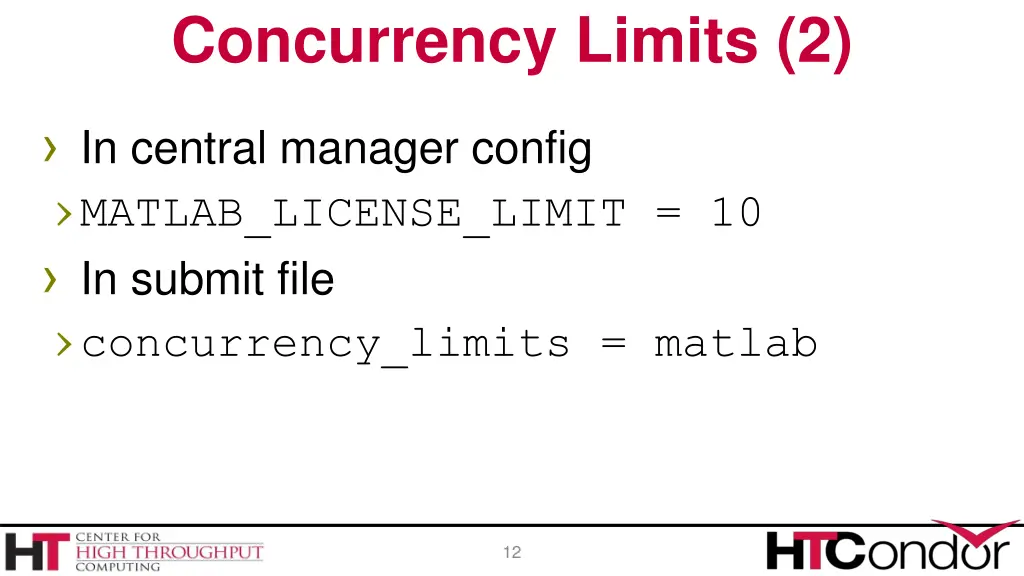
Concurrency Limits Useful for globally (pool-wide): License limits, NFS server overload prevention Limiting database access Limits total number jobs across all schedds 11
Concurrency Limits (2) In central manager config MATLAB_LICENSE_LIMIT = 10 In submit file concurrency_limits = matlab 12
Rest of this talk: Provisioning, not Scheduling schedd sends idle users to the negotiator Negotiator picks machines (idle or busy) to send to the schedd for those users How does it pick? 13
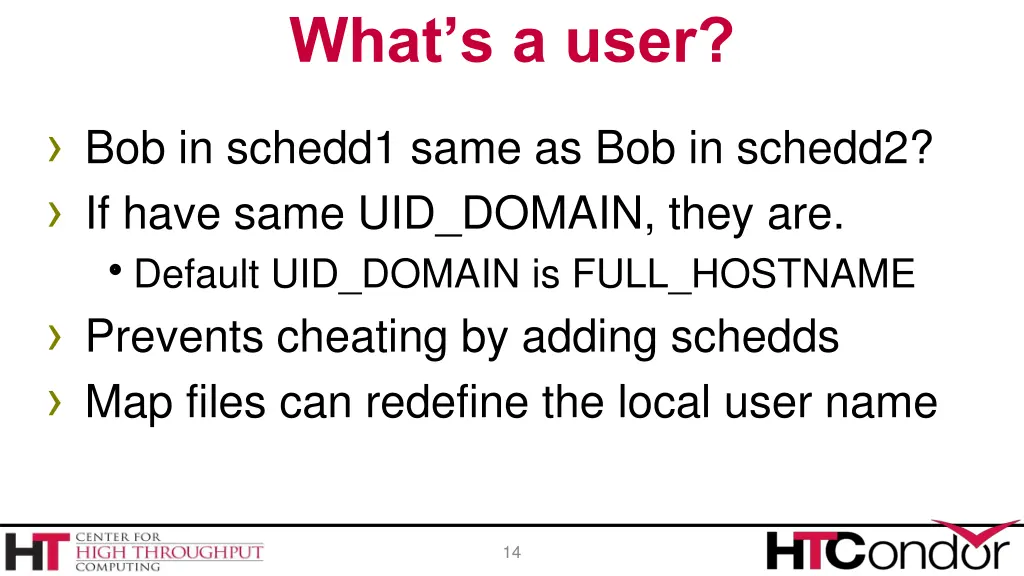
Whats a user? Bob in schedd1 same as Bob in schedd2? If have same UID_DOMAIN, they are. Default UID_DOMAIN is FULL_HOSTNAME Prevents cheating by adding schedds Map files can redefine the local user name 14
Accounting Groups (2 kinds) Manage priorities across groups of users Can guarantee maximum numbers of computers for groups (quotas) Supports hierarchies Anyone can join any group 16
Accounting Groups as Alias In submit file Accounting_Group = group1 Treats all users as the same for priority Accounting groups not pre-defined No verification condor trusts the job condor_userprio replaces user with group 17
Accounting Groups w/ Quota aka: Hierarchical Group Quota 18
Maximum 19
Minimum 20
HGQ: Strict quotas a limited to 10 b to 20, Even if idle machines What is the unit? Slot weight. With fair share of users within group 21
Group_accept_surplus Group_accept_surplus = true Group_accept_surplus_a = true This is what creates hierarchy But only for quotas 22
GROUP_AUTOREGROUP Allows groups to go over quota if idle machines Last chance wild-west round, with every submitter for themselves. 23
Hierarchical Group Quotas 200 700 CompSci physics 600 100 100 100 string theory particle physics architecture DB 200 100 200 ATLAS CMS CDF 24
Hierarchical Group Quotas 700 GROUP_QUOTA_physics = 700 GROUP_QUOTA_physics.string_theory = 100 GROUP_QUOTA_physics.particle_physics = 600 GROUP_QUOTA_physics.particle_physics.CMS = 200 GROUP_QUOTA_physics.particle_physics.ATLAS = 200 GROUP_QUOTA_physics.particle_physics.CDF = 100 physics 600 100 string theory particle physics 200 100 200 group.sub- group.sub-sub- group CMS ATLAS CDF 25
Hierarchical Group Quotas 700 Groups configured to accept surplus will share it in proportion to their quota. physics 600 100 string theory particle physics Here, unused particle physics surplus is shared by ATLAS 200 100 200 CMS ATLAS CDF 2/3 surplus 1/3 surplus and CDF. GROUP_ACCEPT_SURPLUS_physics.particle_physics.ATLAS = true GROUP_ACCEPT_SURPLUS_physics.particle_physics.CDF = true 26
Gotchas with quotas Quotas don t know about matching Assuming everything matches everything Surprises with partitionable slots Managing groups not easy May want to think about draining instead. 31
Enough about Groups Remember: group quota comes first! Groups only way to limit total running jobs per user/group Haven t gotten to matchmaking yet 32
Negotiation Cycle Gets all the slot ads from collector Based on new user prio, computes submitter limit for each user Foreach user, finds the schedd, gets a job Finds all matching machines for job Sorts the machines Gives the job the best machine (may preempt) 33
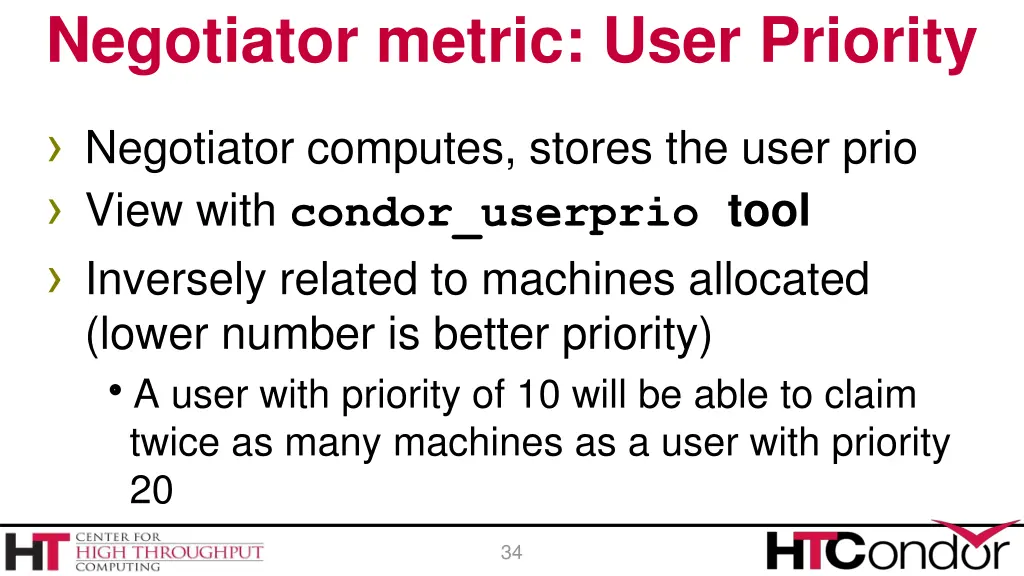
Negotiator metric: User Priority Negotiator computes, stores the user prio View with condor_userprio tool Inversely related to machines allocated (lower number is better priority) A user with priority of 10 will be able to claim twice as many machines as a user with priority 20 34
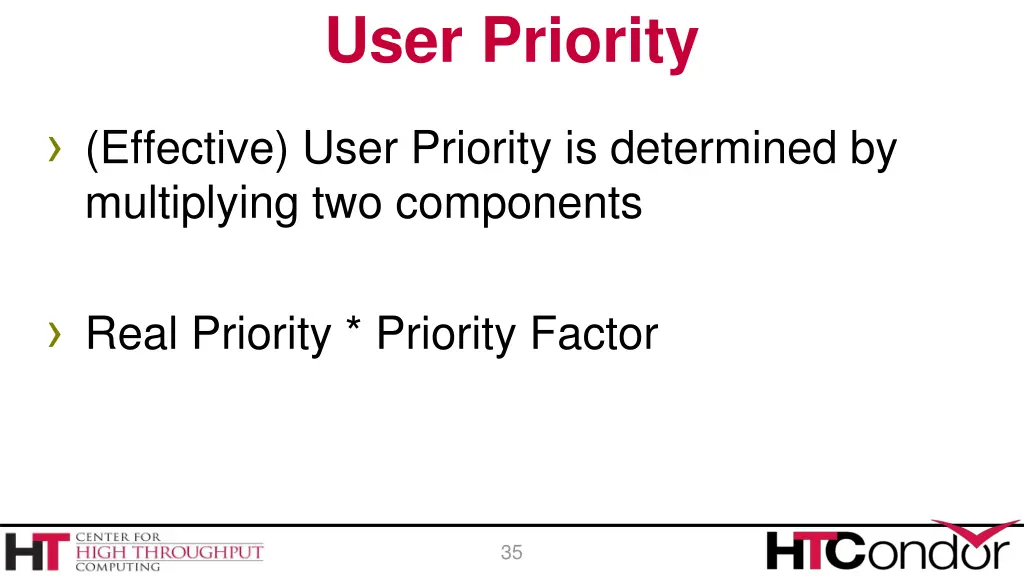
User Priority (Effective) User Priority is determined by multiplying two components Real Priority * Priority Factor 35
Real Priority Based on actual usage, starts at .5 Approaches actual number of machines used over time Configuration setting PRIORITY_HALFLIFE If PRIORITY_HALFLIFE = +Inf, no history Default one day (in seconds) Asymptotically grows/shrinks to current usage 36
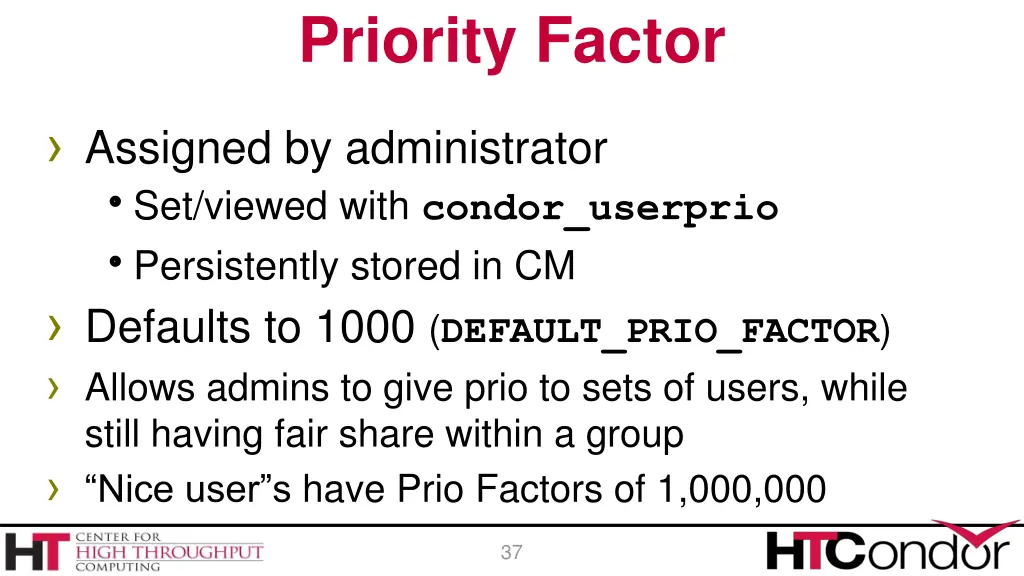
Priority Factor Assigned by administrator Set/viewed with condor_userprio Persistently stored in CM Defaults to 1000 (DEFAULT_PRIO_FACTOR) Allows admins to give prio to sets of users, while still having fair share within a group Nice user s have Prio Factors of 1,000,000 37
condor_userprio Command usage: condor_userprio most Effective Priority User Name ---------------------------------------------- --------- ------ ----------- ---------- lmichael@submit-3.chtc.wisc.edu blin@osghost.chtc.wisc.edu osgtest@osghost.chtc.wisc.edu 90.57 10.00 47 45505.99 <now> cxiong36@submit-3.chtc.wisc.edu 500.00 1000.00 0 0.29 0+00:09 ojalvo@hep.wisc.edu 500.00 1000.00 0 398148.56 0+05:37 wjiang4@submit-3.chtc.wisc.edu 500.00 1000.00 0 0.22 0+21:25 cxiong36@submit.chtc.wisc.edu 500.00 1000.00 0 63.38 0+21:42 Priority Factor In Use (wghted-hrs) Last Usage 5.00 10.00 0 16.37 0+23:46 7.71 10.00 0 5412.38 0+01:05 38
Prio factors with groups condor_userprio setfactor 10 group1.wisc.edu condor_userprio setfactor 20 group2.wisc.edu Note that you must get UID_DOMAIN correct Gives group1 members 2x resources as group2 39
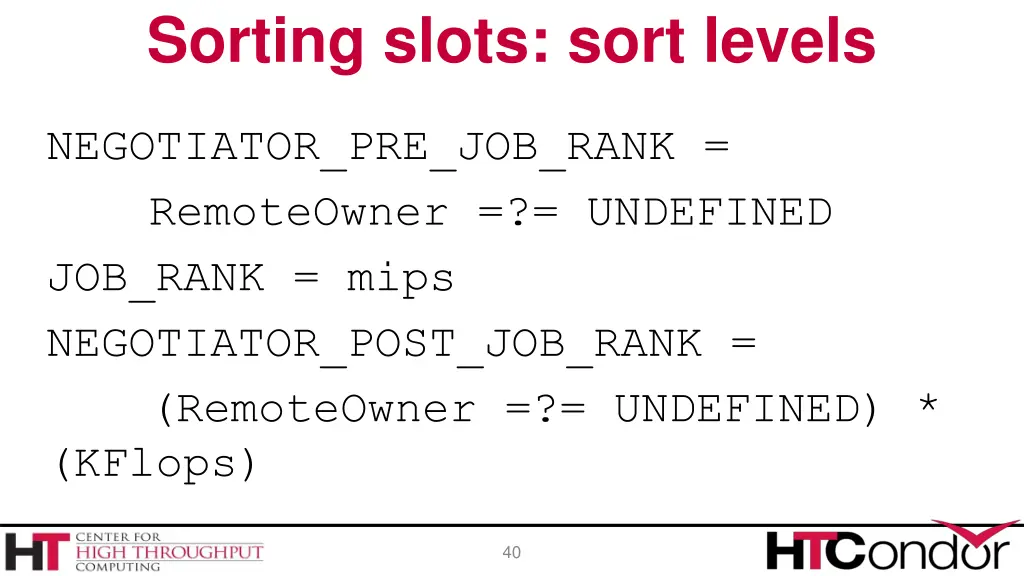
Sorting slots: sort levels NEGOTIATOR_PRE_JOB_RANK = RemoteOwner =?= UNDEFINED JOB_RANK = mips NEGOTIATOR_POST_JOB_RANK = (RemoteOwner =?= UNDEFINED) * (KFlops) 40
Power of NEGOTIATOR_PRE_JOB_RANK Very powerful Used to pack machines NEGOTIATOR_PRE_JOB_RANK = isUndefined(RemoteOwner) * (- SlotId) Sort multicore vs. serial jobs 41
More Power of NEGOTIATOR_PRE_JOB_RANK Best fit of multicore jobs: NEGOTIATOR_PRE_JOB_RANK = (1000000 * (RemoteOwner =?= UNDEFINED)) - (100000 * Cpus) - Memory 42
If Matched machine claimed, extra checks required PREEMPTION_REQUIREMENTSand PREEMPTION_RANK Evaluated when condor_negotiator considers replacing a lower priority job with a higher priority job Completely unrelated to the PREEMPT expression (which should be called evict) 43
A note about Preemption Fundamental tension between Throughput vs. Fairness Preemption is required to have fairness Need to think hard about runtimes, fairness and preemption Negotiator implementation preemption (Workers implement eviction: different) 44
PREEMPTION_REQUIREMENTS MY = busy machine // TARGET = job If false will not preempt machine Typically used to avoid pool thrashing Typically use: RemoteUserPrio Priority of user of currently running job (higher is worse) SubmittorPrio Priority of user of higher priority idle job (higher is worse) 45
PREEMPTION_REQUIREMENTS Replace jobs running > 1 hour and 20% lower priority StateTimer = \ (CurrentTime EnteredCurrentState) HOUR = (60*60) PREEMPTION_REQUIREMENTS = \ $(StateTimer) > (1 * $(HOUR)) \ && RemoteUserPrio > SubmittorPrio * 1.2 46
Preemption with HQG By default, won t preempt to make quota But, there s a knob for that PREEMPTION_REQUIREMENTS = (SubmitterGroupResourcesInUse < SubmitterGroupQuota) && (RemoteGroupResourcesInUse > RemoteGroupQuota) && ( RemoteGroup =!= SubmitterGroup 47
PREEMPTION_REQUIREMENTS is an expression ( MY.TotalJobRunTime > ifThenElse((isUndefined(MAX_PREEMPT) || (MAX_PREEMPT =?= 0)),(72*(60 * 60)),MAX_PREEMPT) ) && RemoteUserPrio > SubmittorPrio * 1.2 48
PREEMPTION_RANK Of all claimed machines where PREEMPTION_REQUIREMENTS is true, picks which one machine to reclaim Strongly prefer preempting jobs with a large (bad) priority and a small image size PREEMPTION_RANK = \ (RemoteUserPrio * 1000000)- ImageSize 49
Better PREEMPTION_RANK Based on Runtime? Cpus? SlotWeight? 50
MaxJobRetirementTime Can be used to guarantee minimum time E.g. if claimed, give an hour runtime, no matter what: MaxJobRetirementTime = 3600 Can also be an expression 51
Partitionable slots What is the cost of a match? SLOT_WEIGHT (cpus) What is the cost of an unclaimed pslot? The whole rest of the machine Leads to quantization problems By default, schedd splits slots Consumption Policies : some rough edges 52
Draining and defrag Instead of preemping, we can drain Condor_drain command initiates draining Defrag daemon periodically calls drain 53
Defrag knobs DEFRAG_MAX_WHOLE_MACHINES = 12 DEFRAG_DRAINING_MACHINES_PER_HOUR = 1 DEFRAG_REQUIREMENTS = PartitionableSlot && TotalCpus > 4 && DEFRAG_WHOLE_MACHINE_EXPR= PartitionableSlot && cpus > 4 54