Explore the comprehensive Human Research Protection Program at Northwell Health, led by Hallie Kassan, dedicated to safeguarding the rights and welfare of research participants and ensuring compliance with ethical standards and regulations in clinical research. Learn about key learning objectives, functions of the Institutional Review Board, ethical considerations in study design, and more.
Please find below an Image/Link to download the presentation.
The content on the website is provided AS IS for your information and personal use only. It may not be sold, licensed, or shared on other websites without obtaining consent from the author. If you encounter any issues during the download, it is possible that the publisher has removed the file from their server.
You are allowed to download the files provided on this website for personal or commercial use, subject to the condition that they are used lawfully. All files are the property of their respective owners.
The content on the website is provided AS IS for your information and personal use only. It may not be sold, licensed, or shared on other websites without obtaining consent from the author.
E N D
Presentation Transcript
Northwell Health IRB 101 Hallie Kassan, MS, CIP, Director Office of the Human Research Protection Program 1
Learning Objectives Identify the ethical cases which led to the creation of the Human Subject Protection Program Understand and apply the three main principles of the Belmont Report Understand the federal regulatory definition of which activities are considered research Understand the federal regulatory definition of research that includes the use of human subjects 2
Learning Objectives Understand the federal regulatory definition of minimal risk Understand the functions of an Institutional Review Board Understand when an exemption from review by the IRB is permissible 3
Learning Objectives Understand the ethical considerations of study design Understand the importance of clinical equipoise Understand the role of analysis of risks and benefits in the ethical conduct of research Understand the impact of therapeutic misconception 4
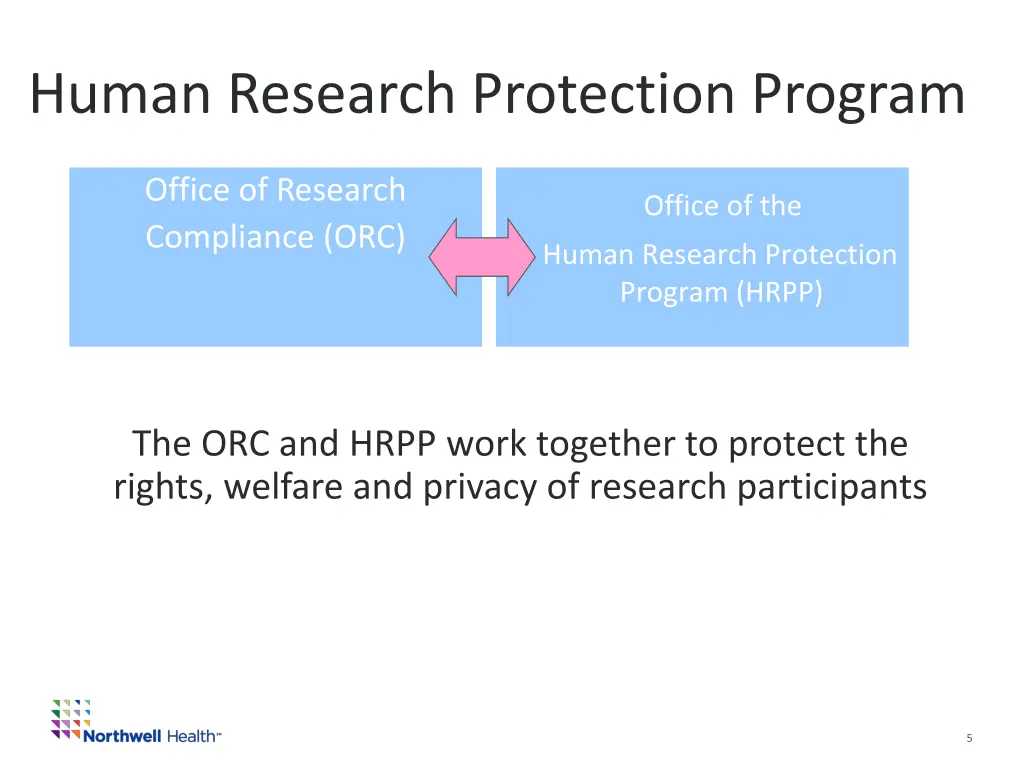
Human Research Protection Program Office of Research Compliance (ORC) Office of the Human Research Protection Program (HRPP) The ORC and HRPP work together to protect the rights, welfare and privacy of research participants 5
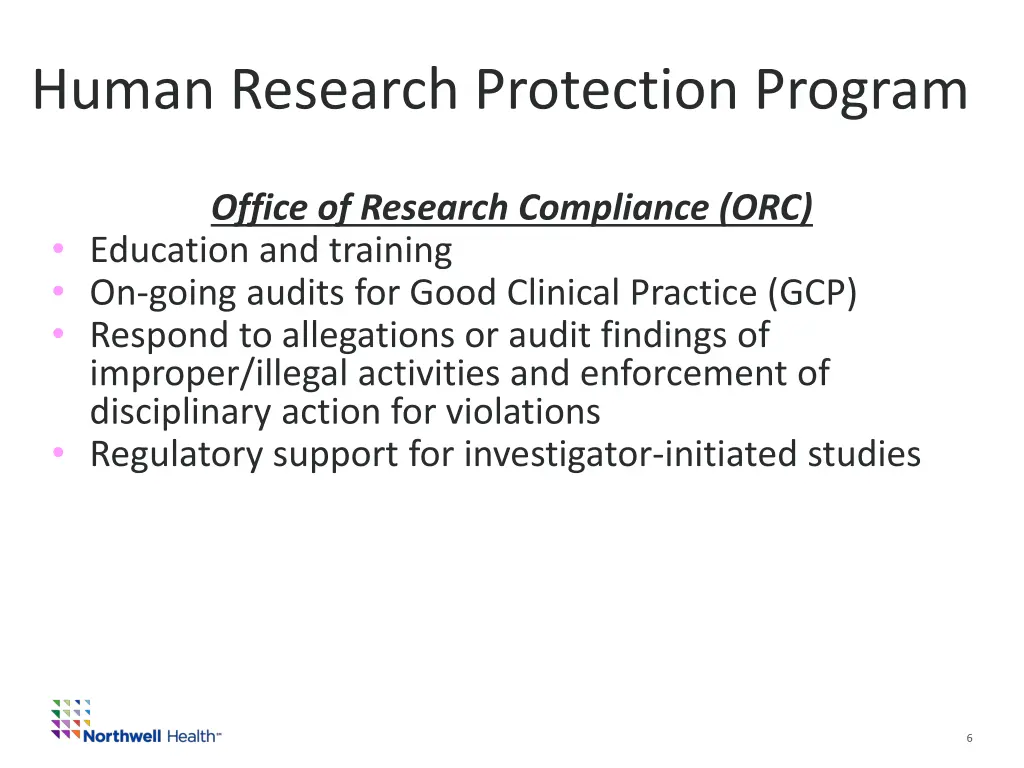
Human Research Protection Program Office of Research Compliance (ORC) Education and training On-going audits for Good Clinical Practice (GCP) Respond to allegations or audit findings of improper/illegal activities and enforcement of disciplinary action for violations Regulatory support for investigator-initiated studies 6
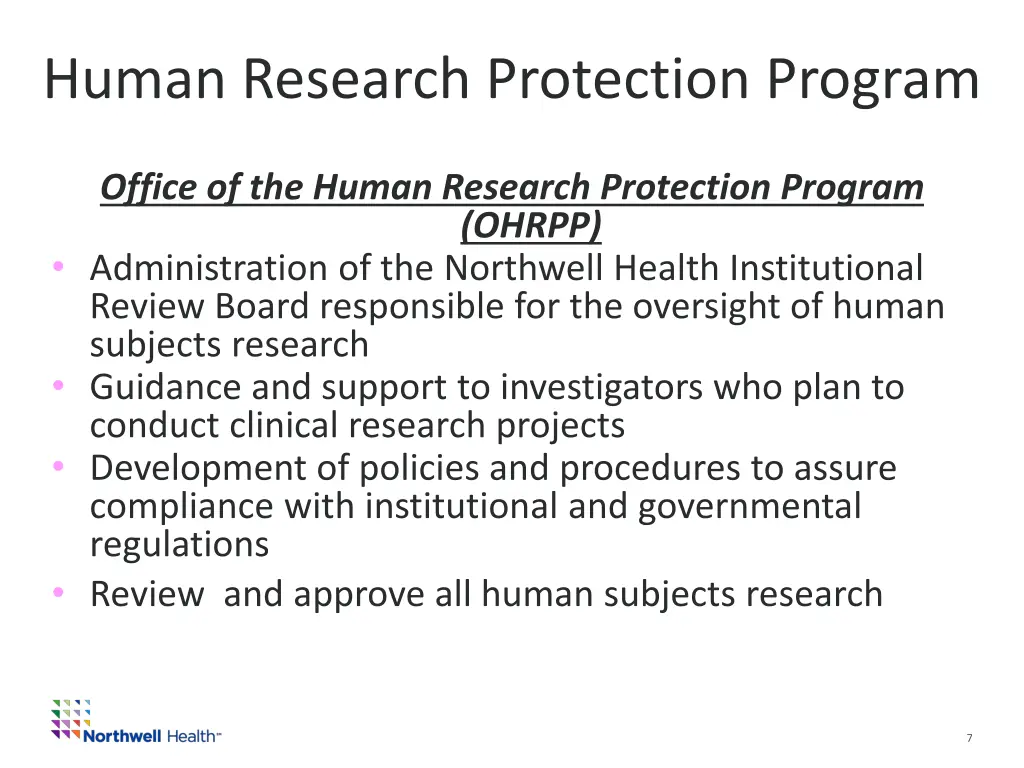
Human Research Protection Program Office of the Human Research Protection Program (OHRPP) Administration of the Northwell Health Institutional Review Board responsible for the oversight of human subjects research Guidance and support to investigators who plan to conduct clinical research projects Development of policies and procedures to assure compliance with institutional and governmental regulations Review and approve all human subjects research 7
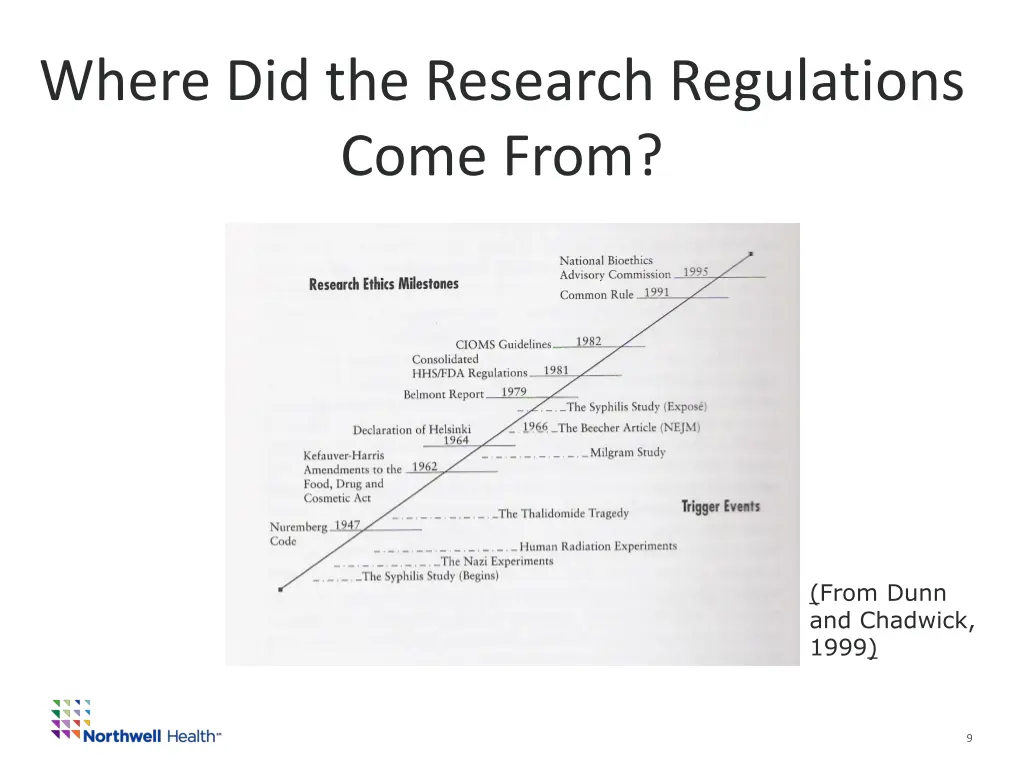
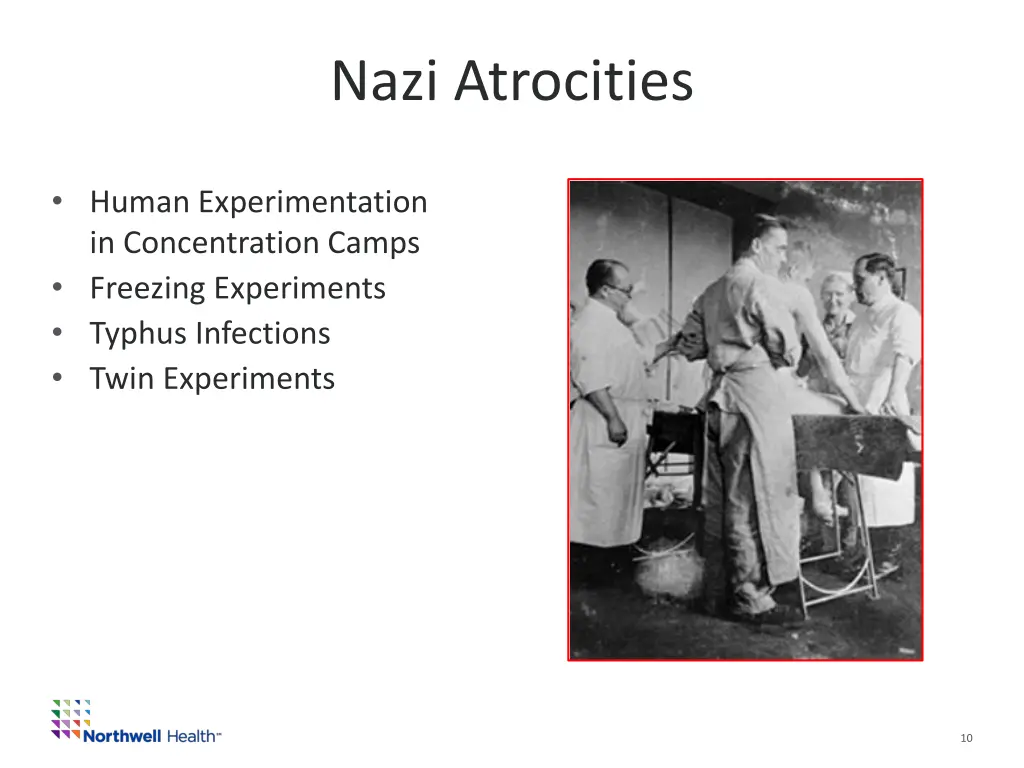
Nazi Atrocities Human Experimentation in Concentration Camps Freezing Experiments Typhus Infections Twin Experiments 10
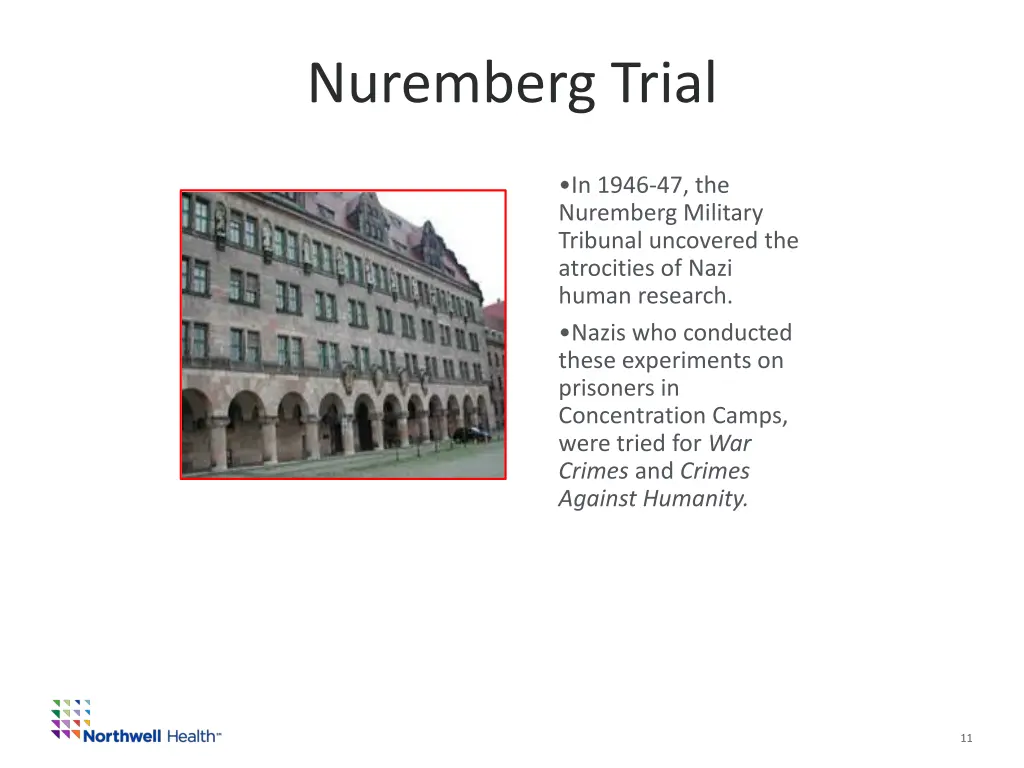
Nuremberg Trial In 1946-47, the Nuremberg Military Tribunal uncovered the atrocities of Nazi human research. Nazis who conducted these experiments on prisoners in Concentration Camps, were tried for War Crimes and Crimes Against Humanity. 11
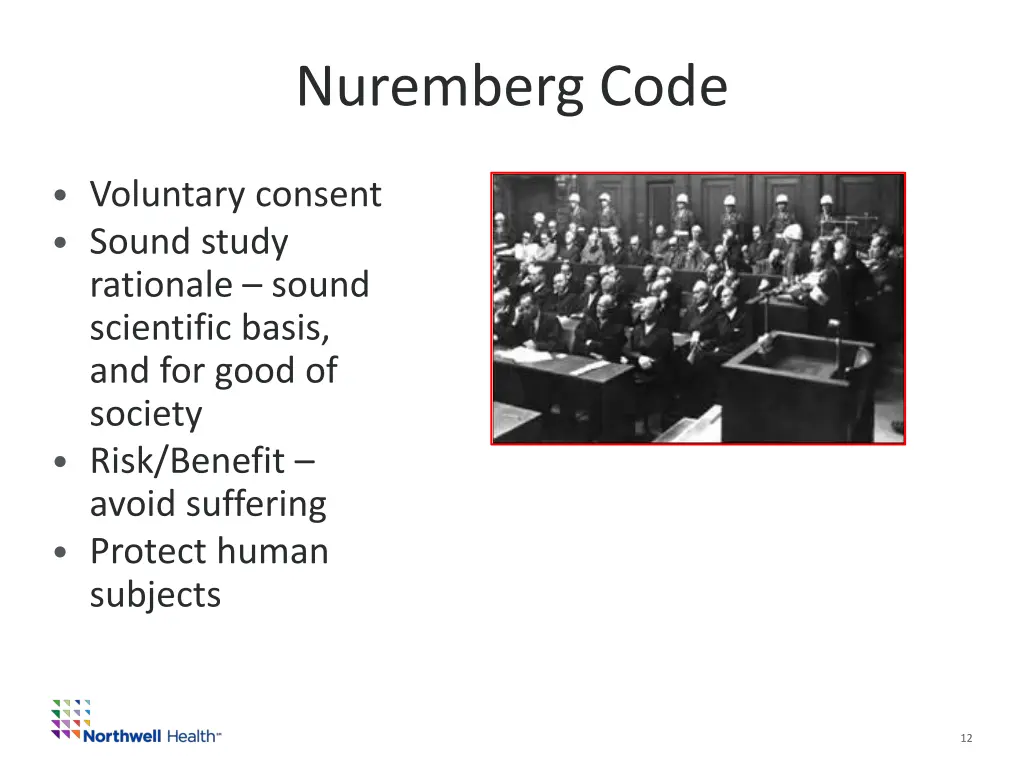
Nuremberg Code Voluntary consent Sound study rationale sound scientific basis, and for good of society Risk/Benefit avoid suffering Protect human subjects 12
Nuremberg Code Generally held as the first international ethical code for the protection of human research subjects. Not widely distributed or followed throughout the world. The Nuremberg Code was believed to apply to the Nazi doctors, not to other researchers. Abuses of human subjects continued to occur in the 1940 s-1960 s. 13
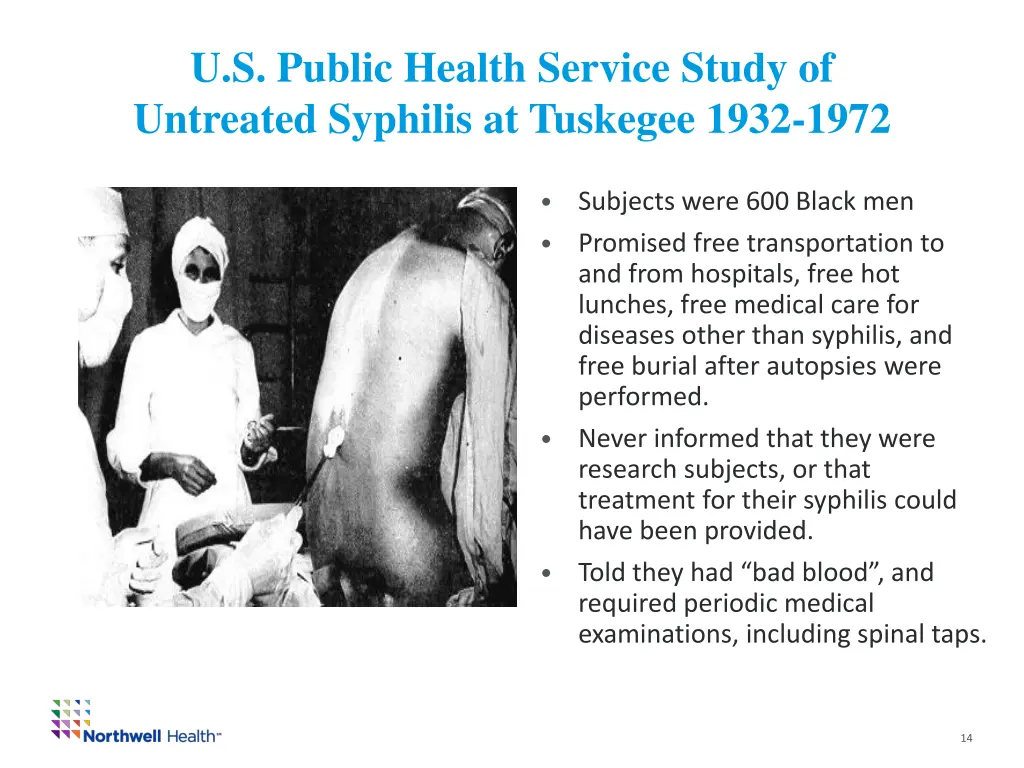
U.S. Public Health Service Study of Untreated Syphilis at Tuskegee 1932-1972 Subjects were 600 Black men Promised free transportation to and from hospitals, free hot lunches, free medical care for diseases other than syphilis, and free burial after autopsies were performed. Never informed that they were research subjects, or that treatment for their syphilis could have been provided. Told they had bad blood , and required periodic medical examinations, including spinal taps. 14
Tuskegee Syphilis Experiment Subjects were not offered information regarding the available treatment, and were actively prevented from seeking it elsewhere. Some subjects died of the disease, passed it on to wives, or passed congenital syphilis to children. 15
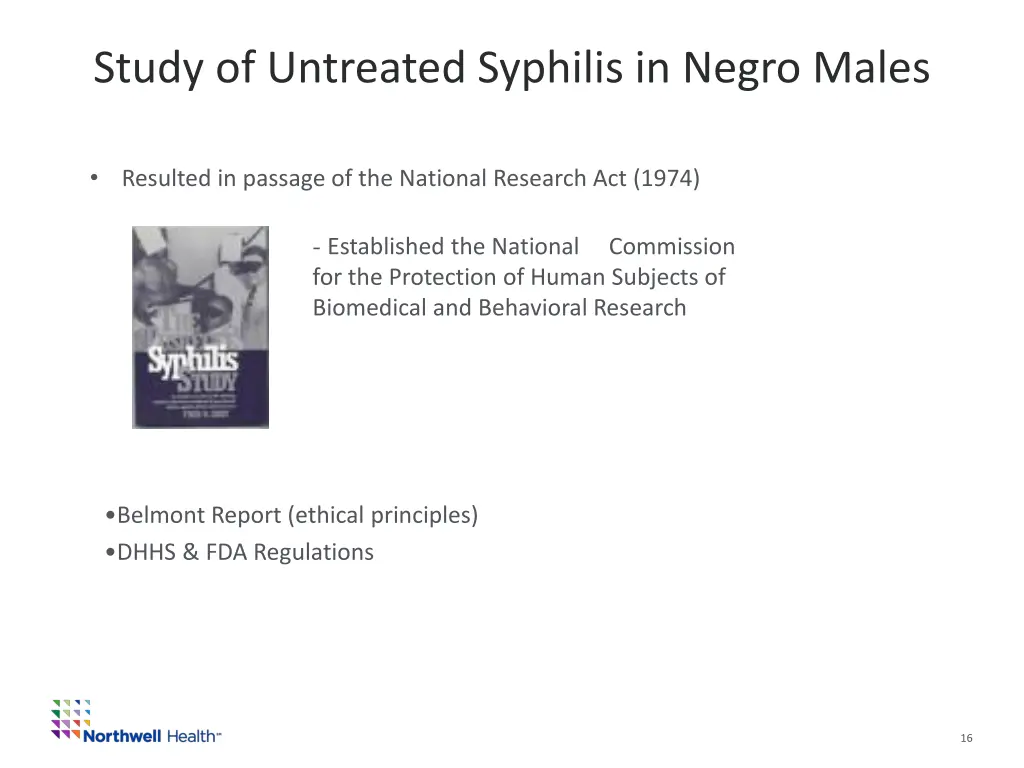
Study of Untreated Syphilis in Negro Males Resulted in passage of the National Research Act (1974) - Established the National Commission for the Protection of Human Subjects of Biomedical and Behavioral Research Belmont Report (ethical principles) DHHS & FDA Regulations 16
National Research Act of 1974 On July 12, 1974, the National Research Act was signed into law, there-by creating the National Commission for the Protection of Human Subjects of Biomedical and Behavioral Research. The NRA also mandated the creation of Institutional Review Boards (IRB s) for all research that receives direct or indirect funding from the Department of Health and Human Services. 18
Belmont Report Differences between Research and Clinical Practice Identified basic ethical principles which underlie the ethical conduct of research involving human subjects Respect for persons. Beneficence. Justice. 19
Boundaries Between Research & Practice Practice: interventions that are designed solely to enhance the well-being of a client and have a reasonable expectation of success. Research: Activity designed to test a hypothesis, permit conclusions to be drawn, contribute to generalizable knowledge. Research and Practice can be done together, but there is a Potential Conflict: When a subject s participation may place him/her at risk of harm. 20
Respect for Persons = Informed Consent 1. Informed Choice Acknowledges the freedom and dignity of every person. People should be able to choose what shall and shall not happen to them. Requires obtaining informed consent from all potential research subjects. Month Day, Year 21
Respect for Persons 2. Persons with diminished ability to consent are entitled to protection. The extent of protection required depends on the risk of harm and the likelihood of benefit. Even these persons should be informed about the study, and assent to the extent possible. 3. That true informed consent has been obtained is the responsibility of the investigator. 22
Beneficence = Risks and Benefits 1. Do no harm One should not injure a person despite possible benefits to others (society). Risks to subjects should be minimized. 2. Maximize Benefits/Minimize Harms Beneficence recognizes the long-term benefits that arise from improving knowledge and medical care. 23
Justice = Enrollment Justice requires equitable selection, recruitment, and fair treatment of research subjects. Subjects should not be selected because of easy availability or vulnerability. Research should not provide benefits only to those who can afford them. Research should not unduly involve subjects from groups unlikely to benefit from such research. Groups of subjects should only be included or excluded from research for scientific reasons. 24
How did the Tuskegee Study violate these principles? Respect for Persons No informed consent process. Deception participants were told that non-therapeutic Beneficence spinal taps were treatment for bad blood . Withholding effective treatment. Justice Lack of meaningful and effective continuing review. Vulnerable population was used. 25
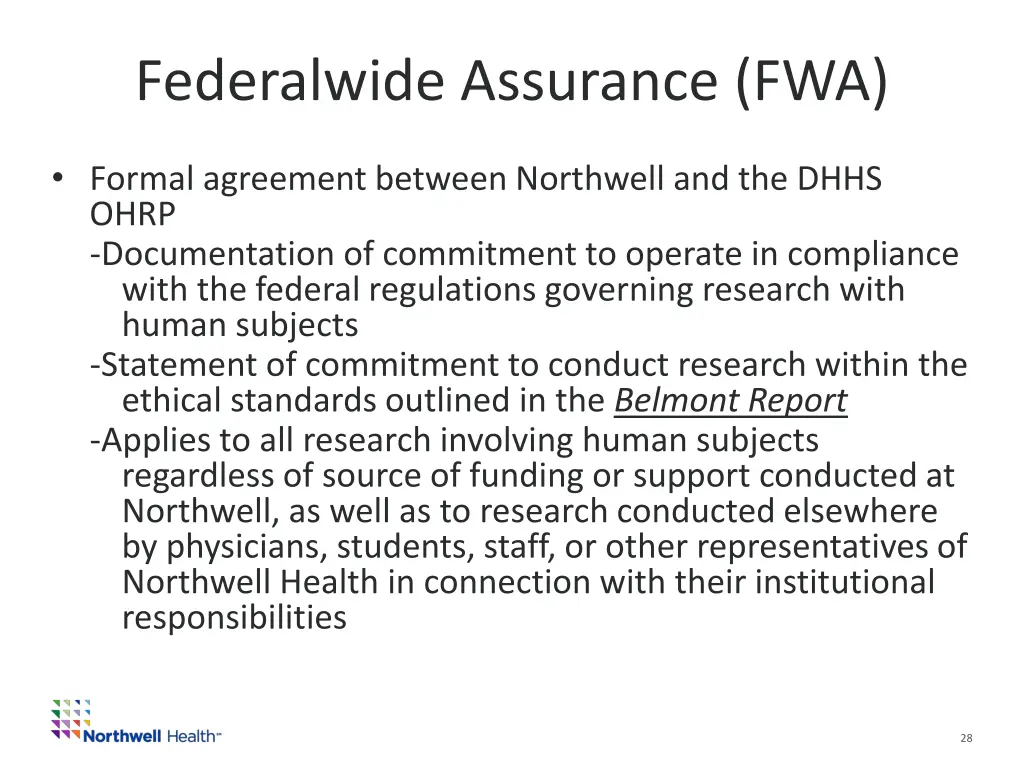
Federalwide Assurance (FWA) Formal agreement between Northwell and the DHHS OHRP -Documentation of commitment to operate in compliance with the federal regulations governing research with human subjects -Statement of commitment to conduct research within the ethical standards outlined in the Belmont Report -Applies to all research involving human subjects regardless of source of funding or support conducted at Northwell, as well as to research conducted elsewhere by physicians, students, staff, or other representatives of Northwell Health in connection with their institutional responsibilities 28
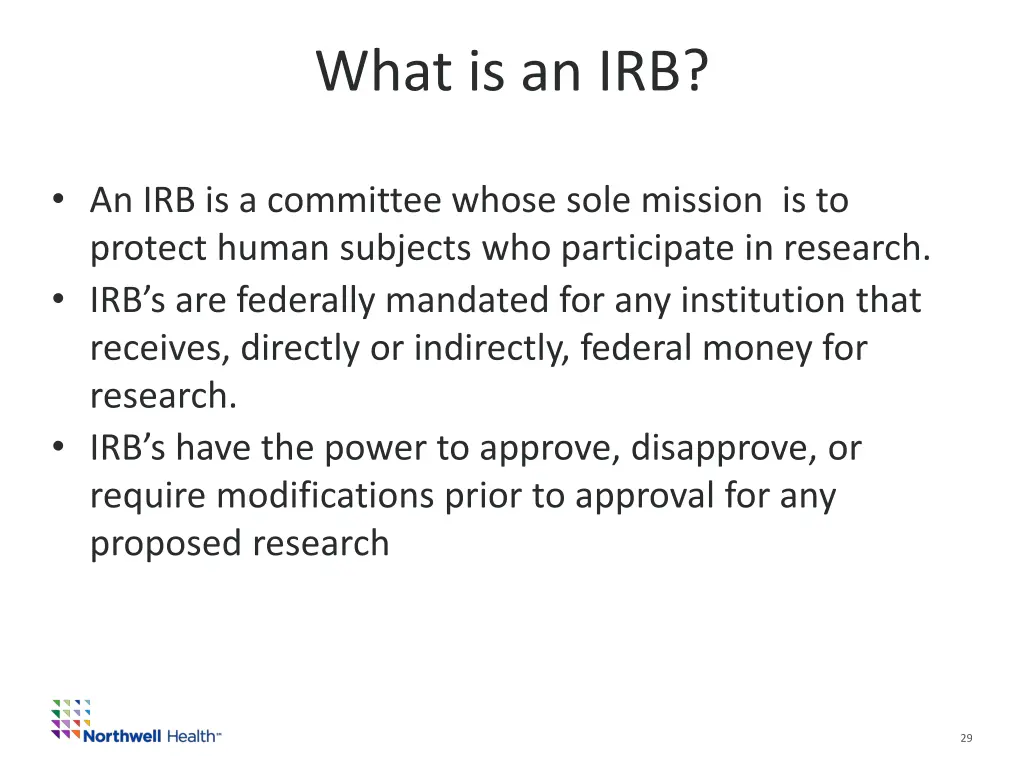
What is an IRB? An IRB is a committee whose sole mission is to protect human subjects who participate in research. IRB s are federally mandated for any institution that receives, directly or indirectly, federal money for research. IRB s have the power to approve, disapprove, or require modifications prior to approval for any proposed research 29
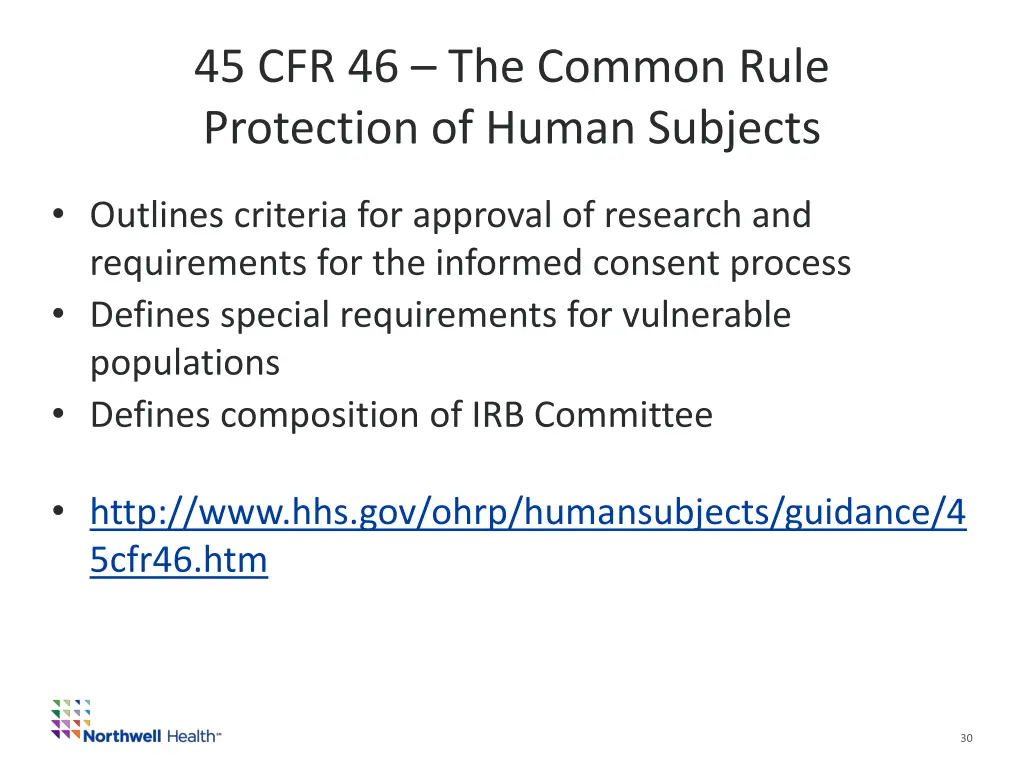
45 CFR 46 The Common Rule Protection of Human Subjects Outlines criteria for approval of research and requirements for the informed consent process Defines special requirements for vulnerable populations Defines composition of IRB Committee http://www.hhs.gov/ohrp/humansubjects/guidance/4 5cfr46.htm 30
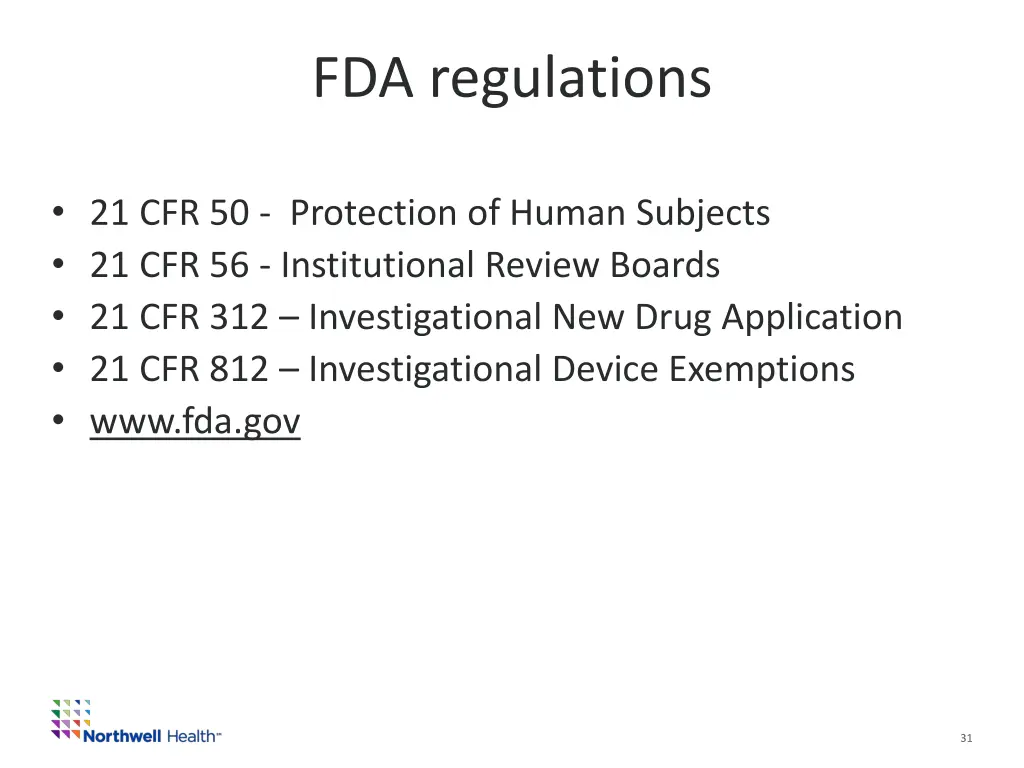
FDA regulations 21 CFR 50 - Protection of Human Subjects 21 CFR 56 - Institutional Review Boards 21 CFR 312 Investigational New Drug Application 21 CFR 812 Investigational Device Exemptions www.fda.gov 31
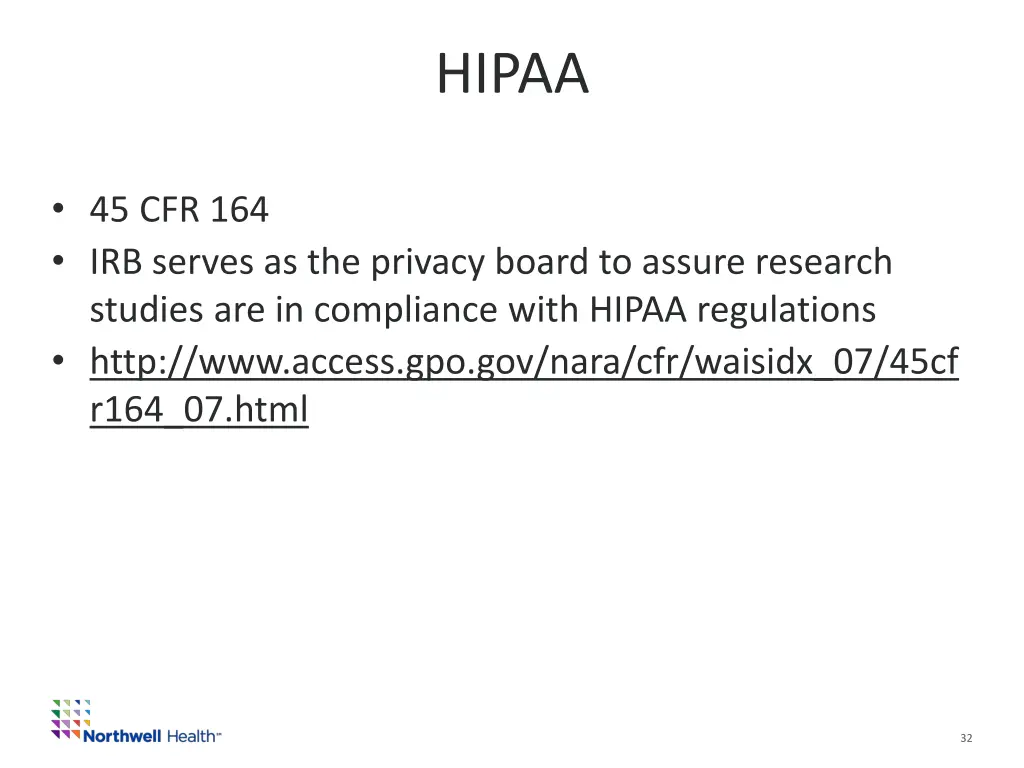
HIPAA 45 CFR 164 IRB serves as the privacy board to assure research studies are in compliance with HIPAA regulations http://www.access.gpo.gov/nara/cfr/waisidx_07/45cf r164_07.html 32
NY State Law Public Health Law Article 24A Protection of Human Subjects 33
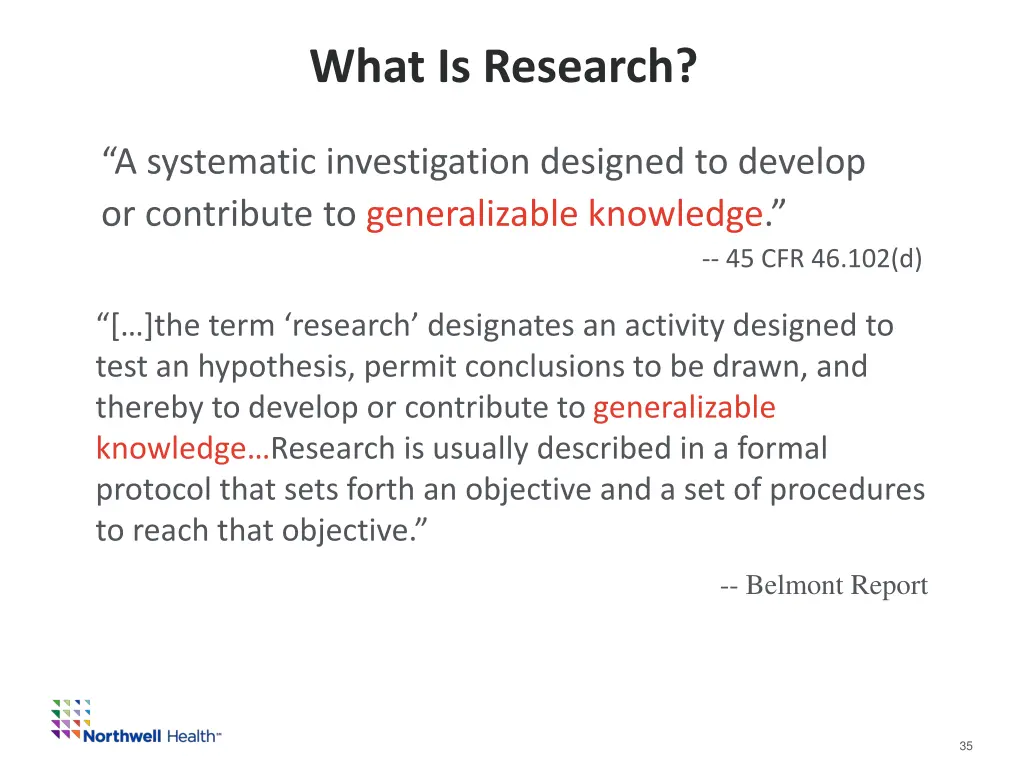
What Is Research? A systematic investigation designed to develop or contribute to generalizable knowledge. -- 45 CFR 46.102(d) [ ]the term research designates an activity designed to test an hypothesis, permit conclusions to be drawn, and thereby to develop or contribute to generalizable knowledge Research is usually described in a formal protocol that sets forth an objective and a set of procedures to reach that objective. -- Belmont Report 35
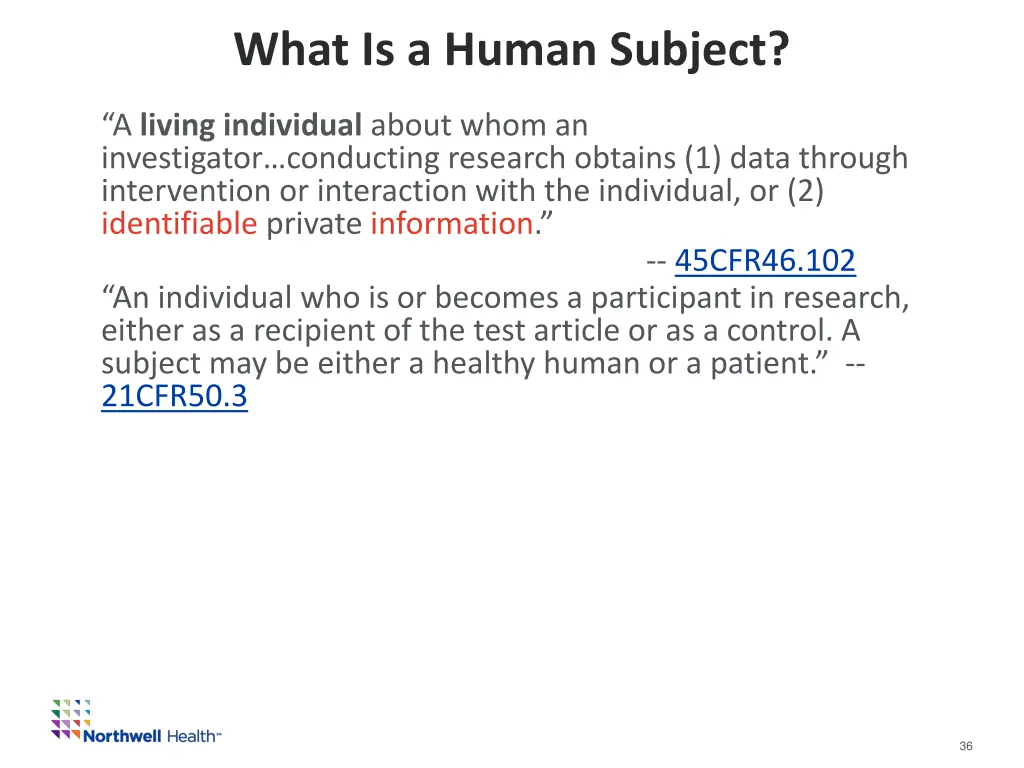
What Is a Human Subject? A living individual about whom an investigator conducting research obtains (1) data through intervention or interaction with the individual, or (2) identifiable private information. -- 45CFR46.102 An individual who is or becomes a participant in research, either as a recipient of the test article or as a control. A subject may be either a healthy human or a patient. -- 21CFR50.3 36
Is It Research? Quality Assurance or Quality Improvement projects. Chart reviews. Use of discard specimens. Even though patient care is not altered, it may still be research! 38
Research vs. Standard Care The distinction between research and practice is blurred partly because both often occur together (as in research designed to evaluate a therapy or procedure)[ ] 39
If Its Human Subjects Research, What Do You Do? Determine what category your research falls into. Exempt. Expedited. Full board review. 40
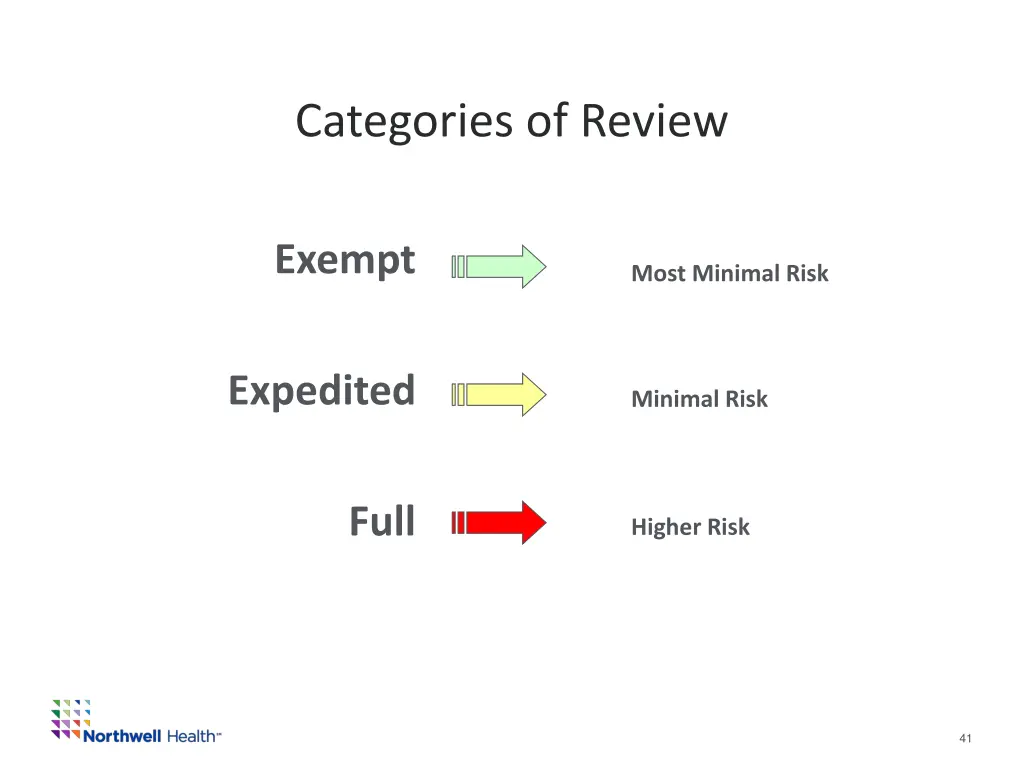
Categories of Review Exempt Most Minimal Risk Expedited Minimal Risk Full Higher Risk 41
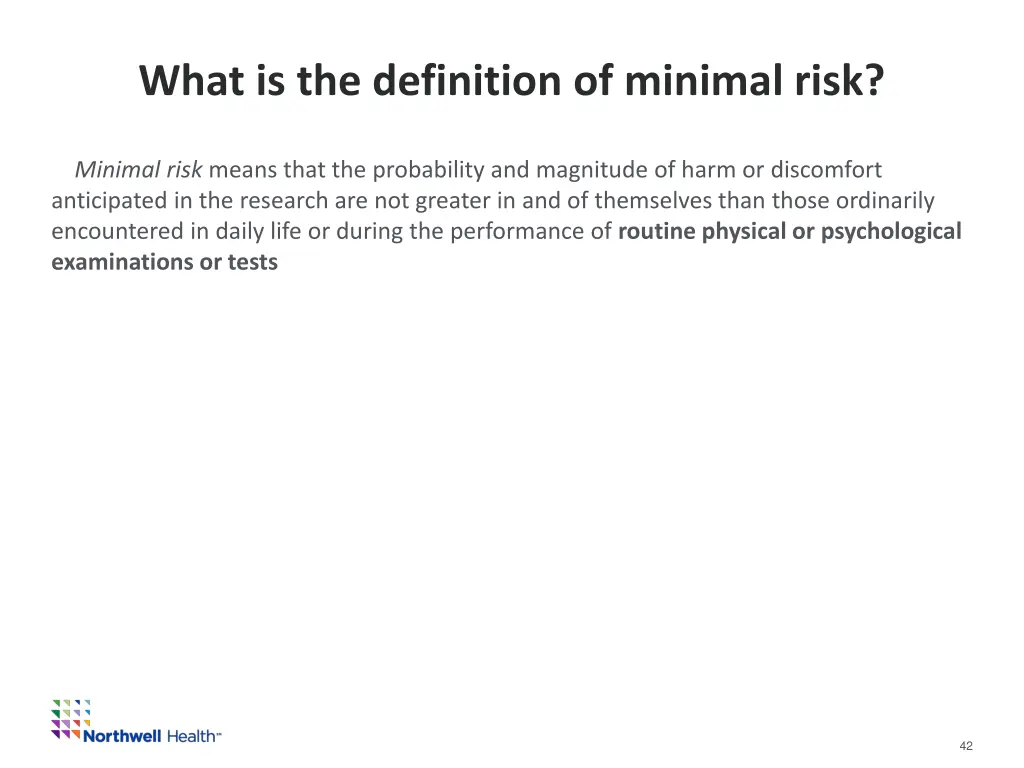
What is the definition of minimal risk? Minimal risk means that the probability and magnitude of harm or discomfort anticipated in the research are not greater in and of themselves than those ordinarily encountered in daily life or during the performance of routine physical or psychological examinations or tests 42
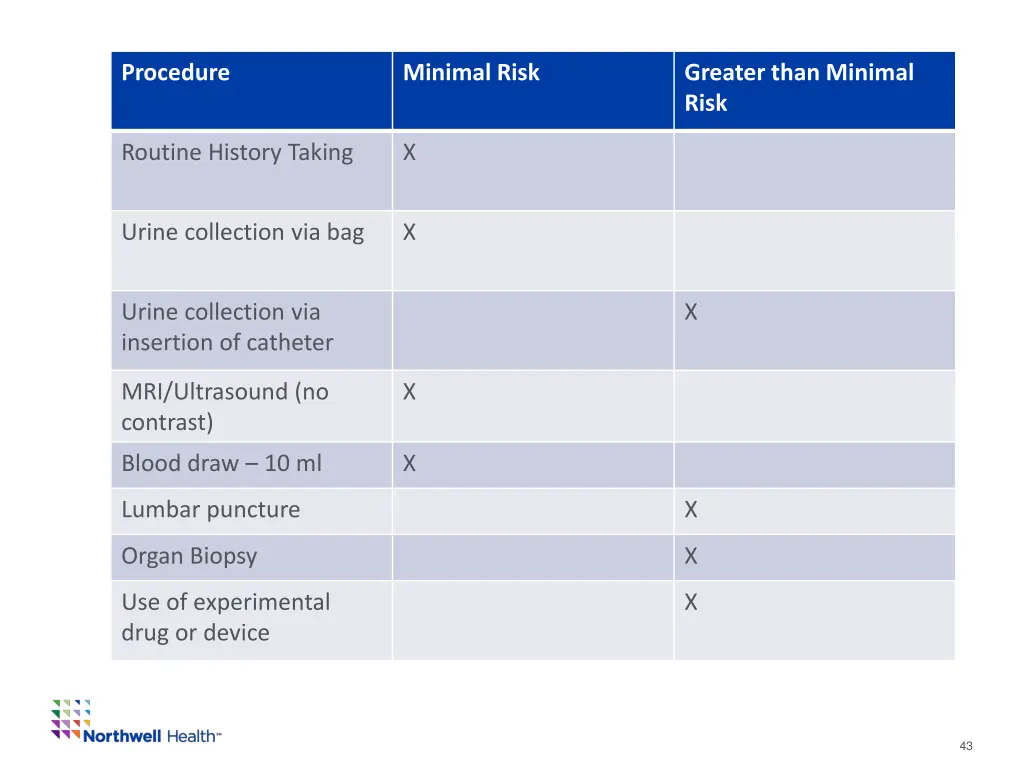
Procedure Minimal Risk Greater than Minimal Risk Routine History Taking X Urine collection via bag X Urine collection via insertion of catheter X MRI/Ultrasound (no contrast) X Blood draw 10 ml X Lumbar puncture X Organ Biopsy X Use of experimental drug or device X 43
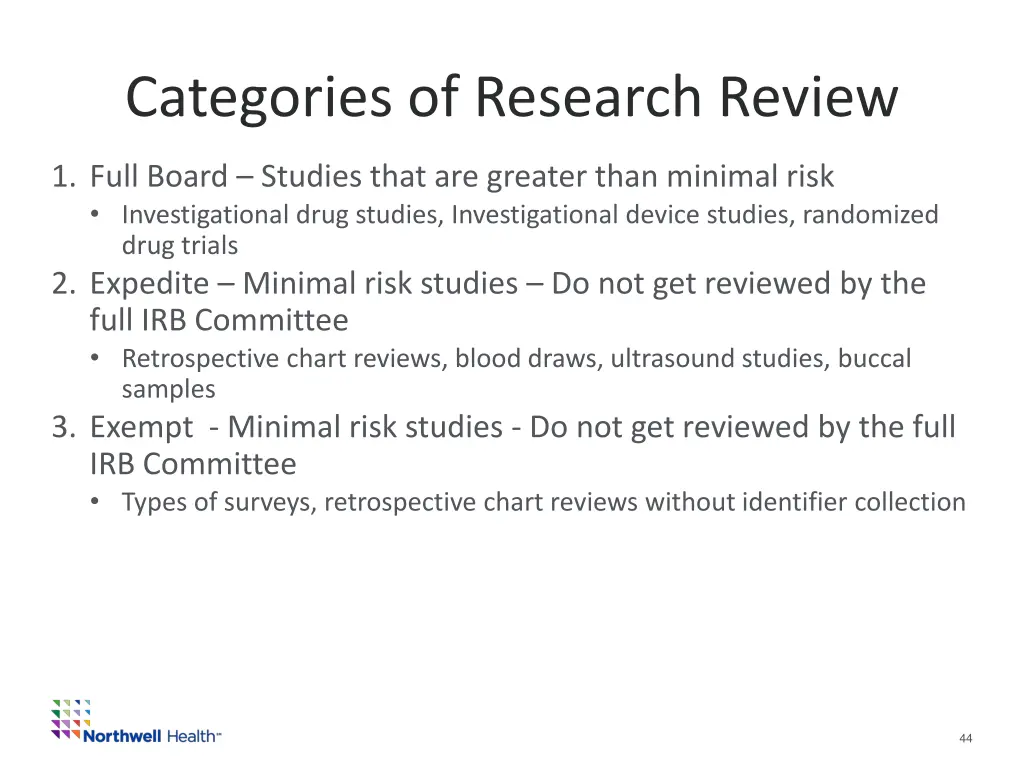
Categories of Research Review 1. Full Board Studies that are greater than minimal risk Investigational drug studies, Investigational device studies, randomized drug trials 2. Expedite Minimal risk studies Do not get reviewed by the full IRB Committee Retrospective chart reviews, blood draws, ultrasound studies, buccal samples 3. Exempt - Minimal risk studies - Do not get reviewed by the full IRB Committee Types of surveys, retrospective chart reviews without identifier collection 44
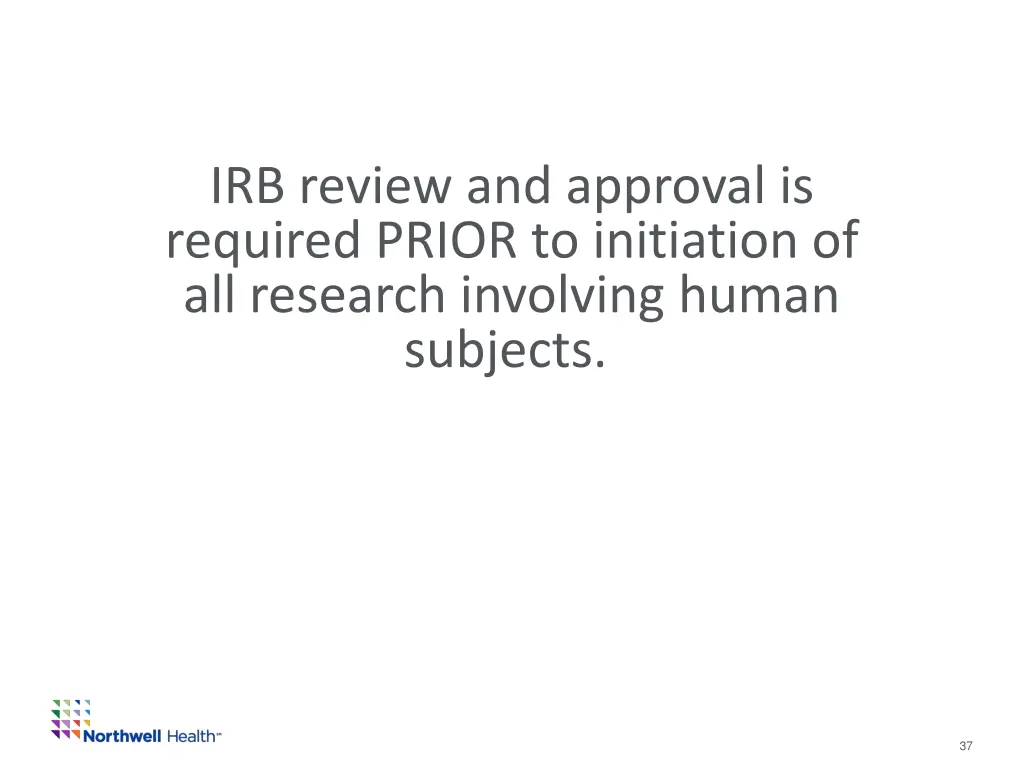
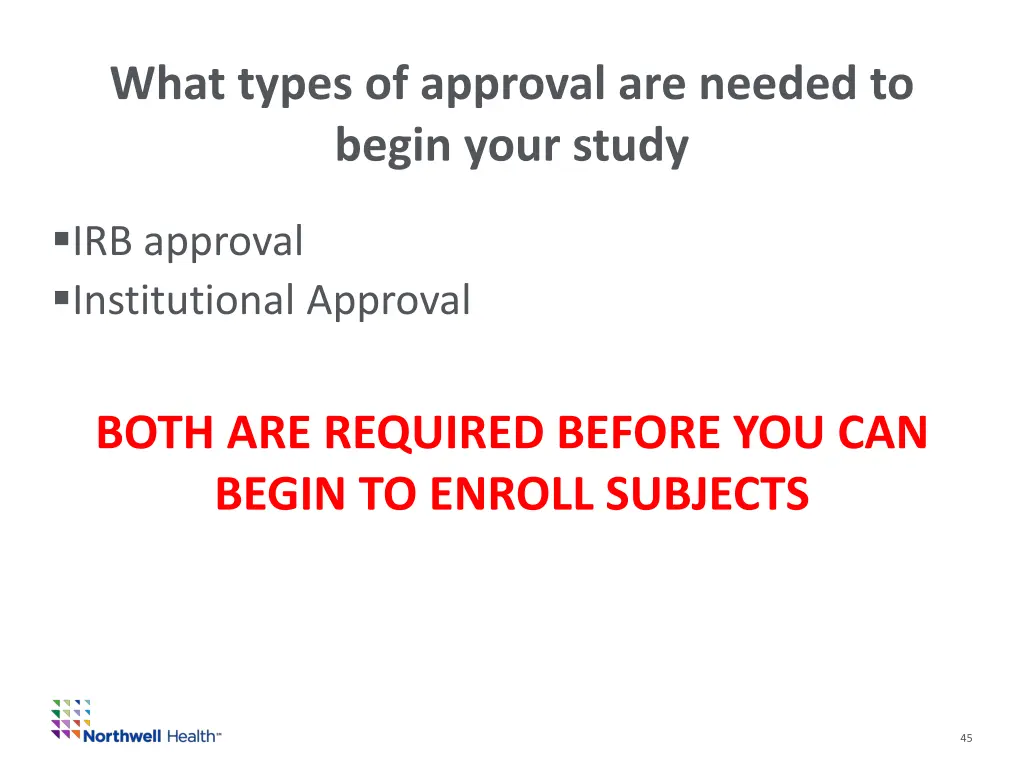
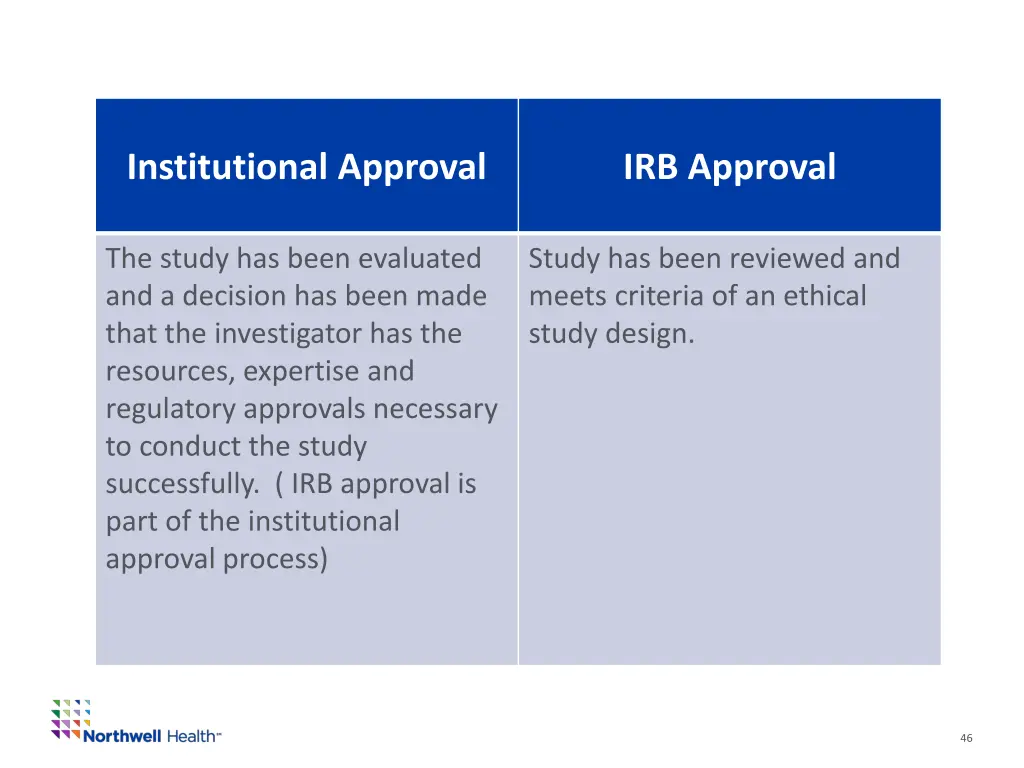
What types of approval are needed to begin your study IRB approval Institutional Approval BOTH ARE REQUIRED BEFORE YOU CAN BEGIN TO ENROLL SUBJECTS 45
Institutional Approval IRB Approval The study has been evaluated and a decision has been made that the investigator has the resources, expertise and regulatory approvals necessary to conduct the study successfully. ( IRB approval is part of the institutional approval process) Study has been reviewed and meets criteria of an ethical study design. 46
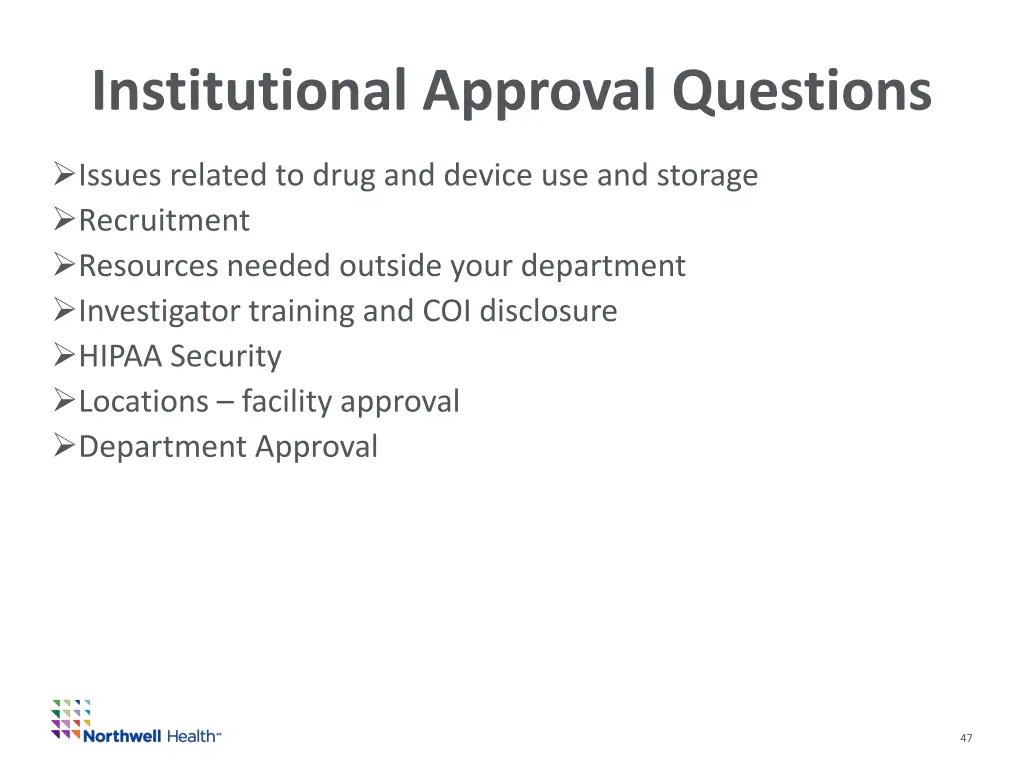
Institutional Approval Questions Issues related to drug and device use and storage Recruitment Resources needed outside your department Investigator training and COI disclosure HIPAA Security Locations facility approval Department Approval 47
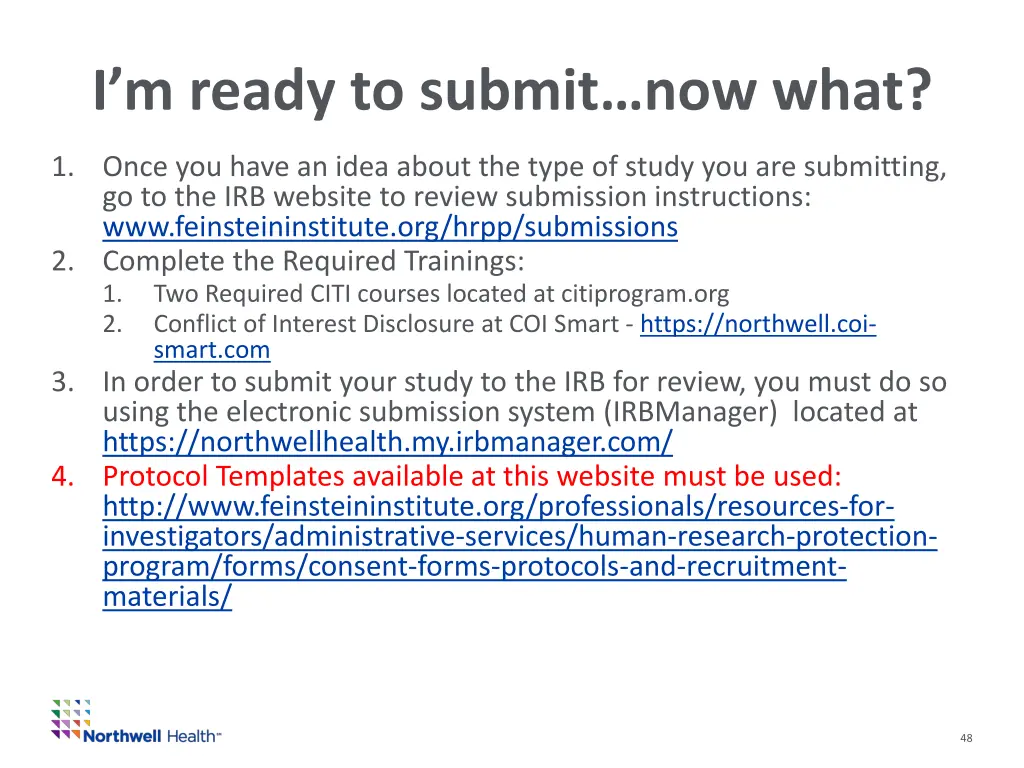
Im ready to submitnow what? 1. Once you have an idea about the type of study you are submitting, go to the IRB website to review submission instructions: www.feinsteininstitute.org/hrpp/submissions 2. Complete the Required Trainings: 1. Two Required CITI courses located at citiprogram.org 2. Conflict of Interest Disclosure at COI Smart - https://northwell.coi- smart.com 3. In order to submit your study to the IRB for review, you must do so using the electronic submission system (IRBManager) located at https://northwellhealth.my.irbmanager.com/ 4. Protocol Templates available at this website must be used: http://www.feinsteininstitute.org/professionals/resources-for- investigators/administrative-services/human-research-protection- program/forms/consent-forms-protocols-and-recruitment- materials/ 48
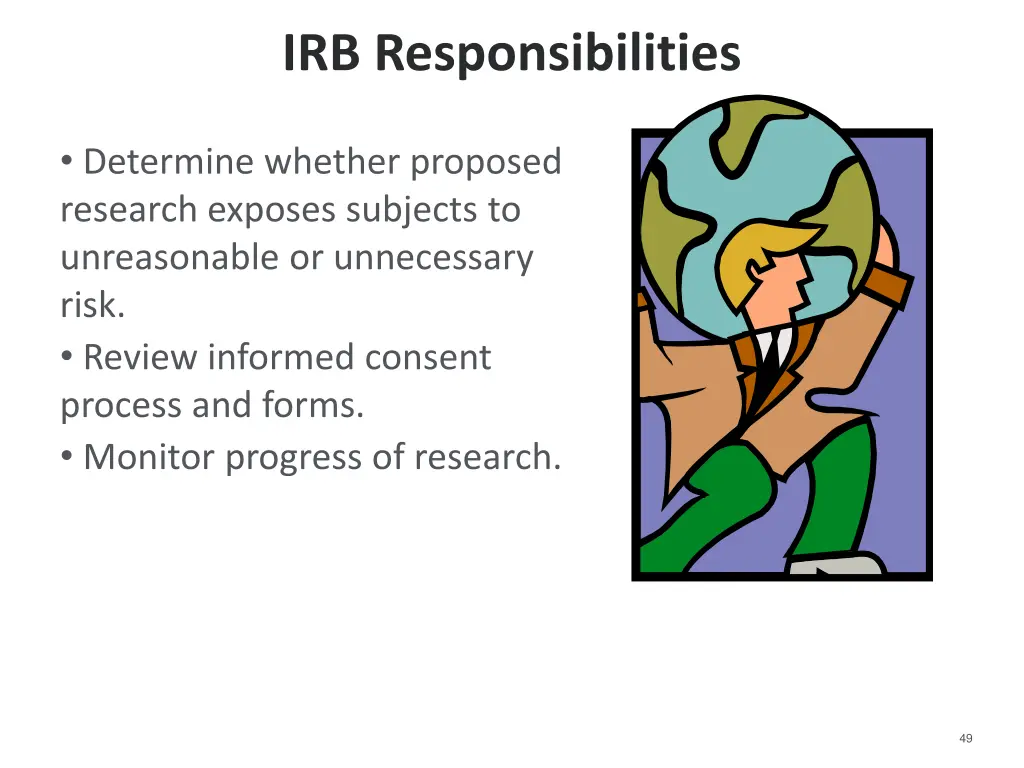
IRB Responsibilities Determine whether proposed research exposes subjects to unreasonable or unnecessary risk. Review informed consent process and forms. Monitor progress of research. 49
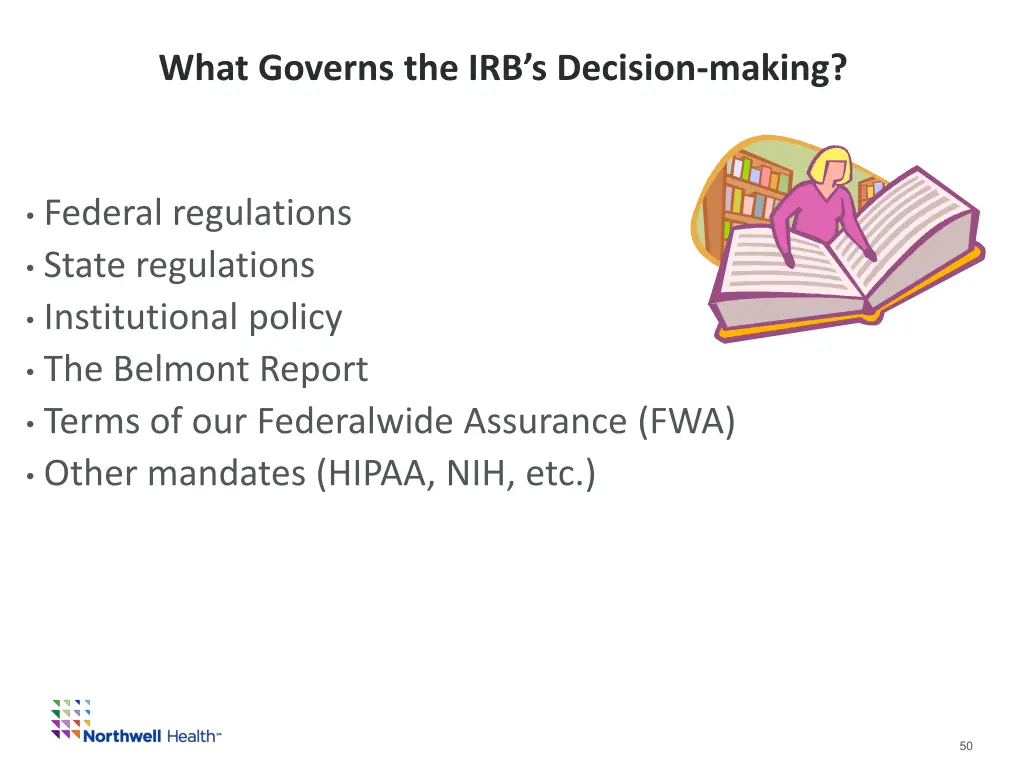
What Governs the IRBs Decision-making? Federal regulations State regulations Institutional policy The Belmont Report Terms of our Federalwide Assurance (FWA) Other mandates (HIPAA, NIH, etc.) 50