Human Rights Instruments for Small-Scale Fisheries and the Right to Food
Explore the relevance of human rights instruments to small-scale fisheries, with a focus on the right to food. Learn about international laws, FAO guidelines, and principles related to fisheries and human rights, including the special case of indigenous peoples. Understand why a human rights-based development approach is essential for upholding dignity, addressing inequalities, and managing conflicts effectively.

Download Presentation

Please find below an Image/Link to download the presentation.
The content on the website is provided AS IS for your information and personal use only. It may not be sold, licensed, or shared on other websites without obtaining consent from the author. If you encounter any issues during the download, it is possible that the publisher has removed the file from their server.
You are allowed to download the files provided on this website for personal or commercial use, subject to the condition that they are used lawfully. All files are the property of their respective owners.
The content on the website is provided AS IS for your information and personal use only. It may not be sold, licensed, or shared on other websites without obtaining consent from the author.
E N D
Presentation Transcript
Human rights instruments relevant to small scale fisheries with special attention to the right to food By Margret Vidar, Legal Officer, Development Law Service of the FOOD AND AGRICULTURE ORGANIZATION OF THE UNITED NATIONS
Presentation outline Why a human rights based approach to development International human rights instruments of relevance to small scale fisheries The right to food in international law Linkages to other human rights The right to food in FAO Right to Food Guidelines Summits and COFI Tenure Guidelines Implementation Guidelines on Fisheries Human Rights Principles General In fisheries The special case of indigenous peoples & FPIC
Why a human rights-based approach to development? Intrinsic value Based on universal values Universal legal standards for a life with dignity Instrumental to development strategies Addresses power inequalities and discrimination Deals with weaknesses in accountability systems Objective framework to manage conflicts and seek redress Institutional reasons (UN comparative advantage) Impartiality to deal with sensitive issues Holistic analysis and integral responses to problems Source http://hrbaportal.org/common-learning-package-on-hrbahttp://hrbaportal.org/common-learning-package-on-hrba
Key international human rights instruments Universal Declaration of Human Rights International Covenant on Civil and Political Rights International Covenant on Economic, Social and Cultural Rights International Convention on the Elimination of All Forms of Racial Discrimination Convention on the Elimination of All Forms of Discrimination against Women Convention on the Rights of the Child International Convention on the Protection of the Rights of All Migrant Workers and Members of Their Families Declaration on the Right to Development ILO Declaration on Fundamental Principles and Rights at Work; and Work in Fishing Convention, many other conventions relating to above Covenants United Nations Declaration on the Rights of Indigenous Peoples ILO Convention 169 on Indigenous and Tribal Peoples
The Right to Food International Law The right of everyone to an adequate standard of living, including adequate food The fundamental right of everyone to be free from hunger International Covenant on Economic, Social and Cultural Rights 160 State Parties
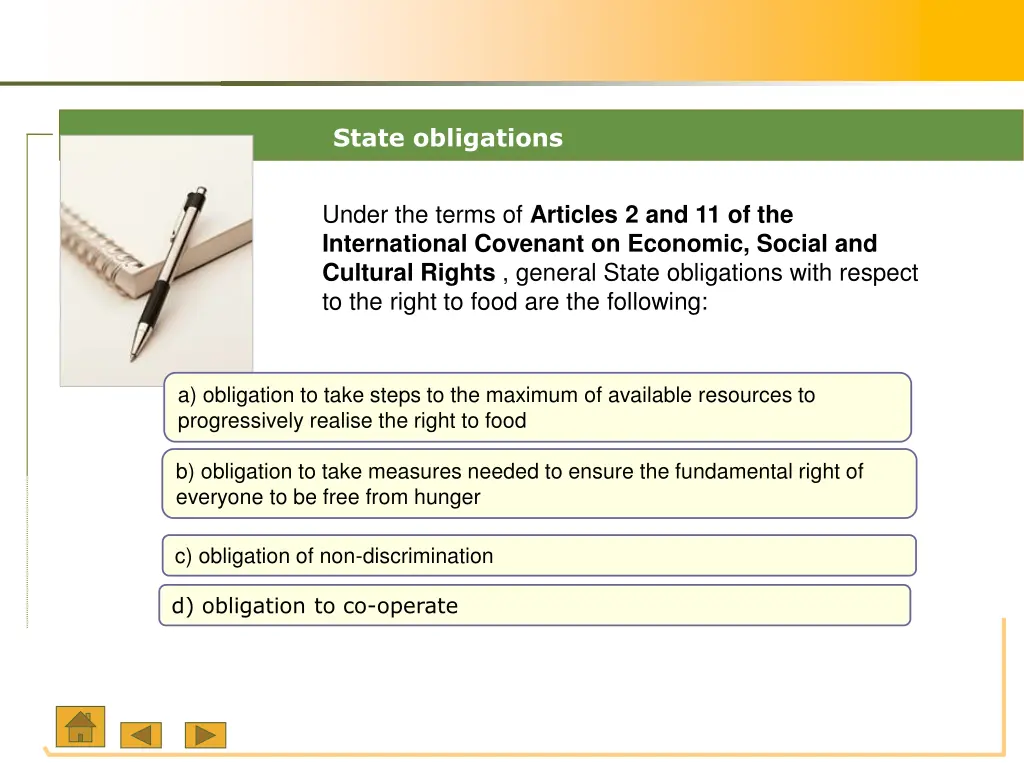
State obligations Under the terms of Articles 2 and 11 of the International Covenant on Economic, Social and Cultural Rights , general State obligations with respect to the right to food are the following: a) obligation to take steps to the maximum of available resources to progressively realise the right to food b) obligation to take measures needed to ensure the fundamental right of everyone to be free from hunger c) obligation of non-discrimination d) obligation to co-operate
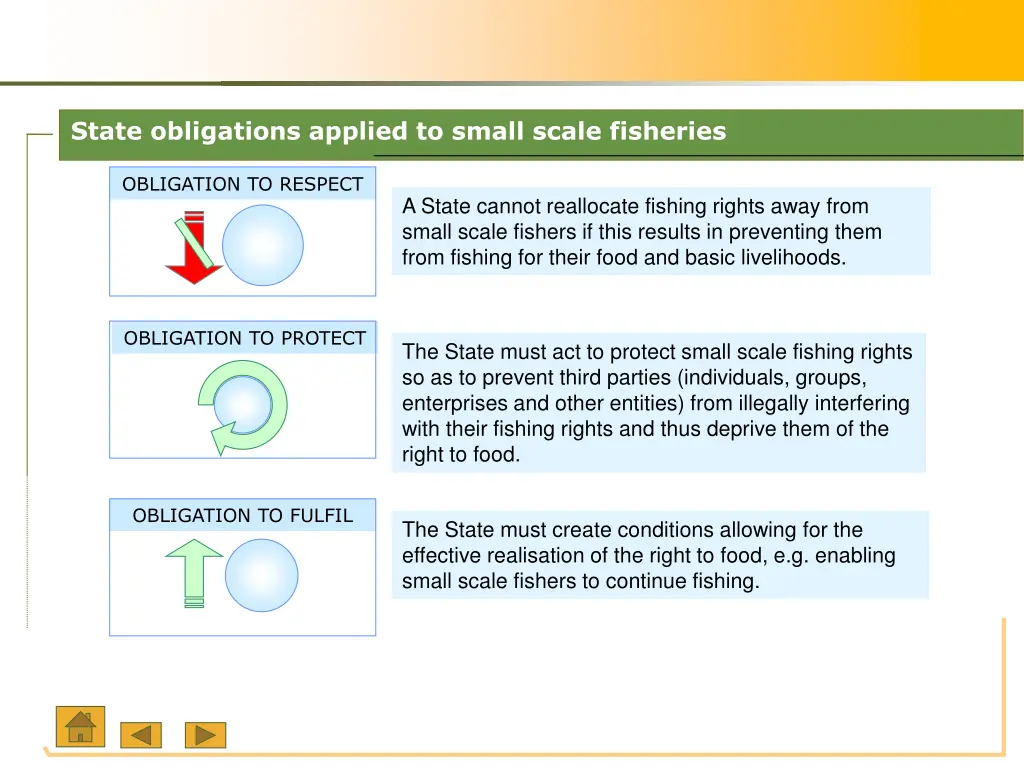
State obligations applied to small scale fisheries OBLIGATION TO RESPECT A State cannot reallocate fishing rights away from small scale fishers if this results in preventing them from fishing for their food and basic livelihoods. OBLIGATION TO PROTECT The State must act to protect small scale fishing rights so as to prevent third parties (individuals, groups, enterprises and other entities) from illegally interfering with their fishing rights and thus deprive them of the right to food. OBLIGATION TO FULFIL The State must create conditions allowing for the effective realisation of the right to food, e.g. enabling small scale fishers to continue fishing.
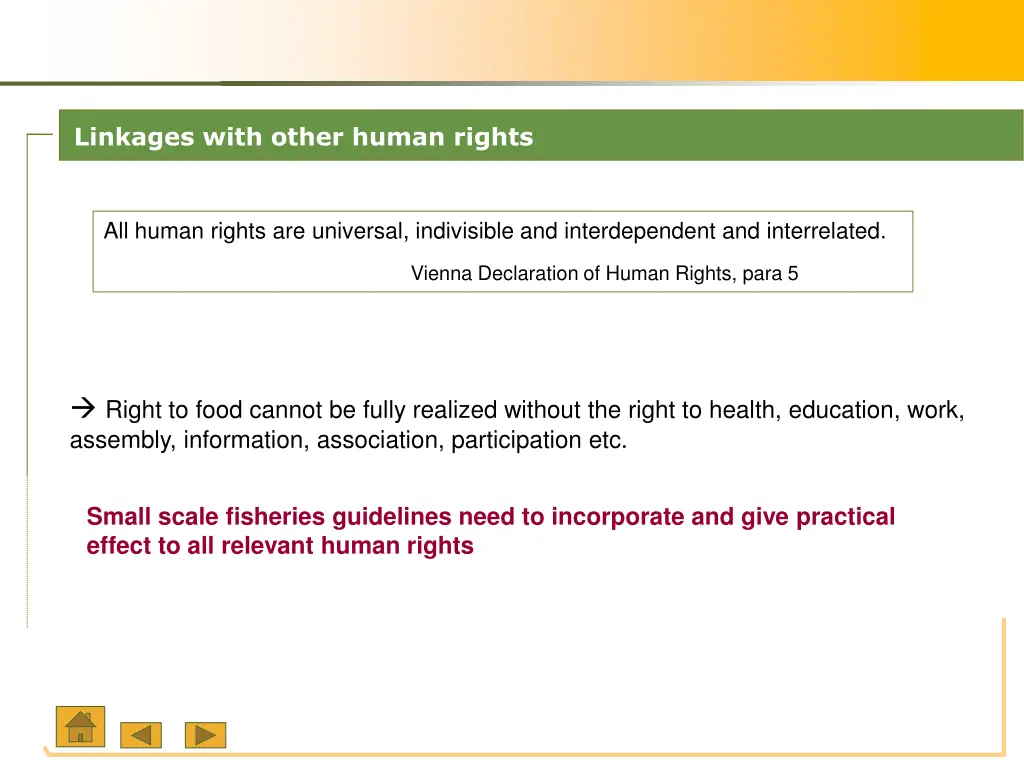
Linkages with other human rights All human rights are universal, indivisible and interdependent and interrelated. Vienna Declaration of Human Rights, para 5 Right to food cannot be fully realized without the right to health, education, work, assembly, information, association, participation etc. Small scale fisheries guidelines need to incorporate and give practical effect to all relevant human rights
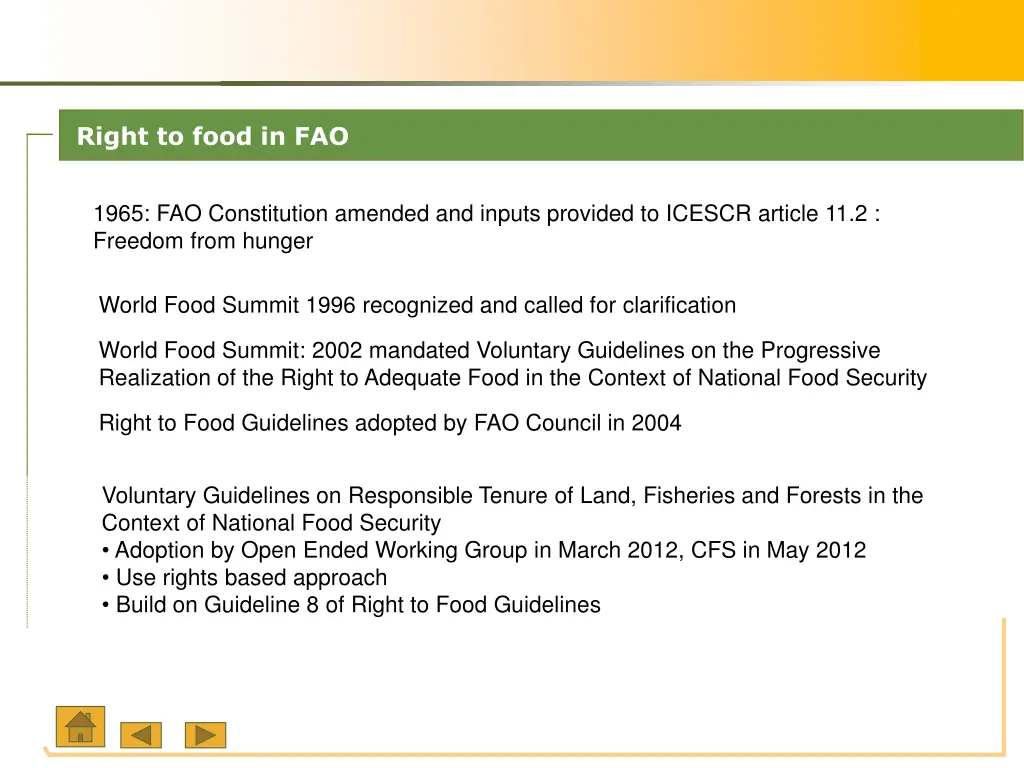
Right to food in FAO 1965: FAO Constitution amended and inputs provided to ICESCR article 11.2 : Freedom from hunger World Food Summit 1996 recognized and called for clarification World Food Summit: 2002 mandated Voluntary Guidelines on the Progressive Realization of the Right to Adequate Food in the Context of National Food Security Right to Food Guidelines adopted by FAO Council in 2004 Voluntary Guidelines on Responsible Tenure of Land, Fisheries and Forests in the Context of National Food Security Adoption by Open Ended Working Group in March 2012, CFS in May 2012 Use rights based approach Build on Guideline 8 of Right to Food Guidelines
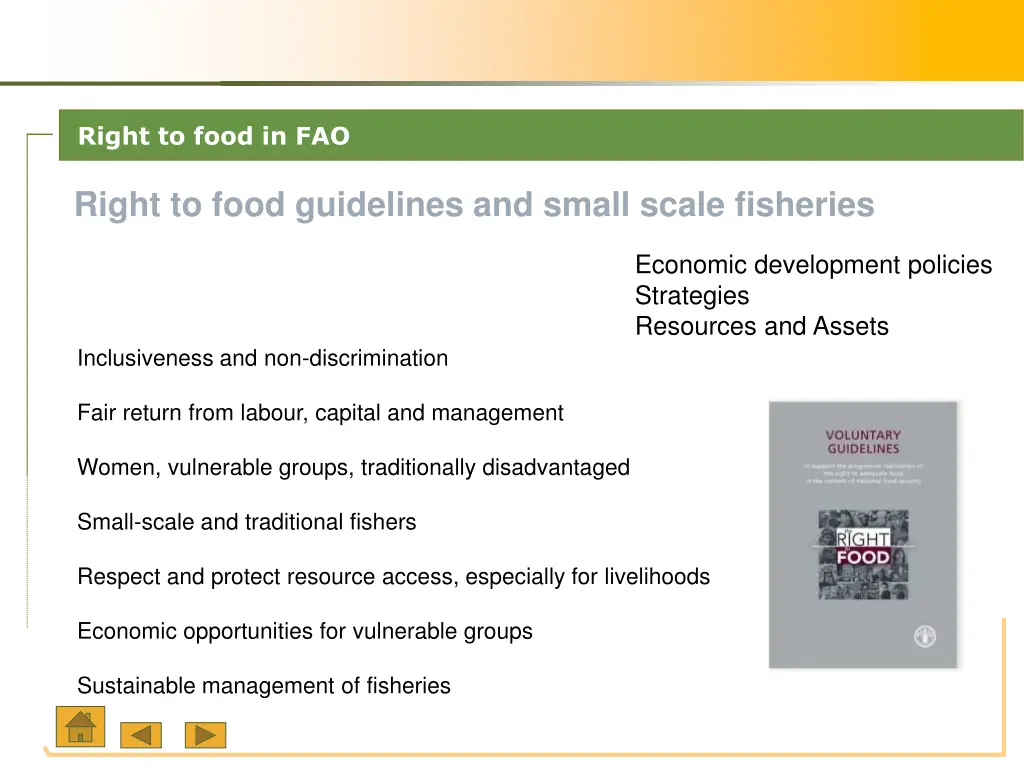
Right to food in FAO Right to food guidelines and small scale fisheries Economic development policies Strategies Resources and Assets Inclusiveness and non-discrimination Fair return from labour, capital and management Women, vulnerable groups, traditionally disadvantaged Small-scale and traditional fishers Respect and protect resource access, especially for livelihoods Economic opportunities for vulnerable groups Sustainable management of fisheries
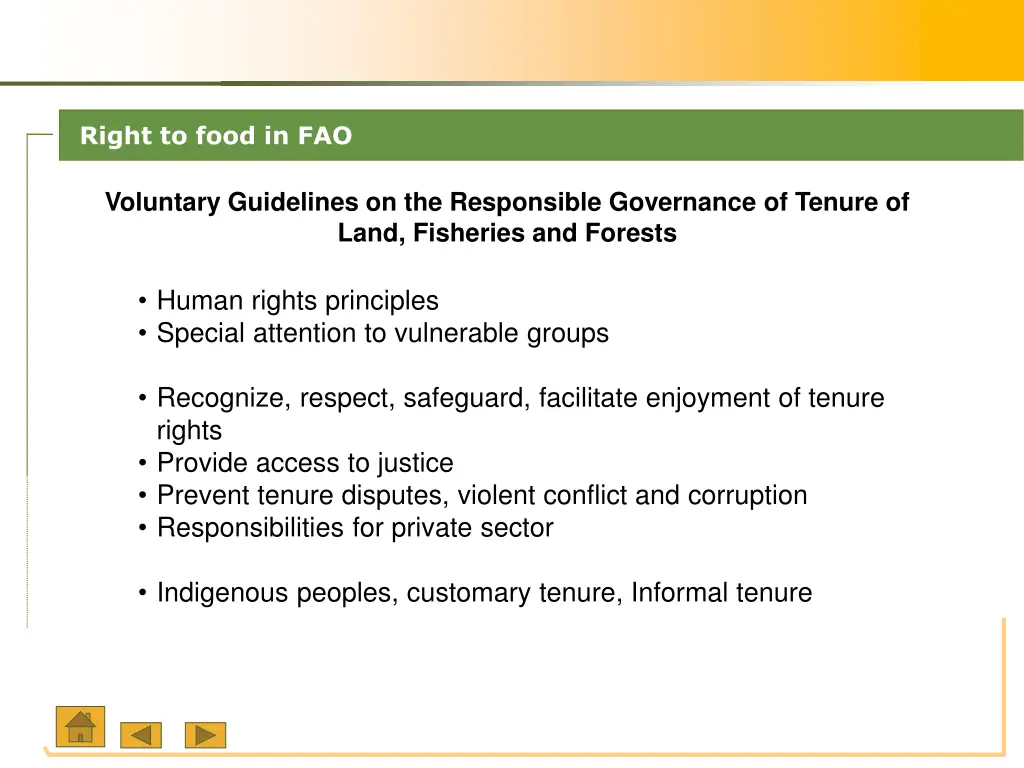
Right to food in FAO Voluntary Guidelines on the Responsible Governance of Tenure of Land, Fisheries and Forests Human rights principles Special attention to vulnerable groups Recognize, respect, safeguard, facilitate enjoyment of tenure rights Provide access to justice Prevent tenure disputes, violent conflict and corruption Responsibilities for private sector Indigenous peoples, customary tenure, Informal tenure
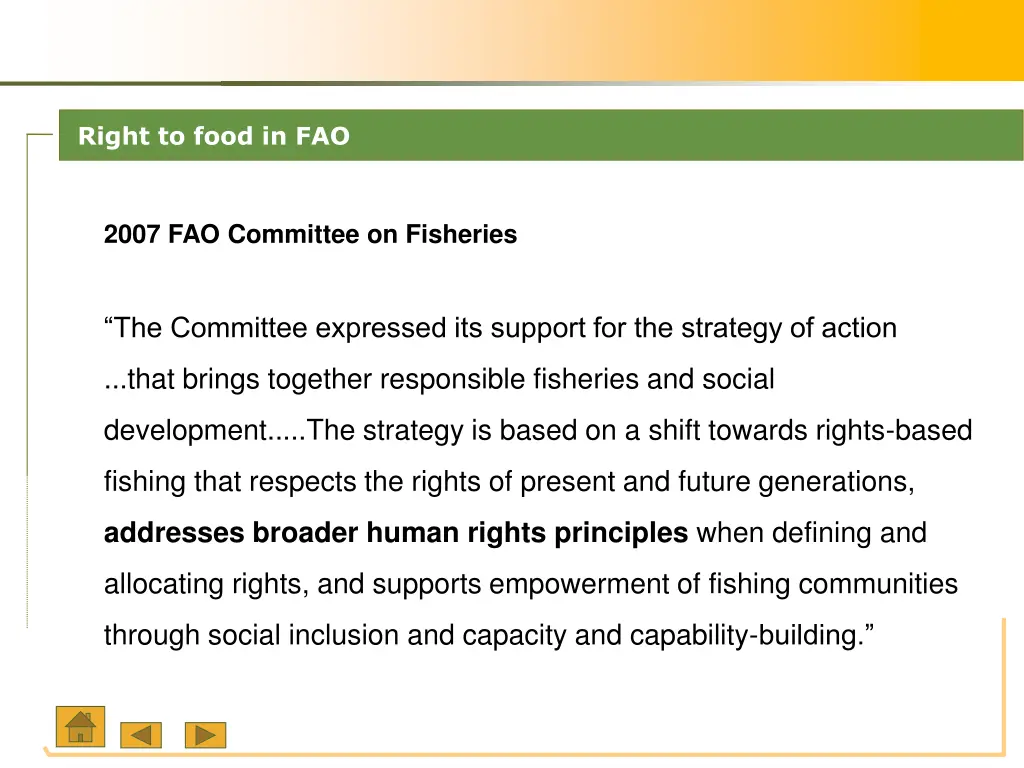
Right to food in FAO 2007 FAO Committee on Fisheries The Committee expressed its support for the strategy of action ...that brings together responsible fisheries and social development.....The strategy is based on a shift towards rights-based fishing that respects the rights of present and future generations, addresses broader human rights principles when defining and allocating rights, and supports empowerment of fishing communities through social inclusion and capacity and capability-building.
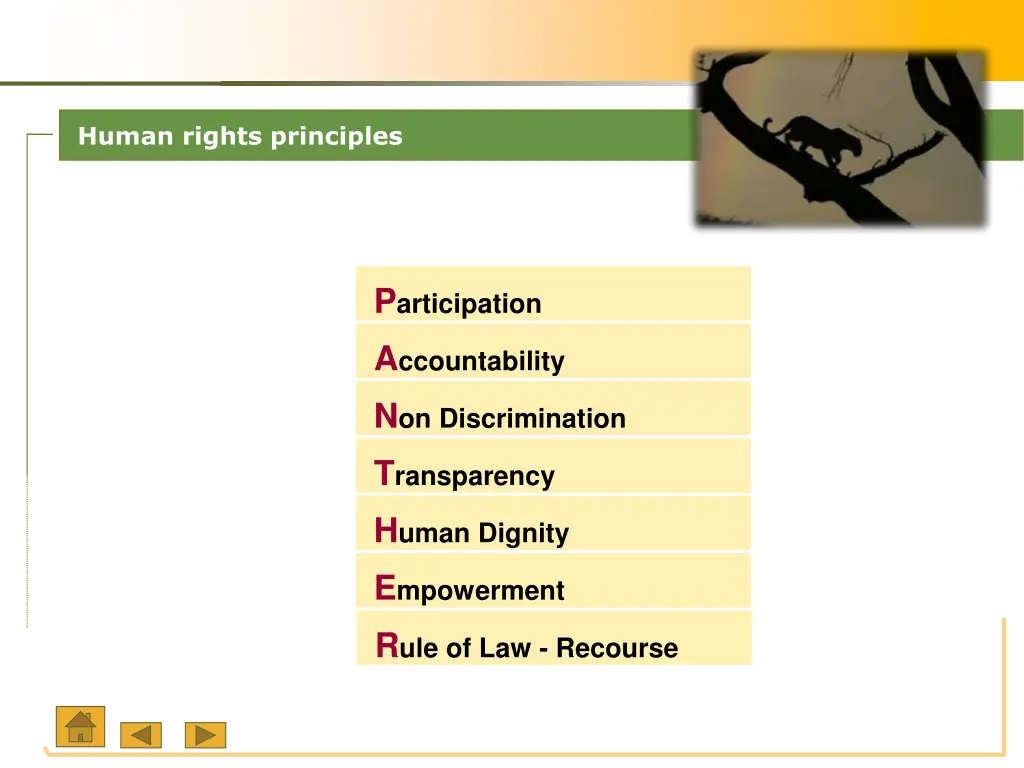
Human rights principles Participation Accountability Non Discrimination Transparency Human Dignity Empowerment Rule of Law - Recourse
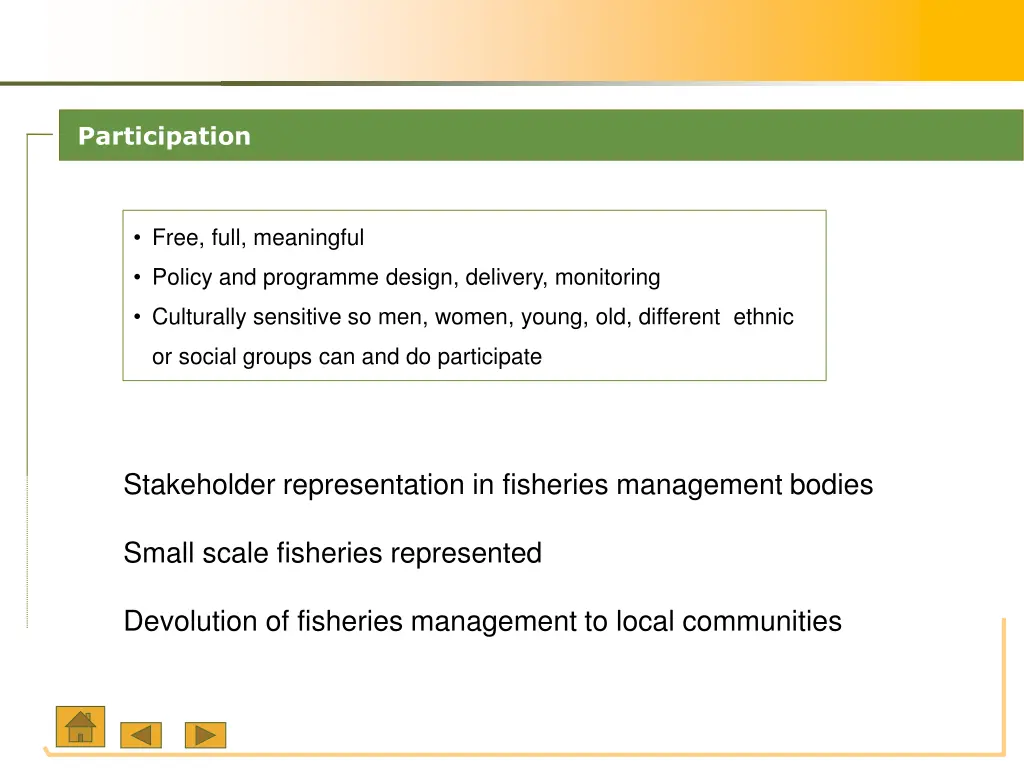
Participation Free, full, meaningful Policy and programme design, delivery, monitoring Culturally sensitive so men, women, young, old, different ethnic or social groups can and do participate Stakeholder representation in fisheries management bodies Small scale fisheries represented Devolution of fisheries management to local communities
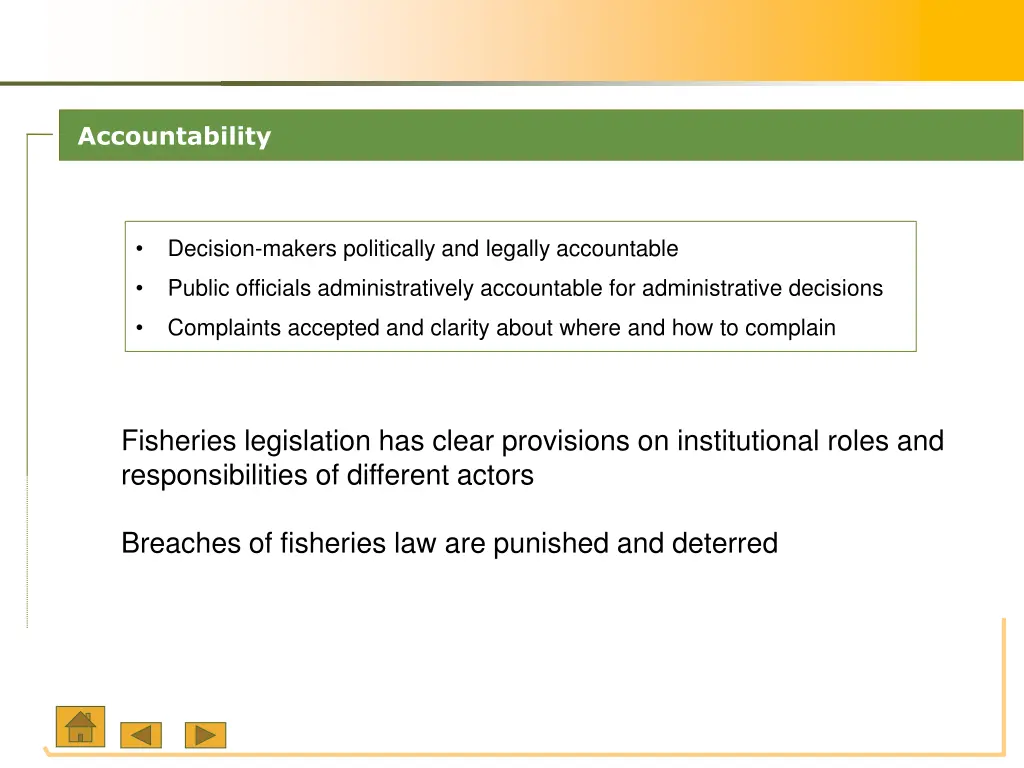
Accountability Decision-makers politically and legally accountable Public officials administratively accountable for administrative decisions Complaints accepted and clarity about where and how to complain Fisheries legislation has clear provisions on institutional roles and responsibilities of different actors Breaches of fisheries law are punished and deterred
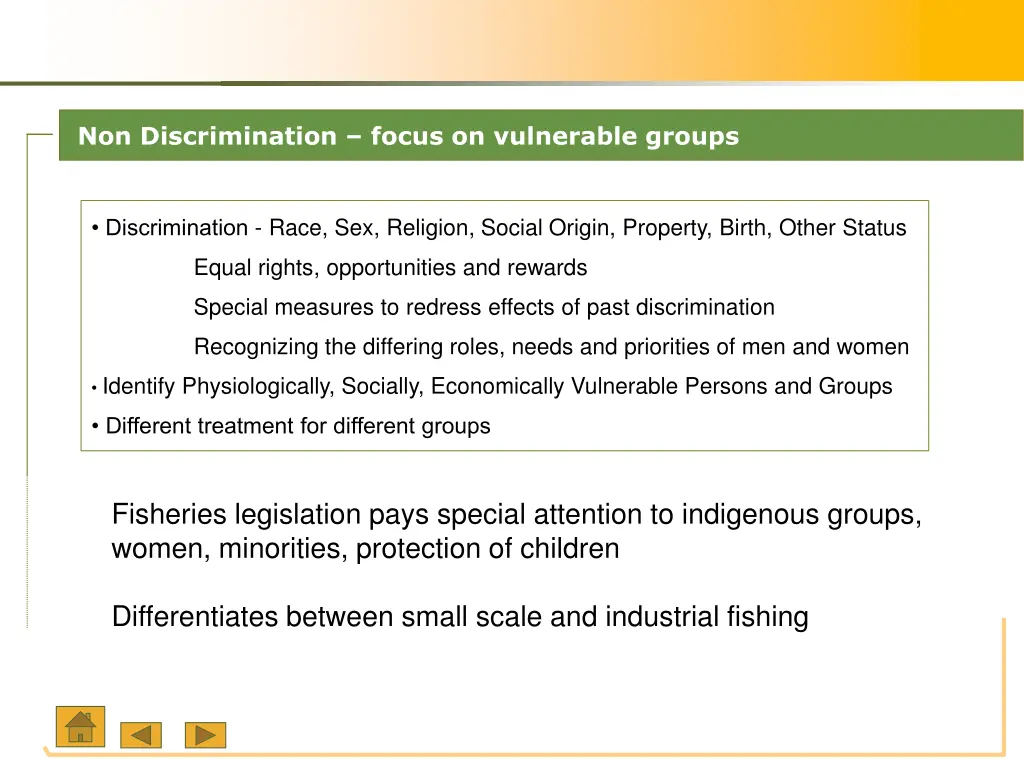
Non Discrimination focus on vulnerable groups Discrimination - Race, Sex, Religion, Social Origin, Property, Birth, Other Status Equal rights, opportunities and rewards Special measures to redress effects of past discrimination Recognizing the differing roles, needs and priorities of men and women Identify Physiologically, Socially, Economically Vulnerable Persons and Groups Different treatment for different groups Fisheries legislation pays special attention to indigenous groups, women, minorities, protection of children Differentiates between small scale and industrial fishing
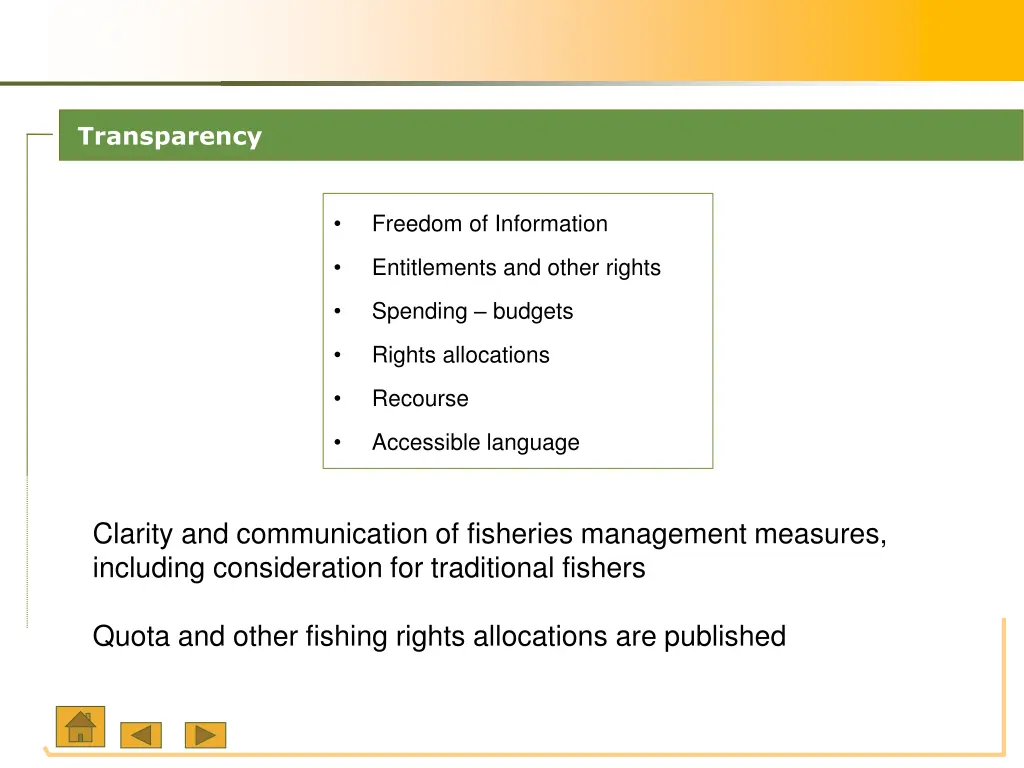
Transparency Freedom of Information Entitlements and other rights Spending budgets Rights allocations Recourse Accessible language Clarity and communication of fisheries management measures, including consideration for traditional fishers Quota and other fishing rights allocations are published
Human dignity Hunger is a violation of human dignity People should not have to beg for food entitlements Scavenging on rubbish heaps is undignified Receiving assistance should not be humiliating Fisheries enforcement measures respect human dignity Fish workers and fishers have dignified conditions of work
Empowerment People know they have human rights They know their entitlements to assistance & services They can hold officials accountable Application of other principles + education Small scale fishers know their human and fishing rights and how to claim them. Small scale fishers have access to general and specific education to help them improve their livelihoods
Rule of law - recourse Laws are binding on the ruled and on rulers Administrative recourse effective Court action possible Decisions on fisheries are taken in accordance with law and on the basis of legal authority Information about recourse is easily accessible to all, including small scale fishers Special measures for access to justice for small scale fishers
Human Rights of Indigenous Peoples UN Declaration on the rights of indigenous people Self-determination, i.e. right of all peoples to freely pursue their economic, social and cultural development Development with identity , i.e. peoples socio-cultural expressions, values, and traditions should not be threatened by the development process Free, Prior and Informed Consent, demands that states and organizations of all kinds and at all levels obtain indigenous peoples authorization before adopting and implementing projects, programmes, or legislative and administrative measures which may affect them
Human Rights of Indigenous Peoples (continued) Land rights and natural resources: indigenous peoples are entitled to own, use, develop and control the lands, territories and resources that they possess by reason of traditional ownership, occupation or use Cultural rights are fundamental for indigenous peoples as their cultures are distinct and threatened by continuous change and pressures for assimilation Collective rights are indispensable for the survival, well-being and integral development of indigenous peoples as distinct human groups
Conclusion A human rights approach demands that we pay special attention to fisheries in terms of food security and basic livelihoods. THANK YOU FOR YOUR ATTENTION