Explore the essential role of the Institutional Review Board (IRB) in human subjects research compliance at the University of Oregon. Learn about the background, regulations, and services to ensure ethical research practices and protect human subjects' rights and safety.
Please find below an Image/Link to download the presentation.
The content on the website is provided AS IS for your information and personal use only. It may not be sold, licensed, or shared on other websites without obtaining consent from the author. If you encounter any issues during the download, it is possible that the publisher has removed the file from their server.
You are allowed to download the files provided on this website for personal or commercial use, subject to the condition that they are used lawfully. All files are the property of their respective owners.
The content on the website is provided AS IS for your information and personal use only. It may not be sold, licensed, or shared on other websites without obtaining consent from the author.
E N D
Presentation Transcript
Conducting Human Subjects Research UO Research Compliance Services Institutional Review Board Carolyn Craig, PhD, CIP Research Compliance Administrator craig3@uoregon.edu
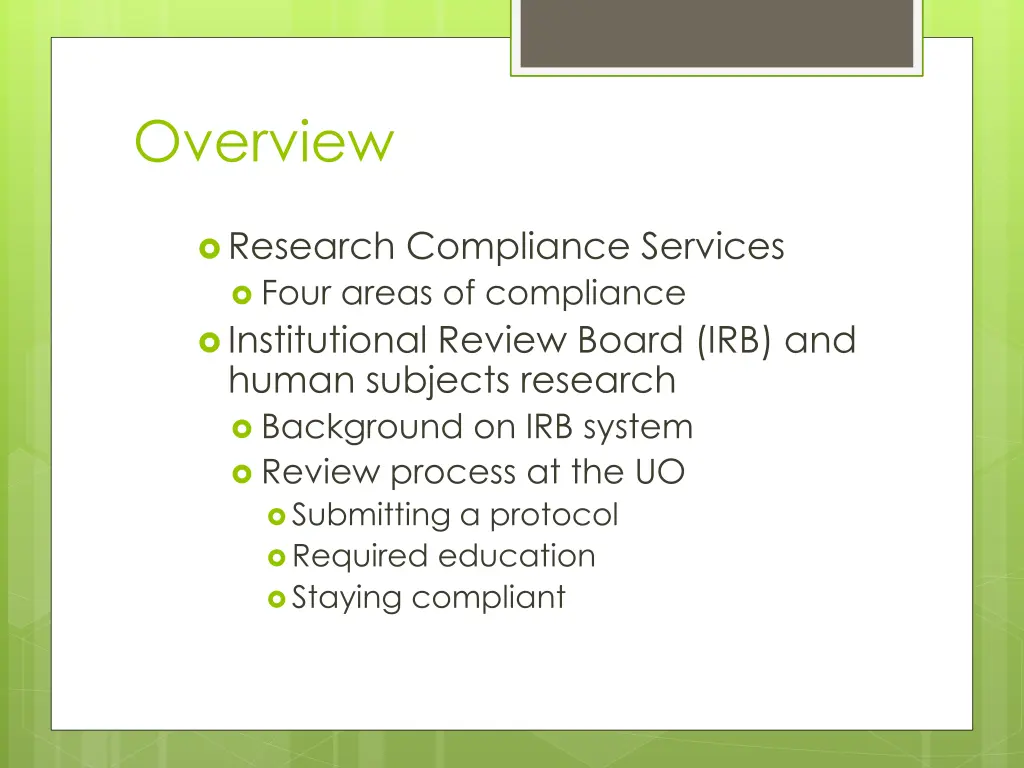
Overview Research Compliance Services Four areas of compliance Institutional Review Board (IRB) and human subjects research Background on IRB system Review process at the UO Submitting a protocol Required education Staying compliant
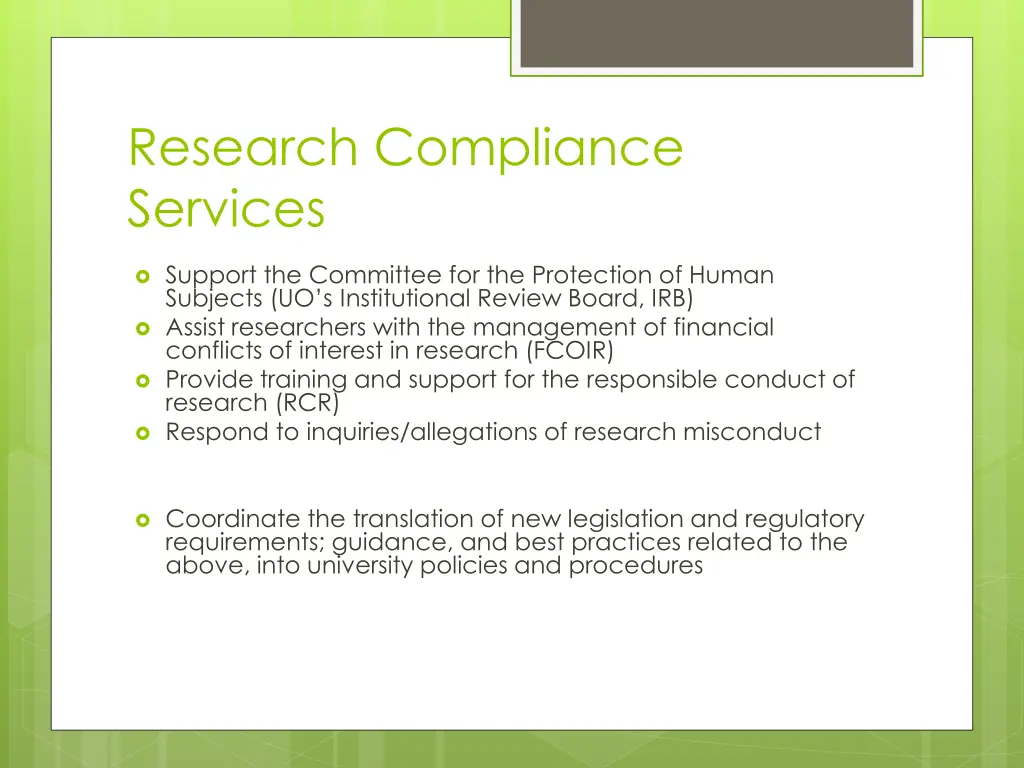
Research Compliance Services Support the Committee for the Protection of Human Subjects (UO s Institutional Review Board, IRB) Assist researchers with the management of financial conflicts of interest in research (FCOIR) Provide training and support for the responsible conduct of research (RCR) Respond to inquiries/allegations of research misconduct Coordinate the translation of new legislation and regulatory requirements; guidance, and best practices related to the above, into university policies and procedures
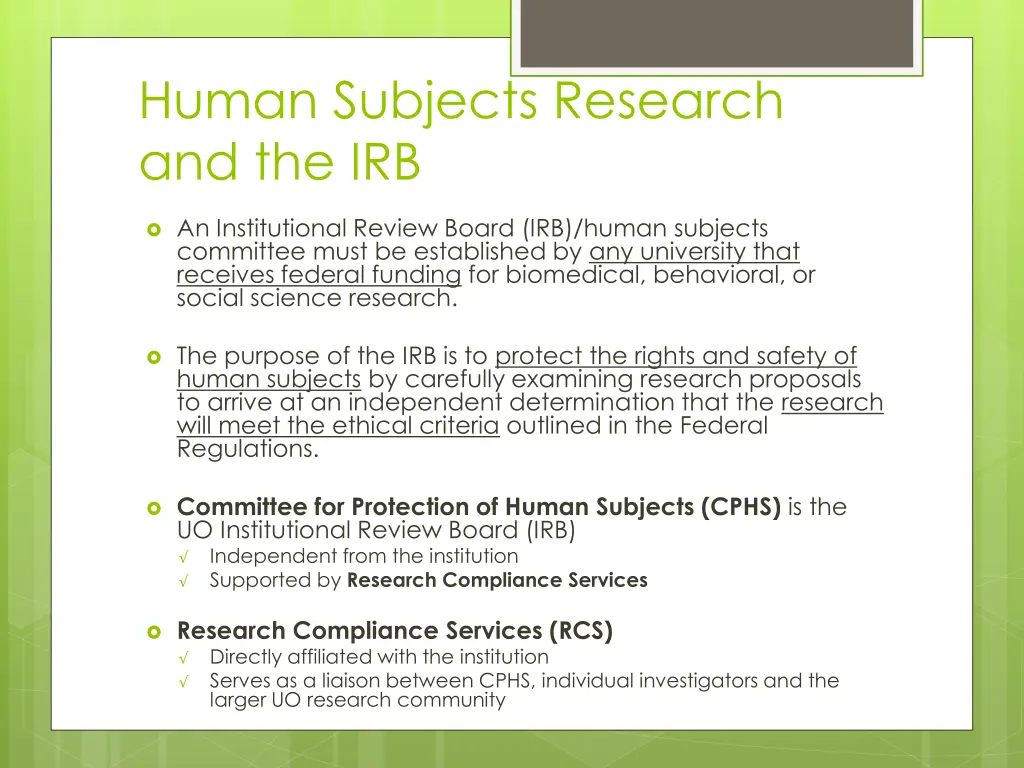
Human Subjects Research and the IRB An Institutional Review Board (IRB)/human subjects committee must be established by any university that receives federal funding for biomedical, behavioral, or social science research. The purpose of the IRB is to protect the rights and safety of human subjects by carefully examining research proposals to arrive at an independent determination that the research will meet the ethical criteria outlined in the Federal Regulations. Committee for Protection of Human Subjects (CPHS) is the UO Institutional Review Board (IRB) Independent from the institution Supported by Research Compliance Services Research Compliance Services (RCS) Directly affiliated with the institution Serves as a liaison between CPHS, individual investigators and the larger UO research community
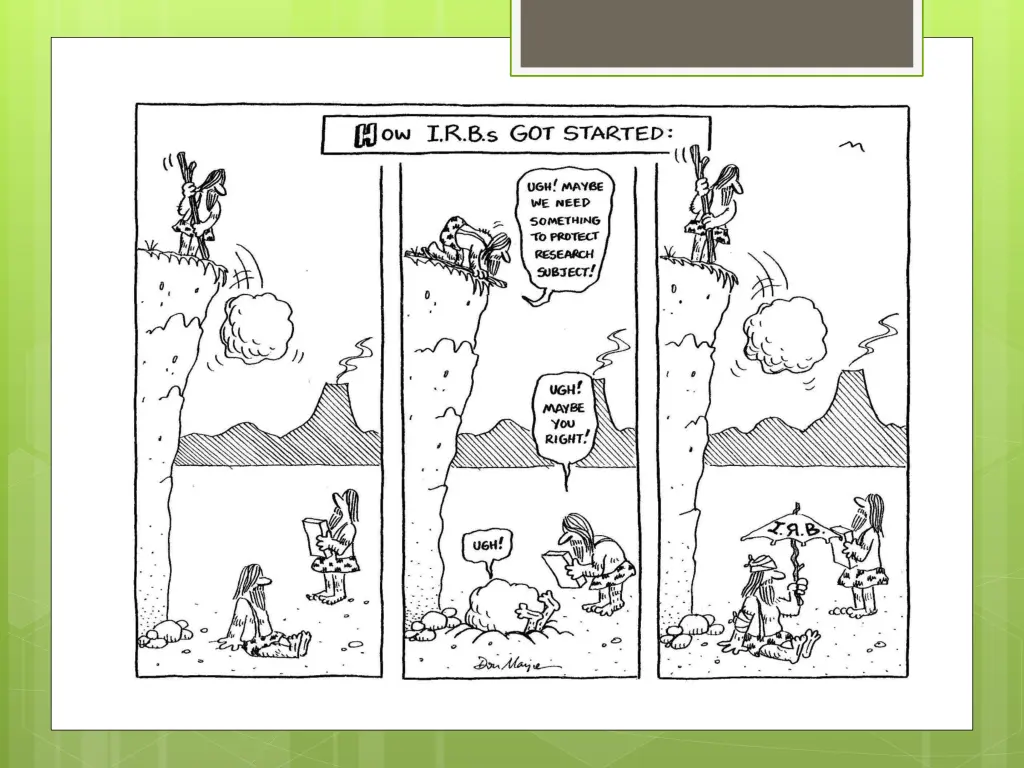
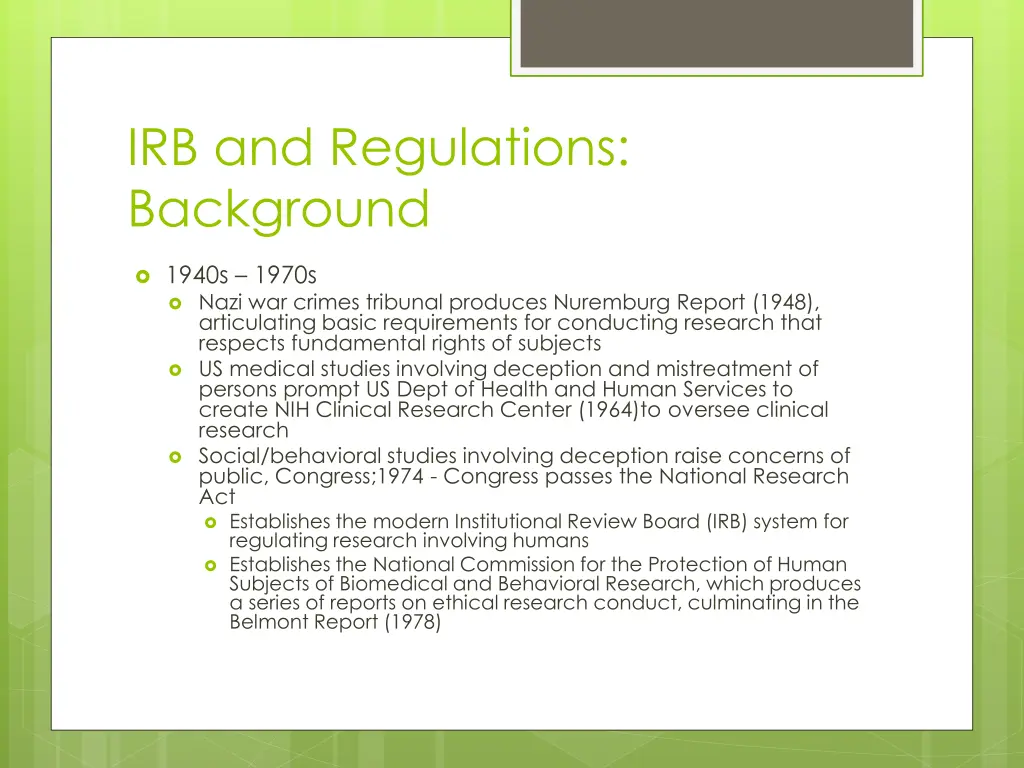
IRB and Regulations: Background 1940s 1970s Nazi war crimes tribunal produces Nuremburg Report (1948), articulating basic requirements for conducting research that respects fundamental rights of subjects US medical studies involving deception and mistreatment of persons prompt US Dept of Health and Human Services to create NIH Clinical Research Center (1964)to oversee clinical research Social/behavioral studies involving deception raise concerns of public, Congress;1974 - Congress passes the National Research Act Establishes the modern Institutional Review Board (IRB) system for regulating research involving humans Establishes the National Commission for the Protection of Human Subjects of Biomedical and Behavioral Research, which produces a series of reports on ethical research conduct, culminating in the Belmont Report (1978)
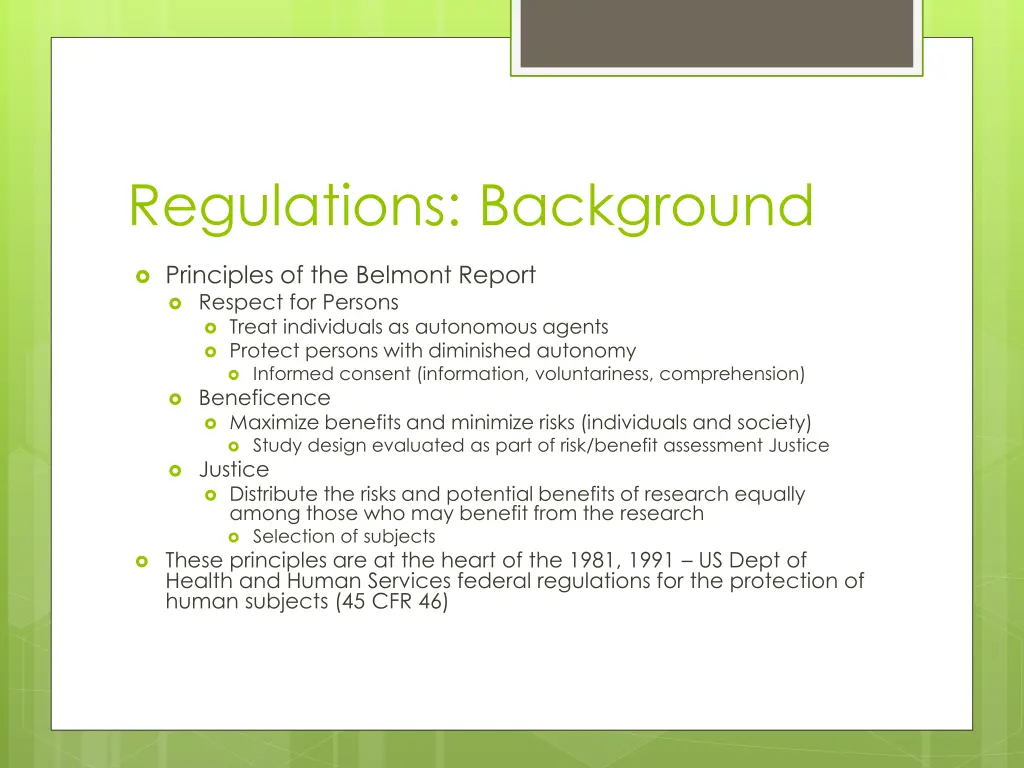
Regulations: Background Principles of the Belmont Report Respect for Persons Treat individuals as autonomous agents Protect persons with diminished autonomy Informed consent (information, voluntariness, comprehension) Beneficence Maximize benefits and minimize risks (individuals and society) Study design evaluated as part of risk/benefit assessment Justice Justice Distribute the risks and potential benefits of research equally among those who may benefit from the research Selection of subjects These principles are at the heart of the 1981, 1991 US Dept of Health and Human Services federal regulations for the protection of human subjects (45 CFR 46)
Regulations: Key Definitions Human Subject Research (HSR) Research - a systematic investigation, including research development, testing, and evaluation, designed to develop or contribute to generalizable knowledge. Human Subject - a living individual about whom an investigator (whether professional or student) conducting research obtains: Data through intervention or interaction with the individual, or Identifiable private information. HSR determination worksheet on RCS website: http://rcs.uoregon.edu/node/8
Do I need approval for research I'm doing for a class? It depends! Student research conducted purely for instructional purposes as part of course work at the UO is generally not reviewed by the CPHS/IRB. Unless there is a possibility that the data will be used to contribute to generalizable knowledge, or be published (i.e., academic journals, etc.), presented at conferences and/ or maintained for later use. NOTE: The IRB is unable to give post facto approval. If you think you might want to use data from a class project for research purposes, it is best to contact our office for suggestions on how to proceed.
Human Subjects Review Submitting a Protocol: Signed and completed application (this includes any applicable attachments); Research Plan; Recruitment script(s), email(s), letter(s); Consent/assent template(s); Debriefing template (if applicable); and, Data collection tools (measures, open- ended interview questions, surveys, etc.) Letters of permission
Human Subjects Review Required Education: The IRB must provide educational training in the protection of human research subjects. Collaborative IRB Training Initiative (CITI) www.citiprogram.org offers on-line ethics training tool that satisfies the education requirement. All UO researchers (faculty, staff or student) involved in human subjects are required to successfully complete the CITI training. CITI must be completed before approval may be granted on any new or continuing IRB protocol. http://rcs.uoregon.edu/node/5 for more information
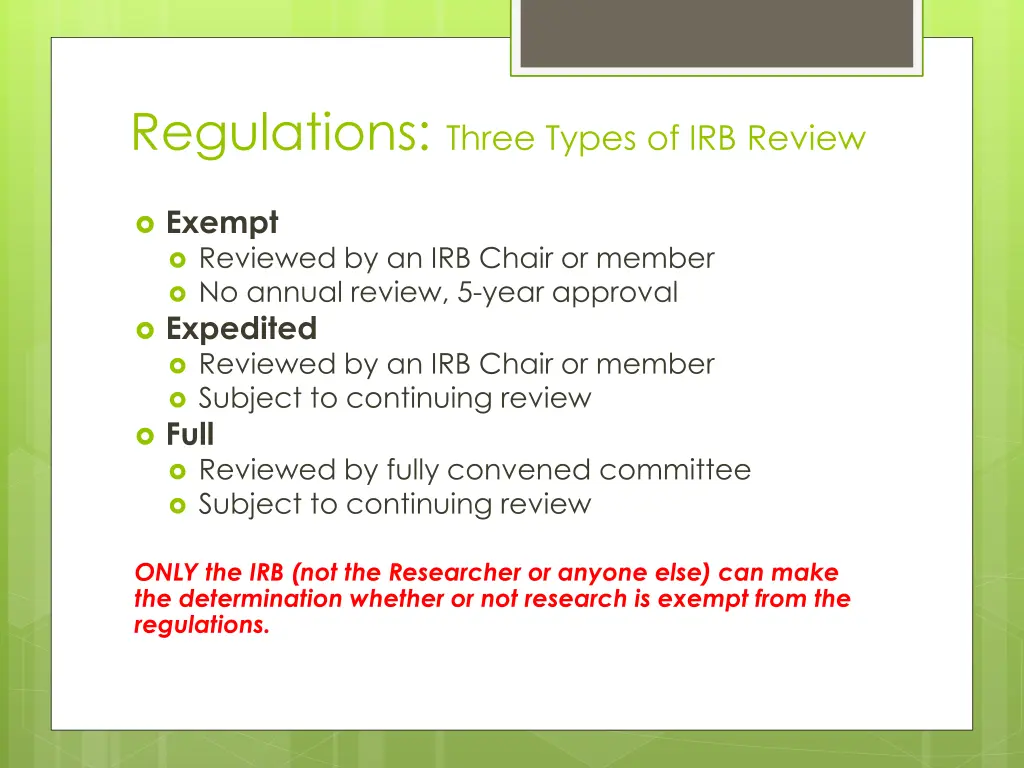
Regulations: Three Types of IRB Review Exempt Reviewed by an IRB Chair or member No annual review, 5-year approval Expedited Reviewed by an IRB Chair or member Subject to continuing review Full Reviewed by fully convened committee Subject to continuing review ONLY the IRB (not the Researcher or anyone else) can make the determination whether or not research is exempt from the regulations.
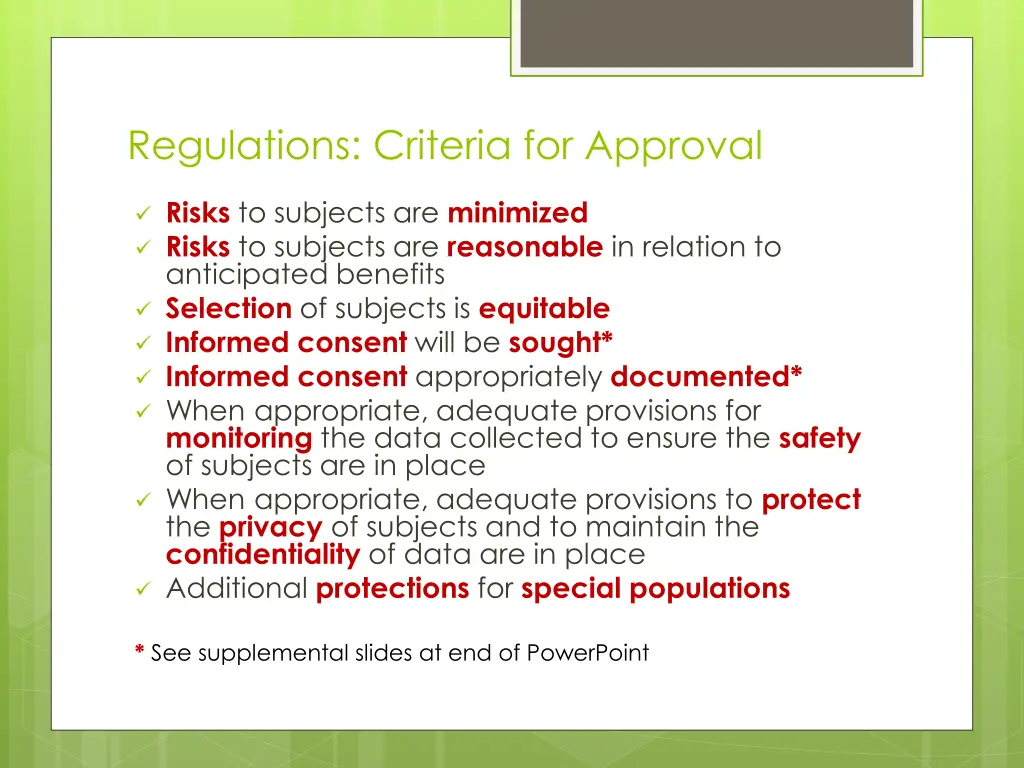
Regulations: Criteria for Approval Risks to subjects are minimized Risks to subjects are reasonable in relation to anticipated benefits Selection of subjects is equitable Informed consent will be sought* Informed consent appropriately documented* When appropriate, adequate provisions for monitoring the data collected to ensure the safety of subjects are in place When appropriate, adequate provisions to protect the privacy of subjects and to maintain the confidentiality of data are in place Additional protections for special populations * See supplemental slides at end of PowerPoint
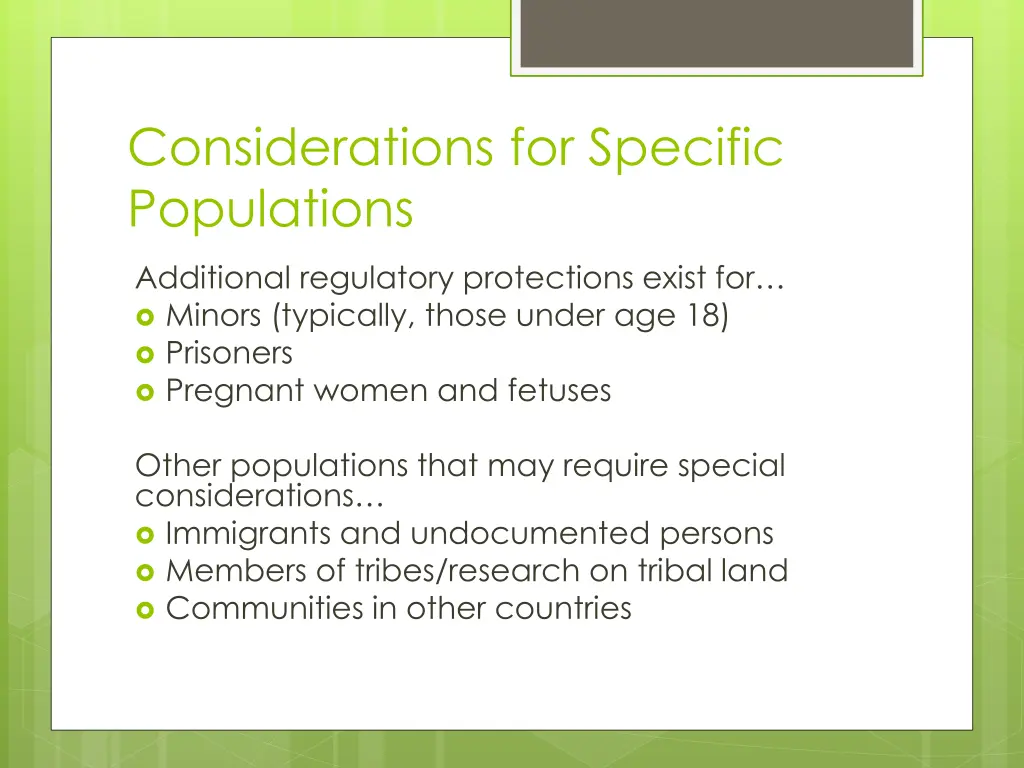
Considerations for Specific Populations Additional regulatory protections exist for Minors (typically, those under age 18) Prisoners Pregnant women and fetuses Other populations that may require special considerations Immigrants and undocumented persons Members of tribes/research on tribal land Communities in other countries
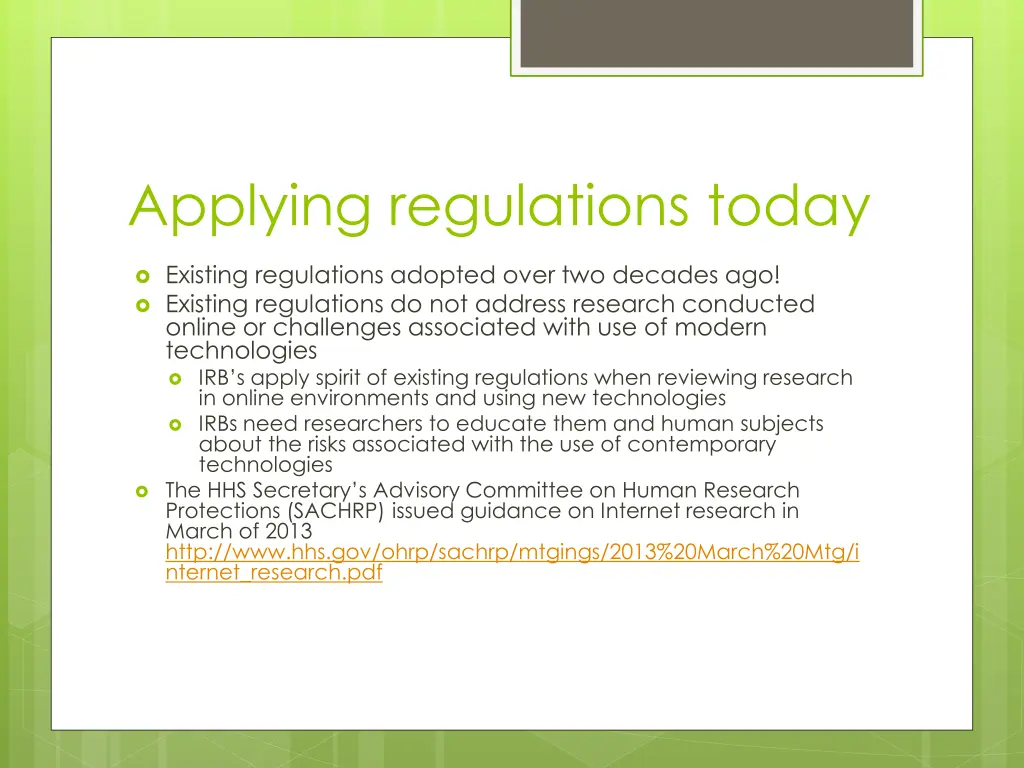
Applying regulations today Existing regulations adopted over two decades ago! Existing regulations do not address research conducted online or challenges associated with use of modern technologies IRB s apply spirit of existing regulations when reviewing research in online environments and using new technologies IRBs need researchers to educate them and human subjects about the risks associated with the use of contemporary technologies The HHS Secretary s Advisory Committee on Human Research Protections (SACHRP) issued guidance on Internet research in March of 2013 http://www.hhs.gov/ohrp/sachrp/mtgings/2013%20March%20Mtg/i nternet_research.pdf
Staying Compliant: Once your protocol is approved you need to Submit an Amendment request for review and approval for ANY changes to the approved protocol, for example: Change in procedures Change in instruments/measures Change in research personnel Change in approved debriefing Change in funding Submit a Continuing Review request to continue research beyond issued expiration Submit Event Reports including protocol deviations, adverse events, unanticipated problems
Human Subjects Review Helpful Hints: RCS website rcs.uoregon.edu includes application materials and useful information on human subjects research for more specific questions. RCS has sample templates for recruitment materials and consent/assent forms which are available on our website and has more specific samples that are not posted. Call, email or set up a time to meet with one of us. We re always happy to help!
Research Compliance Services: Contact Us! Email: ResearchCompliance@uoregon.edu RCS Website: rcs.uoregon.edu Main Phone: 541-346-2510 Carolyn Craig, PhD, CIP Research Compliance Administrator 541-346-1845 craig3@uoregon.edu
RCS Presentation Feedback You will receive an email from your instructor with a link to a brief survey to provide feedback on today s presentation. 6 questions Anonymous Optional
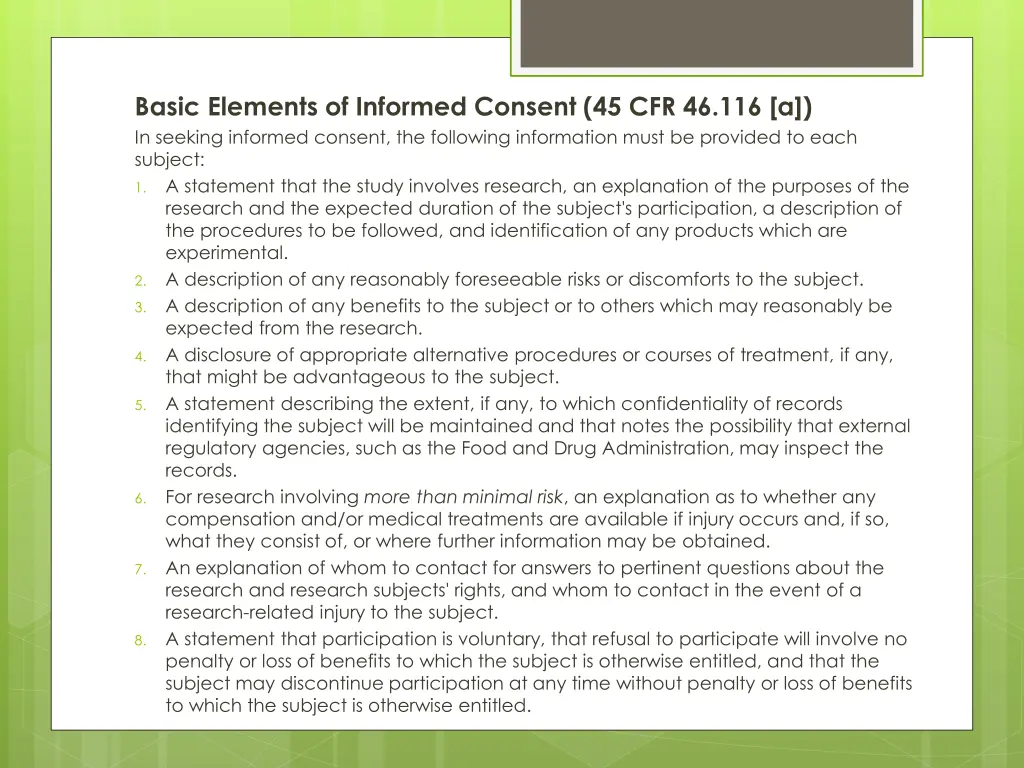
Basic Elements of Informed Consent (45 CFR 46.116 [a]) In seeking informed consent, the following information must be provided to each subject: A statement that the study involves research, an explanation of the purposes of the research and the expected duration of the subject's participation, a description of the procedures to be followed, and identification of any products which are experimental. A description of any reasonably foreseeable risks or discomforts to the subject. A description of any benefits to the subject or to others which may reasonably be expected from the research. A disclosure of appropriate alternative procedures or courses of treatment, if any, that might be advantageous to the subject. A statement describing the extent, if any, to which confidentiality of records identifying the subject will be maintained and that notes the possibility that external regulatory agencies, such as the Food and Drug Administration, may inspect the records. For research involving more than minimal risk, an explanation as to whether any compensation and/or medical treatments are available if injury occurs and, if so, what they consist of, or where further information may be obtained. An explanation of whom to contact for answers to pertinent questions about the research and research subjects' rights, and whom to contact in the event of a research-related injury to the subject. A statement that participation is voluntary, that refusal to participate will involve no penalty or loss of benefits to which the subject is otherwise entitled, and that the subject may discontinue participation at any time without penalty or loss of benefits to which the subject is otherwise entitled. 1. 2. 3. 4. 5. 6. 7. 8.
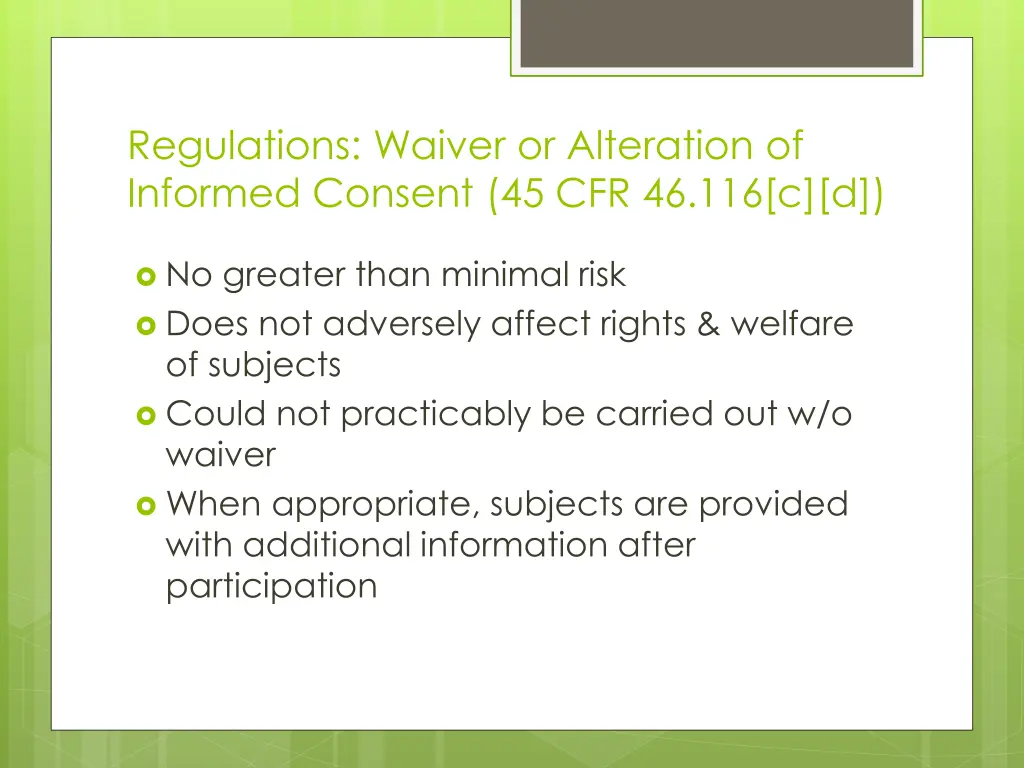
Regulations: Waiver or Alteration of Informed Consent (45 CFR 46.116[c][d]) No greater than minimal risk Does not adversely affect rights & welfare of subjects Could not practicably be carried out w/o waiver When appropriate, subjects are provided with additional information after participation
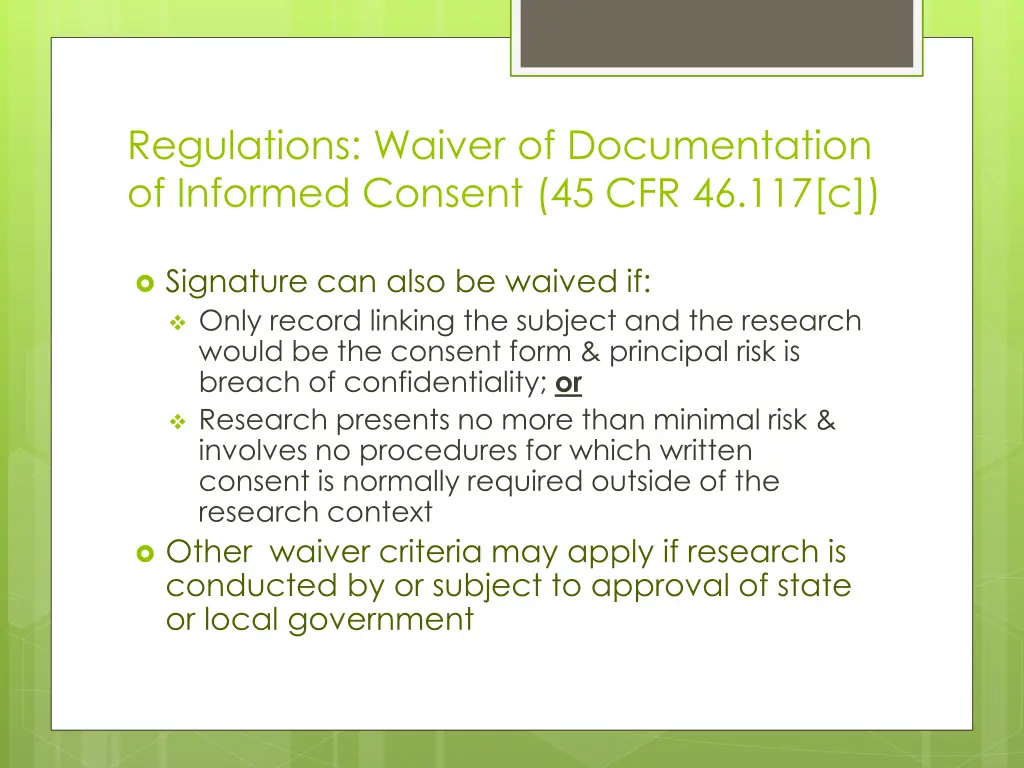
Regulations: Waiver of Documentation of Informed Consent (45 CFR 46.117[c]) Signature can also be waived if: Only record linking the subject and the research would be the consent form & principal risk is breach of confidentiality; or Research presents no more than minimal risk & involves no procedures for which written consent is normally required outside of the research context Other waiver criteria may apply if research is conducted by or subject to approval of state or local government