Hydrodynamic Pressure in Lubricant Film Around Shaftless Reaction Wheel
Investigate the hydrodynamic pressure generated in the lubricant film surrounding a shaftless reaction wheel. The study focuses on the line contact problem of a rolling cylinder on a plane, aiming to develop an empirical relationship for pressure as a function of rotational speed and film thickness. Literature review includes analytical equations and the use of the Reynolds Equation governing the pressure. Presented at TFAWS 2016.

Download Presentation

Please find below an Image/Link to download the presentation.
The content on the website is provided AS IS for your information and personal use only. It may not be sold, licensed, or shared on other websites without obtaining consent from the author. If you encounter any issues during the download, it is possible that the publisher has removed the file from their server.
You are allowed to download the files provided on this website for personal or commercial use, subject to the condition that they are used lawfully. All files are the property of their respective owners.
The content on the website is provided AS IS for your information and personal use only. It may not be sold, licensed, or shared on other websites without obtaining consent from the author.
E N D
Presentation Transcript
TFAWS Interdisciplinary Paper Session Hydrodynamic Pressure Generated in Lubricant Film Around Shaftless Reaction Wheel Sahadeo Ramjatan Graduate Student - University of Florida Space Systems Group Alvin Yew Aerospace Engineer, NASA GSFC Presented By (Sahadeo Ramjatan) Thermal & Fluids Analysis Workshop TFAWS 2016 August 1-5, 2016 NASA Ames Research Center Mountain View, CA
Outline Background Problem Description Literature Review Methodology and Approach Spring Loaded Application Conclusions TFAWS 2016 August 1-5, 2016 2
Background Conformal Bearings High Degree of Geometrical Conformity Load is carried over a large area Journal Bearings Non-conformal Bearings Contacting surfaces do not conform well together Full burden of load is carried by a small contact area Mating Gear Teeth and Rolling Element Bearings Rolling Element Bearings Ball Bearings where load is primarily radial with some thrust load present Roller Bearings where load is purely radial in most applications TFAWS 2016 August 1-5, 2016 3
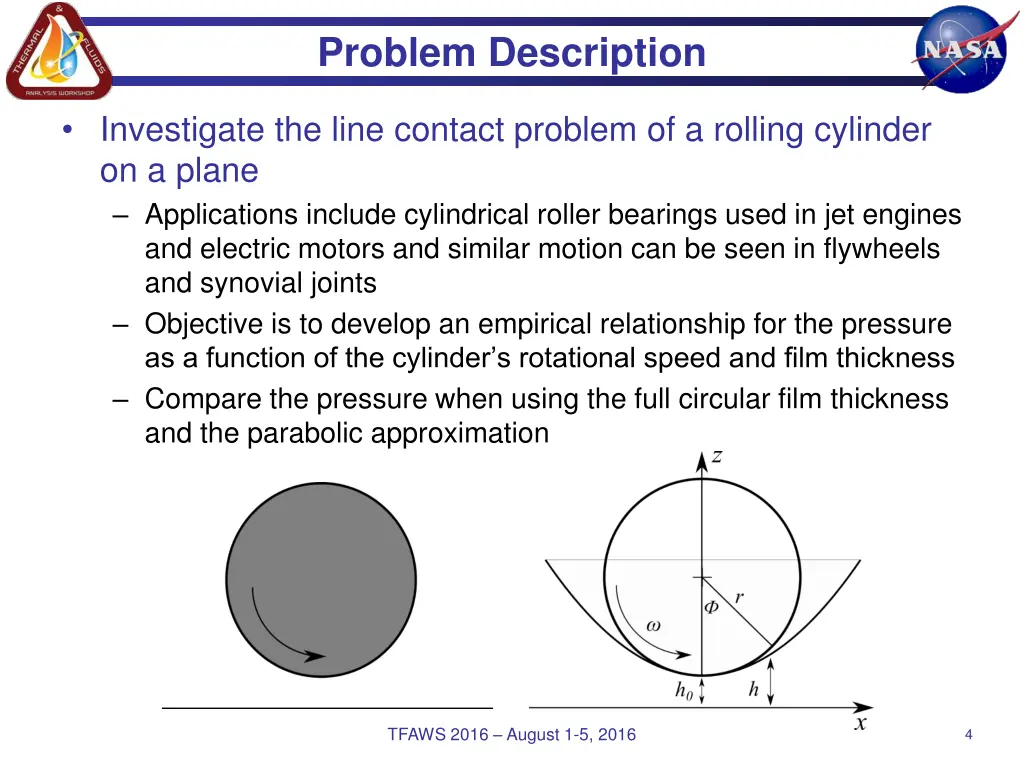
Problem Description Investigate the line contact problem of a rolling cylinder on a plane Applications include cylindrical roller bearings used in jet engines and electric motors and similar motion can be seen in flywheels and synovial joints Objective is to develop an empirical relationship for the pressure as a function of the cylinder s rotational speed and film thickness Compare the pressure when using the full circular film thickness and the parabolic approximation TFAWS 2016 August 1-5, 2016 4
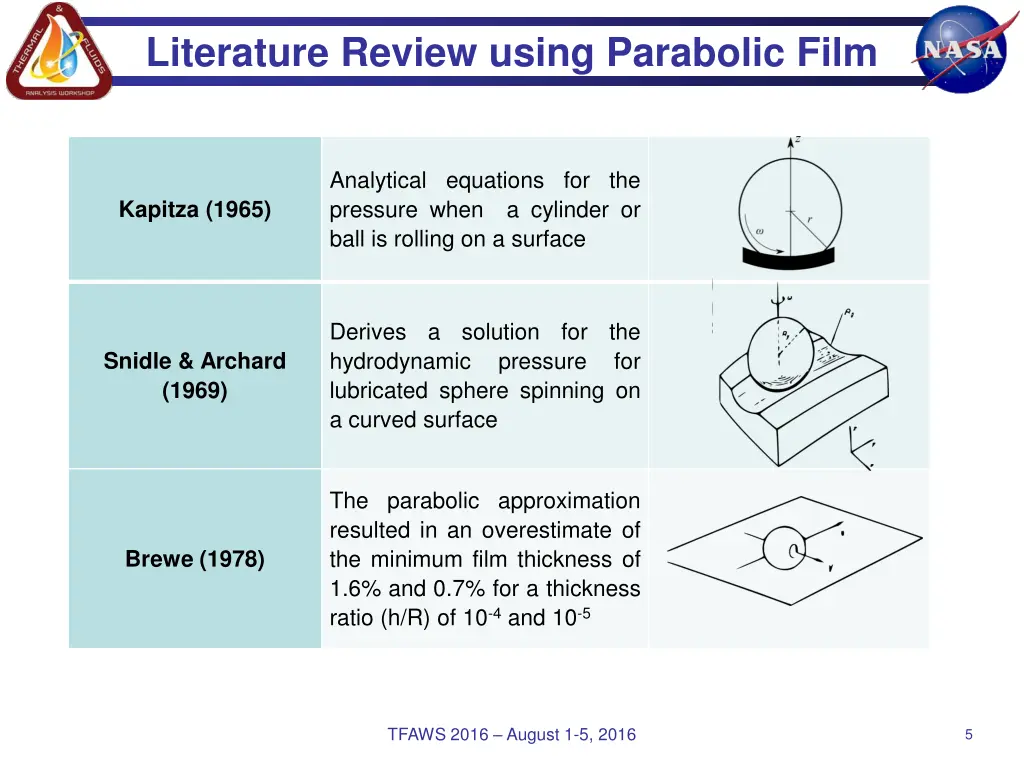
Literature Review using Parabolic Film Analytical equations for the pressure when a cylinder or ball is rolling on a surface Kapitza (1965) Derives a solution for the hydrodynamic lubricated sphere spinning on a curved surface Snidle & Archard (1969) pressure for The parabolic approximation resulted in an overestimate of the minimum film thickness of 1.6% and 0.7% for a thickness ratio (h/R) of 10-4 and 10-5 Brewe (1978) TFAWS 2016 August 1-5, 2016 5
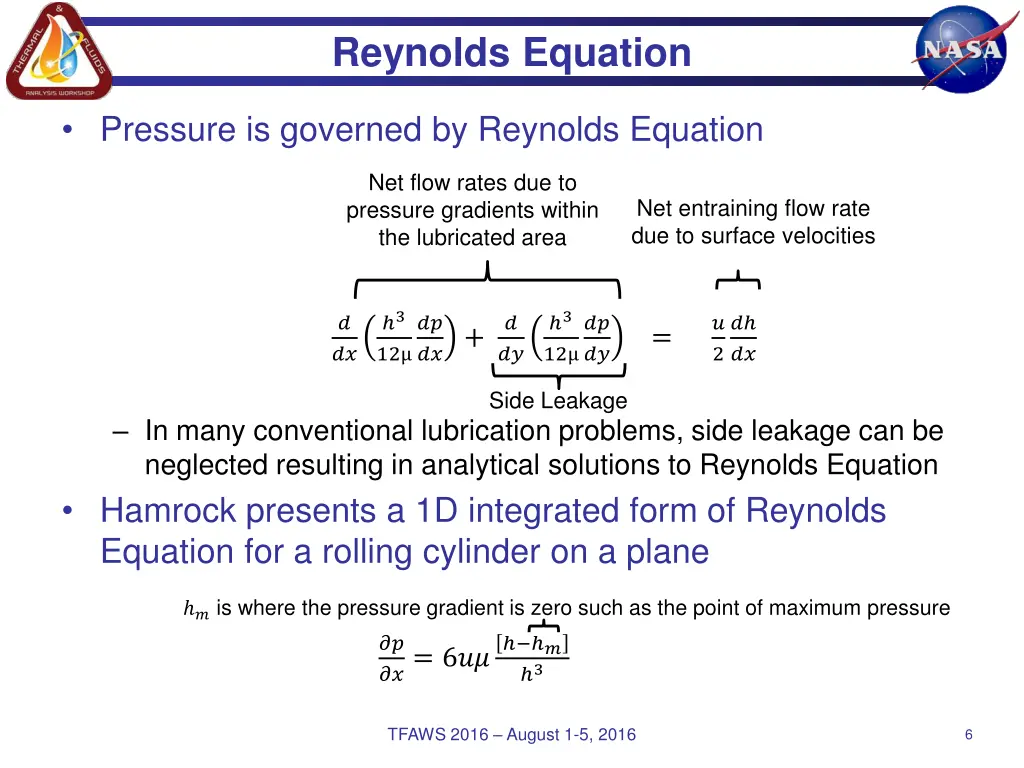
Reynolds Equation Pressure is governed by Reynolds Equation Net flow rates due to pressure gradients within the lubricated area Net entraining flow rate due to surface velocities 3 12 3 12 ? ?? ?? ??+ ? ?? ?? ?? = ? 2 ? ?? Side Leakage In many conventional lubrication problems, side leakage can be neglected resulting in analytical solutions to Reynolds Equation Hamrock presents a 1D integrated form of Reynolds Equation for a rolling cylinder on a plane ? is where the pressure gradient is zero such as the point of maximum pressure ?? ??= 6?? ? 3 TFAWS 2016 August 1-5, 2016 6
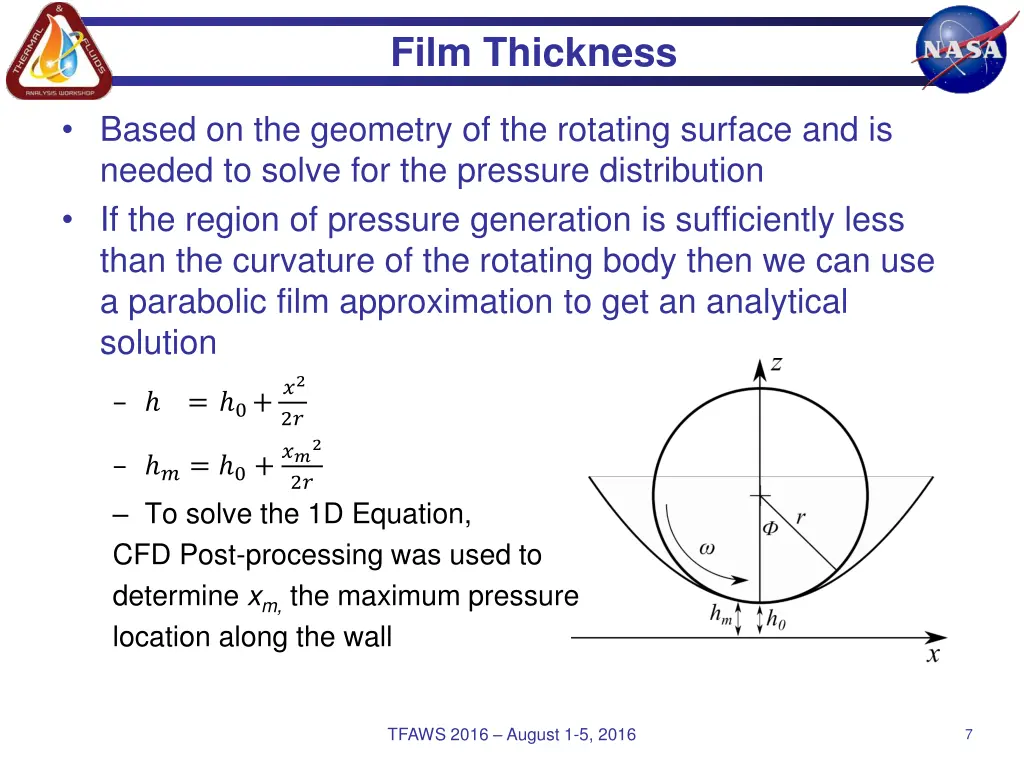
Film Thickness Based on the geometry of the rotating surface and is needed to solve for the pressure distribution If the region of pressure generation is sufficiently less than the curvature of the rotating body then we can use a parabolic film approximation to get an analytical solution = 0+ ?2 2? ?= 0+??2 2? To solve the 1D Equation, CFD Post-processing was used to determine xm,the maximum pressure location along the wall TFAWS 2016 August 1-5, 2016 7
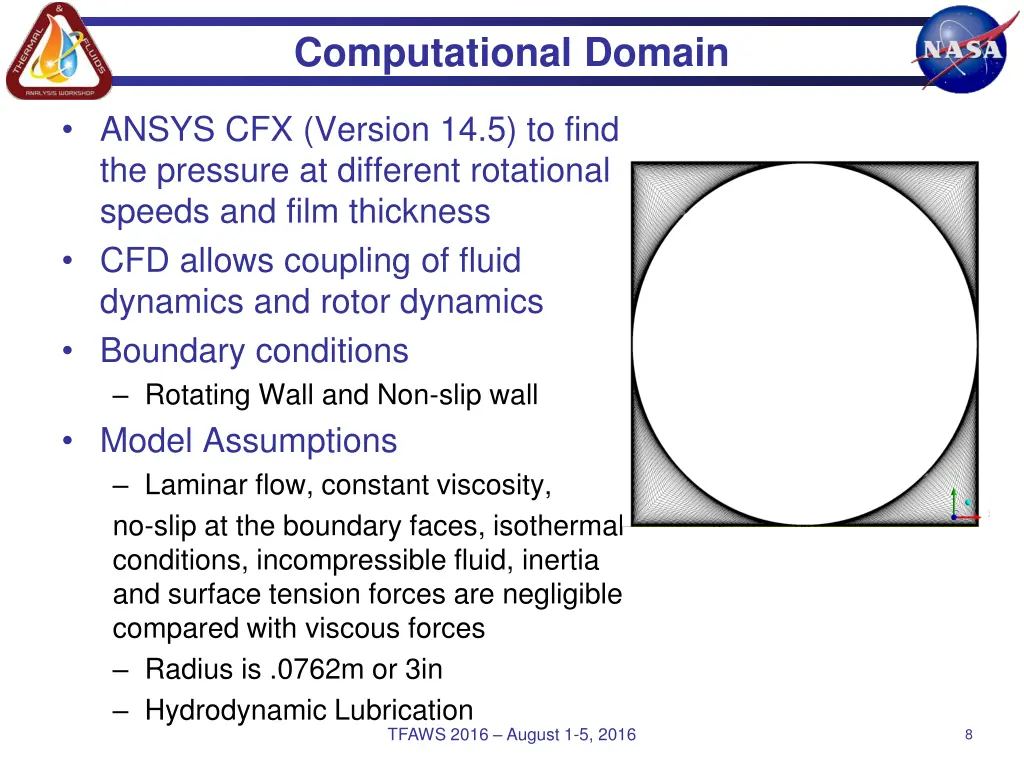
Computational Domain ANSYS CFX (Version 14.5) to find the pressure at different rotational speeds and film thickness CFD allows coupling of fluid dynamics and rotor dynamics Boundary conditions Rotating Wall and Non-slip wall Model Assumptions Laminar flow, constant viscosity, no-slip at the boundary faces, isothermal conditions, incompressible fluid, inertia and surface tension forces are negligible compared with viscous forces Radius is .0762m or 3in Hydrodynamic Lubrication TFAWS 2016 August 1-5, 2016 8
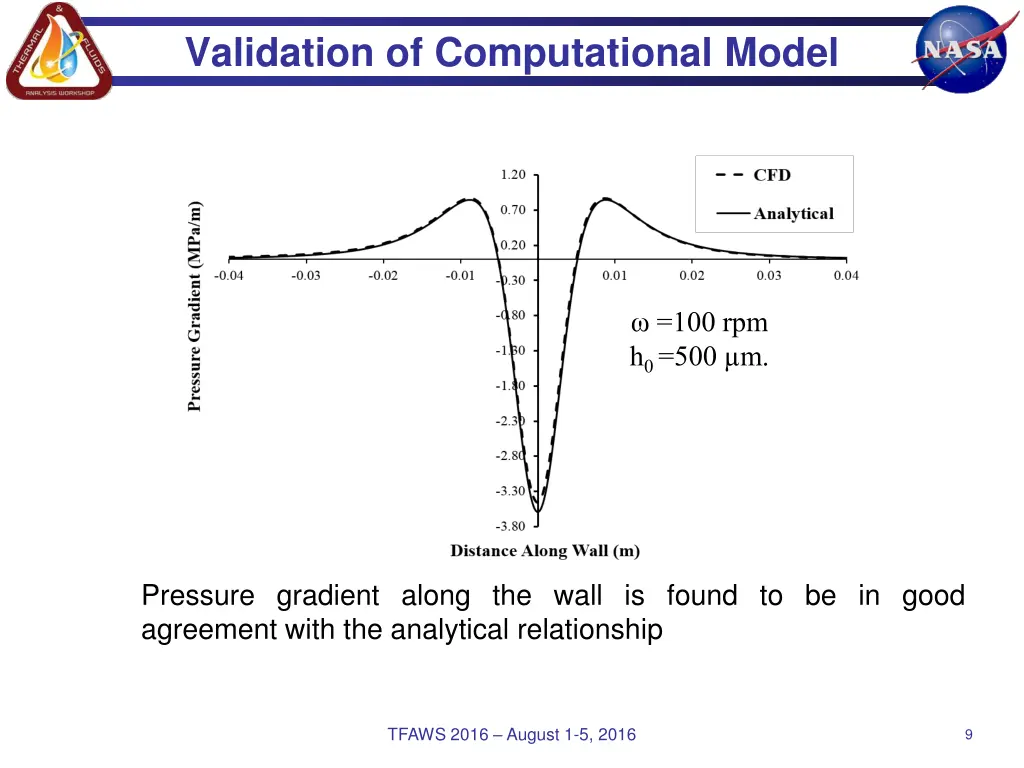
Validation of Computational Model =100 rpm h0 =500 m. Pressure gradient along the wall is found to be in good agreement with the analytical relationship TFAWS 2016 August 1-5, 2016 9
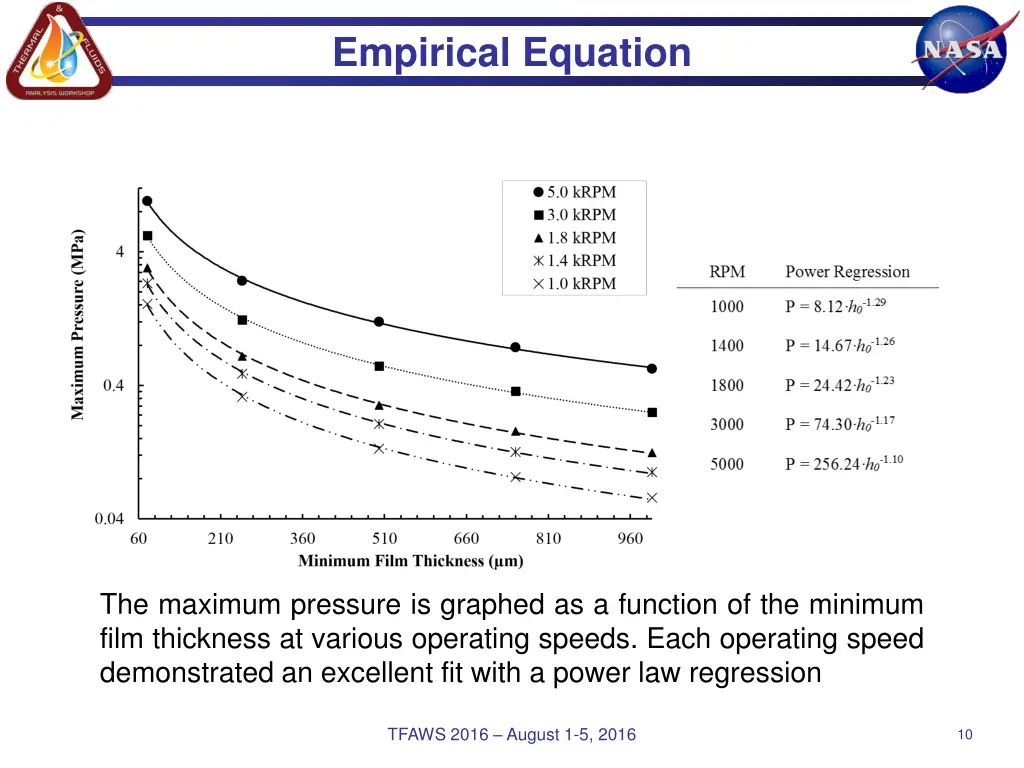
Empirical Equation The maximum pressure is graphed as a function of the minimum film thickness at various operating speeds. Each operating speed demonstrated an excellent fit with a power law regression TFAWS 2016 August 1-5, 2016 10
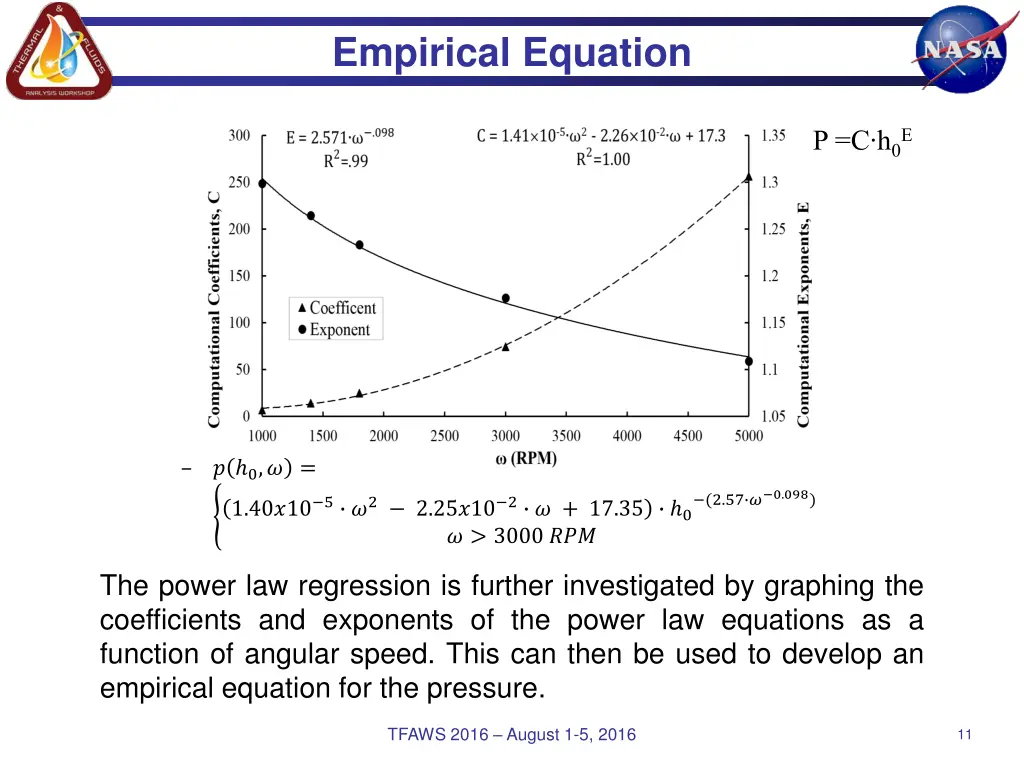
Empirical Equation P =C h0E ? 0,? = 1.40?10 5 ?2 2.25?10 2 ? + 17.35 0 ? > 3000 ??? (2.57 ? 0.098) The power law regression is further investigated by graphing the coefficients and exponents of the power law equations as a function of angular speed. This can then be used to develop an empirical equation for the pressure. TFAWS 2016 August 1-5, 2016 11
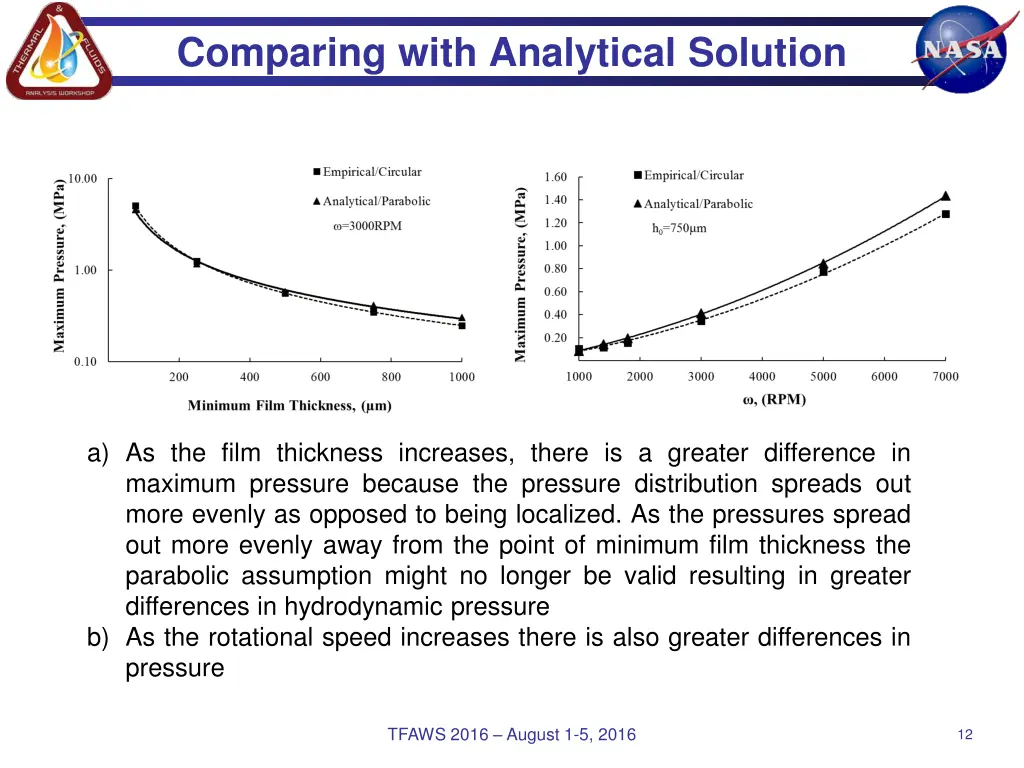
Comparing with Analytical Solution a) As the film thickness increases, there is a greater difference in maximum pressure because the pressure distribution spreads out more evenly as opposed to being localized. As the pressures spread out more evenly away from the point of minimum film thickness the parabolic assumption might no longer be valid resulting in greater differences in hydrodynamic pressure b) As the rotational speed increases there is also greater differences in pressure TFAWS 2016 August 1-5, 2016 12
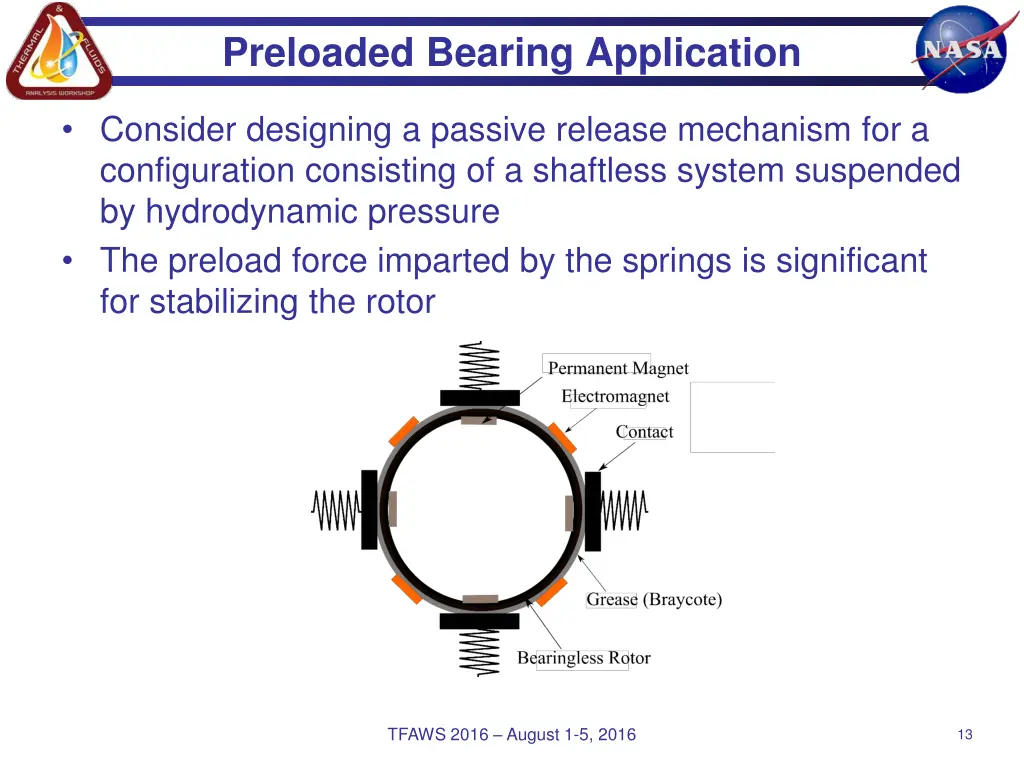
Preloaded Bearing Application Consider designing a passive release mechanism for a configuration consisting of a shaftless system suspended by hydrodynamic pressure The preload force imparted by the springs is significant for stabilizing the rotor TFAWS 2016 August 1-5, 2016 13
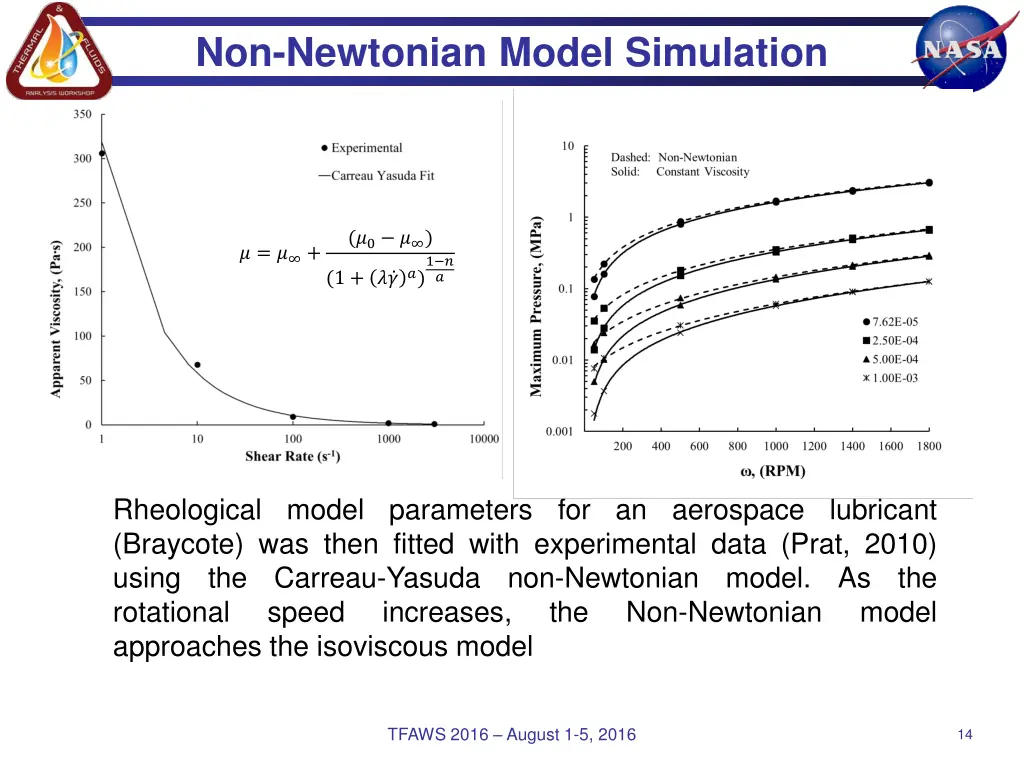
Non-Newtonian Model Simulation (?0 ? ) ? = ? + 1 ? ? (1 + ? ??) Rheological model parameters for an aerospace lubricant (Braycote) was then fitted with experimental data (Prat, 2010) using the Carreau-Yasuda non-Newtonian model. As the rotational speed increases, approaches the isoviscous model the Non-Newtonian model TFAWS 2016 August 1-5, 2016 14
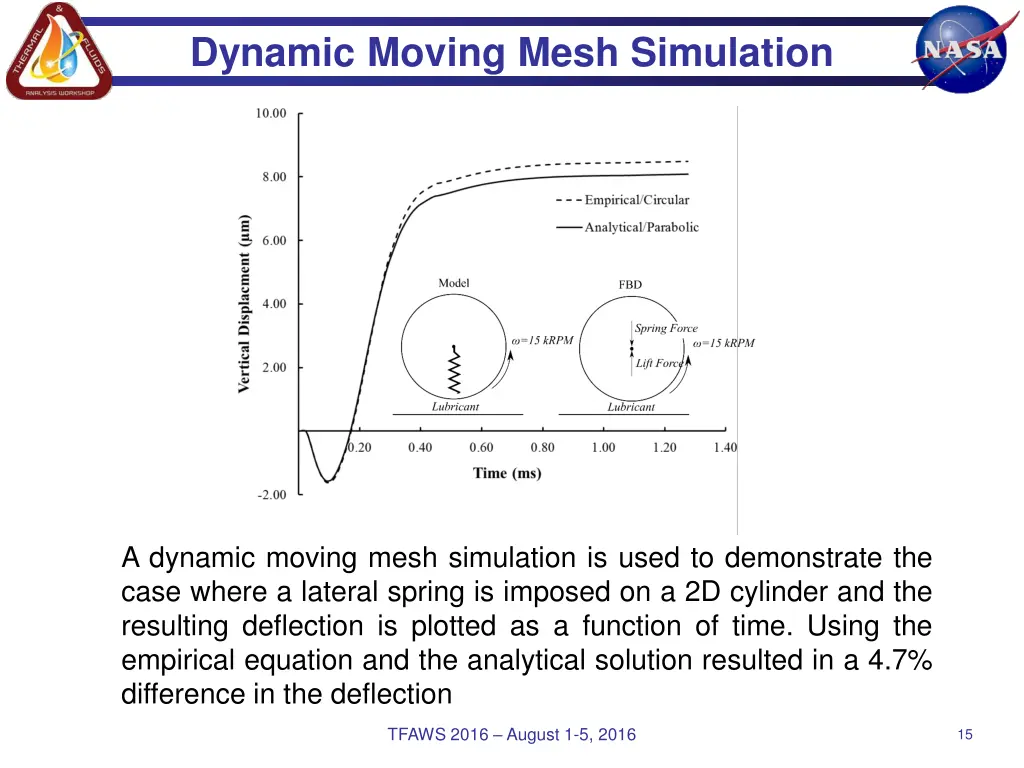
Dynamic Moving Mesh Simulation A dynamic moving mesh simulation is used to demonstrate the case where a lateral spring is imposed on a 2D cylinder and the resulting deflection is plotted as a function of time. Using the empirical equation and the analytical solution resulted in a 4.7% difference in the deflection TFAWS 2016 August 1-5, 2016 15
Conclusion Investigated the hydrodynamic pressure of a rolling cylinder on a plane Reviewing literature, we saw that the parabolic approximation could result in an overestimate of the film thickness with larger errors for thicker films Developed an empirical relationship for the pressure as a function of the cylinder s rotational speed and film thickness As the film thickness or speed increased, there was a greater difference in maximum pressure from the analytical (parabolic) and empirical (full circular film) expression Considered a passive release mechanism for a shaftless system working with a non-Newtonian lubricant which resulted in a 4.7% difference in the deflection between the empirical and analytical equation TFAWS 2016 August 1-5, 2016 16
Acknowledgements We would like to thank Dr. Norman Fitz-Coy, Associate Professor, Mechanical & Aerospace Engineering, University of Florida, for all of his guidance and support We would like to thank Mr. Russell Roder, NASA GSFC, for his guidance and support We would like to thank the John Mather Nobel Scholarship Program for funding our travel TFAWS 2016 August 1-5, 2016 17
References P. Kapitza, Collected Papers of Kapitza, London: Pergamon Press, 1965 R. Snidle and J. Archard, "Theory of Hydrodynamic Lubrication for a Spinning Sphere," in Proc Instn Mech Engrs , Leicester, 1969-70 D. E. Brewe, B. J. Hamrock and C. M. Taylor, "Effect of Geometery on Hydrodynamic Film Thickness," NASA, Virginia, 1978. P. Prat, M. Vergne, M. Pochard and J. Sicre, "Optimization of the Rheological Behavior of Thickened Liquid Lubricants for Spacecraft Applications," in Lubricants and Lubrication, 1995 TFAWS 2016 August 1-5, 2016 18