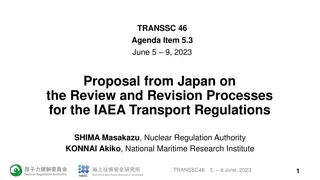
Review the minutes from the kick-off meeting for the revision of the IAEA transport regulations, highlighting challenges in the current process, objectives for improvement, and the proposed revision schedule. Key points include inconsistencies in processing methods, the need for clearer documentation, and the focus on efficient regulatory development.
Please find below an Image/Link to download the presentation.
The content on the website is provided AS IS for your information and personal use only. It may not be sold, licensed, or shared on other websites without obtaining consent from the author. If you encounter any issues during the download, it is possible that the publisher has removed the file from their server.
You are allowed to download the files provided on this website for personal or commercial use, subject to the condition that they are used lawfully. All files are the property of their respective owners.
The content on the website is provided AS IS for your information and personal use only. It may not be sold, licensed, or shared on other websites without obtaining consent from the author.
E N D
Presentation Transcript
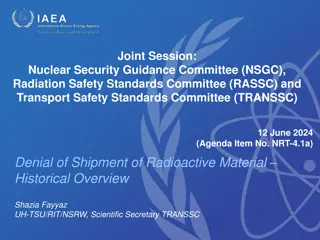
WG on Revision of the IAEA Transport Regulations Meeting Minutes from Kick Off Meeting Meeting Minutes from Kick Off Meeting TRANSSC 48 June 13, 2024 Rick Boyle (USA)
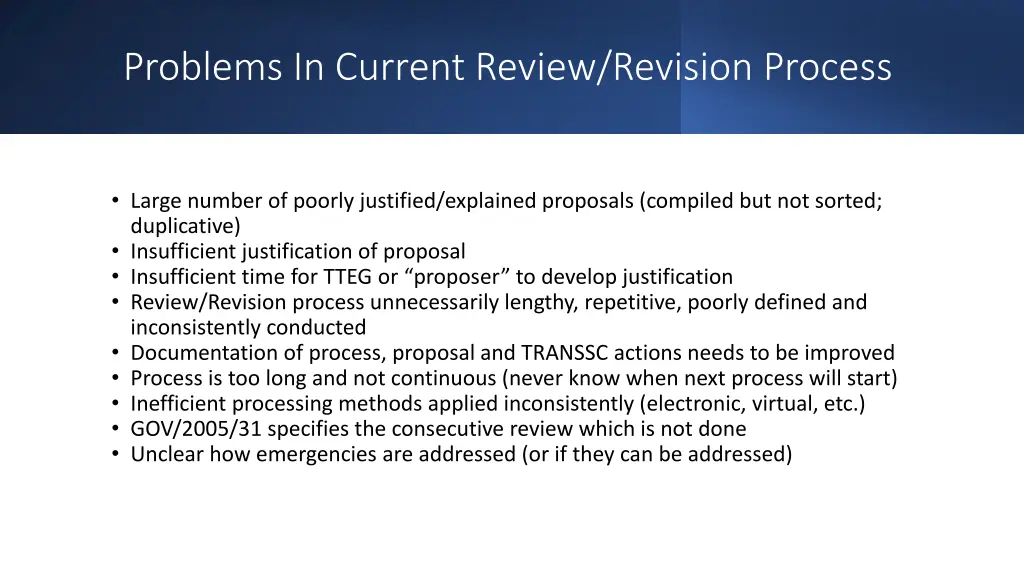
Problems In Current Review/Revision Process Large number of poorly justified/explained proposals (compiled but not sorted; duplicative) Insufficient justification of proposal Insufficient time for TTEG or proposer to develop justification Review/Revision process unnecessarily lengthy, repetitive, poorly defined and inconsistently conducted Documentation of process, proposal and TRANSSC actions needs to be improved Process is too long and not continuous (never know when next process will start) Inefficient processing methods applied inconsistently (electronic, virtual, etc.) GOV/2005/31 specifies the consecutive review which is not done Unclear how emergencies are addressed (or if they can be addressed)
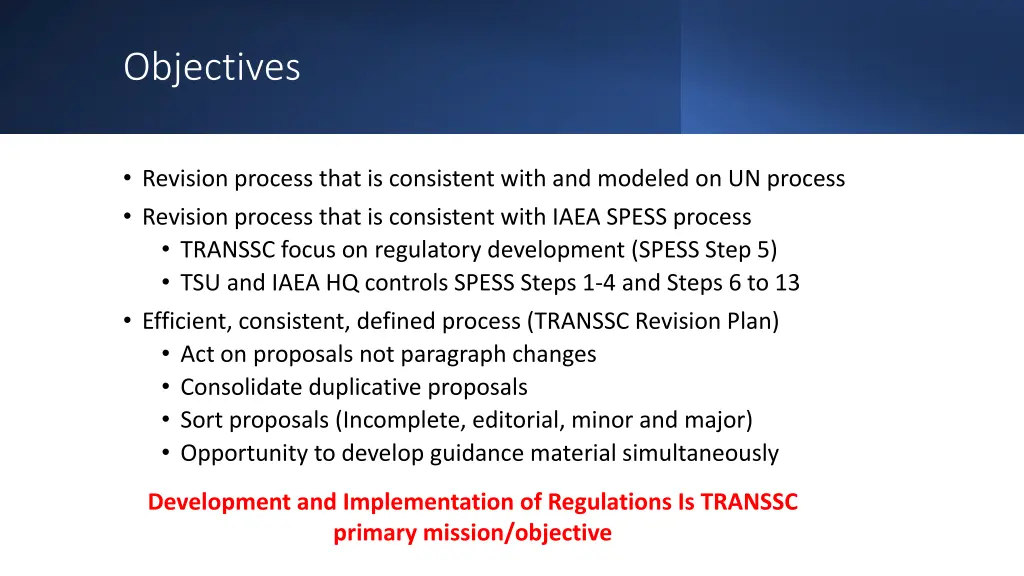
Objectives Revision process that is consistent with and modeled on UN process Revision process that is consistent with IAEA SPESS process TRANSSC focus on regulatory development (SPESS Step 5) TSU and IAEA HQ controls SPESS Steps 1-4 and Steps 6 to 13 Efficient, consistent, defined process (TRANSSC Revision Plan) Act on proposals not paragraph changes Consolidate duplicative proposals Sort proposals (Incomplete, editorial, minor and major) Opportunity to develop guidance material simultaneously Development and Implementation of Regulations Is TRANSSC primary mission/objective
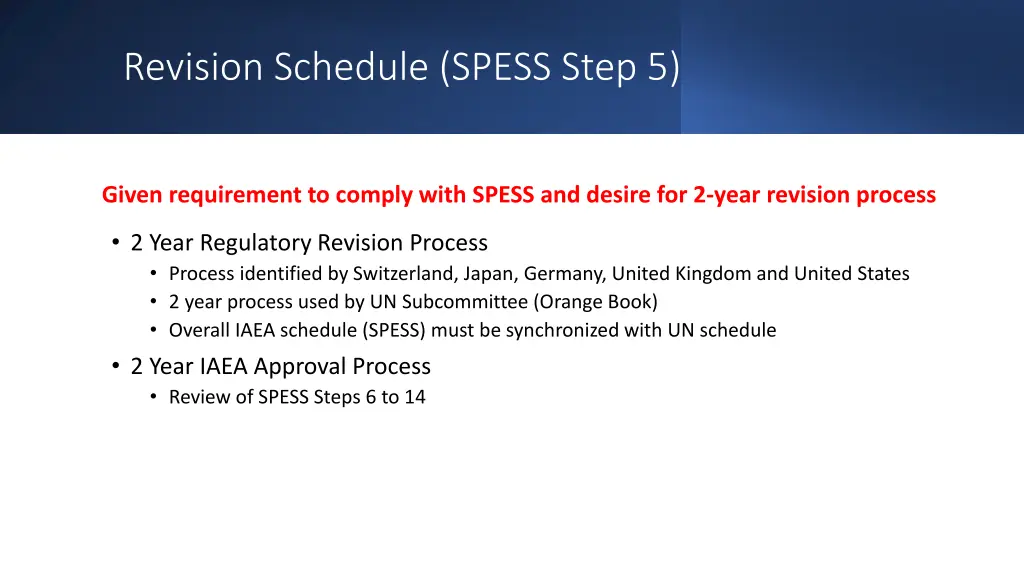
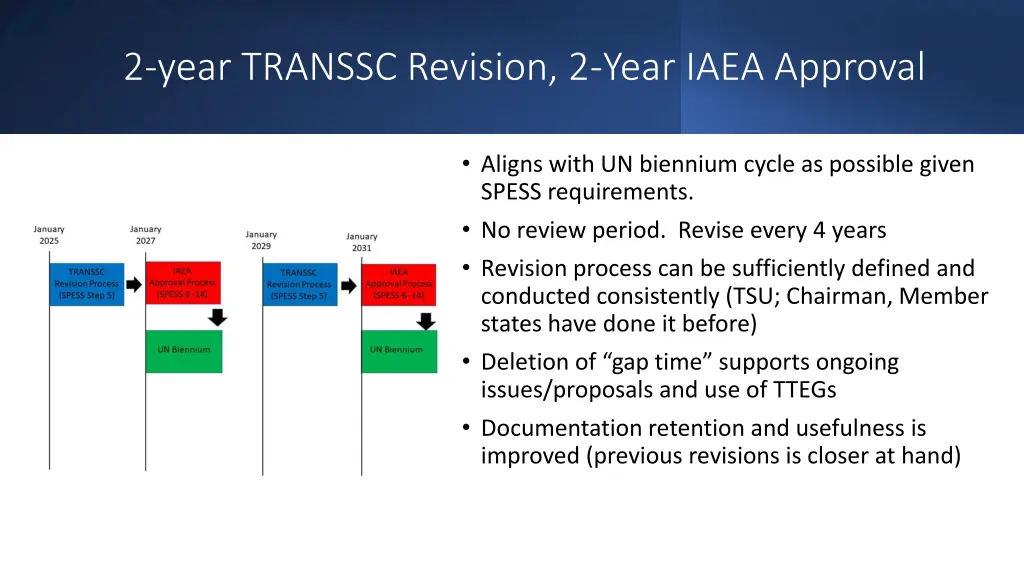
Revision Schedule (SPESS Step 5) Given requirement to comply with SPESS and desire for 2-year revision process 2 Year Regulatory Revision Process Process identified by Switzerland, Japan, Germany, United Kingdom and United States 2 year process used by UN Subcommittee (Orange Book) Overall IAEA schedule (SPESS) must be synchronized with UN schedule 2 Year IAEA Approval Process Review of SPESS Steps 6 to 14
2-year TRANSSC Revision, 2-Year IAEA Approval Aligns with UN biennium cycle as possible given SPESS requirements. No review period. Revise every 4 years Revision process can be sufficiently defined and conducted consistently (TSU; Chairman, Member states have done it before) Deletion of gap time supports ongoing issues/proposals and use of TTEGs Documentation retention and usefulness is improved (previous revisions is closer at hand)
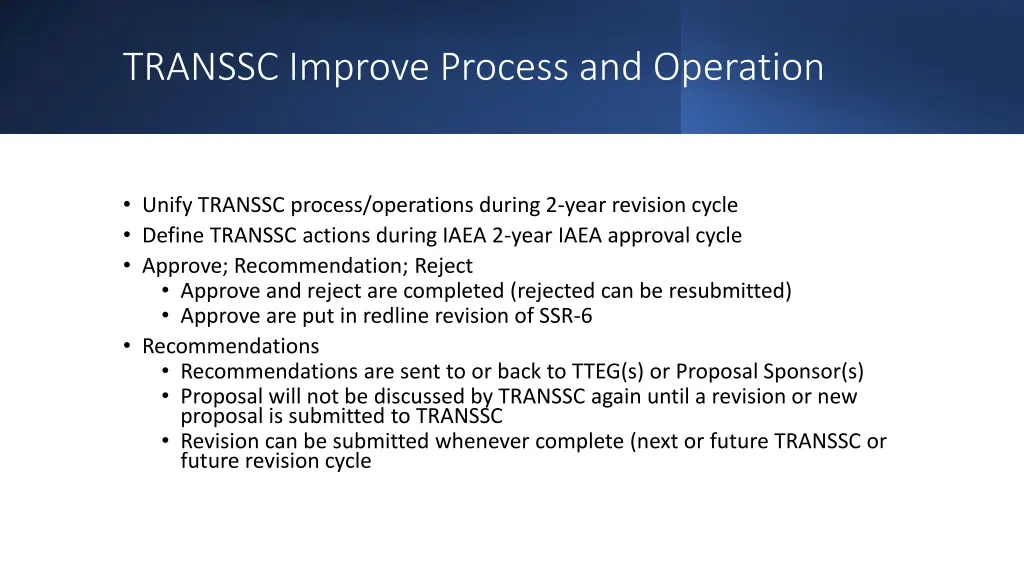
TRANSSC Improve Process and Operation Unify TRANSSC process/operations during 2-year revision cycle Define TRANSSC actions during IAEA 2-year IAEA approval cycle Approve; Recommendation; Reject Approve and reject are completed (rejected can be resubmitted) Approve are put in redline revision of SSR-6 Recommendations Recommendations are sent to or back to TTEG(s) or Proposal Sponsor(s) Proposal will not be discussed by TRANSSC again until a revision or new proposal is submitted to TRANSSC Revision can be submitted whenever complete (next or future TRANSSC or future revision cycle
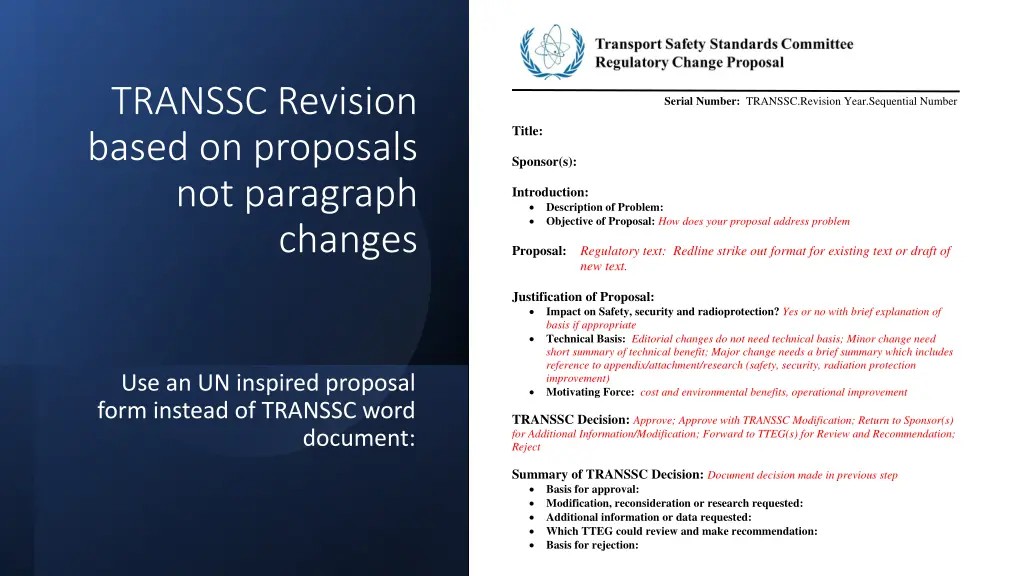
TRANSSC Revision based on proposals not paragraph Serial Number: TRANSSC.Revision Year.Sequential Number Title: Sponsor(s): Introduction: Description of Problem: Objective of Proposal: How does your proposal address problem Proposal: Regulatory text: Redline strike out format for existing text or draft of new text. Justification of Proposal: Impact on Safety, security and radioprotection? Yes or no with brief explanation of basis if appropriate Technical Basis: Editorial changes do not need technical basis; Minor change need short summary of technical benefit; Major change needs a brief summary which includes reference to appendix/attachment/research (safety, security, radiation protection improvement) Motivating Force: cost and environmental benefits, operational improvement TRANSSC Decision: Approve; Approve with TRANSSC Modification; Return to Sponsor(s) for Additional Information/Modification; Forward to TTEG(s) for Review and Recommendation; Reject Summary of TRANSSC Decision: Document decision made in previous step Basis for approval: Modification, reconsideration or research requested: Additional information or data requested: Which TTEG could review and make recommendation: Basis for rejection: changes Use an UN inspired proposal form instead of TRANSSC word document:
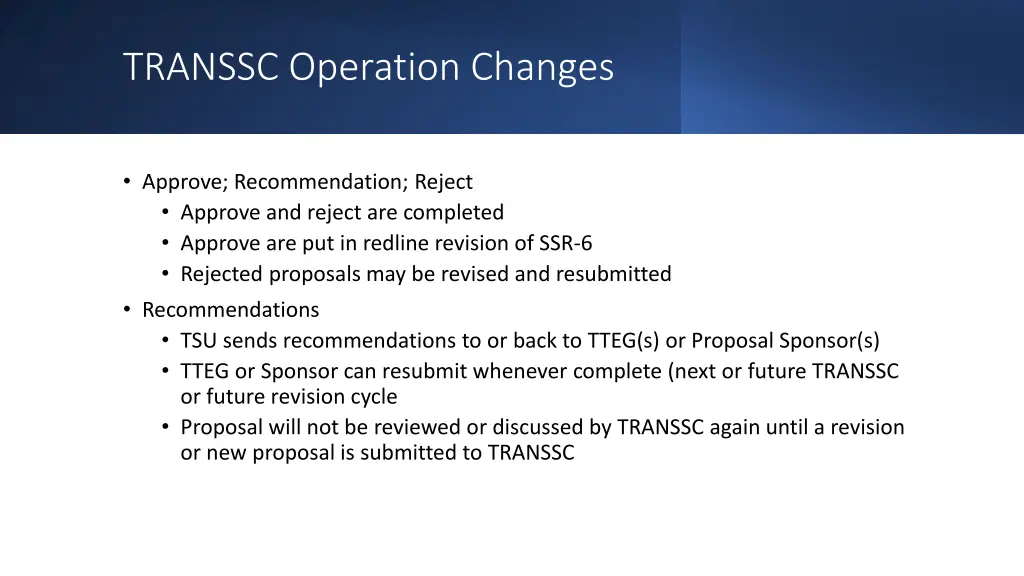
TRANSSC Operation Changes Approve; Recommendation; Reject Approve and reject are completed Approve are put in redline revision of SSR-6 Rejected proposals may be revised and resubmitted Recommendations TSU sends recommendations to or back to TTEG(s) or Proposal Sponsor(s) TTEG or Sponsor can resubmit whenever complete (next or future TRANSSC or future revision cycle Proposal will not be reviewed or discussed by TRANSSC again until a revision or new proposal is submitted to TRANSSC
Thank You Questions and Discussion (with permission of Chair)