IBR Challenges in System Protection - Concerns and Testing End-to-End
Explore the challenges faced by the Oncor system in protection related to IBR, including issues with negative sequence fault current, relay logic, and distance elements. Learn about the testing concerns and solutions for effective end-to-end protection testing.

Download Presentation

Please find below an Image/Link to download the presentation.
The content on the website is provided AS IS for your information and personal use only. It may not be sold, licensed, or shared on other websites without obtaining consent from the author. If you encounter any issues during the download, it is possible that the publisher has removed the file from their server.
You are allowed to download the files provided on this website for personal or commercial use, subject to the condition that they are used lawfully. All files are the property of their respective owners.
The content on the website is provided AS IS for your information and personal use only. It may not be sold, licensed, or shared on other websites without obtaining consent from the author.
E N D
Presentation Transcript
IBR Generation End to End Testing Concerns Oncor System Protection
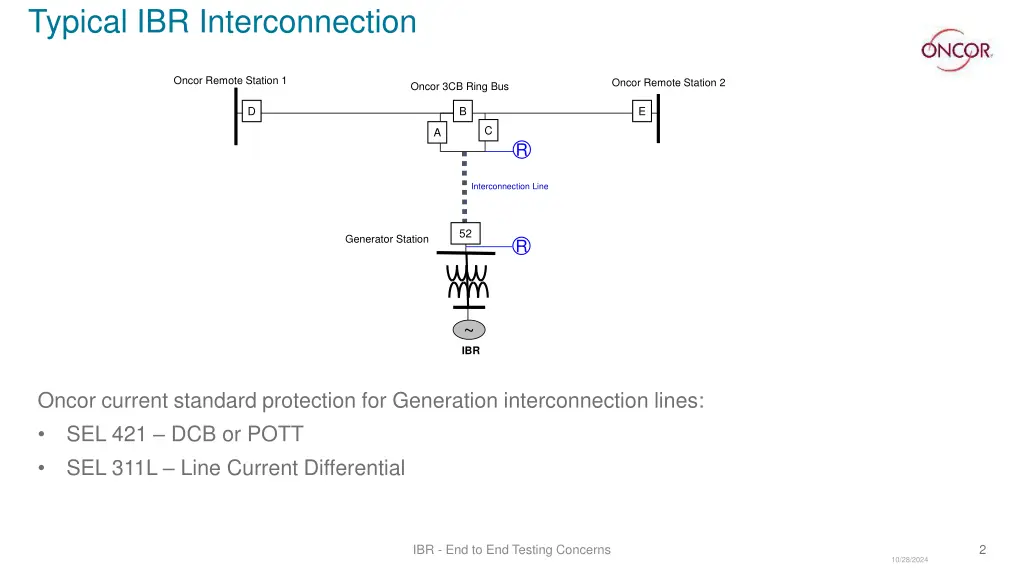
Typical IBR Interconnection Oncor Remote Station 1 Oncor Remote Station 2 Oncor 3CB Ring Bus D B E C A R Interconnection Line 52 Generator Station R ~ IBR Oncor current standard protection for Generation interconnection lines: SEL 421 DCB or POTT SEL 311L Line Current Differential IBR - End to End Testing Concerns 2 10/28/2024
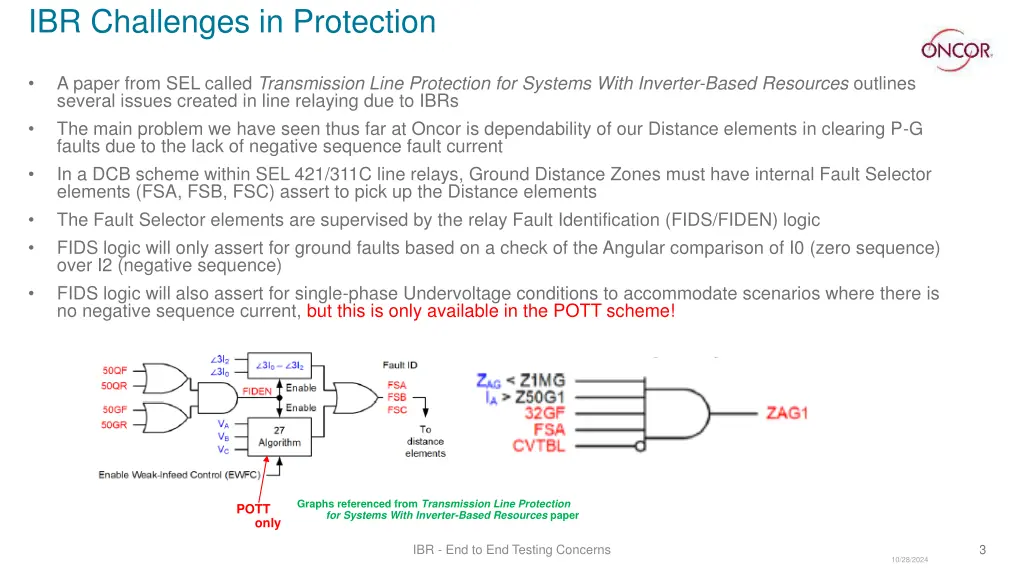
IBR Challenges in Protection A paper from SEL called Transmission Line Protection for Systems With Inverter-Based Resources outlines several issues created in line relaying due to IBRs The main problem we have seen thus far at Oncor is dependability of our Distance elements in clearing P-G faults due to the lack of negative sequence fault current In a DCB scheme within SEL 421/311C line relays, Ground Distance Zones must have internal Fault Selector elements (FSA, FSB, FSC) assert to pick up the Distance elements The Fault Selector elements are supervised by the relay Fault Identification (FIDS/FIDEN) logic FIDS logic will only assert for ground faults based on a check of the Angular comparison of I0 (zero sequence) over I2 (negative sequence) FIDS logic will also assert for single-phase Undervoltage conditions to accommodate scenarios where there is no negative sequence current, but this is only available in the POTT scheme! Graphs referenced from Transmission Line Protection for Systems With Inverter-Based Resources paper POTT only IBR - End to End Testing Concerns 3 10/28/2024
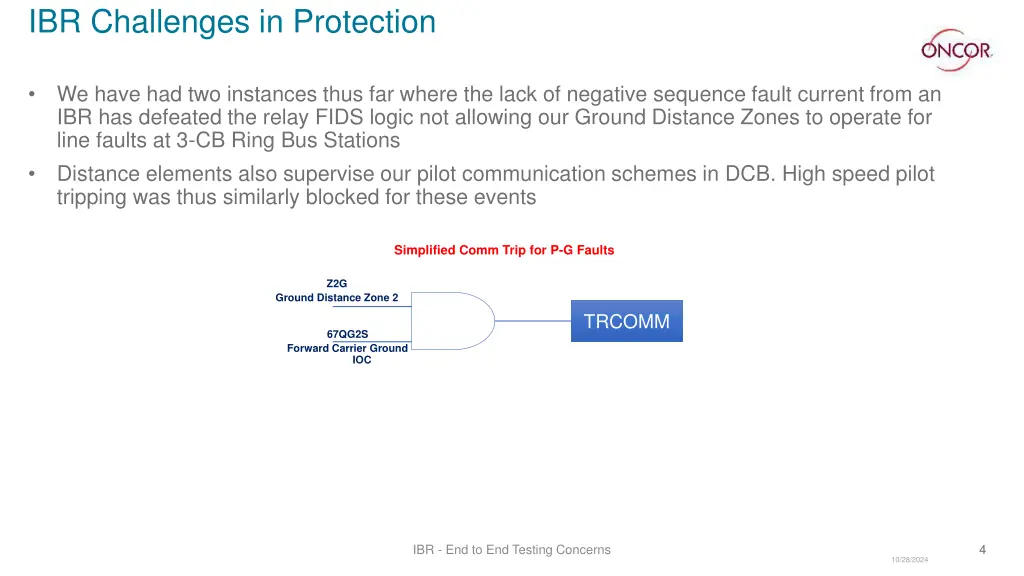
IBR Challenges in Protection We have had two instances thus far where the lack of negative sequence fault current from an IBR has defeated the relay FIDS logic not allowing our Ground Distance Zones to operate for line faults at 3-CB Ring Bus Stations Distance elements also supervise our pilot communication schemes in DCB. High speed pilot tripping was thus similarly blocked for these events Simplified Comm Trip for P-G Faults Z2G Ground Distance Zone 2 TRCOMM 67QG2S Forward Carrier Ground IOC IBR - End to End Testing Concerns 4 10/28/2024
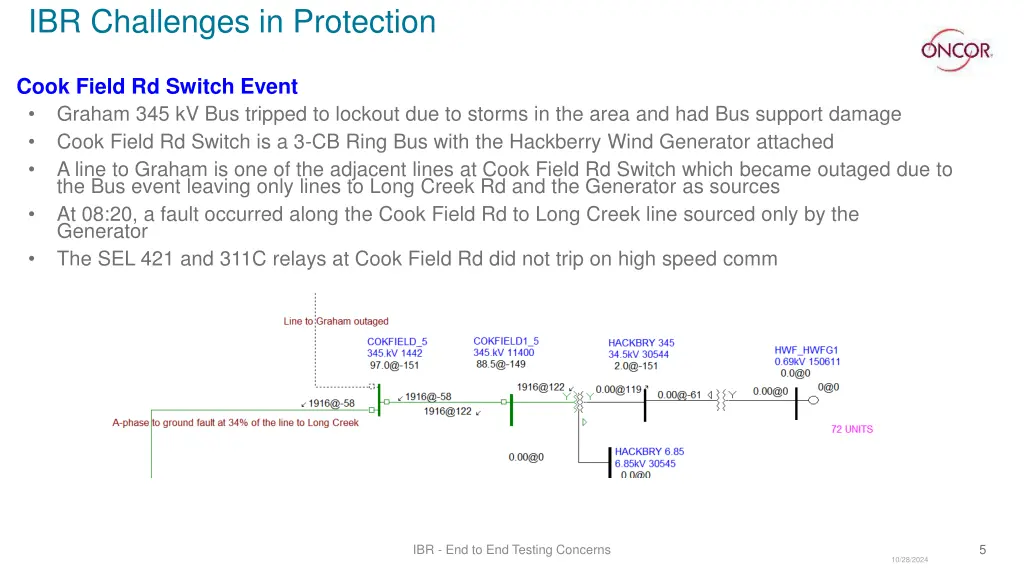
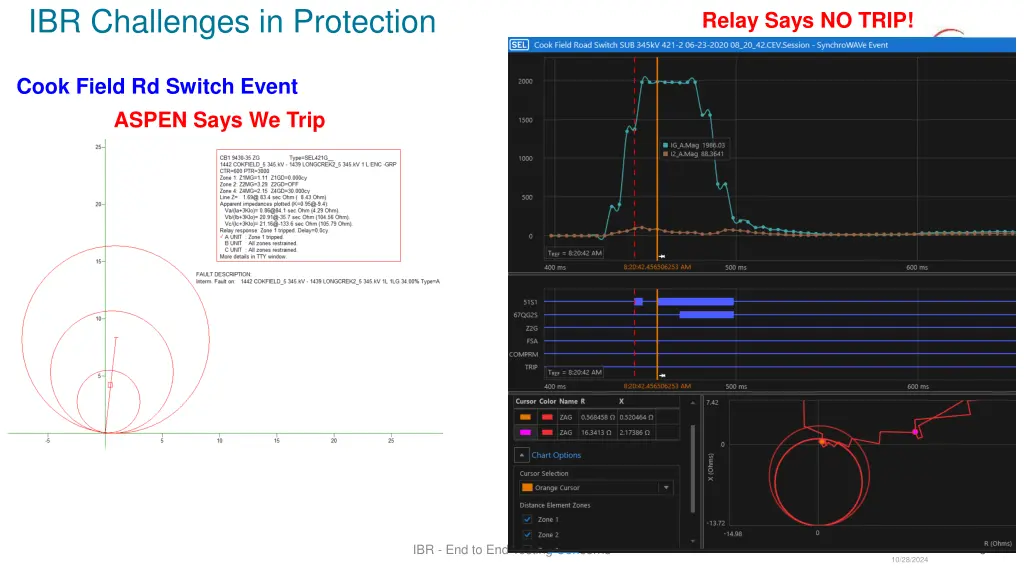
IBR Challenges in Protection Cook Field Rd Switch Event Graham 345 kV Bus tripped to lockout due to storms in the area and had Bus support damage Cook Field Rd Switch is a 3-CB Ring Bus with the Hackberry Wind Generator attached A line to Graham is one of the adjacent lines at Cook Field Rd Switch which became outaged due to the Bus event leaving only lines to Long Creek Rd and the Generator as sources At 08:20, a fault occurred along the Cook Field Rd to Long Creek line sourced only by the Generator The SEL 421 and 311C relays at Cook Field Rd did not trip on high speed comm IBR - End to End Testing Concerns 5 10/28/2024
IBR Challenges in Protection Relay Says NO TRIP! Cook Field Rd Switch Event ASPEN Says We Trip IBR - End to End Testing Concerns 6 10/28/2024
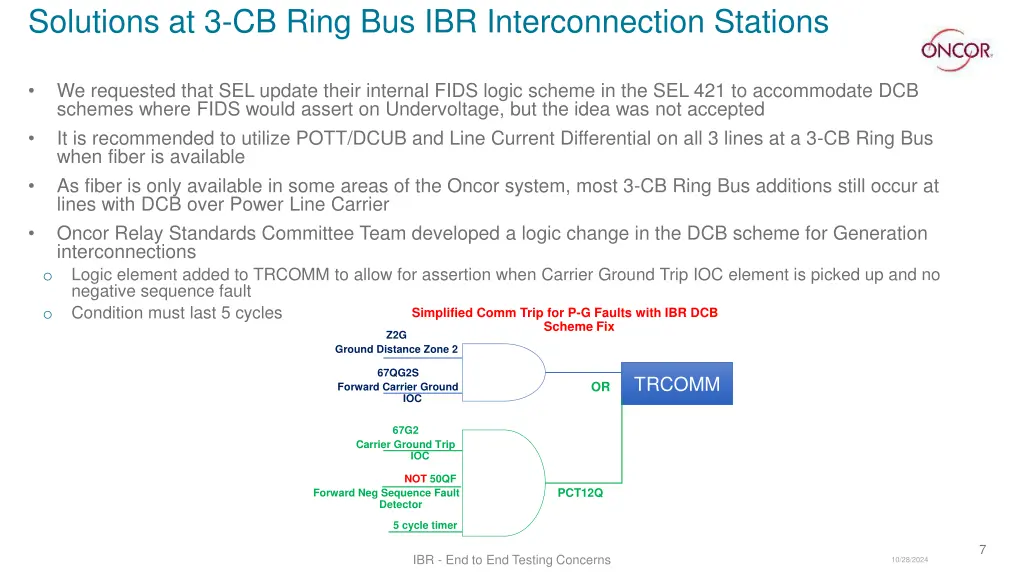
Solutions at 3-CB Ring Bus IBR Interconnection Stations We requested that SEL update their internal FIDS logic scheme in the SEL 421 to accommodate DCB schemes where FIDS would assert on Undervoltage, but the idea was not accepted It is recommended to utilize POTT/DCUB and Line Current Differential on all 3 lines at a 3-CB Ring Bus when fiber is available As fiber is only available in some areas of the Oncor system, most 3-CB Ring Bus additions still occur at lines with DCB over Power Line Carrier Oncor Relay Standards Committee Team developed a logic change in the DCB scheme for Generation interconnections Logic element added to TRCOMM to allow for assertion when Carrier Ground Trip IOC element is picked up and no negative sequence fault Condition must last 5 cycles Simplified Comm Trip for P-G Faults with IBR DCB o o Scheme Fix Z2G Ground Distance Zone 2 67QG2S TRCOMM OR Forward Carrier Ground IOC 67G2 Carrier Ground Trip IOC NOT 50QF PCT12Q Forward Neg Sequence Fault Detector 5 cycle timer 7 IBR - End to End Testing Concerns 10/28/2024
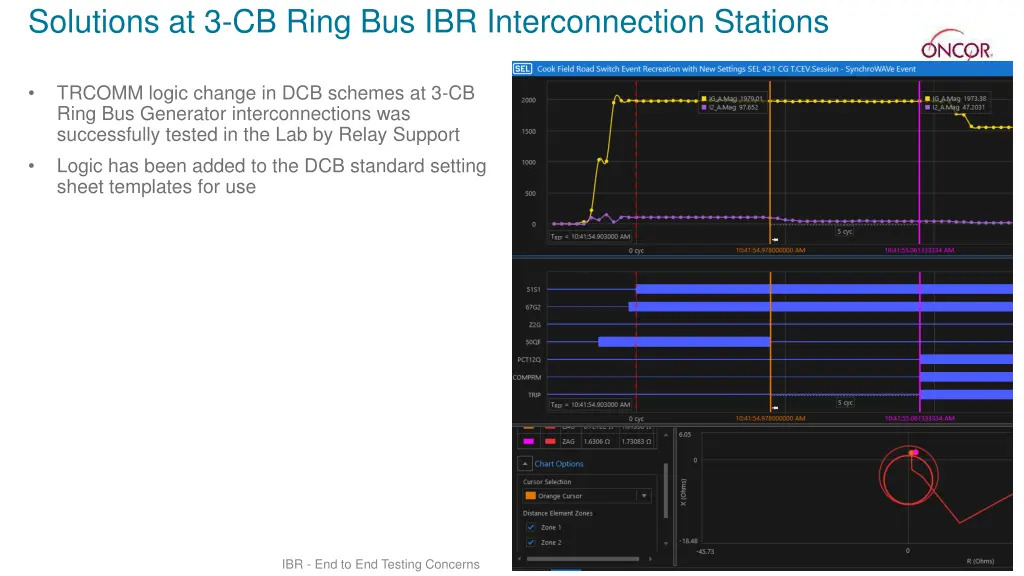
Solutions at 3-CB Ring Bus IBR Interconnection Stations TRCOMM logic change in DCB schemes at 3-CB Ring Bus Generator interconnections was successfully tested in the Lab by Relay Support Logic has been added to the DCB standard setting sheet templates for use 8 10/28/2024 IBR - End to End Testing Concerns
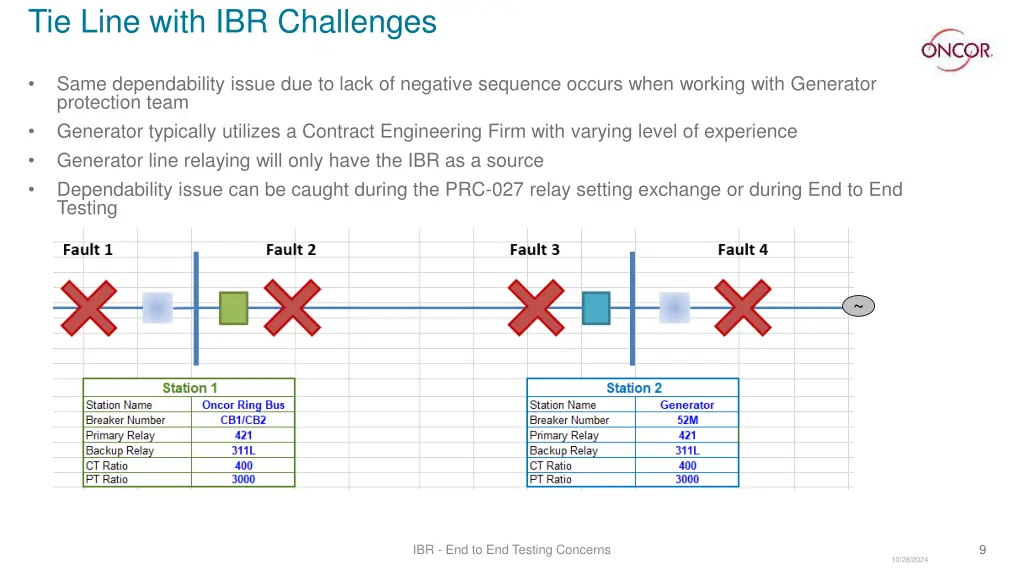
Tie Line with IBR Challenges Same dependability issue due to lack of negative sequence occurs when working with Generator protection team Generator typically utilizes a Contract Engineering Firm with varying level of experience Generator line relaying will only have the IBR as a source Dependability issue can be caught during the PRC-027 relay setting exchange or during End to End Testing ~ IBR - End to End Testing Concerns 9 10/28/2024
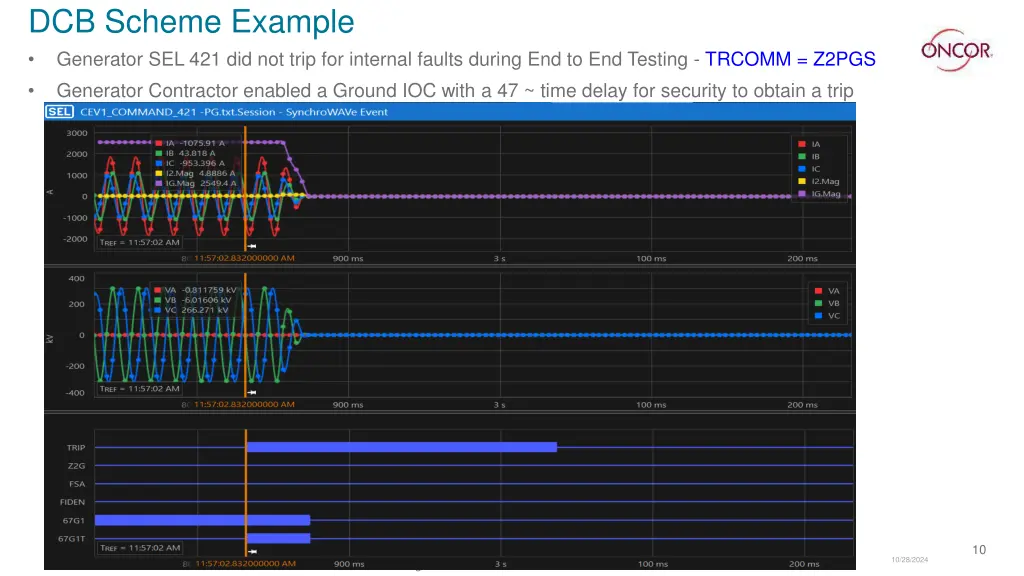
DCB Scheme Example Generator SEL 421 did not trip for internal faults during End to End Testing - TRCOMM = Z2PGS Generator Contractor enabled a Ground IOC with a 47 ~ time delay for security to obtain a trip 10 10/28/2024 IBR - End to End Testing Concerns
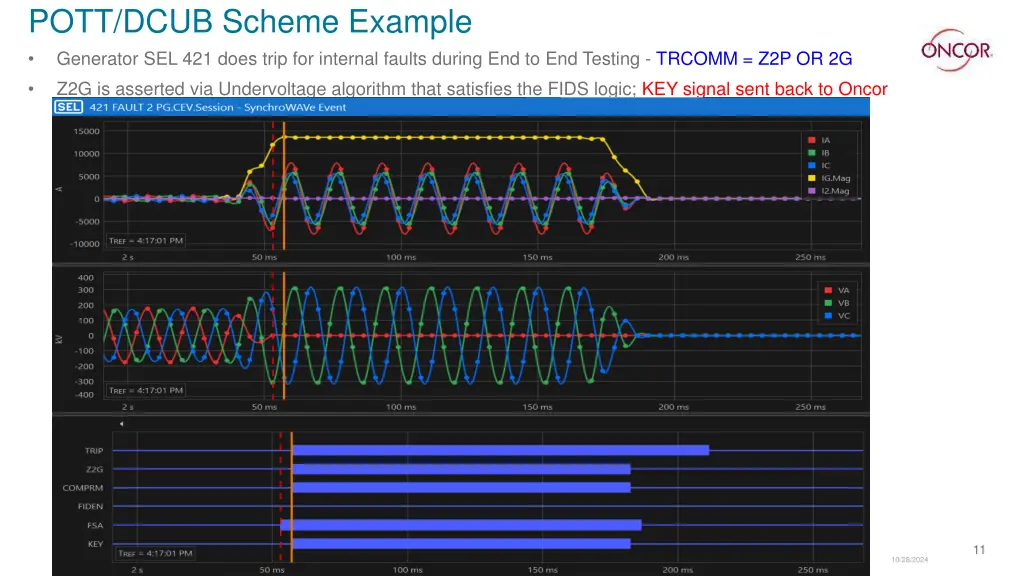
POTT/DCUB Scheme Example Generator SEL 421 does trip for internal faults during End to End Testing - TRCOMM = Z2P OR 2G Z2G is asserted via Undervoltage algorithm that satisfies the FIDS logic; KEY signal sent back to Oncor 11 10/28/2024 IBR - End to End Testing Concerns
Upcoming End to End Testing Issue Currently working with a Generator Contractor for an SEL 421 DCB scheme protecting a tie line where they are disabling Phase Distance protection Customer cites the Applying SEL Relays in Systems With Inverter-Based Resources paper as evidence to question the IBR positive sequence source for phase faults Customer SEL 421 relay will not trip for phase faults Oncor agreed during the PRC-027 setting exchange to send a Transfer Trip signal once the Oncor 421 relay has operated Customer has accepted reliability for tripping in their 421 on the Oncor end Scheme will be checked during upcoming End to End Testing IBR - End to End Testing Concerns 12 10/28/2024