Explore the collaborative efforts of multiple authors from renowned affiliations like Marvell, Qualcomm, Intel, and Broadcom in enhancing IEEE 802.11 standards through padding and packet extension for HE PHY. The document, dated September 2015, showcases a comprehensive approach to advancing wireless communication technology.
Please find below an Image/Link to download the presentation.
The content on the website is provided AS IS for your information and personal use only. It may not be sold, licensed, or shared on other websites without obtaining consent from the author. If you encounter any issues during the download, it is possible that the publisher has removed the file from their server.
You are allowed to download the files provided on this website for personal or commercial use, subject to the condition that they are used lawfully. All files are the property of their respective owners.
The content on the website is provided AS IS for your information and personal use only. It may not be sold, licensed, or shared on other websites without obtaining consent from the author.
E N D
Presentation Transcript
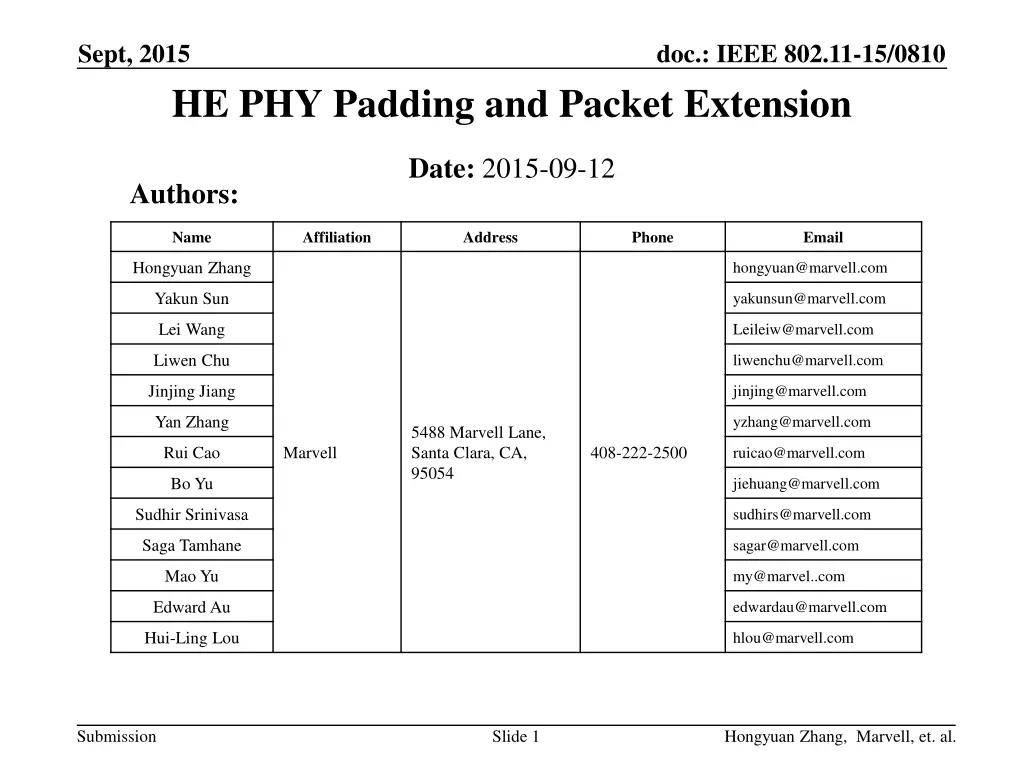
Sept, 2015 doc.: IEEE 802.11-15/0810 HE PHY Padding and Packet Extension Date: 2015-09-12 Authors: Name Affiliation Address Phone Email Hongyuan Zhang hongyuan@marvell.com Yakun Sun yakunsun@marvell.com Lei Wang Leileiw@marvell.com Liwen Chu liwenchu@marvell.com Jinjing Jiang jinjing@marvell.com Yan Zhang yzhang@marvell.com 5488 Marvell Lane, Santa Clara, CA, 95054 Rui Cao Marvell 408-222-2500 ruicao@marvell.com Bo Yu jiehuang@marvell.com Sudhir Srinivasa sudhirs@marvell.com Saga Tamhane sagar@marvell.com Mao Yu my@marvel..com Edward Au edwardau@marvell.com Hui-Ling Lou hlou@marvell.com Submission Slide 1 Hongyuan Zhang, Marvell, et. al.
Sept, 2015 Authors (continued) doc.: IEEE 802.11-15/0810 Name Affiliation Address Phone Email Straatweg 66-S Breukelen, 3621 BR Netherlands 5775 Morehouse Dr. San Diego, CA, USA 5775 Morehouse Dr. San Diego, CA, USA 5775 Morehouse Dr. San Diego, CA, USA 1700 Technology Drive San Jose, CA 95110, USA 5775 Morehouse Dr. San Diego, CA, USA 5775 Morehouse Dr. San Diego, CA, USA 5775 Morehouse Dr. San Diego, CA, USA Straatweg 66-S Breukelen, 3621 BR Netherlands Straatweg 66-S Breukelen, 3621 BR Netherlands 1700 Technology Drive San Jose, CA 95110, USA 5775 Morehouse Dr. San Diego, CA, USA 5775 Morehouse Dr. San Diego, CA, USA 1700 Technology Drive San Jose, CA 95110, USA 1700 Technology Drive San Jose, CA 95110, USA 1700 Technology Drive San Jose, CA 95110, USA Albert Van Zelst allert@qti.qualcomm.com Alfred Asterjadhi aasterja@qti.qualcomm.com Arjun Bharadwaj arjunb@qti.qualcomm.com Bin Tian btian@qti.qualcomm.com Carlos Aldana caldana@qca.qualcomm.com George Cherian gcherian@qti.qualcomm.com Gwendolyn Barriac gbarriac@qti.qualcomm.com Hemanth Sampath hsampath@qti.qualcomm.com Qualcomm Menzo Wentink mwentink@qti.qualcomm.com Richard Van Nee rvannee@qti.qualcomm.com Rolf De Vegt rolfv@qca.qualcomm.com Sameer Vermani svverman@qti.qualcomm.com Simone Merlin smerlin@qti.qualcomm.com Tevfik Yucek tyucek@qca.qualcomm.com VK Jones vkjones@qca.qualcomm.com Youhan Kim youhank@qca.qualcomm.com Submission Hongyuan Zhang, Marvell, et. al. Slide 2
Sept, 2015 Authors (continued) doc.: IEEE 802.11-15/0810 Name Affiliation Address Phone Email Robert Stacey robert.stacey@intel.com Eldad Perahia eldad.perahia@intel.com Shahrnaz Azizi shahrnaz.azizi@intel.com 2111 NE 25th Ave, Hillsboro OR 97124, USA Po-Kai Huang po-kai.huang@intel.com +1-503-724-893 Qinghua Li Intel quinghua.li@intel.com Xiaogang Chen xiaogang.c.chen@intel.com Chitto Ghosh chittabrata.ghosh@intel.com Laurent cariou laurent.cariou@intel.com Rongzhen Yang rongzhen.yang@intel.com Ron Porat rporat@broadcom.com Matthew Fischer Sriram Venkateswaran Andrew Blanksby Matthias Korb mfischer@broadcom.com Broadcom Tu Nguyen Vinko Erceg Submission Hongyuan Zhang, Marvell, et. al. Slide 3
Sept, 2015 Authors (continued) doc.: IEEE 802.11-15/0810 Name Affiliation Address Phone Email No. 1 Dusing 1st Road, Hsinchu, Taiwan James Yee +886-3-567-0766 james.yee@mediatek.com Alan Jauh alan.jauh@mediatek.com chinghwa.yu@mediatek.co m frank.hsu@mediatek.com Mediatek Chingwa Hu Frank Hsu 2860 Junction Ave, San Jose, CA 95134, USA Thomas Pare +1-408-526-1899 thomas.pare@mediatek.com chaochun.wang@mediatek.c om james.wang@mediatek.com ChaoChun Wang James Wang Mediatek USA Jianhan Liu Jianhan.Liu@mediatek.com Tianyu Wu tianyu.wu@mediatek.com russell.huang@mediatek.co m joonsuk@apple.com Russell Huang Joonsuk Kim mujtaba@apple.com Aon Mujtaba Guoqing Li Apple guoqing_li@apple.com Eric Wong ericwong@apple.com Chris Hartman chartman@apple.com Submission Hongyuan Zhang, Marvell, et. al. Slide 4
Sept, 2015 Authors (continued) doc.: IEEE 802.11-15/0810 Name Affiliation Address Phone Email pbarber@broadbandmobilete ch.com peterloc@iwirelesstech.com Phillip Barber The Lone Star State, TX Peter Loc F1-17, Huawei Base, Bantian, Shenzhen 5B-N8, No.2222 Xinjinqiao Road, Pudong, Shanghai F1-17, Huawei Base, Bantian, Shenzhen 5B-N8, No.2222 Xinjinqiao Road, Pudong, Shanghai 5B-N8, No.2222 Xinjinqiao Road, Pudong, Shanghai 10180 Telesis Court, Suite 365, San Diego, CA 92121 NA 303 Terry Fox, Suite 400 Kanata, Ottawa, Canada F1-17, Huawei Base, Bantian, Shenzhen 10180 Telesis Court, Suite 365, San Diego, CA 92121 NA F1-17, Huawei Base, Bantian, SHenzhen 303 Terry Fox, Suite 400 Kanata, Ottawa, Canada 5B-N8, No.2222 Xinjinqiao Road, Pudong, Shanghai Le Liu liule@huawei.com +86-18601656691 Jun Luo jun.l@huawei.com Yi Luo Roy.luoyi@huawei.com +86-18665891036 Yingpei Lin linyingpei@huawei.com Jiyong Pang pangjiyong@huawei.com Huawei Zhigang Rong zhigang.rong@huawei.com Rob Sun Rob.Sun@huawei.com David X. Yang david.yangxun@huawei.com Yunsong Yang yangyunsong@huawei.com Zhou Lan Lanzhou1@huawei.com +86-18565826350 Junghoon Suh Junghoon.Suh@huawei.com Jiayin Zhang zhangjiayin@huawei.com +86-18601656691 Submission Hongyuan Zhang, Marvell, et. al. Slide 5
Sept, 2015 Authors (continued) doc.: IEEE 802.11-15/0810 Name Affiliation Address Phone Email Hyeyoung Choi hy0117.choi@lge.com Kiseon Ryu kiseon.ryu@lge.com Jinyoung Chun jiny.chun@lge.com Jinsoo Choi js.choi@lge.com 19, Yangjae-daero 11gil, Seocho-gu, Seoul 137- 130, Korea Jeongki Kim jeongki.kim@lge.com LG Electronics Giwon Park giwon.park@lge.com Dongguk Lim dongguk.lim@lge.com Suhwook Kim suhwook.kim@lge.com Eunsung Park esung.park@lge.com HanGyu Cho hg.cho@lge.com Thomas Derham Orange thomas.derham@orange.com #9 Wuxingduan, Xifeng Rd., Xi'an, China Bo Sun sun.bo1@zte.com.cn Kaiying Lv Yonggang Fang Ke Yao Weimin Xing Brian Hart Pooya Monajemi lv.kaiying@zte.com.cn yfang@ztetx.com yao.ke5@zte.com.cn xing.weimin@zte.com.cn brianh@cisco.com pmonajem@cisco.com ZTE 170 W Tasman Dr, San Jose, CA 95134 Cisco Systems Submission Hongyuan Zhang, Marvell, et. al. Slide 6
Sept, 2015 Authors (continued) doc.: IEEE 802.11-15/0810 Name Affiliation Address Innovation Park, Cambridge CB4 0DS (U.K.) Maetan 3-dong; Yongtong-Gu Suwon; South Korea 1301, E. Lookout Dr, Richardson TX 75070 Innovation Park, Cambridge CB4 0DS (U.K.) 1301, E. Lookout Dr, Richardson TX 75070 Maetan 3-dong; Yongtong-Gu Suwon; South Korea Phone Email Fei Tong f.tong@samsung.com +44 1223 434633 Hyunjeong Kang hyunjeong.kang@samsung.com +82-31-279-9028 Kaushik Josiam k.josiam@samsung.com (972) 761 7437 Samsung Mark Rison m.rison@samsung.com +44 1223 434600 Rakesh Taori rakesh.taori@samsung.com (972) 761 7470 Sanghyun Chang s29.chang@samsung.com +82-10-8864-1751 Yasushi Takatori takatori.yasushi@lab.ntt.co.jp Yasuhiko Inoue inoue.yasuhiko@lab.ntt.co.jp 1-1 Hikari-no-oka, Yokosuka, Kanagawa 239-0847 Japan Yusuke Asai NTT asai.yusuke@lab.ntt.co.jp Koichi Ishihara ishihara.koichi@lab.ntt.co.jp Akira Kishida kishida.akira@lab.ntt.co.jp 3-6, Hikarinooka, Yokosuka- shi, Kanagawa, 239-8536, Japan Akira Yamada yamadaakira@nttdocomo.com watanabe@docomoinnovations. com hpapadopoulos@docomoinnova tions.com Fujio Watanabe NTT DOCOMO 3240 Hillview Ave, Palo Alto, CA 94304 Haralabos Papadopoulos Submission Hongyuan Zhang, Marvell, et. al. Slide 7
Sept, 2015 doc.: IEEE 802.11-15/0810 Overview HE PHY adopts 4x Numerology [1], mainly for: facilitate OFDMA design, facilitate outdoor channel support, increase PHY efficiency. Area Penalty: ~4x NDBPS compared with 11ac with same BW. Lead to big area or implementation complexity concern, if SIFS time duration is unchanged. ~4x processing speed is required for the last OFDM symbol, for Rx Tx turn-around within SIFS (FFT, MIMO-EQ, Decoding, MAC, Tx). Especially at peak data rates (e.g. 256AM). Overhead Penalty: on the other hand, increasing SIFS or equivalently adding long packet extension (PE) may offset the throughput gain of 4x numerology. Tradeoffs between Area and Overhead: Challenging to optimize both at the same time. Different options give different levels of tradeoffs, with different solution for either reducing area/complexity or reducing overhead. Submission Slide 8 Hongyuan Zhang, Marvell, et. al.
Sept, 2015 doc.: IEEE 802.11-15/0810 Proposed HE Padding and Packet Extension The last mSTBC symbol(s) have 4x duration like other data symbols (12.8us+GI). Apply a two-step padding method in the last mSTBCOFDM symbol(s), i.e.: Pre-FEC padding, and post-FEC padding. Four possible pre-FEC padding segment boundaries ( a factor ) are defined in the last OFDM symbol(s). Based on number of excess info bits in the last symbol(s), pre-FEC pad (the same MAC/PHY padding as in 11ac) toward the nearest boundaries in the last symbol(s). For LDPC, if LDPC extra symbol is needed after puncturing, increment one segment (a = ainit+1), instead of one long symbol. After FEC, insert post-FEC padding bits to fill up the symbol(s). Post FEC padding is added by PHY and does not need to be decoded by the receiver A Packet Extension (PE) field is applied at the end of PPDU, and its duration is a function of the followings: 1. The pre-FEC padding boundaries in the last mSTBCOFDM symbols ( a factor ). 2. Receiving STA s capability on its required PE duration, for the current {BW, NSS, Constellation} combination. Submission Slide 9 Hongyuan Zhang, Marvell, et. al.
Sept, 2015 doc.: IEEE 802.11-15/0810 Bit Stream Illustration Bit stream of the last OFDM symbol (non-STBC) a = 1: Excess Info bits Pre-FEC padding bits + Post-FEC Padding Bits PE1 a = 2: Receiver decoding stops here + Pre-FEC padding bits Excess Info bits Post-FEC Padding Bits PE2 Receiver decoding stops here a = 3: Pre-FEC padding bits + Excess Info bits Post-FEC Padding Bits PE3 Receiver decoding stops here a = 4: Pre-FEC padding bits + Excess Info bits PE4 Receiver decoding stops here Refer to Appendix for the Math Submission Slide 10 Hongyuan Zhang, Marvell, et. al.
Sept, 2015 doc.: IEEE 802.11-15/0810 LDPC Encoding Illustration Use a=1 and LDPC case as an example. LDPC Tone Mapper Constellation Mapper Segment Parser .. Bit stream of size NDBPS.SHORT in the last OFDM symbol, NCBPS.SHORTbits Stream Parser LDPC Encoder Excess Info bits Pre-FEC padding bits : : Post-FEC Padding bits LDPC Tone Mapper (NCBPS - NCBPS.SHORT) bits Constellation Mapper Segment Parser .. where N N Stream/Segment Parsers are all FIFO on the bits stream, therefore the info and pre-FEC padding bits are contained in the first NSD.SHORT tones before LDPC tone mapper = = N N N , , CBPS short SD short N SS R BPSCS , , DBPS short CBPS short Submission Slide 11 Hongyuan Zhang, Marvell, et. al.
Sept, 2015 doc.: IEEE 802.11-15/0810 Processing Delay For LDPC: 4x FFT 4x Tone Demapper Only take the first NSD.SHORTtones FD processing (MIMO Equalizer, LDPC Decoder) MAC processing. Post-FEC padding bits are not processed. For BCC: Almost all tones need to be processed due to interleaver. However, we propose to disallow BCC in 40MHz, 80MHz and 160MHz. See [2] for more details. Submission Slide 12 Hongyuan Zhang, Marvell, et. al.
Sept, 2015 doc.: IEEE 802.11-15/0810 Packet Extension Field PE durations for different pre-FEC padding boundaries (a-factor values). Based on decoding capability of the device. An Example where max PE duration is 16us: TPE1 = 4us, or ~ long symbol (a=1) TPE2 = 8us , or ~1/2 long symbol (a=2) TPE3 = 12us, or ~3/4 long symbol (a=3) TPE4 = 16us, or ~1 long symbol (a=4) TPE values are multiple of 4us, for easier L-LENGTH signaling and legacy spoofing. a = 4: Pre-FEC padding bits Excess Info bits PE4 Duration 16us A non-zero signal with the same average power as the data should be transmitted in PE field. To avoid legacy receiver s early termination of CCA-Busy status, due to carrier lost . Submission Slide 13 Hongyuan Zhang, Marvell, et. al.
Sept, 2015 doc.: IEEE 802.11-15/0810 Packet Extension Field cont d Each STA may claim its PE Capability for receiving PPDUs for different {BW, NSS, Constellation} combinations. Defining two constellation thresholds per {BW, Nss} to split MCSs into 3 groups, corresponding to 0us, and two non-zero max PE durations (equivalent to max PE durations of 8us and 16us respectively). To be clear, the 3 categories are: 0us : TPE = [0 0 0 0]us, for a=1~4 respectively 8us : TPE = [0 0 4 8]us, for a=1~4 respectively 16us : TPE = [4 8 12 16]us, for a=1~4 respectively When STA indicates 80MHz capability or higher, 0 s PE is applied for RU 20MHz No capability indicated for RU 20MHz in this case Otherwise, PE capability is indicated down to TBD RU sizes. Submission Slide 14 Hongyuan Zhang, Marvell, et. al.
Sept, 2015 doc.: IEEE 802.11-15/0810 PE Capability Illustration Max PE 8 s mode Max PE 16 s mode Submission Slide 15 Hongyuan Zhang, Marvell, et. al.
Sept, 2015 doc.: IEEE 802.11-15/0810 Constellation Thresholds for PE Capability (i) HE device capability for determining PE duration is based on two constellation thresholds per{NSS, BW} If constellation threshold16 apply max PE 16 s mode, else if constellation threshold8 apply max PE 8 s mode, else no packet extension The encoding constellation thresholds: constellation HE capability encoding BPSK 000 QPSK 001 16QAM 010 64QAM 011 256QAM 100 1024QAM (TBD) 101 None 111 Example: max PE 8us for 64QAM, max PE 16us for 256QAM and 1024QAM (TBD) BPSK QPSK 16QAM 64QAM 256QAM 1024QAM (TBD) threshold8 threshold16 Submission Slide 16 Hongyuan Zhang, Marvell, et. al.
Sept, 2015 doc.: IEEE 802.11-15/0810 Constellation Thresholds for PE Capability (ii) Some special cases are as follows: If no PE is required both threshold8and threshold16are set to 111 If only max PE 8 s mode is used, set threshold16 to be 111, and threshold8 to be the constellation at which max PE 8 s mode starts If only max PE 16 s mode is used, set threshold16to be the constellation at which max PE 16 s mode starts, and threshold8 to be 111 Submission Slide 17 Hongyuan Zhang, Marvell, et. al.
Sept, 2015 doc.: IEEE 802.11-15/0810 Padding Parameters to Avoid MCS Exclusion If we strictly choose number of tones, for certain BW and MCS, NCBPS,short and NDBPS,short (or NDBPS,Short/NES) are not integers. The simplest approach to avoid excluding MCS: define a compatible NSD.SHORT for the last symbol. Suggested NSD,short for each RU size as shown in the table below: Integer NCBPS,short, NDBPS,short and NDBPS,short/NESfor 20MHz and below ( 242-RU ) Integer NCPBS,short and NDBPS,short for 40MHz and above (LDPC only). The pre-FEC symbol segments become slightly uneven between a=1~3 and a=4 for some RU. But the performance difference should be very negligible. RU Size NSD,Short 26 6 Encoding procedure described in Appendix starts by: 52 12 = = 106 24 N N N N N , , CBPS short SD short N SS R BPSCS 242 60 484 120 , , DBPS short CBPS short 996 240 996x2 492 Submission Slide 18 Hongyuan Zhang, Marvell, et. al.
Sept, 2015 doc.: IEEE 802.11-15/0810 DL-MU Padding Method (1) All user s data fields end at the same time in the DL-MU PPDU. All users share the same PE duration. All users share a common a-factor across all users, based on the user with the longest span. Clean design, simple signaling, simple padding as in 11ac. Minimize SIG field overhead, no per-user fields needed. No per-user a-factor field. As in 11ac DLMU, there is only 1 common bit needed for all users indicating LDPC extra symbol , even if some users are doing BCC! Based on a-factor value and each user s PE capabilities, AP computes the PE duration for each user TPE,u, and the PE duration of the whole DL-MU PPDU is . ( ) 0...., 1 , max u PE u N PE u T T = = For DL-MU, AP indicates common Nsym , a-factor , LDPC Extra Symbol indication, and TPE in the HE-SIG field for all users. Slide 19 Submission Hongyuan Zhang, Marvell, et. al.
Sept, 2015 doc.: IEEE 802.11-15/0810 DL-MU Padding Method (2) Illustration (DL-OFDMA) Symbol NSYM(a=2) Symbol - NSYM -1 User-1 Post-FEC Pre-FEC Info bits Info bits PE User-2 (longest span) Pre- FEC Post-FEC Info bits Info bits PE Post-FEC Info bits Pre-FEC Pre-FEC User-3 PE Post-FEC Info bits Pre-FEC Pre-FEC User-4 PE Submission Slide 20 Hongyuan Zhang, Marvell, et. al.
Sept, 2015 doc.: IEEE 802.11-15/0810 UL-MU Padding Method In UL-MU, AP does not have exact number of bytes in each user s buffer hence cannot compute a-factor on a per user basis like SU and DL-MU. However, the STA can use pre-FEC padding to fill Nsym long symbols + a-factor short segments. Prefer a common a-factor design similar to DL-MU, i.e. AP indicates common Nsym , a-factor , LDPC Extra Symbol indication, and TPE for all users, in the trigger frame. BCC users always pre-FEC pad to the pre-determined a-factor. LDPC users: If LDPC Extra Symbol = 1, always pre-FEC pad to ainit = a-1 in the last symbol(s), and always apply LDPC extra symbol using the last symbol segment (a=ainit+1). If LDPC Extra Symbol = 0, always pre-FEC pad to ainit = a in the last symbol(s), and always do not apply LDPC extra symbol. Submission Slide 21 Hongyuan Zhang, Marvell, et. al.
Sept, 2015 doc.: IEEE 802.11-15/0810 SIG Field Signaling (1) HE-SIG Field: 2-bits for a-factor . 1 bit for PE dis-ambiguity . For receiver to derive correct TPE and NSYM without ambiguity. a-factor field definition: 1 2 3 4 Submission Slide 22 Hongyuan Zhang, Marvell, et. al.
Sept, 2015 doc.: IEEE 802.11-15/0810 SIG Field Signaling (2) Timing Parameters: = + + + TXTIME L PREAMBLE T HE PREAMBL T HE DATA T T _ _ _ E PE = = + (12.8 ) HE DATA T HE SYM T N T N where _ _ SYM GI SYM L-SIG: 20 TXTIME = 3 3 + = _ , 1 or 2 L LENGTH m m 4 Submission Slide 23 Hongyuan Zhang, Marvell, et. al.
Sept, 2015 doc.: IEEE 802.11-15/0810 , SIG Field Signaling (3) HE-SIG-A: PE-Disambiguity Field: Tx: if the following is met, set this field to 1; otherwise, set to 0. 20 20 TXTIME TXTIME + 4 T SYM T PE 4 4 Rx Side Computation: + _ 3 L LENGTH m = 4 / N HE PREAMBLE T SYM T PE Disambiguity b _ _ SYM 3 + _ 3 L LENGTH m 4 T N SYM T _ HE PREAMBLE SYM 3 = 4 T PE 4 Submission Slide 24 Hongyuan Zhang, Marvell, et. al.
Sept, 2015 doc.: IEEE 802.11-15/0810 Simulations: LDPC Performance Sanity Check Simulate the same MCS for 11ax and 11ac. 80MHz, 4 Rx 3SS, LDPC, DNLOS channel. For sanity check purpose, we tried different packet sizes to trigger difference scenarios: L=16K Bytes, MCS9-3SS. 11ax padding Op4: 7 symbols, a = 3, no LDPC additional symbol; 11ac: 28 symbols , no additional symbol. L=15000 bits, MCS7-3SS 11ax padding Op4: 2 symbols, a = 1, no LDPC additional symbol; 11ac: 5 symbols , no LDPC additional symbol. L= 5000 bits, MCS7-3SS 11ax padding Op4: 1 symbols, a = 3, with LDPC additional symbol; 11ac: 3 symbols , with LDPC additional symbol. L= 3150 bits, MCS7-3SS 11ax padding Op4: 1 symbols, a = 3, with LDPC additional symbol; 11ac: 2 symbols , with LDPC additional symbol. Submission Slide 25 Hongyuan Zhang, Marvell, et. al.
Sept, 2015 doc.: IEEE 802.11-15/0810 Discussions of Alternative Methods-1 An alternative method of reducing OFDM symbol durations was proposed in [3]. It seems that [3] mentioned two different methods: 1. Use short symbols (1/2x, 1x, 2x, 4x), no PE. 2. Use short symbols ((1/2x),1x, 2x, 4x), but repeat to 4x, with PE. Case 1 ??? Method-1 in [3] Method-2 in [3] Submission Slide 27 Hongyuan Zhang, Marvell, et. al.
Sept, 2015 doc.: IEEE 802.11-15/0810 Discussions of Alternative Methods-2 Assuming that in [3] method-1 is used for low BW or MCS, while method-2 is used for high BW or MCS, we have the following issues: 1. Method-1 requires OFDM symbol duration switching all the time, which complicates the receiver design. 2. Although Method-2 may be realized by always using 4x symbol duration, but there is no efficiency gain over our method! 3. It is undesirable to introduce different padding flows for different PHY configurations (BW, MCS, Nss, etc), which was never seen in previous generations (11a/n/ac). With STBC and LDPC extra symbol, the number of modes will explode (e.g. 1/2x, 1x, 2x, 4x, two 1x, two 2x, two 4x, four 1x, four 2x, two 1/2x, four 1/2x)! 4. It is hard to address LDPC extra symbol: e.g. what happens if 2x is selected at beginning but requires LDPC extra symbol? Same for 1/2x and 4x symbols. may skew the effective coding rates. 5. What is 1.6us OFDM symbol (1/2x)? Does it appear in method-2? 6. Uneven bit splitting (1/2x, 1x, 2x, 4x). 7. Unsure about 1/2x and 1x symbol performance in outdoor channels. Our proposal is a unified approach for all PHY modes that balances efficiency and implementation complexity. Submission Slide 28 Hongyuan Zhang, Marvell, et. al.
Sept, 2015 doc.: IEEE 802.11-15/0810 Conclusions A HE PHY padding and Packet Extension method is proposed to address the area and overhead concern caused by 11ax 4x OFDM numerology. The two-step padding and variable PE duration properly addresses the tradeoff between implementation complexity and HE-PHY overhead. Further discussions on detailed padding parameters; PE capability definition; MU padding methods; and PHY signaling in HE-SIG. Submission Slide 29 Hongyuan Zhang, Marvell, et. al.
Sept, 2015 doc.: IEEE 802.11-15/0810 Straw Poll #1 Do you agree to add the following text into Section 3.4 HE Data Field of the current SFD: An 11ax SU PPDU should apply the MAC/PHY pre-FEC padding scheme as in 11ac, to pad toward the nearest of the four possible boundaries ( a factor) in the last Data OFDM symbol(s), and then use post-FEC padding bits to fill up the last OFDM symbol(s). Packet Extension (PE) field is defined at the end of 11ax PPDUs. PE should have the same average power as data field. Submission Slide 30 Hongyuan Zhang, Marvell, et. al.
Sept, 2015 doc.: IEEE 802.11-15/0810 Straw Poll #2 Do you agree to add the following text into SFD: 11ax shall define the max packet extension modes of 8 s and 16 s, correspond to the short symbol segment padding boundaries ( a-factor )according to the following PE duration (TPE) values: Max packet extension mode 8 s: TPE = [0 0 4 8] s for a = 1~4 respectively; Max packet extension mode 16 s: TPE = [4 8 12 16] s for a = 1~4 respectively. HE Capability field shall define two constellation level thresholds (threshold16and threshold8) for a given {NSS, BW} combination, to determine if and when max packet extension modes 8 s and 16 s are applied, i.e. 3 bits are used to specify each threshold as the table below. If constellation threshold16 apply max PE 16 s mode, else if constellation threshold8 apply max PE 8 s mode, else no packet extension. If no PE is required for all constellations both threshold8and threshold16are set to 111 If only max PE 8 s mode is required, set threshold16 to be 111, and threshold8 to be the constellation at which max PE 8 s mode starts If only max PE 16 s mode is required, set threshold16to be the constellation at which max PE 16 s mode starts, and threshold8 to be 111 When 80 MHz is supported, no thresholds are defined for RU size less than or equal to 242 tones (20 MHz); otherwise, thresholds are defined down to a TBD RU size. Constellation Threshold Encoding in HE Capability 000 001 010 011 100 101 111 BPSK QPSK 16QAM 64QAM 256QAM 1024QAM (TBD) None Submission Slide 31 Hongyuan Zhang, Marvell, et. al.
Sept, 2015 doc.: IEEE 802.11-15/0810 Straw Poll #3 Do you agree to add the following text into SFD: The number of uncoded bits for each of the first 3 short symbol segments (a=1~3) equals to the number of uncoded bits corresponding to NSD.short subcarriers as specified by the following table, and the number of uncoded bits for the last short symbol segment (a=4) equals to the number of bits of the whole OFDM symbol subtracting the total number of uncoded bits of the first three short symbol segments. NSD.short 6 12 24 60 120 240 492 RU Size 26 52 106 242 484 996 996x2 Submission Slide 32 Hongyuan Zhang, Marvell, et. al.
Sept, 2015 doc.: IEEE 802.11-15/0810 Straw Poll #4 Do you agree to add the following text (this page and next page) into SFD: , HE-SIG-A field contains a a-factor field of 2 bits, and a PE-Disambiguity field of 1 bit, with setting methods as blow: In L-SIG, the L-LENGTH field is set by: 20 = T TXTIME = 3 3 + = _ , 1 or 2 L LENGTH m m 4 + + + where TXTIME L PREAMBLE T HE DATA T T _ _ _ HE PREAMBLE PE = = + (12.8 ) HE DATA T HE SYM T N T N _ _ SYM GI SYM is the PE duration T PE In HE-SIG-A: a-factor field: a-factor value 1 2 3 4 a-factor field encoding 01 10 11 00 Submission Slide 33 Hongyuan Zhang, Marvell, et. al.
Sept, 2015 doc.: IEEE 802.11-15/0810 SP4 cont d PE Dis-ambiguity Field: If , where , set this field to 1; otherwise, set to 0. At receiver side, the following equations may be run to compute NSYM and TPE respectively: 20 20 TXTIME TXTIME = + 12.8 SYM T T + 4 T SYM T GI PE 4 4 + _ 3 L LENGTH m = 4 / N HE PREAMBLE T SYM T PE Disambiguity b _ _ SYM 3 + _ 3 L LENGTH m 4 T N SYM T _ HE PREAMBLE SYM 3 = 4 T PE 4 Submission Slide 34 Hongyuan Zhang, Marvell, et. al.
Sept, 2015 doc.: IEEE 802.11-15/0810 Straw Poll #5 Do you agree to add the following text into SFD: When the AP transmits DL-MU packets: All users use the same NSYMand a-factor values according to the user with the longest span. Based on a-factor value and each user s PE capabilities, compute the PE duration for each user TPE,u, and the PE duration of the whole DL-MU PPDU is TPE = maxu(TPE,u). In HE-SIG-A field, the a-factor field, the PE Disambiguity field, and the LDPC extra symbol field, are common for all users. Submission Slide 35 Hongyuan Zhang, Marvell, et. al.
Sept, 2015 doc.: IEEE 802.11-15/0810 Straw Poll #6 Do you agree to add the following text into SFD: For UL-MU packet transmission: AP indicates its desired Nsym, a-factor, LDPC Extra Symbol indicationand PE duration values in trigger frame. Possible PE values for UL-MU are TBD. Each user when transmitting the UL-MU PPDU, shall encode and conduct PHY padding using the parameters: NSYM as indicated in the trigger frame; a-factor as indicated in the trigger frame; LDPC Extra Symbol as indicated in the trigger frame; Append PE specified in the trigger frame. Submission Slide 36 Hongyuan Zhang, Marvell, et. al.
Sept, 2015 doc.: IEEE 802.11-15/0810 Appendix: Example Math for SU Padding Submission Slide 37 Hongyuan Zhang, Marvell, et. al.
Sept, 2015 doc.: IEEE 802.11-15/0810 Initiating Parameters = = N N N N N N , , CBPS short SD short SS R BPSCS , , DBPS short CBPS short Where NSD.short is defined as in below table: RU Size NSD,Short 26 6 52 12 106 24 242 60 484 120 996 240 996x2 492 Submission Slide 38 Hongyuan Zhang, Marvell, et. al.
Sept, 2015 doc.: IEEE 802.11-15/0810 Step-1 Compute initial number of payload symbols. BCC: + + 8. _ . APEP LENGTH N N N = . N m Tail ES service . SYM init STBC . m N STBC DBPS LDPC: + 8. _ APEP LENGTH N m = . N m service . SYM init STBC . N STBC DBPS Submission Slide 39 Hongyuan Zhang, Marvell, et. al.
Sept, 2015 doc.: IEEE 802.11-15/0810 Step-2 Compute initial numbers of data bits and coded bits in the last symbol and initial excess factor a value, based on number of excess bits: BCC: LDPC: Initial a-factor value: If 0 < . , then If . < 2. If 2. . < 3. If 3. . < STBC DBPS SHORT m N N ss . , if if DBPS init N a a N a N N a = ( ) = + + mod 8.APEP_LENGTH ( mod 8.APEP_LENGTH . , . N N N N m ) N Excess Tail ES m service N STBC DBPS = + , . N N Excess service STBC DBPS = 1 N m N N a N Excess N . STBC DBPS SHORT init = . , then , then N 2 = m m a . Excess N . STBC m DBPS SHORT N STBC m DBPS SHORT N , or 4 init a 0, then . 3 . Excess . STBC DBPS SHORT STBC DBPS SHORT init = = . 4 m N a . Exce Excess STBC a DBPS init a N . init DBPS SHORT init = = N . . DBPS LAST init 4 , . , if 4 . init CBPS SHORT init = . . CBPS LAST init if 4 , CBPS init Submission Slide 40 Hongyuan Zhang, Marvell, et. al.
Sept, 2015 doc.: IEEE 802.11-15/0810 Step-3 Compute number of (pre-FEC) MAC/PHY padding bits as below, and conduct MAC/PHY Padding as in 11ac. BCC: ( 8. _ APEP LENGTH = + ). . N N m N N m N , . . . PAD PRE FEC SYM init STBC DBPS STBC N DBPS LAST init . N Tail ES service LDPC: = + ( ). . N N m N N m N , . . . PAD PRE FEC SYM init STBC DBPS STBC DBPS LAST init 8. _ APEP LENGTH service Submission Slide 41 Hongyuan Zhang, Marvell, et. al.
Sept, 2015 doc.: IEEE 802.11-15/0810 Step-4 FEC coding and Compute final NSYM and a-factor: BCC: Then conduct regular BCC coding based on these parameters. = = , N N a a . SYM SYM init init LDPC: = + ( ). . N N m N m N . . . pld SYM init STBC DBPS STBC DBPS LAST init = + ( ). . N N m N m N . . . avbits SYM init STBC CBPS STBC CBPS LAST init Compute LDPC encoding parameters {LLDPC, NCW, Nshrt, Npunc} as in 802.11n (clause 20.3.11.7.5) starting from Navbits. In step d) of clause 20.3.11.7.5, if the condition for LDPC Extra Symbol is met, then ( . 3. . avbits STBC CBPS SHORT N m N + ) + = , if 3 N m N N a = . avbits STBC CBPS CBPS SHORT init N avbits , otherwise . ( ) = max 0, ( ) N N LDPC L N N punc CW avbits shrt = = + = = , and a = 1, if 1, otherwise 4 N N N N m a + a . SYM SYM init STBC a init , and . SYM SYM init init Submission Slide 42 Hongyuan Zhang, Marvell, et. al.
Sept, 2015 doc.: IEEE 802.11-15/0810 Step-4 (Cont d) (LDPC Cont d) if the above mentioned LDPC Extra Symbol condition is not met: = = , a a N N . init SYM SYM init Conduct Regular LDPC encoding using these parameters. Finally, update below: . , if a 4 a N a = . CBPS SHORT N = N . CBPS LAST if 4 , CBPS Submission Slide 43 Hongyuan Zhang, Marvell, et. al.
Sept, 2015 doc.: IEEE 802.11-15/0810 Step-5 Post-FEC padding and remaining Tx steps: = N N N , . PAD POST FEC CBPS CBPS LAST Pad NPAD.POST-FEC bits after encoded bits in each of the last mSTBC OFDM symbols, and then continue with the following transmission steps Submission Slide 44 Hongyuan Zhang, Marvell, et. al.
Sept, 2015 doc.: IEEE 802.11-15/0810 Step-6 Packet Extension Insertion: Insert Packet Extension Field at the end of the PPDU, according to a- factor value, the MCS, BW and Nss parameters used in the data field, and the PE capability of the intended recipient of the PPDU Submission Slide 45 Hongyuan Zhang, Marvell, et. al.