This document discusses the UL MU Carrier Sensing Rules for IEEE 802.11-16/0031r0 in January 2016. It includes authors' affiliations, addresses, phone numbers, and emails from various companies such as Marvell, LG Electronics, ZTE, Qualcomm, Intel, and Broadcom, among others.
Please find below an Image/Link to download the presentation.
The content on the website is provided AS IS for your information and personal use only. It may not be sold, licensed, or shared on other websites without obtaining consent from the author. If you encounter any issues during the download, it is possible that the publisher has removed the file from their server.
You are allowed to download the files provided on this website for personal or commercial use, subject to the condition that they are used lawfully. All files are the property of their respective owners.
The content on the website is provided AS IS for your information and personal use only. It may not be sold, licensed, or shared on other websites without obtaining consent from the author.
E N D
Presentation Transcript
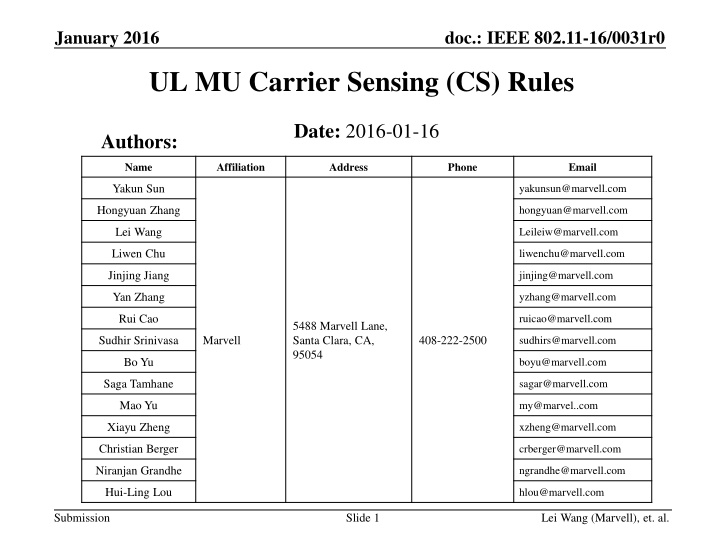
January 2016 doc.: IEEE 802.11-16/0031r0 UL MU Carrier Sensing (CS) Rules Date: 2016-01-16 Authors: Name Affiliation Address Phone Email Yakun Sun yakunsun@marvell.com Hongyuan Zhang hongyuan@marvell.com Lei Wang Leileiw@marvell.com Liwen Chu liwenchu@marvell.com Jinjing Jiang jinjing@marvell.com Yan Zhang yzhang@marvell.com Rui Cao ruicao@marvell.com 5488 Marvell Lane, Santa Clara, CA, 95054 Sudhir Srinivasa Marvell 408-222-2500 sudhirs@marvell.com Bo Yu boyu@marvell.com Saga Tamhane sagar@marvell.com Mao Yu my@marvel..com Xiayu Zheng xzheng@marvell.com Christian Berger crberger@marvell.com Niranjan Grandhe ngrandhe@marvell.com Hui-Ling Lou hlou@marvell.com Submission Slide 1 Lei Wang (Marvell), et. al.
January 2016 Authors (continued) doc.: IEEE 802.11-16/0031r0 Name Affiliation Address Phone Email Kiseon Ryu kiseon.ryu@lge.com Jinyoung Chun jiny.chun@lge.com Jinsoo Choi js.choi@lge.com Jeongki Kim jeongki.kim@lge.com Giwon Park giwon.park@lge.com 19, Yangjae-daero 11gil, Seocho-gu, Seoul 137- 130, Korea Dongguk Lim LG Electronics dongguk.lim@lge.com Suhwook Kim suhwook.kim@lge.com Eunsung Park esung.park@lge.com Hyeyoung Choi hy0117.choi@lge.com Jinmin Kim Jinmin1230.kim@lge.com HanGyu Cho hg.cho@lge.com Bo Sun Sub.bo1@zte.com.cn Kaiying Lv lv.kaiying@zte.com.cn #9 Wuxing duan, Xifeng Rd, Xi an, China Yonggang Fang ZTE yfang@ztetx.com Ke Yao Yao.ke5@zte.com.cn Weimin Xing Xing.weimin@zte.com.cn Submission Slide 2 Lei Wang (Marvell), et. al.
January 2016 Authors (continued) doc.: IEEE 802.11-16/0031r0 Name Affiliation Address Phone Email Straatweg 66-S Breukelen, 3621 BR Netherlands 5775 Morehouse Dr. San Diego, CA, USA 5775 Morehouse Dr. San Diego, CA, USA 1700 Technology Drive San Jose, CA 95110, USA 5775 Morehouse Dr. San Diego, CA, USA 5775 Morehouse Dr. San Diego, CA, USA 5775 Morehouse Dr. San Diego, CA, USA Straatweg 66-S Breukelen, 3621 BR Netherlands Straatweg 66-S Breukelen, 3621 BR Netherlands 1700 Technology Drive San Jose, CA 95110, USA 5775 Morehouse Dr. San Diego, CA, USA 5775 Morehouse Dr. San Diego, CA, USA 1700 Technology Drive San Jose, CA 95110, USA 1700 Technology Drive San Jose, CA 95110, USA 1700 Technology Drive San Jose, CA 95110, USA Albert Van Zelst allert@qti.qualcomm.com Alfred Asterjadhi aasterja@qti.qualcomm.com Bin Tian btian@qti.qualcomm.com Carlos Aldana caldana@qca.qualcomm.com George Cherian gcherian@qti.qualcomm.com Gwendolyn Barriac gbarriac@qti.qualcomm.com Hemanth Sampath hsampath@qti.qualcomm.com Menzo Wentink mwentink@qti.qualcomm.com Qualcomm Richard Van Nee rvannee@qti.qualcomm.com Rolf De Vegt rolfv@qca.qualcomm.com Sameer Vermani svverman@qti.qualcomm.com Simone Merlin smerlin@qti.qualcomm.com Tevfik Yucek tyucek@qca.qualcomm.com VK Jones vkjones@qca.qualcomm.com Youhan Kim youhank@qca.qualcomm.com Alice Chen Lin Yang Submission Slide 3 Lei Wang (Marvell), et. al.
January 2016 doc.: IEEE 802.11-16/0031r0 Authors (continued) Name Affiliation Address Phone Email Ron Porat rporat@broadcom.com Matthew Fischer Sriram Venkateswaran Zhou Lan mfischer@broadcom.com Broadcom Leo Montreuil Andrew Blanksby Vinko Erceg Robert Stacey robert.stacey@intel.com Eldad Perahia eldad.perahia@intel.com Shahrnaz Azizi shahrnaz.azizi@intel.com 2111 NE 25th Ave, Hillsboro OR 97124, USA Po-Kai Huang po-kai.huang@intel.com +1-503-724-893 Qinghua Li Intel quinghua.li@intel.com Xiaogang Chen xiaogang.c.chen@intel.com Chitto Ghosh chittabrata.ghosh@intel.com Rongzhen Yang rongzhen.yang@intel.com Laurent cariou laurent.cariou@intel.com Submission Slide 4 Lei Wang (Marvell), et. al.
January 2016 Authors (continued) doc.: IEEE 802.11-16/0031r0 Name Affiliation Address Phone Email No. 1 Dusing 1st Road, Hsinchu, Taiwan James Yee +886-3-567-0766 james.yee@mediatek.com Mediatek Alan Jauh alan.jauh@mediatek.com Frank Hsu frank.hsu@mediatek.com 2860 Junction Ave, San Jose, CA 95134, USA Thomas Pare +1-408-526-1899 thomas.pare@mediatek.com chaochun.wang@mediatek.c om james.wang@mediatek.com ChaoChun Wang James Wang Mediatek USA Jianhan Liu Jianhan.Liu@mediatek.com Tianyu Wu tianyu.wu@mediatek.com russell.huang@mediatek.co m Russell Huang Brian Hart brianh@cisco.com 170 W Tasman Dr, San Jose, CA 95134 Cisco Systems Pooya Monajemi pmonajem@cisco.com Joonsuk Kim joonsuk@apple.com Aon Mujtaba mujtaba@apple.com Guoqing Li Apple guoqing_li@apple.com Eric Wong ericwong@apple.com Chris Hartman chartman@apple.com Submission Slide 5 Lei Wang (Marvell), et. al.
January 2016 doc.: IEEE 802.11-16/0031r0 Authors (continued) Name Affiliation Address Innovation Park, Cambridge CB4 0DS (U.K.) Maetan 3-dong; Yongtong-Gu Suwon; South Korea 1301, E. Lookout Dr, Richardson TX 75070 Innovation Park, Cambridge CB4 0DS (U.K.) 1301, E. Lookout Dr, Richardson TX 75070 Maetan 3-dong; Yongtong-Gu Suwon; South Korea Phone Email Fei Tong f.tong@samsung.com +44 1223 434633 Hyunjeong Kang hyunjeong.kang@samsung.com +82-31-279-9028 Kaushik Josiam k.josiam@samsung.com (972) 761 7437 Samsung Mark Rison m.rison@samsung.com +44 1223 434600 Rakesh Taori rakesh.taori@samsung.com (972) 761 7470 Sanghyun Chang s29.chang@samsung.com +82-10-8864-1751 Yasushi Takatori takatori.yasushi@lab.ntt.co.jp Yasuhiko Inoue inoue.yasuhiko@lab.ntt.co.jp 1-1 Hikari-no-oka, Yokosuka, Kanagawa 239-0847 Japan Yusuke Asai NTT asai.yusuke@lab.ntt.co.jp Koichi Ishihara ishihara.koichi@lab.ntt.co.jp Akira Kishida kishida.akira@lab.ntt.co.jp 3-6, Hikarinooka, Yokosuka- shi, Kanagawa, 239-8536, Japan Akira Yamada yamadaakira@nttdocomo.com watanabe@docomoinnovations. com hpapadopoulos@docomoinnova tions.com Fujio Watanabe NTT DOCOMO 3240 Hillview Ave, Palo Alto, CA 94304 Haralabos Papadopoulos Submission Slide 6 Lei Wang (Marvell), et. al.
January 2016 doc.: IEEE 802.11-16/0031r0 Authors (continued) Name Affiliation Address Phone Email pbarber@broadbandmobilete ch.com peterloc@iwirelesstech.com Phillip Barber The Lone Star State, TX Peter Loc F1-17, Huawei Base, Bantian, Shenzhen 5B-N8, No.2222 Xinjinqiao Road, Pudong, Shanghai F1-17, Huawei Base, Bantian, Shenzhen 5B-N8, No.2222 Xinjinqiao Road, Pudong, Shanghai 5B-N8, No.2222 Xinjinqiao Road, Pudong, Shanghai 10180 Telesis Court, Suite 365, San Diego, CA 92121 NA 303 Terry Fox, Suite 400 Kanata, Ottawa, Canada F1-17, Huawei Base, Bantian, Shenzhen 10180 Telesis Court, Suite 365, San Diego, CA 92121 NA F1-17, Huawei Base, Bantian, SHenzhen 303 Terry Fox, Suite 400 Kanata, Ottawa, Canada 5B-N8, No.2222 Xinjinqiao Road, Pudong, Shanghai Le Liu liule@huawei.com +86-18601656691 Jun Luo jun.l@huawei.com Yi Luo Roy.luoyi@huawei.com +86-18665891036 Yingpei Lin linyingpei@huawei.com Jiyong Pang pangjiyong@huawei.com Huawei Zhigang Rong zhigang.rong@huawei.com Rob Sun Rob.Sun@huawei.com David X. Yang david.yangxun@huawei.com Yunsong Yang yangyunsong@huawei.com Zhou Lan Lanzhou1@huawei.com +86-18565826350 Junghoon Suh Junghoon.Suh@huawei.com Jiayin Zhang zhangjiayin@huawei.com +86-18601656691 Submission Slide 7 Lei Wang (Marvell), et. al.
January 2016 doc.: IEEE 802.11-16/0031r0 Background (1) Typical 11ax UL MU frame exchange sequences: Basic and Cascading Basic: Trigger ++ UL MU data ++ DL ACK/BA AP Gains the channel access DL UL DL ACK /BA Trigger UL MU PPDU TXOP Cascading: (Trigger + DL MU data) ++ UL MU data ++ DL ACK/BA AP Gains the channel access DL UL DL ACK /BA Trigger + DL MU Data UL MU PPDU TXOP Submission Slide 8 Lei Wang (Marvell), et. al.
January 2016 doc.: IEEE 802.11-16/0031r0 Background (2) Based on the 11ax contribution [1], the text below has been accepted into the current revision of 11ax SFD [2]: A STA shall consider CCA status to respond to a Trigger frame under a non-null TBD set of conditions. The above 11ax SFD text indicates two possible scenarios: Scenario-1: Under a non-null TBD set of conditions, a STA can transmit UL MU PPDU in response to a trigger frame, without considering CS, i.e., without carrier sensing; Scenario-2: Otherwise, a STA shall consider CS, i.e., with carrier sensing, before transmitting UL MU PPDU in response to a trigger frame Then some open questions for the scenario that carrier sensing is required before UL MU transmission in responses to a trigger frame, e.g., When to sense the channel? Which channel to sense? This contribution addresses the above questions. Submission Lei Wang (Marvell), et. al. Slide 9
January 2016 doc.: IEEE 802.11-16/0031r0 When To Sense the Channel? When to sense the channel if CS is required before UL MU transmission in responses to a trigger frame? Two places as shown in the diagram below: before trigger frame: Similar to the 11ac procedure required for RTS operation with dynamic BW; but not applicable to cascading OFDMA transmission. after trigger frame: applicable to cascading OFDMA transmission. But IFS requirement needs to be addressed. Recommend to conduct Carrier Sense (CS) after trigger frame, as a unified solution. CS Detection CS Detection AP Gains the channel access AP Gains the channel access DL UL DL DL UL DL ACK /BA ACK /BA Trigger UL MU PPDU Trigger + DL MU Data UL MU PPDU TXOP TXOP Submission Lei Wang (Marvell), et. al. Slide 10
January 2016 doc.: IEEE 802.11-16/0031r0 Which channel to sense? (1) First, what s the baseline carrier sense (CS) when channel bandwidth is greater than 20MHz? Virtual CS (NAV): based on Primary Channel; Physical CS (CCA detection): The PHY entity reports to the MAC entity whether the wireless medium is busy through the following channel list: primary 20MHz, secondary 20MHz, secondary 40MHz, secondary 80MHz. The MAC entity doesn t know the busy/idle state of each 20MHz channel. Submission Lei Wang (Marvell), et. al. Slide 11
January 2016 doc.: IEEE 802.11-16/0031r0 Which channel to sense? (2) What about 11ax channel sensing, particularly with OFDMA? For simplicity, the minimum channel size for carrier sense is 20MHz; e.g., STA1 needs to sense Ch1, even its UL OFDAM allocation is only part of Ch1; A STA really cares the channel status of its allocated subchannel, i.e., a 20MHz channel or multiple of adjacent 20MHz channels where its UL OFDAM allocation is located; STA0 and STA1 care the status of Ch1; a single 20MHz channel, i.e., the Secondary20 o STA2 cares the status of Ch2+Ch3; a combination of two adjacent 20MHz channel, i.e., primary20 + party of Secondary40 o sensing either per 20MHz or one 40MHz o STA3 cares the status of Ch4 a single 20MHz channel, part of the Secondary40 o Trigger STA0 Ch4 STA3 A-MPDU to AP M-BA Secondary 40MHz AP STA1 Trigger M-BA Ch3 Backoff or PIFS STA2 A-MPDU to AP STA3 Trigger M-BA Ch2 Primary 20MHz Trigger STA1 A-MPDU to AP M-BA Ch1 Secondary 20MHz STA0 A-MPDU to AP STA2 DL UL DL TXOP Submission Lei Wang (Marvell), et. al. Slide 12
January 2016 doc.: IEEE 802.11-16/0031r0 Which channel to sense? (3) The baseline channel sensing does not service 11ax UL MU transmission well, e.g., STA3 needs to sense Primary20, Secondary20, and Secondary40, (Ch3+Ch4), but it actually only cares Ch4; STA2 does not care Ch1, but the baseline channel sensing requires it to sense Ch1, due to the order of channel list; Every STA needs to sense the primary channel (Ch2), while only STA2 actually cares Ch2. Trigger STA0 Ch4 STA3 A-MPDU to AP M-BA Secondary 40MHz AP STA1 Trigger M-BA Ch3 Backoff or PIFS STA2 A-MPDU to AP STA3 Trigger M-BA Ch2 Primary 20MHz Trigger STA1 A-MPDU to AP M-BA Ch1 Secondary 20MHz STA0 A-MPDU to AP STA2 DL UL DL TXOP Submission Lei Wang (Marvell), et. al. Slide 13
January 2016 doc.: IEEE 802.11-16/0031r0 Which channel to sense? (4) Discussions about 11ax STA Channel Sensing for UL MU transmissions: Does every STA still need to sense primary channel? NO Only the STA(s) have its/their UL allocation in the Primary channel needs to sense it Can an 11ax STA only sense the subchannel that contains its UL allocation before the UL MU transmission in response to a Trigger Frame? Yes Notes: The sensed subchannel is either a single 20MHz channel or multiple of 20MHz channels Recommendation: An 11ax STA only conducts physical channel sensing on the subchannel that contains its UL allocation before the UL MU transmission in response to a Trigger Frame. Submission Lei Wang (Marvell), et. al. Slide 14
January 2016 doc.: IEEE 802.11-16/0031r0 Straw Poll #1 Do you support that , when a STA is required to sense the medium before its UL MU transmission in response to a trigger frame, it senses the medium using ED after receiving the PPDU that contains the trigger frame (i.e. during the SIFS time)? Yes No Abstain Submission Slide 15 Lei Wang (Marvell), et. al.
January 2016 doc.: IEEE 802.11-16/0031r0 Straw Poll #2 Do you support that , when a STA needs to perform the physical carrier sensing (ED) before its UL MU transmission in response to a trigger frame, it shall perform the physical carrier sensing (ED) at least in the subchannel that contains the STA s UL allocation, where the sensed subchannel consists of either a single 20MHz channel or multiple of 20MHz channels? Yes No Abstain Submission Slide 16 Lei Wang (Marvell), et. al.
January 2016 doc.: IEEE 802.11-16/0031r0 References 1) 11-15-1058-00-00ax-cca-consideration-for-ul-mu-transmission 2) 11-15-0132-13-00ax-spec-framework 3) IEEE P802.11-REVmc/D4.2, Sept 2015 Submission Lei Wang (Marvell), et. al. Slide 17
January 2016 doc.: IEEE 802.11-16/0031r0 Motion #1 Move to add the following text into Section 4.3 of the SFD: When a STA is required to sense the medium before its UL MU transmission in response to a trigger frame, it senses the medium using ED after receiving the PPDU that contains the trigger frame (i.e. during the SIFS time). Yes No Abstain Submission Slide 18 Lei Wang (Marvell), et. al.
January 2016 doc.: IEEE 802.11-16/0031r0 Motion #2 Move to add the following text into Section 4.3 of the SFD: When a STA needs to perform the physical carrier sensing (ED) before its UL MU transmission in response to a trigger frame, it shall perform the physical carrier sensing (ED) at least in the subchannel that contains the STA s UL allocation, where the sensed subchannel consists of either a single 20MHz channel or multiple of 20MHz channels. Yes No Abstain Submission Slide 19 Lei Wang (Marvell), et. al.