IEEE 802.11-17/0966r1 Data Rate Selection for Wake-up Receiver
Explore the proposal for Wake-up Receiver link quality measurement in IEEE 802.11-17/0966r1 document, discussing methods of determining data rates for efficient transmission, with details on signal encoding, modulation techniques, and performance measurement strategies.

Download Presentation

Please find below an Image/Link to download the presentation.
The content on the website is provided AS IS for your information and personal use only. It may not be sold, licensed, or shared on other websites without obtaining consent from the author. If you encounter any issues during the download, it is possible that the publisher has removed the file from their server.
You are allowed to download the files provided on this website for personal or commercial use, subject to the condition that they are used lawfully. All files are the property of their respective owners.
The content on the website is provided AS IS for your information and personal use only. It may not be sold, licensed, or shared on other websites without obtaining consent from the author.
E N D
Presentation Transcript
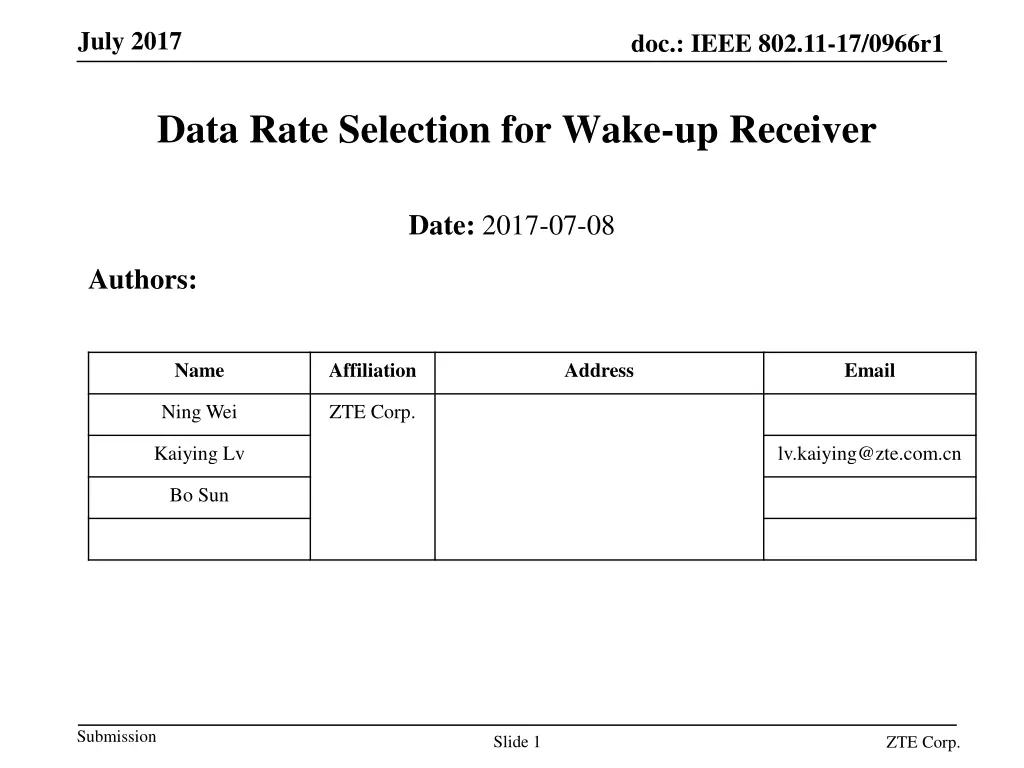
July 2017 doc.: IEEE 802.11-17/0966r1 Data Rate Selection for Wake-up Receiver Date: 2017-07-08 Authors: Name Affiliation Address Email Ning Wei ZTE Corp. Kaiying Lv lv.kaiying@zte.com.cn Bo Sun Submission Slide 1 ZTE Corp.
July 2017 doc.: IEEE 802.11-17/0966r1 Introduction 11ba group has agreed that the payload part of a wake-up packet shall support multiple data rates for a higher efficiency or wider coverage[1,2] Wake up link information is useful for AP to select an appropriate transmission rate to transmit wake-up packet rather than blind selection However, how to measure the WUR link is still TBD In this proposal, we discuss WUR link measuring method for WUR data rate selection. Submission Slide 2 ZTE Corp.
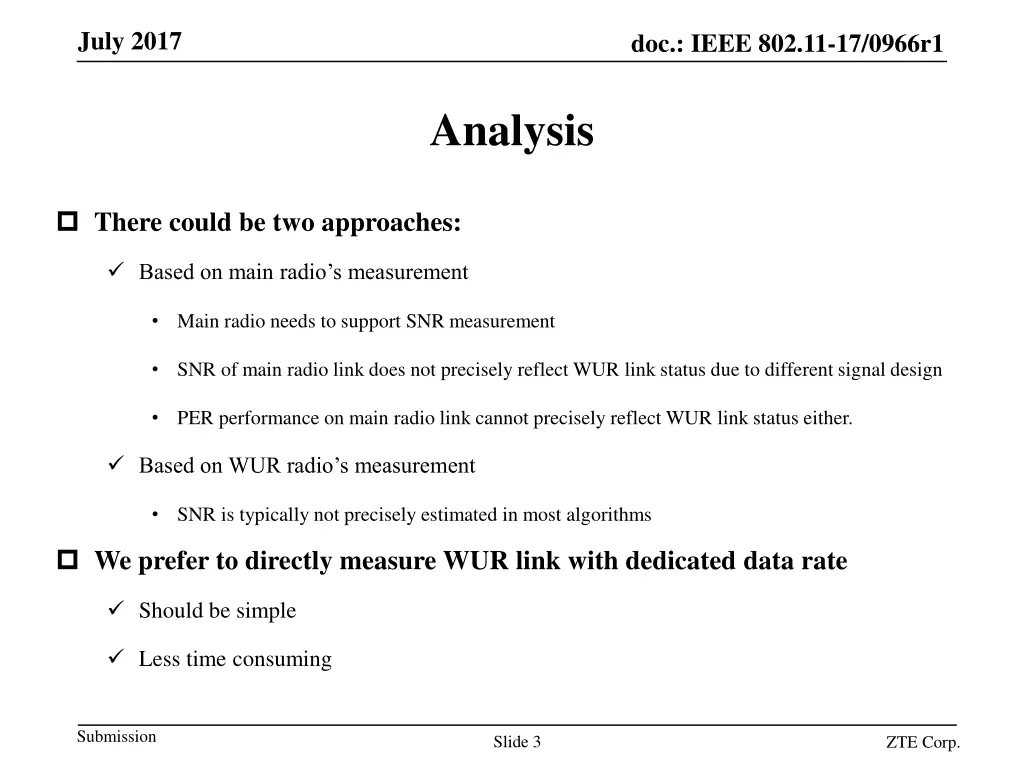
July 2017 doc.: IEEE 802.11-17/0966r1 Analysis There could be two approaches: Based on main radio s measurement Main radio needs to support SNR measurement SNR of main radio link does not precisely reflect WUR link status due to different signal design PER performance on main radio link cannot precisely reflect WUR link status either. Based on WUR radio s measurement SNR is typically not precisely estimated in most algorithms We prefer to directly measure WUR link with dedicated data rate Should be simple Less time consuming Submission Slide 3 ZTE Corp.
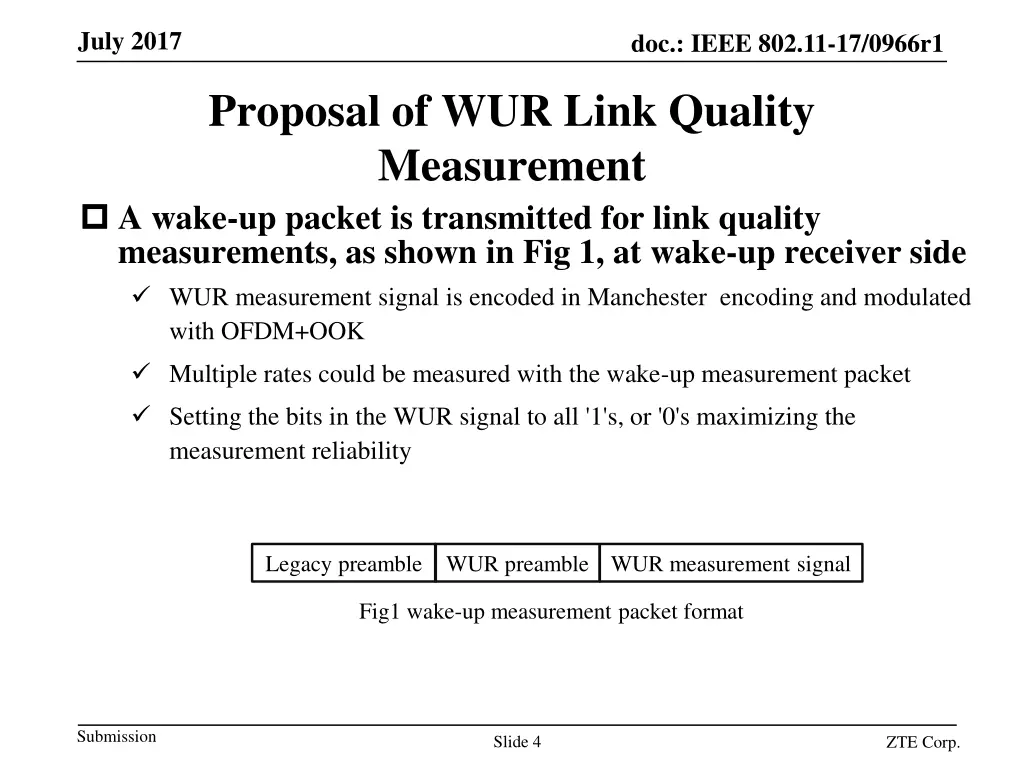
July 2017 doc.: IEEE 802.11-17/0966r1 Proposal of WUR Link Quality Measurement A wake-up packet is transmitted for link quality measurements, as shown in Fig 1, at wake-up receiver side WUR measurement signal is encoded in Manchester encoding and modulated with OFDM+OOK Multiple rates could be measured with the wake-up measurement packet Setting the bits in the WUR signal to all '1's, or '0's maximizing the measurement reliability Legacy preamble WUR preamble WUR measurement signal Fig1 wake-up measurement packet format Submission Slide 4 ZTE Corp.
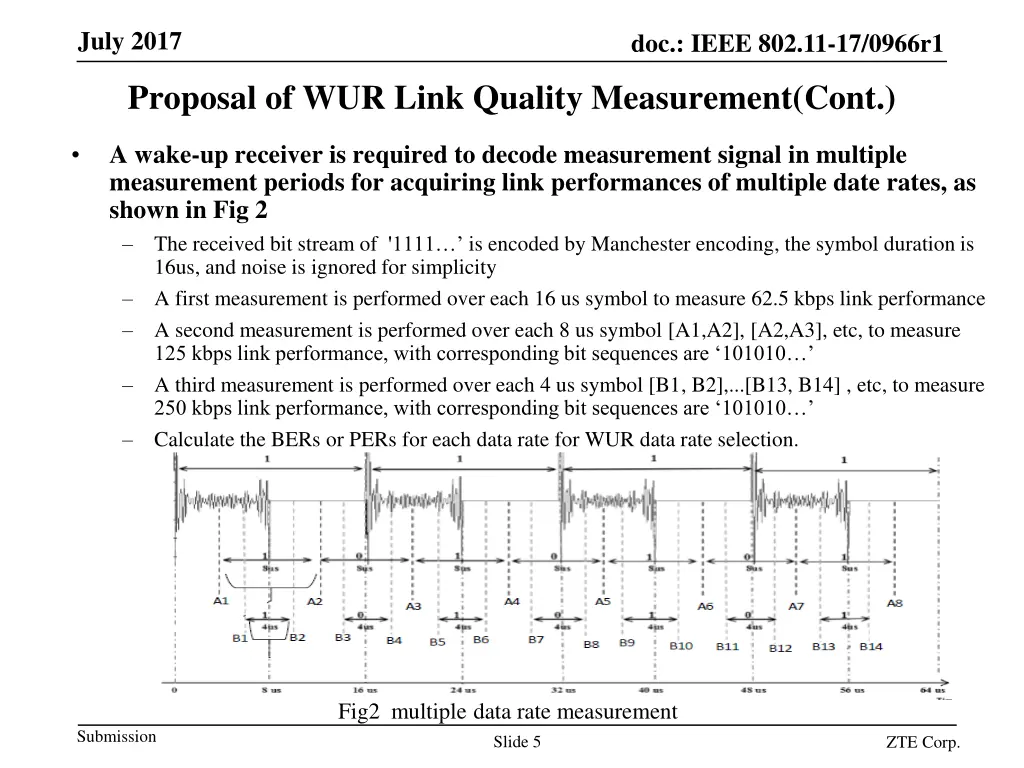
July 2017 doc.: IEEE 802.11-17/0966r1 Proposal of WUR Link Quality Measurement(Cont.) A wake-up receiver is required to decode measurement signal in multiple measurement periods for acquiring link performances of multiple date rates, as shown in Fig 2 The received bit stream of '1111 is encoded by Manchester encoding, the symbol duration is 16us, and noise is ignored for simplicity A first measurement is performed over each 16 us symbol to measure 62.5 kbps link performance A second measurement is performed over each 8 us symbol [A1,A2], [A2,A3], etc, to measure 125 kbps link performance, with corresponding bit sequences are 101010 A third measurement is performed over each 4 us symbol [B1, B2],...[B13, B14] , etc, to measure 250 kbps link performance, with corresponding bit sequences are 101010 Calculate the BERs or PERs for each data rate for WUR data rate selection. Fig2 multiple data rate measurement Submission Slide 5 ZTE Corp.
July 2017 doc.: IEEE 802.11-17/0966r1 Proposal of WUR measurement protocol(Cont.) Finally, as a respond, STA should feedback the WUR link performance measurement Include the measurement results of multiple data rate to assist AP on WUR transmission rate selection; Or Inform AP the preferred data rate Submission Slide 6 ZTE Corp.
July 2017 doc.: IEEE 802.11-17/0966r1 Conclusion In this contribution, we proposed an approach to achieve link performance measurement for multiple data rates with one WUR measurement packet: The measurement sequence of all '1's or '0's at a single data rate is proposed to maximize the measurement reliability Wake-up receiver is required to decode received signal several times with different measurement periods Submission Slide 7 ZTE Corp.
July 2017 doc.: IEEE 802.11-17/0966r1 Straw Poll #1 Do you agree to add the following to the 11ba SFD? WUR measurement protocol should be defined in 11ba Y/N/A : Submission Slide 8 ZTE Corp.
July 2017 doc.: IEEE 802.11-17/0966r1 Straw Poll #2 Do you agree to add the following to the 11ba SFD? A WUR measurement packet supporting multi-rate measurement should be defined in 11ba as shown in slide 4 Y/N/A : Submission Slide 9 ZTE Corp.
July 2017 doc.: IEEE 802.11-17/0966r1 Straw Poll #3 Do you agree to add the following to the 11ba SFD? A WUR measurement procedure supporting multi-rate measurement should be defined in 11ba as shown in slide 5 Y/N/A : Submission Slide 10 ZTE Corp.
July 2017 doc.: IEEE 802.11-17/0966r1 References 1. 11-17-0654-01-00ba-multiple-data-rates-for-wur 2. 11-17-0575-01-00ba-spec-framework Submission Slide 11 ZTE Corp.