Explore the latest improvements in MU sounding technology as presented in the July 2018 IEEE document. Topics include enhancements to sounding for multi-user scenarios, considerations for increasing spatial streams, and advancements in the 11ax sounding protocol. Dive into the evolving landscape of wireless communication technologies and the quest for improved efficiency and throughput in the realm of IEEE 802.11 standards.
Please find below an Image/Link to download the presentation.
The content on the website is provided AS IS for your information and personal use only. It may not be sold, licensed, or shared on other websites without obtaining consent from the author. If you encounter any issues during the download, it is possible that the publisher has removed the file from their server.
You are allowed to download the files provided on this website for personal or commercial use, subject to the condition that they are used lawfully. All files are the property of their respective owners.
The content on the website is provided AS IS for your information and personal use only. It may not be sold, licensed, or shared on other websites without obtaining consent from the author.
E N D
Presentation Transcript
July 2018 doc.: IEEE 802.11-18/1191 MU sounding improvements Date: 7/8/2018 Authors: Name Sigurd Schelstraete Huizhao Wang Affiliations Address Phone +1 669 209 5661 email sigurd@quantenna.com hwang@quantenna.com Quantenna Communications 1704 Automation Parkway Brajesh Dave ddash@quantenna.com Debashis Dash bdave@quantenna.com Roger Marks Lyu Yunping Huawei Denver, CO, USA +1-802-capable roger@ethair.net lvyunping@huawei.com Huawei Huawei Nanjing, PRC 2111 NE 25th Ave, Hillsboro OR 97124, USA Laurent Cariou Intel laurent.cariou@intel.com Submission Slide 1 Sigurd Schelstraete, Quantenna
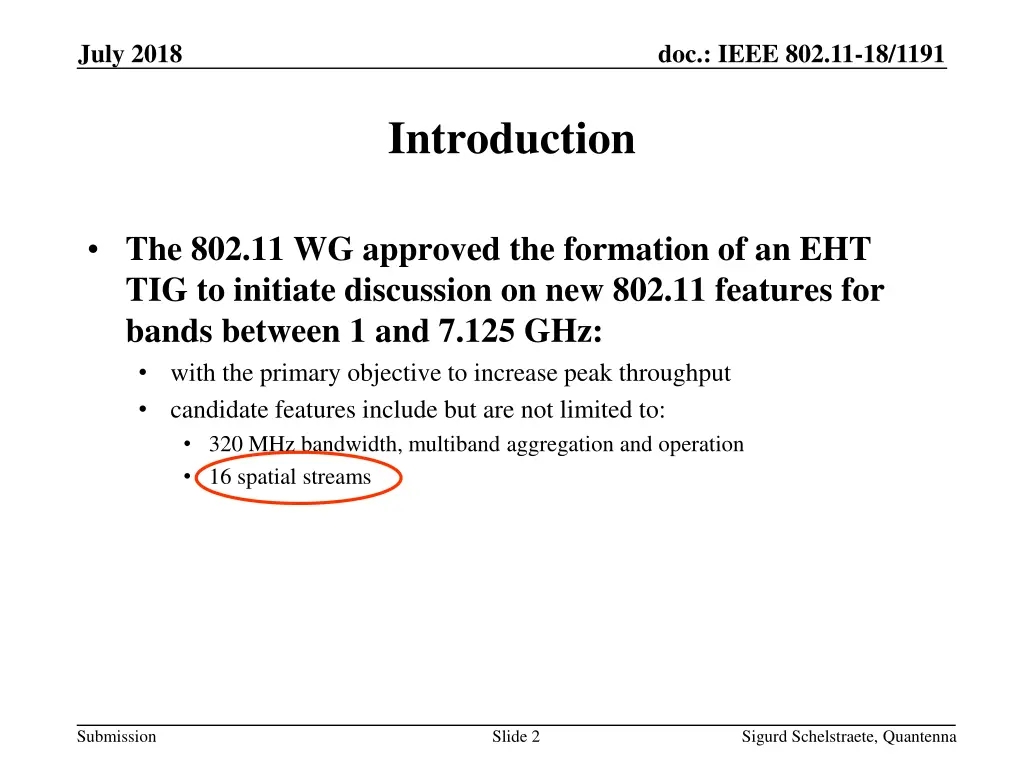
July 2018 doc.: IEEE 802.11-18/1191 Introduction The 802.11 WG approved the formation of an EHT TIG to initiate discussion on new 802.11 features for bands between 1 and 7.125 GHz: with the primary objective to increase peak throughput candidate features include but are not limited to: 320 MHz bandwidth, multiband aggregation and operation 16 spatial streams Submission Slide 2 Sigurd Schelstraete, Quantenna
July 2018 doc.: IEEE 802.11-18/1191 Summary As part of the scope of EHT, enhancements to sounding should be considered 16 SS most useful for MU, for which sounding is a must See [1] for potential gains of MU Sounding overhead will grow further (compared to 11ac/11ax) when increasing NSS from 8 to 16 Aside from 16 SS, other kinds of MIMO enhancements will also require overhead reduction Submission Slide 3 Sigurd Schelstraete, Quantenna
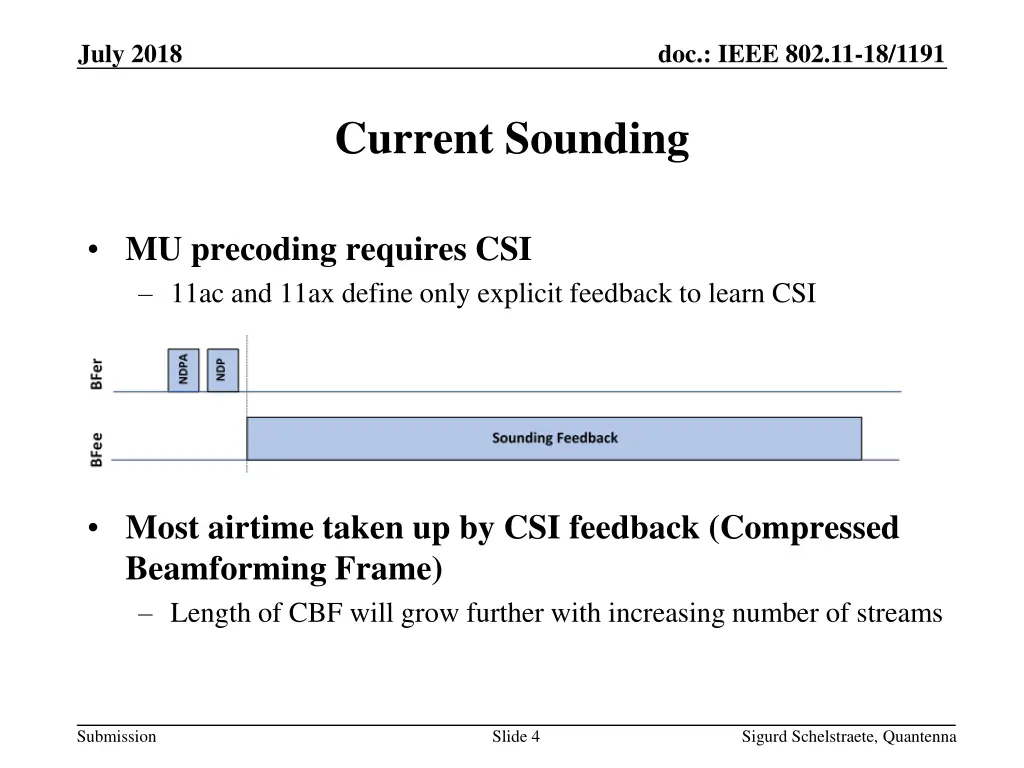
July 2018 doc.: IEEE 802.11-18/1191 Current Sounding MU precoding requires CSI 11ac and 11ax define only explicit feedback to learn CSI Most airtime taken up by CSI feedback (Compressed Beamforming Frame) Length of CBF will grow further with increasing number of streams Submission Slide 4 Sigurd Schelstraete, Quantenna
July 2018 doc.: IEEE 802.11-18/1191 Improvements in 11ax Sounding protocol essentially identical to 11ac, with minor improvements Partial BW feedback CQI feedback (not useful for MU-MIMO) CSI airtime reduction using TB sounding sequence Further improvements are needed in EHT to control sounding overhead Submission Slide 5 Sigurd Schelstraete, Quantenna
July 2018 doc.: IEEE 802.11-18/1191 Implicit feedback Implicit sounding avoids overhead from CSI feedback For implicit feedback to work: 1. BFer must be calibrated 2. BFee must send packet appropriate for channel estimation BW, #streams = #antennas, 3. BFee must send packets at appropriate time intervals Ideally as determined by BFer Item 1 may be achieved in a number of ways See e.g. [2] Items 2 and 3 can not currently be guaranteed Submission Slide 6 Sigurd Schelstraete, Quantenna
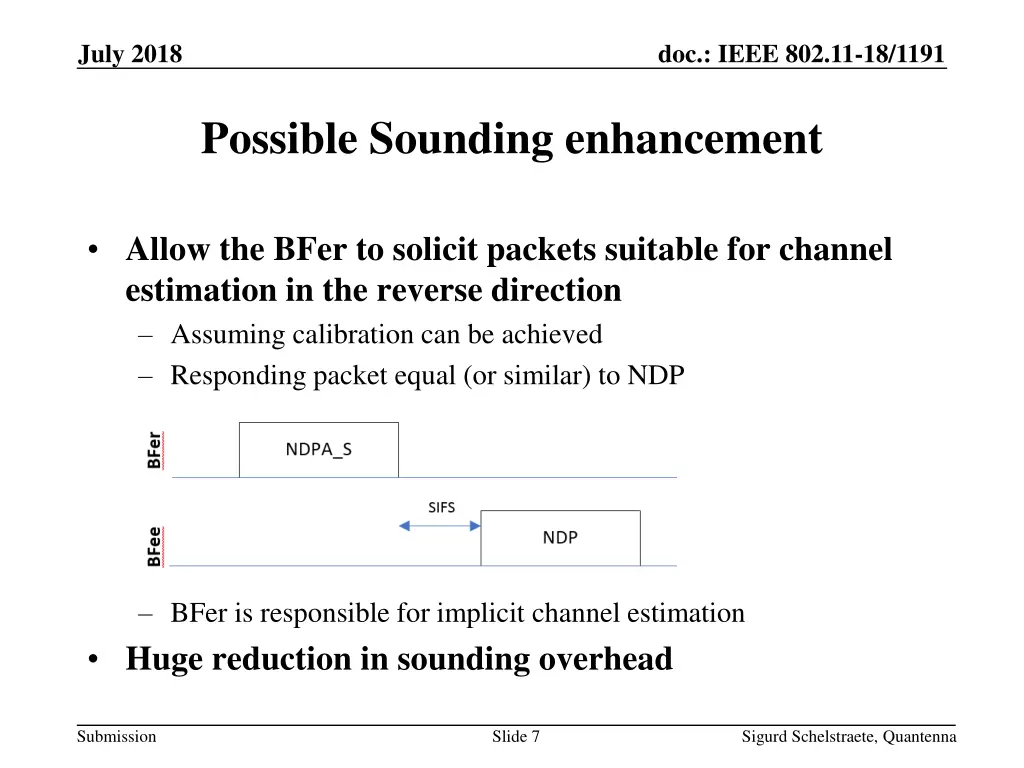
July 2018 doc.: IEEE 802.11-18/1191 Possible Sounding enhancement Allow the BFer to solicit packets suitable for channel estimation in the reverse direction Assuming calibration can be achieved Responding packet equal (or similar) to NDP BFer is responsible for implicit channel estimation Huge reduction in sounding overhead Submission Slide 7 Sigurd Schelstraete, Quantenna
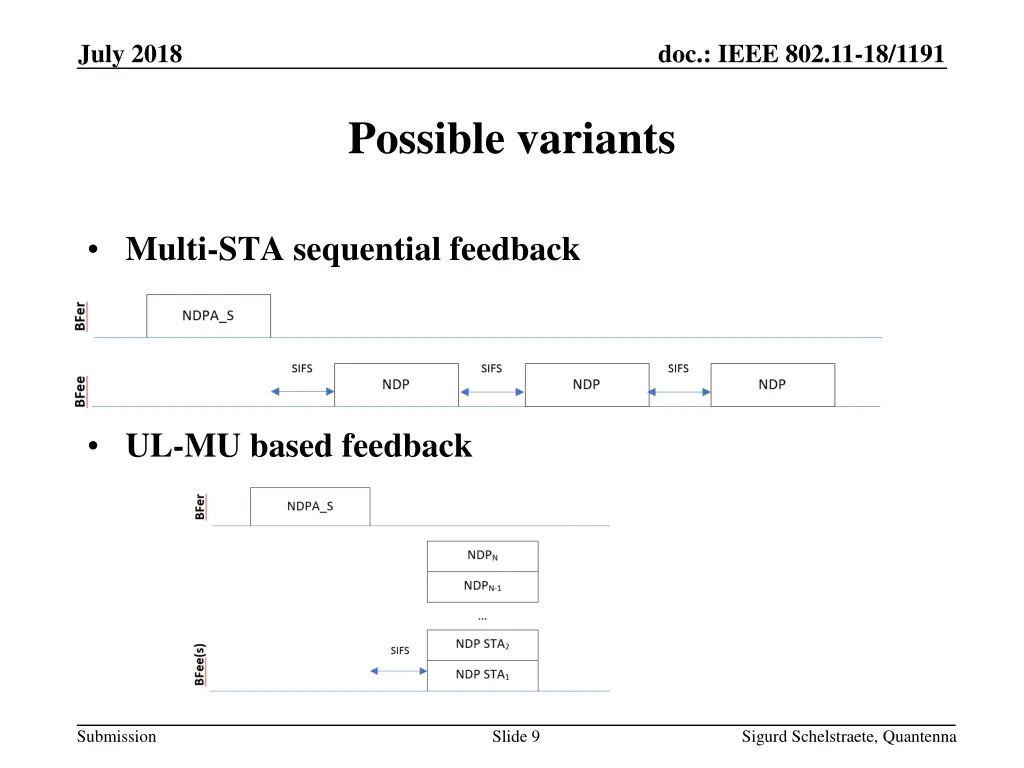
July 2018 doc.: IEEE 802.11-18/1191 Soliciting NDPs BFee responds to NDPA_S within SIFS with NDP NDPA_S identifies (one or more) STAs that should respond NDP should be sent with #streams= # BFee antennas Direct mapping or unitary Spatial mapping In case of UL MU, NDPs use number of LTFs indicated by NDPA_S, with specific streams assigned to different STAs Submission Slide 8 Sigurd Schelstraete, Quantenna
July 2018 doc.: IEEE 802.11-18/1191 Possible variants Multi-STA sequential feedback UL-MU based feedback Submission Slide 9 Sigurd Schelstraete, Quantenna
July 2018 doc.: IEEE 802.11-18/1191 Conclusion Given the current scope of EHT, the following features should be considered as part of the scope: Enhancements to sounding with the goal of reducing sounding overhead (especially for MU) Enhancements to enable or facilitate implicit sounding Submission Slide 10 Sigurd Schelstraete, Quantenna
July 2018 doc.: IEEE 802.11-18/1191 References [1] 16 Spatial Stream Support in Next Generation WLAN, IEEE 802.11-18/818r3 [2] Reconsidering Implicit Feedback for Beamforming, IEEE 802.11- 18/509r1 Submission Slide 11 Sigurd Schelstraete, Quantenna