IEEE 802.11-24/2124r1 Frame Sequence for Coordinated Spatial Reuse and Beamforming
Explore the frame exchange sequence for Coordinated Spatial Reuse (Co-SR) and Coordinated Beamforming (Co-BF) in IEEE 802.11-24/2124r1 standard to enhance system throughput and latency performance. Delve into the proposed sequence, assumptions, and issues affecting the current Co-BF process.

Download Presentation

Please find below an Image/Link to download the presentation.
The content on the website is provided AS IS for your information and personal use only. It may not be sold, licensed, or shared on other websites without obtaining consent from the author. If you encounter any issues during the download, it is possible that the publisher has removed the file from their server.
You are allowed to download the files provided on this website for personal or commercial use, subject to the condition that they are used lawfully. All files are the property of their respective owners.
The content on the website is provided AS IS for your information and personal use only. It may not be sold, licensed, or shared on other websites without obtaining consent from the author.
E N D
Presentation Transcript
doc.: IEEE 802.11-24/2124r1 Frame Sequence for CSR and CBF Date: 2024-11-21 Authors: Name Affiliations Address Phone email Jason Yuchen Guo Huawei Technologies guoyuchen@huaw ei.com Yunbo Li Guogang Huang Ming Gan Yue Zhao Maolin Zhang Zhenpeng Shi Lyutianyang Zhang Submission Slide 1 Jason Yuchen Guo, et al., Huawei Technologies
doc.: IEEE 802.11-24/2124r1 Introduction Coordinated spatial reuse (Co-SR) and coordinated beamforming (Co-BF) are considered as two multi-AP schemes that can improve system throughput and latency performance. Both of the two schemes are performed at a TXOP level. This contribution discusses the frame exchange sequence of Co-SR and Co-BF. Submission Slide 2 Jason Yuchen Guo, et al., Huawei Technologies
doc.: IEEE 802.11-24/2124r1 Part I: Co-BF Sequence Submission Slide 3 Jason Yuchen Guo, et al., Huawei Technologies
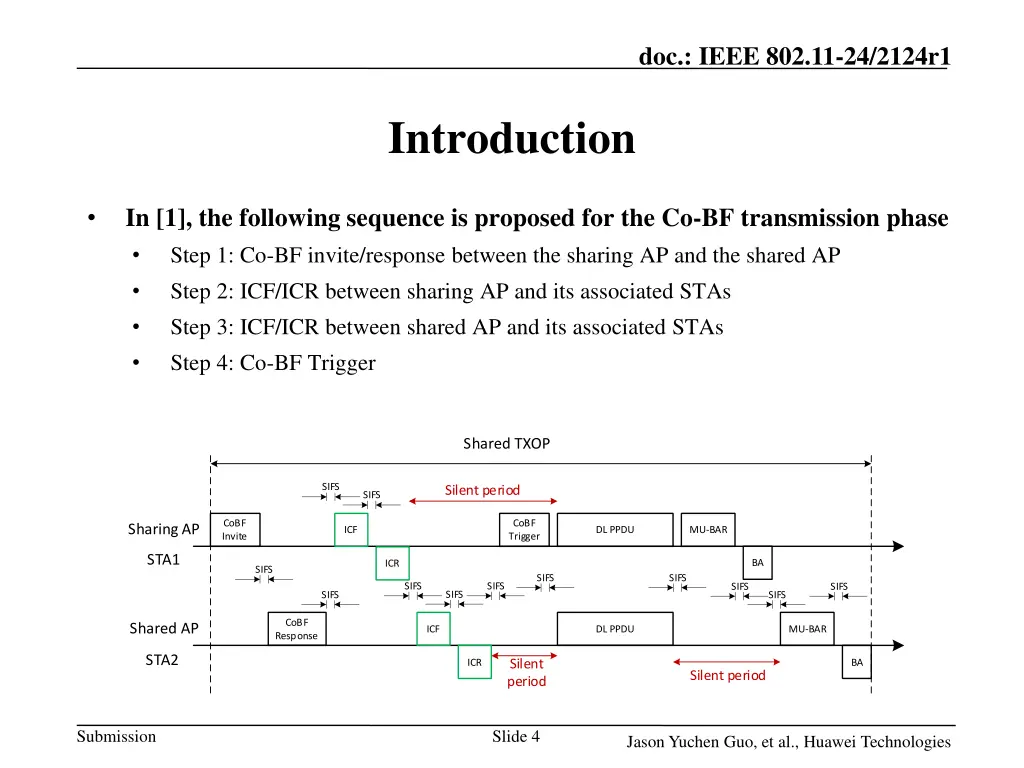
doc.: IEEE 802.11-24/2124r1 Introduction In [1], the following sequence is proposed for the Co-BF transmission phase Step 1: Co-BF invite/response between the sharing AP and the shared AP Step 2: ICF/ICR between sharing AP and its associated STAs Step 3: ICF/ICR between shared AP and its associated STAs Step 4: Co-BF Trigger Shared TXOP SIFS Silent period SIFS CoBF Invite CoBF Trigger Sharing AP ICF DL PPDU MU-BAR STA1 BA ICR SIFS SIFS SIFS SIFS SIFS SIFS SIFS SIFS SIFS SIFS CoBF Response Shared AP ICF DL PPDU MU-BAR STA2 Silent period ICR BA Silent period Submission Slide 4 Jason Yuchen Guo, et al., Huawei Technologies
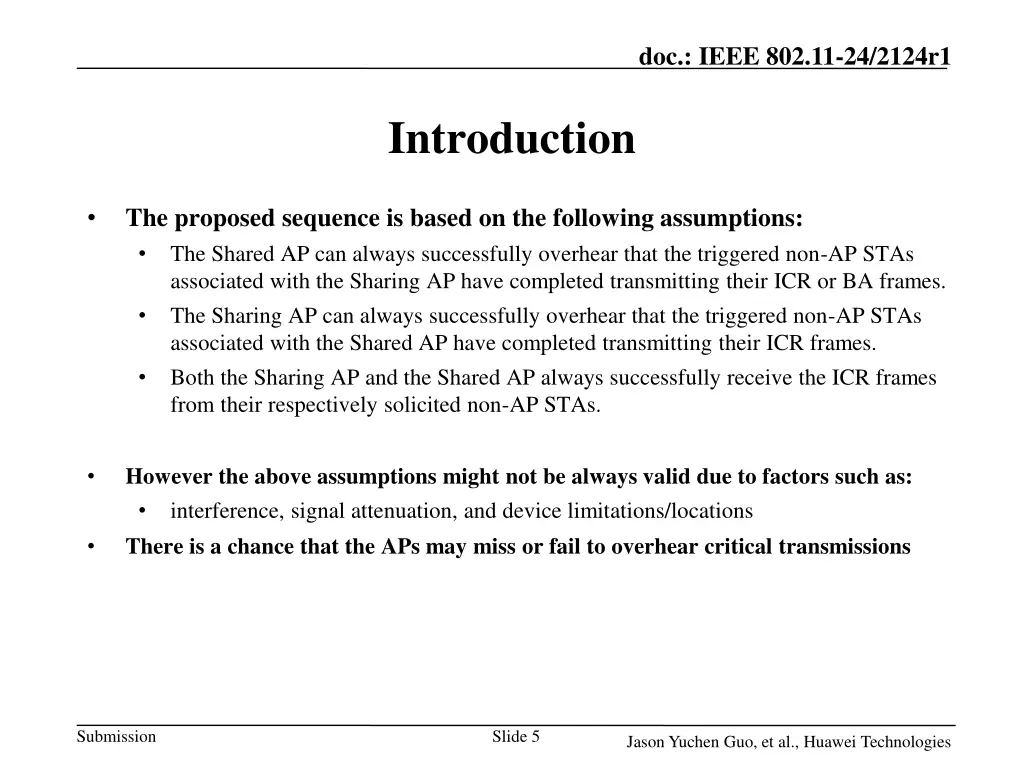
doc.: IEEE 802.11-24/2124r1 Introduction The proposed sequence is based on the following assumptions: The Shared AP can always successfully overhear that the triggered non-AP STAs associated with the Sharing AP have completed transmitting their ICR or BA frames. The Sharing AP can always successfully overhear that the triggered non-AP STAs associated with the Shared AP have completed transmitting their ICR frames. Both the Sharing AP and the Shared AP always successfully receive the ICR frames from their respectively solicited non-AP STAs. However the above assumptions might not be always valid due to factors such as: interference, signal attenuation, and device limitations/locations There is a chance that the APs may miss or fail to overhear critical transmissions Submission Slide 5 Jason Yuchen Guo, et al., Huawei Technologies
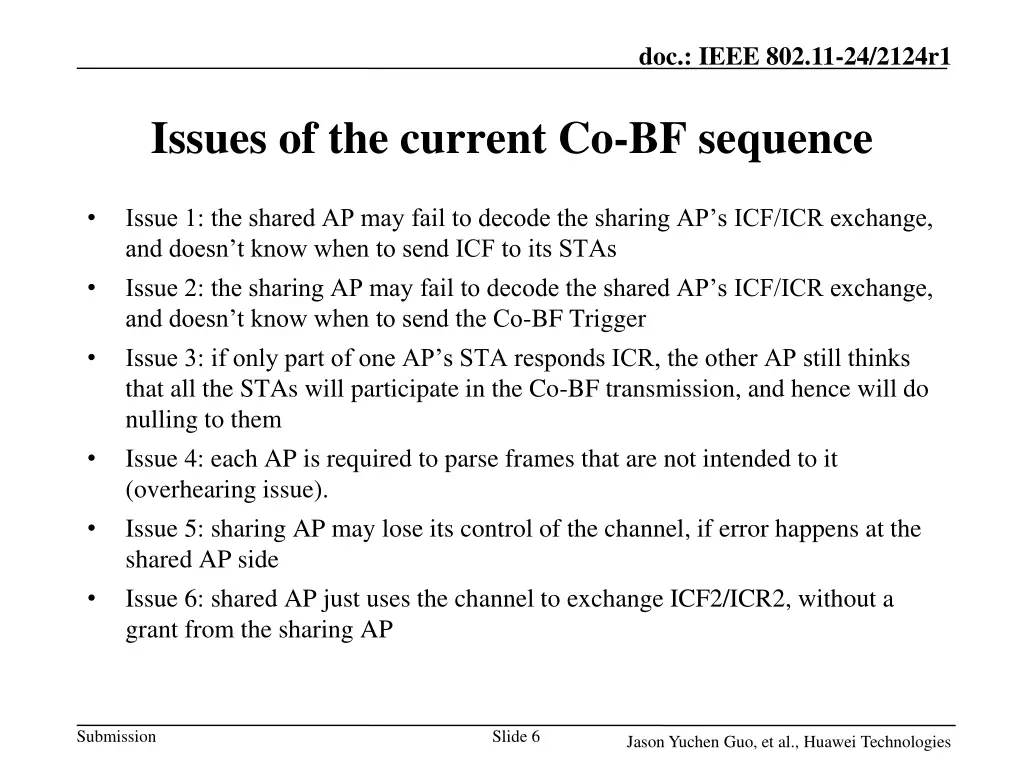
doc.: IEEE 802.11-24/2124r1 Issues of the current Co-BF sequence Issue 1: the shared AP may fail to decode the sharing AP s ICF/ICR exchange, and doesn t know when to send ICF to its STAs Issue 2: the sharing AP may fail to decode the shared AP s ICF/ICR exchange, and doesn t know when to send the Co-BF Trigger Issue 3: if only part of one AP s STA responds ICR, the other AP still thinks that all the STAs will participate in the Co-BF transmission, and hence will do nulling to them Issue 4: each AP is required to parse frames that are not intended to it (overhearing issue). Issue 5: sharing AP may lose its control of the channel, if error happens at the shared AP side Issue 6: shared AP just uses the channel to exchange ICF2/ICR2, without a grant from the sharing AP Submission Slide 6 Jason Yuchen Guo, et al., Huawei Technologies
doc.: IEEE 802.11-24/2124r1 Proposal We propose two options to solve the issues mentioned in the previous slide Option 1: Change the order of Co-BF invite/response and ICF/ICR Option 2: based on the sequence in [1], add explicit Timing Indication for Co- BF Transmission Phase Submission Slide 7 Jason Yuchen Guo, et al., Huawei Technologies
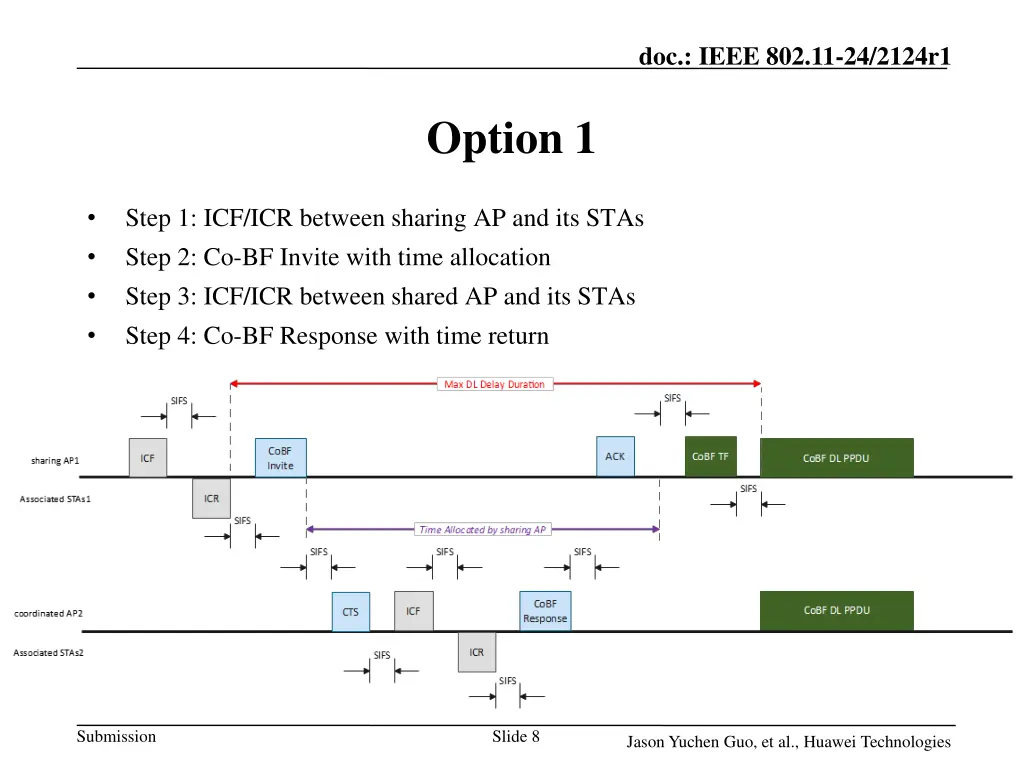
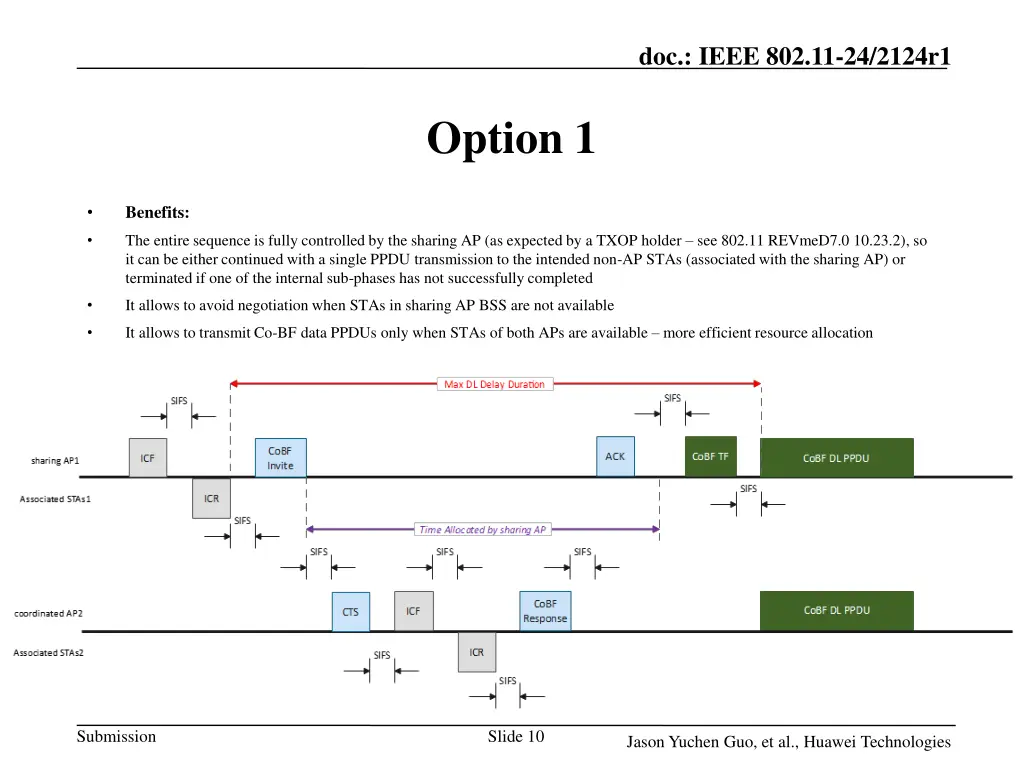
doc.: IEEE 802.11-24/2124r1 Option 1 Step 1: ICF/ICR between sharing AP and its STAs Step 2: Co-BF Invite with time allocation Step 3: ICF/ICR between shared AP and its STAs Step 4: Co-BF Response with time return Submission Slide 8 Jason Yuchen Guo, et al., Huawei Technologies
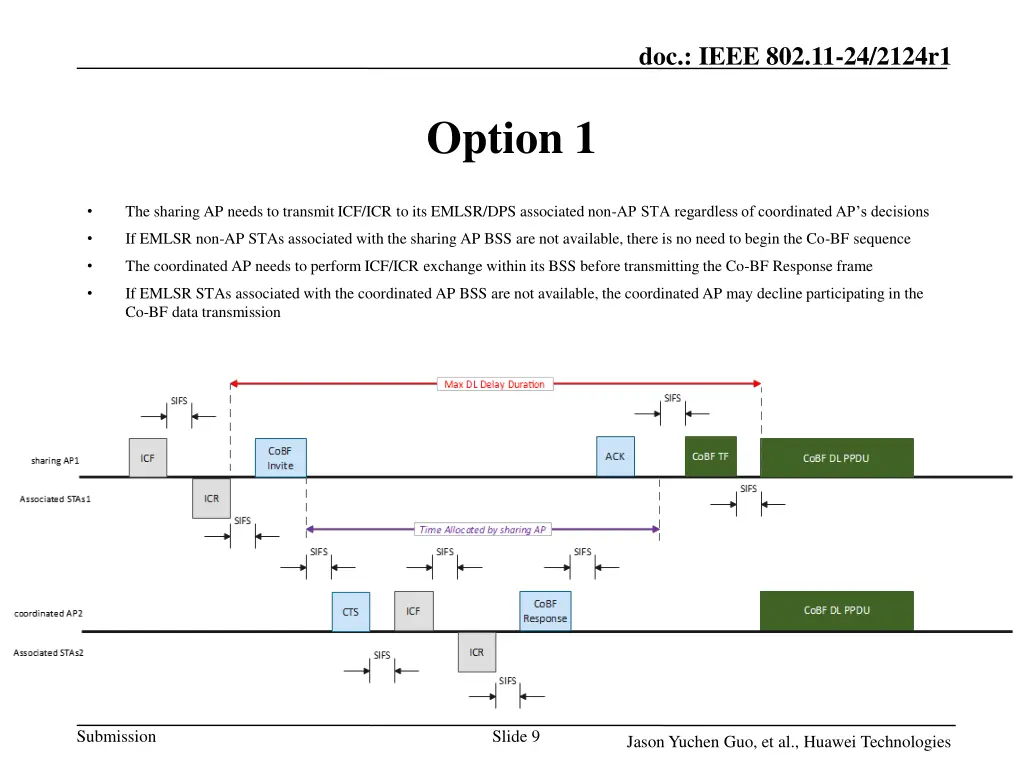
doc.: IEEE 802.11-24/2124r1 Option 1 The sharing AP needs to transmit ICF/ICR to its EMLSR/DPS associated non-AP STA regardless of coordinated AP s decisions If EMLSR non-AP STAs associated with the sharing AP BSS are not available, there is no need to begin the Co-BF sequence The coordinated AP needs to perform ICF/ICR exchange within its BSS before transmitting the Co-BF Response frame If EMLSR STAs associated with the coordinated AP BSS are not available, the coordinated AP may decline participating in the Co-BF data transmission Submission Slide 9 Jason Yuchen Guo, et al., Huawei Technologies
doc.: IEEE 802.11-24/2124r1 Option 1 Benefits: The entire sequence is fully controlled by the sharing AP (as expected by a TXOP holder see 802.11 REVmeD7.0 10.23.2), so it can be either continued with a single PPDU transmission to the intended non-AP STAs (associated with the sharing AP) or terminated if one of the internal sub-phases has not successfully completed It allows to avoid negotiation when STAs in sharing AP BSS are not available It allows to transmit Co-BF data PPDUs only when STAs of both APs are available more efficient resource allocation Submission Slide 10 Jason Yuchen Guo, et al., Huawei Technologies
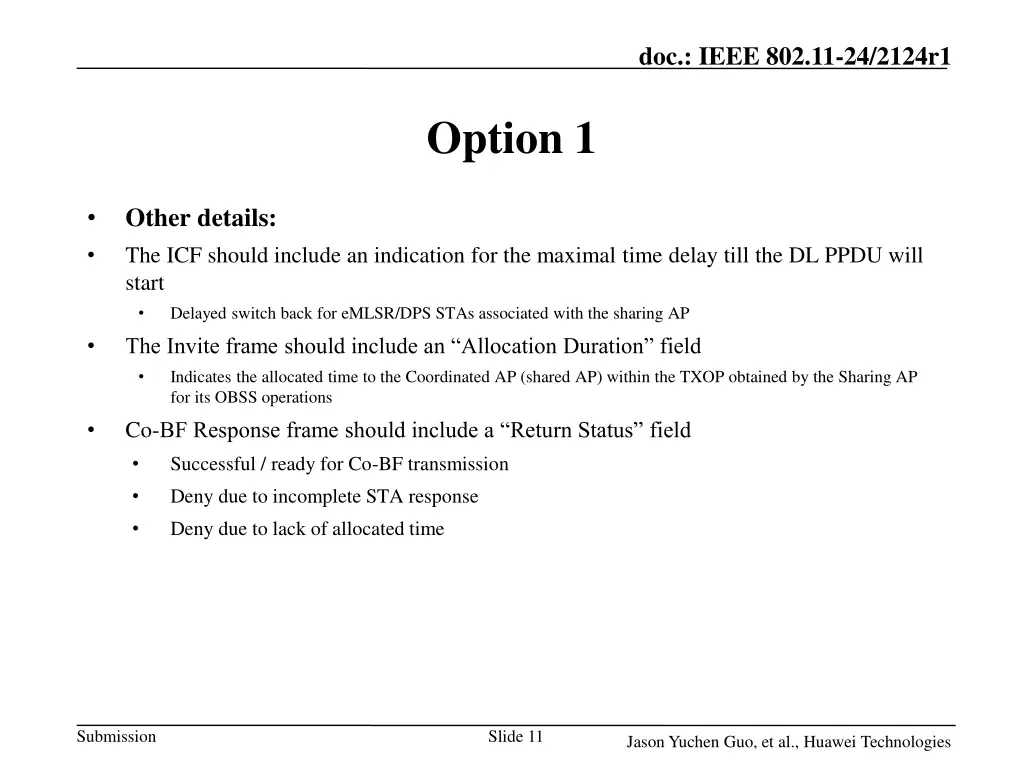
doc.: IEEE 802.11-24/2124r1 Option 1 Other details: The ICF should include an indication for the maximal time delay till the DL PPDU will start Delayed switch back for eMLSR/DPS STAs associated with the sharing AP The Invite frame should include an Allocation Duration field Indicates the allocated time to the Coordinated AP (shared AP) within the TXOP obtained by the Sharing AP for its OBSS operations Co-BF Response frame should include a Return Status field Successful / ready for Co-BF transmission Deny due to incomplete STA response Deny due to lack of allocated time Submission Slide 11 Jason Yuchen Guo, et al., Huawei Technologies
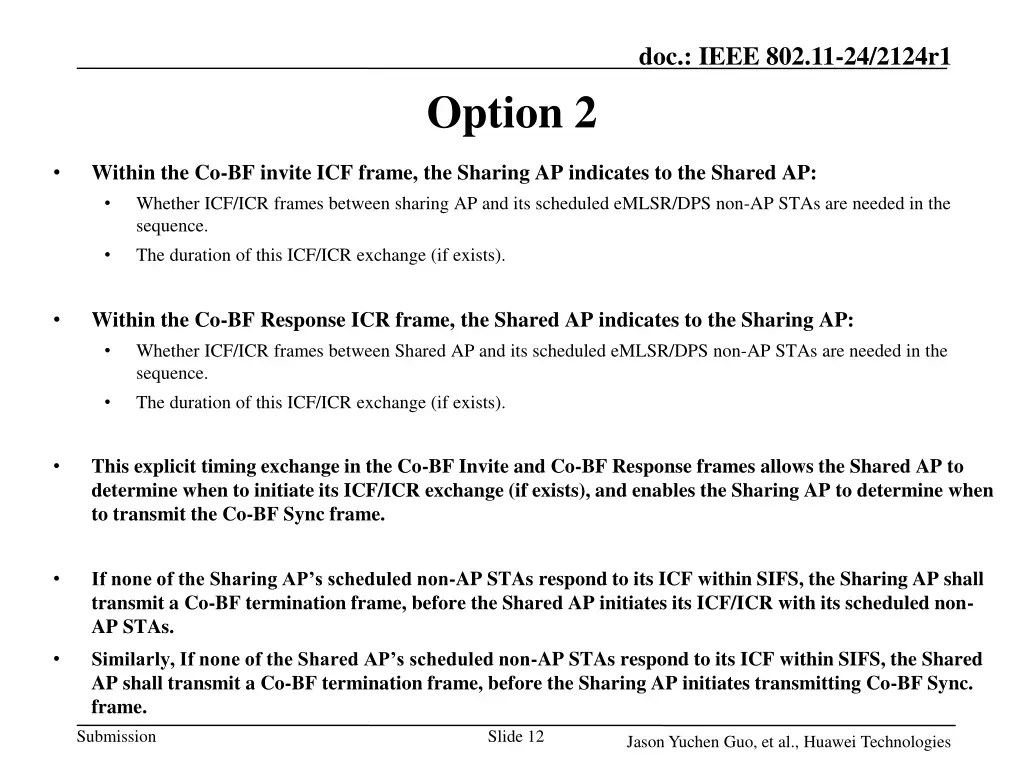
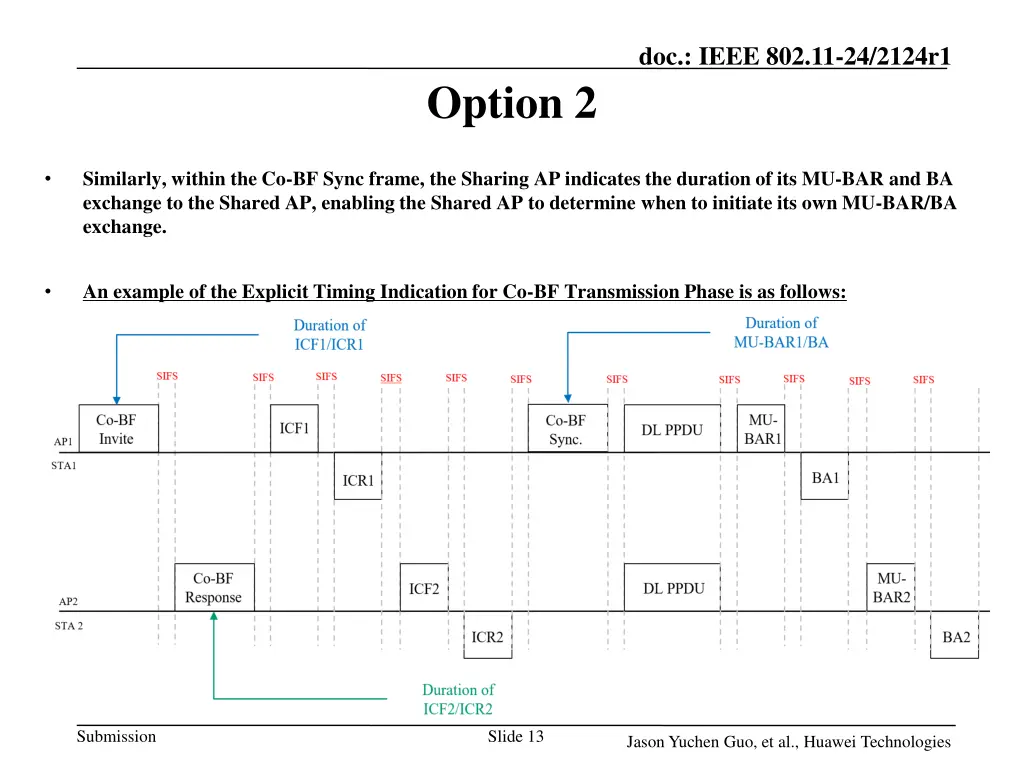
doc.: IEEE 802.11-24/2124r1 Option 2 Within the Co-BF invite ICF frame, the Sharing AP indicates to the Shared AP: Whether ICF/ICR frames between sharing AP and its scheduled eMLSR/DPS non-AP STAs are needed in the sequence. The duration of this ICF/ICR exchange (if exists). Within the Co-BF Response ICR frame, the Shared AP indicates to the Sharing AP: Whether ICF/ICR frames between Shared AP and its scheduled eMLSR/DPS non-AP STAs are needed in the sequence. The duration of this ICF/ICR exchange (if exists). This explicit timing exchange in the Co-BF Invite and Co-BF Response frames allows the Shared AP to determine when to initiate its ICF/ICR exchange (if exists), and enables the Sharing AP to determine when to transmit the Co-BF Sync frame. If none of the Sharing AP s scheduled non-AP STAs respond to its ICF within SIFS, the Sharing AP shall transmit a Co-BF termination frame, before the Shared AP initiates its ICF/ICR with its scheduled non- AP STAs. Similarly, If none of the Shared AP s scheduled non-AP STAs respond to its ICF within SIFS, the Shared AP shall transmit a Co-BF termination frame, before the Sharing AP initiates transmitting Co-BF Sync. frame. Submission Slide 12 Jason Yuchen Guo, et al., Huawei Technologies
doc.: IEEE 802.11-24/2124r1 Option 2 Similarly, within the Co-BF Sync frame, the Sharing AP indicates the duration of its MU-BAR and BA exchange to the Shared AP, enabling the Shared AP to determine when to initiate its own MU-BAR/BA exchange. An example of the Explicit Timing Indication for Co-BF Transmission Phase is as follows: Submission Slide 13 Jason Yuchen Guo, et al., Huawei Technologies
doc.: IEEE 802.11-24/2124r1 Summary We raised 6 issues of the current CoBF sequence, and propose two candidate solutions to solve them Option 1 can solve all 6 issues with some modifications of the frame sequence Option 2 can solve issues 1,2,4,5 without modifying the current sequence Extra process may be needed to solve issue 3,6. Submission Slide 14 Jason Yuchen Guo, et al., Huawei Technologies
doc.: IEEE 802.11-24/2124r1 Part II: Co-SR Sequence Submission Slide 15 Jason Yuchen Guo, et al., Huawei Technologies
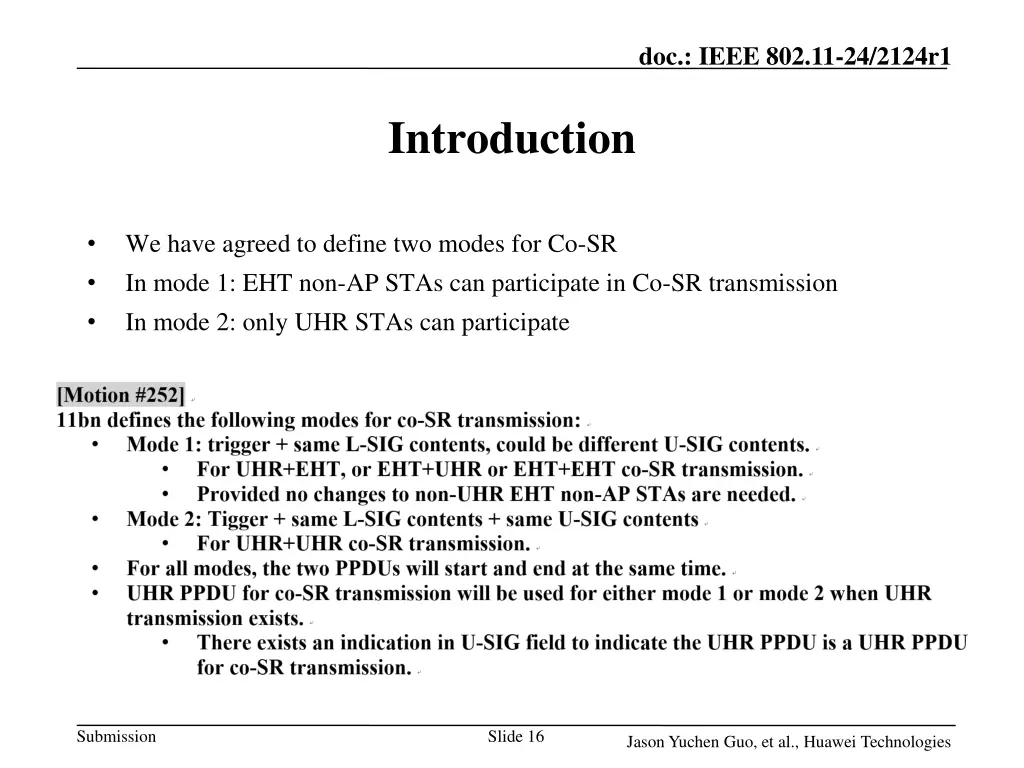
doc.: IEEE 802.11-24/2124r1 Introduction We have agreed to define two modes for Co-SR In mode 1: EHT non-AP STAs can participate in Co-SR transmission In mode 2: only UHR STAs can participate Submission Slide 16 Jason Yuchen Guo, et al., Huawei Technologies
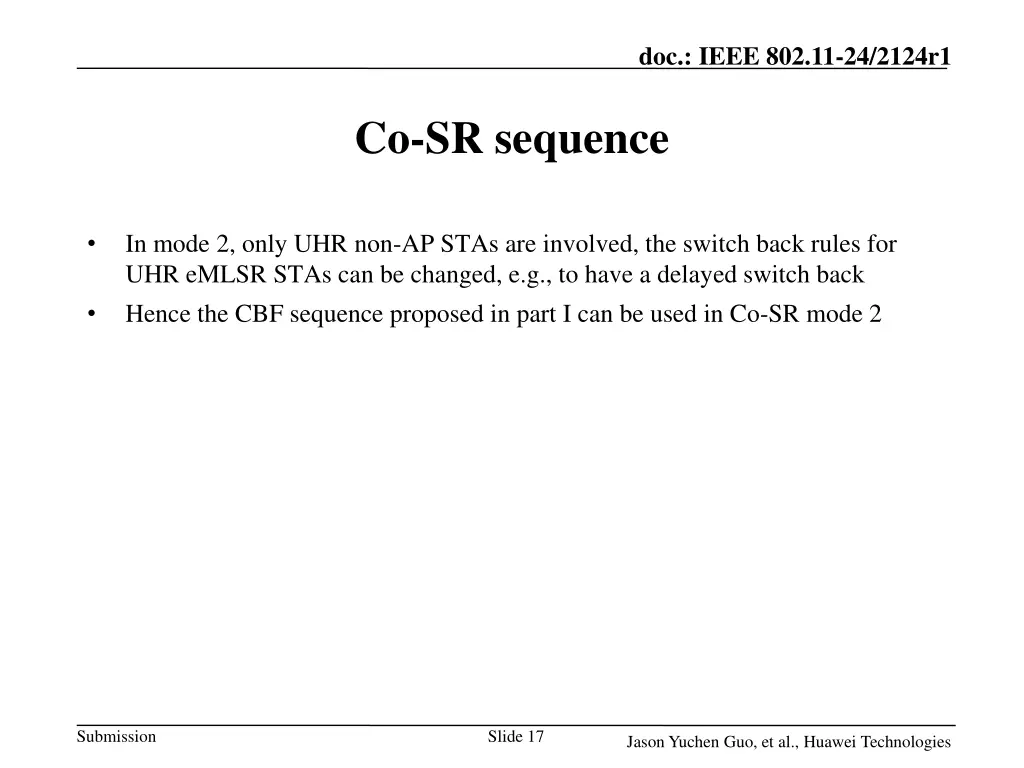
doc.: IEEE 802.11-24/2124r1 Co-SR sequence In mode 2, only UHR non-AP STAs are involved, the switch back rules for UHR eMLSR STAs can be changed, e.g., to have a delayed switch back Hence the CBF sequence proposed in part I can be used in Co-SR mode 2 Submission Slide 17 Jason Yuchen Guo, et al., Huawei Technologies
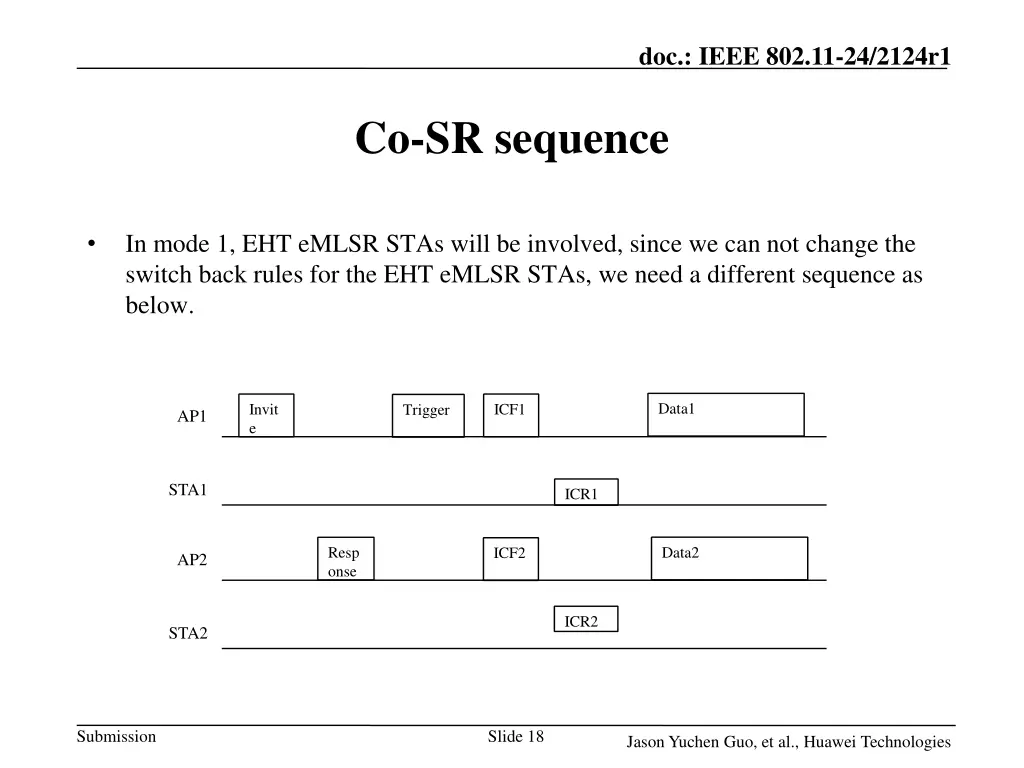
doc.: IEEE 802.11-24/2124r1 Co-SR sequence In mode 1, EHT eMLSR STAs will be involved, since we can not change the switch back rules for the EHT eMLSR STAs, we need a different sequence as below. Data1 Invit e ICF1 Trigger AP1 STA1 ICR1 Data2 Resp onse ICF2 AP2 ICR2 STA2 Submission Slide 18 Jason Yuchen Guo, et al., Huawei Technologies
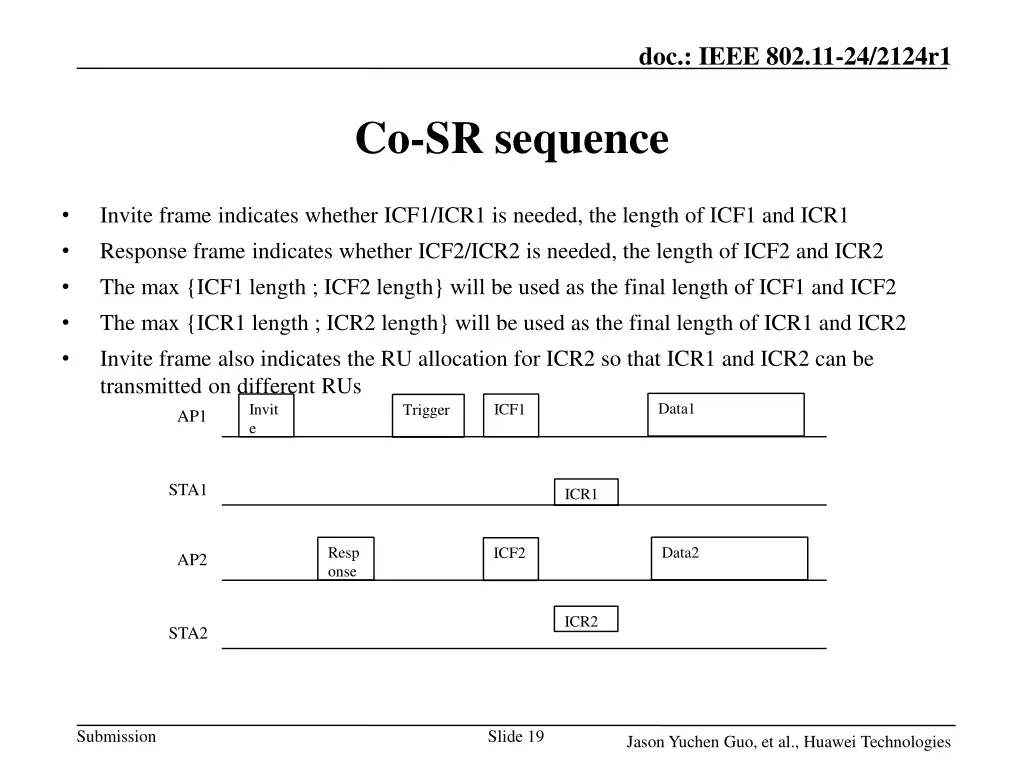
doc.: IEEE 802.11-24/2124r1 Co-SR sequence Invite frame indicates whether ICF1/ICR1 is needed, the length of ICF1 and ICR1 Response frame indicates whether ICF2/ICR2 is needed, the length of ICF2 and ICR2 The max {ICF1 length ; ICF2 length} will be used as the final length of ICF1 and ICF2 The max {ICR1 length ; ICR2 length} will be used as the final length of ICR1 and ICR2 Invite frame also indicates the RU allocation for ICR2 so that ICR1 and ICR2 can be transmitted on different RUs Data1 Invit e ICF1 Trigger AP1 STA1 ICR1 Data2 Resp onse ICF2 AP2 ICR2 STA2 Submission Slide 19 Jason Yuchen Guo, et al., Huawei Technologies
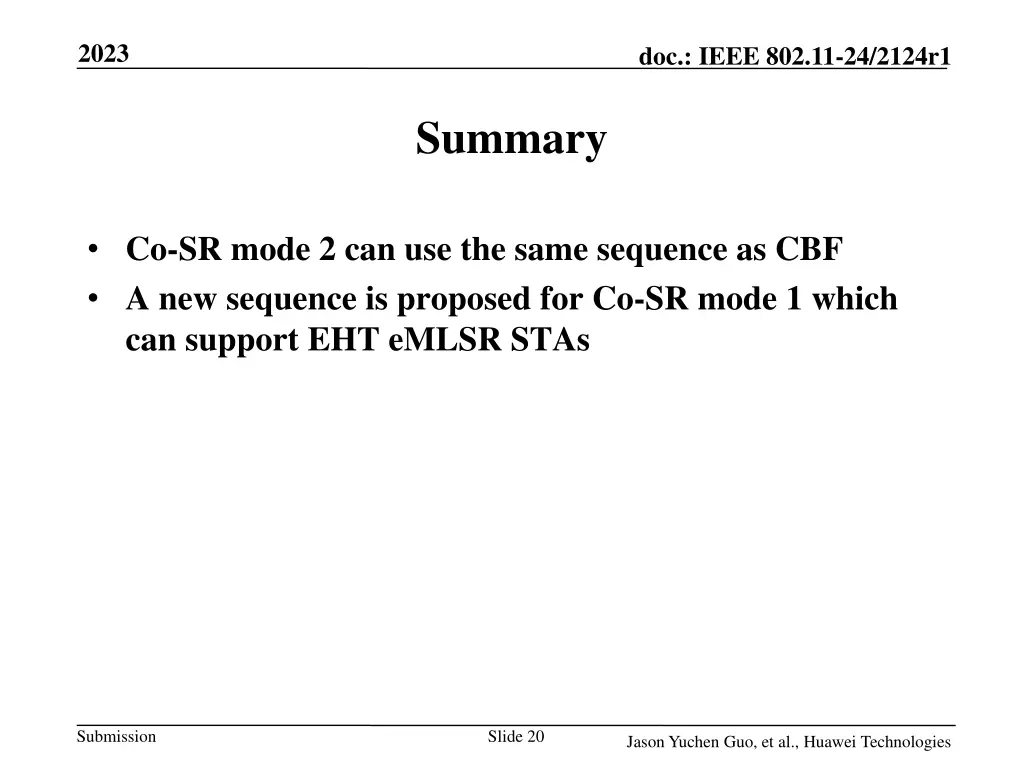
2023 doc.: IEEE 802.11-24/2124r1 Summary Co-SR mode 2 can use the same sequence as CBF A new sequence is proposed for Co-SR mode 1 which can support EHT eMLSR STAs Submission Slide 20 Jason Yuchen Guo, et al., Huawei Technologies
doc.: IEEE 802.11-24/2124r1 References [1] 11-25/0412r0 CoBF Frame Sequences and Signaling Details Submission Slide 21 Jason Yuchen Guo, et al., Huawei Technologies