IEEE 802.11-25/0557r0 Discussion on NP-Channel Access Mechanism
Explore the proposal for a mechanism addressing CID 1774 in IEEE 802.11-25/0557r0 document, focusing on enabling NP-channel access for DPS STAs and discussing the potential switch to higher capability modes. The proposal suggests defining behaviors for DPS STAs when transitioning to NP-channel primary channel, emphasizing the importance of optimizing time and decision-making based on traffic and power statuses.

Download Presentation

Please find below an Image/Link to download the presentation.
The content on the website is provided AS IS for your information and personal use only. It may not be sold, licensed, or shared on other websites without obtaining consent from the author. If you encounter any issues during the download, it is possible that the publisher has removed the file from their server.
You are allowed to download the files provided on this website for personal or commercial use, subject to the condition that they are used lawfully. All files are the property of their respective owners.
The content on the website is provided AS IS for your information and personal use only. It may not be sold, licensed, or shared on other websites without obtaining consent from the author.
E N D
Presentation Transcript
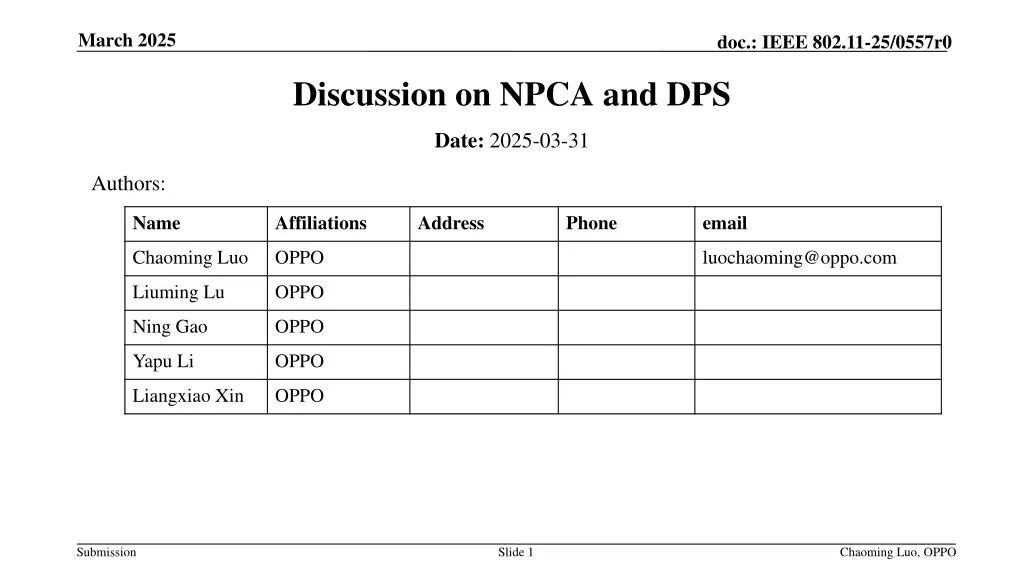
March 2025 doc.: IEEE 802.11-25/0557r0 Discussion on NPCA and DPS Date: 2025-03-31 Authors: Name Affiliations Address Phone email Chaoming Luo OPPO luochaoming@oppo.com Liuming Lu OPPO Ning Gao OPPO Yapu Li OPPO Liangxiao Xin OPPO Submission Slide 1 Chaoming Luo, OPPO
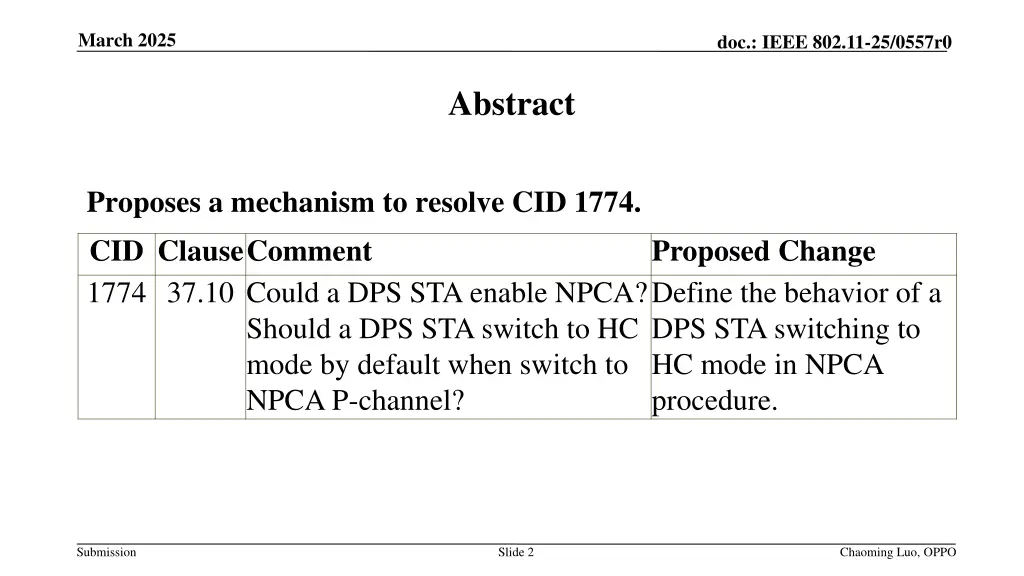
March 2025 doc.: IEEE 802.11-25/0557r0 Abstract Proposes a mechanism to resolve CID 1774. CID ClauseComment 1774 37.10 Could a DPS STA enable NPCA? Should a DPS STA switch to HC mode by default when switch to NPCA P-channel? Proposed Change Define the behavior of a DPS STA switching to HC mode in NPCA procedure. Submission Slide 2 Chaoming Luo, OPPO
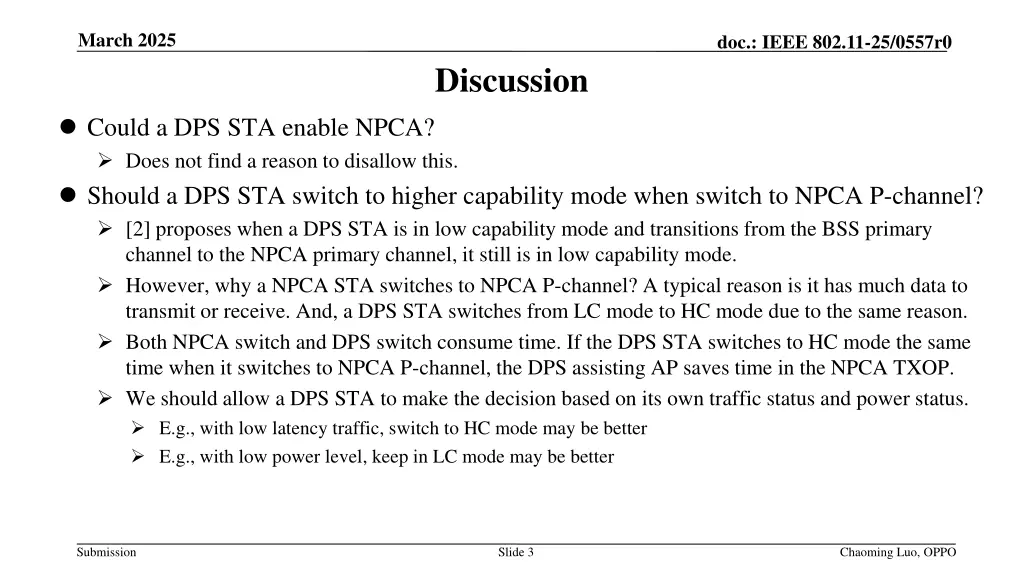
March 2025 doc.: IEEE 802.11-25/0557r0 Discussion Could a DPS STA enable NPCA? Does not find a reason to disallow this. Should a DPS STA switch to higher capability mode when switch to NPCA P-channel? [2] proposes when a DPS STA is in low capability mode and transitions from the BSS primary channel to the NPCA primary channel, it still is in low capability mode. However, why a NPCA STA switches to NPCA P-channel? A typical reason is it has much data to transmit or receive. And, a DPS STA switches from LC mode to HC mode due to the same reason. Both NPCA switch and DPS switch consume time. If the DPS STA switches to HC mode the same time when it switches to NPCA P-channel, the DPS assisting AP saves time in the NPCA TXOP. We should allow a DPS STA to make the decision based on its own traffic status and power status. E.g., with low latency traffic, switch to HC mode may be better E.g., with low power level, keep in LC mode may be better Submission Slide 3 Chaoming Luo, OPPO
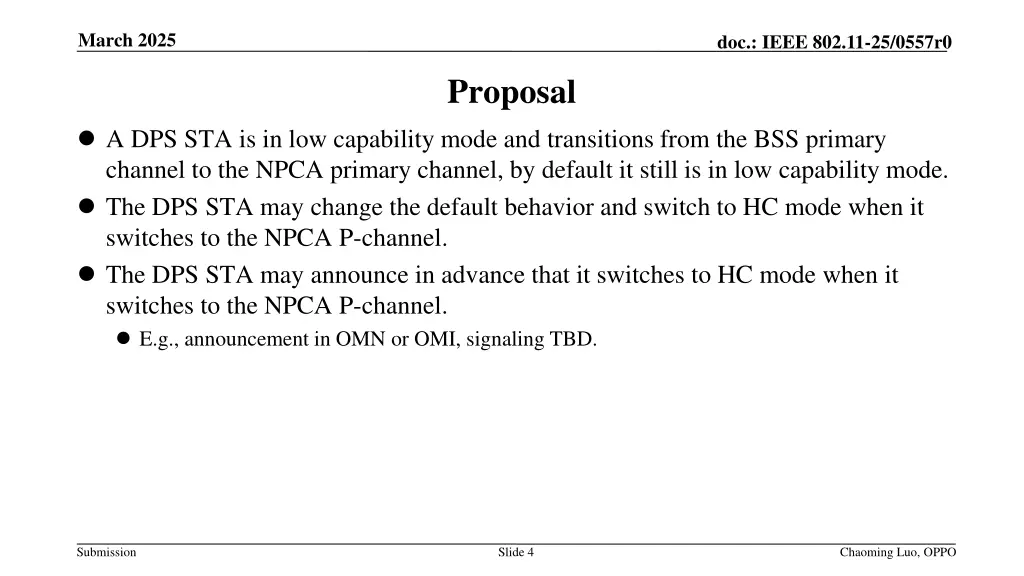
March 2025 doc.: IEEE 802.11-25/0557r0 Proposal A DPS STA is in low capability mode and transitions from the BSS primary channel to the NPCA primary channel, by default it still is in low capability mode. The DPS STA may change the default behavior and switch to HC mode when it switches to the NPCA P-channel. The DPS STA may announce in advance that it switches to HC mode when it switches to the NPCA P-channel. E.g., announcement in OMN or OMI, signaling TBD. Submission Slide 4 Chaoming Luo, OPPO
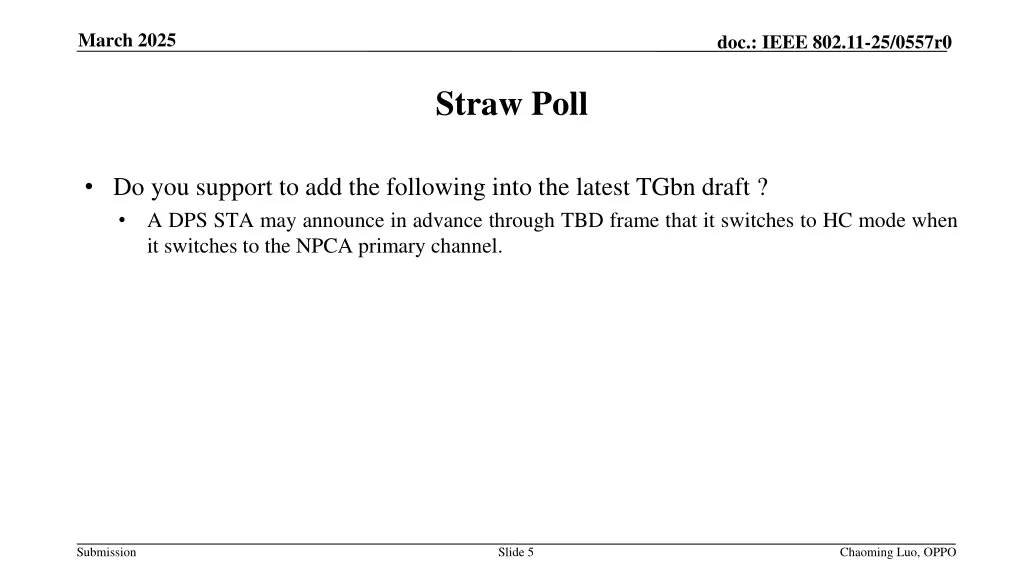
March 2025 doc.: IEEE 802.11-25/0557r0 Straw Poll Do you support to add the following into the latest TGbn draft ? A DPS STA may announce in advance through TBD frame that it switches to HC mode when it switches to the NPCA primary channel. Submission Slide 5 Chaoming Luo, OPPO
March 2025 doc.: IEEE 802.11-25/0557r0 References [1] Draft P802.11bn_D0.1 [2] 11-24-1886-00-00bn-npca-with-emlsr-dps-coex-mode Submission Slide 6 Chaoming Luo, OPPO