Explore the IEEE 802.11 threshold-based sensing procedure for selecting receivers with significant CSI variations, reducing overhead by triggering only relevant receivers for further feedback. Learn about the optional threshold-based measurement and reporting procedure, including CSI variation calculation methods and signaling between initiator and responder.
Please find below an Image/Link to download the presentation.
The content on the website is provided AS IS for your information and personal use only. It may not be sold, licensed, or shared on other websites without obtaining consent from the author. If you encounter any issues during the download, it is possible that the publisher has removed the file from their server.
You are allowed to download the files provided on this website for personal or commercial use, subject to the condition that they are used lawfully. All files are the property of their respective owners.
The content on the website is provided AS IS for your information and personal use only. It may not be sold, licensed, or shared on other websites without obtaining consent from the author.
E N D
Presentation Transcript
Sep 2021 doc.: IEEE 802.11-21/1364r2 Threshold Based Sensing Procedure Date: 2021-09-24 Authors: Name Affiliation Address Phone Email Mengshi Hu humengshi@huawei.com Rui Du Huawei Technologies Co. Ltd F3, Huawei Base, Shenzhen, China Chenchen Liu Yi Lv Danny Kai Pin Tan Submission Slide 1 Mengshi Hu (Huawei)
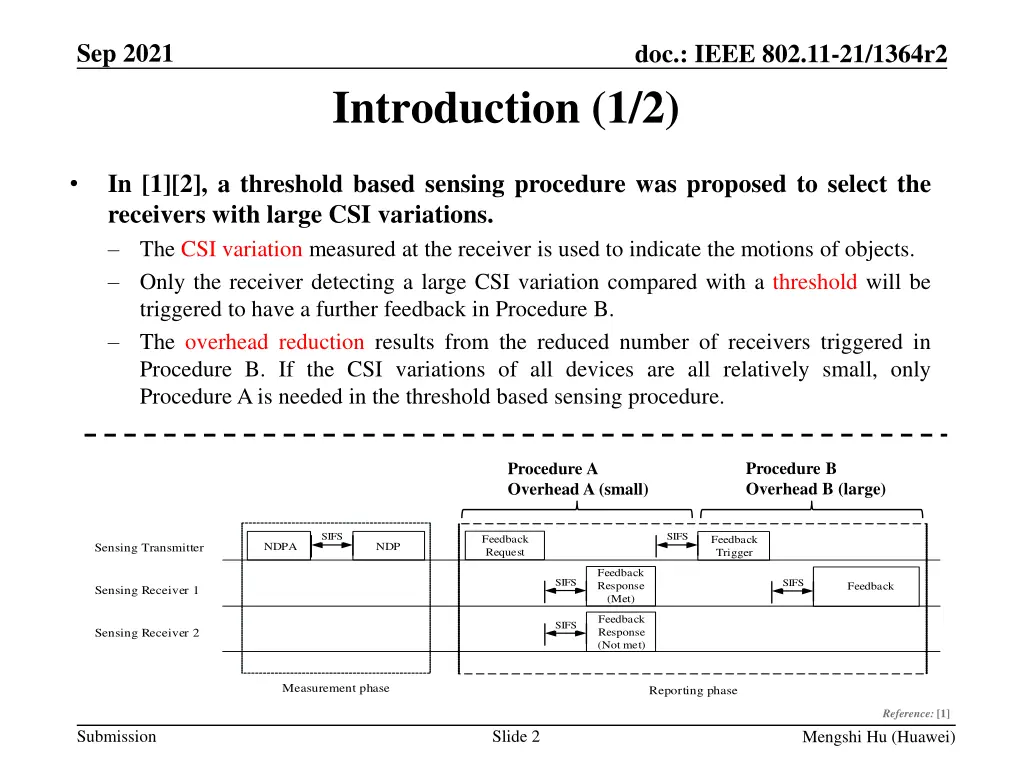
Sep 2021 doc.: IEEE 802.11-21/1364r2 Introduction (1/2) In [1][2], a threshold based sensing procedure was proposed to select the receivers with large CSI variations. The CSI variation measured at the receiver is used to indicate the motions of objects. Only the receiver detecting a large CSI variation compared with a threshold will be triggered to have a further feedback in Procedure B. The overhead reduction results from the reduced number of receivers triggered in Procedure B. If the CSI variations of all devices are all relatively small, only Procedure A is needed in the threshold based sensing procedure. Procedure B Overhead B (large) Procedure A Overhead A (small) SIFS SIFS Feedback Request Feedback Trigger NDPA NDP Sensing Transmitter Feedback Response (Met) SIFS SIFS Feedback Sensing Receiver 1 Feedback Response (Not met) SIFS Sensing Receiver 2 Measurement phase Reporting phase Reference: [1] Submission Slide 2 Mengshi Hu (Huawei)
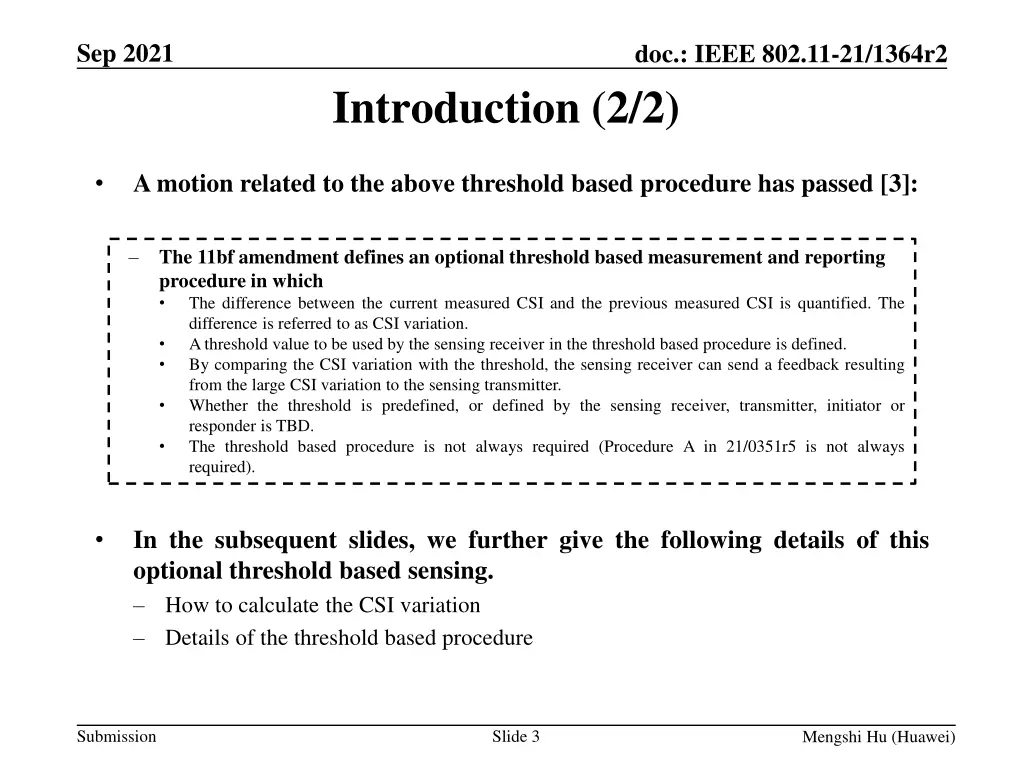
Sep 2021 doc.: IEEE 802.11-21/1364r2 Introduction (2/2) A motion related to the above threshold based procedure has passed [3]: The 11bf amendment defines an optional threshold based measurement and reporting procedure in which The difference between the current measured CSI and the previous measured CSI is quantified. The difference is referred to as CSI variation. A threshold value to be used by the sensing receiver in the threshold based procedure is defined. By comparing the CSI variation with the threshold, the sensing receiver can send a feedback resulting from the large CSI variation to the sensing transmitter. Whether the threshold is predefined, or defined by the sensing receiver, transmitter, initiator or responder is TBD. The threshold based procedure is not always required (Procedure A in 21/0351r5 is not always required). In the subsequent slides, we further give the following details of this optional threshold based sensing. How to calculate the CSI variation Details of the threshold based procedure Submission Slide 3 Mengshi Hu (Huawei)
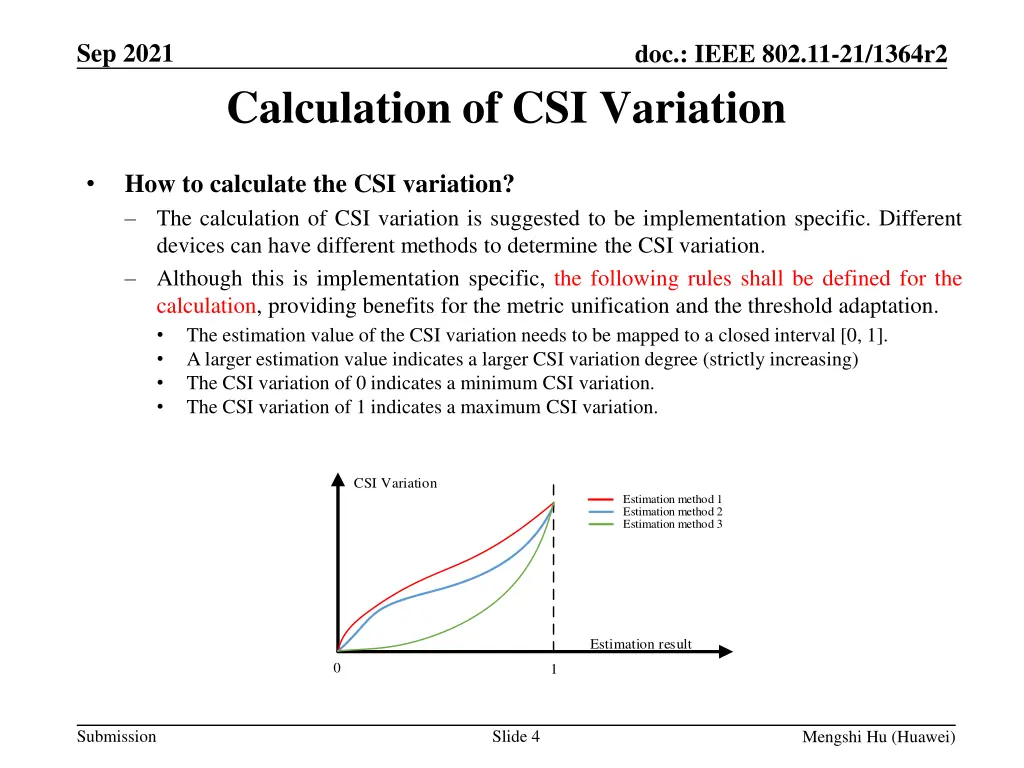
Sep 2021 doc.: IEEE 802.11-21/1364r2 Calculation of CSI Variation How to calculate the CSI variation? The calculation of CSI variation is suggested to be implementation specific. Different devices can have different methods to determine the CSI variation. Although this is implementation specific, the following rules shall be defined for the calculation, providing benefits for the metric unification and the threshold adaptation. The estimation value of the CSI variation needs to be mapped to a closed interval [0, 1]. A larger estimation value indicates a larger CSI variation degree (strictly increasing) The CSI variation of 0 indicates a minimum CSI variation. The CSI variation of 1 indicates a maximum CSI variation. CSI Variation Estimation method 1 Estimation method 2 Estimation method 3 Estimation result 0 1 Submission Slide 4 Mengshi Hu (Huawei)
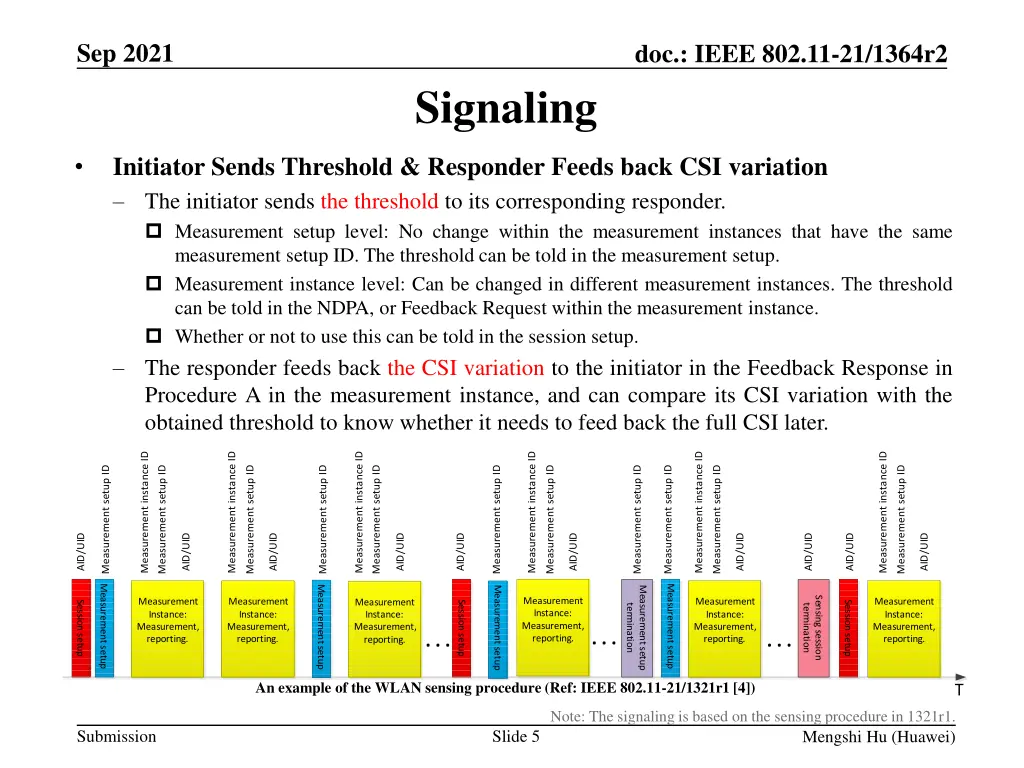
Sep 2021 doc.: IEEE 802.11-21/1364r2 Signaling Initiator Sends Threshold & Responder Feeds back CSI variation The initiator sends the threshold to its corresponding responder. Measurement setup level: No change within the measurement instances that have the same measurement setup ID. The threshold can be told in the measurement setup. Measurement instance level: Can be changed in different measurement instances. The threshold can be told in the NDPA, or Feedback Request within the measurement instance. Whether or not to use this can be told in the session setup. The responder feeds back the CSI variation to the initiator in the Feedback Response in Procedure A in the measurement instance, and can compare its CSI variation with the obtained threshold to know whether it needs to feed back the full CSI later. Measurement instance ID Measurement instance ID Measurement instance ID Measurement instance ID Measurement instance ID Measurement instance ID Measurement setup ID Measurement setup ID Measurement setup ID Measurement setup ID Measurement setup ID Measurement setup ID Measurement setup ID Measurement setup ID Measurement setup ID Measurement setup ID Measurement setup ID AID/UID AID/UID AID/UID AID/UID AID/UID AID/UID AID/UID AID/UID AID/UID AID/UID Measurement setup Measurement setup Measurement setup Measurement setup Measurement setup Sensing session Measurement Instance: Measurement, reporting. Measurement Instance: Measurement, reporting. Measurement Instance: Measurement, reporting. Measurement Instance: Measurement, reporting. Measurement Instance: Measurement, reporting. Measurement Instance: Measurement, reporting. Session setup Session setup Session setup termination termination . . . . . . . . . An example of the WLAN sensing procedure (Ref: IEEE 802.11-21/1321r1 [4]) T Note: The signaling is based on the sensing procedure in 1321r1. Submission Slide 5 Mengshi Hu (Huawei)
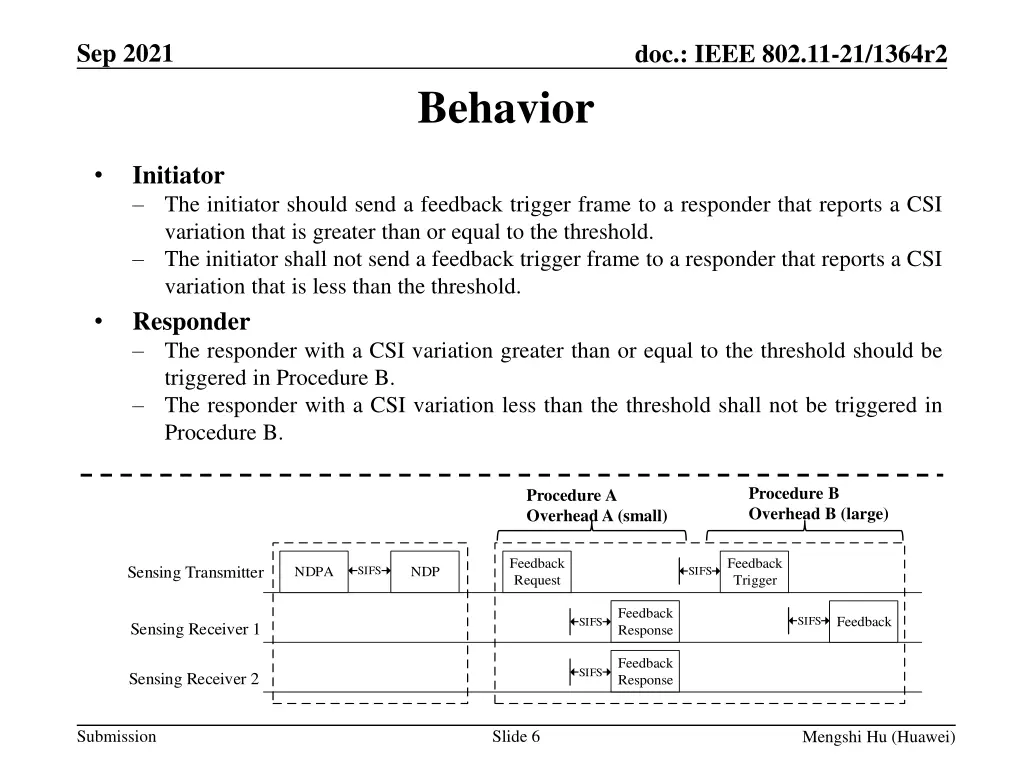
Sep 2021 doc.: IEEE 802.11-21/1364r2 Behavior Initiator The initiator should send a feedback trigger frame to a responder that reports a CSI variation that is greater than or equal to the threshold. The initiator shall not send a feedback trigger frame to a responder that reports a CSI variation that is less than the threshold. Responder The responder with a CSI variation greater than or equal to the threshold should be triggered in Procedure B. The responder with a CSI variation less than the threshold shall not be triggered in Procedure B. Procedure B Overhead B (large) Procedure A Overhead A (small) Feedback Request Feedback Trigger Sensing Transmitter NDPA NDP SIFS SIFS Feedback Response Feedback SIFS SIFS Sensing Receiver 1 Feedback Response SIFS Sensing Receiver 2 Submission Slide 6 Mengshi Hu (Huawei)
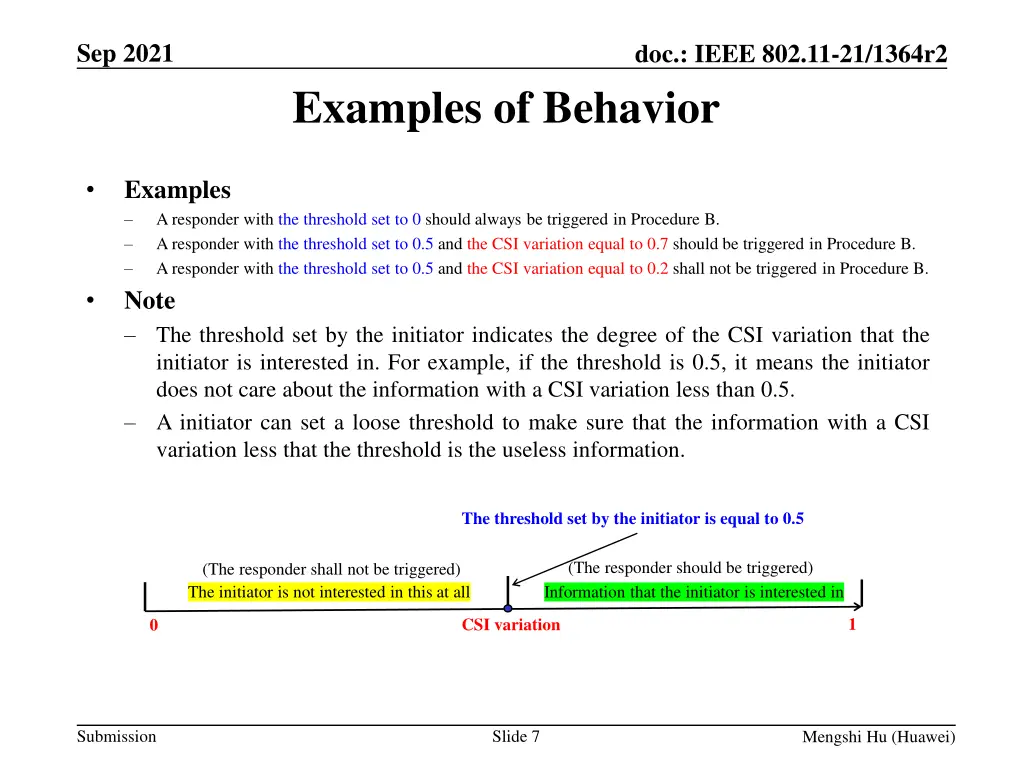
Sep 2021 doc.: IEEE 802.11-21/1364r2 Examples of Behavior Examples A responder with the threshold set to 0 should always be triggered in Procedure B. A responder with the threshold set to 0.5 and the CSI variation equal to 0.7 should be triggered in Procedure B. A responder with the threshold set to 0.5 and the CSI variation equal to 0.2 shall not be triggered in Procedure B. Note The threshold set by the initiator indicates the degree of the CSI variation that the initiator is interested in. For example, if the threshold is 0.5, it means the initiator does not care about the information with a CSI variation less than 0.5. A initiator can set a loose threshold to make sure that the information with a CSI variation less that the threshold is the useless information. The threshold set by the initiator is equal to 0.5 (The responder should be triggered) (The responder shall not be triggered) The initiator is not interested in this at all Information that the initiator is interested in 1 CSI variation 0 Submission Slide 7 Mengshi Hu (Huawei)
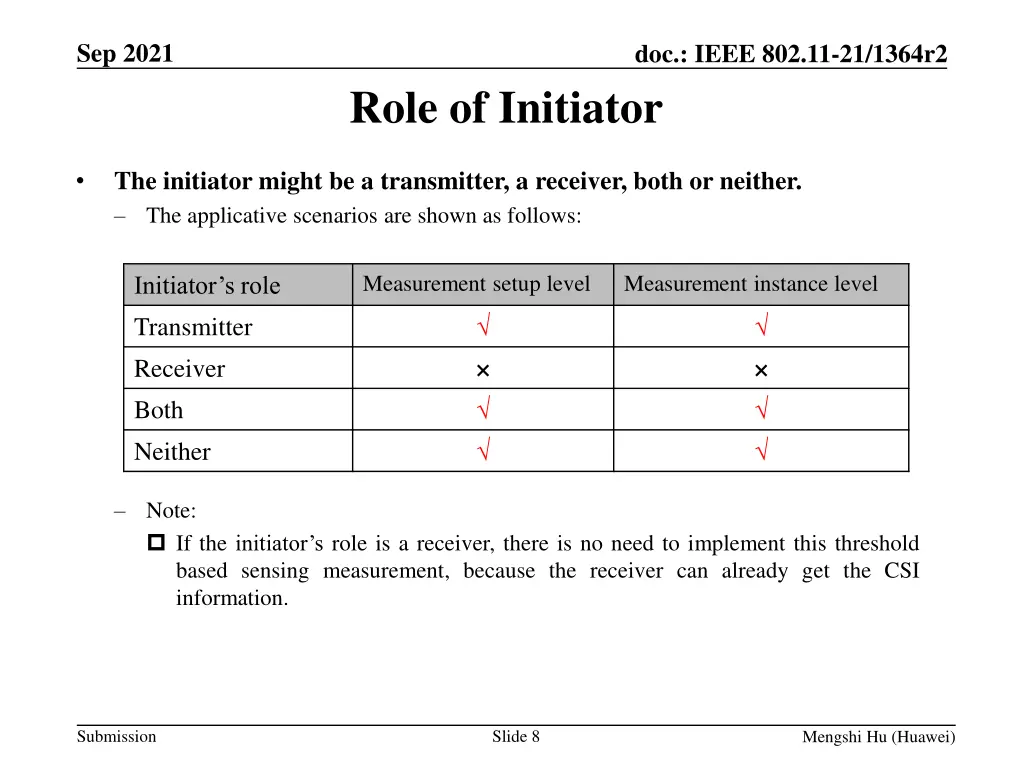
Sep 2021 doc.: IEEE 802.11-21/1364r2 Role of Initiator The initiator might be a transmitter, a receiver, both or neither. The applicative scenarios are shown as follows: Measurement setup level Measurement instance level Initiator s role Transmitter Receiver Both Neither Note: If the initiator s role is a receiver, there is no need to implement this threshold based sensing measurement, because the receiver can already get the CSI information. Submission Slide 8 Mengshi Hu (Huawei)
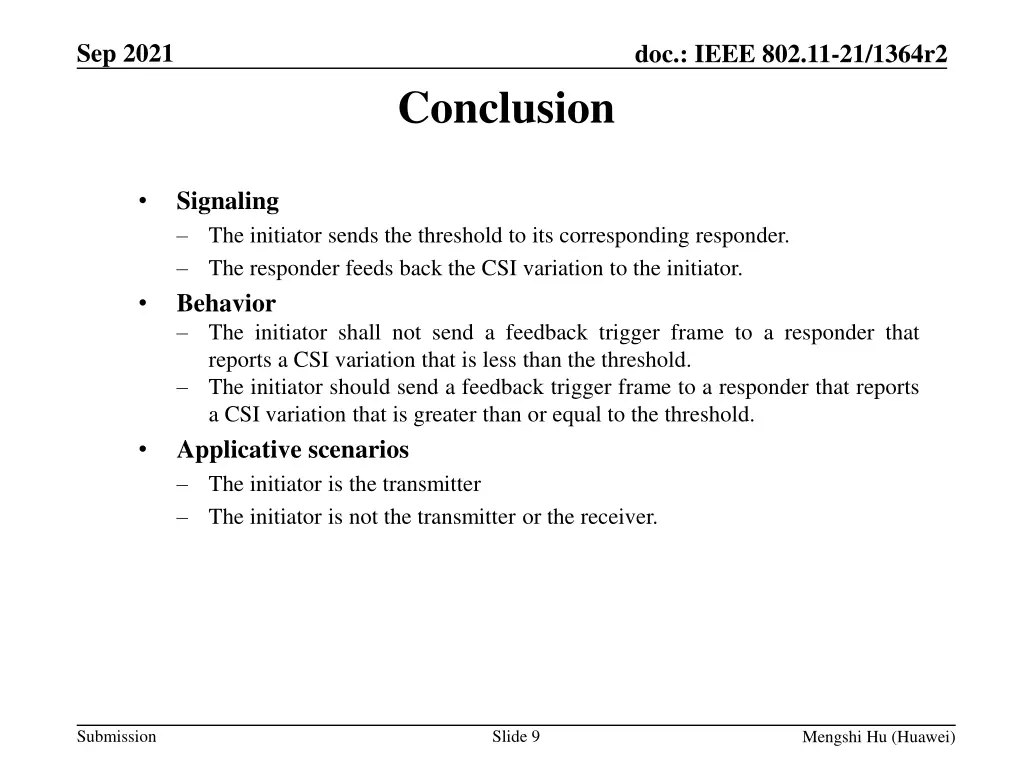
Sep 2021 doc.: IEEE 802.11-21/1364r2 Conclusion Signaling The initiator sends the threshold to its corresponding responder. The responder feeds back the CSI variation to the initiator. Behavior The initiator shall not send a feedback trigger frame to a responder that reports a CSI variation that is less than the threshold. The initiator should send a feedback trigger frame to a responder that reports a CSI variation that is greater than or equal to the threshold. Applicative scenarios The initiator is the transmitter The initiator is not the transmitter or the receiver. Submission Slide 9 Mengshi Hu (Huawei)
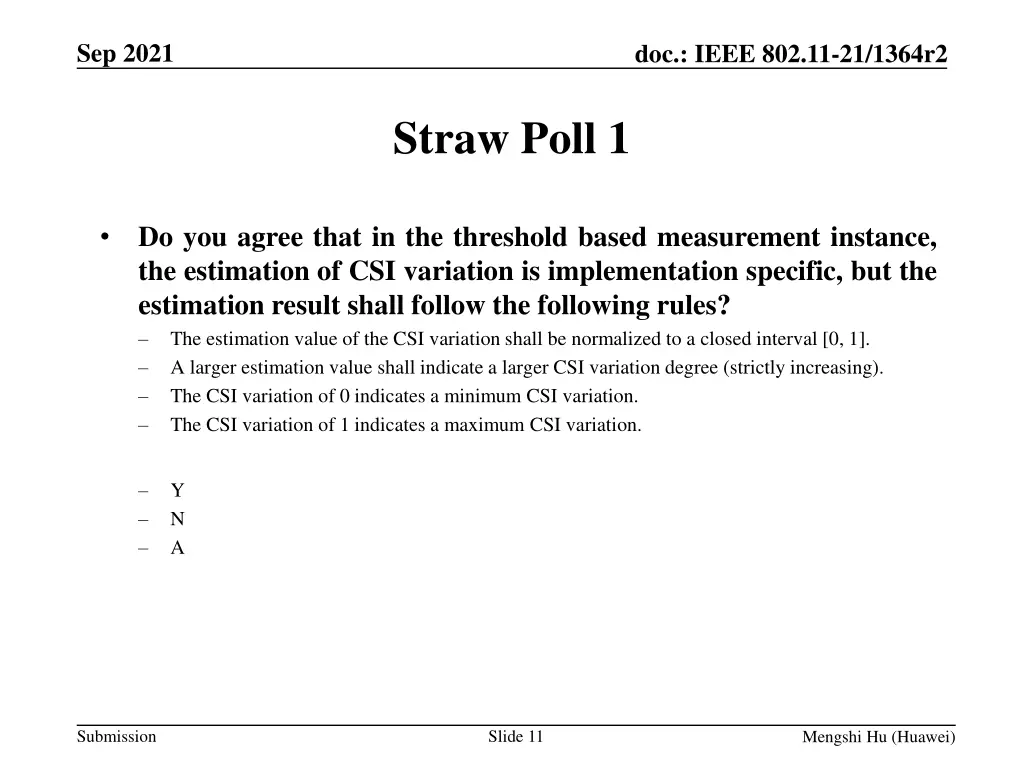
Sep 2021 doc.: IEEE 802.11-21/1364r2 Straw Poll 1 Do you agree that in the threshold based measurement instance, the estimation of CSI variation is implementation specific, but the estimation result shall follow the following rules? The estimation value of the CSI variation shall be normalized to a closed interval [0, 1]. A larger estimation value shall indicate a larger CSI variation degree (strictly increasing). The CSI variation of 0 indicates a minimum CSI variation. The CSI variation of 1 indicates a maximum CSI variation. Y N A Submission Slide 11 Mengshi Hu (Huawei)
Sep 2021 doc.: IEEE 802.11-21/1364r2 Straw Poll 2 Do you agree that in the threshold based measurement instance, the threshold to be compared with the CSI variation value is determined by the initiator? Y N A Submission Slide 12 Mengshi Hu (Huawei)
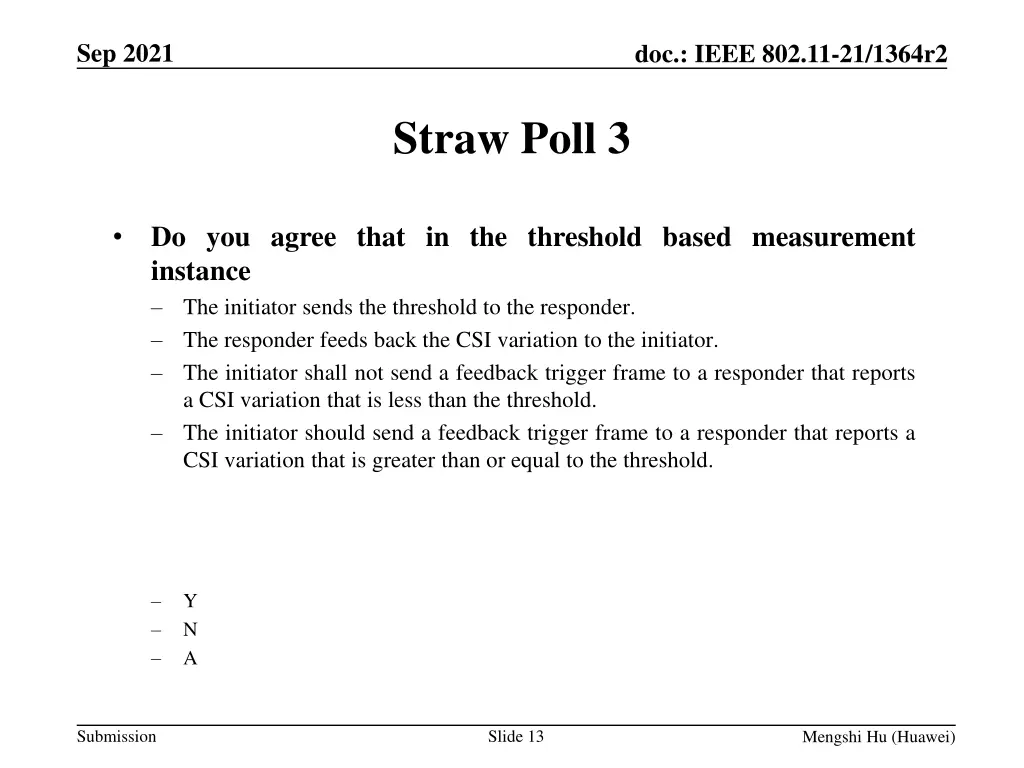
Sep 2021 doc.: IEEE 802.11-21/1364r2 Straw Poll 3 Do you agree that in the threshold based measurement instance The initiator sends the threshold to the responder. The responder feeds back the CSI variation to the initiator. The initiator shall not send a feedback trigger frame to a responder that reports a CSI variation that is less than the threshold. The initiator should send a feedback trigger frame to a responder that reports a CSI variation that is greater than or equal to the threshold. Y N A Submission Slide 13 Mengshi Hu (Huawei)