IEEE 802.11be Spectral Flatness Requirements for EHT Modes
Delve into the complex spectral flatness requirements for IEEE 802.11be transmissions, addressing cases like DUP and puncturing, with proposals for different BW and OFDMA scenarios to ensure optimal performance and compliance.

Download Presentation

Please find below an Image/Link to download the presentation.
The content on the website is provided AS IS for your information and personal use only. It may not be sold, licensed, or shared on other websites without obtaining consent from the author. If you encounter any issues during the download, it is possible that the publisher has removed the file from their server.
You are allowed to download the files provided on this website for personal or commercial use, subject to the condition that they are used lawfully. All files are the property of their respective owners.
The content on the website is provided AS IS for your information and personal use only. It may not be sold, licensed, or shared on other websites without obtaining consent from the author.
E N D
Presentation Transcript
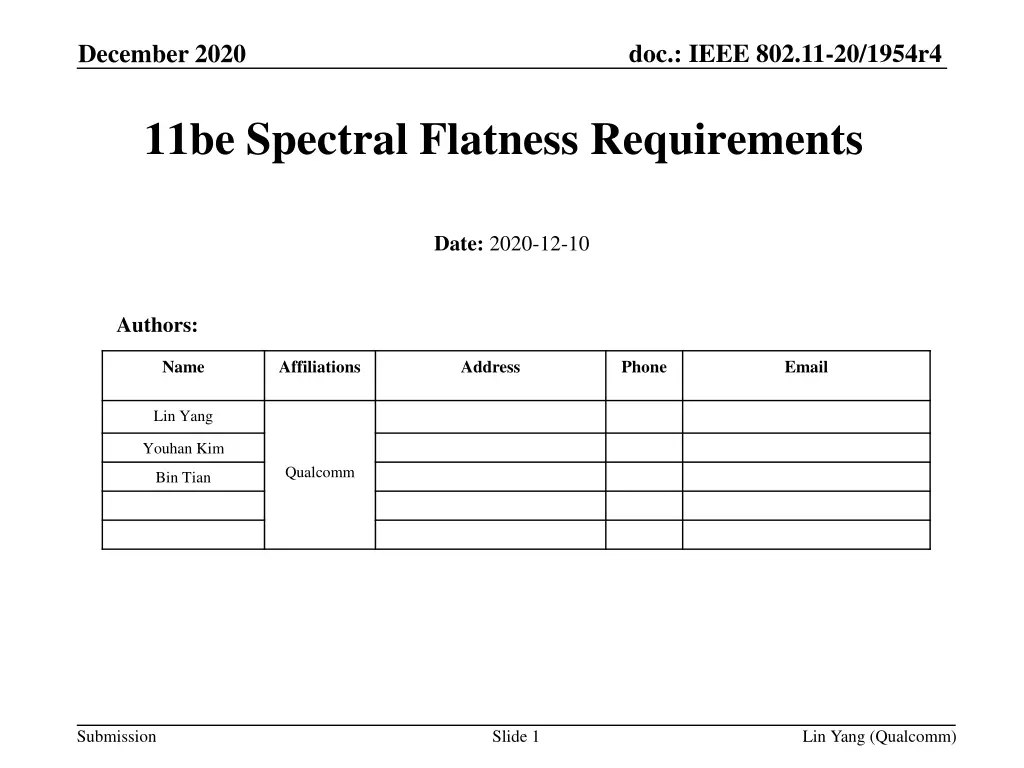
doc.: IEEE 802.11-20/1954r4 December 2020 11be Spectral Flatness Requirements Date: 2020-12-10 Authors: Name Affiliations Address Phone Email Lin Yang Youhan Kim Qualcomm Bin Tian Submission Slide 1 Lin Yang (Qualcomm)
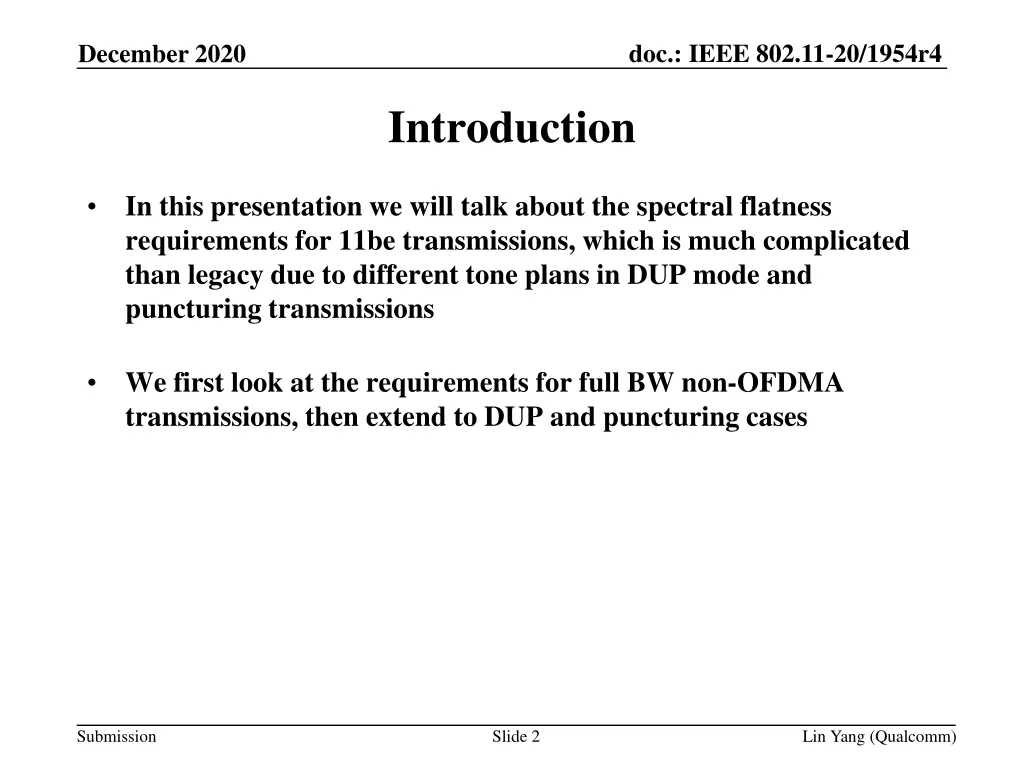
doc.: IEEE 802.11-20/1954r4 December 2020 Introduction In this presentation we will talk about the spectral flatness requirements for 11be transmissions, which is much complicated than legacy due to different tone plans in DUP mode and puncturing transmissions We first look at the requirements for full BW non-OFDMA transmissions, then extend to DUP and puncturing cases Submission Slide 2 Lin Yang (Qualcomm)
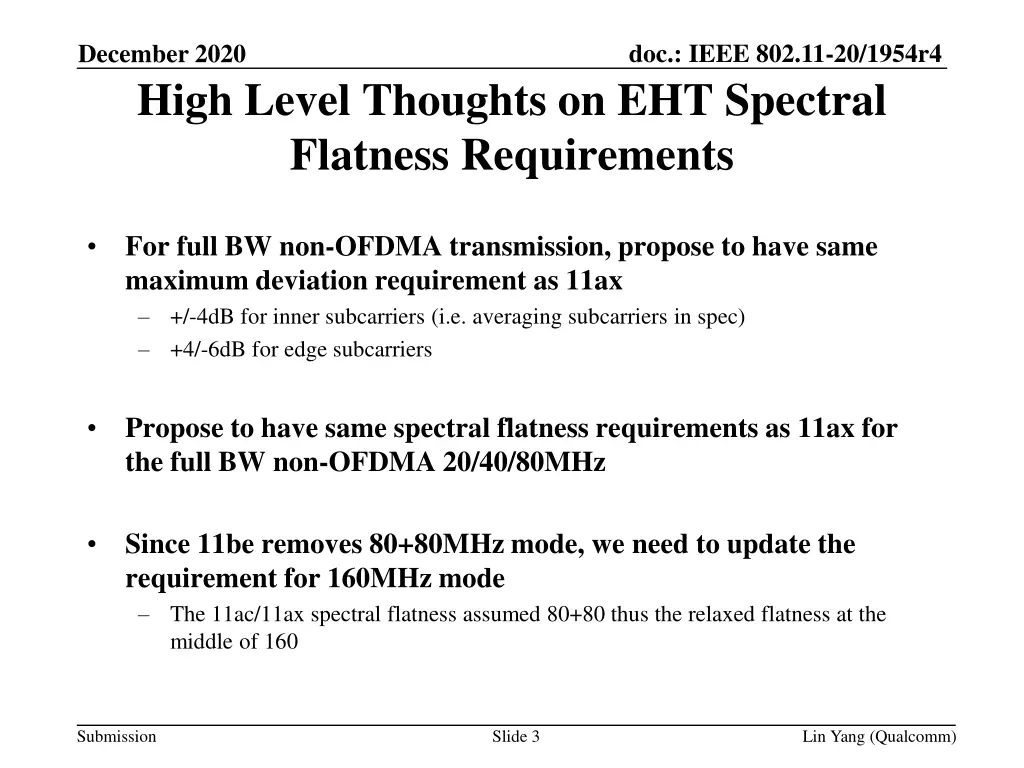
doc.: IEEE 802.11-20/1954r4 December 2020 High Level Thoughts on EHT Spectral Flatness Requirements For full BW non-OFDMA transmission, propose to have same maximum deviation requirement as 11ax +/-4dB for inner subcarriers (i.e. averaging subcarriers in spec) +4/-6dB for edge subcarriers Propose to have same spectral flatness requirements as 11ax for the full BW non-OFDMA 20/40/80MHz Since 11be removes 80+80MHz mode, we need to update the requirement for 160MHz mode The 11ac/11ax spectral flatness assumed 80+80 thus the relaxed flatness at the middle of 160 Submission Slide 3 Lin Yang (Qualcomm)
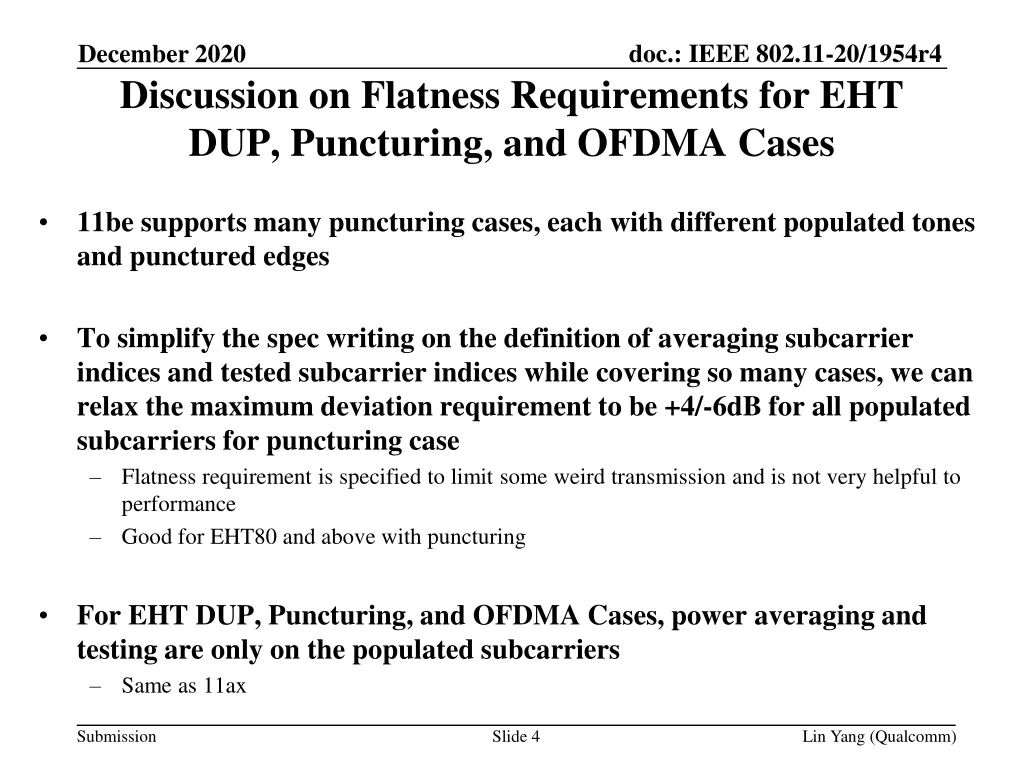
doc.: IEEE 802.11-20/1954r4 December 2020 Discussion on Flatness Requirements for EHT DUP, Puncturing, and OFDMA Cases 11be supports many puncturing cases, each with different populated tones and punctured edges To simplify the spec writing on the definition of averaging subcarrier indices and tested subcarrier indices while covering so many cases, we can relax the maximum deviation requirement to be +4/-6dB for all populated subcarriers for puncturing case Flatness requirement is specified to limit some weird transmission and is not very helpful to performance Good for EHT80 and above with puncturing For EHT DUP, Puncturing, and OFDMA Cases, power averaging and testing are only on the populated subcarriers Same as 11ax Submission Slide 4 Lin Yang (Qualcomm)
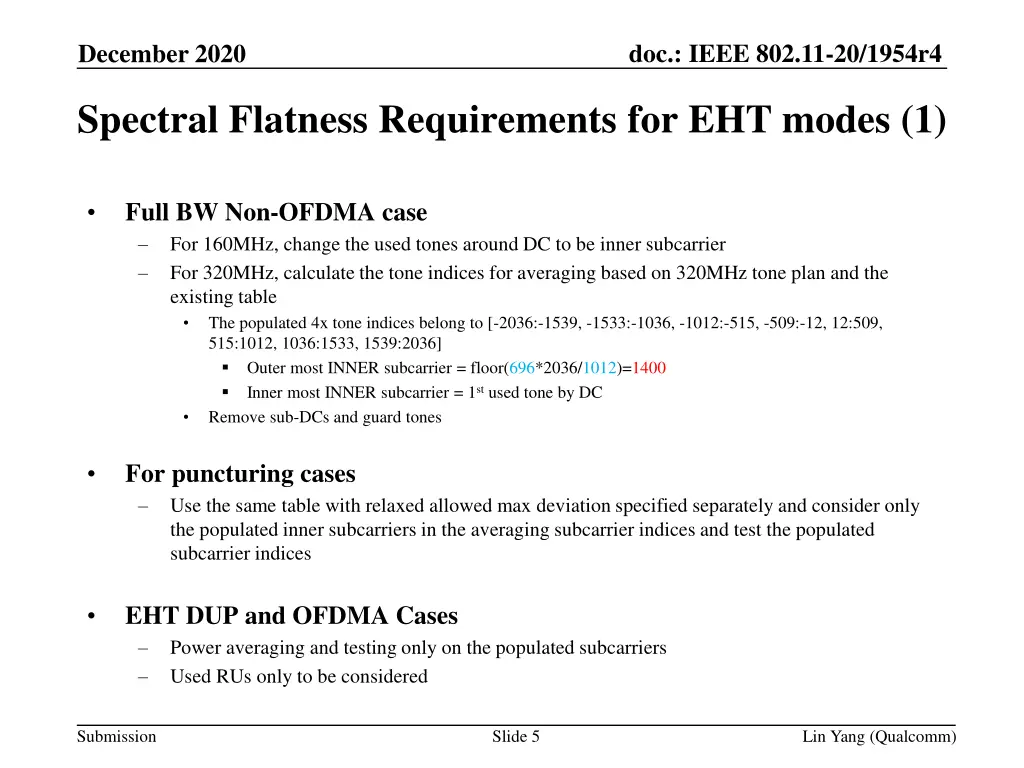
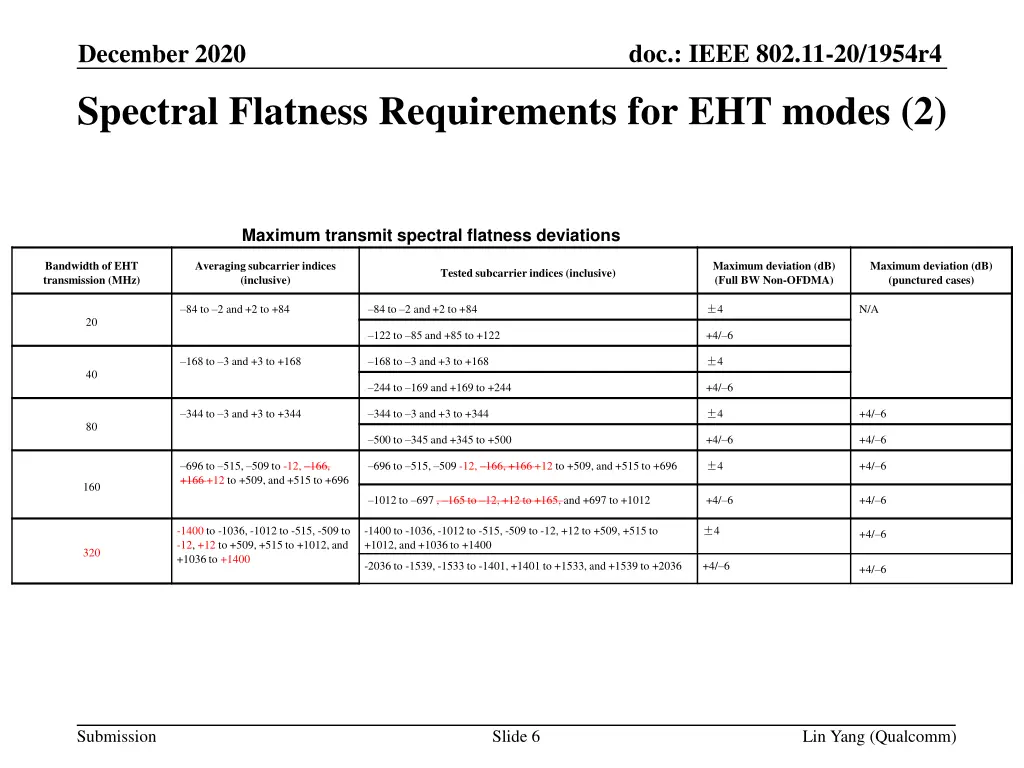
doc.: IEEE 802.11-20/1954r4 December 2020 Spectral Flatness Requirements for EHT modes (1) Full BW Non-OFDMA case For 160MHz, change the used tones around DC to be inner subcarrier For 320MHz, calculate the tone indices for averaging based on 320MHz tone plan and the existing table The populated 4x tone indices belong to [-2036:-1539, -1533:-1036, -1012:-515, -509:-12, 12:509, 515:1012, 1036:1533, 1539:2036] Outer most INNER subcarrier = floor(696*2036/1012)=1400 Inner most INNER subcarrier = 1st used tone by DC Remove sub-DCs and guard tones For puncturing cases Use the same table with relaxed allowed max deviation specified separately and consider only the populated inner subcarriers in the averaging subcarrier indices and test the populated subcarrier indices EHT DUP and OFDMA Cases Power averaging and testing only on the populated subcarriers Used RUs only to be considered Submission Slide 5 Lin Yang (Qualcomm)
doc.: IEEE 802.11-20/1954r4 December 2020 Spectral Flatness Requirements for EHT modes (2) Maximum transmit spectral flatness deviations Bandwidth of EHT transmission (MHz) Averaging subcarrier indices (inclusive) Maximum deviation (dB) (Full BW Non-OFDMA) Maximum deviation (dB) (punctured cases) Tested subcarrier indices (inclusive) 84 to 2 and +2 to +84 84 to 2 and +2 to +84 4 N/A 20 122 to 85 and +85 to +122 +4/ 6 168 to 3 and +3 to +168 168 to 3 and +3 to +168 4 40 244 to 169 and +169 to +244 +4/ 6 344 to 3 and +3 to +344 344 to 3 and +3 to +344 4 +4/ 6 80 500 to 345 and +345 to +500 +4/ 6 +4/ 6 696 to 515, 509 to -12, 166, +166 +12 to +509, and +515 to +696 696 to 515, 509 -12, 166, +166 +12 to +509, and +515 to +696 4 +4/ 6 160 1012 to 697 , 165 to 12, +12 to +165, and +697 to +1012 +4/ 6 +4/ 6 -1400 to -1036, -1012 to -515, -509 to -12, +12 to +509, +515 to +1012, and +1036 to +1400 -1400 to -1036, -1012 to -515, -509 to -12, +12 to +509, +515 to +1012, and +1036 to +1400 4 +4/ 6 320 -2036 to -1539, -1533 to -1401, +1401 to +1533, and +1539 to +2036 +4/ 6 +4/ 6 Submission Slide 6 Lin Yang (Qualcomm)
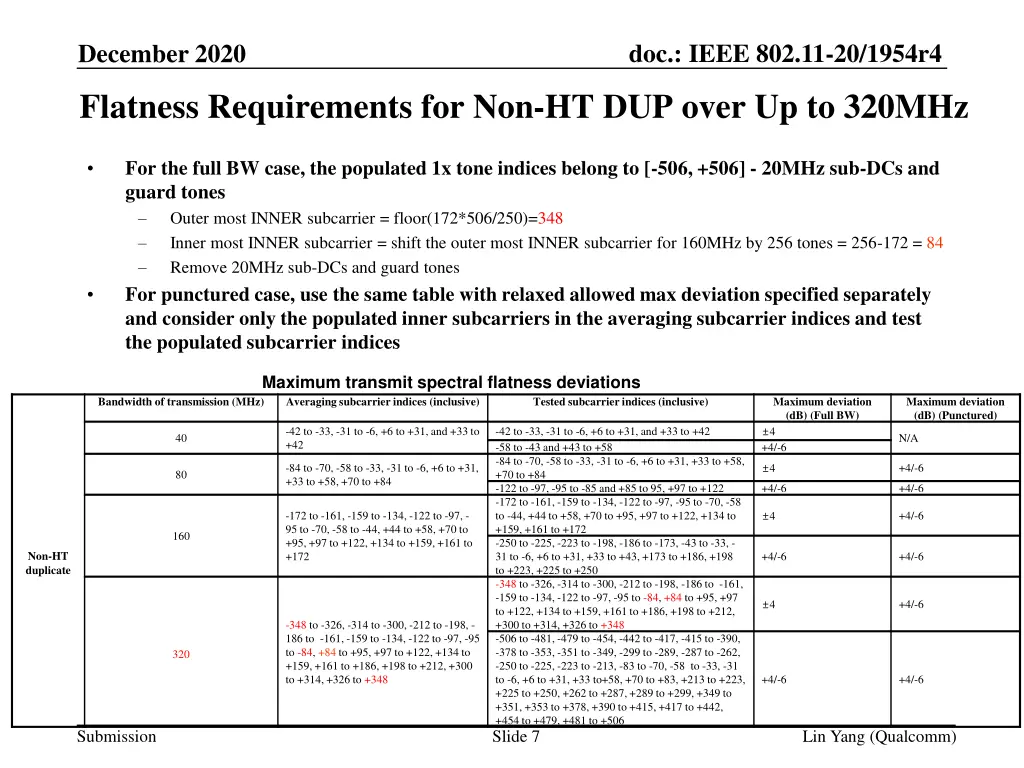
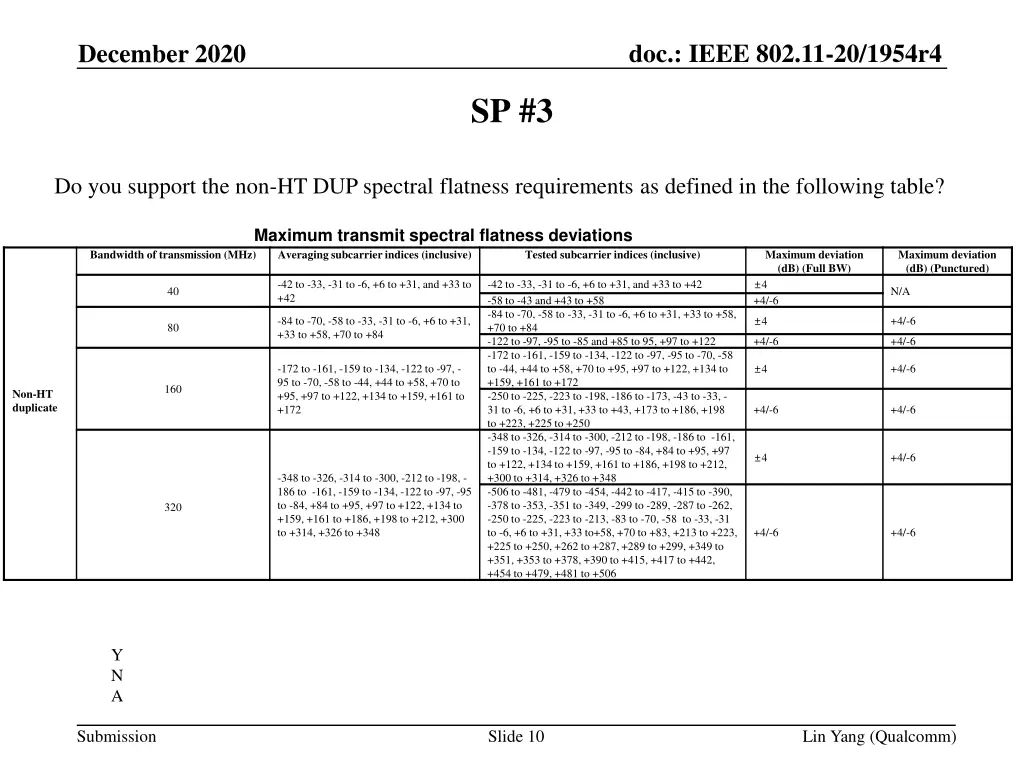
doc.: IEEE 802.11-20/1954r4 December 2020 Flatness Requirements for Non-HT DUP over Up to 320MHz For the full BW case, the populated 1x tone indices belong to [-506, +506] - 20MHz sub-DCs and guard tones Outer most INNER subcarrier = floor(172*506/250)=348 Inner most INNER subcarrier = shift the outer most INNER subcarrier for 160MHz by 256 tones = 256-172 = 84 Remove 20MHz sub-DCs and guard tones For punctured case, use the same table with relaxed allowed max deviation specified separately and consider only the populated inner subcarriers in the averaging subcarrier indices and test the populated subcarrier indices Maximum transmit spectral flatness deviations Bandwidth of transmission (MHz) Averaging subcarrier indices (inclusive) Tested subcarrier indices (inclusive) Maximum deviation (dB) (Full BW) 4 +4/-6 4 Maximum deviation (dB) (Punctured) -42 to -33, -31 to -6, +6 to +31, and +33 to +42 -42 to -33, -31 to -6, +6 to +31, and +33 to +42 -58 to -43 and +43 to +58 -84 to -70, -58 to -33, -31 to -6, +6 to +31, +33 to +58, +70 to +84 -122 to -97, -95 to -85 and +85 to 95, +97 to +122 -172 to -161, -159 to -134, -122 to -97, -95 to -70, -58 to -44, +44 to +58, +70 to +95, +97 to +122, +134 to +159, +161 to +172 -250 to -225, -223 to -198, -186 to -173, -43 to -33, - 31 to -6, +6 to +31, +33 to +43, +173 to +186, +198 to +223, +225 to +250 -348 to -326, -314 to -300, -212 to -198, -186 to -161, -159 to -134, -122 to -97, -95 to -84, +84 to +95, +97 to +122, +134 to +159, +161 to +186, +198 to +212, +300 to +314, +326 to +348 -506 to -481, -479 to -454, -442 to -417, -415 to -390, -378 to -353, -351 to -349, -299 to -289, -287 to -262, -250 to -225, -223 to -213, -83 to -70, -58 to -33, -31 to -6, +6 to +31, +33 to+58, +70 to +83, +213 to +223, +225 to +250, +262 to +287, +289 to +299, +349 to +351, +353 to +378, +390 to +415, +417 to +442, +454 to +479, +481 to +506 40 N/A -84 to -70, -58 to -33, -31 to -6, +6 to +31, +33 to +58, +70 to +84 +4/-6 80 +4/-6 +4/-6 4 -172 to -161, -159 to -134, -122 to -97, - 95 to -70, -58 to -44, +44 to +58, +70 to +95, +97 to +122, +134 to +159, +161 to +172 +4/-6 160 Non-HT duplicate +4/-6 +4/-6 4 +4/-6 -348 to -326, -314 to -300, -212 to -198, - 186 to -161, -159 to -134, -122 to -97, -95 to -84, +84 to +95, +97 to +122, +134 to +159, +161 to +186, +198 to +212, +300 to +314, +326 to +348 320 +4/-6 +4/-6 Submission Slide 7 Lin Yang (Qualcomm)
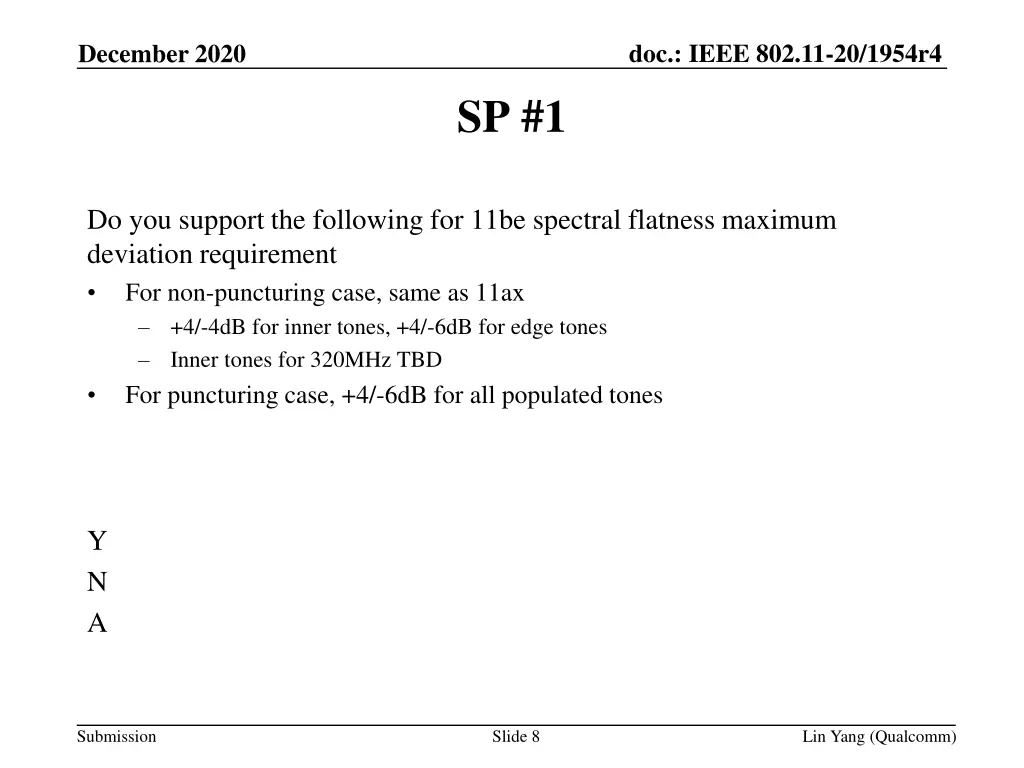
doc.: IEEE 802.11-20/1954r4 December 2020 SP #1 Do you support the following for 11be spectral flatness maximum deviation requirement For non-puncturing case, same as 11ax +4/-4dB for inner tones, +4/-6dB for edge tones Inner tones for 320MHz TBD For puncturing case, +4/-6dB for all populated tones Y N A Submission Slide 8 Lin Yang (Qualcomm)
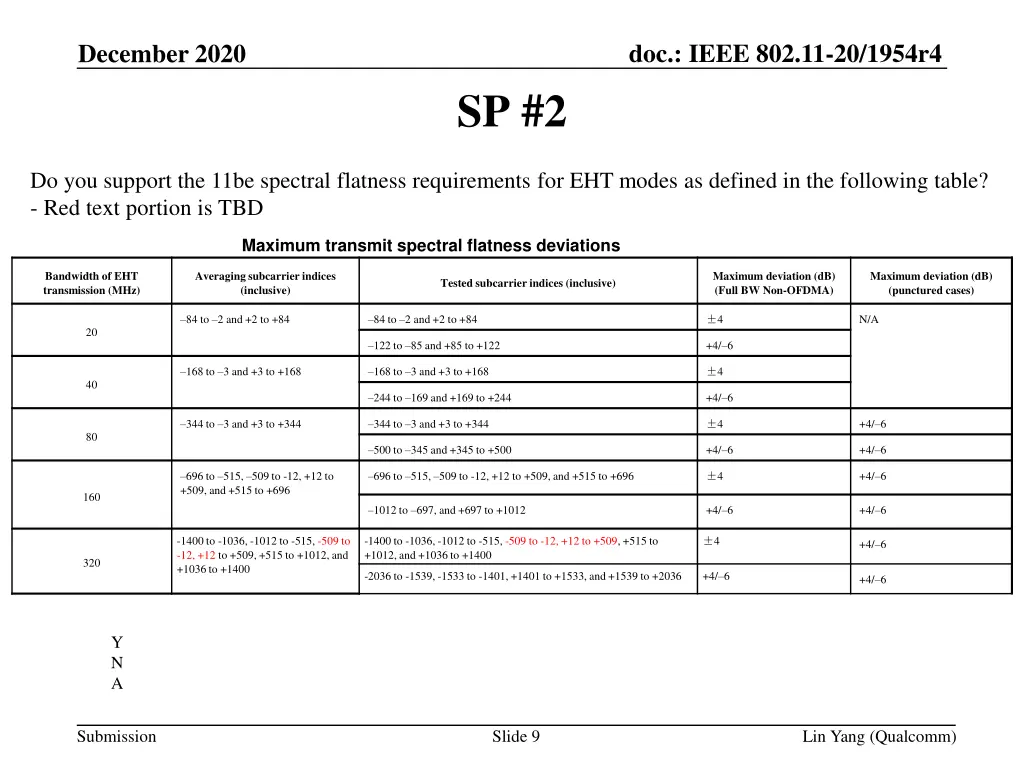
doc.: IEEE 802.11-20/1954r4 December 2020 SP #2 Do you support the 11be spectral flatness requirements for EHT modes as defined in the following table? - Red text portion is TBD Maximum transmit spectral flatness deviations Bandwidth of EHT transmission (MHz) Averaging subcarrier indices (inclusive) Maximum deviation (dB) (Full BW Non-OFDMA) Maximum deviation (dB) (punctured cases) Tested subcarrier indices (inclusive) 84 to 2 and +2 to +84 84 to 2 and +2 to +84 4 N/A 20 122 to 85 and +85 to +122 +4/ 6 168 to 3 and +3 to +168 168 to 3 and +3 to +168 4 40 244 to 169 and +169 to +244 +4/ 6 344 to 3 and +3 to +344 344 to 3 and +3 to +344 4 +4/ 6 80 500 to 345 and +345 to +500 +4/ 6 +4/ 6 696 to 515, 509 to -12, +12 to +509, and +515 to +696 696 to 515, 509 to -12, +12 to +509, and +515 to +696 4 +4/ 6 160 1012 to 697, and +697 to +1012 +4/ 6 +4/ 6 -1400 to -1036, -1012 to -515, -509 to -12, +12 to +509, +515 to +1012, and +1036 to +1400 -1400 to -1036, -1012 to -515, -509 to -12, +12 to +509, +515 to +1012, and +1036 to +1400 4 +4/ 6 320 -2036 to -1539, -1533 to -1401, +1401 to +1533, and +1539 to +2036 +4/ 6 +4/ 6 Y N A Submission Slide 9 Lin Yang (Qualcomm)
doc.: IEEE 802.11-20/1954r4 December 2020 SP #3 Do you support the non-HT DUP spectral flatness requirements as defined in the following table? Maximum transmit spectral flatness deviations Bandwidth of transmission (MHz) Averaging subcarrier indices (inclusive) Tested subcarrier indices (inclusive) Maximum deviation (dB) (Full BW) 4 +4/-6 4 Maximum deviation (dB) (Punctured) -42 to -33, -31 to -6, +6 to +31, and +33 to +42 -42 to -33, -31 to -6, +6 to +31, and +33 to +42 -58 to -43 and +43 to +58 -84 to -70, -58 to -33, -31 to -6, +6 to +31, +33 to +58, +70 to +84 -122 to -97, -95 to -85 and +85 to 95, +97 to +122 -172 to -161, -159 to -134, -122 to -97, -95 to -70, -58 to -44, +44 to +58, +70 to +95, +97 to +122, +134 to +159, +161 to +172 -250 to -225, -223 to -198, -186 to -173, -43 to -33, - 31 to -6, +6 to +31, +33 to +43, +173 to +186, +198 to +223, +225 to +250 -348 to -326, -314 to -300, -212 to -198, -186 to -161, -159 to -134, -122 to -97, -95 to -84, +84 to +95, +97 to +122, +134 to +159, +161 to +186, +198 to +212, +300 to +314, +326 to +348 -506 to -481, -479 to -454, -442 to -417, -415 to -390, -378 to -353, -351 to -349, -299 to -289, -287 to -262, -250 to -225, -223 to -213, -83 to -70, -58 to -33, -31 to -6, +6 to +31, +33 to+58, +70 to +83, +213 to +223, +225 to +250, +262 to +287, +289 to +299, +349 to +351, +353 to +378, +390 to +415, +417 to +442, +454 to +479, +481 to +506 40 N/A -84 to -70, -58 to -33, -31 to -6, +6 to +31, +33 to +58, +70 to +84 +4/-6 80 +4/-6 +4/-6 4 -172 to -161, -159 to -134, -122 to -97, - 95 to -70, -58 to -44, +44 to +58, +70 to +95, +97 to +122, +134 to +159, +161 to +172 +4/-6 160 Non-HT duplicate +4/-6 +4/-6 4 +4/-6 -348 to -326, -314 to -300, -212 to -198, - 186 to -161, -159 to -134, -122 to -97, -95 to -84, +84 to +95, +97 to +122, +134 to +159, +161 to +186, +198 to +212, +300 to +314, +326 to +348 320 +4/-6 +4/-6 Y N A Submission Slide 10 Lin Yang (Qualcomm)