Implementing Assessment Literacy in Education
Explore the importance of assessment literacy for teachers, school leaders, and district leaders. Learn how to enhance assessment practices, understand key assessment vocabulary, and implement a Comprehensive Balanced Assessment System for student success.

Download Presentation

Please find below an Image/Link to download the presentation.
The content on the website is provided AS IS for your information and personal use only. It may not be sold, licensed, or shared on other websites without obtaining consent from the author. If you encounter any issues during the download, it is possible that the publisher has removed the file from their server.
You are allowed to download the files provided on this website for personal or commercial use, subject to the condition that they are used lawfully. All files are the property of their respective owners.
The content on the website is provided AS IS for your information and personal use only. It may not be sold, licensed, or shared on other websites without obtaining consent from the author.
E N D
Presentation Transcript
Building Assessment Literacy In Building Assessment Literacy In ACPSD Teacher Leaders ACPSD Teacher Leaders
Primary Objectives 1. Increase knowledge and pedagogy in good assessment practices. 2. Understand the primary components of a Comprehensive Balanced Assessment System 3. Understand our role as Assessment Ambassadors 4. Advance our assessment practices across the district by implementing next phase of CFA s required CFA in major instructional unit. 5. Continue to increase alignment between benchmarks and EOY state testing blueprints.
Learning Outcomes Participants will be able to: 1. Clearly explain what assessment literacy is and the impact of assessment literacy on teaching and learning. 2. Understand the characteristics of an assessment literate person 3. Understand key assessment vocabulary 4. Understand and be able to communicate the components of a Comprehensive and Balanced Assessment System 5. Understand the importance of Common Formative Assessments in advancing teaching and learning
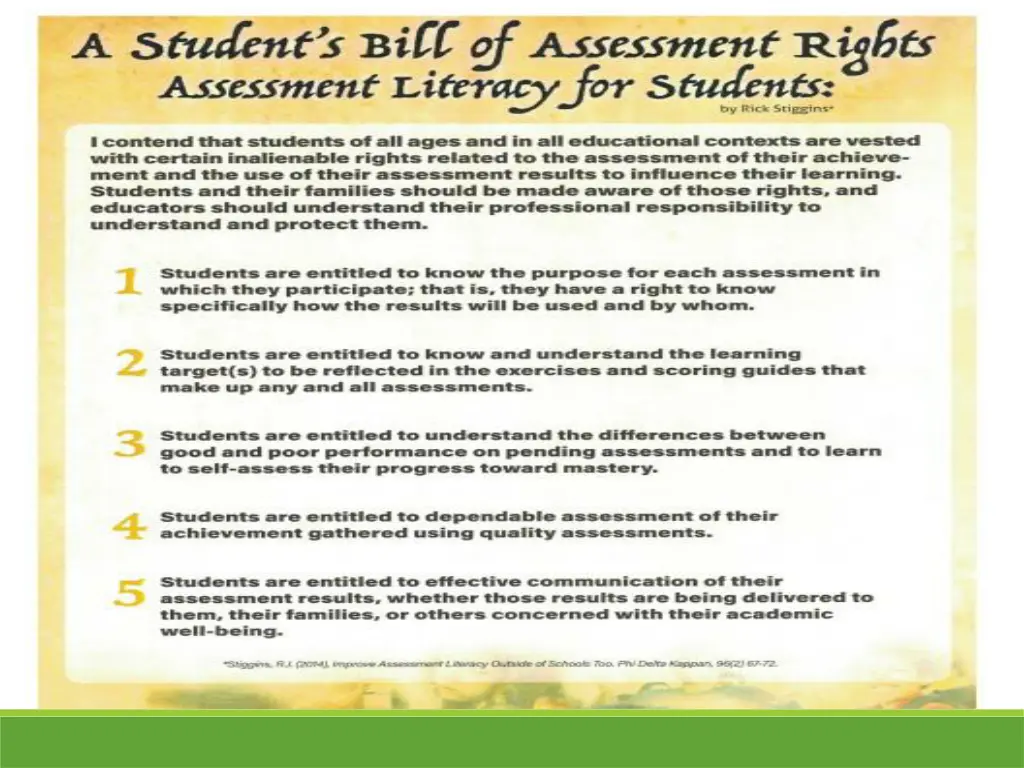
Assessment Literacy One becomes assessment literate by mastering basic principles of sound assessment practice, coming to believe strongly in their consistent, high-quality application in order to meet the diverse needs of all students, and acting proactively based on those values. Different things for different people but ALL need to be literate. District Leaders School Leaders Teachers Students Parent s
Assessment Literacy Understand the different purposes and types of assessment Common understanding of assessment related terms and vocabulary Differences between assessment FOR learning and assessments OF learning.
What Does Assessment Literacy Look Like? An assessment literate person understands that it is not possible to conduct a sound assessment without a clear and specific purpose. Who will use the results? What will they use them to accomplish? What information about student learning does the user need? The assessment must be specifically designed, developed, and conducted to supply the information needed to serve the intended purpose. Only then can it work in the service of student learning.
Assessment Assessment is the process of gathering information about student learning to inform education-related decisions. Assessments can reflect a wide variety of learning targets using a range of methods serving many important users and uses at a variety of levels from the classroom to the boardroom. Assessment is an essential part of the teaching and learning process.
Comprehensive Balanced Assessment System At its core: Different consumers of assessment information need different things. Classroom level: students, parents, teachers Building/District level: Superintendent, ISD, Principals, CI s, Balanced does not mean equal number of assessments in each category but a balance of information to meet the needs of the consumers.
Comprehensive Balanced Assessment System (aligned to SC State Standards) Typically includes at least three levels of assessment measures: 1. summative measures (such as SC READY, PASS & EOC), 2. interim assessment measures (common tests administered by districts or schools), and 3. formative assessment measures (administered frequently by teachers during an instructional unit to assess student learning as it happens. Helps the teacher to quickly adjust instruction to improve learning
Summative Assessment Assessment information used to provide evidence of student achievement for the purpose of making a judgment about student competence or program effectiveness. Summative assessments are found at the classroom, district and state level and can be graded and used in accountability systems. The information gathered from summative assessments is evaluative and is used to categorize students so performance among students can be compared.
Formative Assessment A process used by teachers and students during instruction that provides feedback to adjust ongoing teaching and learning to help students improve their achievement of intended instructional outcomes. Formative assessment is found at the classroom level and happens minute-to-minute or in short cycles. Formative assessment is not graded or used in accountability systems. Feedback involved in formative assessment is descriptive in nature so that students know what they need to do next to improve learning.
Interim Assessments Interim assessments fall between formative and summative assessments in both timing and purpose. Interim assessments evaluate student progress on common content standards, or benchmarks, that students must master to be on track to reach end-of-year learning goals. Interim assessments are administered on a regular, preplanned schedule. Unlike summative assessments, however, interim assessments take place in time for teachers to adjust instruction to address any identified gaps in student mastery. Such assessments allow teachers to combine and compare data across classrooms and work together to develop appropriate instructional responses which is formative in nature.
Formative Assessment Formative assessment is a planned process in which assessment-elicited evidence of students status is used by teachers to adjust their ongoing instructional practices or by students to adjust their current learning tactics. Popham, Transformative Assessment (2008), p. 6
To ensure a guaranteed and viable curriculum Curriculum teams should be able to answer the following questions: 1. What do we want students to know and be able to do? 2. How will we know they are learning? 3. How will we respond when they aren t learning? 4. How will we respond when they already learned it?
Relationship between Standards & Assessment Standards are meaningless until you define how you will assess them. Bambrick-Santoyo, Driven by Data: A Practical Guide to Improve Instruction (2010)
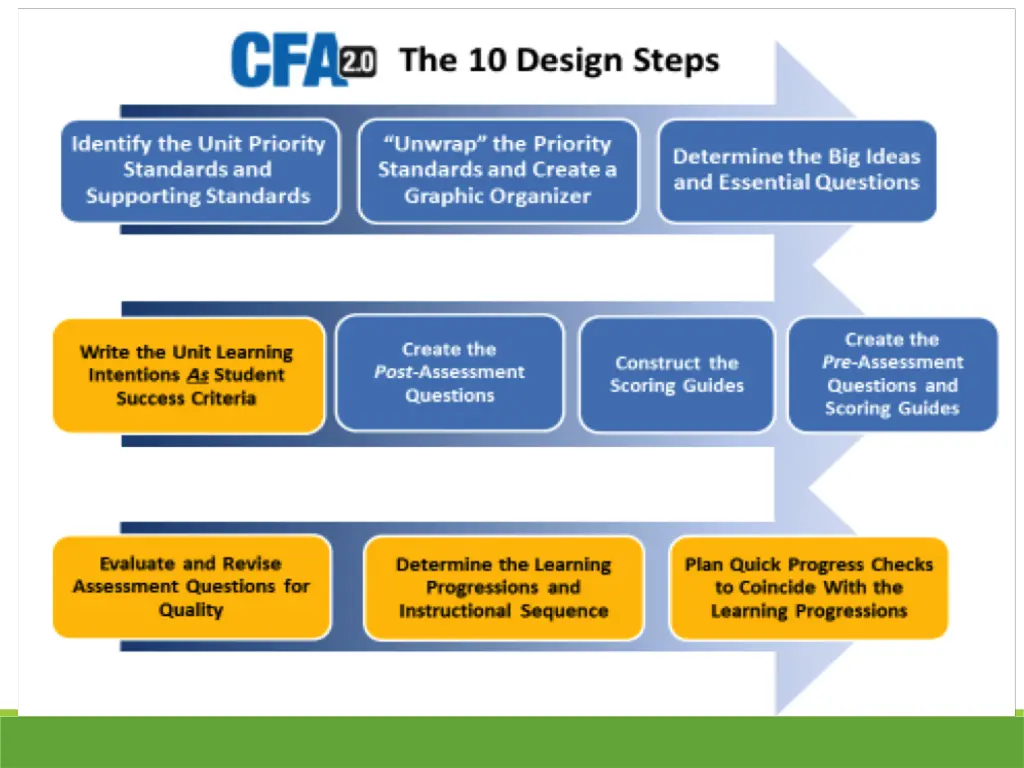
What is a CFA? Aligned formative assessments within units of study that are collaboratively designed by a grade level or course level team and administered to students by each participating teacher throughout the year. Assess student understanding of the particular learning intentions that the grade level or course level educators are currently focusing on in a curricular unit of study. Written around learning targets rather than standards. Focus of CFA is on the smaller skills and concepts students have to learn to become proficient on the standard. Not a major testing event. Provide valuable feedback: what students currently know and what they yet need to learn with regard to the learning intentions for that unit.
Benefits of CFA Provides collective clarity on what students should know and do: Guaranteed and viable curriculum Trickles down to the student Help identify groups of students who need additional support Aligns to what teachers are actually teaching (based on agreement about what students should be learning) Allows frequent feedback to students to ensure learning is on track. Embeds into instruction not major testing events Provides purpose and results for the curriculum team Popham,Transformative Assessment (2008), p. 6
CFAs will impact learning! Formative evaluation ranks fourth among all positive influences on student learning, producing an overall effect size of 0.90 equivalent to more than two years of student gains within a single academic school year. John Hattie, Visible Learning, 2009, p. 181
Role of the team: Decide what s important to teach. Decide how they ll know that students learned it. Decide what they ll do if they don t learn it or if they already know it. Do it study it review and revise it and continue the cycle going> FEEDBACK LOOP What you ll need: Your state test blue-print, standards, quarterly benchmarks, c-maps
Curriculum Team: Identify the most critical standards: POWER standards and answer the following questions: 1. What standards do we emphasize in our instruction, assessment, and intervention? 2. What skills and concepts do we feel are absolutely essential? (vs. what is nice to know!)
Unwrap the standards to reveal the learning targets What students should know (nouns) What students should be able to do (verbs) Critical vocabulary and academic language Any criteria or conditions referenced
Aligning Assessments with Standards What do we mean by aligned assessments? Are they accurate? Face validity: Does the item measure what we are trying to teach? Is this item the best method to gain information on this learning target (target method match)? Are they efficient? Does this method get the needed information in a reasonable amount of time?
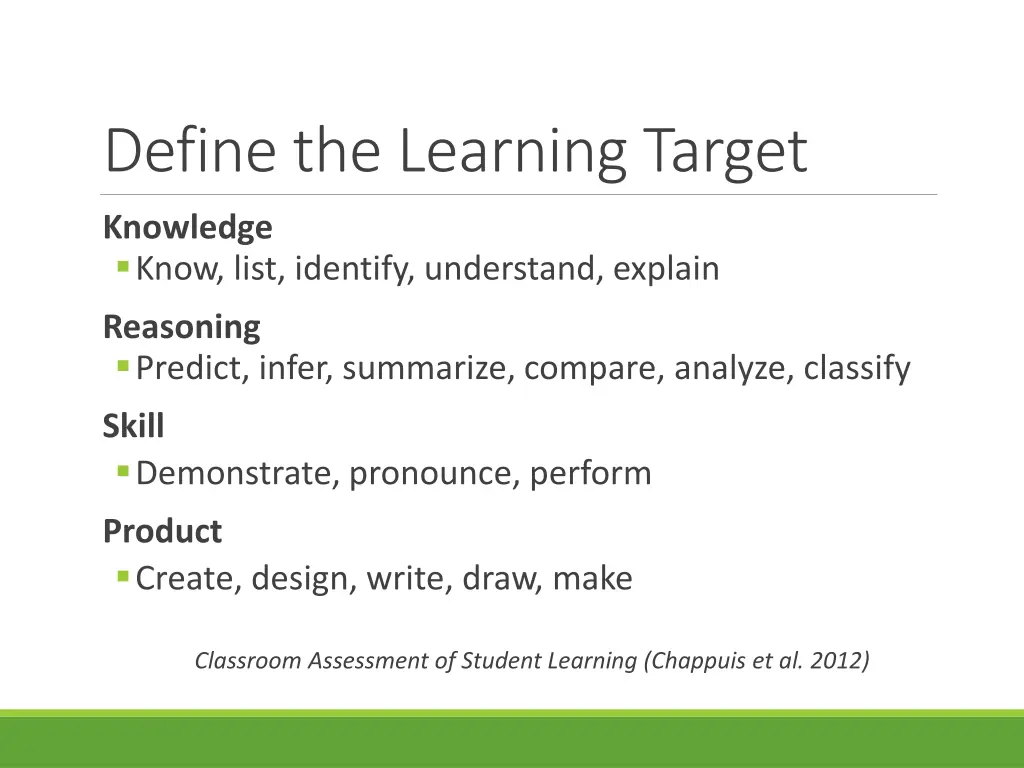
Define the Learning Target Knowledge Know, list, identify, understand, explain Reasoning Predict, infer, summarize, compare, analyze, classify Skill Demonstrate, pronounce, perform Product Create, design, write, draw, make Classroom Assessment of Student Learning (Chappuis et al. 2012)
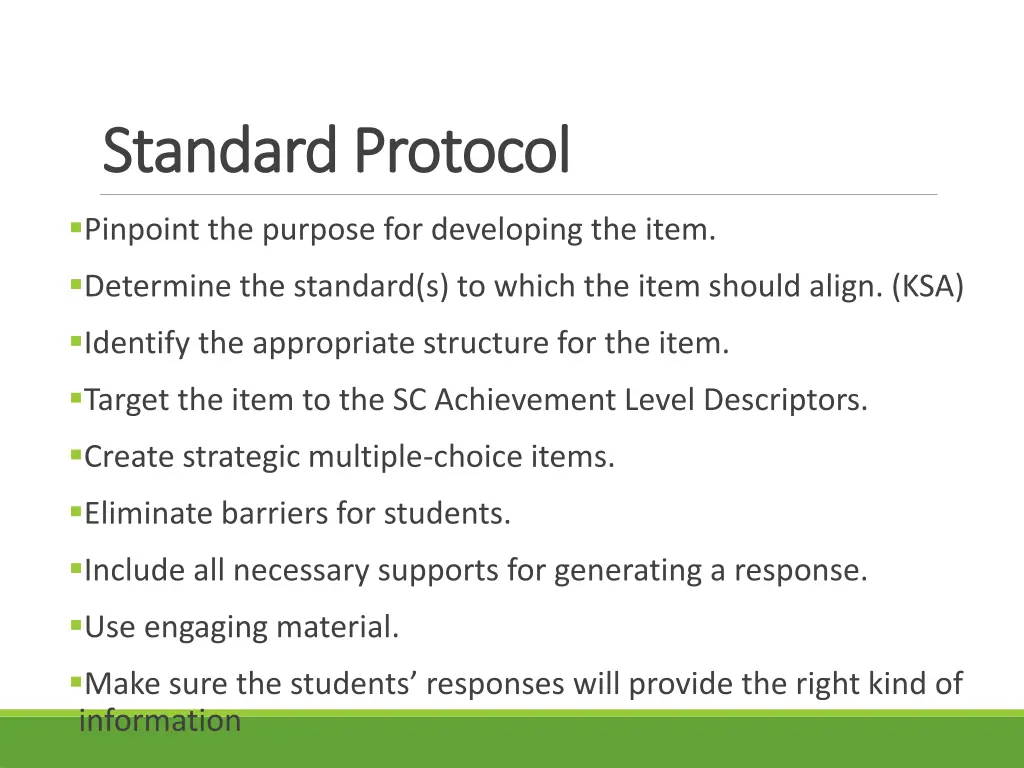
Standard Protocol Standard Protocol Pinpoint the purpose for developing the item. Determine the standard(s) to which the item should align. (KSA) Identify the appropriate structure for the item. Target the item to the SC Achievement Level Descriptors. Create strategic multiple-choice items. Eliminate barriers for students. Include all necessary supports for generating a response. Use engaging material. Make sure the students responses will provide the right kind of information
NATIONAL TASK FORCE ON ASSESSMENT EDUCATION ADVANCING ASSESSMENT EDUCATION
QUESTIONS QUESTIONS & COMMENTS AIKEN COUNTY PUBLIC SCHOOL DISTRICT | FEBRUARY 23, 2018