Implementing Priority Queues for Efficient Data Handling
"Learn about the significance of priority queues in data management, their applications in various systems, and the implementation strategies using different data structures. Understand the key concepts of prioritization and object arrangement for effective handling of tasks and processes."

Download Presentation

Please find below an Image/Link to download the presentation.
The content on the website is provided AS IS for your information and personal use only. It may not be sold, licensed, or shared on other websites without obtaining consent from the author. If you encounter any issues during the download, it is possible that the publisher has removed the file from their server.
You are allowed to download the files provided on this website for personal or commercial use, subject to the condition that they are used lawfully. All files are the property of their respective owners.
The content on the website is provided AS IS for your information and personal use only. It may not be sold, licensed, or shared on other websites without obtaining consent from the author.
E N D
Presentation Transcript
Priority Queues CSE 332 Spring 2025 Lecture 4 1
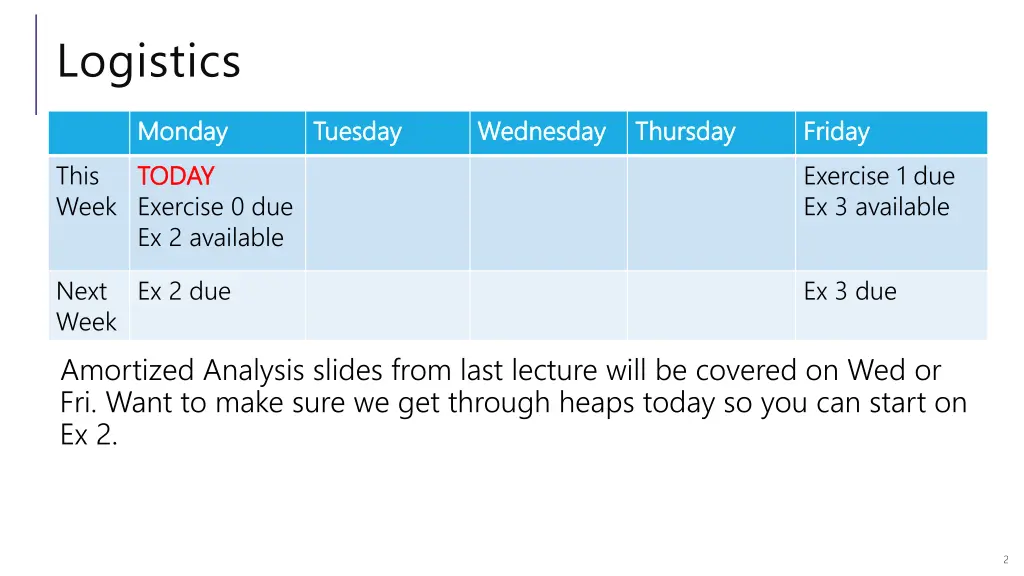
Logistics Monday Monday TODAY TODAY Exercise 0 due Ex 2 available Tuesday Tuesday Wednesday Wednesday Thursday Thursday Friday Friday Exercise 1 due Ex 3 available This Week Next Week Ex 2 due Ex 3 due Amortized Analysis slides from last lecture will be covered on Wed or Fri. Want to make sure we get through heaps today so you can start on Ex 2. 2
A New ADT Our previous worklists (stacks, queues, etc.) all choose the next element based on the order they were inserted. That s not always a good idea. Emergency rooms aren t first-come-first-served. Sometimes our objects come with a priority to do next. priority, that tells us what we need An ADT that can handle a line with priorities is a priority queue. priority queue. 4
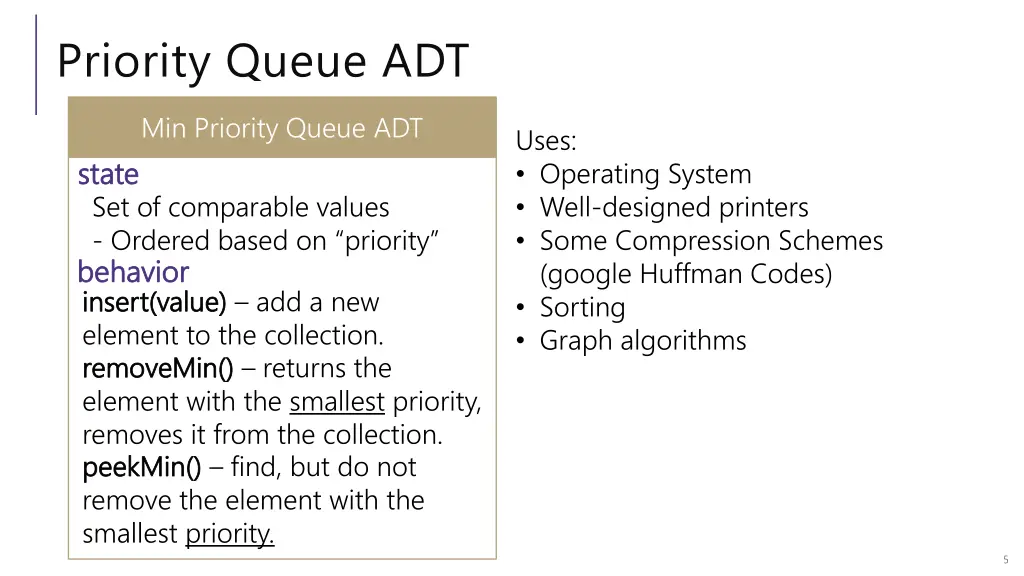
Priority Queue ADT Min Priority Queue ADT Uses: Operating System Well-designed printers Some Compression Schemes (google Huffman Codes) Sorting Graph algorithms state state Set of comparable values - Ordered based on priority behavior behavior insert(value) insert(value) add a new element to the collection. removeMin removeMin() () returns the element with the smallest priority, removes it from the collection. peekMin peekMin() () find, but do not remove the element with the smallest priority. 5
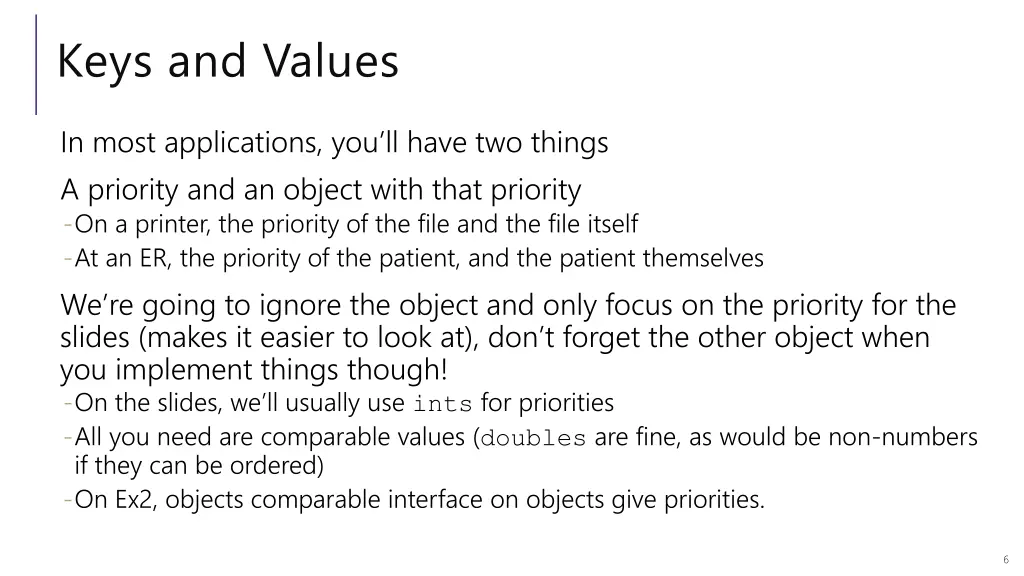
Keys and Values In most applications, you ll have two things A priority and an object with that priority -On a printer, the priority of the file and the file itself -At an ER, the priority of the patient, and the patient themselves We re going to ignore the object and only focus on the priority for the slides (makes it easier to look at), don t forget the other object when you implement things though! -On the slides, we ll usually use ints for priorities -All you need are comparable values (doubles are fine, as would be non-numbers if they can be ordered) -On Ex2, objects comparable interface on objects give priorities. 6
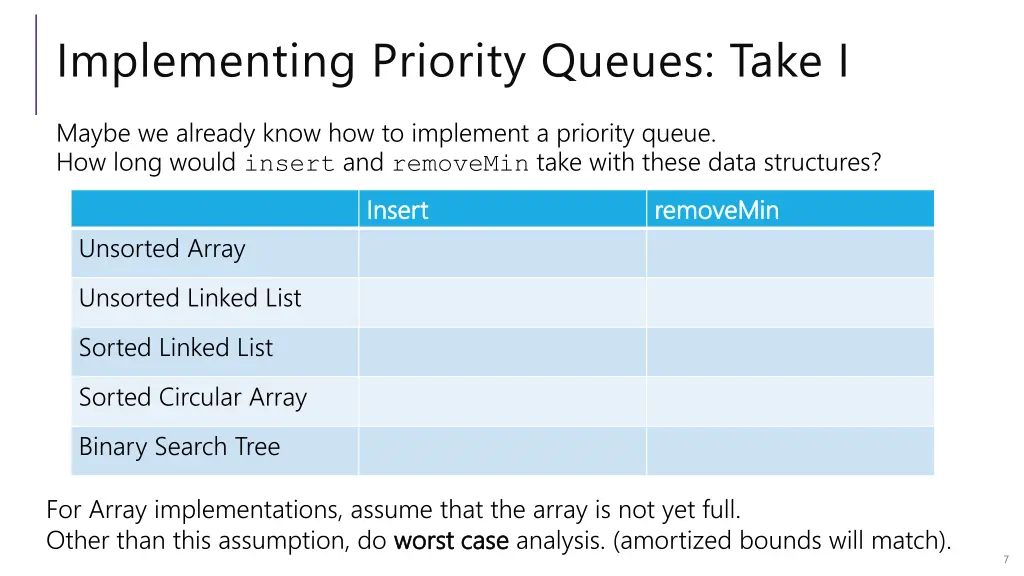
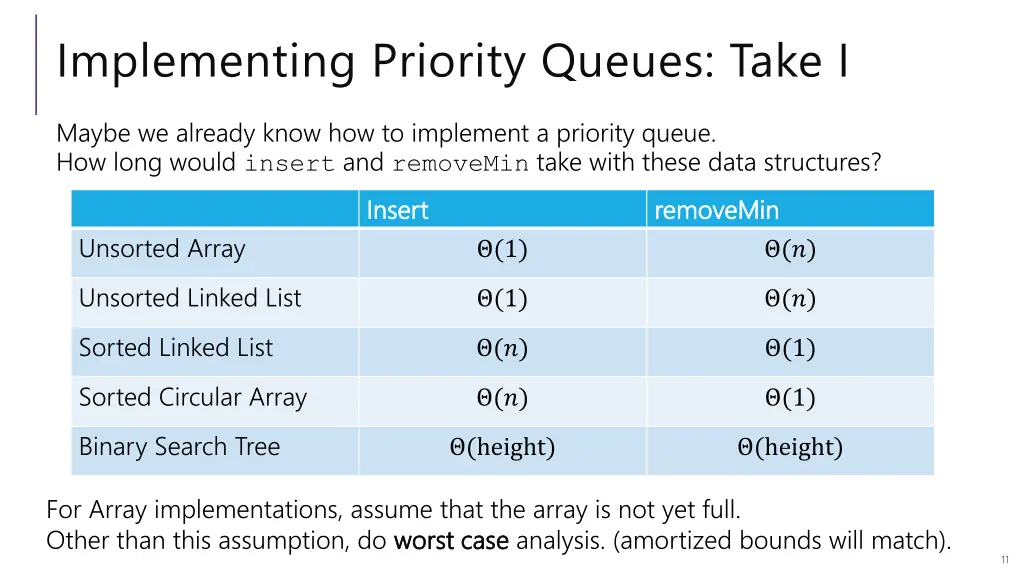
Implementing Priority Queues: Take I Maybe we already know how to implement a priority queue. How long would insert and removeMin take with these data structures? Insert Insert removeMin removeMin Unsorted Array Unsorted Linked List Sorted Linked List Sorted Circular Array Binary Search Tree For Array implementations, assume that the array is not yet full. Other than this assumption, do worst case worst case analysis. (amortized bounds will match). 7
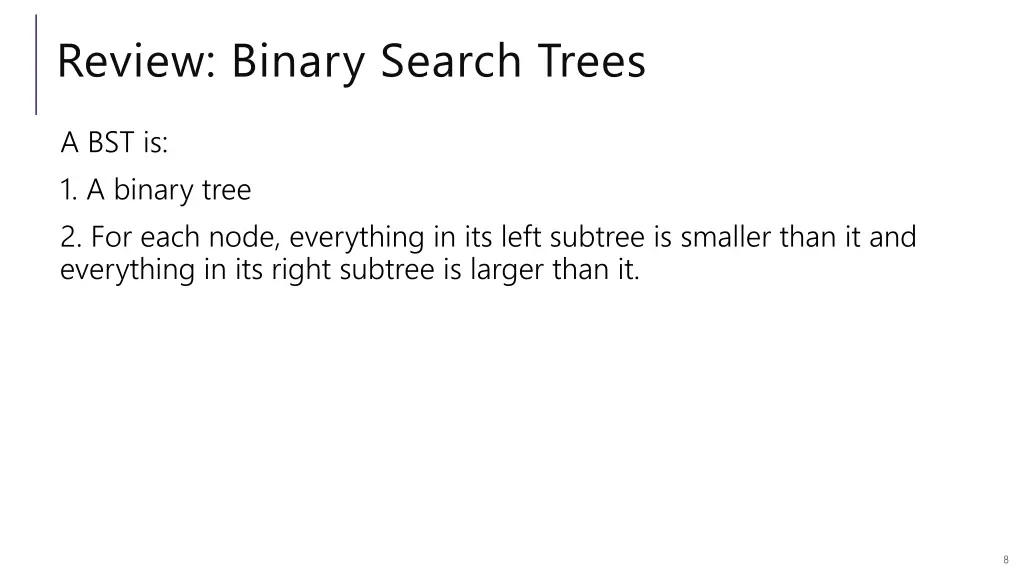
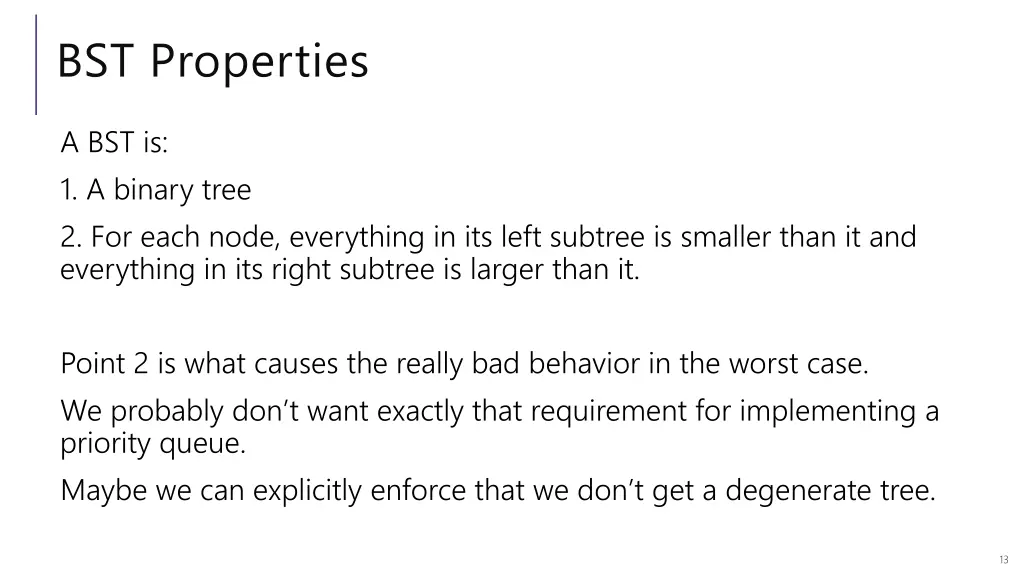
Review: Binary Search Trees A BST is: 1. A binary tree 2. For each node, everything in its left subtree is smaller than it and everything in its right subtree is larger than it. 8
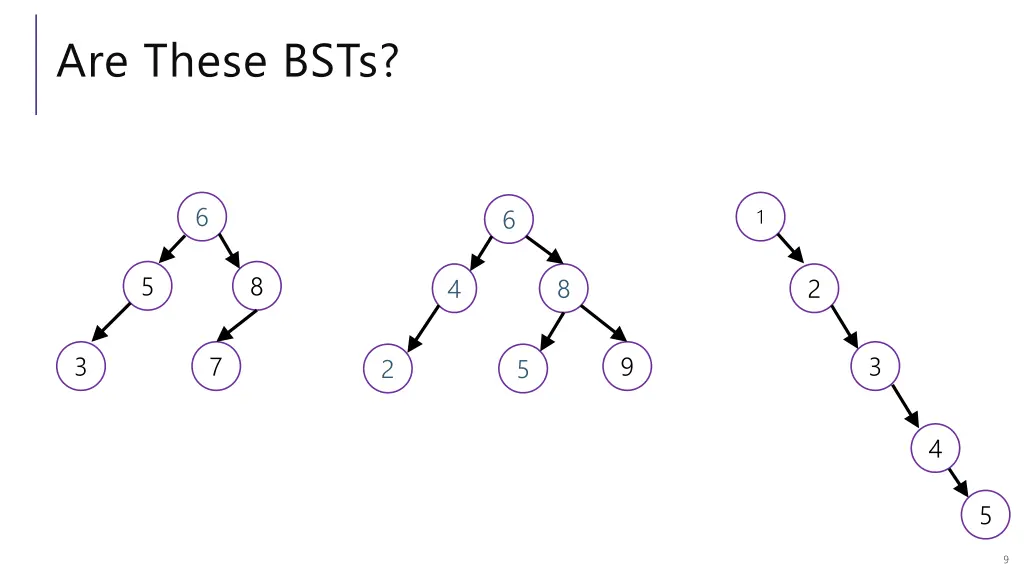
Are These BSTs? 6 6 1 5 8 4 8 2 3 7 9 3 2 5 4 5 9
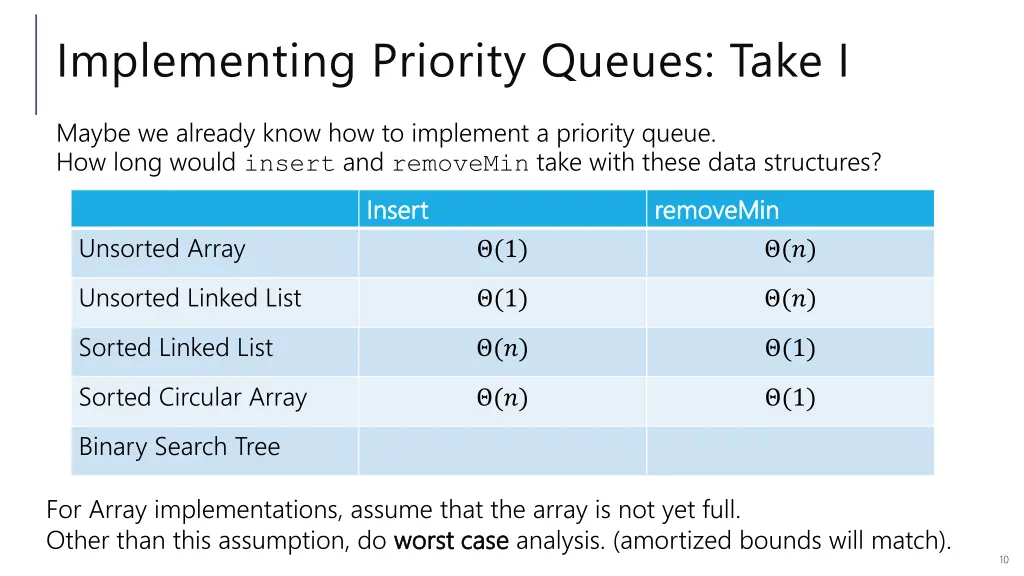
Implementing Priority Queues: Take I Maybe we already know how to implement a priority queue. How long would insert and removeMin take with these data structures? Insert Insert removeMin removeMin Unsorted Array (1) (?) Unsorted Linked List (1) (?) Sorted Linked List (?) (1) Sorted Circular Array (?) (1) Binary Search Tree For Array implementations, assume that the array is not yet full. Other than this assumption, do worst case worst case analysis. (amortized bounds will match). 10
Implementing Priority Queues: Take I Maybe we already know how to implement a priority queue. How long would insert and removeMin take with these data structures? Insert Insert removeMin removeMin Unsorted Array (1) (?) Unsorted Linked List (1) (?) Sorted Linked List (?) (1) Sorted Circular Array (?) (1) Binary Search Tree (height) (height) For Array implementations, assume that the array is not yet full. Other than this assumption, do worst case worst case analysis. (amortized bounds will match). 11
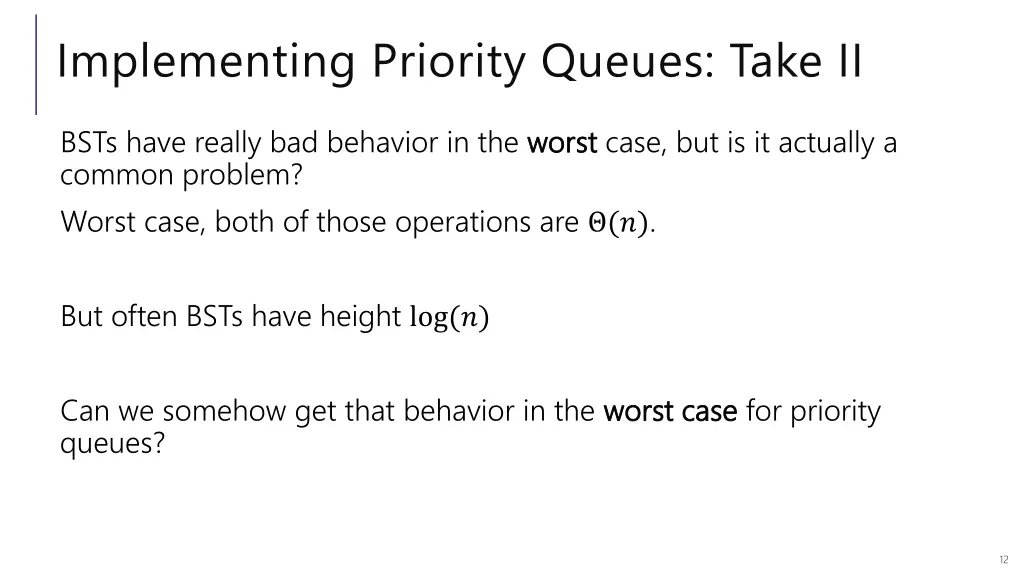
Implementing Priority Queues: Take II BSTs have really bad behavior in the worst common problem? Worst case, both of those operations are (?). worst case, but is it actually a But often BSTs have height log(?) Can we somehow get that behavior in the worst case queues? worst case for priority 12
BST Properties A BST is: 1. A binary tree 2. For each node, everything in its left subtree is smaller than it and everything in its right subtree is larger than it. Point 2 is what causes the really bad behavior in the worst case. We probably don t want exactly that requirement for implementing a priority queue. Maybe we can explicitly enforce that we don t get a degenerate tree. 13
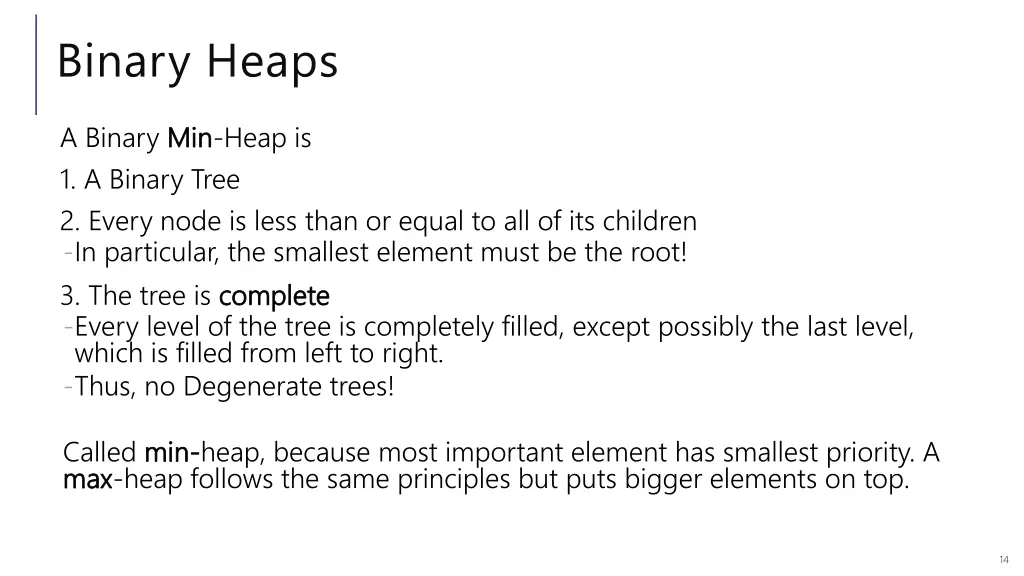
Binary Heaps A Binary Min 1. A Binary Tree 2. Every node is less than or equal to all of its children -In particular, the smallest element must be the root! 3. The tree is complete complete -Every level of the tree is completely filled, except possibly the last level, which is filled from left to right. -Thus, no Degenerate trees! Min-Heap is Called min max max-heap follows the same principles but puts bigger elements on top. min- -heap, because most important element has smallest priority. A 14
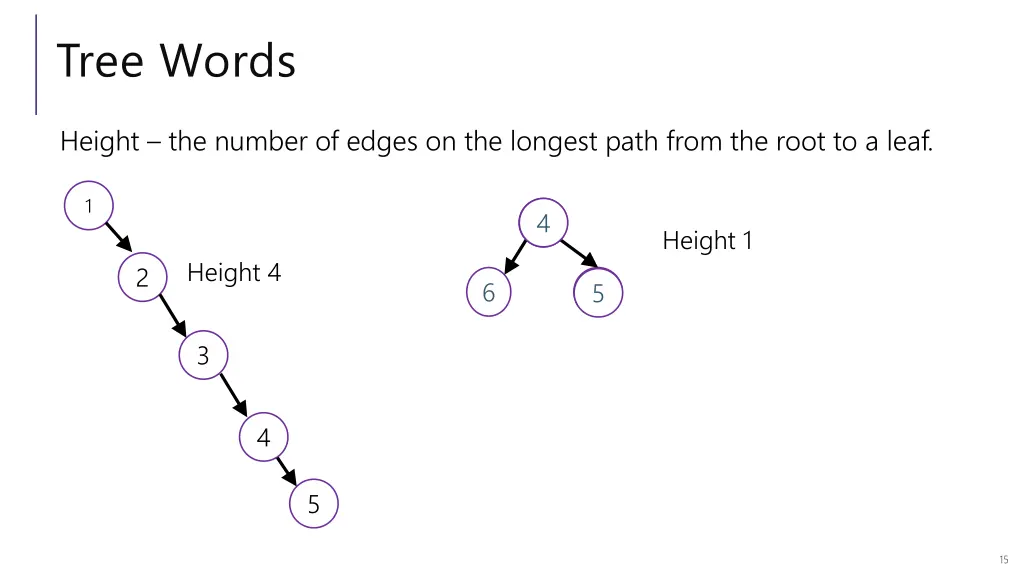
Tree Words Height the number of edges on the longest path from the root to a leaf. 1 2 4 Height 1 Height 4 2 6 4 5 3 4 5 15
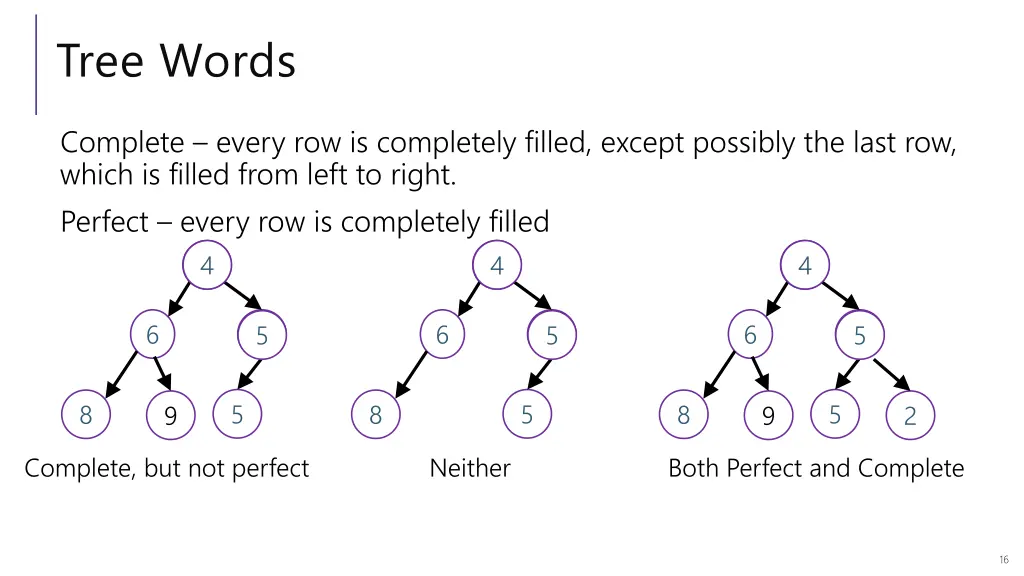
Tree Words Complete every row is completely filled, except possibly the last row, which is filled from left to right. Perfect every row is completely filled 2 4 2 4 2 4 6 4 5 6 4 5 6 4 5 5 5 5 8 8 8 9 9 2 Complete, but not perfect Neither Both Perfect and Complete 16
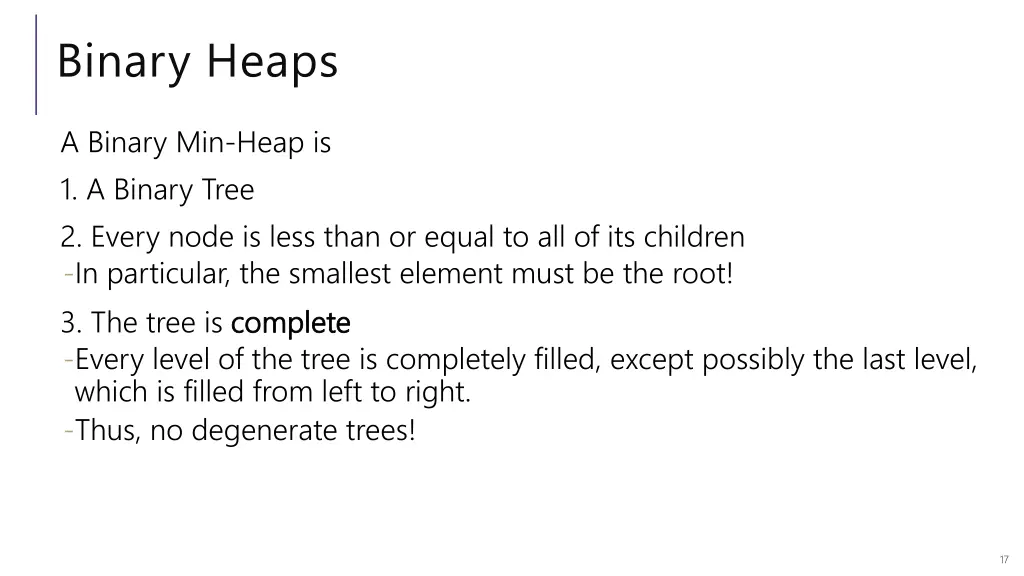
Binary Heaps A Binary Min-Heap is 1. A Binary Tree 2. Every node is less than or equal to all of its children -In particular, the smallest element must be the root! 3. The tree is complete complete -Every level of the tree is completely filled, except possibly the last level, which is filled from left to right. -Thus, no degenerate trees! 17
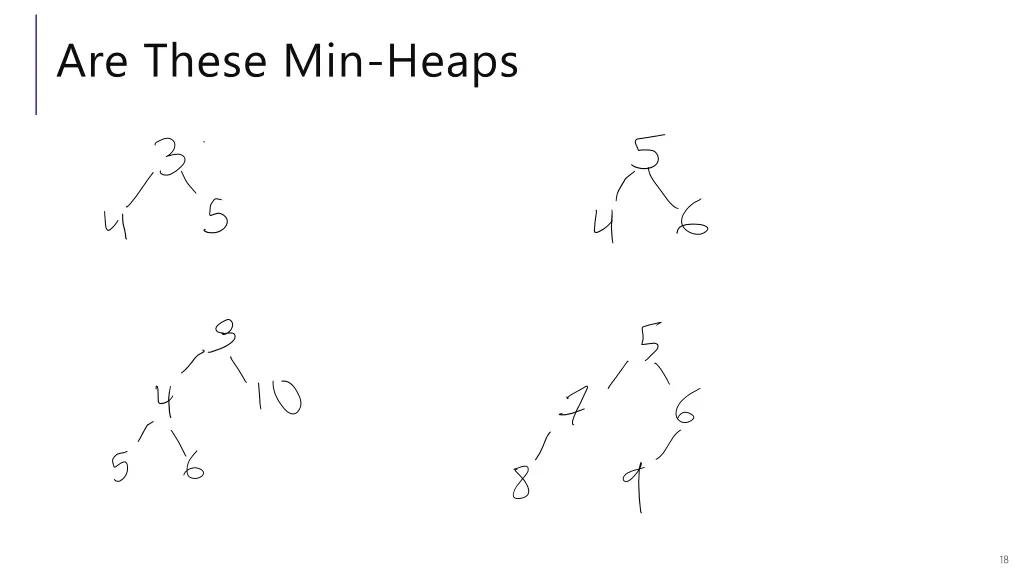
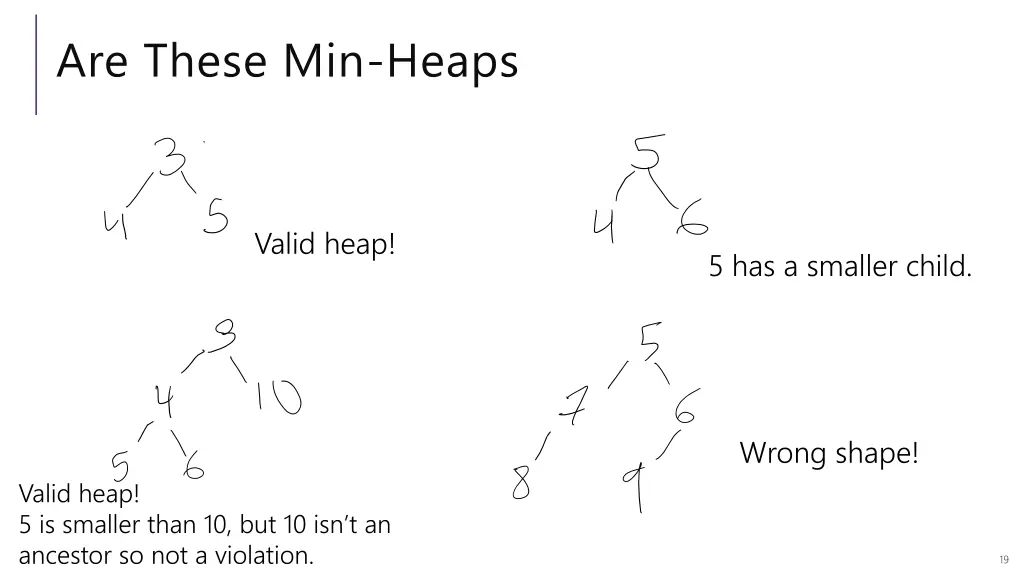
Are These Min-Heaps Valid heap! 5 has a smaller child. Wrong shape! Valid heap! 5 is smaller than 10, but 10 isn t an ancestor so not a violation. 19
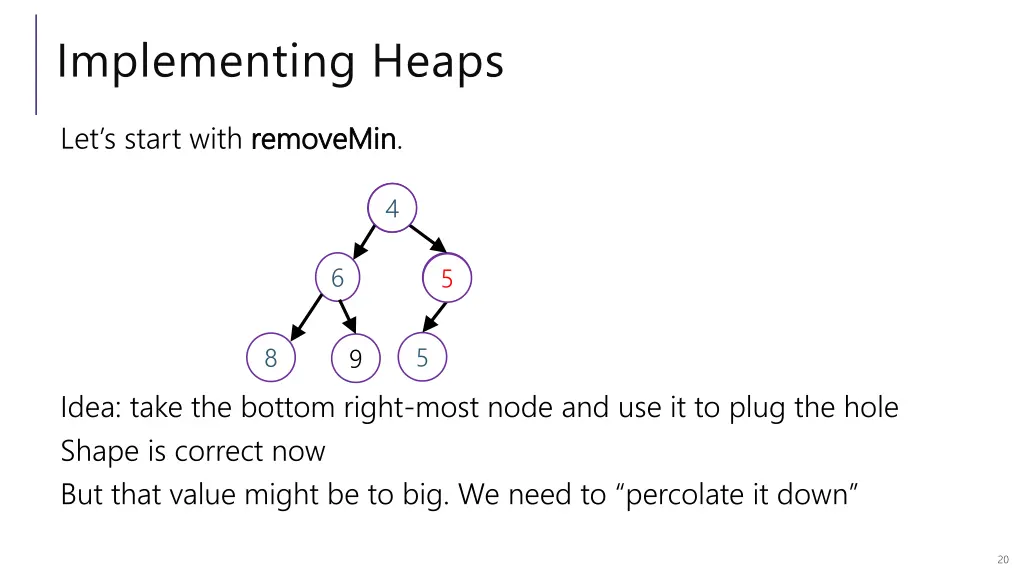
Implementing Heaps Let s start with removeMin removeMin. 2 4 6 4 5 5 8 9 Idea: take the bottom right-most node and use it to plug the hole Shape is correct now But that value might be to big. We need to percolate it down 20
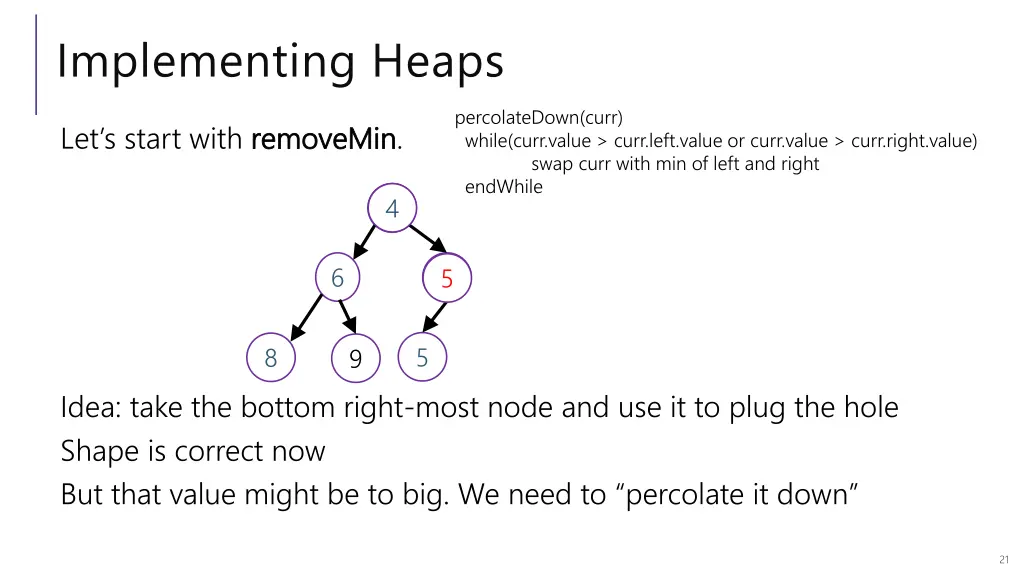
Implementing Heaps percolateDown(curr) while(curr.value > curr.left.value or curr.value > curr.right.value) swap curr with min of left and right endWhile Let s start with removeMin removeMin. 2 4 6 4 5 5 8 9 Idea: take the bottom right-most node and use it to plug the hole Shape is correct now But that value might be to big. We need to percolate it down 21
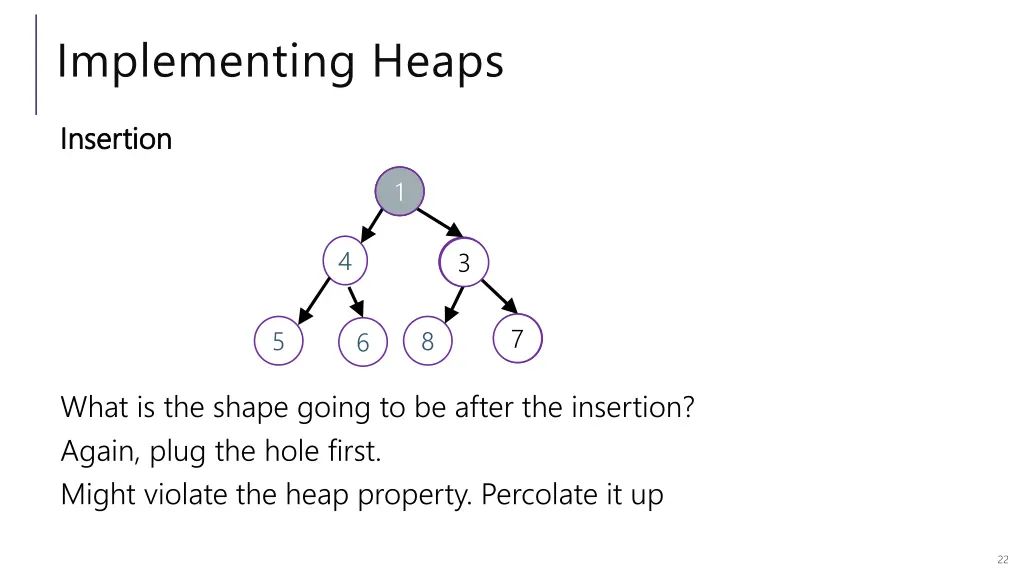
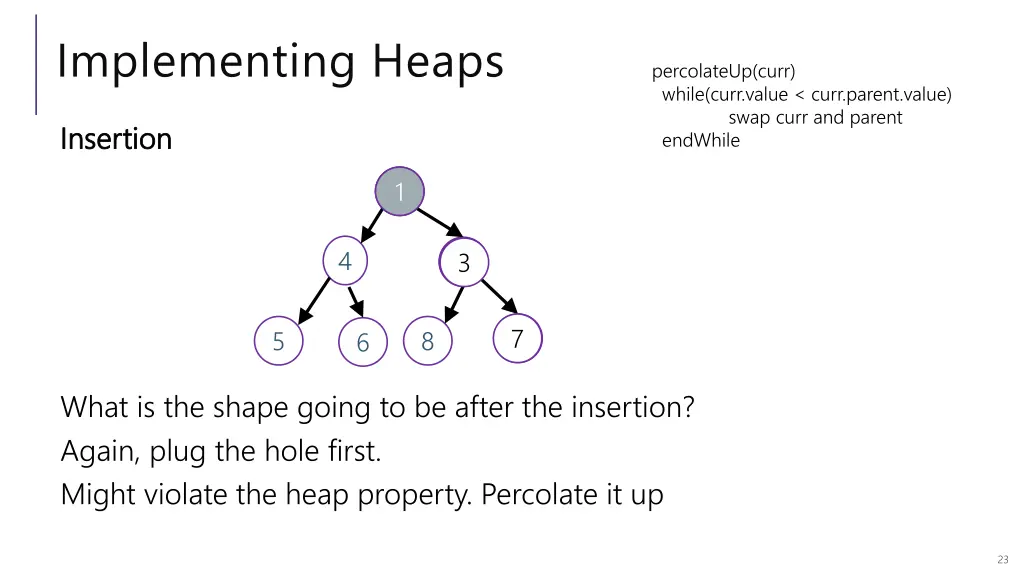
Implementing Heaps Insertion Insertion 3 1 4 7 1 3 1 7 5 8 6 What is the shape going to be after the insertion? Again, plug the hole first. Might violate the heap property. Percolate it up 22
Implementing Heaps percolateUp(curr) while(curr.value < curr.parent.value) swap curr and parent endWhile Insertion Insertion 3 1 4 7 1 3 1 7 5 8 6 What is the shape going to be after the insertion? Again, plug the hole first. Might violate the heap property. Percolate it up 23
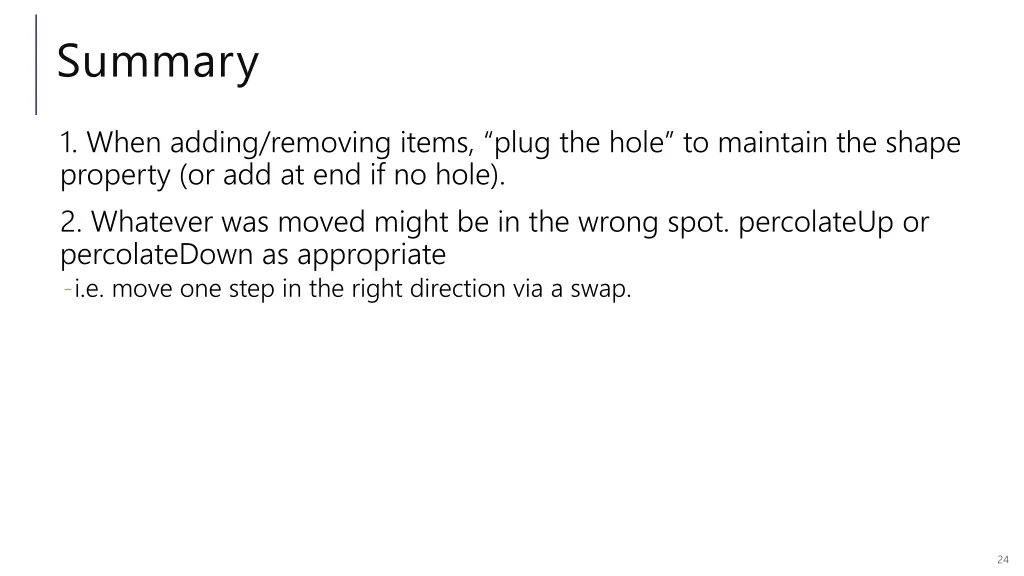
Summary 1. When adding/removing items, plug the hole to maintain the shape property (or add at end if no hole). 2. Whatever was moved might be in the wrong spot. percolateUp or percolateDown as appropriate -i.e. move one step in the right direction via a swap. 24
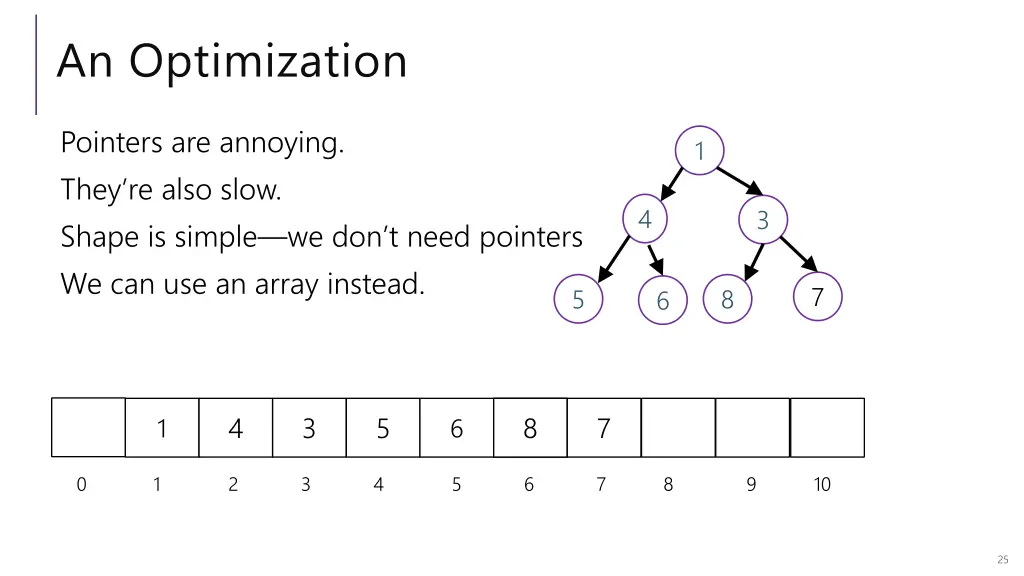
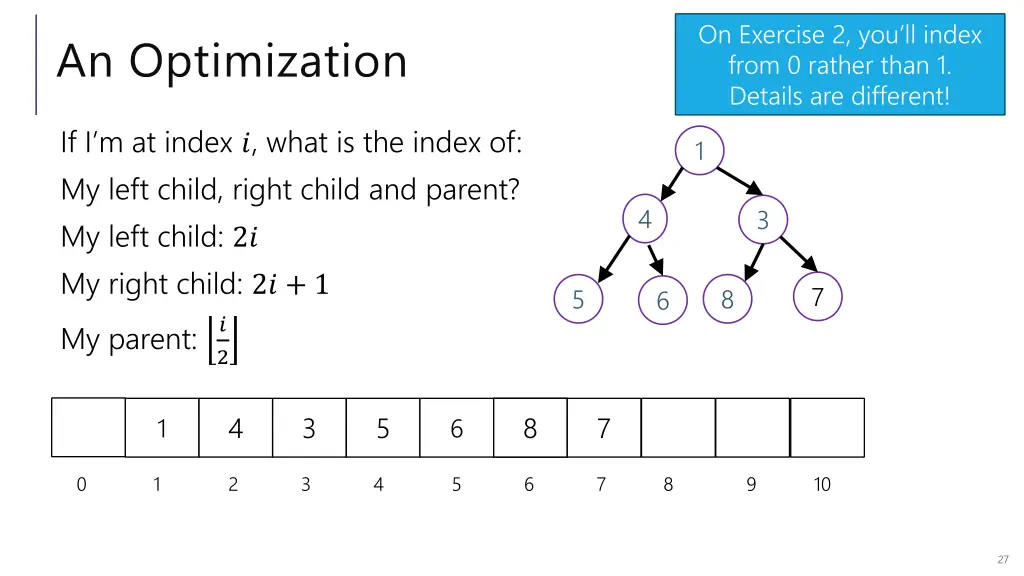
An Optimization Pointers are annoying. They re also slow. Shape is simple we don t need pointers We can use an array instead. 1 4 3 7 5 8 6 4 3 5 8 7 1 6 0 1 2 3 4 5 6 7 8 9 10 25
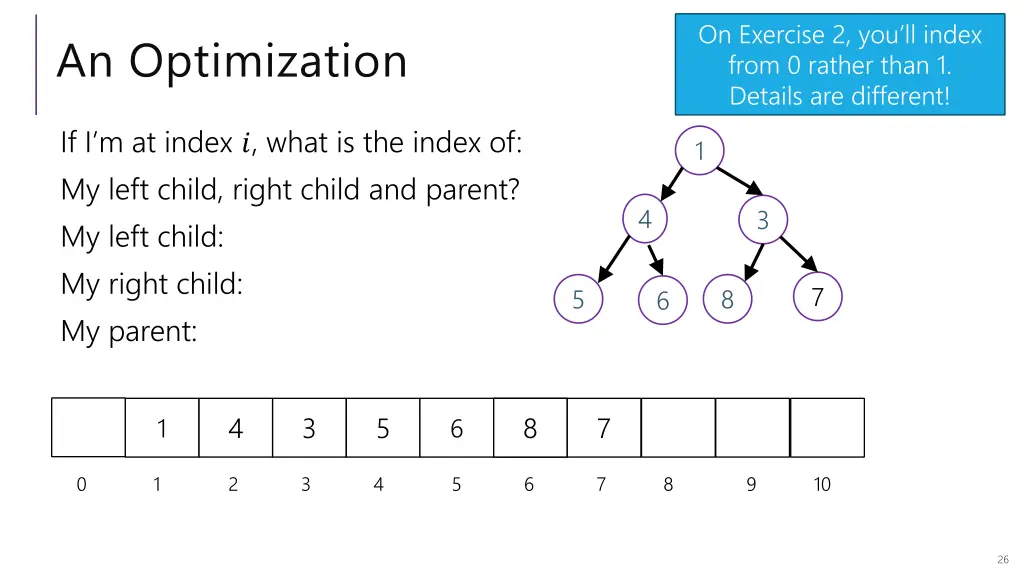
On Exercise 2, youll index from 0 rather than 1. Details are different! An Optimization If I m at index ?, what is the index of: My left child, right child and parent? My left child: My right child: My parent: 1 4 3 7 5 8 6 4 3 5 8 7 1 6 0 1 2 3 4 5 6 7 8 9 10 26
On Exercise 2, youll index from 0 rather than 1. Details are different! An Optimization If I m at index ?, what is the index of: My left child, right child and parent? My left child: 2? My right child: 2? + 1 1 4 3 7 5 8 6 ? 2 My parent: 4 3 5 8 7 1 6 0 1 2 3 4 5 6 7 8 9 10 27
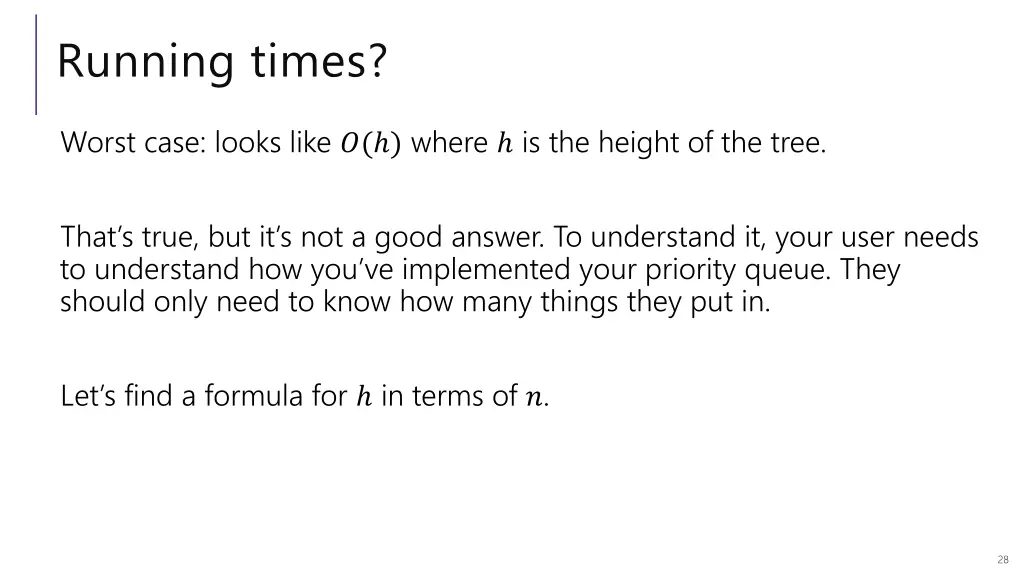
Running times? Worst case: looks like ?( ) where is the height of the tree. That s true, but it s not a good answer. To understand it, your user needs to understand how you ve implemented your priority queue. They should only need to know how many things they put in. Let s find a formula for in terms of ?. 28
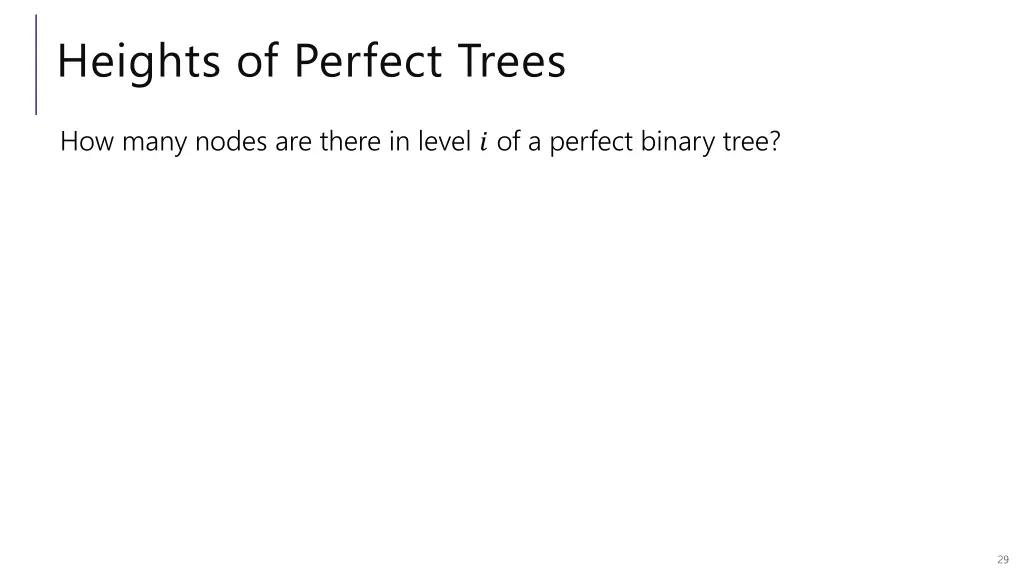
Heights of Perfect Trees How many nodes are there in level ? of a perfect binary tree? 29
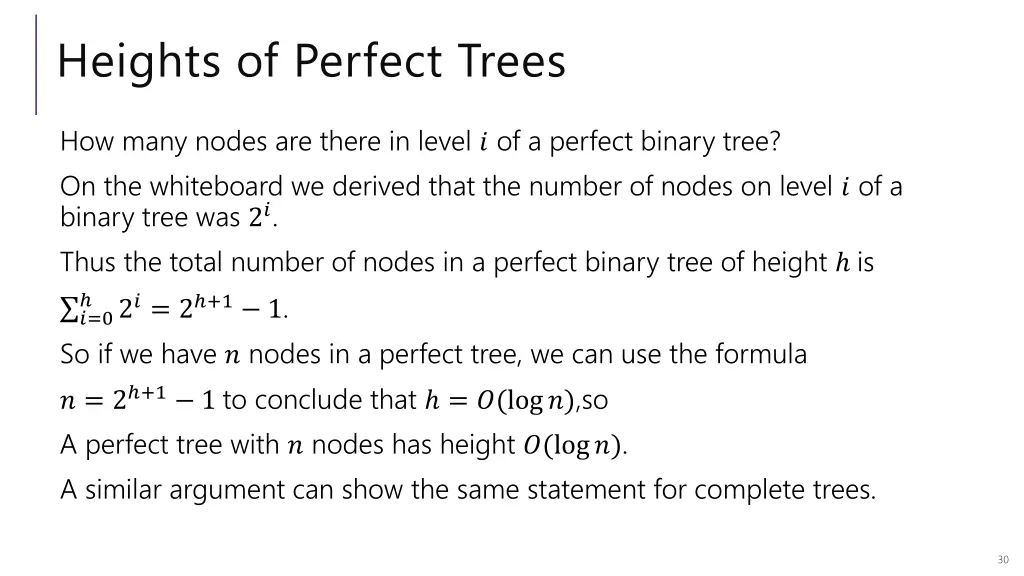
Heights of Perfect Trees How many nodes are there in level ? of a perfect binary tree? On the whiteboard we derived that the number of nodes on level ? of a binary tree was 2?. Thus the total number of nodes in a perfect binary tree of height is 2?= 2 +1 1. So if we have ? nodes in a perfect tree, we can use the formula ? = 2 +1 1 to conclude that = ?(log?),so A perfect tree with ? nodes has height ?(log?). A similar argument can show the same statement for complete trees. ?=0 30
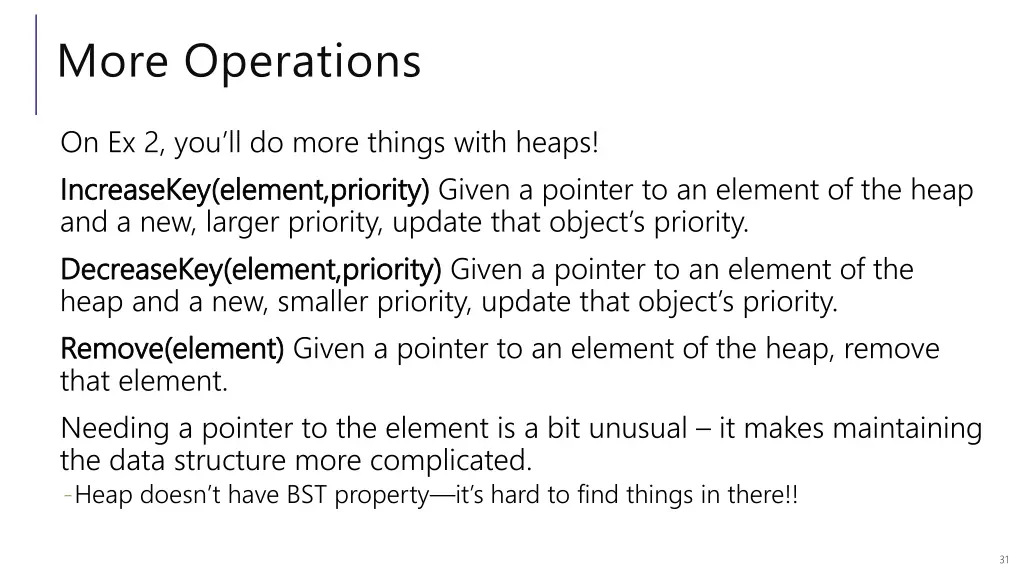
More Operations On Ex 2, you ll do more things with heaps! IncreaseKey IncreaseKey( (element,priority element,priority) ) Given a pointer to an element of the heap and a new, larger priority, update that object s priority. DecreaseKey DecreaseKey( (element,priority element,priority) ) Given a pointer to an element of the heap and a new, smaller priority, update that object s priority. Remove(element) Remove(element) Given a pointer to an element of the heap, remove that element. Needing a pointer to the element is a bit unusual it makes maintaining the data structure more complicated. -Heap doesn t have BST property it s hard to find things in there!! 31
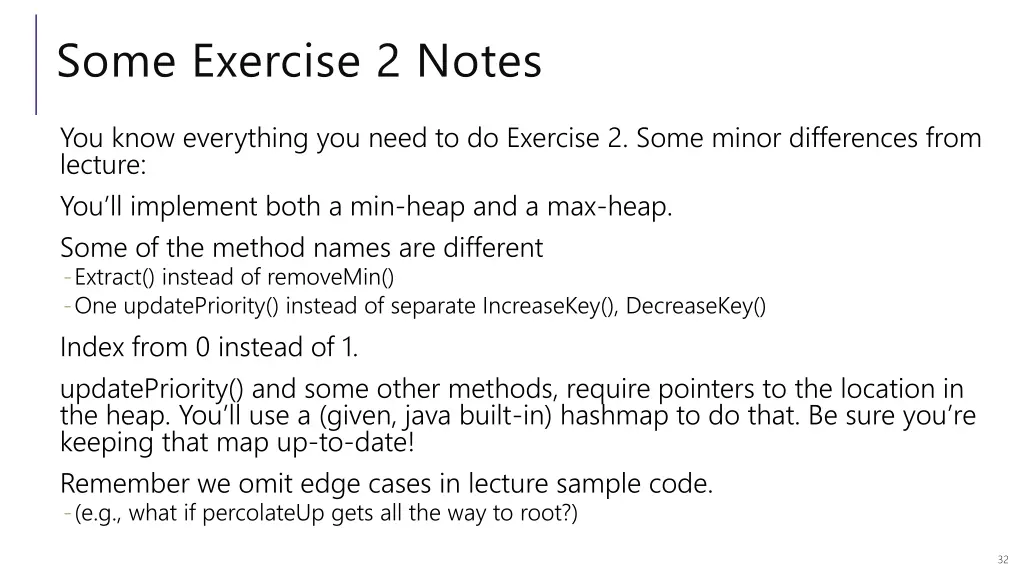
Some Exercise 2 Notes You know everything you need to do Exercise 2. Some minor differences from lecture: You ll implement both a min-heap and a max-heap. Some of the method names are different -Extract() instead of removeMin() -One updatePriority() instead of separate IncreaseKey(), DecreaseKey() Index from 0 instead of 1. updatePriority() and some other methods, require pointers to the location in the heap. You ll use a (given, java built-in) hashmap to do that. Be sure you re keeping that map up-to-date! Remember we omit edge cases in lecture sample code. -(e.g., what if percolateUp gets all the way to root?) 32
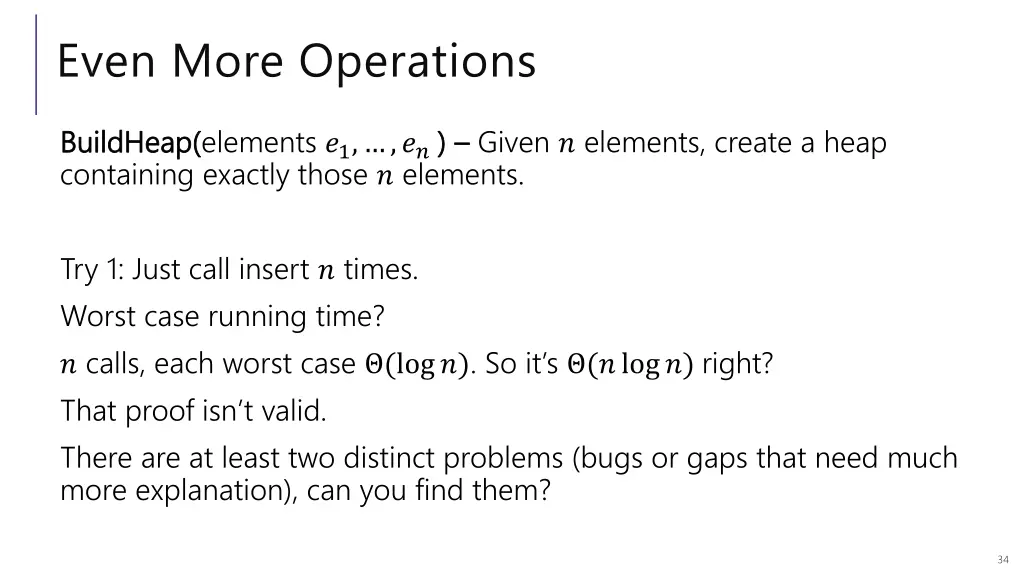
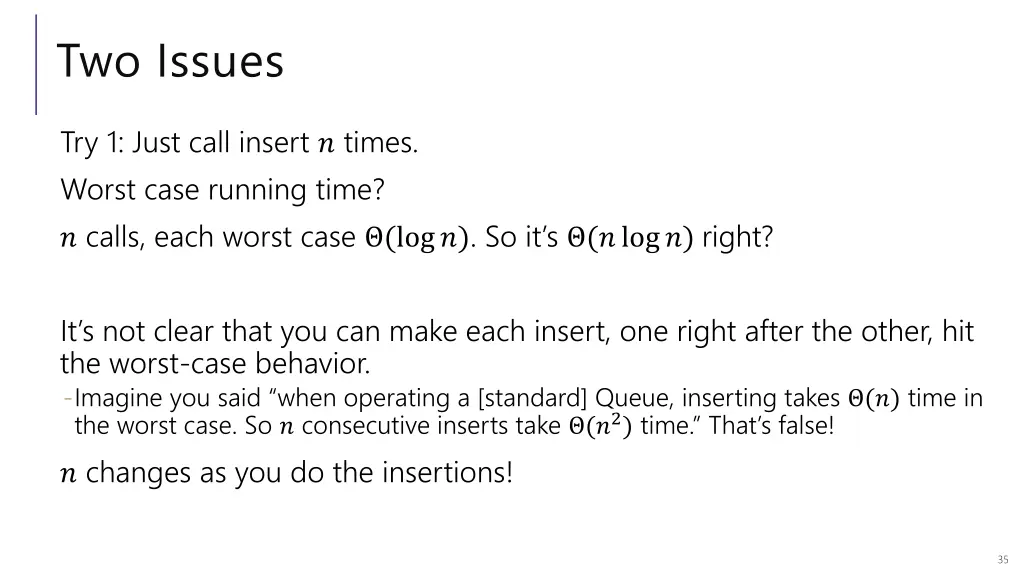
Even More Operations BuildHeap( BuildHeap(elements ?1, ,??) ) Given ? elements, create a heap containing exactly those ? elements. Try 1: Just call insert ? times. Worst case running time? ? calls, each worst case (log?). So it s (?log?) right? That proof isn t valid. There are at least two distinct problems (bugs or gaps that need much more explanation), can you find them? 34
Two Issues Try 1: Just call insert ? times. Worst case running time? ? calls, each worst case (log?). So it s (?log?) right? It s not clear that you can make each insert, one right after the other, hit the worst-case behavior. -Imagine you said when operating a [standard] Queue, inserting takes (?) time in the worst case. So ? consecutive inserts take (?2)time. That s false! ? changes as you do the insertions! 35
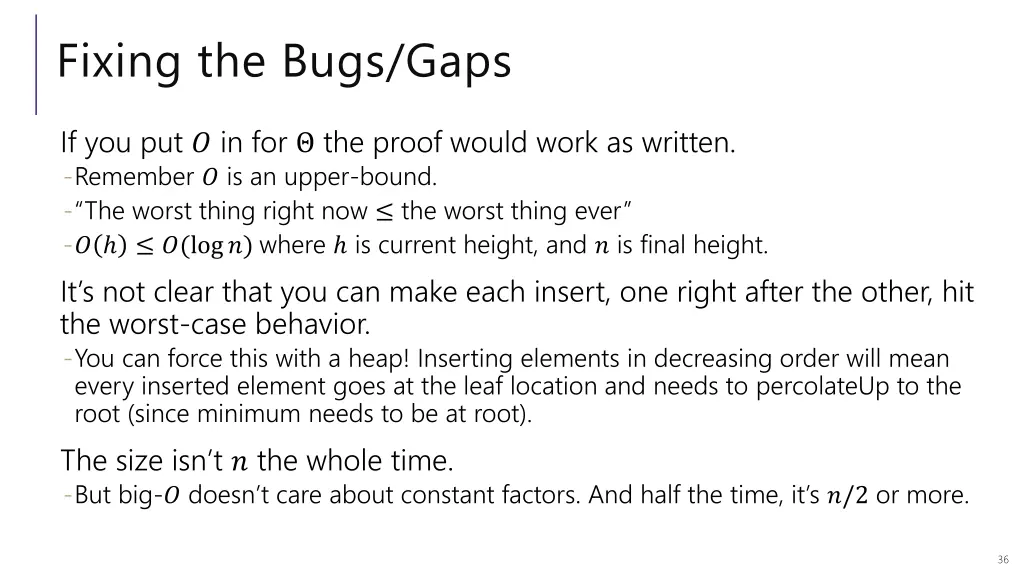
Fixing the Bugs/Gaps If you put ? in for the proof would work as written. -Remember ? is an upper-bound. - The worst thing right now the worst thing ever -? ?(log?) where is current height, and ? is final height. It s not clear that you can make each insert, one right after the other, hit the worst-case behavior. -You can force this with a heap! Inserting elements in decreasing order will mean every inserted element goes at the leaf location and needs to percolateUp to the root (since minimum needs to be at root). The size isn t ? the whole time. -But big-?doesn t care about constant factors. And half the time, it s ?/2 or more. 36
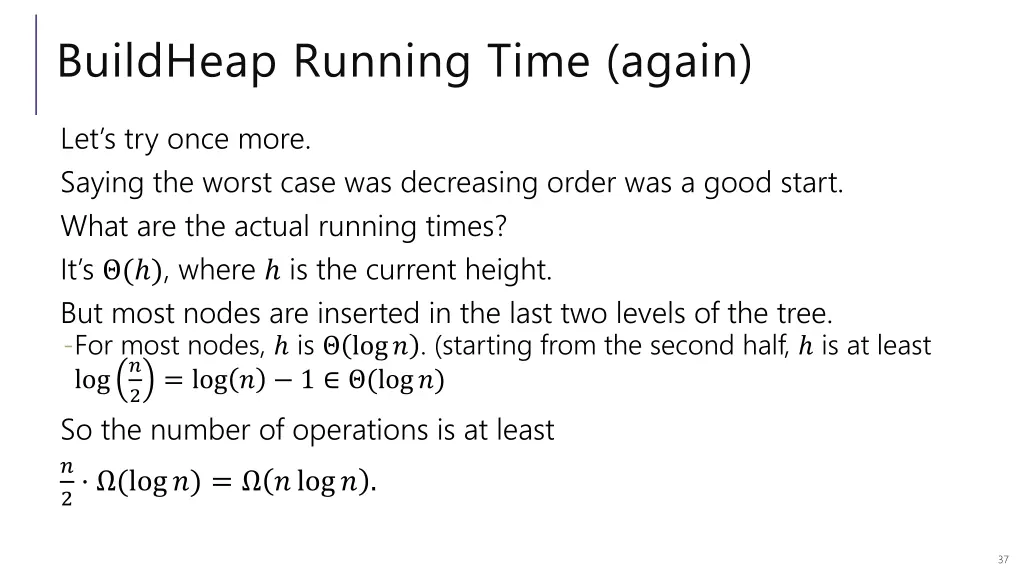
BuildHeap Running Time (again) Let s try once more. Saying the worst case was decreasing order was a good start. What are the actual running times? It s ( ), where is the current height. But most nodes are inserted in the last two levels of the tree. -For most nodes, is log? . (starting from the second half, is at least log 2 = log ? 1 (log?) So the number of operations is at least ? 2 (log?) = ?log? . ? 37
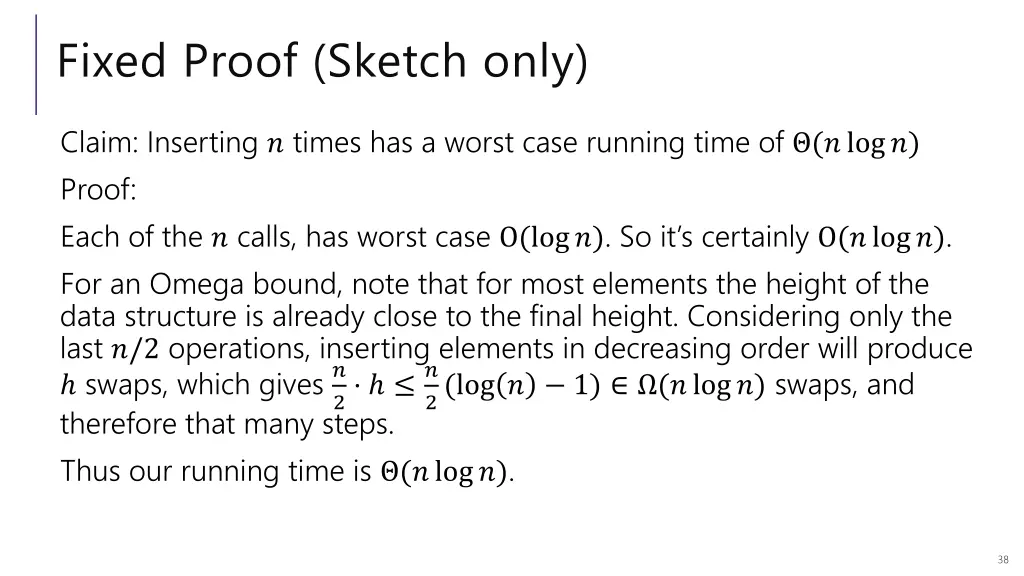
Fixed Proof (Sketch only) Claim: Inserting ? times has a worst case running time of (?log?) Proof: Each of the ? calls, has worst case O(log?). So it s certainly O(?log?). For an Omega bound, note that for most elements the height of the data structure is already close to the final height. Considering only the last ?/2 operations, inserting elements in decreasing order will produce swaps, which gives ? therefore that many steps. Thus our running time is (?log?). 2 ? 2(log ? 1) (?log?) swaps, and 38
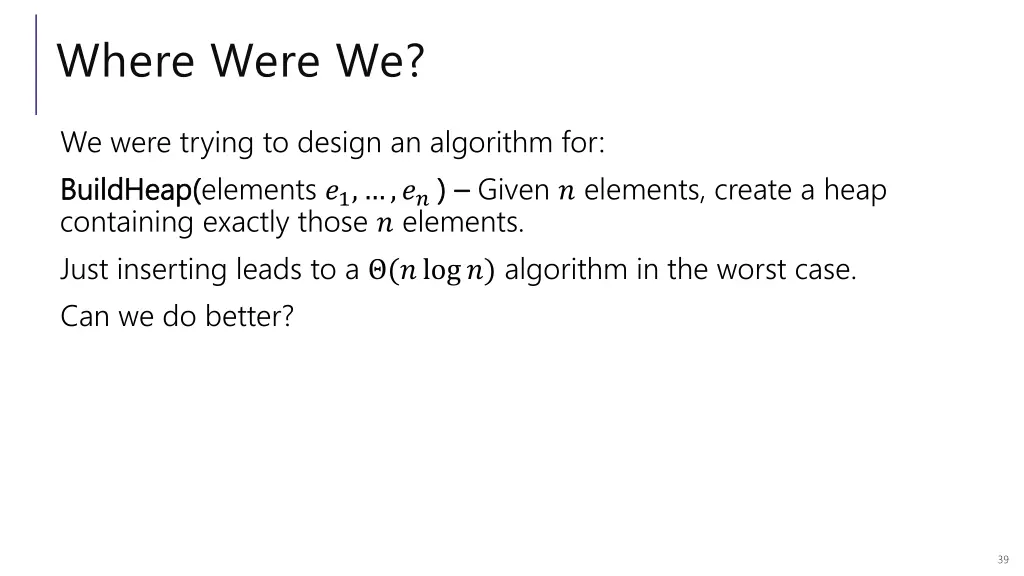
Where Were We? We were trying to design an algorithm for: BuildHeap( BuildHeap(elements ?1, ,??) ) Given ? elements, create a heap containing exactly those ? elements. Just inserting leads to a (?log?) algorithm in the worst case. Can we do better? 39
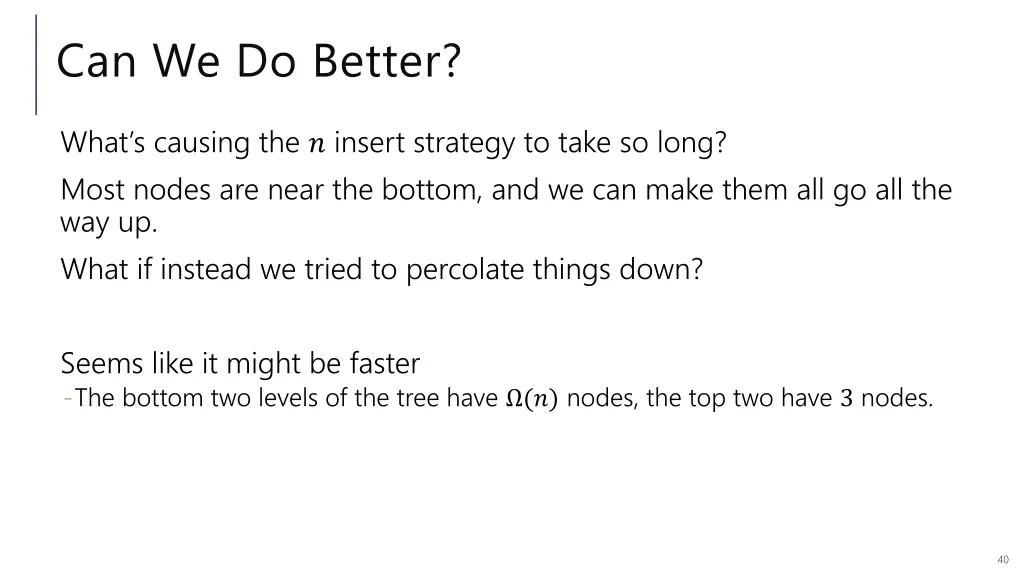
Can We Do Better? What s causing the ? insert strategy to take so long? Most nodes are near the bottom, and we can make them all go all the way up. What if instead we tried to percolate things down? Seems like it might be faster -The bottom two levels of the tree have (?) nodes, the top two have 3 nodes. 40