Implications of Computers as Second Language Speakers for CFL Learning
Exploring the concept of computers as second language speakers, this presentation discusses research and pedagogical challenges for CFL (Computer as a Foreign Language) learning and instruction. It argues for viewing computers as L2 speakers and examines their implications on teaching, learning, and acquisition research. The content highlights observations on natural language processing technologies, traditional roles of technology in L2 education, and perceptions of computer functions in language learning. Various examples and links to audio and text clips are provided to support the arguments presented.

Download Presentation

Please find below an Image/Link to download the presentation.
The content on the website is provided AS IS for your information and personal use only. It may not be sold, licensed, or shared on other websites without obtaining consent from the author. If you encounter any issues during the download, it is possible that the publisher has removed the file from their server.
You are allowed to download the files provided on this website for personal or commercial use, subject to the condition that they are used lawfully. All files are the property of their respective owners.
The content on the website is provided AS IS for your information and personal use only. It may not be sold, licensed, or shared on other websites without obtaining consent from the author.
E N D
Presentation Transcript
Computers as second language speakers and its implications for CFL learning and instruction Jun Da ( ), Ph.D. CLTA-SIG, 08/07/2021
Note First presented at BCLTS 2021 in July 2021: https://bclts.org.uk/conference/
Objectives Argue for viewing computers as second language speakers Discuss some research and pedagogical challenges for CFL learning and instruction
Outline 1. Some observations about the use of natural language technologies from the real word and L2 classrooms Traditional roles of technology and perceptions of its functions in L2 learning and teaching Arguments for viewing computers as L2 speakers Implications for L2 learning, teaching, and acquisition research 2. 3. 4.
1. Natural language processing technologies: Some observations
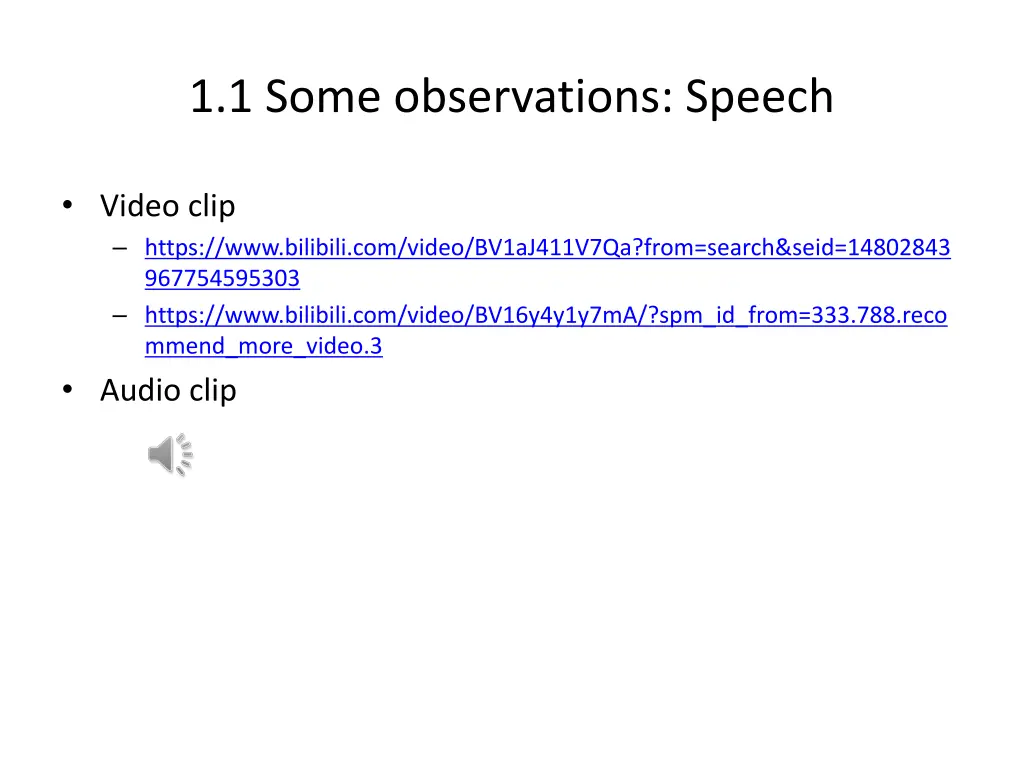
1.1 Some observations: Speech Video clip https://www.bilibili.com/video/BV1aJ411V7Qa?from=search&seid=14802843 967754595303 https://www.bilibili.com/video/BV16y4y1y7mA/?spm_id_from=333.788.reco mmend_more_video.3 Audio clip
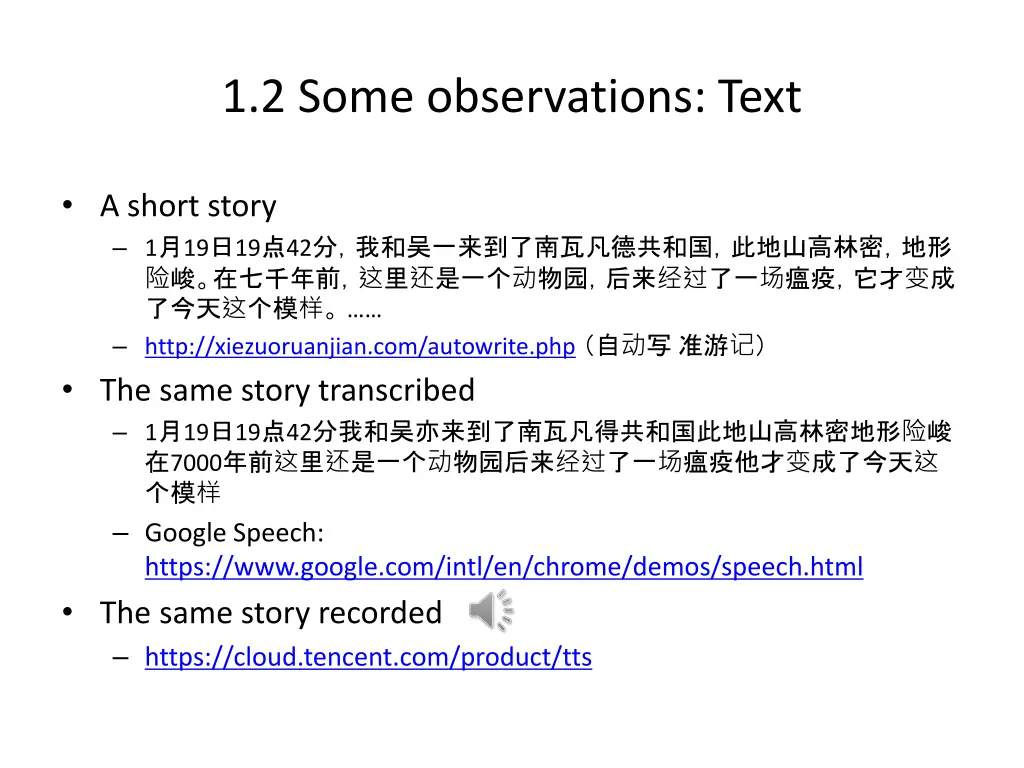
1.2 Some observations: Text A short story 1 19 19 42 http://xiezuoruanjian.com/autowrite.php The same story transcribed 1 19 19 42 7000 Google Speech: https://www.google.com/intl/en/chrome/demos/speech.html The same story recorded https://cloud.tencent.com/product/tts
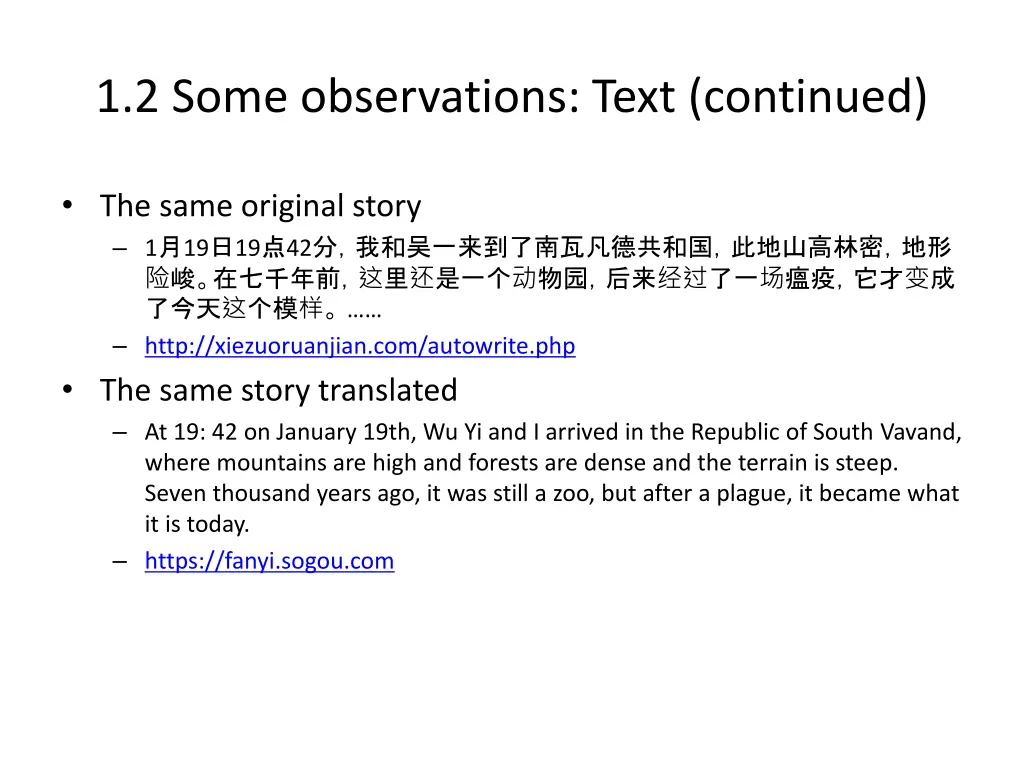
1.2 Some observations: Text (continued) The same original story 1 19 19 42 http://xiezuoruanjian.com/autowrite.php The same story translated At 19: 42 on January 19th, Wu Yi and I arrived in the Republic of South Vavand, where mountains are high and forests are dense and the terrain is steep. Seven thousand years ago, it was still a zoo, but after a plague, it became what it is today. https://fanyi.sogou.com
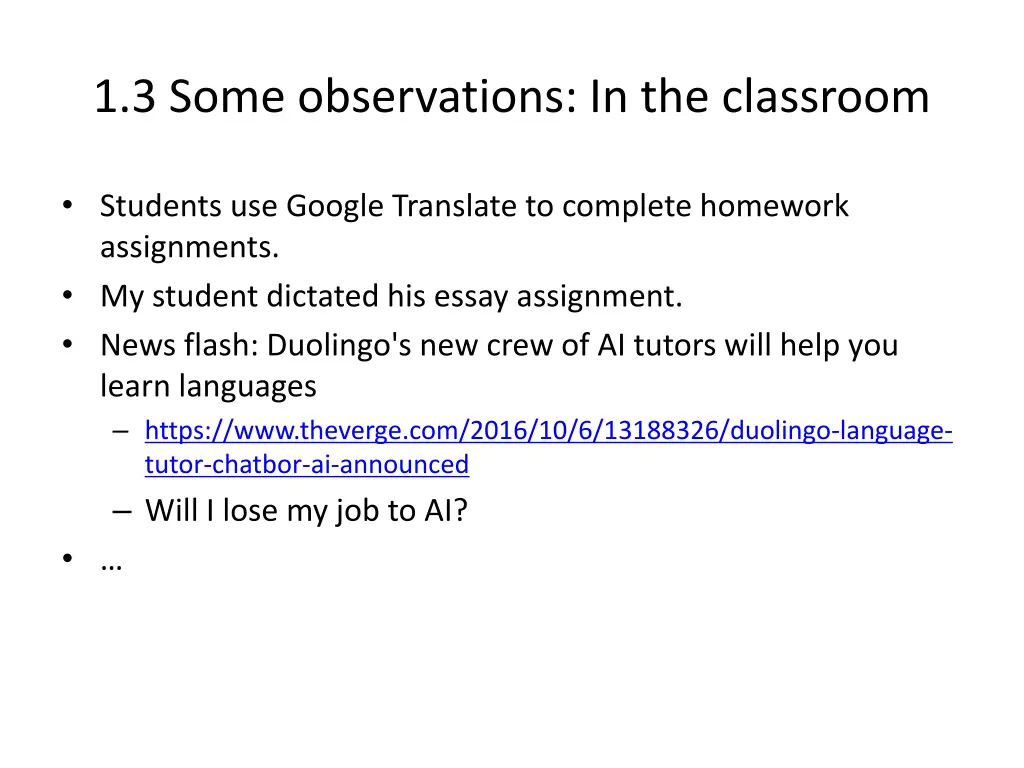
1.3 Some observations: In the classroom Students use Google Translate to complete homework assignments. My student dictated his essay assignment. News flash: Duolingo's new crew of AI tutors will help you learn languages https://www.theverge.com/2016/10/6/13188326/duolingo-language- tutor-chatbor-ai-announced Will I lose my job to AI?
1.4 What do they have in common? Result of or related to natural language processing technologies!
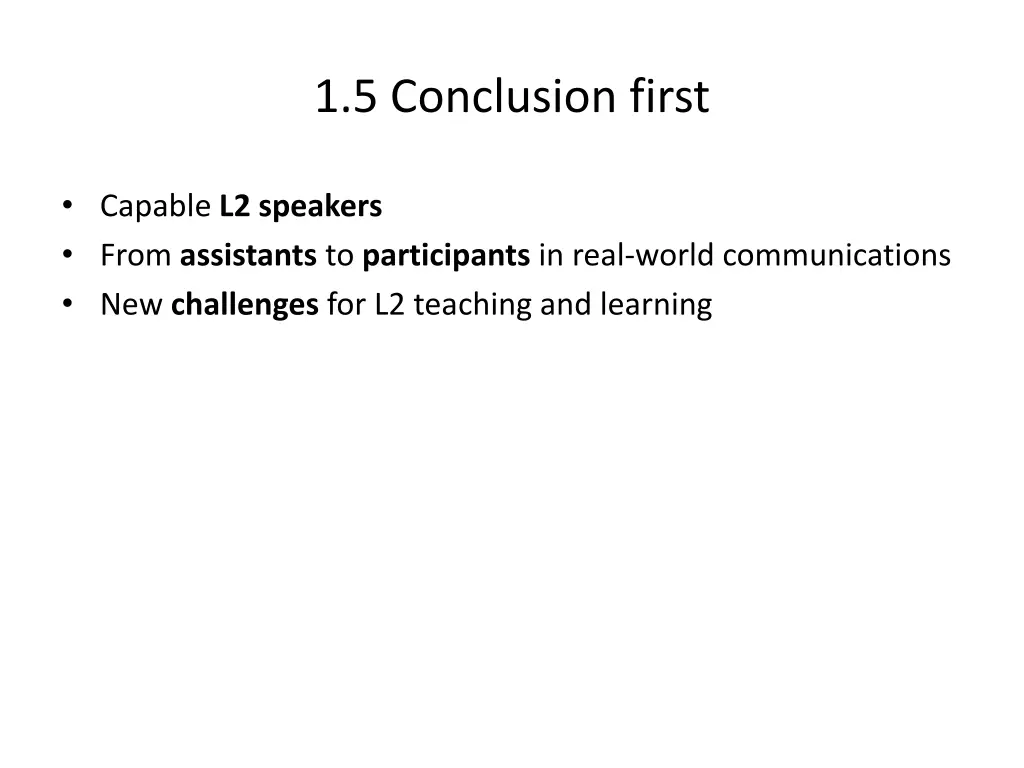
1.5 Conclusion first Capable L2 speakers From assistants to participants in real-world communications New challenges for L2 teaching and learning
2. The traditional roles and functions of computers, or technology in general
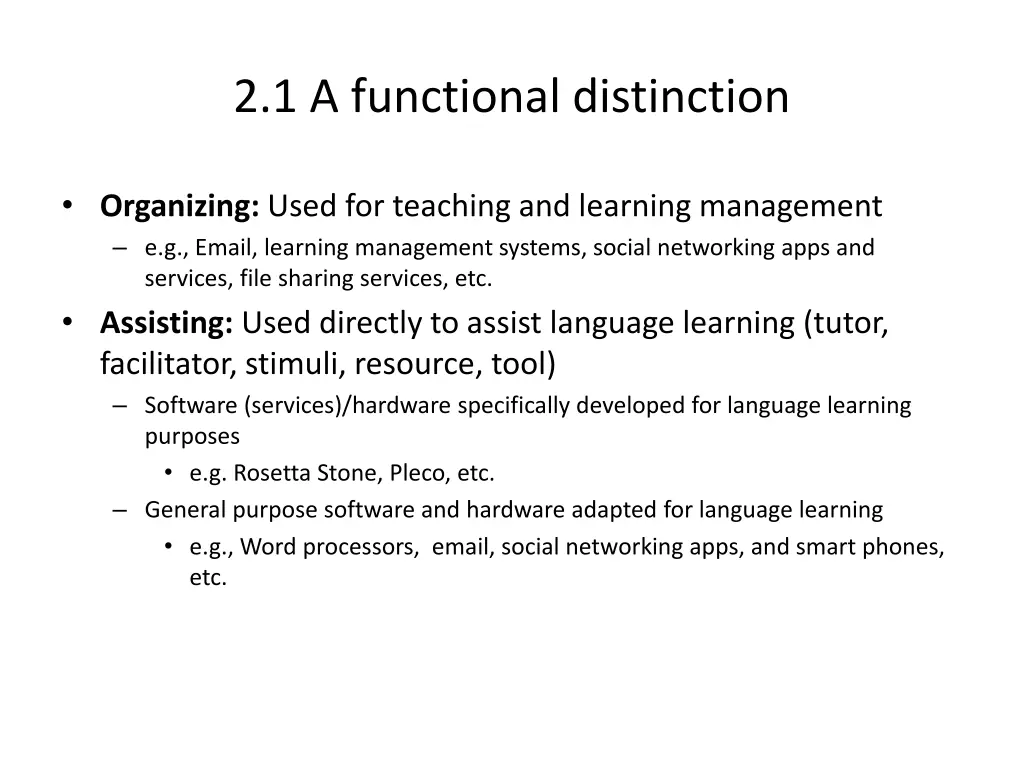
2.1 A functional distinction Organizing: Used for teaching and learning management e.g., Email, learning management systems, social networking apps and services, file sharing services, etc. Assisting: Used directly to assist language learning (tutor, facilitator, stimuli, resource, tool) Software (services)/hardware specifically developed for language learning purposes e.g. Rosetta Stone, Pleco, etc. General purpose software and hardware adapted for language learning e.g., Word processors, email, social networking apps, and smart phones, etc.
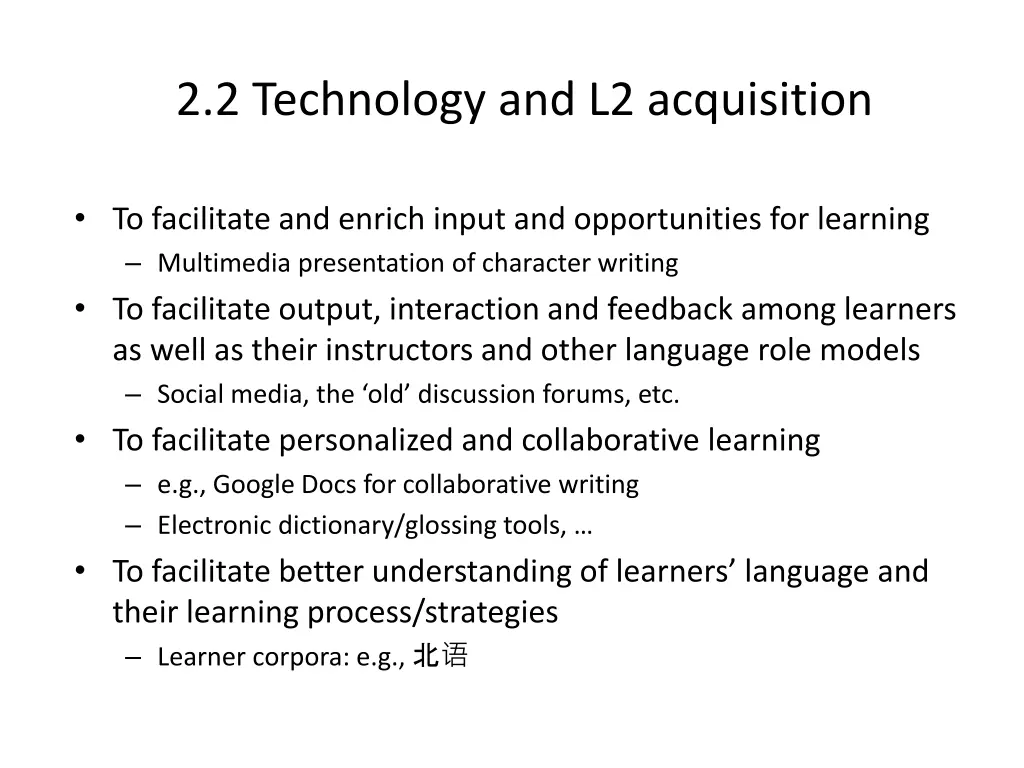
2.2 Technology and L2 acquisition To facilitate and enrich input and opportunities for learning Multimedia presentation of character writing To facilitate output, interaction and feedback among learners as well as their instructors and other language role models Social media, the old discussion forums, etc. To facilitate personalized and collaborative learning e.g., Google Docs for collaborative writing Electronic dictionary/glossing tools, To facilitate better understanding of learners language and their learning process/strategies Learner corpora: e.g.,
2.3 References Frank et al., 2008 Wu, 2016 Da & Zheng, 2018 Liu & Da, 2021
3. Natural language processing and the emerging participatory role of computers as L2 speakers in real- world communications
3.1 Natural language processing (NLP) Natural language understanding Natural language generation
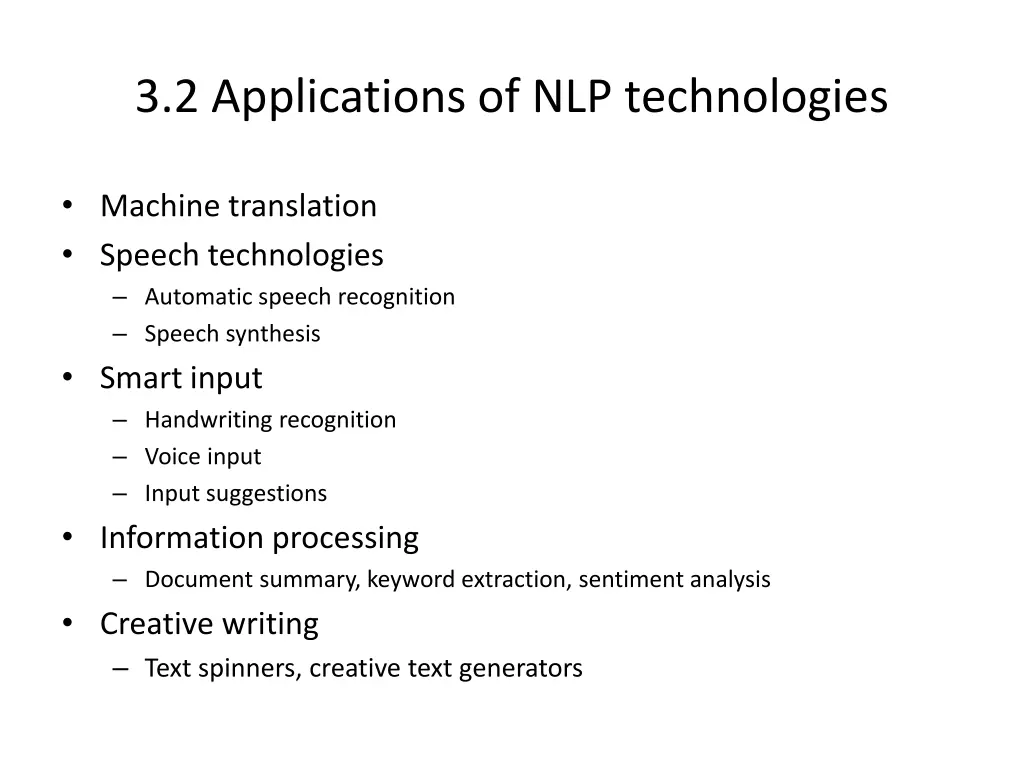
3.2 Applications of NLP technologies Machine translation Speech technologies Automatic speech recognition Speech synthesis Smart input Handwriting recognition Voice input Input suggestions Information processing Document summary, keyword extraction, sentiment analysis Creative writing Text spinners, creative text generators
3.3 Computers as L2 speakers Computers speak human/natural language at different proficiency levels!
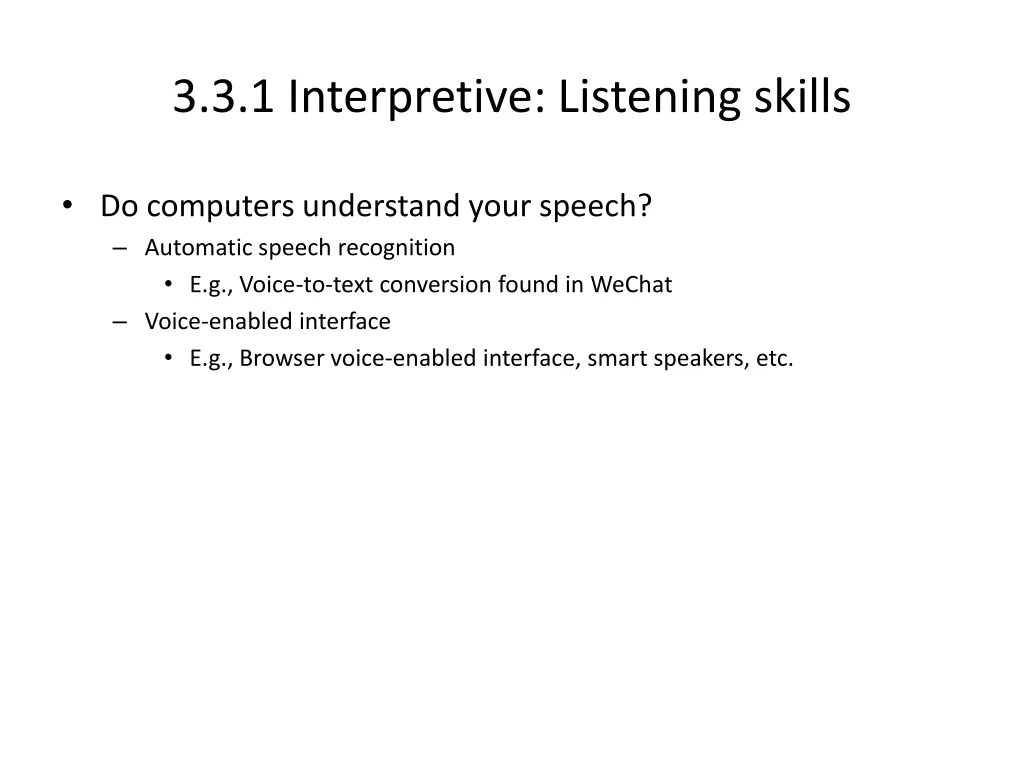
3.3.1 Interpretive: Listening skills Do computers understand your speech? Automatic speech recognition E.g., Voice-to-text conversion found in WeChat Voice-enabled interface E.g., Browser voice-enabled interface, smart speakers, etc.
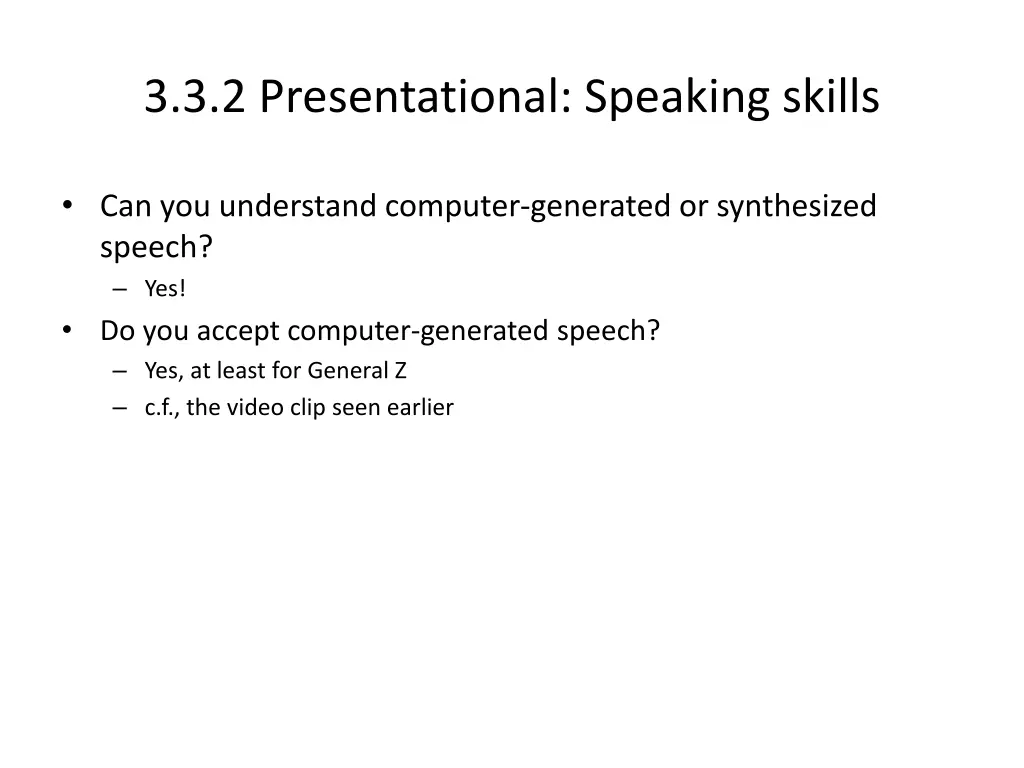
3.3.2 Presentational: Speaking skills Can you understand computer-generated or synthesized speech? Yes! Do you accept computer-generated speech? Yes, at least for General Z c.f., the video clip seen earlier
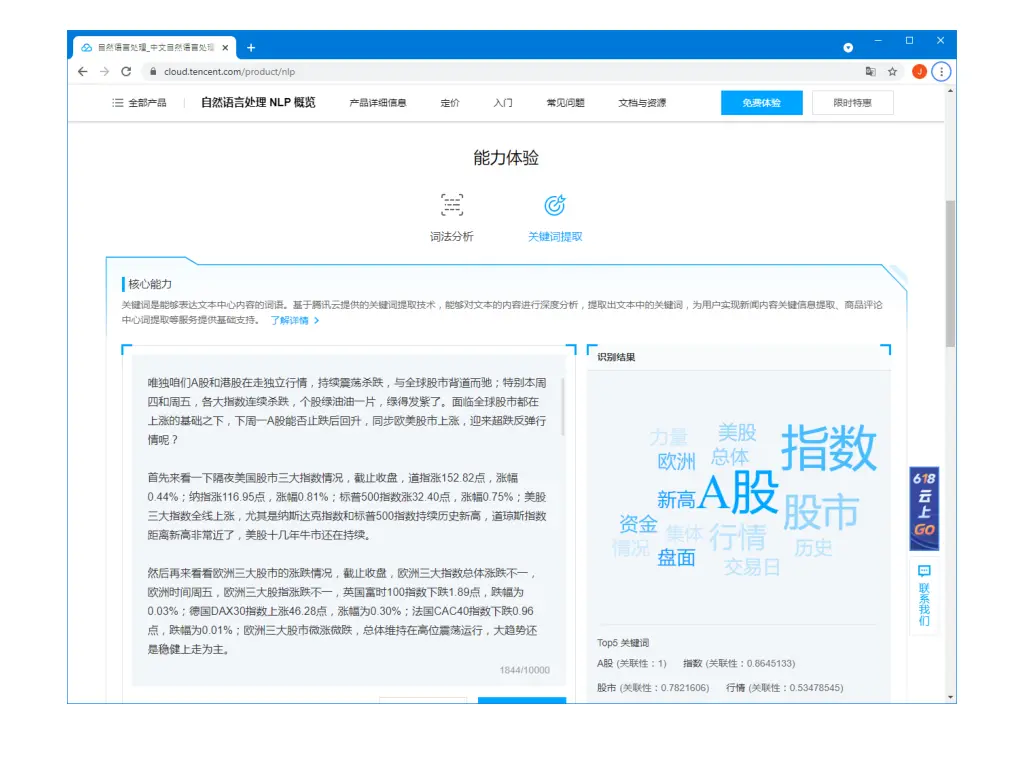
3.3.3 Interpretive: Reading skills Can computers read and understand text? Yes, to some degree. E.g., https://new.qq.com/omn/20210703/20210703A0A7KH00.html https://cloud.tencent.com/product/nlp Screen capture next page
3.3.4 Presentational: Writing skills A novice writer Mostly rewriting of human created content at the phrase/sentence level e.g., Text spinners (c.f. https://spinbot.com/) A more advanced writer Creative use of language e.g., http://textsummarization.net/text-summarizer e.g., https://www.splitbrain.org/services/ots e.g., https://medium.com/@andronovhopf/teaching-a-neural-network-to- love-e2e8a082ed99 e.g. http://xiezuoruanjian.com/autowrite.php Machine translation as writer? Very simple introduction to text spinning and automatic text generation: https://en.wikipedia.org/wiki/Natural-language_generation https://en.wikipedia.org/wiki/Article_spinning
3.3.5 Grammatical competence Do computers make grammatical errors? They are grammatical most of the time, though errors do occur, very often at the global or pragmatic level. c.f. the short story and video clip given earlier C.f., Language-learner language or interlanguage (e.g., Selinker, 1972; Ellis, 1986) Permeable: IL at any one stage is not fixed but are open to amendment Dynamic: IL changes in stages Systematic: A simplified grammar
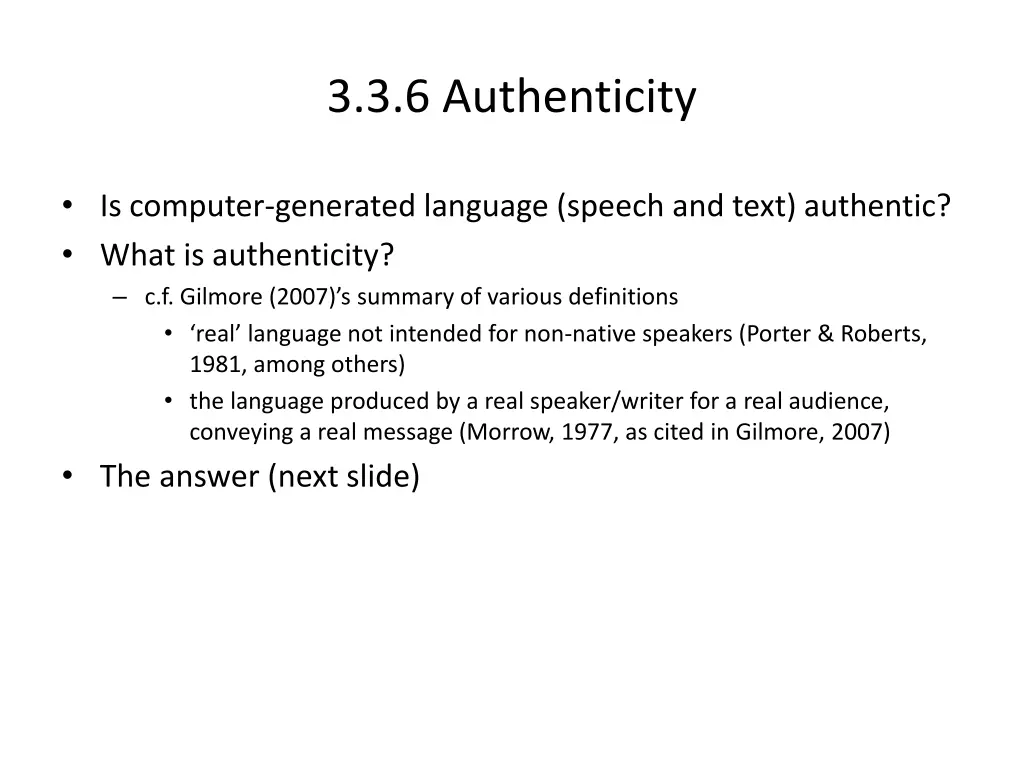
3.3.6 Authenticity Is computer-generated language (speech and text) authentic? What is authenticity? c.f. Gilmore (2007) s summary of various definitions real language not intended for non-native speakers (Porter & Roberts, 1981, among others) the language produced by a real speaker/writer for a real audience, conveying a real message (Morrow, 1977, as cited in Gilmore, 2007) The answer (next slide)
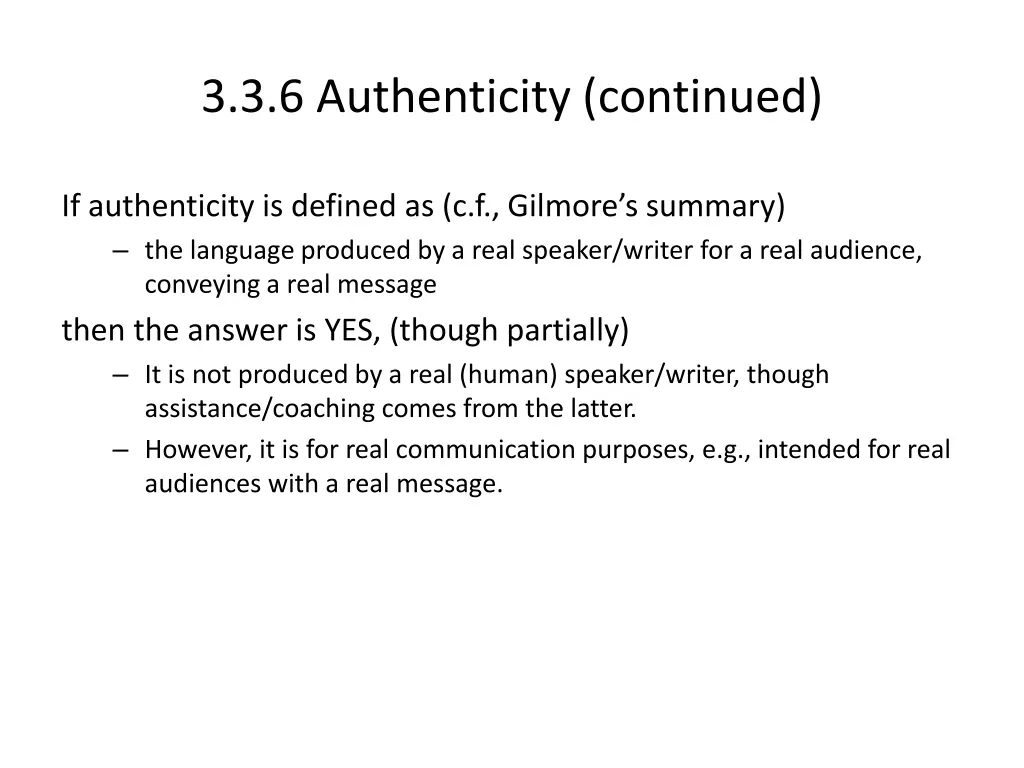
3.3.6 Authenticity (continued) If authenticity is defined as (c.f., Gilmore s summary) the language produced by a real speaker/writer for a real audience, conveying a real message then the answer is YES, (though partially) It is not produced by a real (human) speaker/writer, though assistance/coaching comes from the latter. However, it is for real communication purposes, e.g., intended for real audiences with a real message.
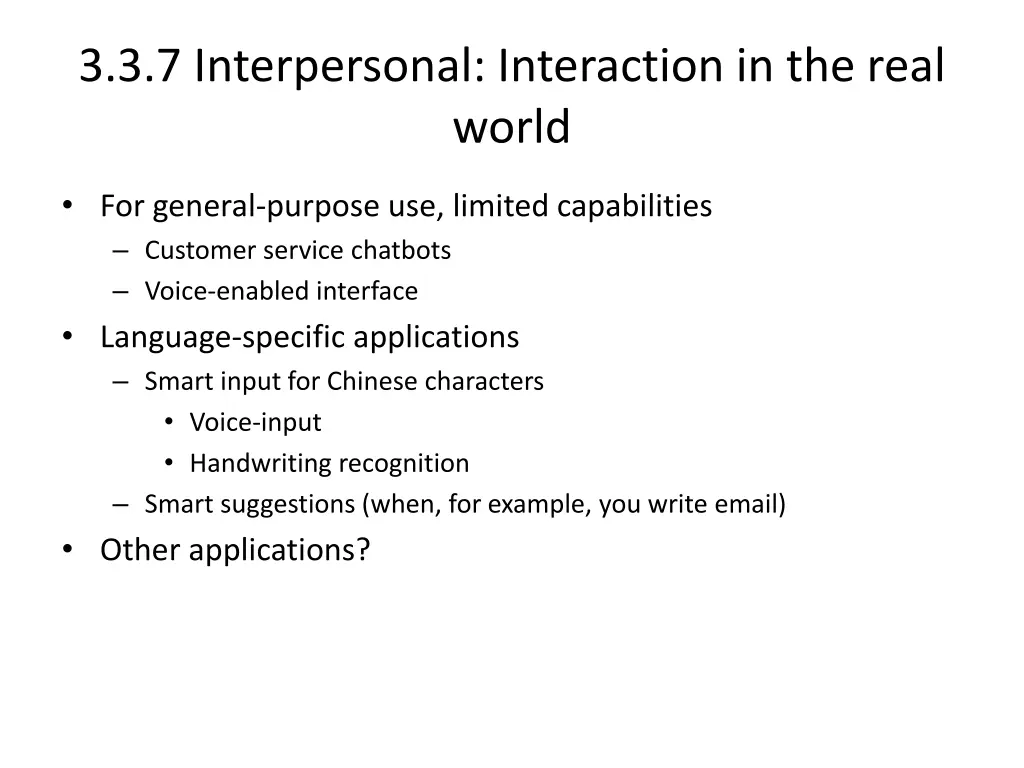
3.3.7 Interpersonal: Interaction in the real world For general-purpose use, limited capabilities Customer service chatbots Voice-enabled interface Language-specific applications Smart input for Chinese characters Voice-input Handwriting recognition Smart suggestions (when, for example, you write email) Other applications?
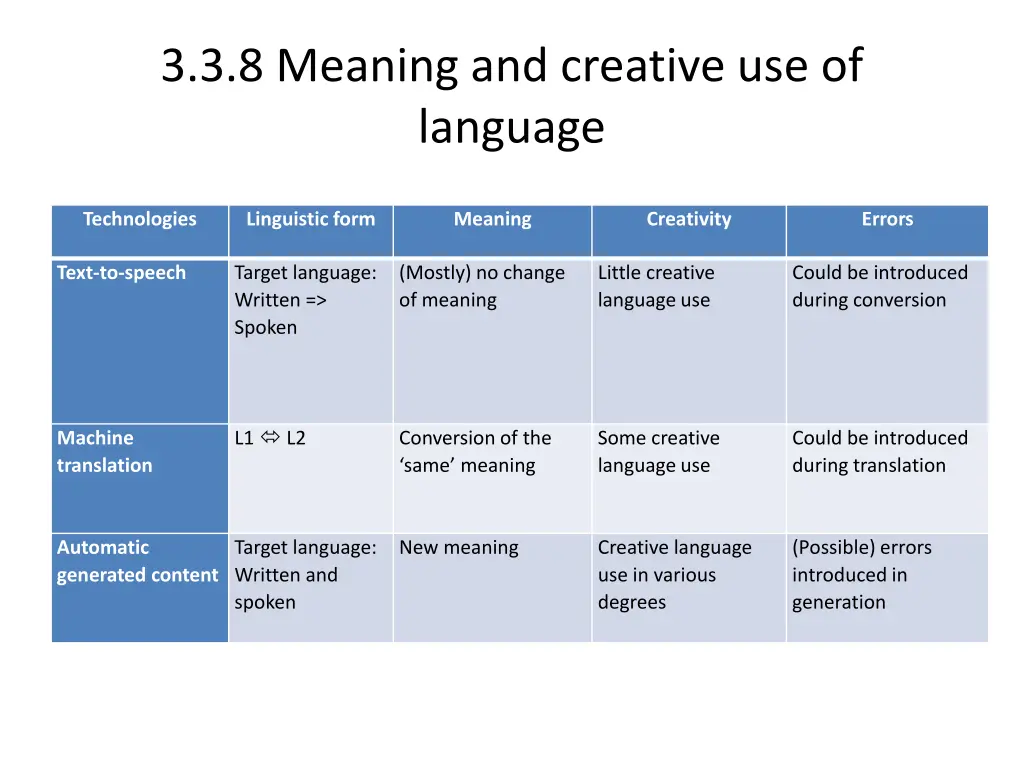
3.3.8 Meaning and creative use of language Technologies Linguistic form Meaning Creativity Errors Text-to-speech Target language: Written => Spoken (Mostly) no change of meaning Little creative language use Could be introduced during conversion L1 L2 Machine translation Conversion of the same meaning Some creative language use Could be introduced during translation Automatic generated content Target language: Written and spoken New meaning Creative language use in various degrees (Possible) errors introduced in generation
3.4 Conclusion Current advancement in natural language processing technologies has turned a dummy computer into a capable second language speaker with subskills at different levels. Computers have become direct participants in real-world communications with both native and non-native speakers.
4. Research questions and implications for L2 learning and instruction
4.1 At the operational level Can synthesized speech be used for listening comprehension practice? Do instructors and learners accept such input generated by a computer? When computers are so good at recognizing real human speech, should we allow students to voice-write Chinese characters? Can my students consult machine translation to search for ideas/prompts in completing their written homework assignments? Should we allow students to use creative writing software (e.g., text spinner) to assist their writing? Is it plagiarism?
4.2 At the pedagogical level Can a computer, as a (capable) L2 speaker, provide input for L2 learning and serve as a role model for L2 learners? What kind of effect, whether positive or negative, do computer generated language (both text and speech) have on human L2 learners language acquisition? c.f. Authentic vs non-authentic/modified input Authentic input Positive evidence (c.f. Long, 2015, among others) Cultural information c.f. https://www.actfl.org/guiding-principles/use-authentic-texts-language-learning Non-authentic/modified input What lower level learner are exposed to most of the time (especially in a classroom situation)
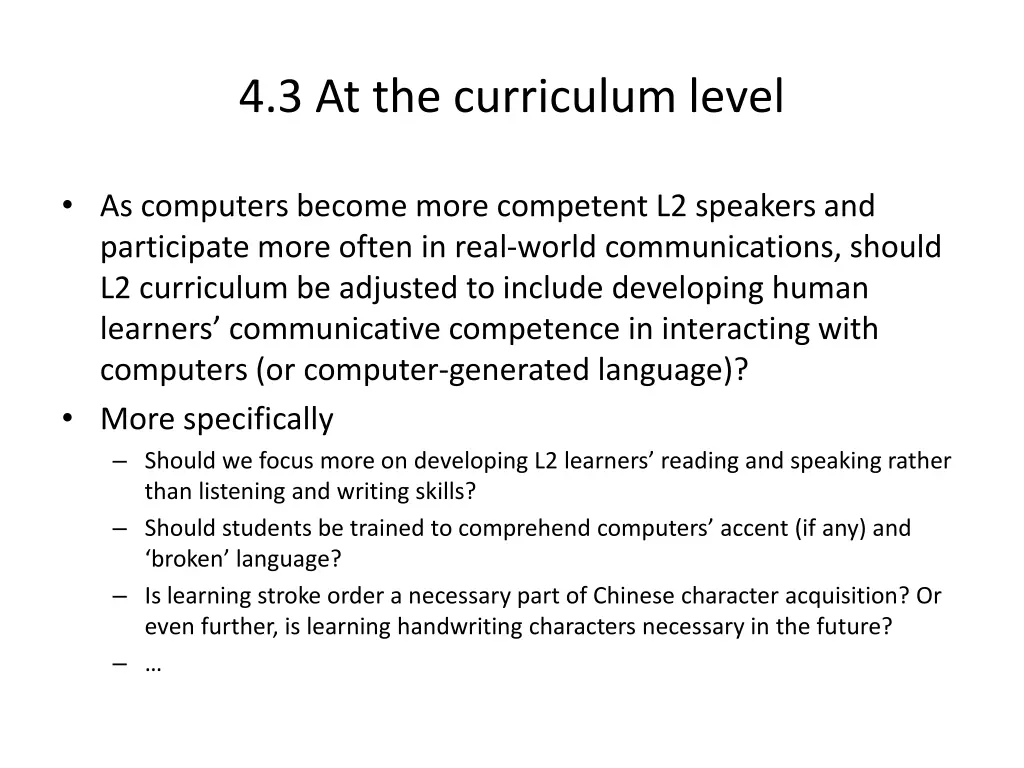
4.3 At the curriculum level As computers become more competent L2 speakers and participate more often in real-world communications, should L2 curriculum be adjusted to include developing human learners communicative competence in interacting with computers (or computer-generated language)? More specifically Should we focus more on developing L2 learners reading and speaking rather than listening and writing skills? Should students be trained to comprehend computers accent (if any) and broken language? Is learning stroke order a necessary part of Chinese character acquisition? Or even further, is learning handwriting characters necessary in the future?
4.4 Conclusion We need to address these questions as computers become increasingly capable L2 speakers!
References Da, J., & Zheng, Y. (2018). Technology and the teaching and learning of Chinese as a foreign language. In C. Ke. (Ed.), The Routledge handbook of Chinese second language acquisition (pp. 432-447). New York: Routledge. Ellis, R. 1986. Understanding second language acquisition (pp. 42-74). Oxford University Press. Frank, V., Golonka, E., Bowles, A., Becker, E., Freynick, S., & Richardson, D. (2008). Optimal foreign language learning: The role of technology. College Park, MD: Center for Advanced Study of Language at the University of Maryland. https://lingua.mtsu.edu/academic/bclts2021/Frank08_RoleofTechnology.pdf (local cached copy) Gilmore, A. (2007). Authentic materials and authenticity in foreign language learning. Language Teaching, 40(2), 97-118. Liu, S. J., & Da, J. (2021). Technology in Chinese language teaching. To appear in Z. D. Ye, (Ed.), The Palgrave handbook of Chinese language studies. London: Palgrave Macmillan. Selinker, L. 1972. Interlanguage. International Review of Applied Linguistics. 10. 209-231. Wu, Y. (2016). Technology in CFL education. in J. Ruan, J. Zhang & C. B. Leung (Eds.), Chinese language education in the United States (pp. 97-122). New York, NY: Springer.