Importance of Aggregates in Concrete Construction
Aggregates play a fundamental role in concrete by providing strength, reducing shrinkage, and affecting the overall economy of the construction material. Understanding the classification and types of aggregates, including natural and artificial varieties, is crucial for achieving desired concrete properties and performance. Learn about the significance of aggregates in concrete construction and the impact they have on its characteristics and durability.

Download Presentation

Please find below an Image/Link to download the presentation.
The content on the website is provided AS IS for your information and personal use only. It may not be sold, licensed, or shared on other websites without obtaining consent from the author.If you encounter any issues during the download, it is possible that the publisher has removed the file from their server.
You are allowed to download the files provided on this website for personal or commercial use, subject to the condition that they are used lawfully. All files are the property of their respective owners.
The content on the website is provided AS IS for your information and personal use only. It may not be sold, licensed, or shared on other websites without obtaining consent from the author.
E N D
Presentation Transcript
Concrete 2 Department of Architectural Engineering/2ndstage Dr. Zaid Al Hamdany
Aggregates are the important constituents in concrete. They give body to the concrete, reduce shrinkage and effect economy. The mere fact that the aggregates occupy 70 80 per cent of the volume of concrete, their impact on various characteristics and properties of concrete is undoubtedly considerable. To know more about the concrete it is very essential that one should know more about the aggregates which constitute major volume in concrete. Without the study of the aggregate in depth and range, the study of the concrete is incomplete. Cement is the only factory made standard component in concrete. Other ingredients, namely, water and aggregates are natural materials and can vary to any extent in many of their properties.
Aggregate is relatively inexpensive and does not enter into complex chemical reactions with water; it has been customary, therefore, to treat it as an inert filler in concrete. However, due to increasing awareness of the role played by aggregates in determining many important properties of concrete, the traditional view of the aggregate as an inert filler is being seriously questioned.
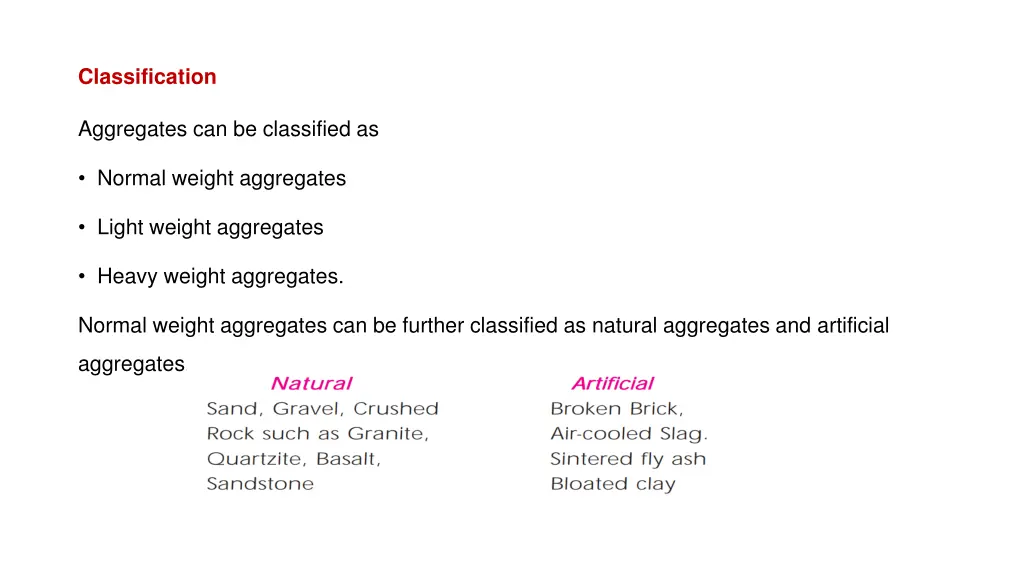
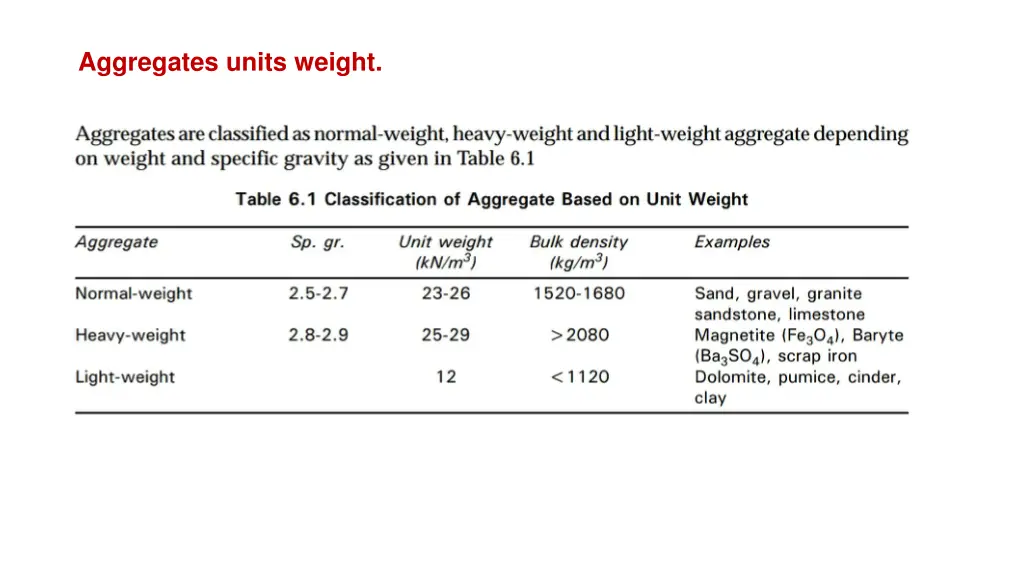
Classification Aggregates can be classified as Normal weight aggregates Light weight aggregates Heavy weight aggregates. Normal weight aggregates can be further classified as natural aggregates and artificial aggregates.
Natural aggregates Natural mineral aggregates form the most important class of aggregates for making portland cement concrete. Approximately half of the total coarse aggregate consumed by the concrete industry in the United States consists of gravel; most of the remainder is crushed rock. Carbonate rocks comprise about two-thirds of the crushed aggregate; sandstone, granite, diorite, gabbro, and basalt make up the rest. Natural silica sand is predominantly used as fine aggregate, even with most lightweight concrete.
Aggregates from Recycled Concert and Municipal Waste (Artificial aggregates) Rubble from demolished concrete buildings yields fragments in which the aggregate is contaminated with hydrated cement paste, gypsum, and minor quantities of other substances. The size fraction that corresponds to fine aggregate contains large amounts of hydrated cement and gypsum, and it is unsuitable for making fresh concrete mixtures. However, the size fraction that corresponds to coarse aggregate, although coated with cement paste, has been used successfully in several laboratory and field studies. Compared with concrete mixtures containing natural aggregate, the mixtures containing recycled-concrete aggregate generally gave at least two-thirds of the compressive strength and modulus of elasticity, and show satisfactory workability and durability.
Source of aggeragte Almost all natural aggregate materials originate from bed rocks. There are three kinds of rocks, namely, igneous, sedimentary and metamorphic. These classifications are based on the mode of formation of rocks. It may be recalled that igneous rocks are formed by the cooling of molten magma or lava at the surface of the crest (trap and basalt) or deep beneath the crest (granite). The sedimentary rocks are formed originally below the sea bed and subsequently lifted up. Metamorphic rocks are originally either igneous or sedimentary rocks which are subsequently metamorphosed due to extreme heat and pressure.
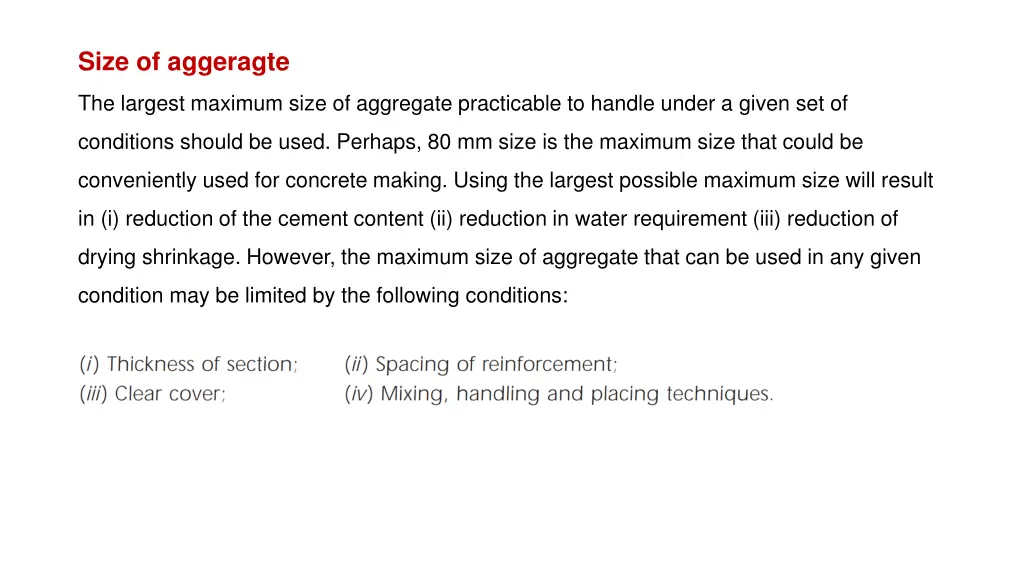
Size of aggeragte The largest maximum size of aggregate practicable to handle under a given set of conditions should be used. Perhaps, 80 mm size is the maximum size that could be conveniently used for concrete making. Using the largest possible maximum size will result in (i) reduction of the cement content (ii) reduction in water requirement (iii) reduction of drying shrinkage. However, the maximum size of aggregate that can be used in any given condition may be limited by the following conditions:
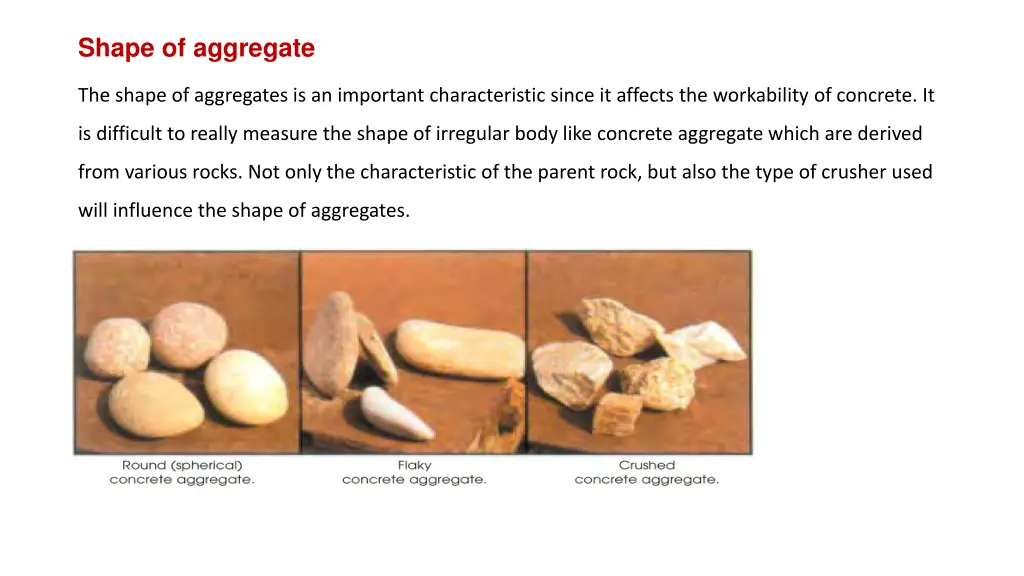
Shape of aggregate The shape of aggregates is an important characteristic since it affects the workability of concrete. It is difficult to really measure the shape of irregular body like concrete aggregate which are derived from various rocks. Not only the characteristic of the parent rock, but also the type of crusher used will influence the shape of aggregates.
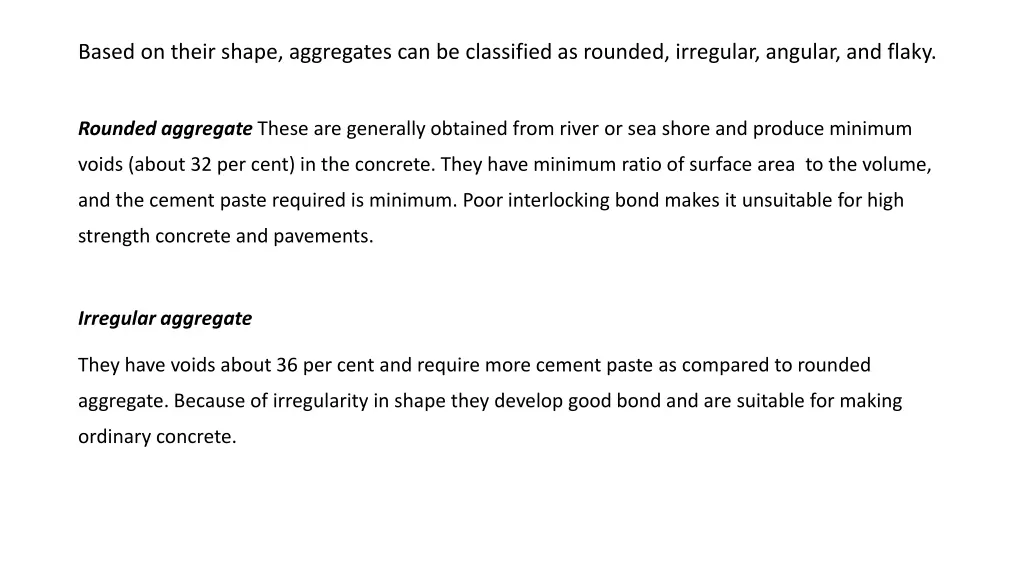
Based on their shape, aggregates can be classified as rounded, irregular, angular, and flaky. Rounded aggregate These are generally obtained from river or sea shore and produce minimum voids (about 32 per cent) in the concrete. They have minimum ratio of surface area to the volume, and the cement paste required is minimum. Poor interlocking bond makes it unsuitable for high strength concrete and pavements. Irregular aggregate They have voids about 36 per cent and require more cement paste as compared to rounded aggregate. Because of irregularity in shape they develop good bond and are suitable for making ordinary concrete.
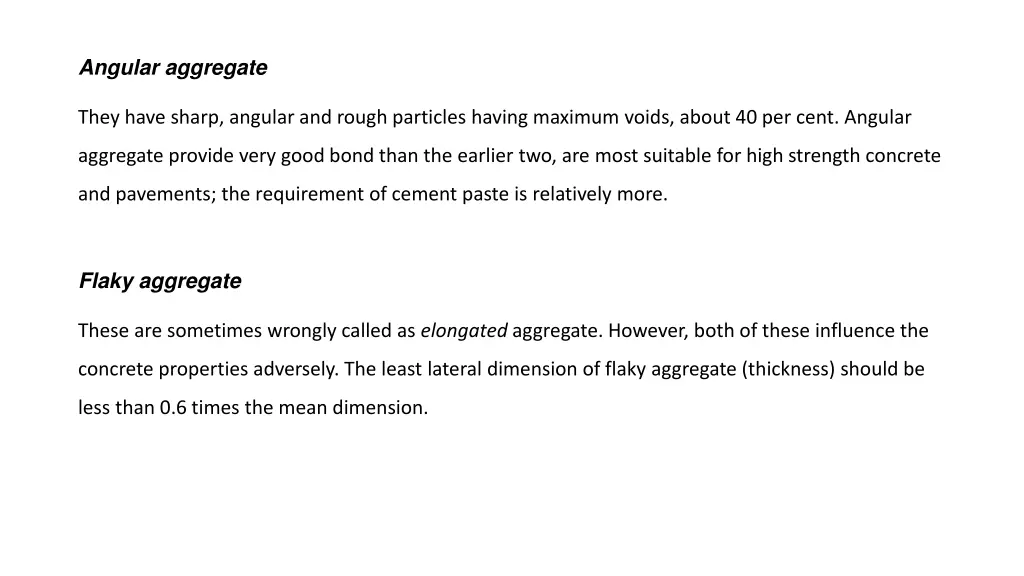
Angular aggregate They have sharp, angular and rough particles having maximum voids, about 40 per cent. Angular aggregate provide very good bond than the earlier two, are most suitable for high strength concrete and pavements; the requirement of cement paste is relatively more. Flaky aggregate These are sometimes wrongly called as elongated aggregate. However, both of these influence the concrete properties adversely. The least lateral dimension of flaky aggregate (thickness) should be less than 0.6 times the mean dimension.
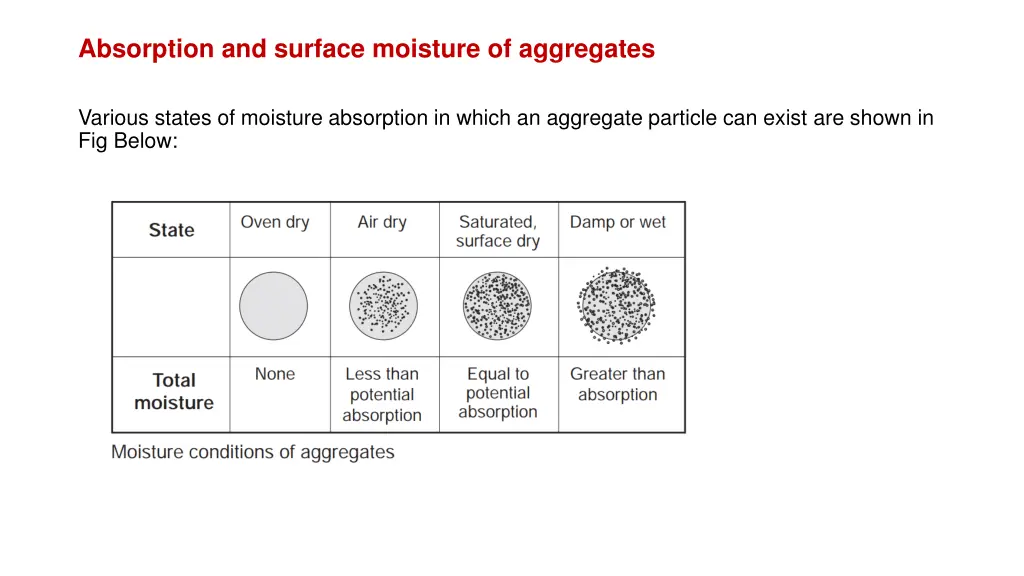
Absorption and surface moistureof aggregates Various states of moisture absorption in which an aggregate particle can exist are shown in Fig Below:
Soundness of aggregates An aggregate is considered unsound when the volume changes in aggregate induced by weather (e.g., alternate cycles of wetting and drying, or freezing and thawing), result in the deterioration of concrete. Unsoundness is shown generally by rocks having a certain characteristic pore structure. Concretes containing some cherts, shales, limestones, and sandstones have been found susceptible to damage by frost action or by salt crystallization within the aggregate particle.
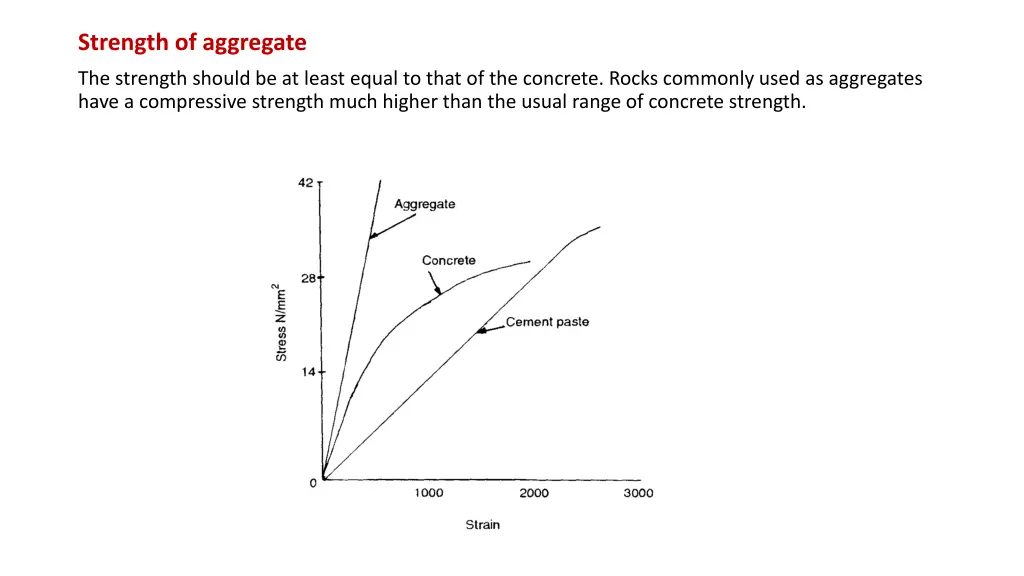
Strength of aggregate The strength should be at least equal to that of the concrete. Rocks commonly used as aggregates have a compressive strength much higher than the usual range of concrete strength.
Bond Strength of Aggregates Due to difference between the coefficients of thermal expansion of paste and aggregate and to the shrinkage of cement paste during hardening, concrete is in a state of internal stress even if no external forces are present. It is reported that the stresses are likely to be greatest at the paste-aggregate interfaces where minute cracks exist, even in concrete that has never been loaded. Under increasing external load, these cracks spread along the interfaces before extending into the paste or aggregate particles. The strength of the bond between aggregate and cement paste thus has an important influence on the strength of concrete.
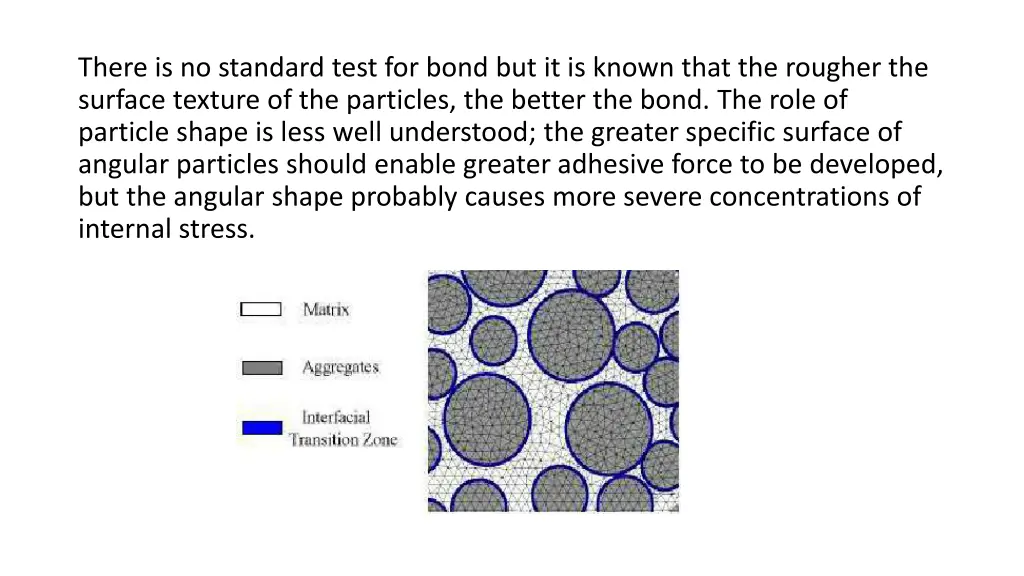
There is no standard test for bond but it is known that the rougher the surface texture of the particles, the better the bond. The role of particle shape is less well understood; the greater specific surface of angular particles should enable greater adhesive force to be developed, but the angular shape probably causes more severe concentrations of internal stress.