Importance of Proper Conductor Size in Fluid Power Systems
Proper selection of pipe, tubing, or hose size is crucial in fluid power systems to avoid power loss and heat generation. This chapter discusses the impact of conductor size on system performance, distribution system choices, material considerations, and factors influencing conductor selection.

Download Presentation

Please find below an Image/Link to download the presentation.
The content on the website is provided AS IS for your information and personal use only. It may not be sold, licensed, or shared on other websites without obtaining consent from the author.If you encounter any issues during the download, it is possible that the publisher has removed the file from their server.
You are allowed to download the files provided on this website for personal or commercial use, subject to the condition that they are used lawfully. All files are the property of their respective owners.
The content on the website is provided AS IS for your information and personal use only. It may not be sold, licensed, or shared on other websites without obtaining consent from the author.
E N D
Presentation Transcript
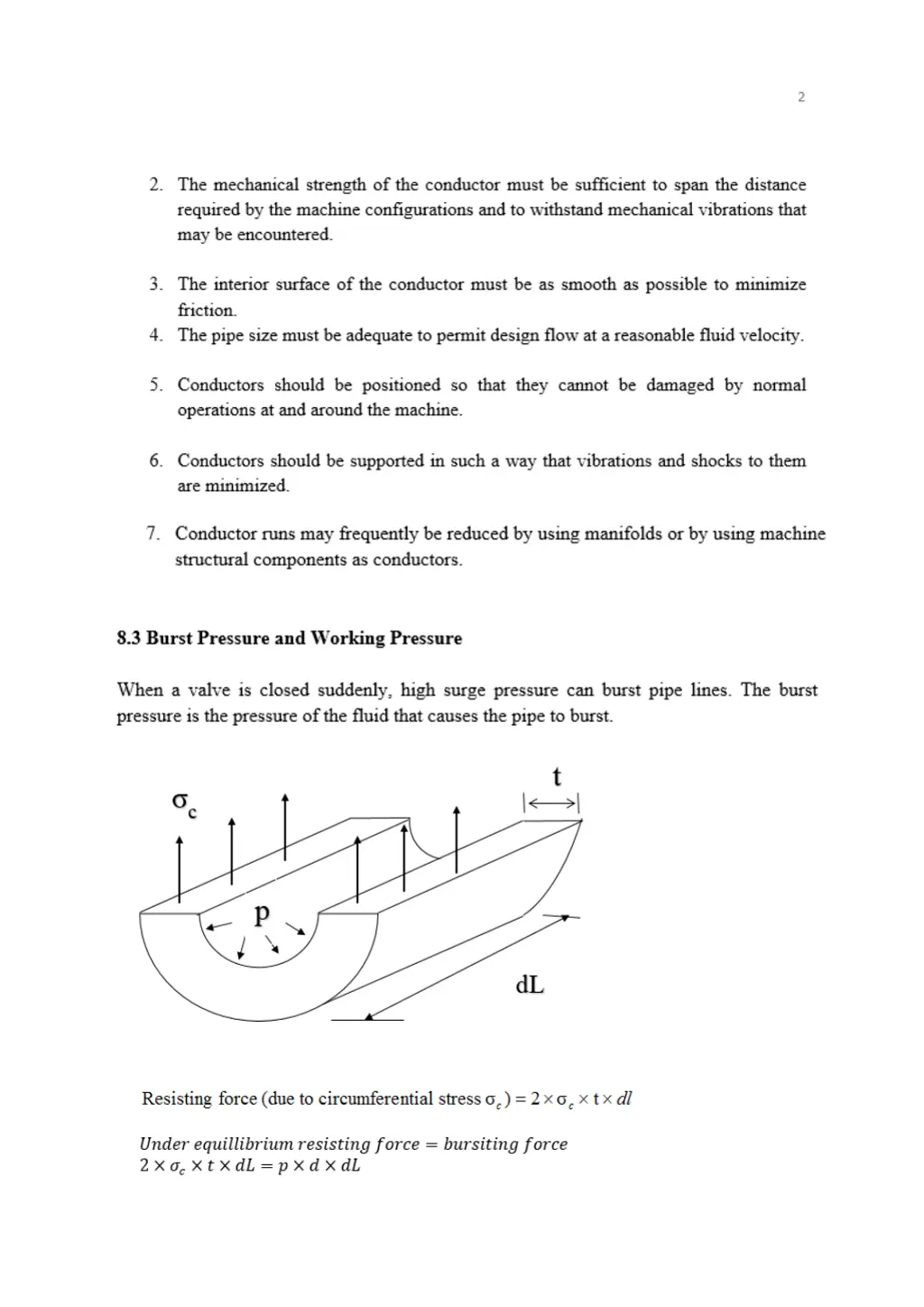
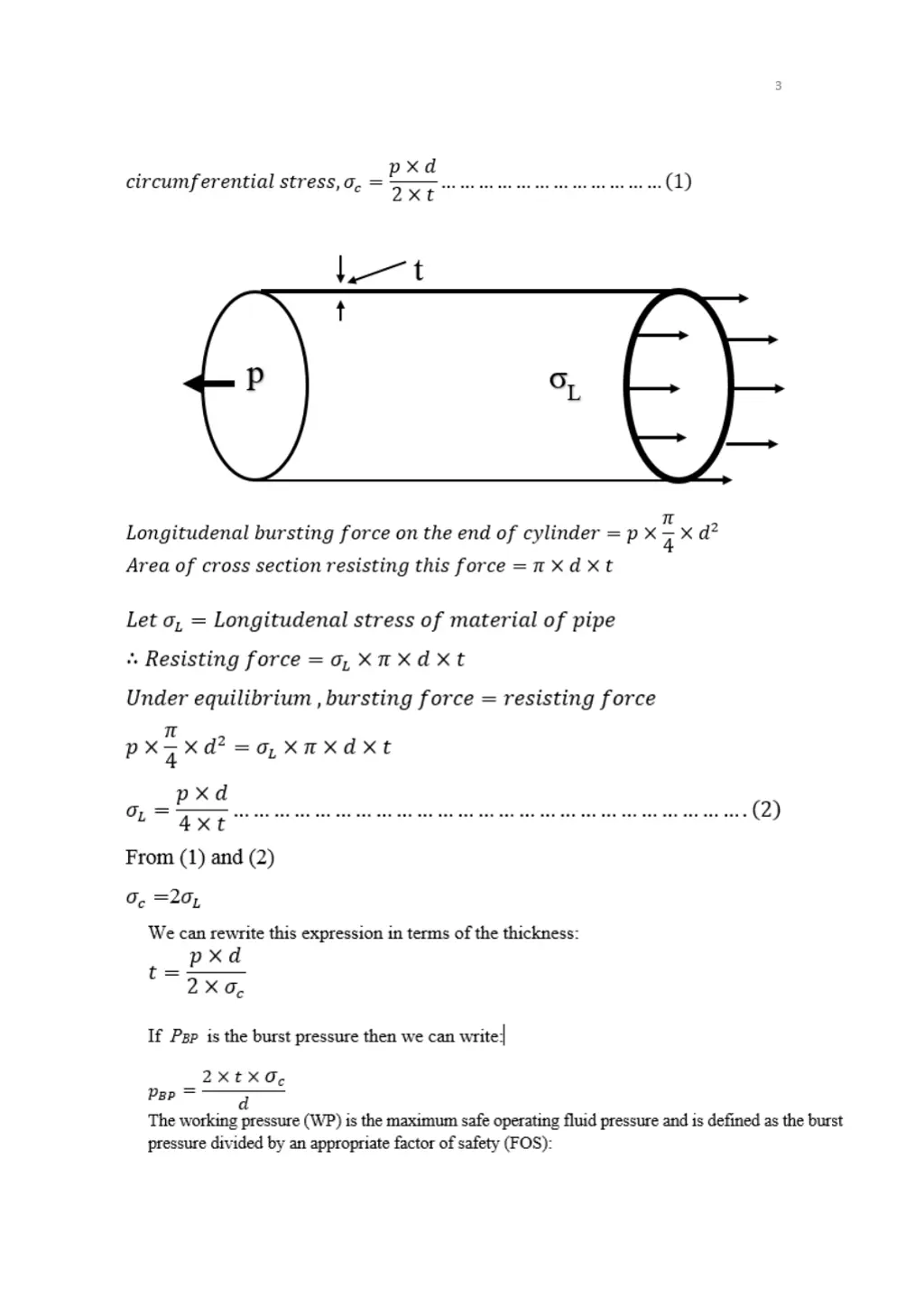
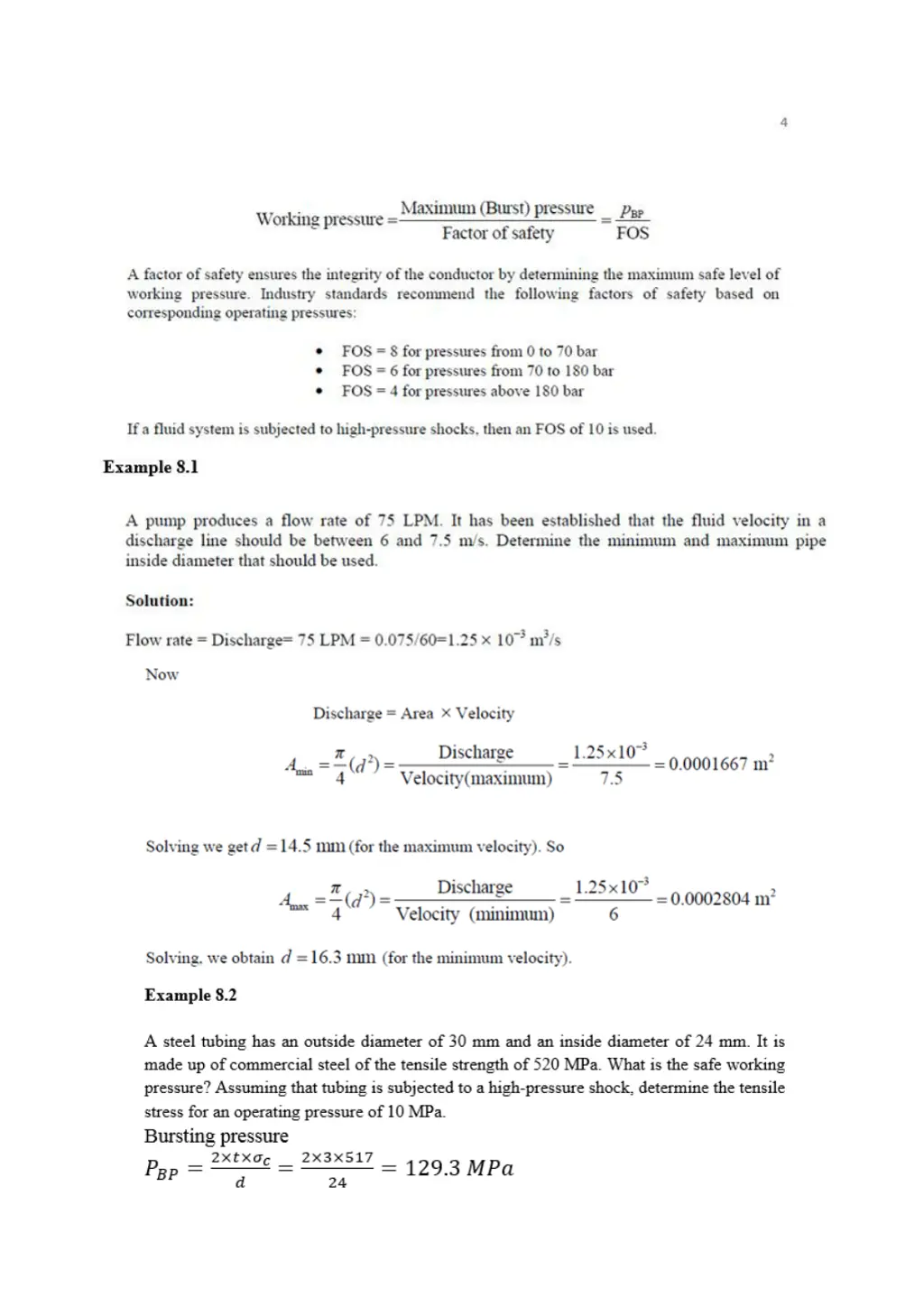
1 Chapter 8 8.1 Introduction The size of pipe, tubing or hose for plumbing fluid power systems is very important. If the size with too small an inside cross-sectional area is used, the oil is forced to flow at a high rate of speed, and this creates excessive power loss and heat generation in the oil. If the size used is larger than necessary, then the power transfer is good and heat generation is low but the time and cost of installation are more than they should be. Pressure losses are present only when fluid is moving. Force can be transmitted from one end of fluid column to other with virtually no loss but when the fluid starts to move, which is necessary to transmit work or power, then the losses start. This chapter deals with selection of distribution systems, losses in fluid power transmission lines and its effect on the performance of fluid system. 8.2 Choice of Distribution A fluid distribution system is composed of pipes, tubings, hose assemblies, manifolds and fittings so arranged that the fluid is carried with minimum losses from the reservoir through controls and working components and is then returned. All materials used to convey fluid power are commonly classified as conductors and the various fittings for connecting components are classified as connectors. More than one type of conductors may be used in the same installations. Conductors are generally steel regardless of conductor material and they may be coated with cadmium or some other corrosion-resistant material. Stainless steel conductors or fittings may be used if extremely corrosive environments are anticipated, but the high cost of such conductors and fitting precludes the general use of this material. Copper can never be used in a hydraulic system because it catalyzes the oxidation of petroleum fluids, while zinc, magnesium and cadmium cannot be used because they are rapidly corroded by glycol fluids. A galvanized pipe is unsatisfactory because galvanization tends to flake off into the system. The choice of pipe, tube or hose depends on the operating pressures of system and flow. Other important factors include environmental conditions, type of fluid and operating temperature, shock loads, relative motion between connected parts, practicality and compliance with certain standards. The material used must have a continuous operating pressure rating so that it can withstand working pressures and provide a factor of safety for short-lived pressure peaks resulting from a hydraulic shock. Hydraulic shocks occur due to sudden stopping or reversing a flow that is backed by large flow forces, sudden deceleration, stopping or reversing of heavy workloads. The following points must be considered both while designing the system and selecting a conductor: 1. The working strength of conductor must be sufficient to contain fluid under all normal operating conditions, and there must be sufficient reserve strength to withstand shock loads due to system operations.
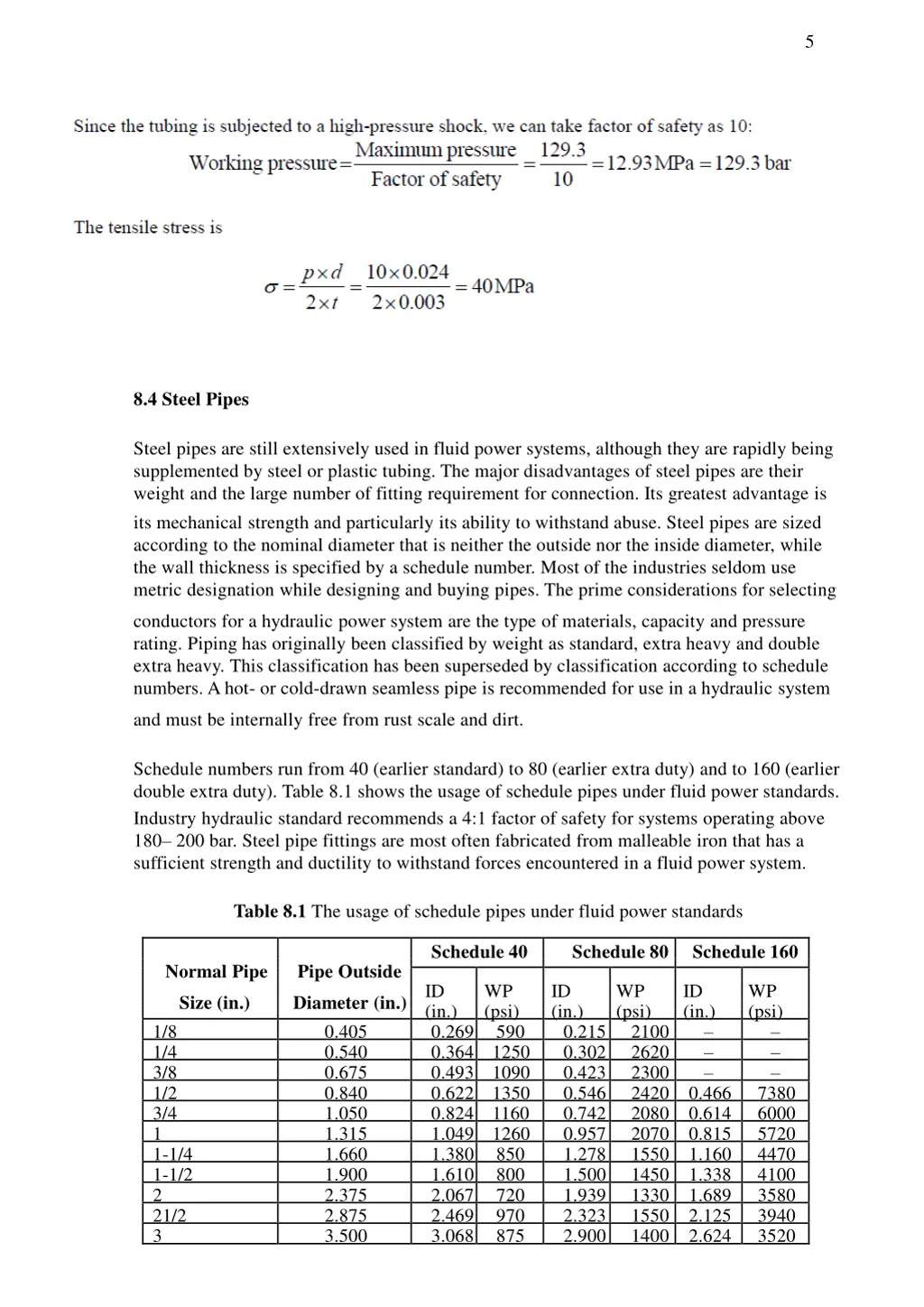
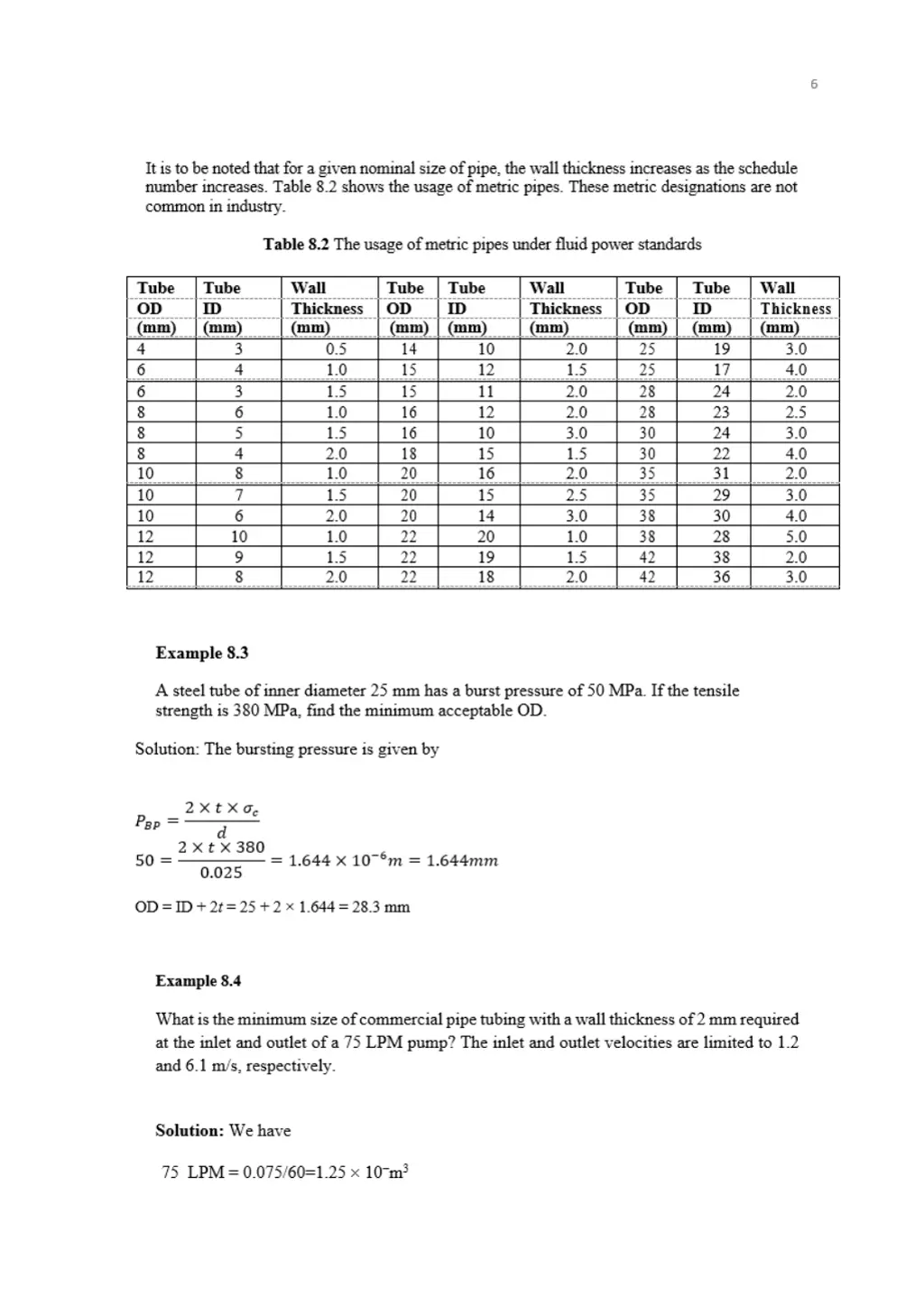
5 8.4 Steel Pipes Steel pipes are still extensively used in fluid power systems, although they are rapidly being supplemented by steel or plastic tubing. The major disadvantages of steel pipes are their weight and the large number of fitting requirement for connection. Its greatest advantage is its mechanical strength and particularly its ability to withstand abuse. Steel pipes are sized according to the nominal diameter that is neither the outside nor the inside diameter, while the wall thickness is specified by a schedule number. Most of the industries seldom use metric designation while designing and buying pipes. The prime considerations for selecting conductors for a hydraulic power system are the type of materials, capacity and pressure rating. Piping has originally been classified by weight as standard, extra heavy and double extra heavy. This classification has been superseded by classification according to schedule numbers. A hot- or cold-drawn seamless pipe is recommended for use in a hydraulic system and must be internally free from rust scale and dirt. Schedule numbers run from 40 (earlier standard) to 80 (earlier extra duty) and to 160 (earlier double extra duty). Table 8.1 shows the usage of schedule pipes under fluid power standards. Industry hydraulic standard recommends a 4:1 factor of safety for systems operating above 180 200 bar. Steel pipe fittings are most often fabricated from malleable iron that has a sufficient strength and ductility to withstand forces encountered in a fluid power system. Table 8.1 The usage of schedule pipes under fluid power standards Schedule 40 Schedule 80 Schedule 160 Normal Pipe Pipe Outside ID (in.) 0.269 0.364 0.493 0.622 0.824 1.049 1.380 1.610 2.067 2.469 3.068 WP (psi) 590 1250 1090 1350 1160 1260 850 800 720 970 875 ID (in.) 0.215 0.302 0.423 0.546 0.742 0.957 1.278 1.500 1.939 2.323 2.900 WP (psi) 2100 2620 2300 2420 2080 2070 1550 1450 1330 1550 1400 ID (in.) WP (psi) Size (in.) Diameter (in.) 0.405 0.540 0.675 0.840 1.050 1.315 1.660 1.900 2.375 2.875 3.500 1/8 1/4 3/8 1/2 3/4 1 1-1/4 1-1/2 2 21/2 3 0.466 0.614 0.815 1.160 1.338 1.689 2.125 2.624 7380 6000 5720 4470 4100 3580 3940 3520
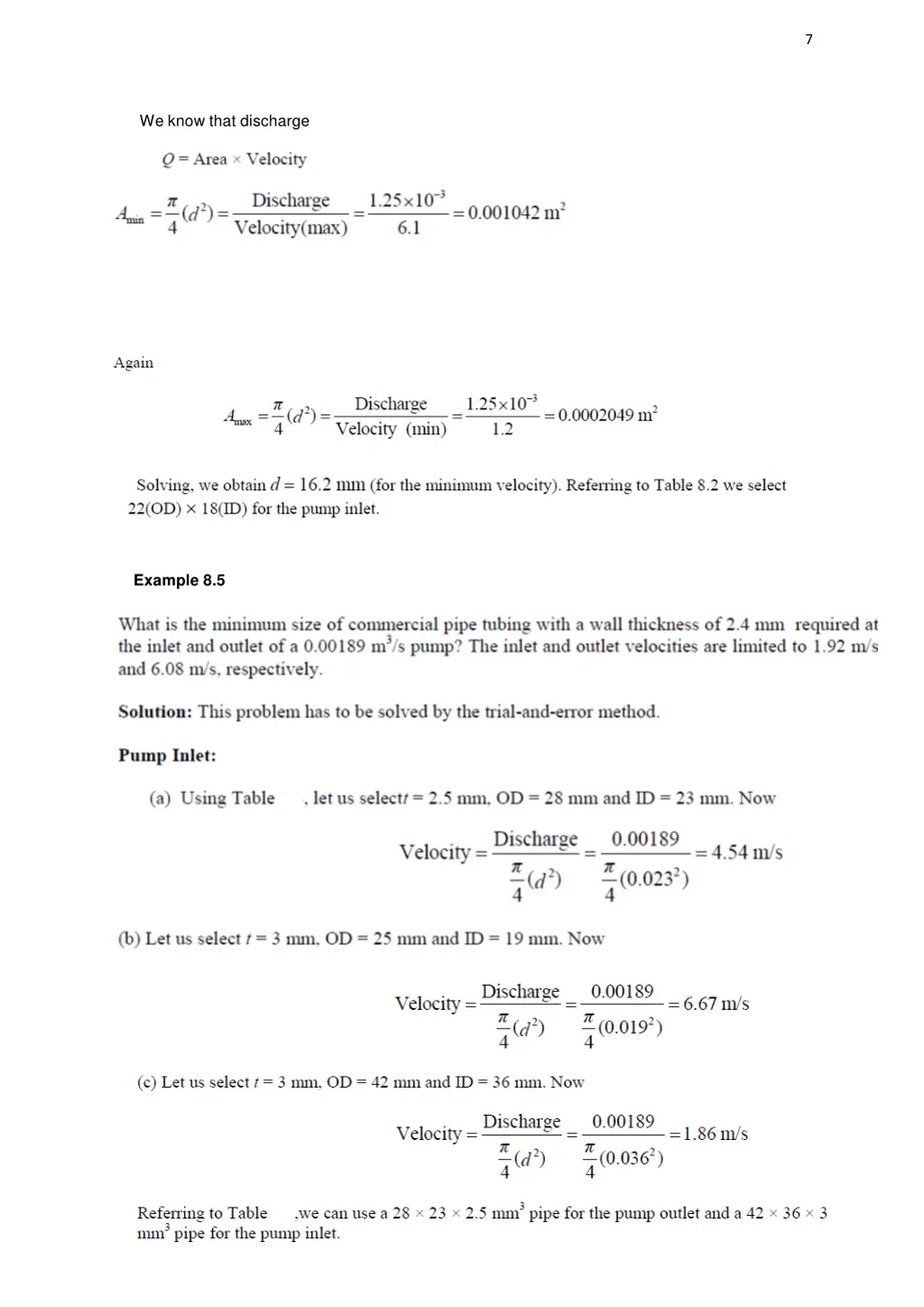
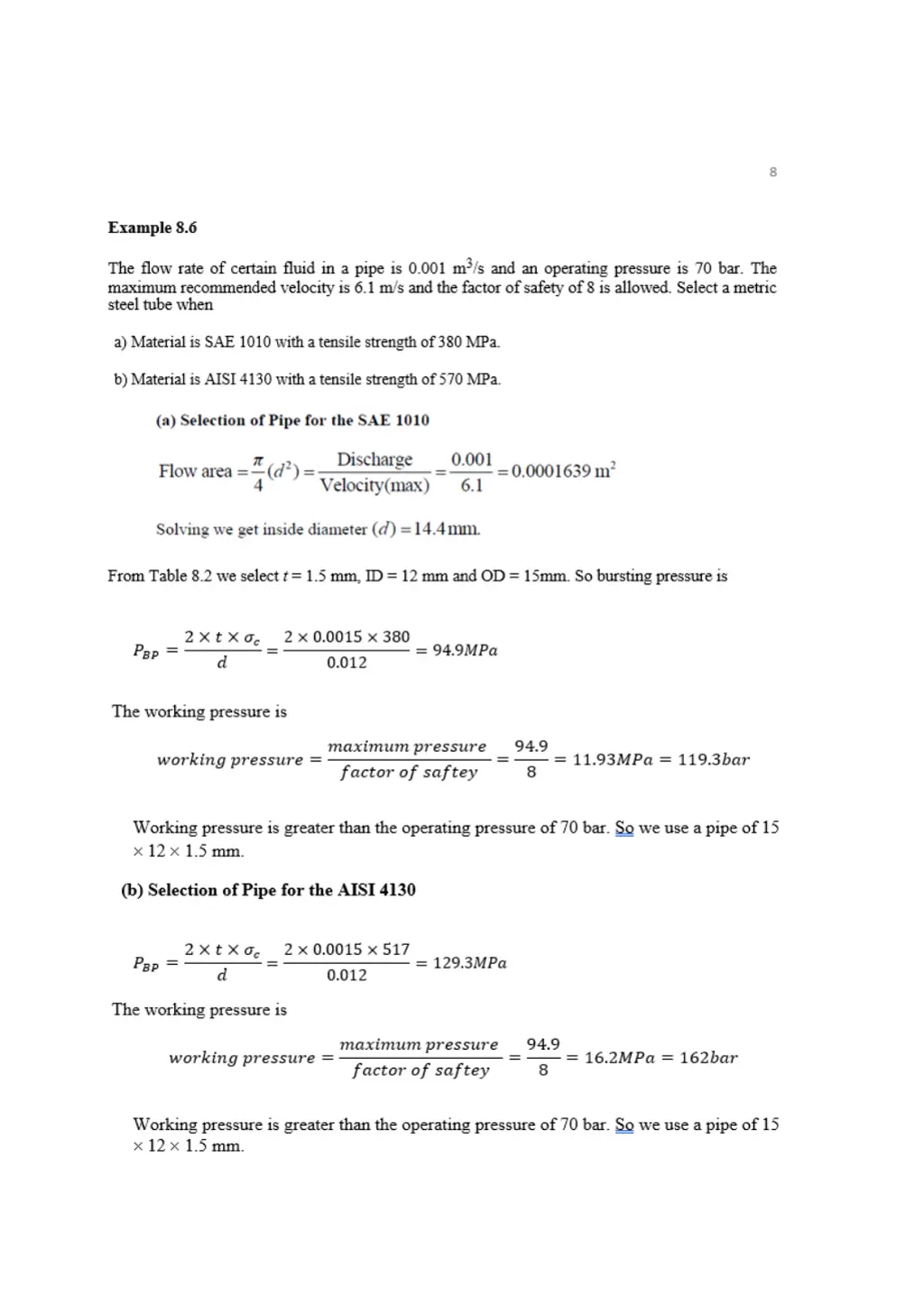
7 We know that discharge Example 8.5
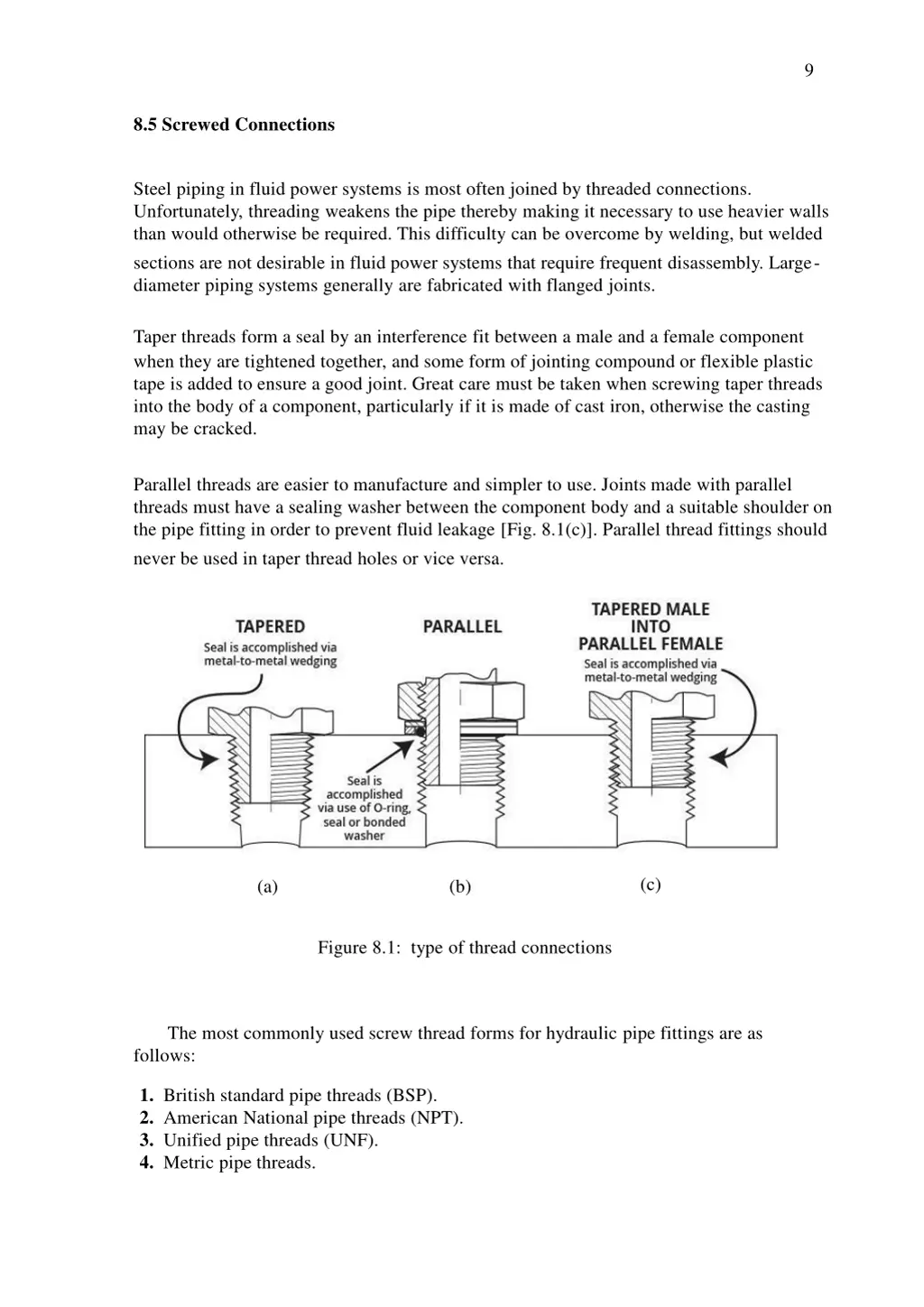
9 8.5 Screwed Connections Steel piping in fluid power systems is most often joined by threaded connections. Unfortunately, threading weakens the pipe thereby making it necessary to use heavier walls than would otherwise be required. This difficulty can be overcome by welding, but welded sections are not desirable in fluid power systems that require frequent disassembly. Large- diameter piping systems generally are fabricated with flanged joints. Taper threads form a seal by an interference fit between a male and a female component when they are tightened together, and some form of jointing compound or flexible plastic tape is added to ensure a good joint. Great care must be taken when screwing taper threads into the body of a component, particularly if it is made of cast iron, otherwise the casting may be cracked. Parallel threads are easier to manufacture and simpler to use. Joints made with parallel threads must have a sealing washer between the component body and a suitable shoulder on the pipe fitting in order to prevent fluid leakage [Fig. 8.1(c)]. Parallel thread fittings should never be used in taper thread holes or vice versa. (c) (a) (b) Figure 8.1: type of thread connections The most commonly used screw thread forms for hydraulic pipe fittings are as follows: 1. British standard pipe threads (BSP). 2. American National pipe threads (NPT). 3. Unified pipe threads (UNF). 4. Metric pipe threads.
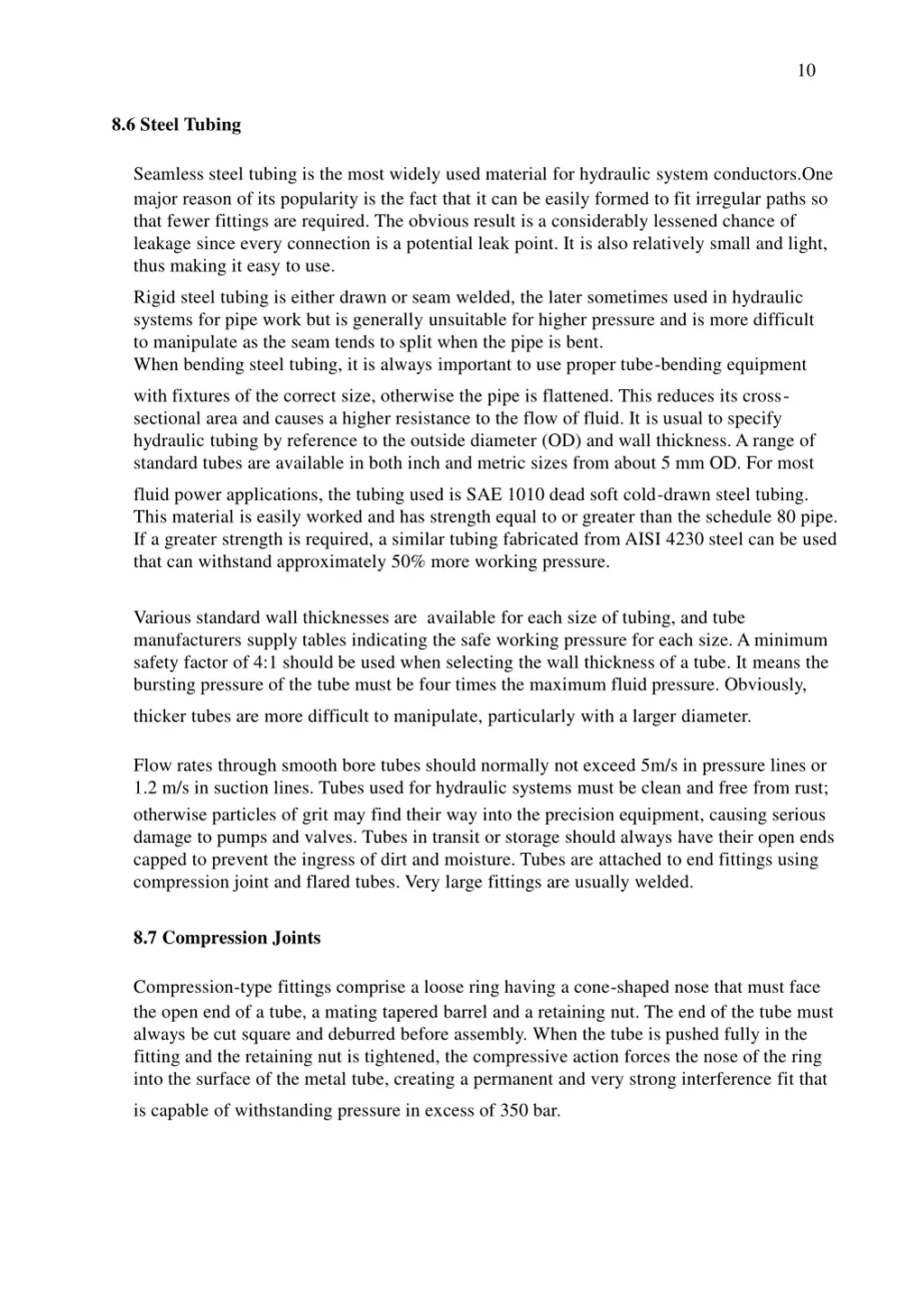
10 8.6 Steel Tubing Seamless steel tubing is the most widely used material for hydraulic system conductors.One major reason of its popularity is the fact that it can be easily formed to fit irregular paths so that fewer fittings are required. The obvious result is a considerably lessened chance of leakage since every connection is a potential leak point. It is also relatively small and light, thus making it easy to use. Rigid steel tubing is either drawn or seam welded, the later sometimes used in hydraulic systems for pipe work but is generally unsuitable for higher pressure and is more difficult to manipulate as the seam tends to split when the pipe is bent. When bending steel tubing, it is always important to use proper tube-bending equipment with fixtures of the correct size, otherwise the pipe is flattened. This reduces its cross- sectional area and causes a higher resistance to the flow of fluid. It is usual to specify hydraulic tubing by reference to the outside diameter (OD) and wall thickness. A range of standard tubes are available in both inch and metric sizes from about 5 mm OD. For most fluid power applications, the tubing used is SAE 1010 dead soft cold-drawn steel tubing. This material is easily worked and has strength equal to or greater than the schedule 80 pipe. If a greater strength is required, a similar tubing fabricated from AISI 4230 steel can be used that can withstand approximately 50% more working pressure. Various standard wall thicknesses are available for each size of tubing, and tube manufacturers supply tables indicating the safe working pressure for each size. A minimum safety factor of 4:1 should be used when selecting the wall thickness of a tube. It means the bursting pressure of the tube must be four times the maximum fluid pressure. Obviously, thicker tubes are more difficult to manipulate, particularly with a larger diameter. Flow rates through smooth bore tubes should normally not exceed 5m/s in pressure lines or 1.2 m/s in suction lines. Tubes used for hydraulic systems must be clean and free from rust; otherwise particles of grit may find their way into the precision equipment, causing serious damage to pumps and valves. Tubes in transit or storage should always have their open ends capped to prevent the ingress of dirt and moisture. Tubes are attached to end fittings using compression joint and flared tubes. Very large fittings are usually welded. 8.7 Compression Joints Compression-type fittings comprise a loose ring having a cone-shaped nose that must face the open end of a tube, a mating tapered barrel and a retaining nut. The end of the tube must always be cut square and deburred before assembly. When the tube is pushed fully in the fitting and the retaining nut is tightened, the compressive action forces the nose of the ring into the surface of the metal tube, creating a permanent and very strong interference fit that is capable of withstanding pressure in excess of 350 bar.
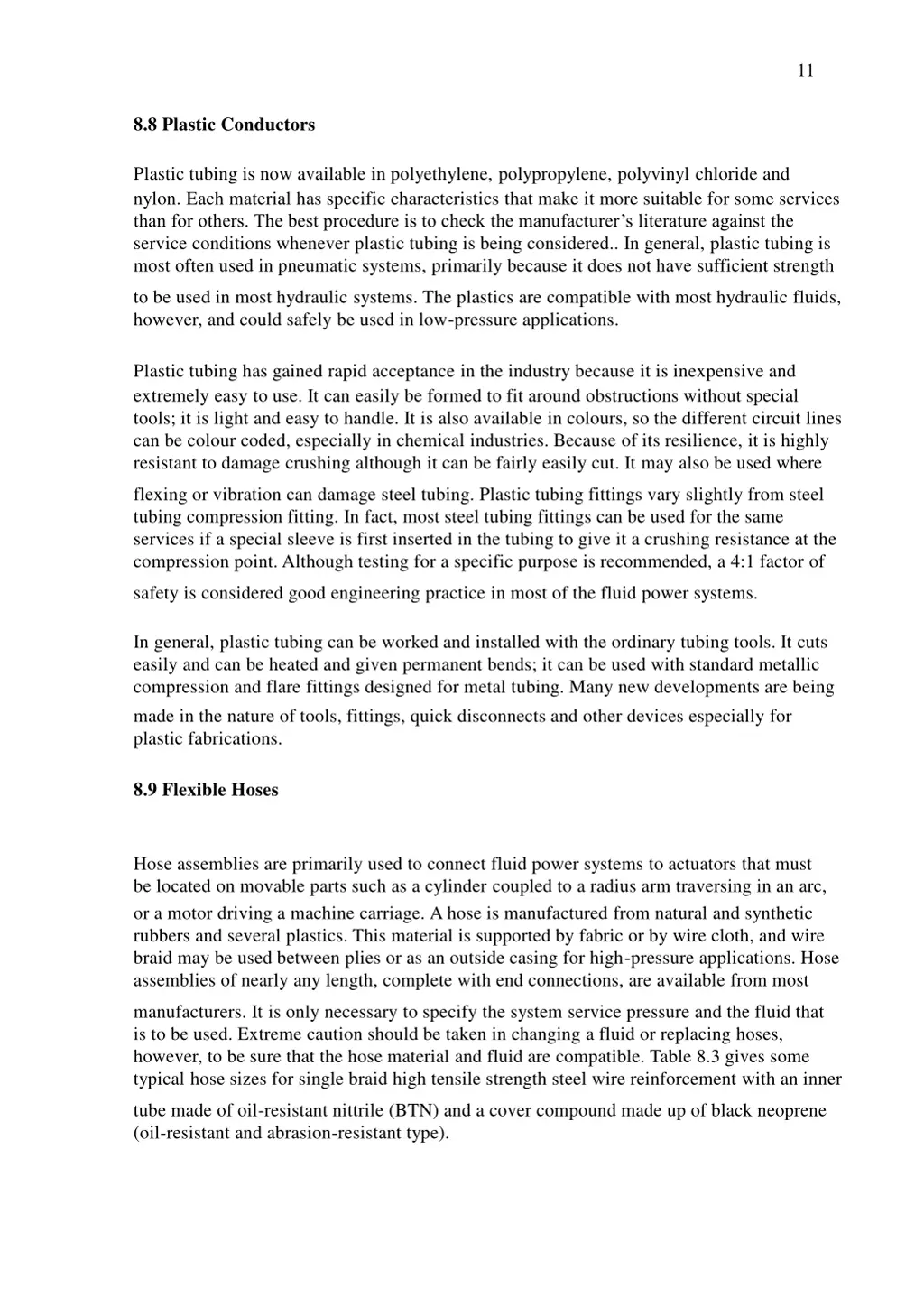
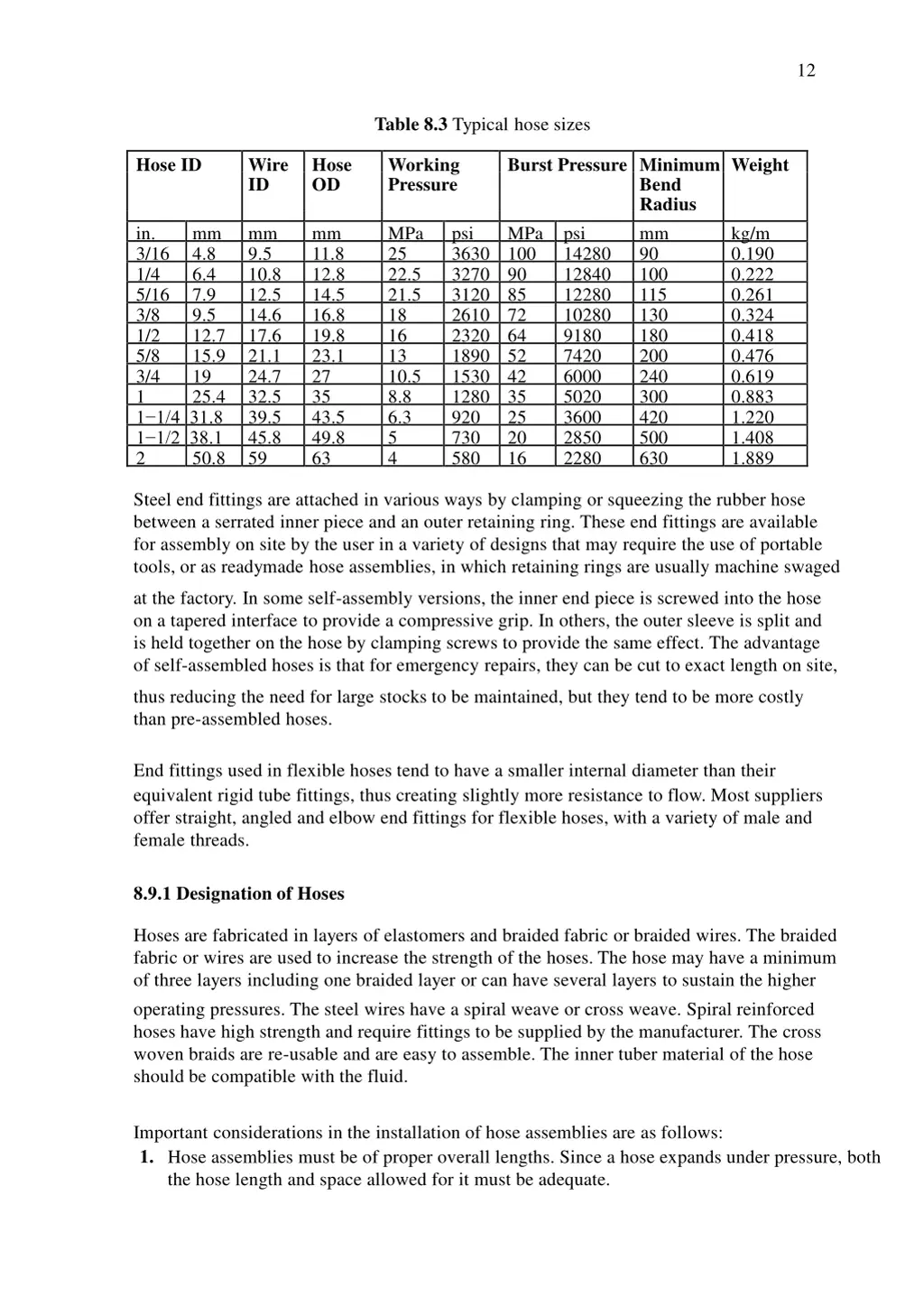
11 8.8 Plastic Conductors Plastic tubing is now available in polyethylene, polypropylene, polyvinyl chloride and nylon. Each material has specific characteristics that make it more suitable for some services than for others. The best procedure is to check the manufacturer s literature against the service conditions whenever plastic tubing is being considered.. In general, plastic tubing is most often used in pneumatic systems, primarily because it does not have sufficient strength to be used in most hydraulic systems. The plastics are compatible with most hydraulic fluids, however, and could safely be used in low-pressure applications. Plastic tubing has gained rapid acceptance in the industry because it is inexpensive and extremely easy to use. It can easily be formed to fit around obstructions without special tools; it is light and easy to handle. It is also available in colours, so the different circuit lines can be colour coded, especially in chemical industries. Because of its resilience, it is highly resistant to damage crushing although it can be fairly easily cut. It may also be used where flexing or vibration can damage steel tubing. Plastic tubing fittings vary slightly from steel tubing compression fitting. In fact, most steel tubing fittings can be used for the same services if a special sleeve is first inserted in the tubing to give it a crushing resistance at the compression point. Although testing for a specific purpose is recommended, a 4:1 factor of safety is considered good engineering practice in most of the fluid power systems. In general, plastic tubing can be worked and installed with the ordinary tubing tools. It cuts easily and can be heated and given permanent bends; it can be used with standard metallic compression and flare fittings designed for metal tubing. Many new developments are being made in the nature of tools, fittings, quick disconnects and other devices especially for plastic fabrications. 8.9 Flexible Hoses Hose assemblies are primarily used to connect fluid power systems to actuators that must be located on movable parts such as a cylinder coupled to a radius arm traversing in an arc, or a motor driving a machine carriage. A hose is manufactured from natural and synthetic rubbers and several plastics. This material is supported by fabric or by wire cloth, and wire braid may be used between plies or as an outside casing for high-pressure applications. Hose assemblies of nearly any length, complete with end connections, are available from most manufacturers. It is only necessary to specify the system service pressure and the fluid that is to be used. Extreme caution should be taken in changing a fluid or replacing hoses, however, to be sure that the hose material and fluid are compatible. Table 8.3 gives some typical hose sizes for single braid high tensile strength steel wire reinforcement with an inner tube made of oil-resistant nittrile (BTN) and a cover compound made up of black neoprene (oil-resistant and abrasion-resistant type).
12 Table 8.3 Typical hose sizes Hose ID Wire ID Hose OD Working Pressure Burst Pressure Minimum Weight Bend Radius MPa psi mm 100 14280 90 90 12840 100 85 12280 115 72 10280 130 64 9180 180 52 7420 200 42 6000 240 35 5020 300 25 3600 420 20 2850 500 16 2280 630 in. 3/16 1/4 5/16 3/8 1/2 5/8 3/4 1 1 1/4 31.8 1 1/2 38.1 2 mm 4.8 6.4 7.9 9.5 12.7 15.9 19 25.4 mm 9.5 10.8 12.5 14.6 17.6 21.1 24.7 32.5 39.5 45.8 59 mm 11.8 12.8 14.5 16.8 19.8 23.1 27 35 43.5 49.8 63 MPa 25 22.5 21.5 18 16 13 10.5 8.8 6.3 5 4 psi 3630 3270 3120 2610 2320 1890 1530 1280 920 730 580 kg/m 0.190 0.222 0.261 0.324 0.418 0.476 0.619 0.883 1.220 1.408 1.889 50.8 Steel end fittings are attached in various ways by clamping or squeezing the rubber hose between a serrated inner piece and an outer retaining ring. These end fittings are available for assembly on site by the user in a variety of designs that may require the use of portable tools, or as readymade hose assemblies, in which retaining rings are usually machine swaged at the factory. In some self-assembly versions, the inner end piece is screwed into the hose on a tapered interface to provide a compressive grip. In others, the outer sleeve is split and is held together on the hose by clamping screws to provide the same effect. The advantage of self-assembled hoses is that for emergency repairs, they can be cut to exact length on site, thus reducing the need for large stocks to be maintained, but they tend to be more costly than pre-assembled hoses. End fittings used in flexible hoses tend to have a smaller internal diameter than their equivalent rigid tube fittings, thus creating slightly more resistance to flow. Most suppliers offer straight, angled and elbow end fittings for flexible hoses, with a variety of male and female threads. 8.9.1 Designation of Hoses Hoses are fabricated in layers of elastomers and braided fabric or braided wires. The braided fabric or wires are used to increase the strength of the hoses. The hose may have a minimum of three layers including one braided layer or can have several layers to sustain the higher operating pressures. The steel wires have a spiral weave or cross weave. Spiral reinforced hoses have high strength and require fittings to be supplied by the manufacturer. The cross woven braids are re-usable and are easy to assemble. The inner tuber material of the hose should be compatible with the fluid. Important considerations in the installation of hose assemblies are as follows: 1. Hose assemblies must be of proper overall lengths. Since a hose expands under pressure, both the hose length and space allowed for it must be adequate.
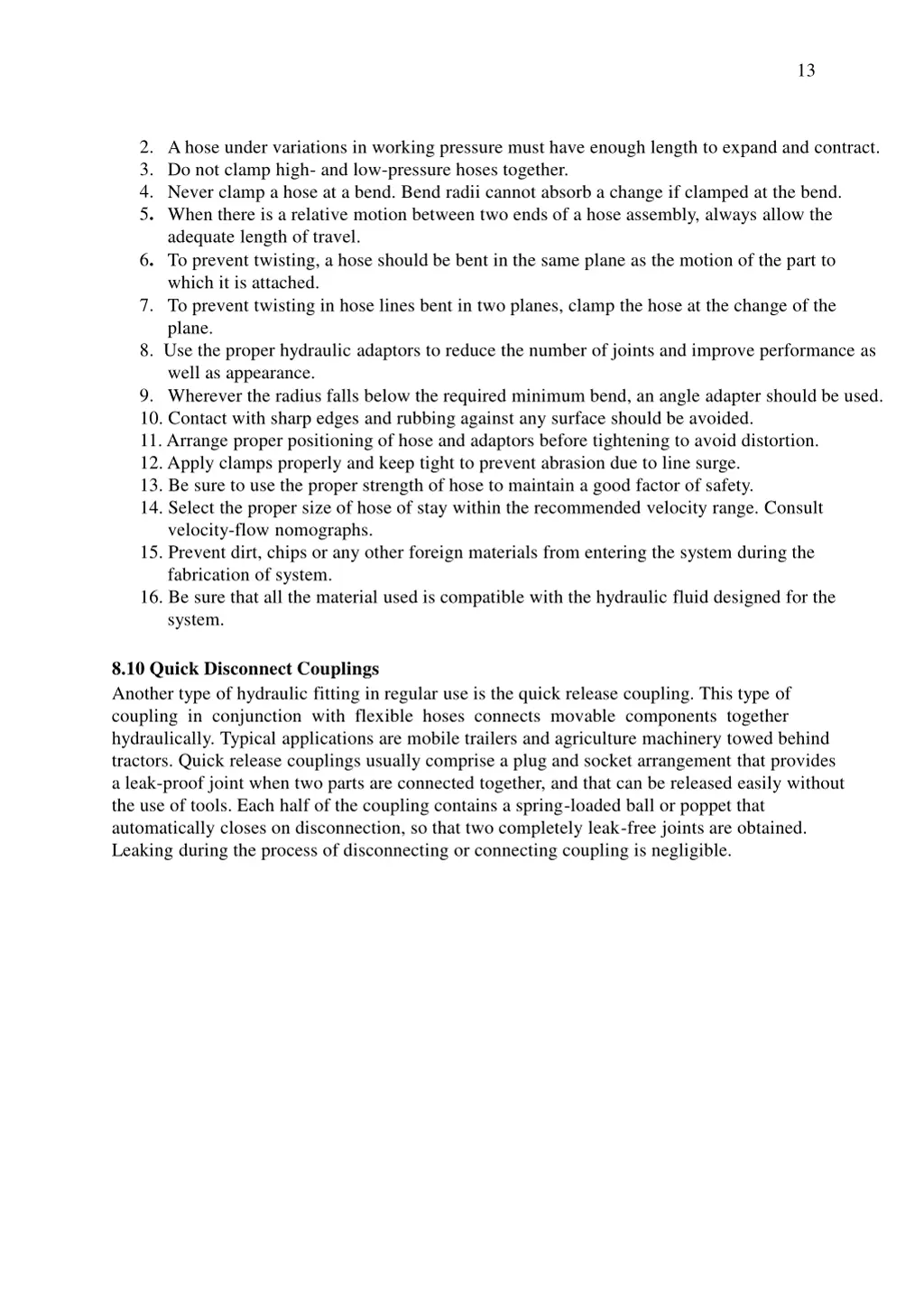
13 2. 3. 4. 5. A hose under variations in working pressure must have enough length to expand and contract. Do not clamp high- and low-pressure hoses together. Never clamp a hose at a bend. Bend radii cannot absorb a change if clamped at the bend. When there is a relative motion between two ends of a hose assembly, always allow the adequate length of travel. 6. To prevent twisting, a hose should be bent in the same plane as the motion of the part to which it is attached. 7. To prevent twisting in hose lines bent in two planes, clamp the hose at the change of the plane. 8. Use the proper hydraulic adaptors to reduce the number of joints and improve performance as well as appearance. 9. Wherever the radius falls below the required minimum bend, an angle adapter should be used. 10. Contact with sharp edges and rubbing against any surface should be avoided. 11. Arrange proper positioning of hose and adaptors before tightening to avoid distortion. 12. Apply clamps properly and keep tight to prevent abrasion due to line surge. 13. Be sure to use the proper strength of hose to maintain a good factor of safety. 14. Select the proper size of hose of stay within the recommended velocity range. Consult velocity-flow nomographs. 15. Prevent dirt, chips or any other foreign materials from entering the system during the fabrication of system. 16. Be sure that all the material used is compatible with the hydraulic fluid designed for the system. 8.10 Quick Disconnect Couplings Another type of hydraulic fitting in regular use is the quick release coupling. This type of coupling in conjunction with flexible hoses connects movable components together hydraulically. Typical applications are mobile trailers and agriculture machinery towed behind tractors. Quick release couplings usually comprise a plug and socket arrangement that provides a leak-proof joint when two parts are connected together, and that can be released easily without the use of tools. Each half of the coupling contains a spring-loaded ball or poppet that automatically closes on disconnection, so that two completely leak-free joints are obtained. Leaking during the process of disconnecting or connecting coupling is negligible.