Importance of Qualified Teachers for Children with Vision Impairment
Learn about the significance of Qualified Teachers of Vision Impaired (QTVI) and the role they play in supporting children with vision impairments in education. Explore the services provided by NatSIP and the National Sensory Impairment Partnership to improve outcomes for children and young people with sensory impairments. Discover the impact of specialized support in areas like accessing information, using equipment, and developing independence skills.

Download Presentation

Please find below an Image/Link to download the presentation.
The content on the website is provided AS IS for your information and personal use only. It may not be sold, licensed, or shared on other websites without obtaining consent from the author. If you encounter any issues during the download, it is possible that the publisher has removed the file from their server.
You are allowed to download the files provided on this website for personal or commercial use, subject to the condition that they are used lawfully. All files are the property of their respective owners.
The content on the website is provided AS IS for your information and personal use only. It may not be sold, licensed, or shared on other websites without obtaining consent from the author.
E N D
Presentation Transcript
Gwasanaethau Cymorth Cyfathrebu a Synhwyraidd Sensory & Communication Support Service The importance of a Qualified Teacher of Vision Impaired and Habilitation in Education Sarah Hughes Head of Gwent Visual Impairment Service Adrian Linney Guide Dogs Cymru
QTVI - Qualified Teacher of Children and Young People with Vision Impairment hold the mandatory qualification in vision impairment work directly with children in a specialist teaching and advisory capacity work closely with schools, or settings, to ensure that children's needs are met advise on and oversee the implementation of strategies to promote children s social inclusion. are involved in a planned approach over time to reducing adult support in favour of strategies which promote independent learning maintain close contact with families and others
Who are NatSIP? National Sensory Impairment Partnership is a national body endorsed by the Government committed to young people with Sensory Impairment receiving the services they require partnership of organisations working together to improve outcomes for children and young people with sensory impairment.
NatSIP Learner Outcomes Framework 8 outcome categories cover the skills that children and young people need to enable them to: Take part in lessons as independent learners Carry out everyday activities Get around by themselves Feel fully included
1. Learning to access Providing the child with the skills to independently access information Young people said: Knowing how to use Braille and voice-over gave me choice I could use one or the other.
2. Use of equipment Able to use a range of equipment Able to choose which equipment to use Understands when to use equipment Young person said: I wish the teachers had showed me how to use the equipment, I would have found it easier in exams and lessons. I used a laptop couldn t use the mouse but someone from the VI service fixed it for me.
3. Independence and negotiation skills The child is able to explain their vision impairment to others To self-advocate To know how to find solutions when things don t go according to plan Young person said: When I started 6th form I spoke to the support in school and the teacher and said 'This is how I think it should be. This is what I think I need ' And everyone said Okay, we'll do that.' My work ethic changed The support I got made a massive improvement on my grades.
4. Participation Able to take part in all aspects of school life Feel socially and emotionally included Young person said: I felt more included at university than during sixth form as when I was in sixth form I didn't have the confidence to go and meet friends in unfamiliar places At university, I lived on campus and during my first couple of weeks my support workers accompanied me to a number of key locations so that I would know where to go I knew how to get to the student union to meet my friends and joining societies was a great way to meet more people
5. Meeting others Given opportunities to meet with other children with vision impairment To experience a range of recreational and leisure activities Gain the skills to participate in the activities that interest them
6. Getting around Has independent mobility skills that are appropriate to the child s age Young person said: The only issue was that I got mobility training quite late so didn t get much out of it. Although when I did have it, I did get a lot. Most other CYP had it from primary school onwards. I don t know why I didn t get it earlier I just wish I d had it sooner. I would have felt more comfortable travelling independently; I m still a bit on edge, though it s getting better.
7. Looking after him/herself Has the skills to look after him/herself Has the skills to carry out everyday living activities that are appropriate to his/her age Young person said: I should have been introduced earlier to life skills I wish I d had these earlier, in primary school
8. Life after school Approaches transition knowing what support is available to enable the young person to succeed at college/university or in getting a job Knows how to access any required support available
What is Habilitation? A child with a vision impairment cannot observe and develop everyday skills in the same way as a sighted child. A child who can see develops skills as they grow up by imitating what they see other family members/siblings and other people do. Habilitation involves training children and young people with a vision impairment in early movement, mobility and independent living skills - and supporting parents to do the same). Habilitation helps a child with vision impairment to become an independent and confident adult.
What is a Habilitation Specialist? Habilitation specialists train children and young people with a vision impairment to use alternative strategies to acquire the same independence skills as their sighted peers. They support and advise parents on alternative skill learning as the child grows up. These strategies involve using the other senses: hearing, touch, taste, smell and balance to provide information about the world around the child. Habilitation specialists training incorporates learning about the key stages of child development especially very young children and babies they are skilled in understanding how visual impairment affects this.
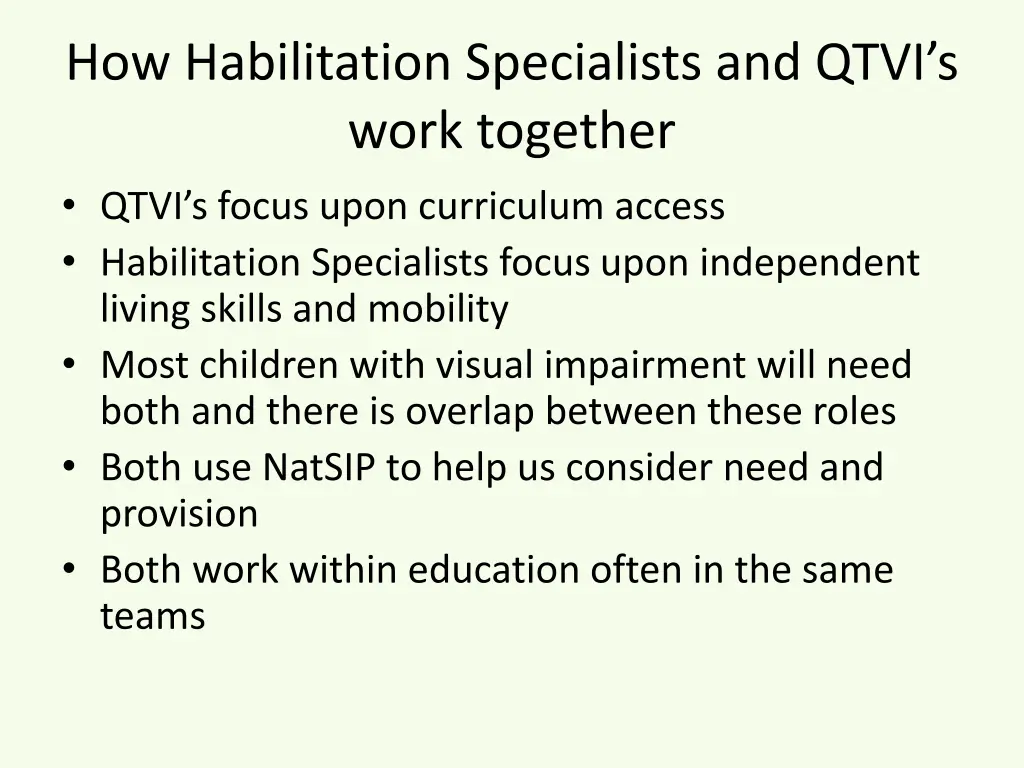
How Habilitation Specialists and QTVIs work together QTVI s focus upon curriculum access Habilitation Specialists focus upon independent living skills and mobility Most children with visual impairment will need both and there is overlap between these roles Both use NatSIP to help us consider need and provision Both work within education often in the same teams
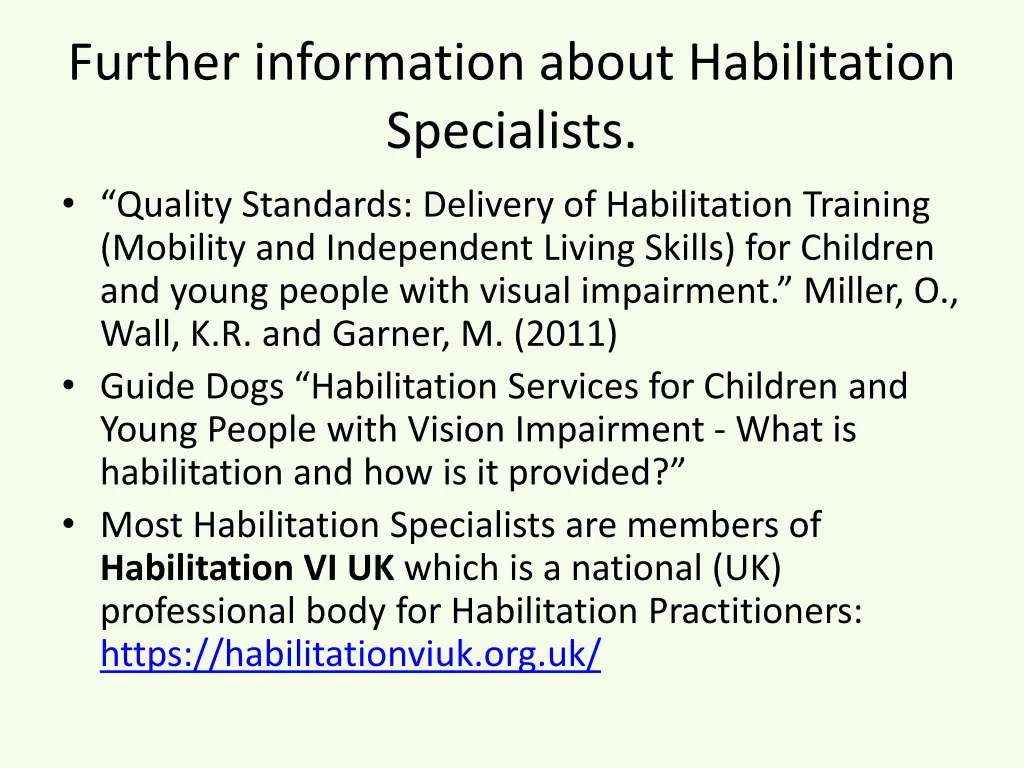
Further information about Habilitation Specialists. Quality Standards: Delivery of Habilitation Training (Mobility and Independent Living Skills) for Children and young people with visual impairment. Miller, O., Wall, K.R. and Garner, M. (2011) Guide Dogs Habilitation Services for Children and Young People with Vision Impairment - What is habilitation and how is it provided? Most Habilitation Specialists are members of Habilitation VI UK which is a national (UK) professional body for Habilitation Practitioners: https://habilitationviuk.org.uk/
Current issues for VI Services and Habilitation Introduction of Additional Learning Needs and Education Tribunal (Wales) Bill Social Services and Well-being (Wales) Act 2014 Identification and early intervention for those with VI Numbers of qualified staff and succession planning
Referrals Referral to a QTVI and Habilitation Specialist can be made by anyone The child does not need to have a Certificate of VI to get support Early intervention is best
Contact Sarah Hughes, Gwent Visual Impairment Service. hughes4@Caerphilly.gov.uk Adrian Linney, Guide Dogs. Adrian.linney@guidedogs.org.uk