Important documents
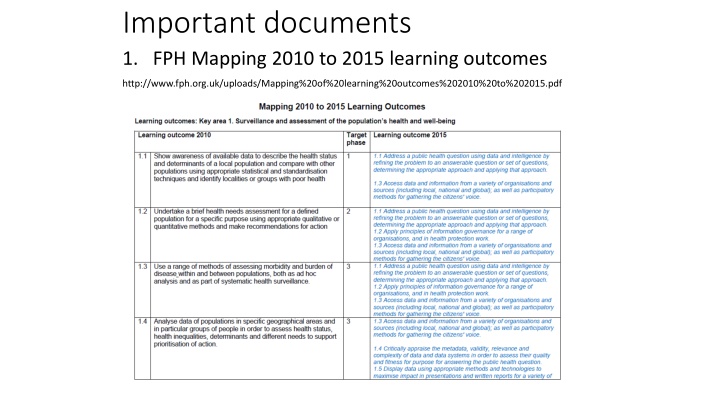
This document includes important information on learning outcomes mapping for public health professionals from 2010 to 2015. It covers key areas such as the use of public health intelligence to assess population health and wellbeing, health needs assessment, and the assessment of policy impacts on populations. The document also provides examples of learning outcomes achievement levels and the evaluation process.

Download Presentation

Please find below an Image/Link to download the presentation.
The content on the website is provided AS IS for your information and personal use only. It may not be sold, licensed, or shared on other websites without obtaining consent from the author.If you encounter any issues during the download, it is possible that the publisher has removed the file from their server.
You are allowed to download the files provided on this website for personal or commercial use, subject to the condition that they are used lawfully. All files are the property of their respective owners.
The content on the website is provided AS IS for your information and personal use only. It may not be sold, licensed, or shared on other websites without obtaining consent from the author.
E N D
Presentation Transcript
Important documents 1. FPH Mapping 2010 to 2015 learning outcomes http://www.fph.org.uk/uploads/Mapping%20of%20learning%20outcomes%202010%20to%202015.pdf
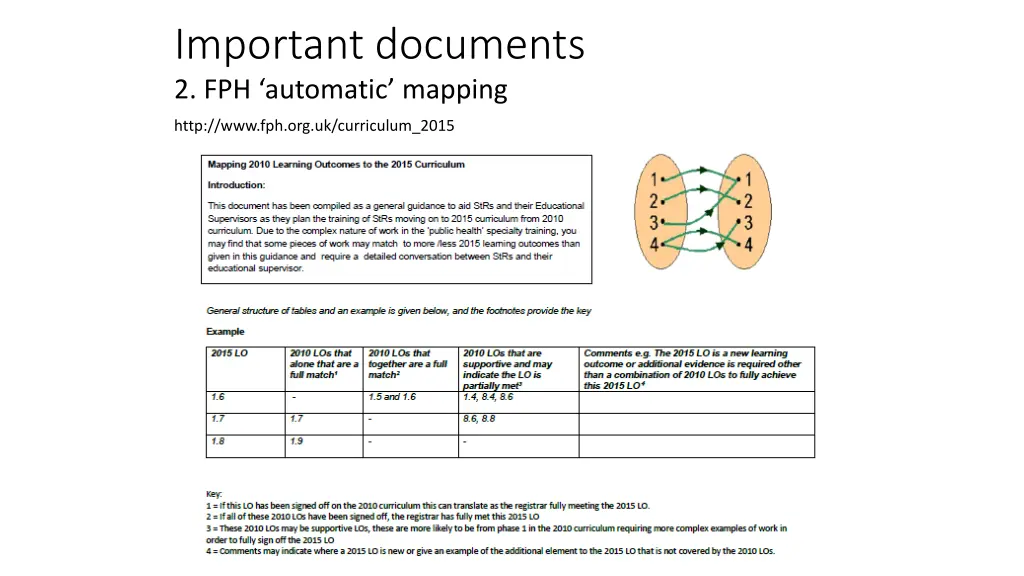
Important documents 2. FPH automatic mapping http://www.fph.org.uk/curriculum_2015
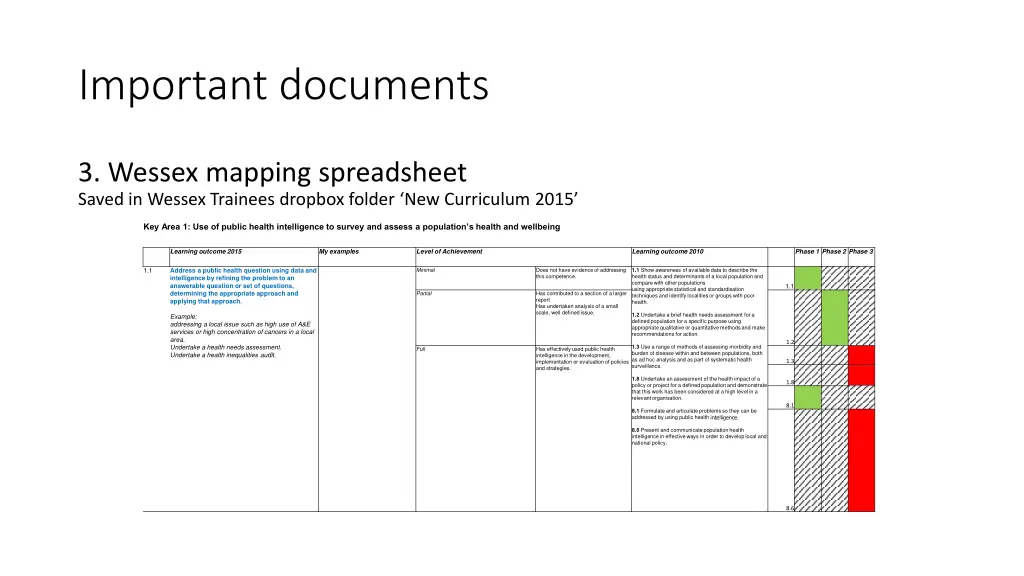
Important documents 3. Wessex mapping spreadsheet Saved in Wessex Trainees dropbox folder New Curriculum 2015 Key Area 1: Use of public health intelligence to survey and assess a population s health and wellbeing Learning outcome 2015 My examples Level of Achievement Learning outcome 2010 Phase 1 Phase 2 Phase 3 1.1 Address a public health question using data and intelligence by refining the problem to an answerable question or set of questions, determining the appropriate approach and applying that approach. Minimal Does not have evidence of addressing this competence. 1.1 Show awareness of available data to describe the health status and determinants of a local population and compare with other populations using appropriate statistical and standardisation techniques and identify localities or groups with poor health. 1.1 Partial Has contributed to a section of a larger report Has undertaken analysis of a small scale, well defined issue. 1.2 Undertake a brief health needs assessment for a defined population for a specific purpose using appropriate qualitative or quantitative methods and make recommendations for action. Example: addressing a local issue such as high use of A&E services or high concentration of cancers in a local area. Undertake a health needs assessment. Undertake a health inequalities audit. 1.2 1.3 Use a range of methods of assessing morbidity and burden of disease within and between populations, both as ad hoc analysis and as part of systematic health surveillance. Full Has effectively used public health intelligence in the development, implementation or evaluation of policies and strategies. 1.3 1.8 Undertake an assessment of the health impact of a policy or project for a defined population and demonstrate that this work has been considered at a high level in a relevant organisation. 1.8 8.1 8.1 Formulate and articulate problems so they can be addressed by using public health intelligence. 8.6 Present and communicate population health intelligence in effective ways in order to develop local and national policy. 8.6
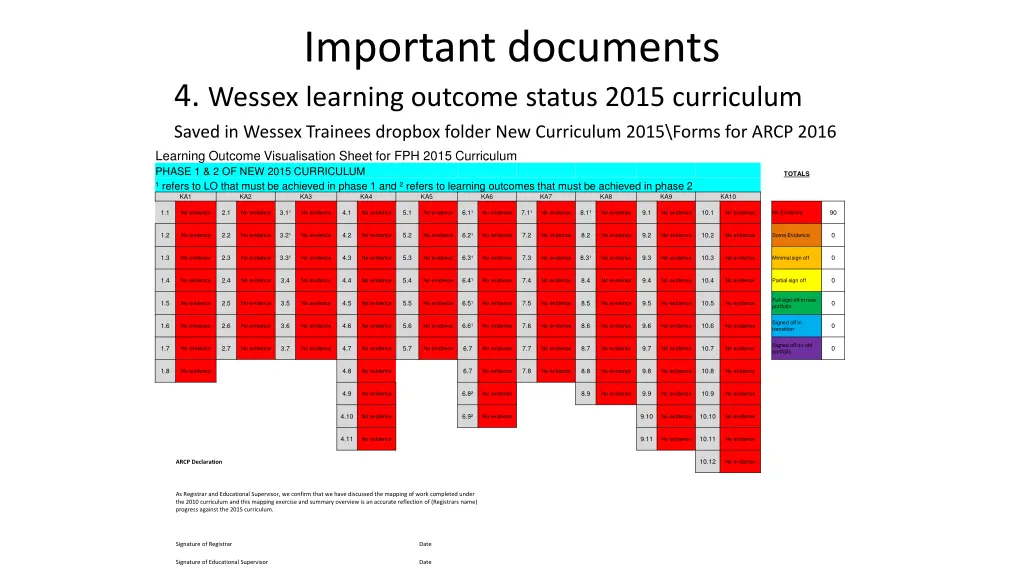
Important documents 4. Wessex learning outcome status 2015 curriculum Saved in Wessex Trainees dropbox folder New Curriculum 2015\Forms for ARCP 2016 Learning Outcome Visualisation Sheet for FPH 2015 Curriculum PHASE 1 & 2 OF NEW 2015 CURRICULUM refers to LO that must be achieved in phase 1 and refers to learning outcomes that must be achieved in phase 2 KA1 KA2 KA3 KA4 KA5 KA6 TOTALS KA7 KA8 KA9 KA10 1.1 2.1 3.1 4.1 5.1 6.1 7.1 8.1 9.1 10.1 90 No evidence No evidence No evidence No evidence No evidence No evidence No evidence No evidence No evidence No evidence No Evidence 1.2 2.2 3.2 4.2 5.2 6.2 7.2 8.2 9.2 10.2 0 No evidence No evidence No evidence No evidence No evidence No evidence No evidence No evidence No evidence No evidence Some Evidence 1.3 2.3 3.3 4.3 5.3 6.3 7.3 8.3 9.3 10.3 0 No evidence No evidence No evidence No evidence No evidence No evidence No evidence No evidence No evidence No evidence Minimal sign off 1.4 2.4 3.4 4.4 5.4 6.4 7.4 8.4 9.4 10.4 0 No evidence No evidence No evidence No evidence No evidence No evidence No evidence No evidence No evidence No evidence Partial sign off Full sign off in new portfolio 1.5 2.5 3.5 4.5 5.5 6.5 7.5 8.5 9.5 10.5 0 No evidence No evidence No evidence No evidence No evidence No evidence No evidence No evidence No evidence No evidence Signed off in transition 1.6 2.6 3.6 4.6 5.6 6.6 7.6 8.6 9.6 10.6 0 No evidence No evidence No evidence No evidence No evidence No evidence No evidence No evidence No evidence No evidence Signed off on old portfolio 1.7 2.7 3.7 4.7 5.7 6.7 7.7 8.7 9.7 10.7 0 No evidence No evidence No evidence No evidence No evidence No evidence No evidence No evidence No evidence No evidence 1.8 4.8 6.7 7.8 8.8 9.8 10.8 No evidence No evidence No evidence No evidence No evidence No evidence No evidence 4.9 6.8 8.9 9.9 10.9 No evidence No evidence No evidence No evidence No evidence 4.10 6.9 9.10 10.10 No evidence No evidence No evidence No evidence 4.11 9.11 10.11 No evidence No evidence No evidence 10.12 No evidence ARCP Declaration As Registrar and Educational Supervisor, we confirm that we have discussed the mapping of work completed under the 2010 curriculum and this mapping exercise and summary overview is an accurate reflection of (Registrars name) progress against the 2015 curriculum. Signature of Registrar Date Signature of Educational Supervisor Date
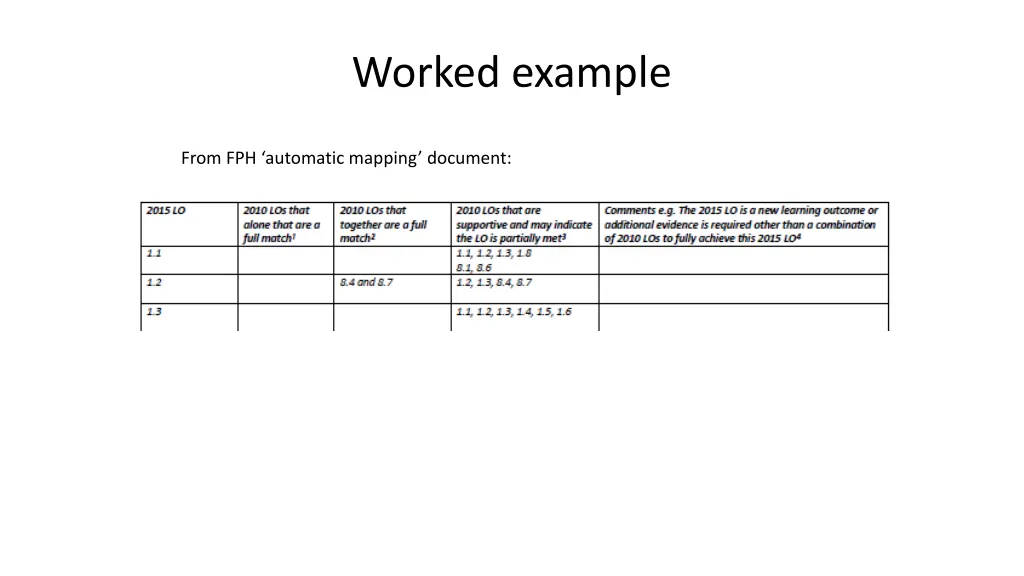
Worked example From FPH automatic mapping document:
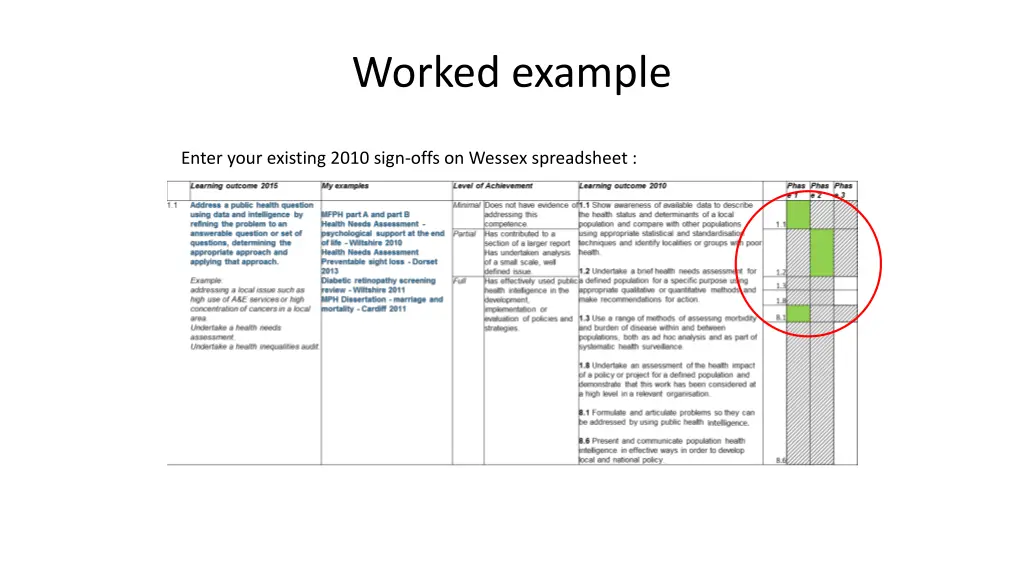
Worked example Enter your existing 2010 sign-offs on Wessex spreadsheet :
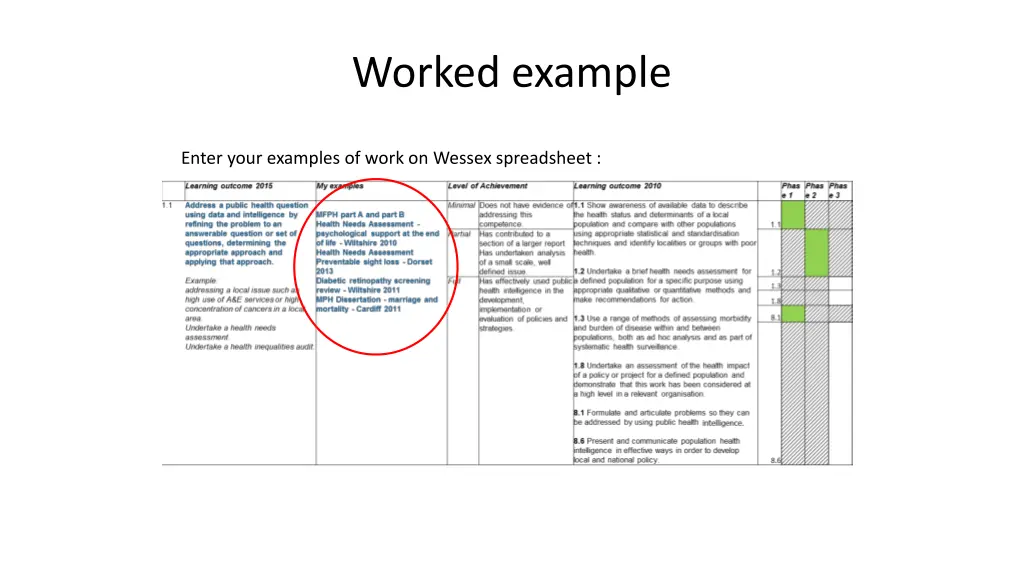
Worked example Enter your examples of work on Wessex spreadsheet :
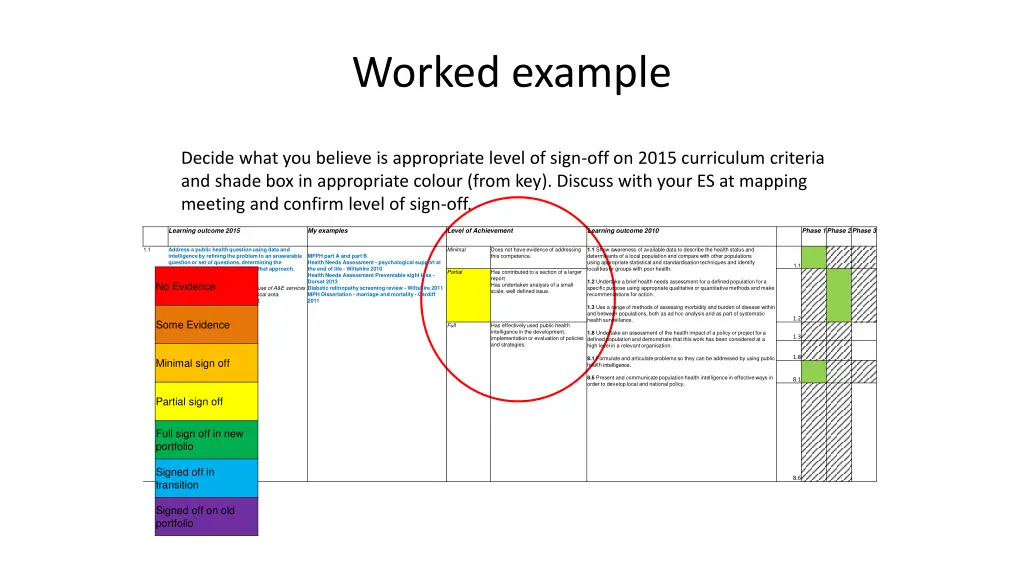
Worked example Decide what you believe is appropriate level of sign-off on 2015 curriculum criteria and shade box in appropriate colour (from key). Discuss with your ES at mapping meeting and confirm level of sign-off. Learning outcome 2015 My examples Level of Achievement Learning outcome 2010 Phase 1Phase 2Phase 3 1.1 Minimal Does not have evidence of addressing this competence. 1.1 Show awareness of available data to describe the health status and determinants of a local population and compare with other populations using appropriate statistical and standardisation techniques and identify localities or groups with poor health. Address a public health question using data and intelligence by refining the problem to an answerable question or set of questions, determining the appropriate approach and applying that approach. MFPH part A and part B Health Needs Assessment - psychological support at the end of life - Wiltshire 2010 Health Needs Assessment Preventable sight loss - Dorset 2013 Diabetic retinopathy screening review - Wiltshire 2011 MPH Dissertation - marriage and mortality - Cardiff 2011 1.1 Partial Has contributed to a section of a larger report Has undertaken analysis of a small scale, well defined issue. Example: addressing a local issue such as high use of A&E services or high concentration of cancers in a local area. Undertake a health needs assessment. Undertake a health inequalities audit. 1.2 Undertake a brief health needs assessment for a defined population for a specific purpose using appropriate qualitative or quantitative methods and make recommendations for action. No Evidence 1.3 Use a range of methods of assessing morbidity and burden of disease within and between populations, both as ad hoc analysis and as part of systematic health surveillance. 1.2 Some Evidence Full Has effectively used public health intelligence in the development, implementation or evaluation of policies and strategies. 1.8 Undertake an assessment of the health impact of a policy or project for a defined population and demonstrate that this work has been considered at a high level in a relevant organisation. 1.3 1.8 8.1 Formulate and articulate problems so they can be addressed by using public health intelligence. Minimal sign off 8.6 Present and communicate population health intelligence in effective ways in order to develop local and national policy. 8.1 Partial sign off Full sign off in new portfolio Signed off in transition 8.6 Signed off on old portfolio
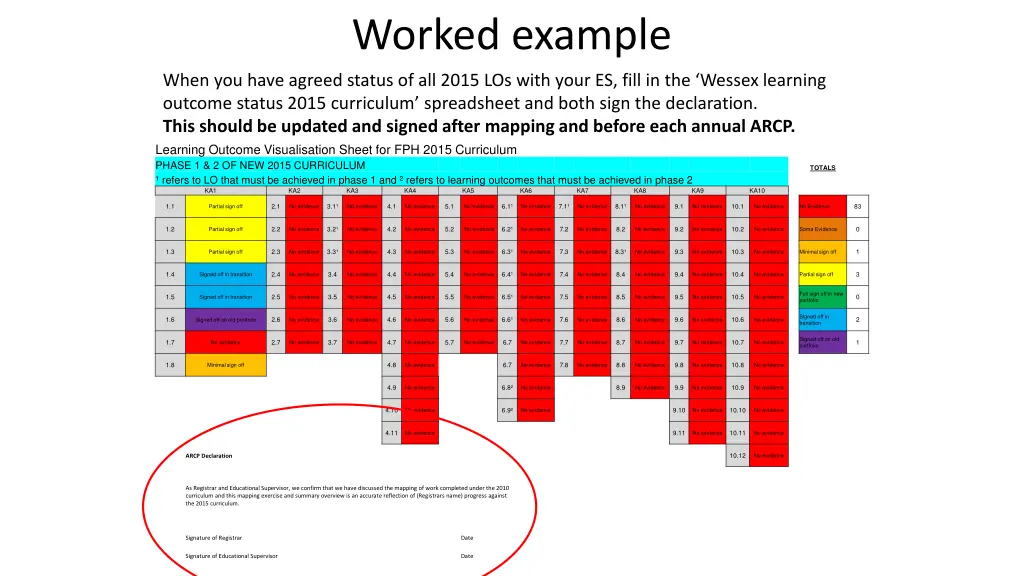
Worked example When you have agreed status of all 2015 LOs with your ES, fill in the Wessex learning outcome status 2015 curriculum spreadsheet and both sign the declaration. This should be updated and signed after mapping and before each annual ARCP. Learning Outcome Visualisation Sheet for FPH 2015 Curriculum PHASE 1 & 2 OF NEW 2015 CURRICULUM refers to LO that must be achieved in phase 1 and refers to learning outcomes that must be achieved in phase 2 KA1 KA2 KA3 KA4 KA5 TOTALS KA6 KA7 KA8 KA9 KA10 1.1 2.1 3.1 4.1 5.1 6.1 7.1 8.1 9.1 10.1 83 Partial sign off No evidence No evidence No evidence No evidence No evidence No evidence No evidence No evidence No evidence No Evidence 1.2 2.2 3.2 4.2 5.2 6.2 7.2 8.2 9.2 10.2 0 Partial sign off No evidence No evidence No evidence No evidence No evidence No evidence No evidence No evidence No evidence Some Evidence 1.3 2.3 3.3 4.3 5.3 6.3 7.3 8.3 9.3 10.3 1 Partial sign off No evidence No evidence No evidence No evidence No evidence No evidence No evidence No evidence No evidence Minimal sign off 1.4 2.4 3.4 4.4 5.4 6.4 7.4 8.4 9.4 10.4 3 Signed off in transition No evidence No evidence No evidence No evidence No evidence No evidence No evidence No evidence No evidence Partial sign off Full sign off in new portfolio 1.5 2.5 3.5 4.5 5.5 6.5 7.5 8.5 9.5 10.5 0 Signed off in transition No evidence No evidence No evidence No evidence No evidence No evidence No evidence No evidence No evidence Signed off in transition 1.6 2.6 3.6 4.6 5.6 6.6 7.6 8.6 9.6 10.6 2 Signed off on old portfolio No evidence No evidence No evidence No evidence No evidence No evidence No evidence No evidence No evidence Signed off on old portfolio 1.7 2.7 3.7 4.7 5.7 6.7 7.7 8.7 9.7 10.7 1 No evidence No evidence No evidence No evidence No evidence No evidence No evidence No evidence No evidence No evidence 1.8 4.8 6.7 7.8 8.8 9.8 10.8 Minimal sign off No evidence No evidence No evidence No evidence No evidence No evidence 4.9 6.8 8.9 9.9 10.9 No evidence No evidence No evidence No evidence No evidence 4.10 6.9 9.10 10.10 No evidence No evidence No evidence No evidence 4.11 9.11 10.11 No evidence No evidence No evidence 10.12 No evidence ARCP Declaration As Registrar and Educational Supervisor, we confirm that we have discussed the mapping of work completed under the 2010 curriculum and this mapping exercise and summary overview is an accurate reflection of (Registrars name) progress against the 2015 curriculum. Signature of Registrar Date Signature of Educational Supervisor Date