Improving Beamforming for Ultra High Reliability (UHR) in IEEE 802.11-22
Enhance your understanding of beamforming improvements for Ultra High Reliability (UHR) in the IEEE 802.11-22 standard. Explore the challenges, solutions, and potential advancements in smooth and UL beamforming techniques, aiming to increase WLAN connectivity reliability, reduce latencies, and boost throughput levels at varying SNR levels.

Download Presentation

Please find below an Image/Link to download the presentation.
The content on the website is provided AS IS for your information and personal use only. It may not be sold, licensed, or shared on other websites without obtaining consent from the author. If you encounter any issues during the download, it is possible that the publisher has removed the file from their server.
You are allowed to download the files provided on this website for personal or commercial use, subject to the condition that they are used lawfully. All files are the property of their respective owners.
The content on the website is provided AS IS for your information and personal use only. It may not be sold, licensed, or shared on other websites without obtaining consent from the author.
E N D
Presentation Transcript
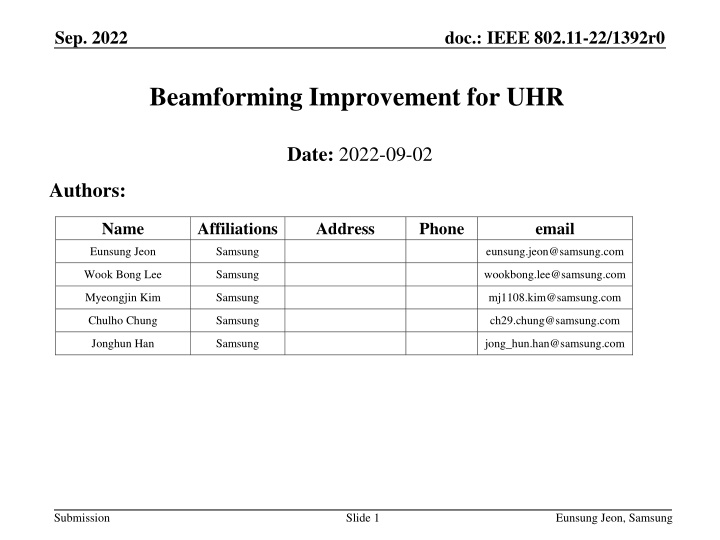
Sep. 2022 doc.: IEEE 802.11-22/1392r0 Beamforming Improvement for UHR Date: 2022-09-02 Authors: Name Affiliations Address Phone email Eunsung Jeon Samsung eunsung.jeon@samsung.com Wook Bong Lee Samsung wookbong.lee@samsung.com Myeongjin Kim Samsung mj1108.kim@samsung.com Chulho Chung Samsung ch29.chung@samsung.com Jonghun Han Samsung jong_hun.han@samsung.com Submission Slide 1 Eunsung Jeon, Samsung
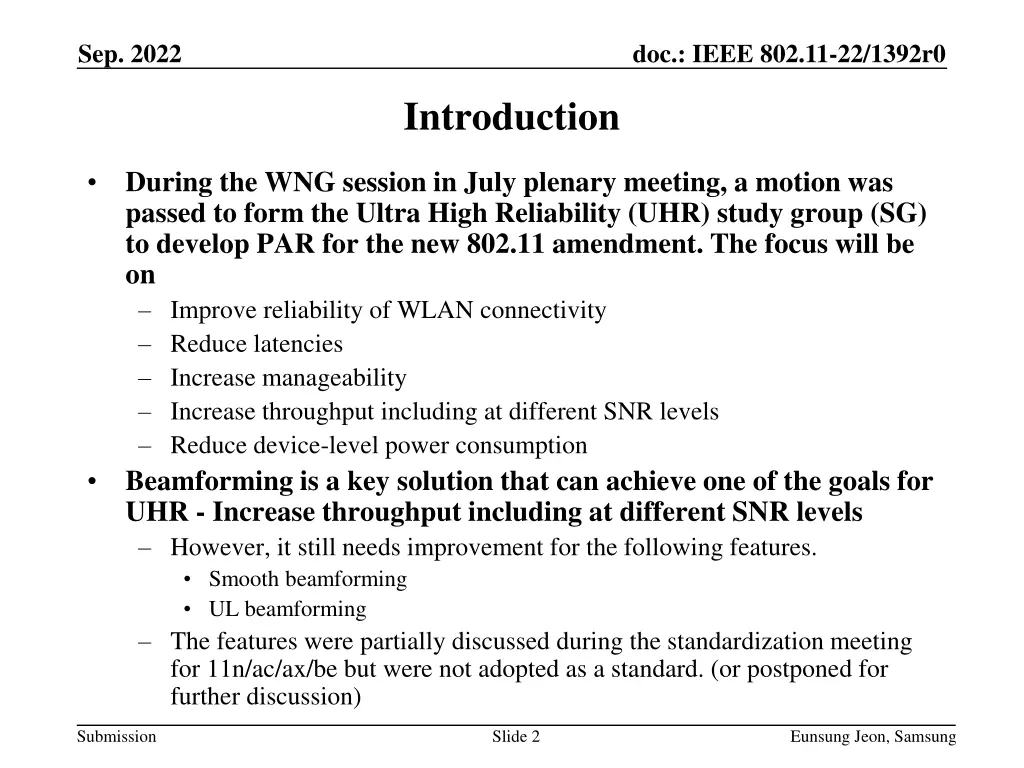
Sep. 2022 doc.: IEEE 802.11-22/1392r0 Introduction During the WNG session in July plenary meeting, a motion was passed to form the Ultra High Reliability (UHR) study group (SG) to develop PAR for the new 802.11 amendment. The focus will be on Improve reliability of WLAN connectivity Reduce latencies Increase manageability Increase throughput including at different SNR levels Reduce device-level power consumption Beamforming is a key solution that can achieve one of the goals for UHR - Increase throughput including at different SNR levels However, it still needs improvement for the following features. Smooth beamforming UL beamforming The features were partially discussed during the standardization meeting for 11n/ac/ax/be but were not adopted as a standard. (or postponed for further discussion) Submission Slide 2 Eunsung Jeon, Samsung
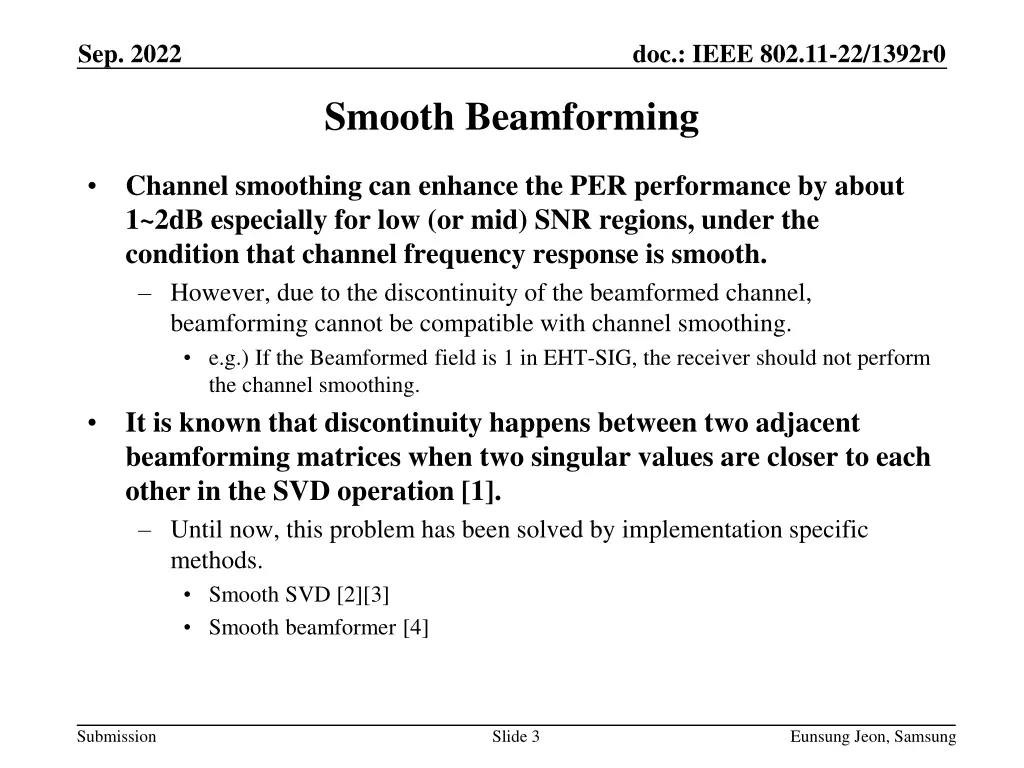
Sep. 2022 doc.: IEEE 802.11-22/1392r0 Smooth Beamforming Channel smoothing can enhance the PER performance by about 1~2dB especially for low (or mid) SNR regions, under the condition that channel frequency response is smooth. However, due to the discontinuity of the beamformed channel, beamforming cannot be compatible with channel smoothing. e.g.) If the Beamformed field is 1 in EHT-SIG, the receiver should not perform the channel smoothing. It is known that discontinuity happens between two adjacent beamforming matrices when two singular values are closer to each other in the SVD operation [1]. Until now, this problem has been solved by implementation specific methods. Smooth SVD [2][3] Smooth beamformer [4] Submission Slide 3 Eunsung Jeon, Samsung
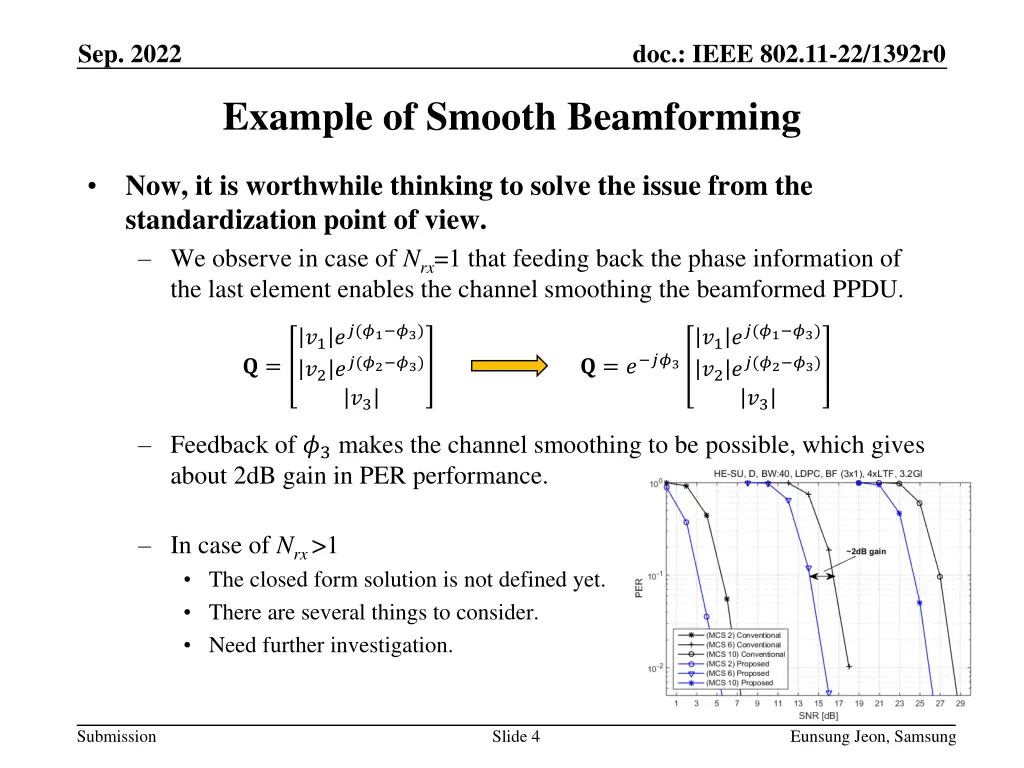
Sep. 2022 doc.: IEEE 802.11-22/1392r0 Example of Smooth Beamforming Now, it is worthwhile thinking to solve the issue from the standardization point of view. We observe in case of Nrx=1 that feeding back the phase information of the last element enables the channel smoothing the beamformed PPDU. ?1??(?1 ?3) ?2??(?2 ?3) ?3 ?1??(?1 ?3) ?2??(?2 ?3) ?3 ? = ? ??3 ? = Feedback of ?3 makes the channel smoothing to be possible, which gives about 2dB gain in PER performance. In case of Nrx >1 The closed form solution is not defined yet. There are several things to consider. Need further investigation. Submission Slide 4 Eunsung Jeon, Samsung
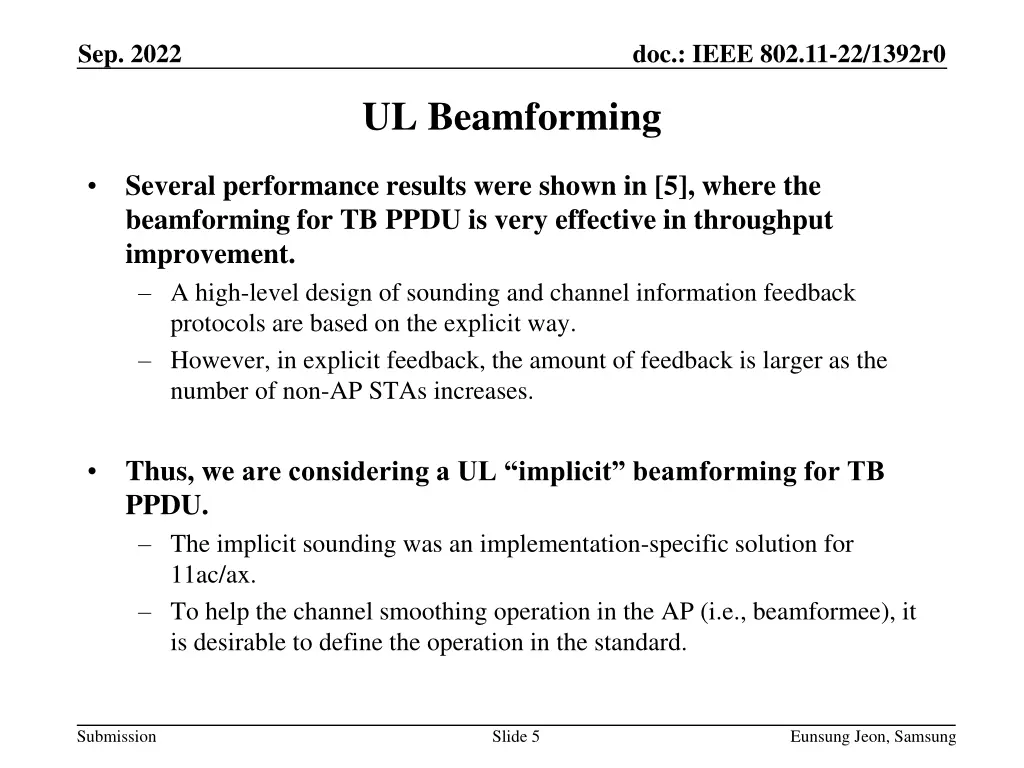
Sep. 2022 doc.: IEEE 802.11-22/1392r0 UL Beamforming Several performance results were shown in [5], where the beamforming for TB PPDU is very effective in throughput improvement. A high-level design of sounding and channel information feedback protocols are based on the explicit way. However, in explicit feedback, the amount of feedback is larger as the number of non-AP STAs increases. Thus, we are considering a UL implicit beamforming for TB PPDU. The implicit sounding was an implementation-specific solution for 11ac/ax. To help the channel smoothing operation in the AP (i.e., beamformee), it is desirable to define the operation in the standard. Submission Slide 5 Eunsung Jeon, Samsung
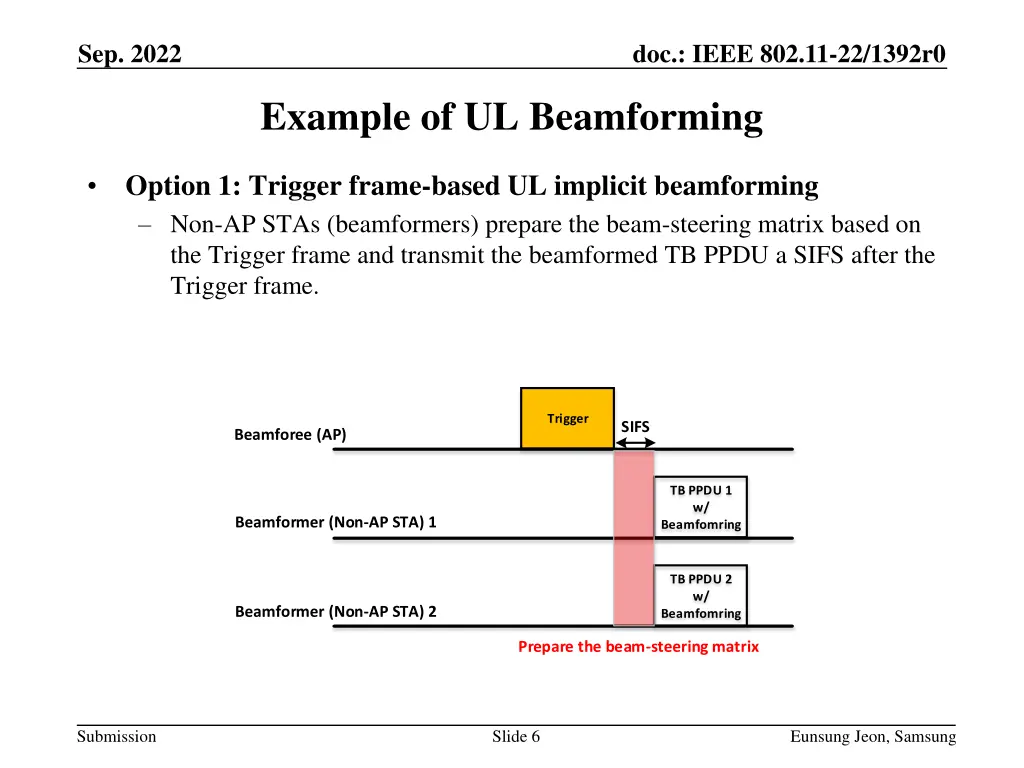
Sep. 2022 doc.: IEEE 802.11-22/1392r0 Example of UL Beamforming Option 1: Trigger frame-based UL implicit beamforming Non-AP STAs (beamformers) prepare the beam-steering matrix based on the Trigger frame and transmit the beamformed TB PPDU a SIFS after the Trigger frame. Trigger SIFS Beamforee (AP) TB PPDU 1 w/ Beamfomring Beamformer (Non-AP STA) 1 TB PPDU 2 w/ Beamfomring Beamformer (Non-AP STA) 2 Prepare the beam-steering matrix Submission Slide 6 Eunsung Jeon, Samsung
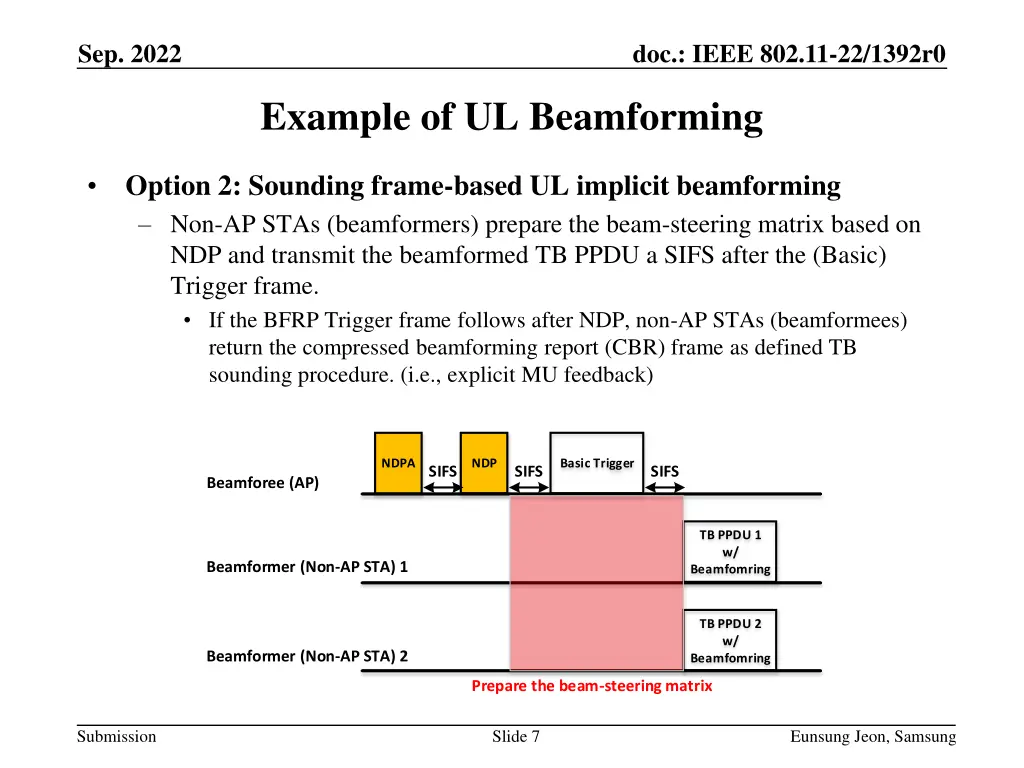
Sep. 2022 doc.: IEEE 802.11-22/1392r0 Example of UL Beamforming Option 2: Sounding frame-based UL implicit beamforming Non-AP STAs (beamformers) prepare the beam-steering matrix based on NDP and transmit the beamformed TB PPDU a SIFS after the (Basic) Trigger frame. If the BFRP Trigger frame follows after NDP, non-AP STAs (beamformees) return the compressed beamforming report (CBR) frame as defined TB sounding procedure. (i.e., explicit MU feedback) NDPA NDP Basic Trigger SIFS SIFS SIFS Beamforee (AP) TB PPDU 1 w/ Beamfomring Beamformer (Non-AP STA) 1 TB PPDU 2 w/ Beamfomring Beamformer (Non-AP STA) 2 Prepare the beam-steering matrix Submission Slide 7 Eunsung Jeon, Samsung
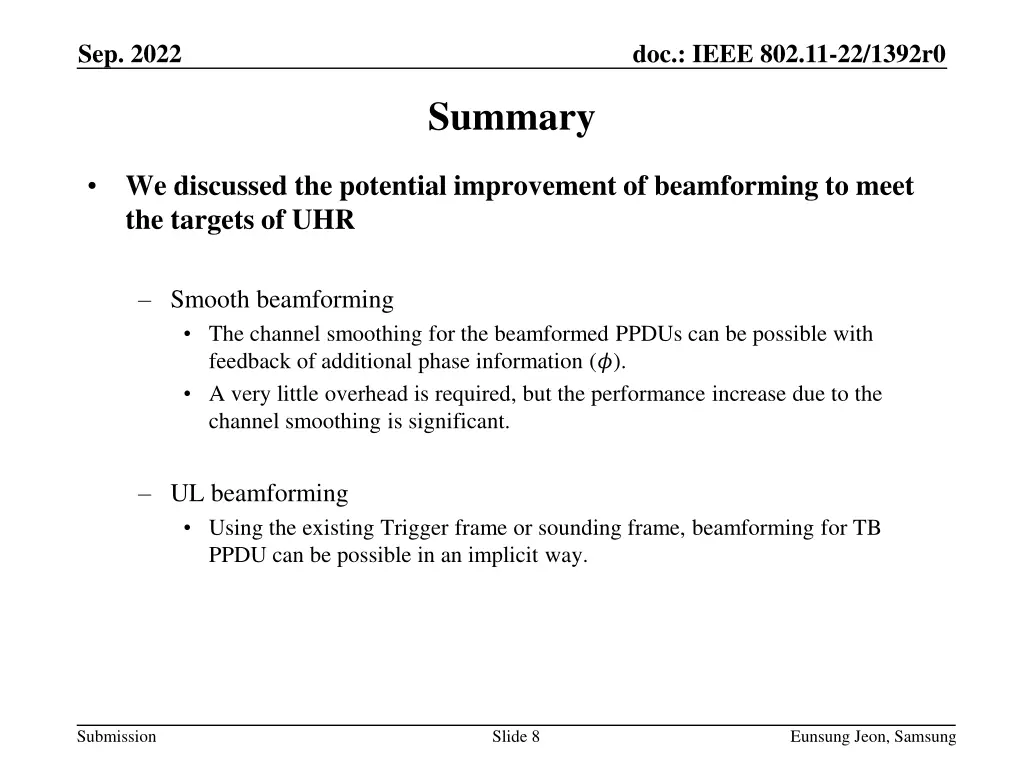
Sep. 2022 doc.: IEEE 802.11-22/1392r0 Summary We discussed the potential improvement of beamforming to meet the targets of UHR Smooth beamforming The channel smoothing for the beamformed PPDUs can be possible with feedback of additional phase information (?). A very little overhead is required, but the performance increase due to the channel smoothing is significant. UL beamforming Using the existing Trigger frame or sounding frame, beamforming for TB PPDU can be possible in an implicit way. Submission Slide 8 Eunsung Jeon, Samsung
Sep. 2022 doc.: IEEE 802.11-22/1392r0 Reference [1] J. S. Sadowsky, T. Yamaura, and J. Ketchem, WWiSE Preambles and MIMO Beamforming, IEEE, Tech. Rep. 802.11-05/1635r1, Jan. 2005. [2] C. Shen and M. P. Fits, MIMO-OFDM Beamforming for Improved Channel Estimation, IEEE J. Selected. Areas Commun., vol.26, no.6, Aug. 2008. [3] M. Sandell and V. Ponnampalam, Smooth beamforming and efficient beamforming weight computation, in Proc. IEEE GLOBECOM, Nov. 2007. [4] E. Jeon, M. Ahn, S. Kim, W. B. Lee, and J. Kim, Joint Beamformer and Beamformee Design for Channel Smoothing in WLAN Systems, in Proc. IEEE VTC-Fall, Sep. 2019. [5] 802.11-20/1672r0, UL Beamforming for TB PPDUs in 11be, Huawei Submission Slide 9 Eunsung Jeon, Samsung