Improving Performance with SIMD Technology
Explore the capabilities of Single Instruction Multiple Data (SIMD) processors in enhancing performance through parallelism. Learn about SIMD designs, hardware control mechanisms, and the advantages of utilizing SIMD for multimedia and graphics processing. Dive into the world of SIMD processors and their impact on optimizing computational efficiency.

Download Presentation

Please find below an Image/Link to download the presentation.
The content on the website is provided AS IS for your information and personal use only. It may not be sold, licensed, or shared on other websites without obtaining consent from the author. If you encounter any issues during the download, it is possible that the publisher has removed the file from their server.
You are allowed to download the files provided on this website for personal or commercial use, subject to the condition that they are used lawfully. All files are the property of their respective owners.
The content on the website is provided AS IS for your information and personal use only. It may not be sold, licensed, or shared on other websites without obtaining consent from the author.
E N D
Presentation Transcript
Lecture 16 SSE vectorprocessing SIMD MultimediaExtensions
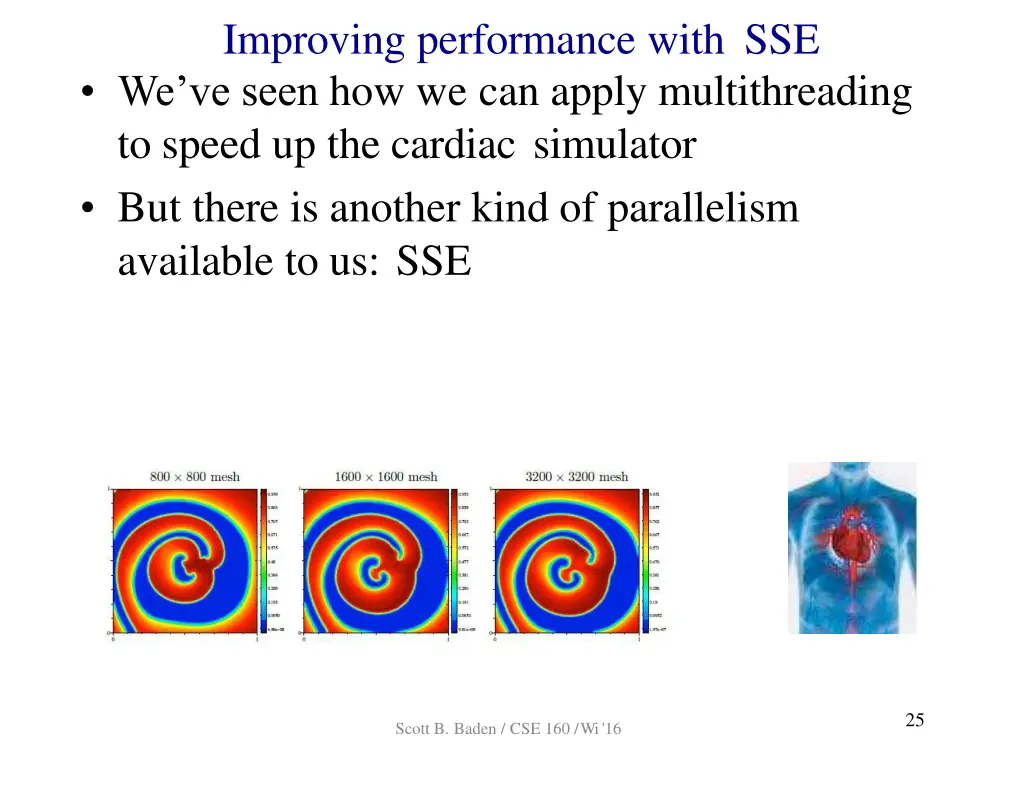
Improving performance with SSE We ve seen how we can apply multithreading to speed up the cardiac simulator But there is another kind of parallelism available to us: SSE 25 Scott B. Baden / CSE 160 /Wi '16
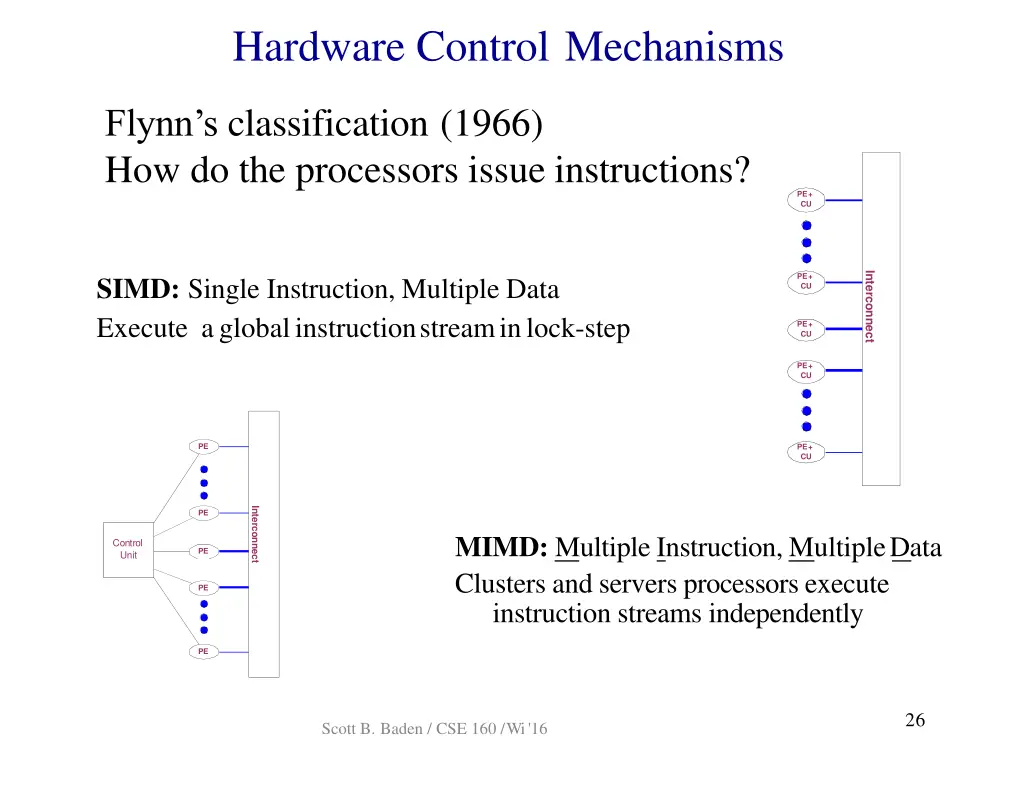
Hardware Control Mechanisms Flynn s classification (1966) How do the processors issue instructions? PE+ CU Interconnect SIMD: Single Instruction, Multiple Data Execute aglobalinstructionstreaminlock-step PE+ CU PE+ CU PE+ CU PE PE+ CU Interconnect PE MIMD: Multiple Instruction, MultipleData Clusters and servers processors execute instruction streams independently Control Unit PE PE PE 26 Scott B. Baden / CSE 160 /Wi '16
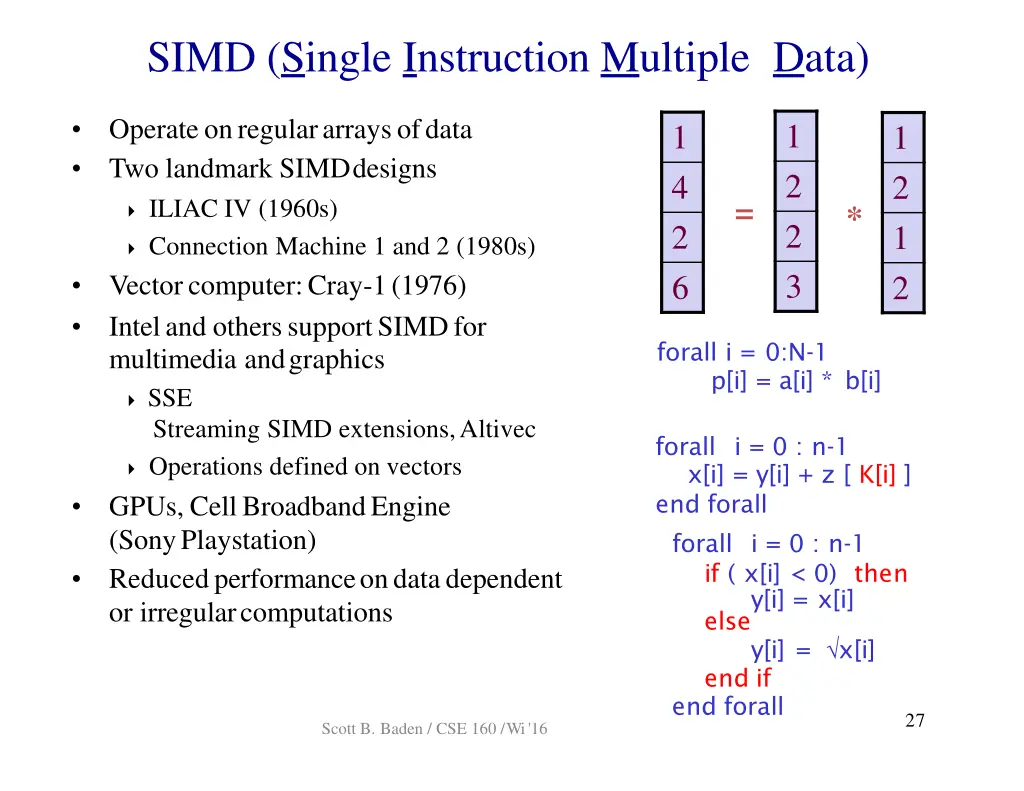
SIMD (Single Instruction Multiple Data) Operateonregulararraysofdata Two landmark SIMDdesigns 1 2 2 3 1 4 2 6 1 2 1 2 = ILIAC IV (1960s) Connection Machine 1 and 2 (1980s) Vectorcomputer:Cray-1(1976) Inteland otherssupportSIMDfor multimedia andgraphics SSE Streaming SIMD extensions,Altivec Operations defined on vectors GPUs, CellBroadbandEngine (SonyPlaystation) Reducedperformanceondatadependent or irregularcomputations * forall i = 0:N-1 p[i] = a[i] * b[i] forall i = 0 : n-1 x[i] = y[i] + z [ K[i] ] end forall forall i = 0 : n-1 if ( x[i] < 0) then y[i] = x[i] else y[i] = x[i] end if end forall 27 Scott B. Baden / CSE 160 /Wi '16
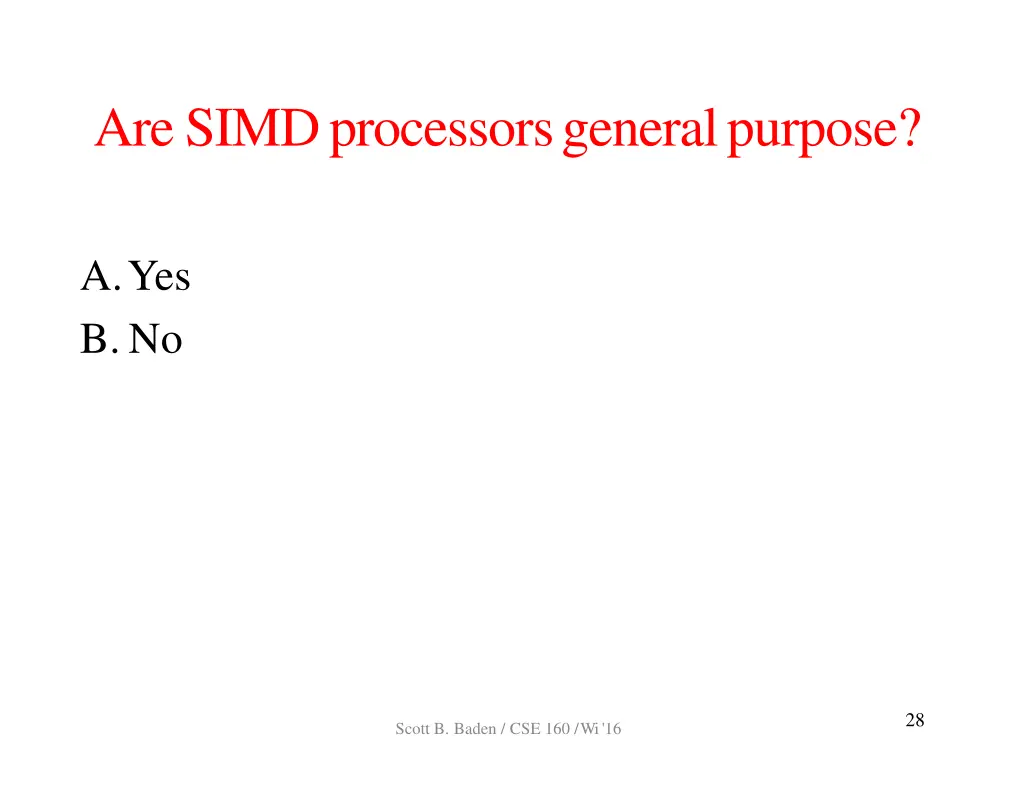
AreSIMDprocessorsgeneralpurpose? A.Yes B.No 28 Scott B. Baden / CSE 160 /Wi '16
AreSIMDprocessorsgeneralpurpose? A.Yes B.No 28 Scott B. Baden / CSE 160 /Wi '16
What kind of parallelismdoesmultithreading provide? A. MIMD B. SIMD 29 Scott B. Baden / CSE 160 /Wi '16
What kind of parallelismdoesmultithreading provide? A. MIMD B. SIMD 29 Scott B. Baden / CSE 160 /Wi '16
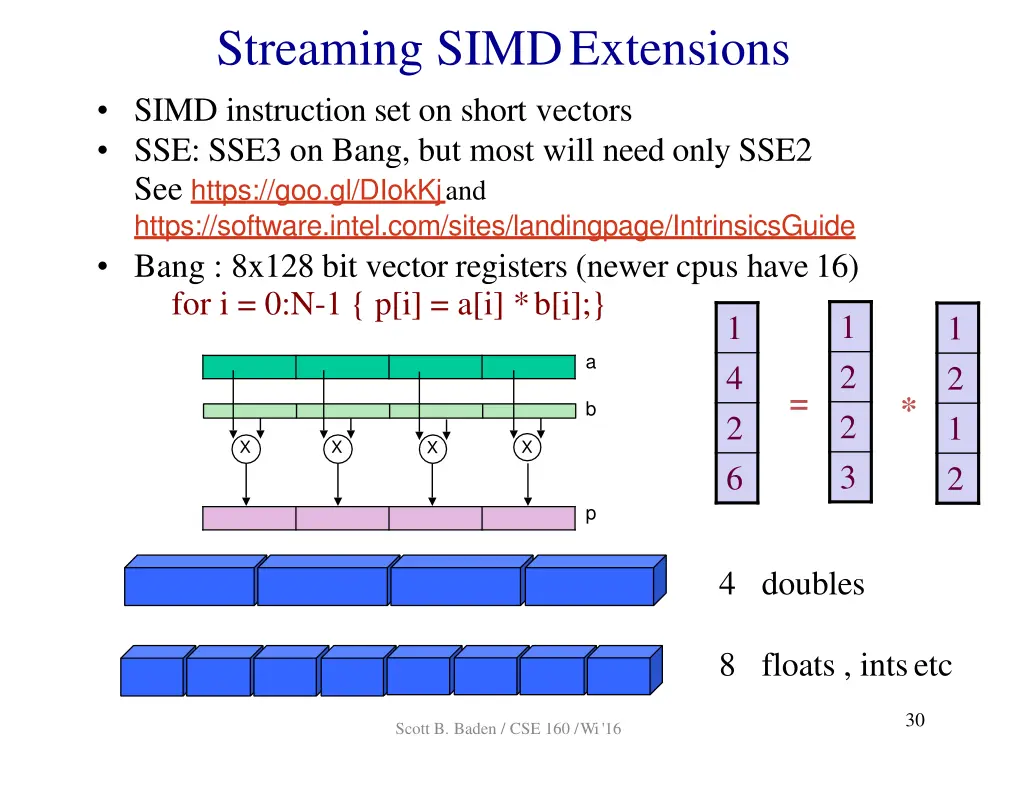
Streaming SIMDExtensions SIMD instruction set on short vectors SSE: SSE3 on Bang, but most will need only SSE2 See https://goo.gl/DIokKjand https://software.intel.com/sites/landingpage/IntrinsicsGuide Bang : 8x128 bit vector registers (newer cpus have16) for i = 0:N-1 { p[i] = a[i] *b[i];} 1 2 2 3 1 4 2 6 1 2 1 2 a = * b X X X X p 4 doubles 8 floats , intsetc 30 Scott B. Baden / CSE 160 /Wi '16
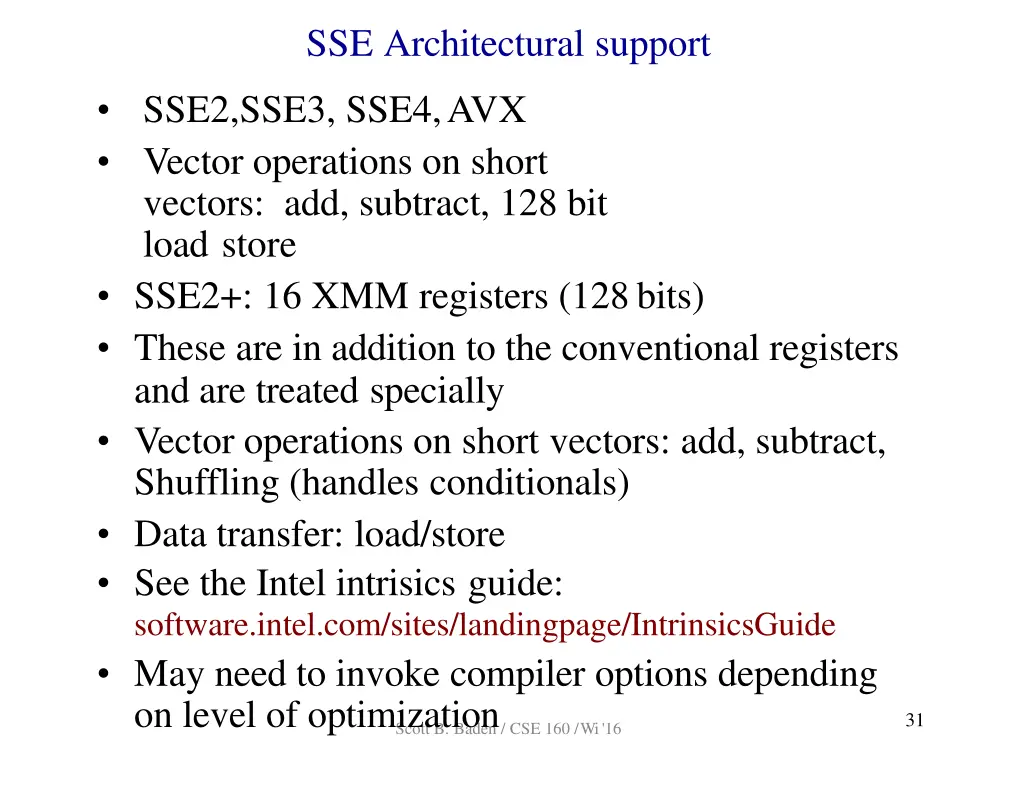
SSE Architectural support SSE2,SSE3, SSE4,AVX Vector operations on short vectors: add, subtract, 128 bit load store SSE2+: 16 XMM registers (128bits) These are in addition to the conventional registers and are treated specially Vector operations on short vectors: add, subtract, Shuffling (handles conditionals) Data transfer: load/store See the Intel intrisics guide: software.intel.com/sites/landingpage/IntrinsicsGuide May need to invoke compiler options depending on level of optimization 31 Scott B. Baden / CSE 160 /Wi '16
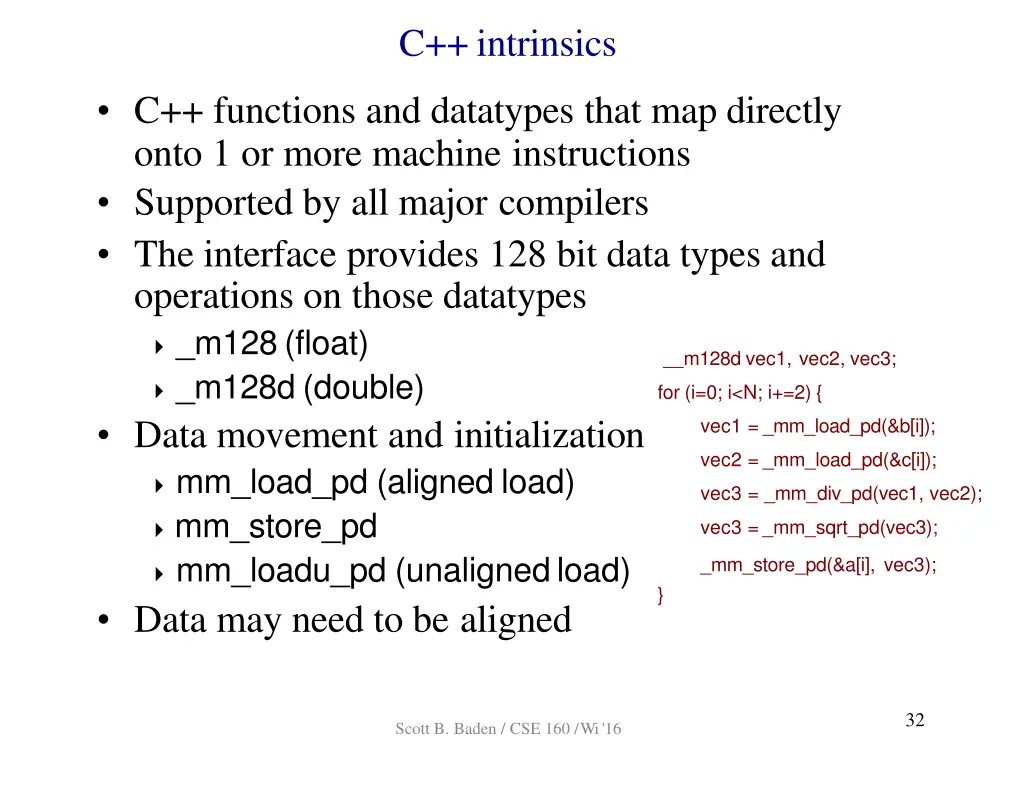
C++ intrinsics C++ functions and datatypes that map directly onto 1 or more machine instructions Supported by all major compilers The interface provides 128 bit data types and operations on those datatypes _m128(float) _m128d (double) Data movement and initialization mm_load_pd (aligned load) mm_store_pd mm_loadu_pd (unalignedload) Data may need to be aligned m128d vec1, vec2, vec3; for (i=0; i<N; i+=2) { vec1 =_mm_load_pd(&b[i]); vec2 =_mm_load_pd(&c[i]); vec3 = _mm_div_pd(vec1, vec2); vec3 =_mm_sqrt_pd(vec3); _mm_store_pd(&a[i], vec3); } 32 Scott B. Baden / CSE 160 /Wi '16
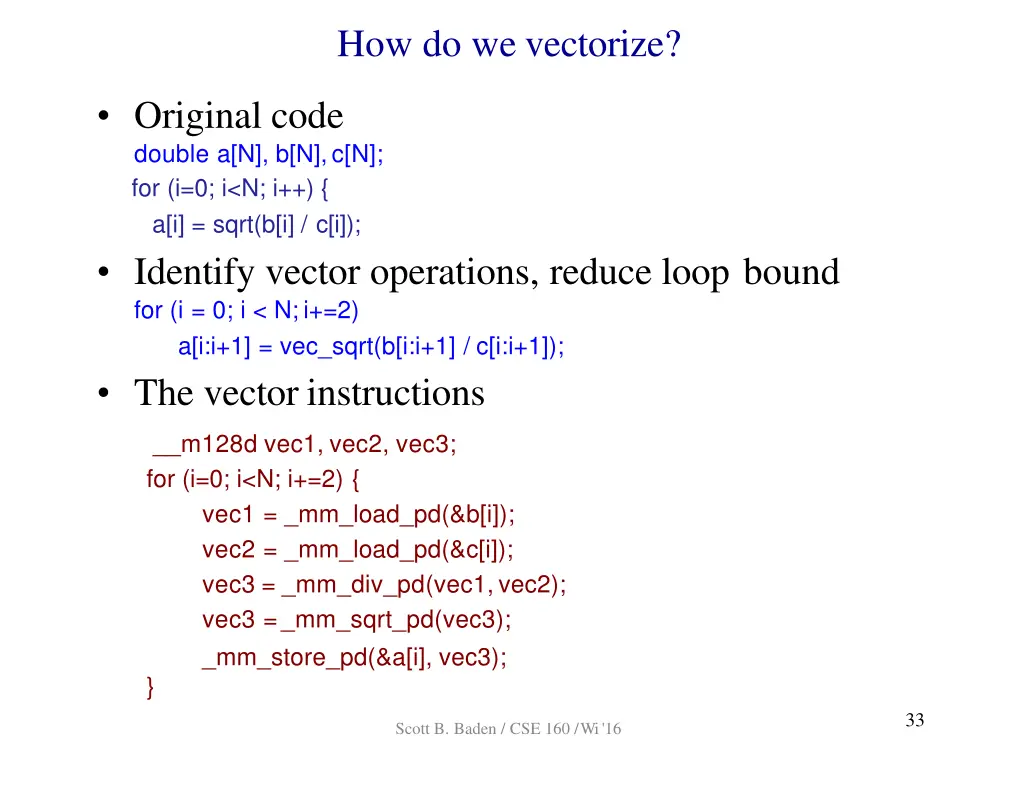
How do we vectorize? Original code double a[N], b[N],c[N]; for (i=0; i<N; i++) { a[i] = sqrt(b[i] / c[i]); Identify vector operations, reduce loop bound for (i = 0; i < N;i+=2) a[i:i+1] = vec_sqrt(b[i:i+1] / c[i:i+1]); The vector instructions __m128d vec1, vec2, vec3; for (i=0; i<N; i+=2) { vec1 = _mm_load_pd(&b[i]); vec2 = _mm_load_pd(&c[i]); vec3 = _mm_div_pd(vec1,vec2); vec3 =_mm_sqrt_pd(vec3); _mm_store_pd(&a[i], vec3); } 33 Scott B. Baden / CSE 160 /Wi '16
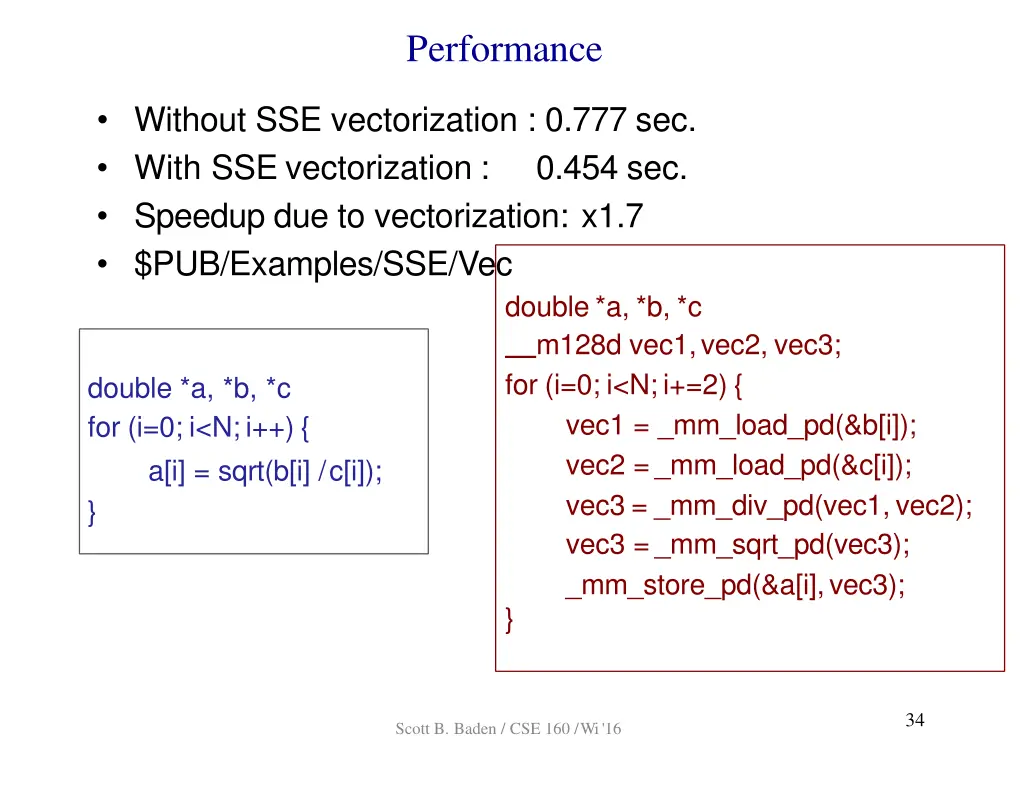
Performance Without SSE vectorization : 0.777 sec. With SSE vectorization : Speedup due to vectorization: x1.7 $PUB/Examples/SSE/Vec 0.454 sec. double*a, *b, *c m128d vec1,vec2, vec3; for (i=0; i<N;i+=2) { vec1 = _mm_load_pd(&b[i]); vec2 =_mm_load_pd(&c[i]); vec3 = _mm_div_pd(vec1,vec2); vec3 =_mm_sqrt_pd(vec3); _mm_store_pd(&a[i],vec3); } double *a, *b, *c for (i=0; i<N;i++) { a[i] = sqrt(b[i] /c[i]); } 34 Scott B. Baden / CSE 160 /Wi '16
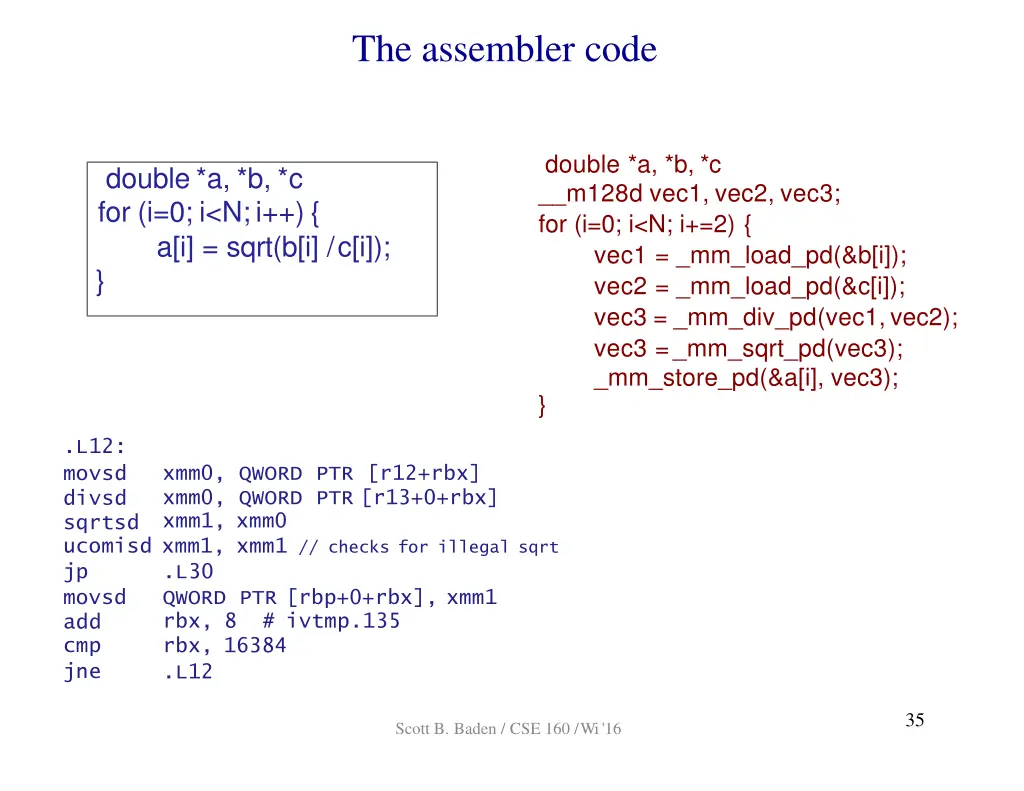
The assembler code double *a, *b, *c __m128d vec1, vec2, vec3; for (i=0; i<N; i+=2) { vec1 = _mm_load_pd(&b[i]); vec2 = _mm_load_pd(&c[i]); vec3 = _mm_div_pd(vec1,vec2); vec3 =_mm_sqrt_pd(vec3); _mm_store_pd(&a[i], vec3); } double*a, *b, *c for (i=0; i<N;i++) { a[i] = sqrt(b[i] /c[i]); } .L12: movsd divsd sqrtsd ucomisd xmm1, xmm1 // checks for illegal sqrt jp .L30 movsd QWORD PTR [rbp+0+rbx], xmm1 add cmp jne .L12 xmm0, QWORD PTR [r12+rbx] xmm0, QWORD PTR [r13+0+rbx] xmm1, xmm0 rbx, 8 rbx, 16384 # ivtmp.135 35 Scott B. Baden / CSE 160 /Wi '16
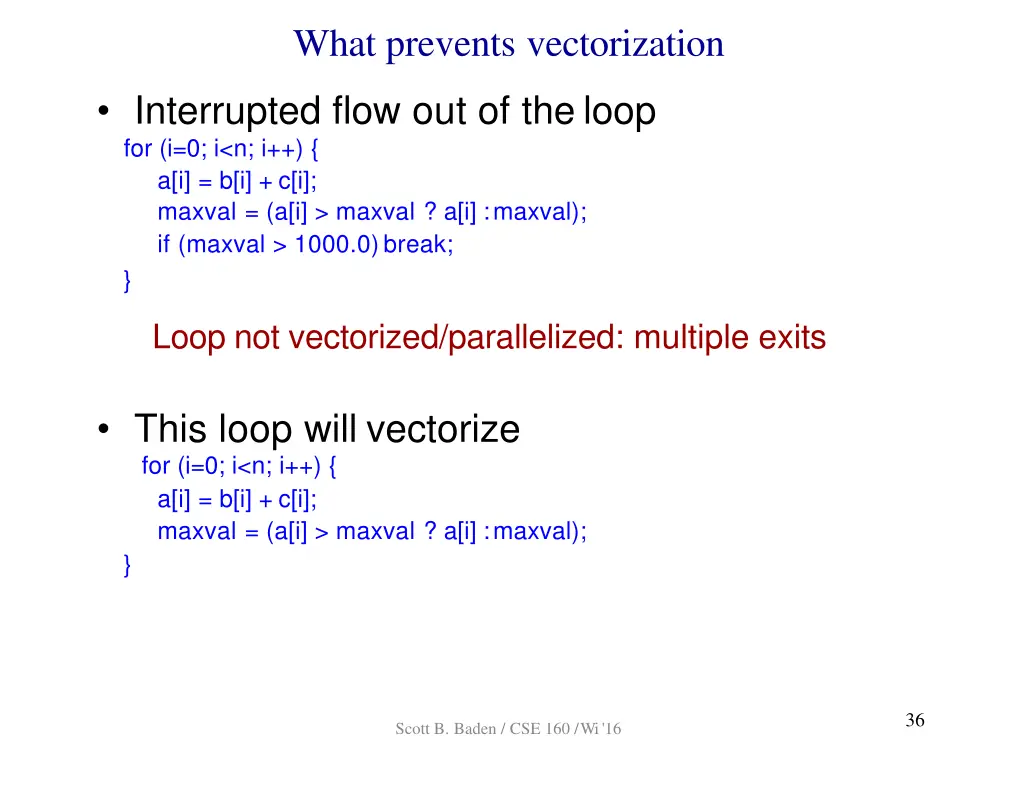
What prevents vectorization Interrupted flow out of theloop for (i=0; i<n; i++) { a[i] = b[i] + c[i]; maxval = (a[i] > maxval ? a[i] :maxval); if (maxval > 1000.0)break; } Loop not vectorized/parallelized: multiple exits This loop will vectorize for (i=0; i<n; i++) { a[i] = b[i] + c[i]; maxval = (a[i] > maxval ? a[i] :maxval); } 36 Scott B. Baden / CSE 160 /Wi '16
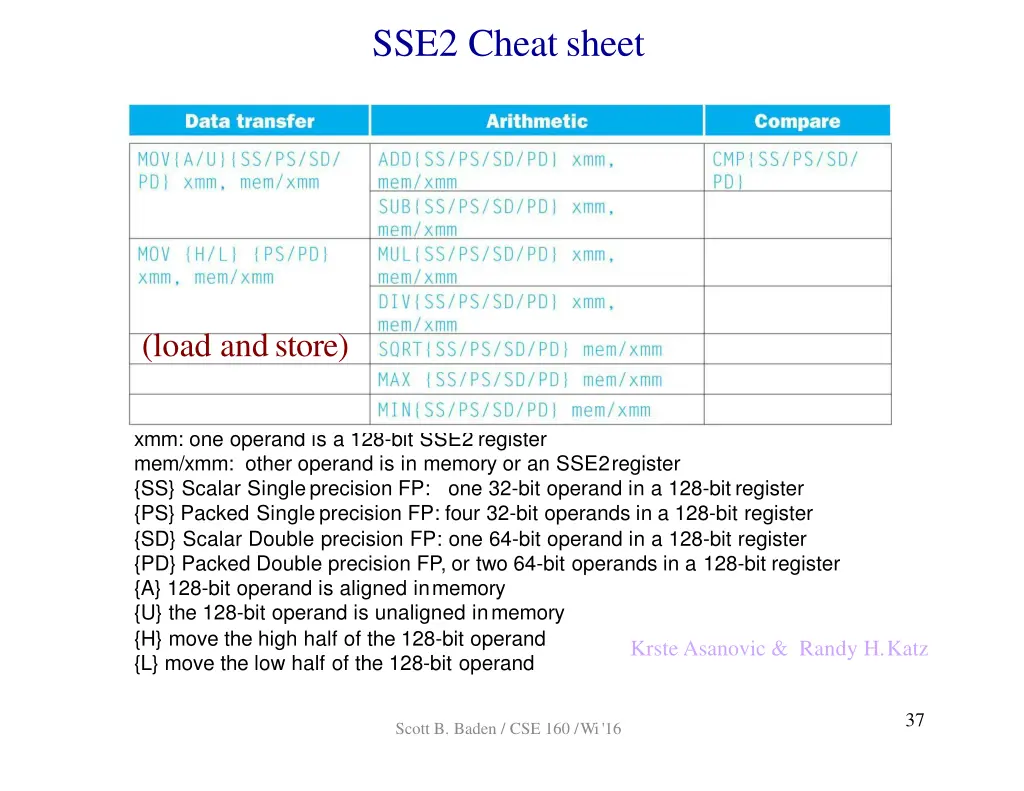
SSE2 Cheat sheet (load andstore) xmm: one operand is a 128-bit SSE2 register mem/xmm: other operand is in memory or an SSE2register {SS} Scalar Singleprecision FP: one 32-bit operand in a 128-bitregister {PS} Packed Singleprecision FP: four 32-bit operands in a 128-bit register {SD} Scalar Double precision FP: one 64-bit operand in a 128-bit register {PD} Packed Double precision FP, or two 64-bit operands in a 128-bit register {A} 128-bit operand is aligned inmemory {U} the 128-bit operand is unaligned inmemory {H} move the high half of the 128-bit operand {L} move the low half of the 128-bit operand Krste Asanovic & Randy H.Katz 37 Scott B. Baden / CSE 160 /Wi '16