The OECD Accession Process serves as a catalyst for reform in candidate countries, involving in-depth reviews by technical committees spanning various government areas. Accession promotes convergence with OECD standards and policies, leading to successful membership invitations for countries like Latvia and Lithuania. The process entails a 5-step journey, from initial Council decision to the signature of the Accession Agreement. Various committees, including those on investment, corporate governance, competition, and environment, play vital roles in this process.
Please find below an Image/Link to download the presentation.
The content on the website is provided AS IS for your information and personal use only. It may not be sold, licensed, or shared on other websites without obtaining consent from the author. If you encounter any issues during the download, it is possible that the publisher has removed the file from their server.
You are allowed to download the files provided on this website for personal or commercial use, subject to the condition that they are used lawfully. All files are the property of their respective owners.
The content on the website is provided AS IS for your information and personal use only. It may not be sold, licensed, or shared on other websites without obtaining consent from the author.
E N D
Presentation Transcript
Accession as a guideline to improve regulation OECD instruments and rules of good practices Winfrid Blaschke Deputy Head, Investment Division, OECD
OECD ACCESSION PROCESS - OVERVIEW Since the OECD s creation in 1961, 17 countries have been invited to become OECD Members. The accession process has become broader and more rigorous over time, reflecting the growing interest and expertise of the Organisation in achieving convergence with OECD standards and policies. Today s accession process has proven to serve as a powerful catalyst for reform in candidate countries. It constitutes an across the board in-depth review of legislation, policy and practice in almost every area of government activity by approximately 20 OECD technical committees.
OECD ACCESSION PROCESS - OVERVIEW In May 2013, the OECD Council decided to launch accession discussions with Colombia and Latvia; in April 2015, it invited Costa Rica and Lithuania to open formal OECD accession talks. Latvia became a member in 2016 and Lithuania joined the OECD in July 2018. In a previous accession round in 2007, the OECD Council decided to open accession discussions with Chile, Estonia, Israel, the Russian Federation and Slovenia. In 2010, Chile, Estonia, Israel and Slovenia became Members.
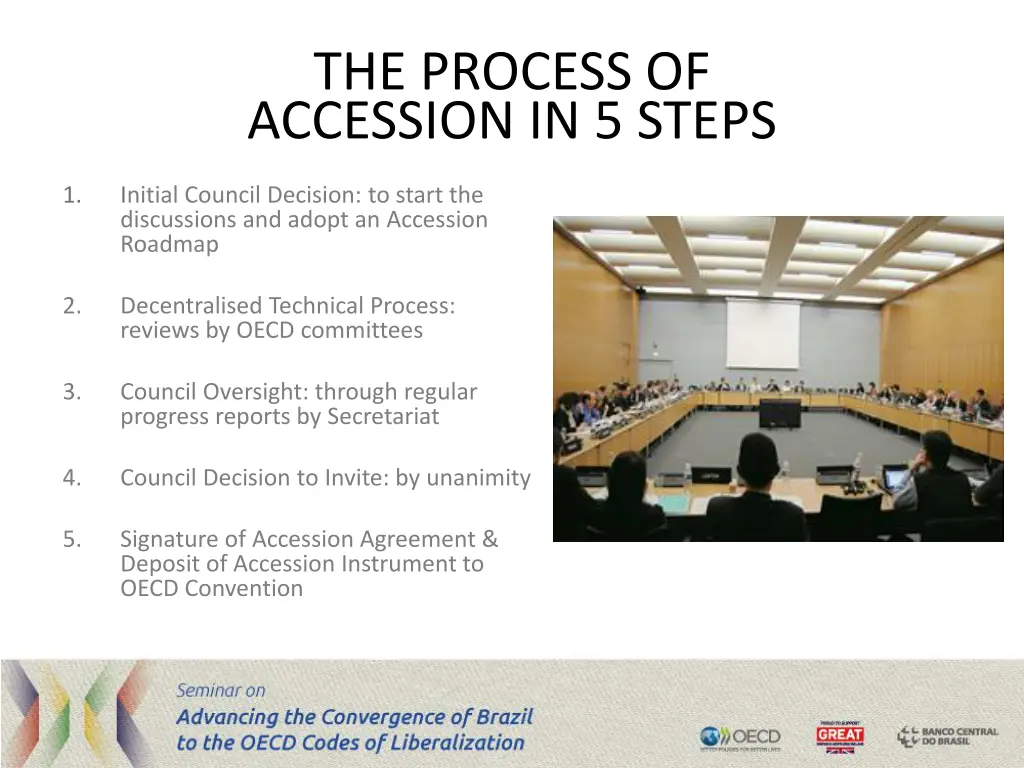
THE PROCESS OF ACCESSION IN 5 STEPS 1. Initial Council Decision: to start the discussions and adopt an Accession Roadmap 2. Decentralised Technical Process: reviews by OECD committees 3. Council Oversight: through regular progress reports by Secretariat 4. Council Decision to Invite: by unanimity 5. Signature of Accession Agreement & Deposit of Accession Instrument to OECD Convention
COMMITTEES TYPICALLY INVOLVED IN REVIEWS Accession Roadmaps are tailored specifically to each accession country and include the list of the approximately 20technical committees that are to perform technical reviews. These typically include the following: Investment Committee Working Group on Bribery in International Business Transactions Corporate Governance Committee Committee on Financial Markets Insurance and Private Pensions Committee Competition Committee Committee on Fiscal Affairs Environment Policy Committee Chemicals Committee Public Governance Committee Regulatory Policy Committee
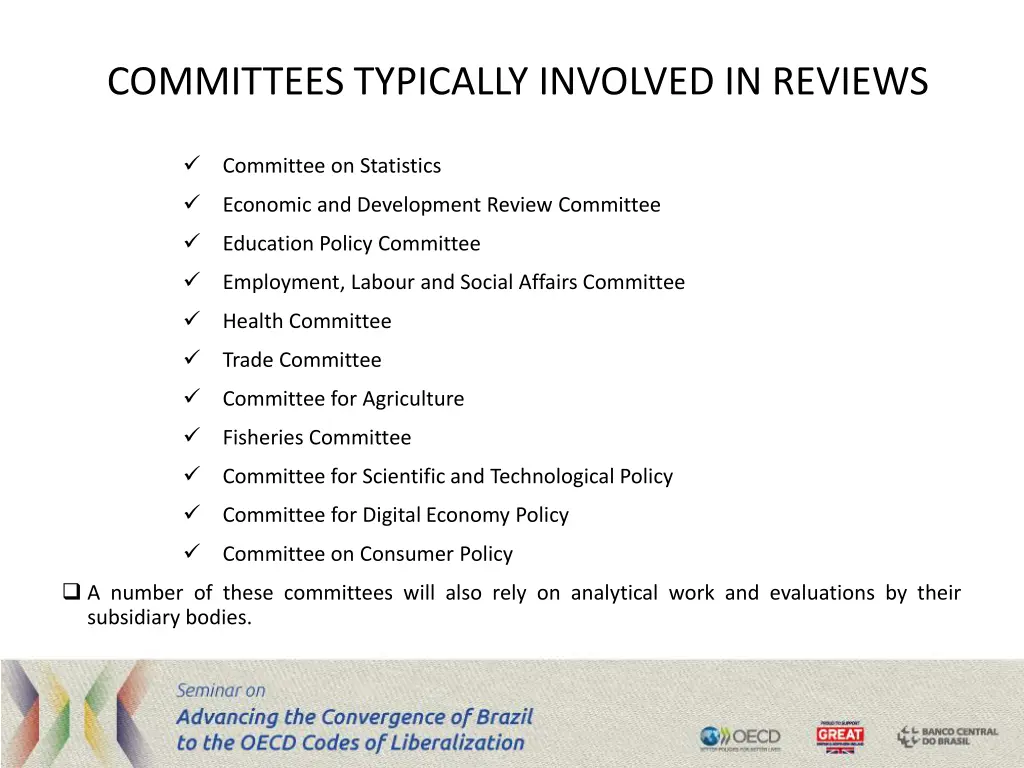
COMMITTEES TYPICALLY INVOLVED IN REVIEWS Committee on Statistics Economic and Development Review Committee Education Policy Committee Employment, Labour and Social Affairs Committee Health Committee Trade Committee Committee for Agriculture Fisheries Committee Committee for Scientific and Technological Policy Committee for Digital Economy Policy Committee on Consumer Policy A number of these committees will also rely on analytical work and evaluations by their subsidiary bodies.
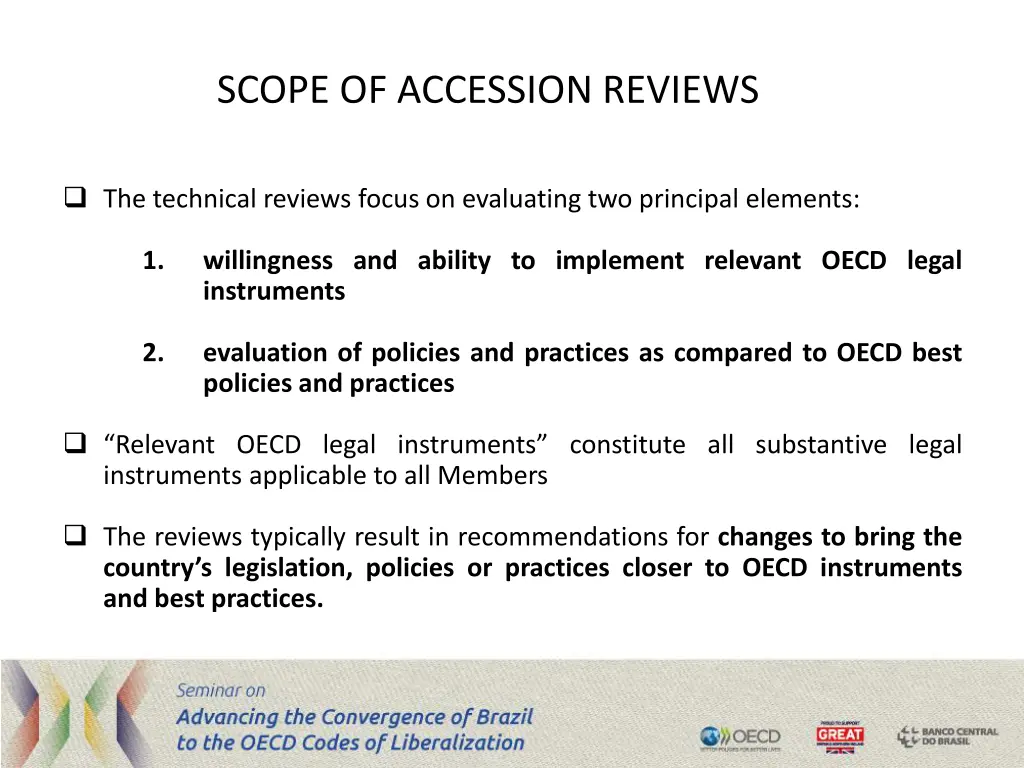
SCOPE OF ACCESSION REVIEWS The technical reviews focus on evaluating two principal elements: 1. willingness and ability to implement relevant OECD legal instruments 2. evaluation of policies and practices as compared to OECD best policies and practices Relevant OECD legal instruments constitute all substantive legal instruments applicable to all Members The reviews typically result in recommendations for changes to bring the country s legislation, policies or practices closer to OECD instruments and best practices.
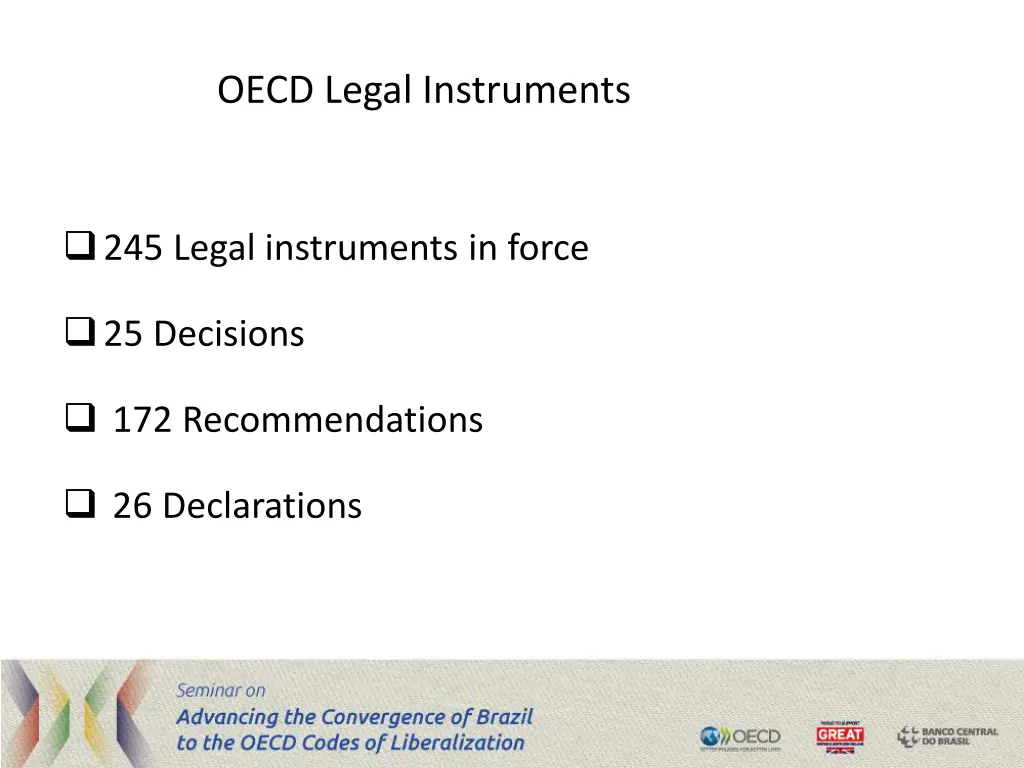
OECD Legal Instruments 245 Legal instruments in force 25 Decisions 172 Recommendations 26 Declarations