Inclusion, Wellbeing & Equalities Professional Learning Framework
This framework aims to support educators in Scotland by enhancing their knowledge about inclusion and equity in education. It includes resources for group learning and self-directed activities, with facilitation notes designed to foster respectful and honest discussions. The framework emphasizes the importance of creating a safe space for reflection on the concepts of inclusion and the responsibilities of all staff in supporting an inclusive educational environment. It aligns with Scotland’s commitment to human rights in education.

Uploaded on Feb 19, 2025 | 0 Views
Download Presentation

Please find below an Image/Link to download the presentation.
The content on the website is provided AS IS for your information and personal use only. It may not be sold, licensed, or shared on other websites without obtaining consent from the author.If you encounter any issues during the download, it is possible that the publisher has removed the file from their server.
You are allowed to download the files provided on this website for personal or commercial use, subject to the condition that they are used lawfully. All files are the property of their respective owners.
The content on the website is provided AS IS for your information and personal use only. It may not be sold, licensed, or shared on other websites without obtaining consent from the author.
E N D
Presentation Transcript
Inclusion Wellbeing & Equalities Professional Learning Framework The Inclusive Scottish Context An Introduction Informed level @ESInclusionTeam For Scotland's learners, with Scotland's educators Do luchd-ionnsachaidh na h-Alba, le luchd-foghlaim Alba For Scotland's learners, with Scotland's educators Do luchd-ionnsachaidh na h-Alba, le luchd-foghlaim Alba
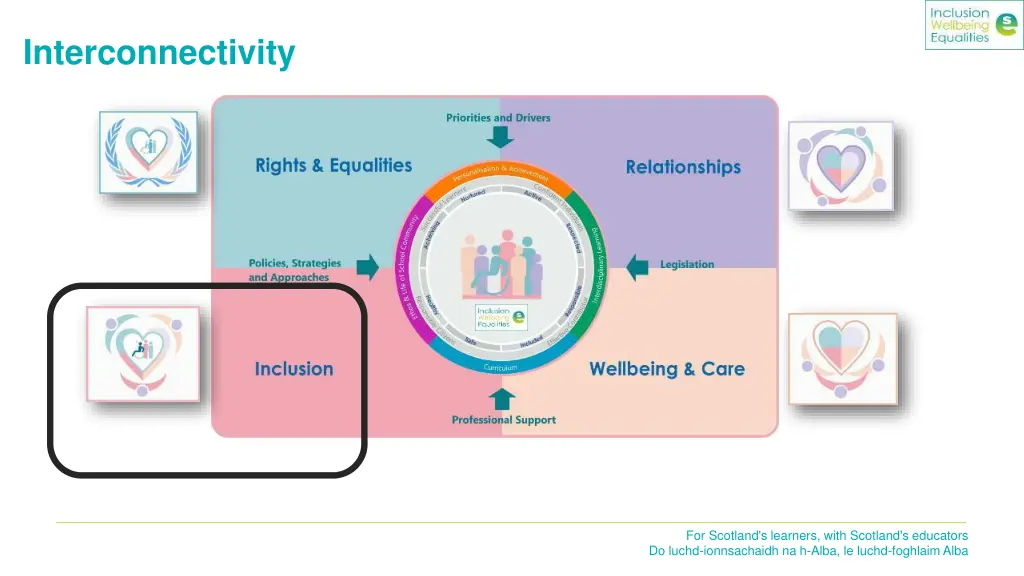
Interconnectivity For Scotland's learners, with Scotland's educators Do luchd-ionnsachaidh na h-Alba, le luchd-foghlaim Alba
How to use this resource These slides can be used to facilitate professional learning in a group or whole-setting, or as a self-directed learning activity as an individual. Facilitation notes are included at the bottom of each slide. Please do not remove or change any of the slides included. Facilitators are welcome to add slides or activities relevant to your own setting, to support discussion and exploration of the topic. Facilitators will know their participants needs best. Anyone who works in an educational setting can be a facilitator and use these slides. For reflection or discussion activities, it is important to establish a safe space which encourages respect and honesty to ensure that everyone is able to participate. For Scotland's learners, with Scotland's educators Do luchd-ionnsachaidh na h-Alba, le luchd-foghlaim Alba
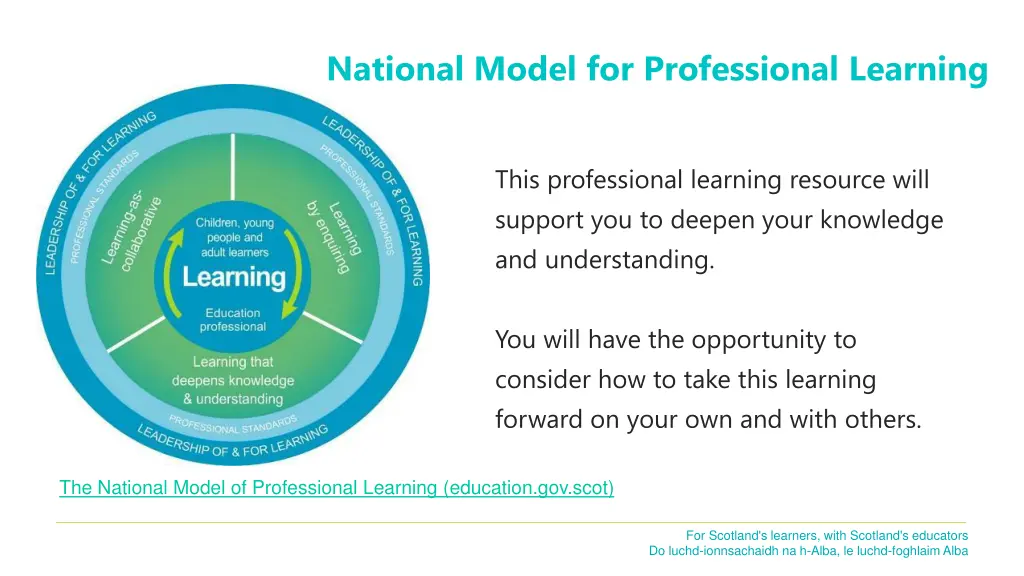
National Model for Professional Learning This professional learning resource will support you to deepen your knowledge and understanding. You will have the opportunity to consider how to take this learning forward on your own and with others. The National Model of Professional Learning (education.gov.scot) For Scotland's learners, with Scotland's educators Do luchd-ionnsachaidh na h-Alba, le luchd-foghlaim Alba
Pause for Thought Welcome This session aims to provide an opportunity to reflect on: What inclusion means to you. The roles and responsibilities of all staff in supporting inclusive education. Your next steps in developing a deeper understanding of inclusion. For Scotland's learners, with Scotland's educators Do luchd-ionnsachaidh na h-Alba, le luchd-foghlaim Alba
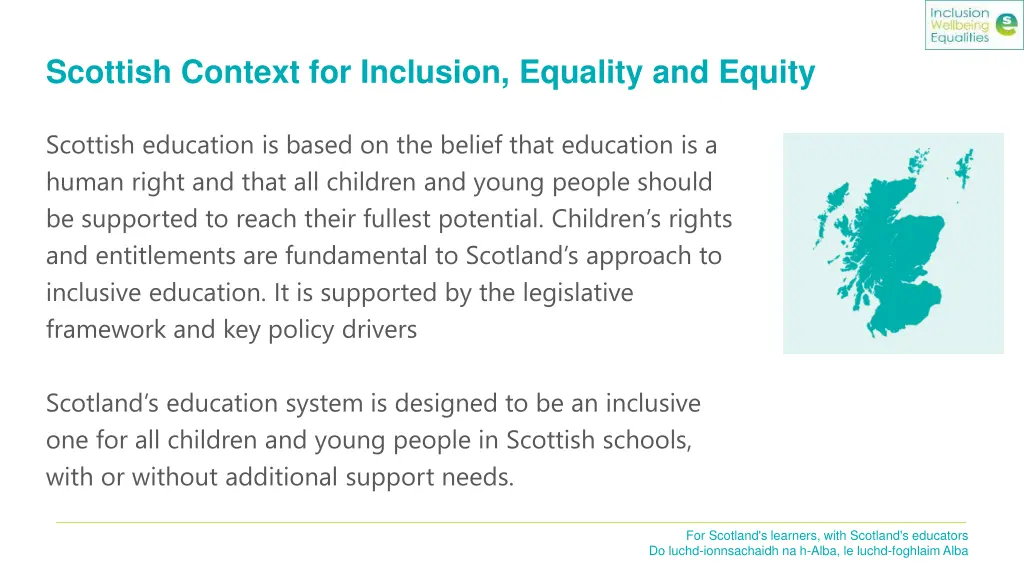
Scottish Context for Inclusion, Equality and Equity Scottish education is based on the belief that education is a human right and that all children and young people should be supported to reach their fullest potential. Children s rights and entitlements are fundamental to Scotland s approach to inclusive education. It is supported by the legislative framework and key policy drivers Scotland s education system is designed to be an inclusive one for all children and young people in Scottish schools, with or without additional support needs. For Scotland's learners, with Scotland's educators Do luchd-ionnsachaidh na h-Alba, le luchd-foghlaim Alba
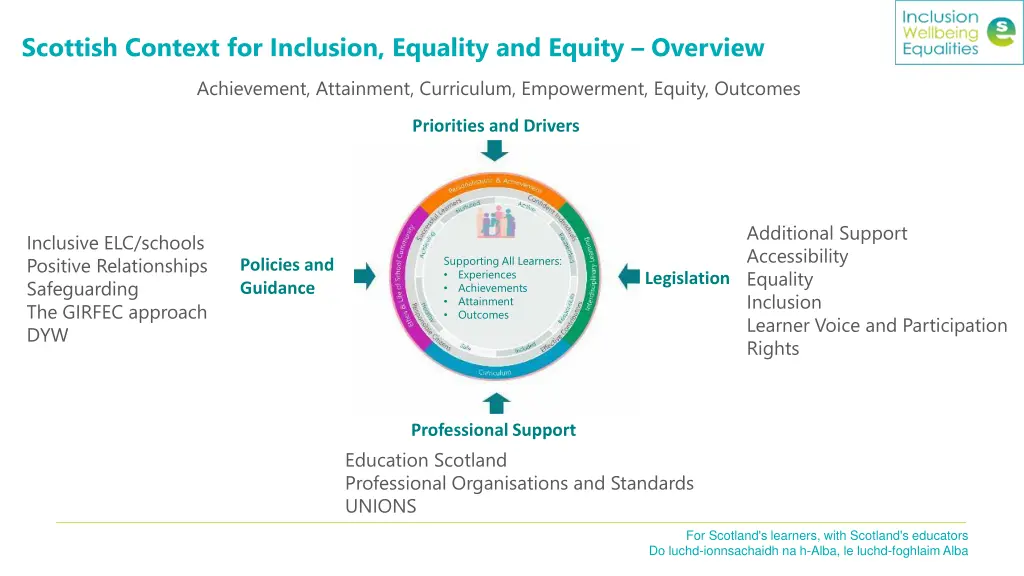
Scottish Context for Inclusion, Equality and Equity Overview Achievement, Attainment, Curriculum, Empowerment, Equity, Outcomes Priorities and Drivers Additional Support Accessibility Equality Inclusion Learner Voice and Participation Rights Inclusive ELC/schools Positive Relationships Safeguarding The GIRFEC approach DYW Supporting All Learners: Experiences Achievements Attainment Outcomes Policies and Guidance Legislation Professional Support Education Scotland Professional Organisations and Standards UNIONS For Scotland's learners, with Scotland's educators Do luchd-ionnsachaidh na h-Alba, le luchd-foghlaim Alba
Supporting all learners Support for all learners begins within the classroom and is provided by the classroom teacher who holds the main responsibility for nurturing, educating and meeting the needs of all learners in their class, working in partnership with support staff to plan, deliver and review curriculum programmes. Learners can display a range of support needs which can result in significantly different profiles and requirements. It is important to realise that the issues children and young people may face do not always fit neatly into categories and it is likely that there are overlapping barriers which are experienced. Parents, carers and children over 12 years old have the legal right to request an assessment and this should be started within 10 weeks of the request. For Scotland's learners, with Scotland's educators Do luchd-ionnsachaidh na h-Alba, le luchd-foghlaim Alba
Inclusion Inclusions means taking positive action and intervening in order to enable achievement for all by building and fulfilling the potential of every child, young person and adult. Curriculum for Excellence was design to be an inclusive curriculum. For Scotland's learners, with Scotland's educators Do luchd-ionnsachaidh na h-Alba, le luchd-foghlaim Alba
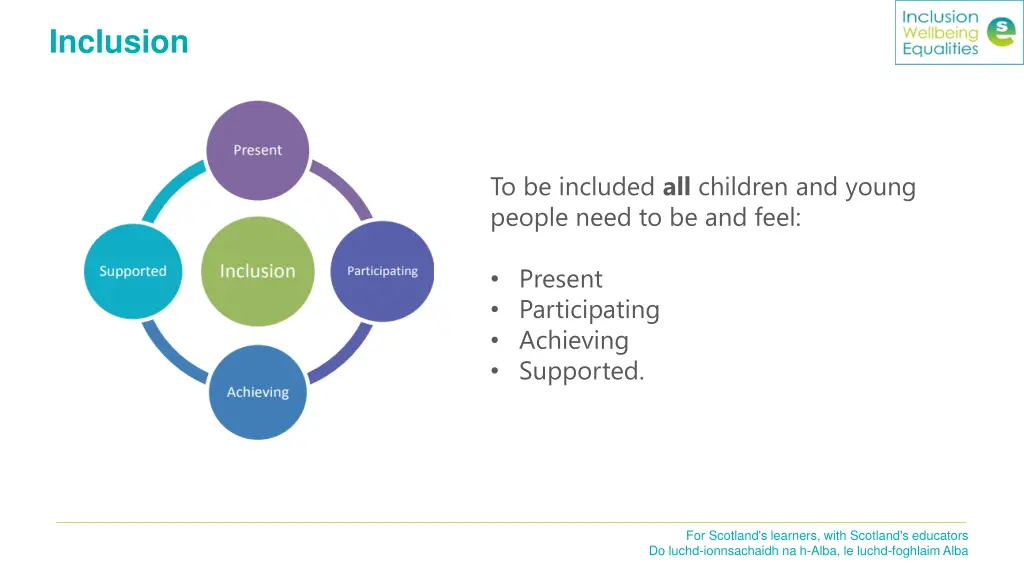
Inclusion To be included all children and young people need to be and feel: Present Participating Achieving Supported. For Scotland's learners, with Scotland's educators Do luchd-ionnsachaidh na h-Alba, le luchd-foghlaim Alba
Equality Equality is described as the removal of discrimination, disadvantage, inequality and / or barriers which can affect people on the grounds of the protected characteristics set out in the Equality Act 2010: age, disability, gender, gender reassignment, pregnancy and maternity, race, religion or belief and sexual orientation. For Scotland's learners, with Scotland's educators Do luchd-ionnsachaidh na h-Alba, le luchd-foghlaim Alba
Equity Equity means treating people fairly, but not necessarily treating people the same. Equity in education means that personal or social circumstances such as gender, ethnic origin or family background are not obstacles to achieving educational potential and that all our young people are well supported to secure wellbeing, skills for learning, life and work and the best possible post-school destination, HGIOS 4 (2016). Equity is generally understood to refer to fairness and impartiality for people in general and sometimes especially relating to fairness for people facing socio- economic disadvantage. For Scotland's learners, with Scotland's educators Do luchd-ionnsachaidh na h-Alba, le luchd-foghlaim Alba
Additional Support Needs Additional Support Needs is the standard terminology used in Scotland when children and young people need more or different - support to what is normally provided in schools or ELC to children of the same age. Additional support is a broad and inclusive term which applies to children or young people who, for whatever reason, require additional support, long or short term, in order to help them make the most of their school education and to be included fully in their learning. For Scotland's learners, with Scotland's educators Do luchd-ionnsachaidh na h-Alba, le luchd-foghlaim Alba
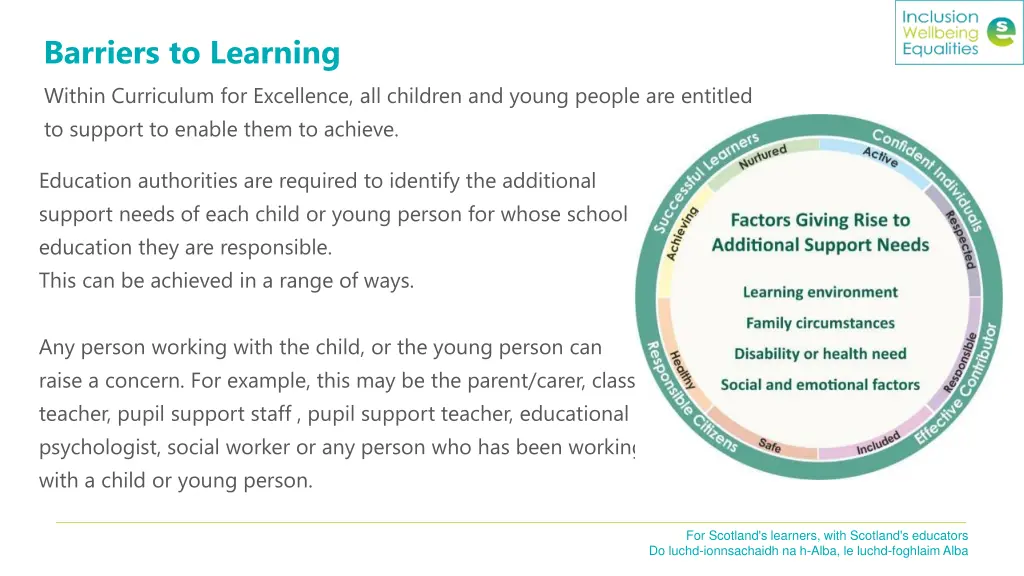
Barriers to Learning Within Curriculum for Excellence, all children and young people are entitled to support to enable them to achieve. Education authorities are required to identify the additional support needs of each child or young person for whose school education they are responsible. This can be achieved in a range of ways. Any person working with the child, or the young person can raise a concern. For example, this may be the parent/carer, class teacher, pupil support staff , pupil support teacher, educational psychologist, social worker or any person who has been working with a child or young person. For Scotland's learners, with Scotland's educators Do luchd-ionnsachaidh na h-Alba, le luchd-foghlaim Alba
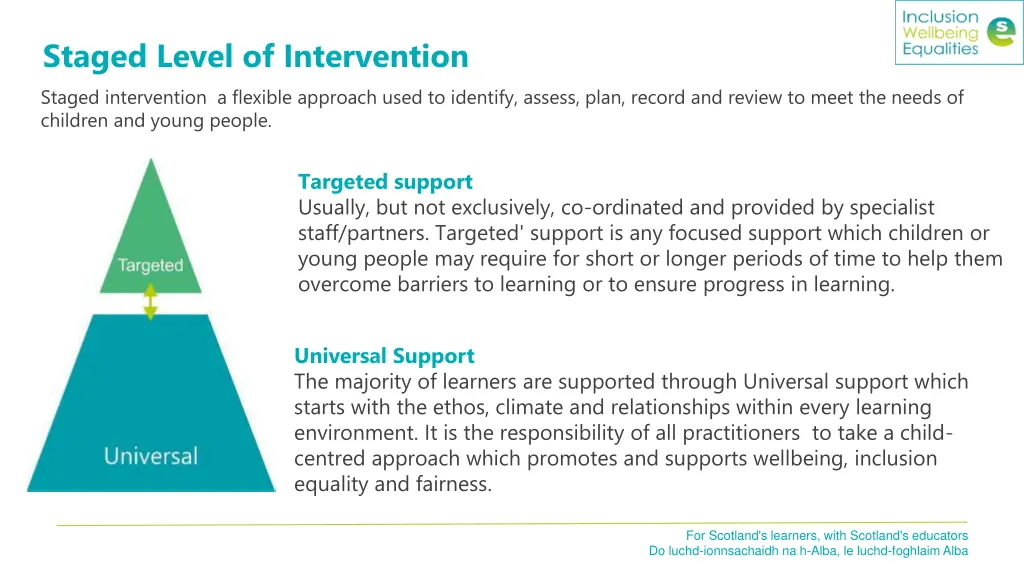
Staged Level of Intervention Staged intervention a flexible approach used to identify, assess, plan, record and review to meet the needs of children and young people. Targeted support Usually, but not exclusively, co-ordinated and provided by specialist staff/partners. Targeted' support is any focused support which children or young people may require for short or longer periods of time to help them overcome barriers to learning or to ensure progress in learning. Universal Support The majority of learners are supported through Universal support which starts with the ethos, climate and relationships within every learning environment. It is the responsibility of all practitioners to take a child- centred approach which promotes and supports wellbeing, inclusion equality and fairness. For Scotland's learners, with Scotland's educators Do luchd-ionnsachaidh na h-Alba, le luchd-foghlaim Alba
Curriculum for Excellence Curriculum for Excellence is an inclusive curriculum from 3 to 18 wherever learning is taking place . Curriculum for Excellence is a world-class example of universal design for learning. Its principles of curriculum design include relevance, personalisation and choice and challenge and enjoyment. At its development stage, special school head teachers and support for learning teachers advised on building experiential learning into the curriculum through experiences and outcomes across its levels. For Scotland's learners, with Scotland's educators Do luchd-ionnsachaidh na h-Alba, le luchd-foghlaim Alba
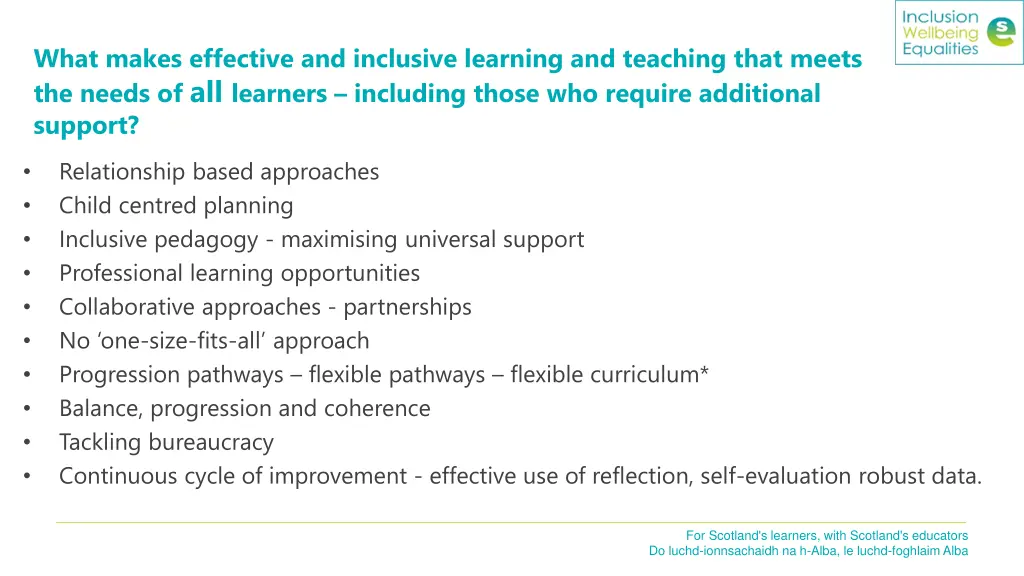
What makes effective and inclusive learning and teaching that meets the needs of all learners including those who require additional support? Relationship based approaches Child centred planning Inclusive pedagogy - maximising universal support Professional learning opportunities Collaborative approaches - partnerships No one-size-fits-all approach Progression pathways flexible pathways flexible curriculum* Balance, progression and coherence Tackling bureaucracy Continuous cycle of improvement - effective use of reflection, self-evaluation robust data. For Scotland's learners, with Scotland's educators Do luchd-ionnsachaidh na h-Alba, le luchd-foghlaim Alba
Reflection From what you have learned so far, think about: How has this made you feel? What has this made you think about? What one action would you like to take forward? How can you link what you plan to do with others in your setting? How you will know that this learning has made a difference? For Scotland's learners, with Scotland's educators Do luchd-ionnsachaidh na h-Alba, le luchd-foghlaim Alba
We value your feedback From now until March 2024 we will be taking feedback on these resources so that we can make changes in advance of a formal launch of the Professional Learning Framework in June 2024 Your feedback could help us improve this resource Please complete this short form, using the link or QR code, to let us know what you thought of it and any suggestions you have on how it could be improved LINK: https://forms.office.com/e/b5PCpJJJ3P For Scotland's learners, with Scotland's educators Do luchd-ionnsachaidh na h-Alba, le luchd-foghlaim Alba
Education Scotland Denholm House Almondvale Business Park Almondvale Way Livingston EH54 6GA T +44 (0)131 244 5000 E enquiries@educationscotland.gsi.gov.uk For Scotland's learners, with Scotland's educators Do luchd-ionnsachaidh na h-Alba, le luchd-foghlaim Alba For Scotland's learners, with Scotland's educators Do luchd-ionnsachaidh na h-Alba, le luchd-foghlaim Alba