Informal Networks in Preventing Domestic Violence
Role of informal networks in preventing domestic violence through societal responses, direct experiences, and examples of engaging programs. Addressing the pervasiveness, costliness, complexity, and preventability of domestic violence, alongside the Shift project's focus on transformational change. Key levers include targeting children, youth, and building healthy relationships to foster cultural norms of non-violence."

Download Presentation

Please find below an Image/Link to download the presentation.
The content on the website is provided AS IS for your information and personal use only. It may not be sold, licensed, or shared on other websites without obtaining consent from the author.If you encounter any issues during the download, it is possible that the publisher has removed the file from their server.
You are allowed to download the files provided on this website for personal or commercial use, subject to the condition that they are used lawfully. All files are the property of their respective owners.
The content on the website is provided AS IS for your information and personal use only. It may not be sold, licensed, or shared on other websites without obtaining consent from the author.
E N D
Presentation Transcript
COVID-19 and Impact on System of Care Practice Bobbi Beale & Rick Shepler Center for Innovative Practices Begun Center for Violence Prevention, Research, and Education Case Western Reserve University Rachel Sorg Clermont County FCFC Contact Information: Richard.shepler@case.edu
The Forgotten Frontline Providers We want to start by saying: Thank you for your service. You are on the frontlines, the first responders, going the extra mile to help families in crisis. None of us have been in this situation before. It is new ground for all of us. Let us know how your program/agency is dealing with the current crisis and the impact on your program.
COVID-19 and System of Care Practice Guidance We have compiled a number of resources that cover a number of topics. Keep in mind that the local agency/county/state is the bottom line decision maker as regards to safe practice. None of the following is meant to countermand any agency expectation or safety guidelines.
Update Memo From Director Criss Regarding Telehealth Services March 18 At this time, there is no guidance specific to behavioral healthcare. Use the guidance found through coronavirus.ohio.gov which links to the CDC and the most up to date information on protecting healthcare workers. We expect that the ODM and OhioMHAS rules and the accompanying Executive Order will be issued imminently. We urge you to begin using telehealth to reach out to the adults and families in your care. Document the decisions you are making with your own policies and protocol, and we will continue to work together to implement the practice and emergency rules once filed. It is vital that you communicate to your community partners and the general public which programs and services remain open in your behavioral healthcare organization. Publish your phone numbers and other contact information. Reach out to current clients through email or by phone. People need to know that behavioral health is open for business.
Office of Civil Rights (OCR), Health and Human Services (HHS) OCR will exercise its enforcement discretion and will not impose penalties for noncompliance with the regulatory requirements under the HIPAA Rules against covered health care providers in connection with the good faith provision of telehealth during the COVID-19 nationwide public health emergency. This notification is effective immediately (March 17, 2020). https://www.hhs.gov/hipaa/for-professionals/special-topics/emergency- preparedness/notification-enforcement-discretion-telehealth/index.html
OCR Emergency Notice Allows Covered health care providers may use popular applications that allow for video chats, to provide telehealth without risk that OCR might seek to impose a penalty for noncompliance with the HIPAA Rules related to the good faith provision of telehealth during the COVID-19 nationwide public health emergency including: Apple FaceTime, Facebook Messenger video chat, Google Hangouts video, or Skype, Providers are encouraged to notify patients that these third-party applications potentially introduce privacy risks, and providers should enable all available encryption and privacy modes when using such applications
Notification of Enforcement Discretion for telehealth remote communications during the COVID-19 nationwide public health emergency (OCR,HHS) A covered health care provider that wants to use audio or video communication technology to provide telehealth to patients during the COVID-19 nationwide public health emergency can use any non-public facing remote communication product that is available to communicate with patients. OCR is exercising its enforcement discretion to not impose penalties for noncompliance with the HIPAA Rules in connection with the good faith provision of telehealth using such non-public facing audio or video communication products during the COVID-19 nationwide public health emergency. This exercise of discretion applies to telehealth provided for any reason, regardless of whether the telehealth service is related to the diagnosis and treatment of health conditions related to COVID-19.
HIPAA Compliant Options of Non-Public Facing Telehealth Options Skype for Business Updox VSee Zoom for Healthcare Doxy.me Google G Suite Hangouts Meet
BAAs with Video Communication Vendors Under this Notice, however, OCR will not impose penalties against covered health care providers for the lack of a BAA with video communication vendors or any other noncompliance with the HIPAA Rules that relates to the good faith provision of telehealth services during the COVID-19 nationwide public health emergency.
Public Facing Under this Notice, however, Facebook Live, Twitch, TikTok, and similar video communication applications are public facing, and should not be used in the provision of telehealth by covered health care providers.
Office for Civil Rights, U.S. Department of Health and Human Services BULLETIN: HIPAA Privacy and Novel Coronavirus Stigma and COVID-19 Please keep in mind our obligations to protect personal health information The HIPAA Privacy Rule protects the privacy of patient s health information but is balanced to ensure that appropriate uses and disclosures of the information still may be made when necessary to treat a patient, to protect the nation s public health, and for other critical purposes. https://www.hhs.gov/sites/default/files/february-2020-hipaa-and-novel- coronavirus.pdf
What is everyone doing? Concerns Review safety precautions people are taking Creative Ideas
Practice Adaptations Change the modality not the help Balancing helping with worker and family safety Maximize the use of telehealth to conduct services Two types of adaptations: Hubbed meeting: provider runs meeting from the family s home with other participants joining the meeting via videoconferencing Fully remotely facilitated meeting
Remotely Facilitated Child and Family Team Meetings Utilize a videoconferencing modality that allows for video or phone participation options Ask participants to utilize the video option if they have access to it Review any new ground rules for telehealth meeting Revise agency Consent for services to include Telehealth modality Plan for possible disconnection during videoconference session (Do I call you? Do we end? Back up technology?). Have family s phone number & confirm at beginning.
Facilitation Challenges to Remotely Provided Wraparound/Service Coordination Meetings Establishing and maintaining relationship, engagement, connections remotely Facilitating and structuring interactions Need for increased facilitator activity: increased clarifications; additional prompting to establish shared understanding; consensus building etc.
New Content Focus Areas Help people stay connected/feel a sense of connection in a world of social distancing. Help the family feel that they are not alone. Give the youth and family hope to get through the next few weeks/months Learn about new family strengths that are uncovered at the time of an external crisis Opportunities: to create new routines; family activity time etc. Address any changes in youth and family s support system Anticipating emotional and guidance support and help needs Understand that families may also be in a financial crisis. So it is important to assess for basic need issues that arise.
Home Visit Safety Recommendations Home Visit Safety Recommendations Consider alternatives to in-person meetings. See telehealth guidelines from OhioMHAS (under resources) If you and your agency decide to do a home-visit, do screening calls before you visit, asking about health issues, particularly fever, cough, and/or shortness of breath. Respect family s preferences about people coming into their home during the crisis. Ask them what they are comfortable with. Pre-structure new safety protocols and procedures with family. Emphasize that this is for their safety/mutual protection. Wash your hands as frequently as is possible throughout the day.
Protect the Family Protect the Family Before entering the home: Disinfect whatever items you are taking into the home. Use hand sanitizer prior to entering the home. Use a disinfectant spray on the soles of your shoes prior to entering the family s home.
Protect Yourself Protect Yourself During the Home Visit: Conduct sessions in areas of the home that allow 6-foot distancing between you and family. If someone appears ill with COVID-19 symptoms, politely leave/reschedule. If the home environment does not allow enough space for 6-foot distancing between you and family consider an outdoor location. Avoid touching surfaces as much as possible.
Before you enter your car after a visit Before you enter your car after a visit Use hand sanitizers prior to entering your car. Disinfect whatever items you took into the family s homes (Lysol spray or wipes) before placing them back in the car. Use a disinfectant spray on the soles of your shoes before re-entering your car.
Before you enter your home Before you enter your home Wash your hands immediately. When you get home, disinfect the inside of your car with a disinfectant spray. Take your shoes off before entering your home. Re-spray the soles of your shoes. Disinfect items used during the day: phone, computer, pens, etc.. Alternatively place them in a plastic garbage bag for cleaning prior to bringing into your home. Follow your agency and state guidelines and recommendations. Follow CDC guidance about sanitary procedures to prevent the spread of the virus, and to maintain personal health (see CDC resource below)
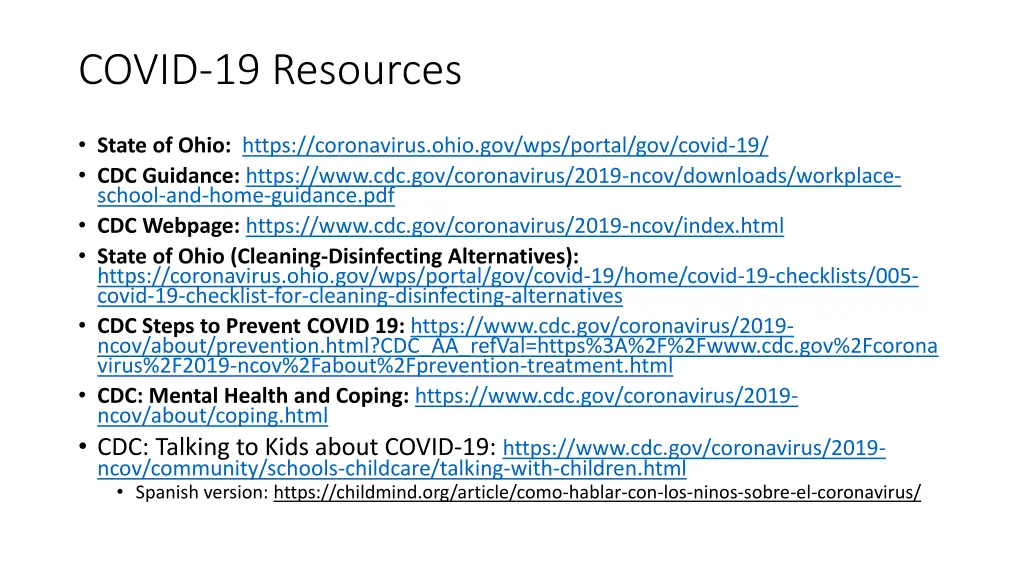
COVID-19 Resources State of Ohio: https://coronavirus.ohio.gov/wps/portal/gov/covid-19/ CDC Guidance: https://www.cdc.gov/coronavirus/2019-ncov/downloads/workplace- school-and-home-guidance.pdf CDC Webpage: https://www.cdc.gov/coronavirus/2019-ncov/index.html State of Ohio (Cleaning-Disinfecting Alternatives): https://coronavirus.ohio.gov/wps/portal/gov/covid-19/home/covid-19-checklists/005- covid-19-checklist-for-cleaning-disinfecting-alternatives CDC Steps to Prevent COVID 19: https://www.cdc.gov/coronavirus/2019- ncov/about/prevention.html?CDC_AA_refVal=https%3A%2F%2Fwww.cdc.gov%2Fcorona virus%2F2019-ncov%2Fabout%2Fprevention-treatment.html CDC: Mental Health and Coping: https://www.cdc.gov/coronavirus/2019- ncov/about/coping.html CDC: Talking to Kids about COVID-19: https://www.cdc.gov/coronavirus/2019- ncov/community/schools-childcare/talking-with-children.html Spanish version: https://childmind.org/article/como-hablar-con-los-ninos-sobre-el-coronavirus/