Innovation Activities and Learning Processes in Crisis: Evidence from Italian Trade
Explore how innovation activities and learning processes have impacted international and interregional trade in Italy during times of crisis. The research delves into the evolving focus on firms and products in international trade studies, emphasizing the role of innovation in firm success and export growth. Theoretical foundations and empirical evidence are combined to showcase the transformative effects of innovative practices on trade outcomes.

Download Presentation

Please find below an Image/Link to download the presentation.
The content on the website is provided AS IS for your information and personal use only. It may not be sold, licensed, or shared on other websites without obtaining consent from the author. If you encounter any issues during the download, it is possible that the publisher has removed the file from their server.
You are allowed to download the files provided on this website for personal or commercial use, subject to the condition that they are used lawfully. All files are the property of their respective owners.
The content on the website is provided AS IS for your information and personal use only. It may not be sold, licensed, or shared on other websites without obtaining consent from the author.
E N D
Presentation Transcript
Innovation activities and learning processes in the crisis. Evidence from Italian international and interregional trade in manufacturing and services Emanuela Marrocu e Stefano Usai University of Cagliari and CRENoS Raffaele Brancati, Manuel Romagnoli MET-Economia SIE - SIEPI session Napoli, 24 ottobre 2015
Motivation / 1 Research in international trade has changed dramatically over the past fifteen years as its focus has shifted from industries and countries to firms and products. This transformation was instigated by the emergence of a wide range of micro-datasets exhibiting sharp variation in firm outcomes and attributes, even within narrow industries. Models developed in reaction to this challenge both rationalize this heterogeneity and offer new insight into the ways in which economies respond to international trade... (Bernard et al., 2012).
Motivation / 2 Export is an issue of self-selection: exporters are more productive because only the most productive firms are able to overcome the sunk costs of entering export markets. The most successful model of such selection is the seminal Melitz (2003) model, which has dominated recent research in the field. Many research show that exporting firms are not only more productive but also larger, more skill intensive, more innovative In particular, the positive association between a firm s export status and its innovation can be considered as a strong empirical regularity in both international economics and the economics of innovation: a wide consensus has been reached on the fact that firms introducing innovations are ex-post more likely to export. Evidence for learning to export (especially inter-regionally) and on the importance of other learning phenomena related to regional and sectoral spillovers is sparser and not conclusive.
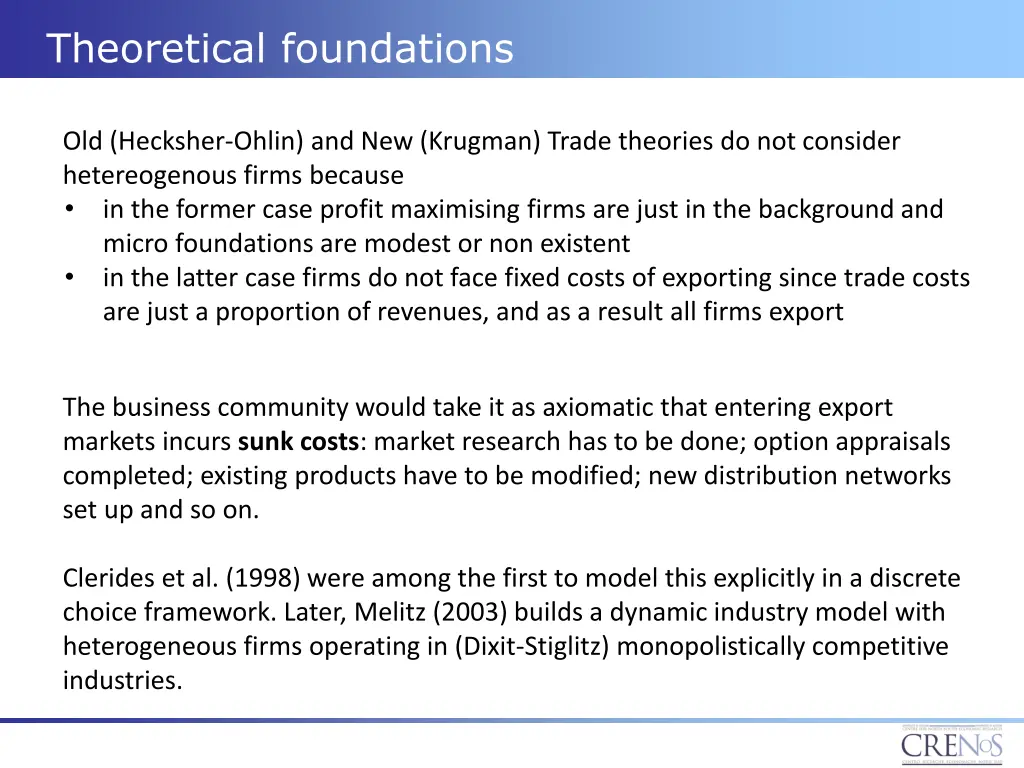
Theoretical foundations Old (Hecksher-Ohlin) and New (Krugman) Trade theories do not consider hetereogenous firms because in the former case profit maximising firms are just in the background and micro foundations are modest or non existent in the latter case firms do not face fixed costs of exporting since trade costs are just a proportion of revenues, and as a result all firms export The business community would take it as axiomatic that entering export markets incurs sunk costs: market research has to be done; option appraisals completed; existing products have to be modified; new distribution networks set up and so on. Clerides et al. (1998) were among the first to model this explicitly in a discrete choice framework. Later, Melitz (2003) builds a dynamic industry model with heterogeneous firms operating in (Dixit-Stiglitz) monopolistically competitive industries.
Melitz (2003) Melitz (2003) builds a dynamic industry model with heterogeneous firms operating in (Dixit-Stiglitz) monopolistically competitive industries. Firms incur a fixed cost to export. However, each has to make a productivity draw from an exogenous distribution which determines whether they produce and export, and an endogenously determined productivity threshold determines who does and does not export. The interaction of these raises industry productivity. First, there is a rationalisation effect. Exporting increases expected profit, which induces entry, pushes up the productivity threshold for survival and drives out the least efficient firms. Clearly this raises average industry productivity. Second, exporting allows the most productive firms to expand and causes less productive firms to contract
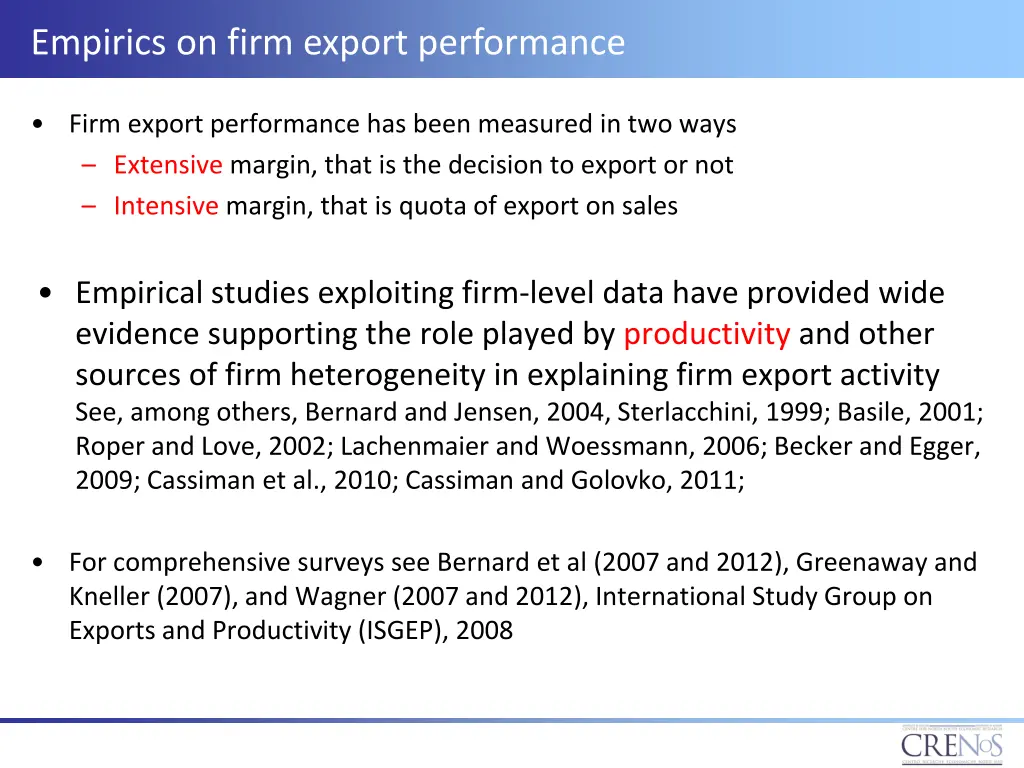
Empirics on firm export performance Firm export performance has been measured in two ways Extensive margin, that is the decision to export or not Intensive margin, that is quota of export on sales Empirical studies exploiting firm-level data have provided wide evidence supporting the role played by productivity and other sources of firm heterogeneity in explaining firm export activity See, among others, Bernard and Jensen, 2004, Sterlacchini, 1999; Basile, 2001; Roper and Love, 2002; Lachenmaier and Woessmann, 2006; Becker and Egger, 2009; Cassiman et al., 2010; Cassiman and Golovko, 2011; For comprehensive surveys see Bernard et al (2007 and 2012), Greenaway and Kneller (2007), and Wagner (2007 and 2012), International Study Group on Exports and Productivity (ISGEP), 2008
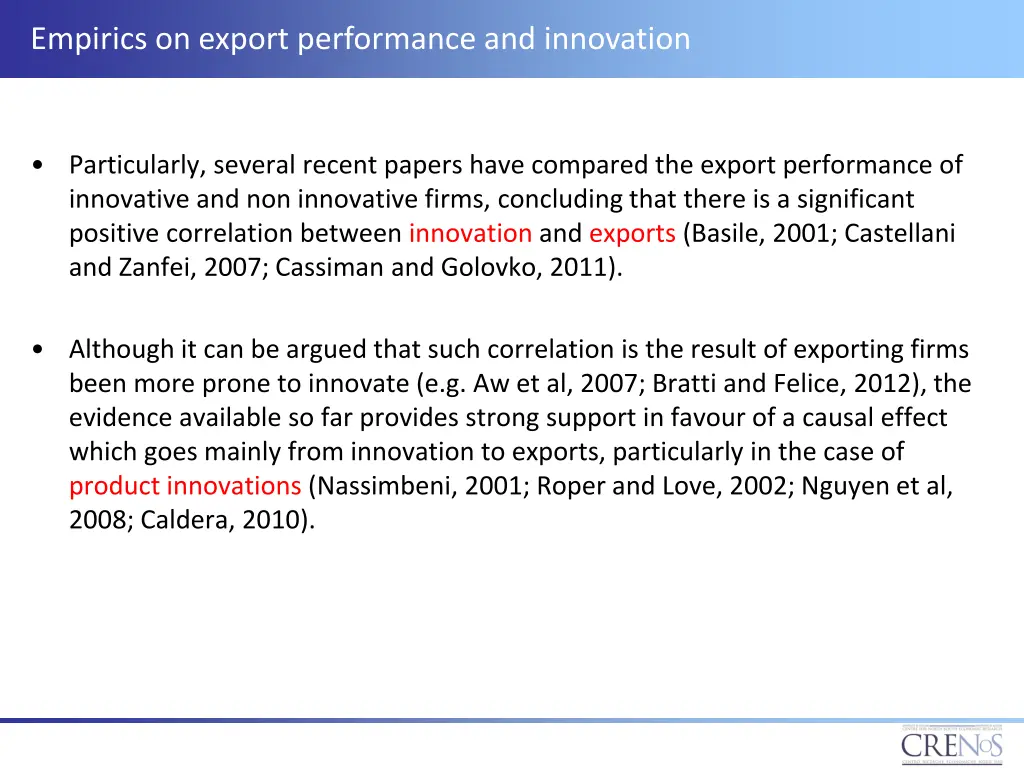
Empirics on export performance and innovation Particularly, several recent papers have compared the export performance of innovative and non innovative firms, concluding that there is a significant positive correlation between innovation and exports (Basile, 2001; Castellani and Zanfei, 2007; Cassiman and Golovko, 2011). Although it can be argued that such correlation is the result of exporting firms been more prone to innovate (e.g. Aw et al, 2007; Bratti and Felice, 2012), the evidence available so far provides strong support in favour of a causal effect which goes mainly from innovation to exports, particularly in the case of product innovations (Nassimbeni, 2001; Roper and Love, 2002; Nguyen et al, 2008; Caldera, 2010).
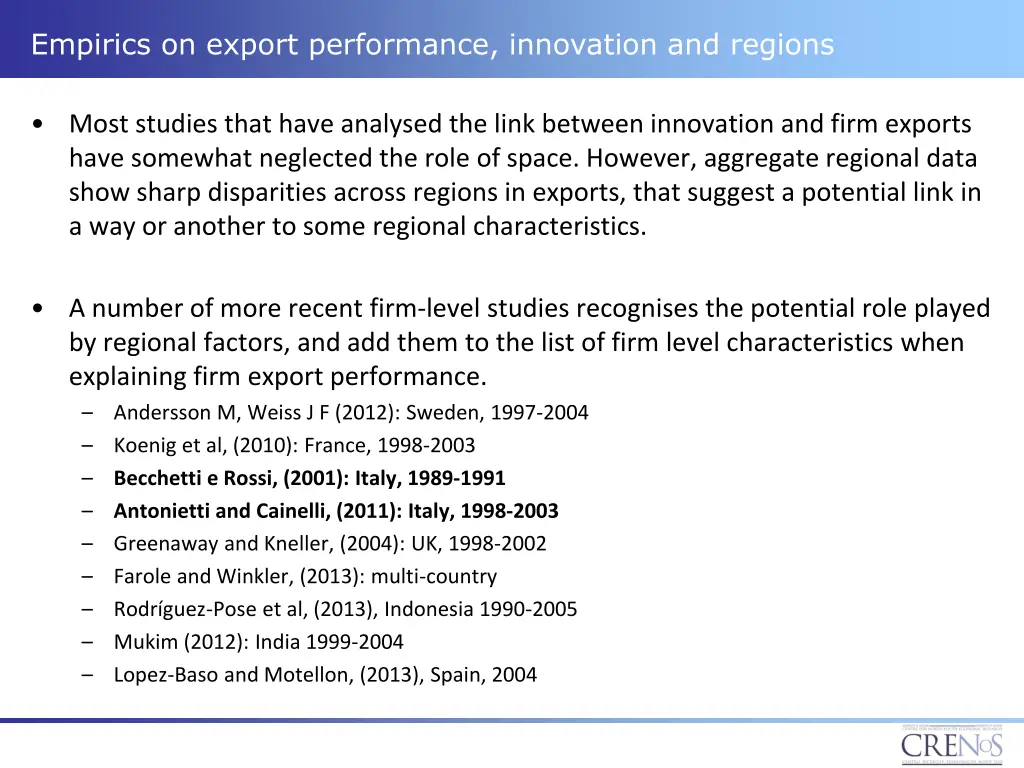
Empirics on export performance, innovation and regions Most studies that have analysed the link between innovation and firm exports have somewhat neglected the role of space. However, aggregate regional data show sharp disparities across regions in exports, that suggest a potential link in a way or another to some regional characteristics. A number of more recent firm-level studies recognises the potential role played by regional factors, and add them to the list of firm level characteristics when explaining firm export performance. Andersson M, Weiss J F (2012): Sweden, 1997-2004 Koenig et al, (2010): France, 1998-2003 Becchetti e Rossi, (2001): Italy, 1989-1991 Antonietti and Cainelli, (2011): Italy, 1998-2003 Greenaway and Kneller, (2004): UK, 1998-2002 Farole and Winkler, (2013): multi-country Rodr guez-Pose et al, (2013), Indonesia 1990-2005 Mukim (2012): India 1999-2004 Lopez-Baso and Motellon, (2013), Spain, 2004
Becchetti and Rossi, 2001 Using a sample composed of over 3,800 manufacturing firms drawn from the Mediocredito Centrale database (more than 11 employees) for the period 1989 1991, find that spatial agglomeration, captured by localization within the boundary of an industrial district, increases average export intensity by 4% points. Tobit estimates show that geographical agglomeration significantly increases export intensity and export participation. The result is robust when controlled for firm size, sector and geographical areas and for the separate and positive effects of export subsidies and export consortia on export intensity.
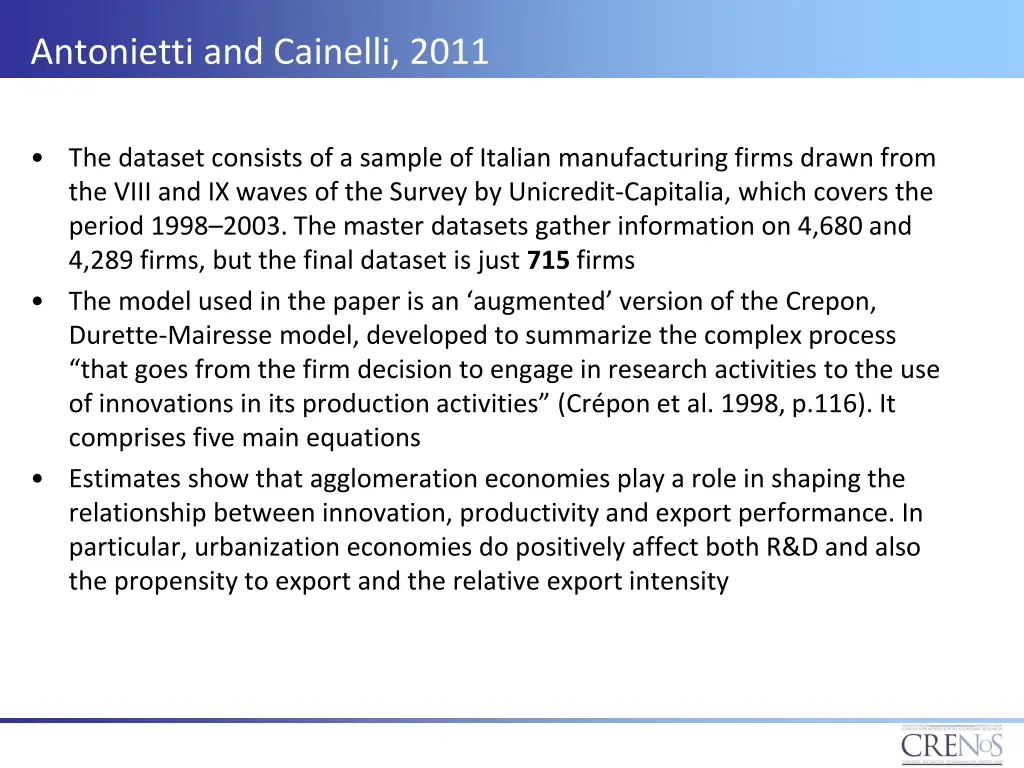
Antonietti and Cainelli, 2011 The dataset consists of a sample of Italian manufacturing firms drawn from the VIII and IX waves of the Survey by Unicredit-Capitalia, which covers the period 1998 2003. The master datasets gather information on 4,680 and 4,289 firms, but the final dataset is just 715 firms The model used in the paper is an augmented version of the Crepon, Durette-Mairesse model, developed to summarize the complex process that goes from the firm decision to engage in research activities to the use of innovations in its production activities (Cr pon et al. 1998, p.116). It comprises five main equations Estimates show that agglomeration economies play a role in shaping the relationship between innovation, productivity and export performance. In particular, urbanization economies do positively affect both R&D and also the propensity to export and the relative export intensity
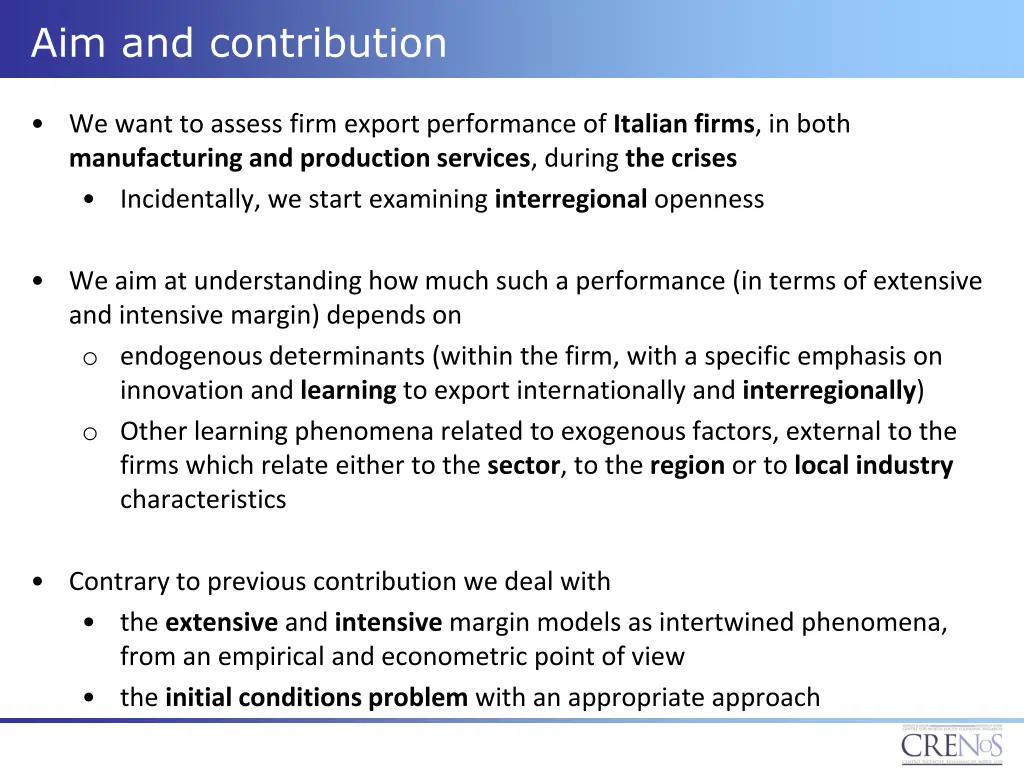
Aim and contribution We want to assess firm export performance of Italian firms, in both manufacturing and production services, during the crises Incidentally, we start examining interregional openness We aim at understanding how much such a performance (in terms of extensive and intensive margin) depends on o endogenous determinants (within the firm, with a specific emphasis on innovation and learning to export internationally and interregionally) o Other learning phenomena related to exogenous factors, external to the firms which relate either to the sector, to the region or to local industry characteristics Contrary to previous contribution we deal with the extensive and intensive margin models as intertwined phenomena, from an empirical and econometric point of view the initial conditions problem with an appropriate approach
Dataset / 1 We focus on the Italian case thanks to a new database (the MET survey) which has collected information at the firm level in four waves, every two years, since 2007 The MET survey is designed to focus on firms structure and strategies (in particular R&D and innovation activities, the internationalisation process and network phenomena) as well as on their financial aspects. Population: All italian firms in industrial sector (manufacturing, energy, mining) and production services (except finance and insurance, real estate, transportation for private consumption). It includes data on micro and family firms Stratification criteria: Firm s dimension (4 classes 1-9, 10-49, 50-249, 250<); Regions (20 regions); Sectors (12 sectors in the manufacturing industry); Methodology: CATI (Computer Assisted Telephone Interview); CAWI (Computer Assisted Web Interview);
Dataset / 2 Since we want to explain current performance with past determinants, firms have to appear at least in two consecutive years to be included in our analysis MET data have been merged with CRIBIS data to collect information on some important financial and economic indicators available in balance sheets. MET-firms Two-period panel Merge with CRIBIS 2007 24,896 2009 22,340 11,549 6,016 2011 25,090 13,901 5,797 2013 25,000 10,537 4,728 The final sample for our analysis thus consists of 16,541 firms
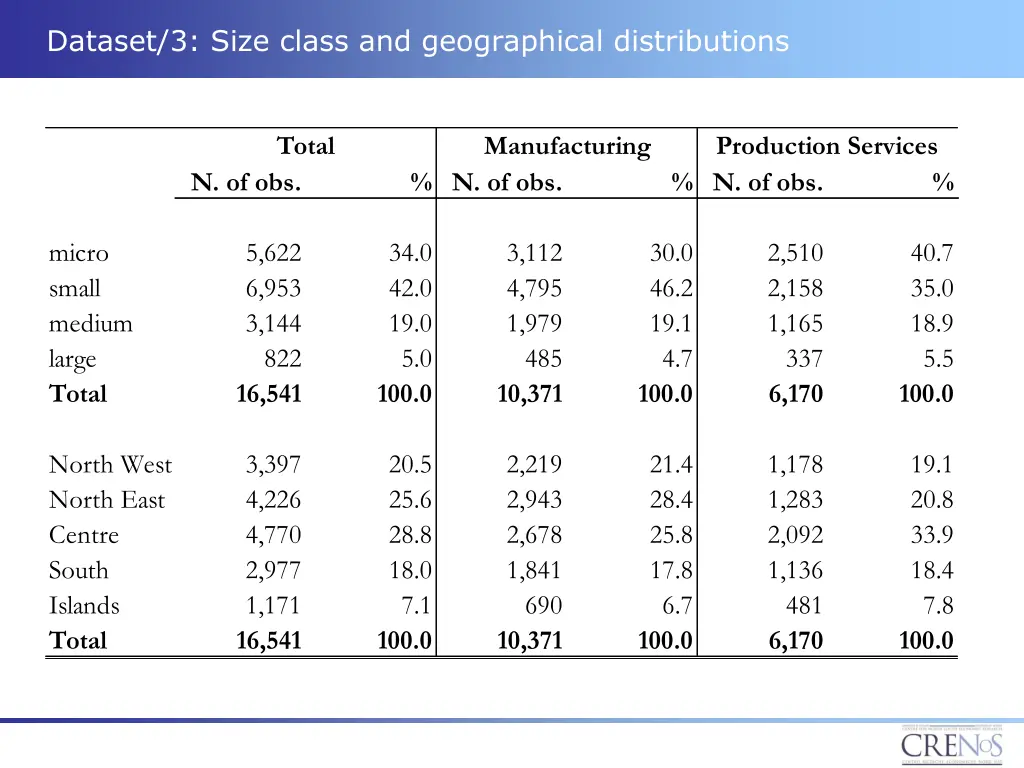
Dataset/3: Size class and geographical distributions Total Manufacturing Production Services N. of obs. % N. of obs. % N. of obs. % micro small medium large Total 5,622 6,953 3,144 822 16,541 34.0 42.0 19.0 5.0 100.0 3,112 4,795 1,979 485 10,371 30.0 46.2 19.1 4.7 100.0 2,510 2,158 1,165 337 6,170 40.7 35.0 18.9 5.5 100.0 North West North East Centre South Islands Total 3,397 4,226 4,770 2,977 1,171 16,541 20.5 25.6 28.8 18.0 7.1 100.0 2,219 2,943 2,678 1,841 690 10,371 21.4 28.4 25.8 17.8 6.7 100.0 1,178 1,283 2,092 1,136 481 6,170 19.1 20.8 33.9 18.4 7.8 100.0
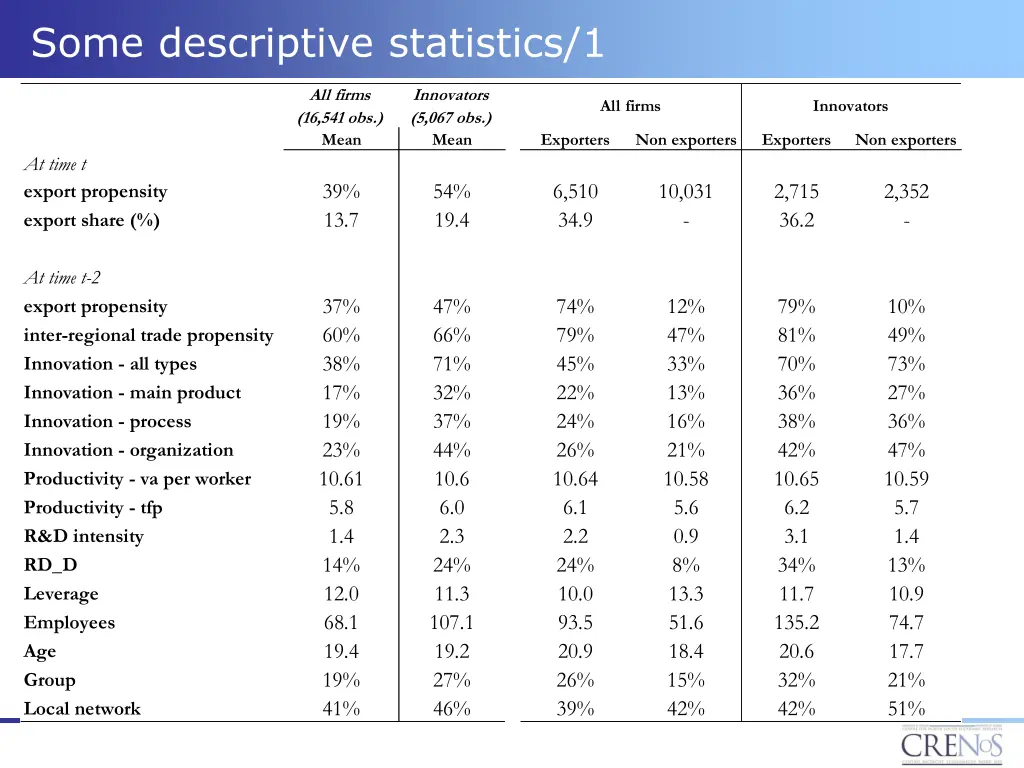
Some descriptive statistics/1 All firms (16,541 obs.) Mean Innovators (5,067 obs.) Mean All firms Innovators Exporters Non exporters Exporters Non exporters At time t export propensity export share (%) 39% 13.7 54% 19.4 6,510 34.9 10,031 - 2,715 36.2 2,352 - At time t-2 export propensity inter-regional trade propensity Innovation - all types Innovation - main product Innovation - process Innovation - organization Productivity - va per worker Productivity - tfp R&D intensity RD_D Leverage Employees Age Group Local network 37% 60% 38% 17% 19% 23% 10.61 5.8 1.4 14% 12.0 68.1 19.4 19% 41% 47% 66% 71% 32% 37% 44% 10.6 6.0 2.3 24% 11.3 107.1 19.2 27% 46% 74% 79% 45% 22% 24% 26% 10.64 6.1 2.2 24% 10.0 93.5 20.9 26% 39% 12% 47% 33% 13% 16% 21% 10.58 5.6 0.9 8% 13.3 51.6 18.4 15% 42% 79% 81% 70% 36% 38% 42% 10.65 6.2 3.1 34% 11.7 135.2 20.6 32% 42% 10% 49% 73% 27% 36% 47% 10.59 5.7 1.4 13% 10.9 74.7 17.7 21% 51%
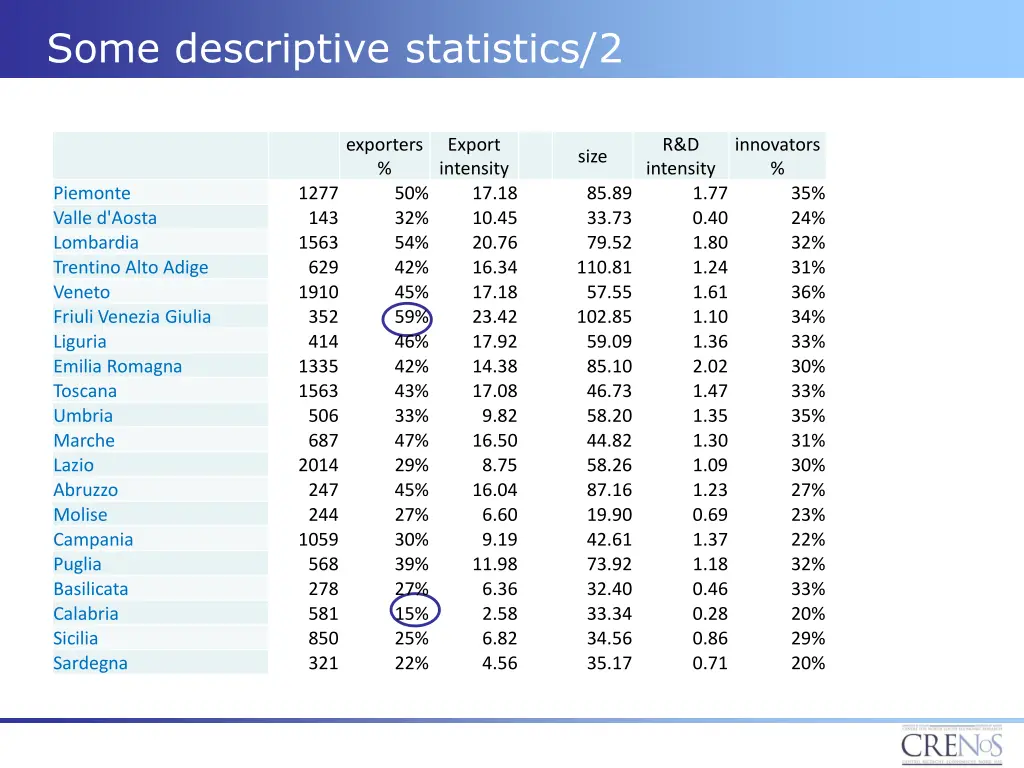
Some descriptive statistics/2 exporters % Export intensity 17.18 10.45 20.76 16.34 17.18 23.42 17.92 14.38 17.08 R&D intensity innovators % size Piemonte Valle d'Aosta Lombardia Trentino Alto Adige Veneto Friuli Venezia Giulia Liguria Emilia Romagna Toscana Umbria Marche Lazio Abruzzo Molise Campania Puglia Basilicata Calabria Sicilia Sardegna 1277 143 1563 629 1910 352 414 1335 1563 506 687 2014 247 244 1059 568 278 581 850 321 50% 32% 54% 42% 45% 59% 46% 42% 43% 33% 47% 29% 45% 27% 30% 39% 27% 15% 25% 22% 85.89 33.73 79.52 110.81 57.55 102.85 59.09 85.10 46.73 58.20 44.82 58.26 87.16 19.90 42.61 73.92 32.40 33.34 34.56 35.17 1.77 0.40 1.80 1.24 1.61 1.10 1.36 2.02 1.47 1.35 1.30 1.09 1.23 0.69 1.37 1.18 0.46 0.28 0.86 0.71 35% 24% 32% 31% 36% 34% 33% 30% 33% 35% 31% 30% 27% 23% 22% 32% 33% 20% 29% 20% 9.82 16.50 8.75 16.04 6.60 9.19 11.98 6.36 2.58 6.82 4.56
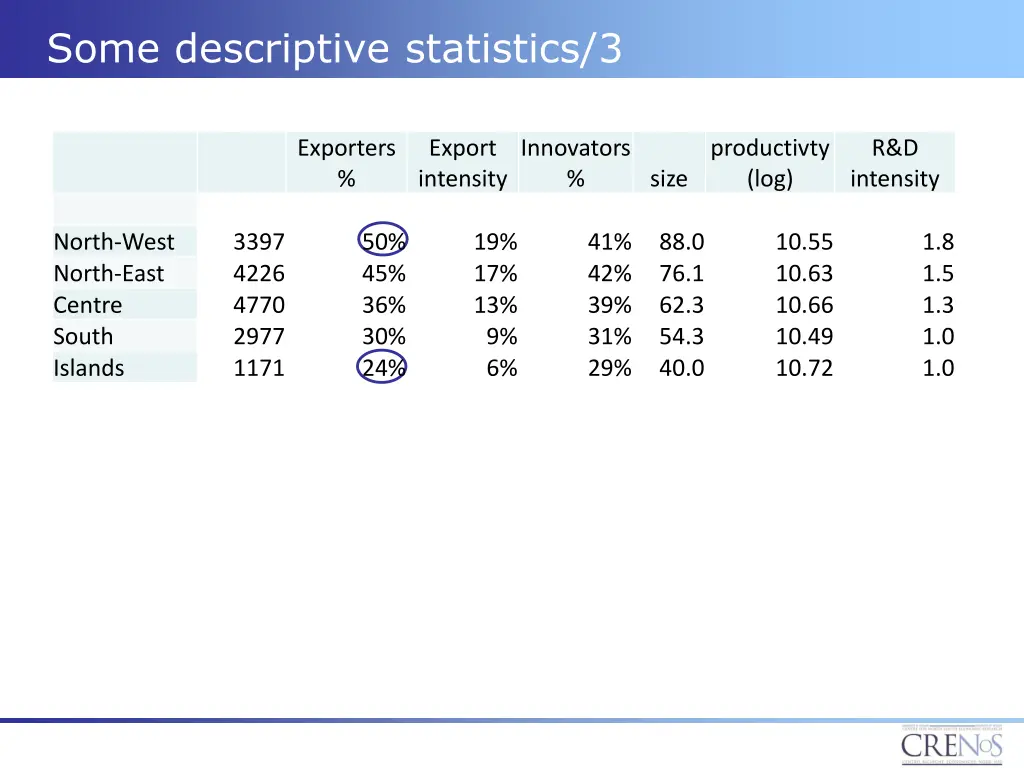
Some descriptive statistics/3 Exporters % Export intensity Innovators % productivty (log) R&D intensity size North-West North-East Centre South Islands 3397 4226 4770 2977 1171 50% 45% 36% 30% 24% 19% 17% 13% 9% 6% 41% 42% 39% 31% 29% 88.0 76.1 62.3 54.3 40.0 10.55 10.63 10.66 10.49 10.72 1.8 1.5 1.3 1.0 1.0
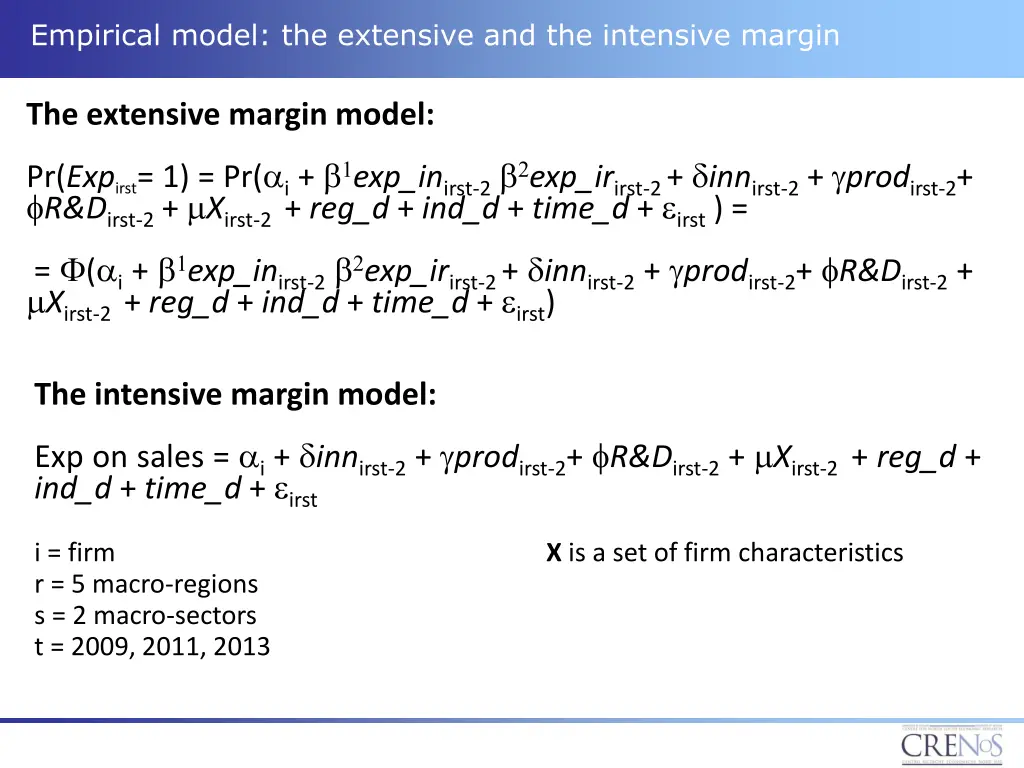
Empirical model: the extensive and the intensive margin The extensive margin model: Pr(Expirst= 1) = Pr( i+ exp_inirst-2 exp_irirst-2+ innirst-2+ prodirst-2+ R&Dirst-2+ Xirst-2+ reg_d + ind_d + time_d + irst) = = ( i+ exp_inirst-2 exp_irirst-2+ innirst-2+ prodirst-2+ R&Dirst-2+ Xirst-2+ reg_d + ind_d + time_d + irst) The intensive margin model: Exp on sales = i+ innirst-2+ prodirst-2+ R&Dirst-2+ Xirst-2+ reg_d + ind_d + time_d + irst i = firm r = 5 macro-regions s = 2 macro-sectors t = 2009, 2011, 2013 X is a set of firm characteristics
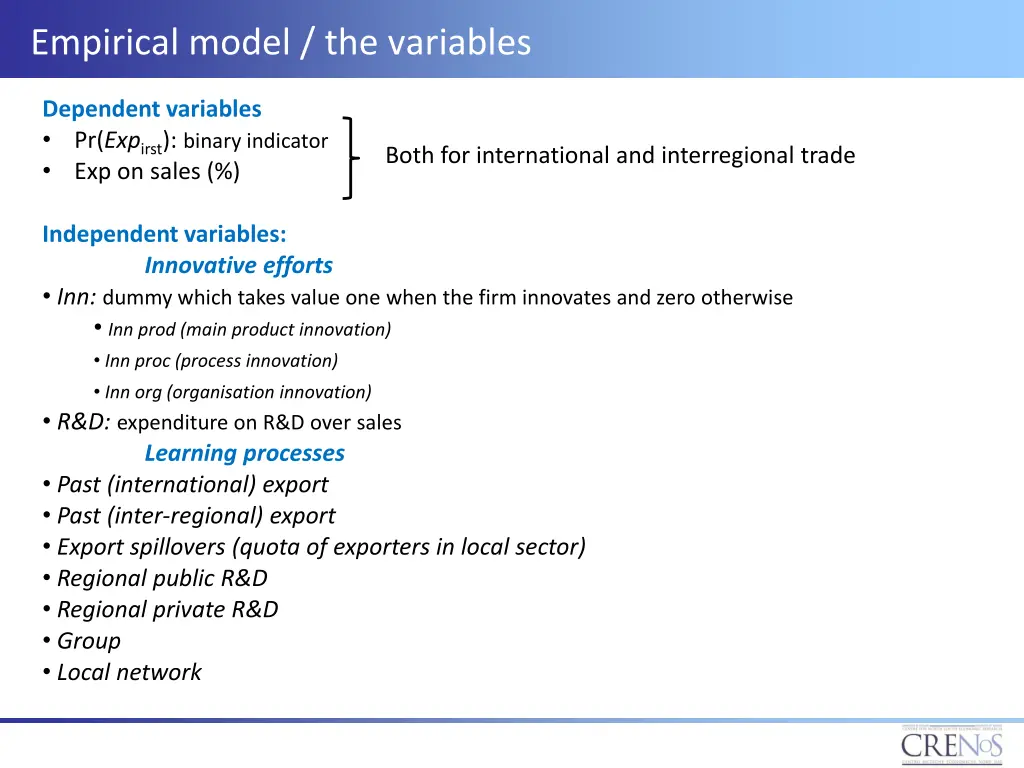
Empirical model / the variables Dependent variables Pr(Expirst): binary indicator Exp on sales (%) Both for international and interregional trade Independent variables: Innovative efforts Inn: dummy which takes value one when the firm innovates and zero otherwise Inn prod (main product innovation) Inn proc (process innovation) Inn org (organisation innovation) R&D: expenditure on R&D over sales Learning processes Past (international) export Past (inter-regional) export Export spillovers (quota of exporters in local sector) Regional public R&D Regional private R&D Group Local network
Empirical model / the variables Firms characteristics (X) Productivity value added per employee tfp (for a smaller sample) Leverage Age Size Dummies Macro-reg_d Macro-sec_d Time_d
Main hypothesis 1. We try to assess the role of experience and learning by including the lag of the dependent variable in the model 2. Most importantly and differently from all previous contribution we consider the experience in exporting beyond regional borders (interregional trade) 3. We try to go beyond the use of dummies to take into account other learning processes which go beyond the firm level which may influence firms ability to export. We explore a set of potential phenomena.
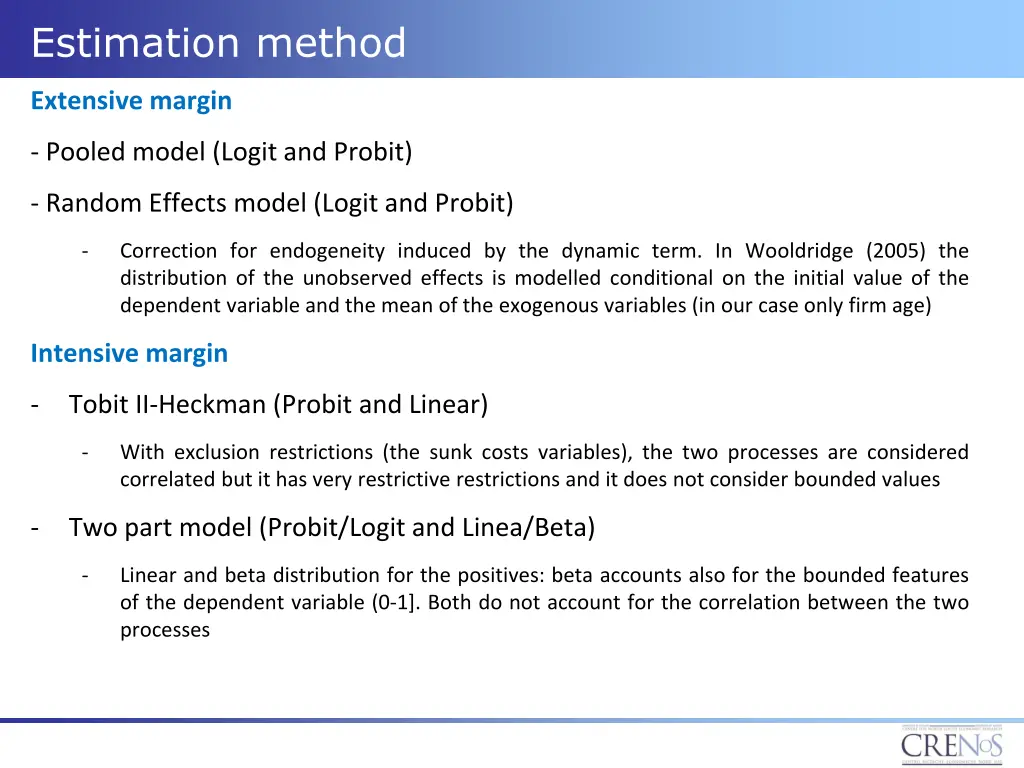
Estimation method Extensive margin - Pooled model (Logit and Probit) - Random Effects model (Logit and Probit) - Correction for endogeneity induced by the dynamic term. In Wooldridge (2005) the distribution of the unobserved effects is modelled conditional on the initial value of the dependent variable and the mean of the exogenous variables (in our case only firm age) Intensive margin - Tobit II-Heckman (Probit and Linear) - With exclusion restrictions (the sunk costs variables), the two processes are considered correlated but it has very restrictive restrictions and it does not consider bounded values - Two part model (Probit/Logit and Linea/Beta) - Linear and beta distribution for the positives: beta accounts also for the bounded features of the dependent variable (0-1]. Both do not account for the correlation between the two processes
Estimation strategy Estimate the benchmark model for the extensive margin 1. Test for robustness with respect to alternative measures of innovation and subsamples. 2. Post-estimation stage: assess the conditional probability of exporting 3. Estimate the benchmark model for the intensive margin 4.
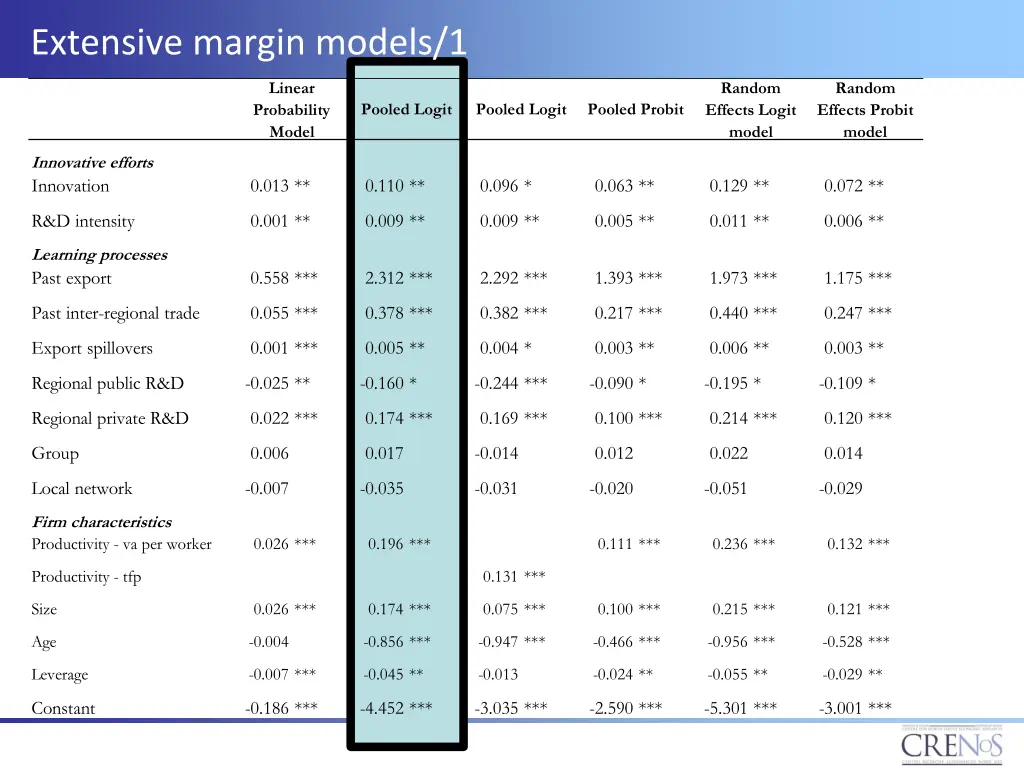
Extensive margin models/1 Linear Probability Model Random Effects Logit model Random Effects Probit model Pooled Logit Pooled Logit Pooled Probit Innovative efforts Innovation 0.013 ** 0.110 ** 0.096 * 0.063 ** 0.129 ** 0.072 ** R&D intensity 0.001 ** 0.009 ** 0.009 ** 0.005 ** 0.011 ** 0.006 ** Learning processes Past export 0.558 *** 2.312 *** 2.292 *** 1.393 *** 1.973 *** 1.175 *** Past inter-regional trade 0.055 *** 0.378 *** 0.382 *** 0.217 *** 0.440 *** 0.247 *** Export spillovers 0.001 *** 0.005 ** 0.004 * 0.003 ** 0.006 ** 0.003 ** Regional public R&D -0.025 ** -0.160 * -0.244 *** -0.090 * -0.195 * -0.109 * Regional private R&D 0.022 *** 0.174 *** 0.169 *** 0.100 *** 0.214 *** 0.120 *** Group 0.006 0.017 -0.014 0.012 0.022 0.014 Local network -0.007 -0.035 -0.031 -0.020 -0.051 -0.029 Firm characteristics Productivity - va per worker 0.026 *** 0.196 *** 0.111 *** 0.236 *** 0.132 *** Productivity - tfp 0.131 *** Size 0.026 *** 0.174 *** 0.075 *** 0.100 *** 0.215 *** 0.121 *** Age -0.004 -0.856 *** -0.947 *** -0.466 *** -0.956 *** -0.528 *** Leverage -0.007 *** -0.045 ** -0.013 -0.024 ** -0.055 ** -0.029 ** Constant -0.186 *** -4.452 *** -3.035 *** -2.590 *** -5.301 *** -3.001 ***
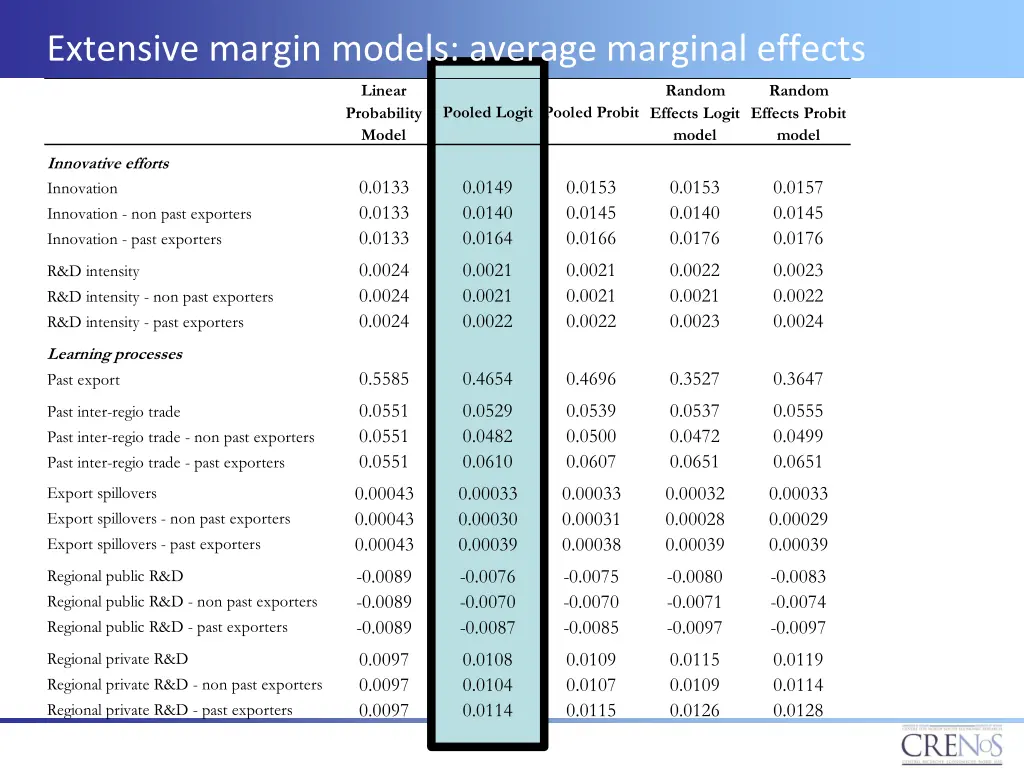
Extensive margin models: average marginal effects Linear Probability Model Random Effects Logit model Random Effects Probit model Pooled Logit Pooled Probit Innovative efforts Innovation Innovation - non past exporters Innovation - past exporters 0.0133 0.0133 0.0133 0.0149 0.0140 0.0164 0.0153 0.0145 0.0166 0.0153 0.0140 0.0176 0.0157 0.0145 0.0176 0.0024 0.0024 0.0024 0.0021 0.0021 0.0022 0.0021 0.0021 0.0022 0.0022 0.0021 0.0023 0.0023 0.0022 0.0024 R&D intensity R&D intensity - non past exporters R&D intensity - past exporters Learning processes Past export 0.5585 0.4654 0.4696 0.3527 0.3647 0.0551 0.0551 0.0551 0.0529 0.0482 0.0610 0.0539 0.0500 0.0607 0.0537 0.0472 0.0651 0.0555 0.0499 0.0651 Past inter-regio trade Past inter-regio trade - non past exporters Past inter-regio trade - past exporters 0.00043 0.00043 0.00043 0.00033 0.00030 0.00039 0.00033 0.00031 0.00038 0.00032 0.00028 0.00039 0.00033 0.00029 0.00039 Export spillovers Export spillovers - non past exporters Export spillovers - past exporters -0.0089 -0.0089 -0.0089 -0.0076 -0.0070 -0.0087 -0.0075 -0.0070 -0.0085 -0.0080 -0.0071 -0.0097 -0.0083 -0.0074 -0.0097 Regional public R&D Regional public R&D - non past exporters Regional public R&D - past exporters 0.0097 0.0097 0.0097 0.0108 0.0104 0.0114 0.0109 0.0107 0.0115 0.0115 0.0109 0.0126 0.0119 0.0114 0.0128 Regional private R&D Regional private R&D - non past exporters Regional private R&D - past exporters
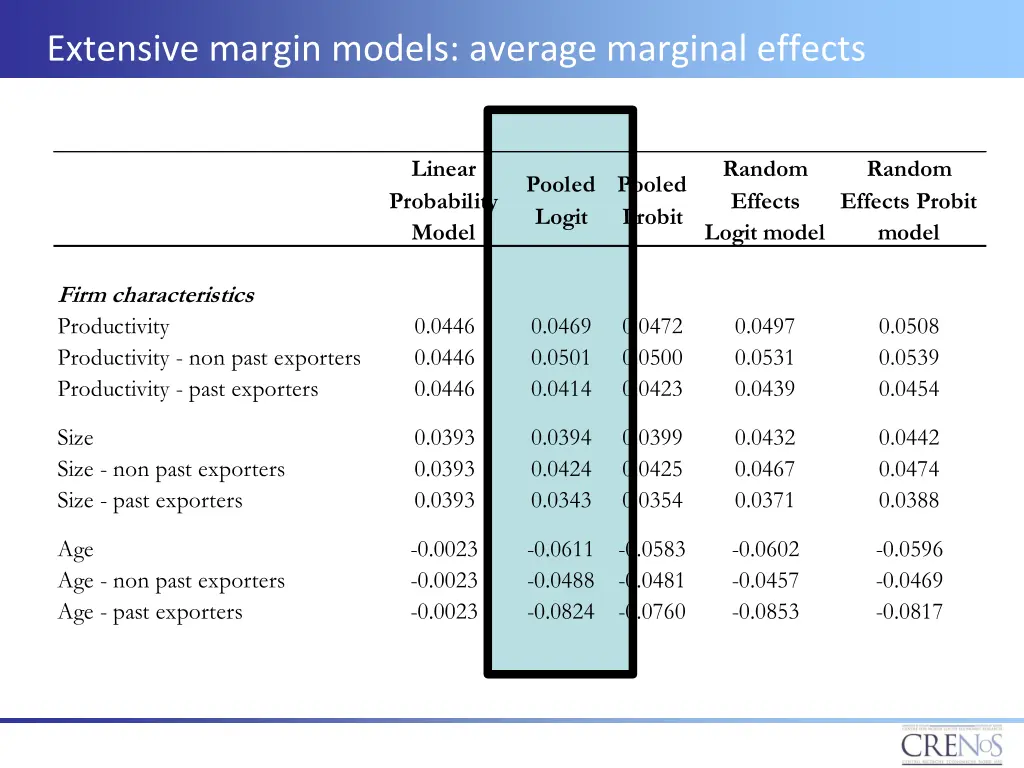
Extensive margin models: average marginal effects Linear Probability Model Random Effects Logit model Random Effects Probit model Pooled Logit Pooled Probit Firm characteristics Productivity Productivity - non past exporters Productivity - past exporters 0.0446 0.0446 0.0446 0.0469 0.0501 0.0414 0.0472 0.0500 0.0423 0.0497 0.0531 0.0439 0.0508 0.0539 0.0454 Size Size - non past exporters Size - past exporters 0.0393 0.0393 0.0393 0.0394 0.0424 0.0343 0.0399 0.0425 0.0354 0.0432 0.0467 0.0371 0.0442 0.0474 0.0388 Age Age - non past exporters Age - past exporters -0.0023 -0.0023 -0.0023 -0.0611 -0.0488 -0.0824 -0.0583 -0.0481 -0.0760 -0.0602 -0.0457 -0.0853 -0.0596 -0.0469 -0.0817
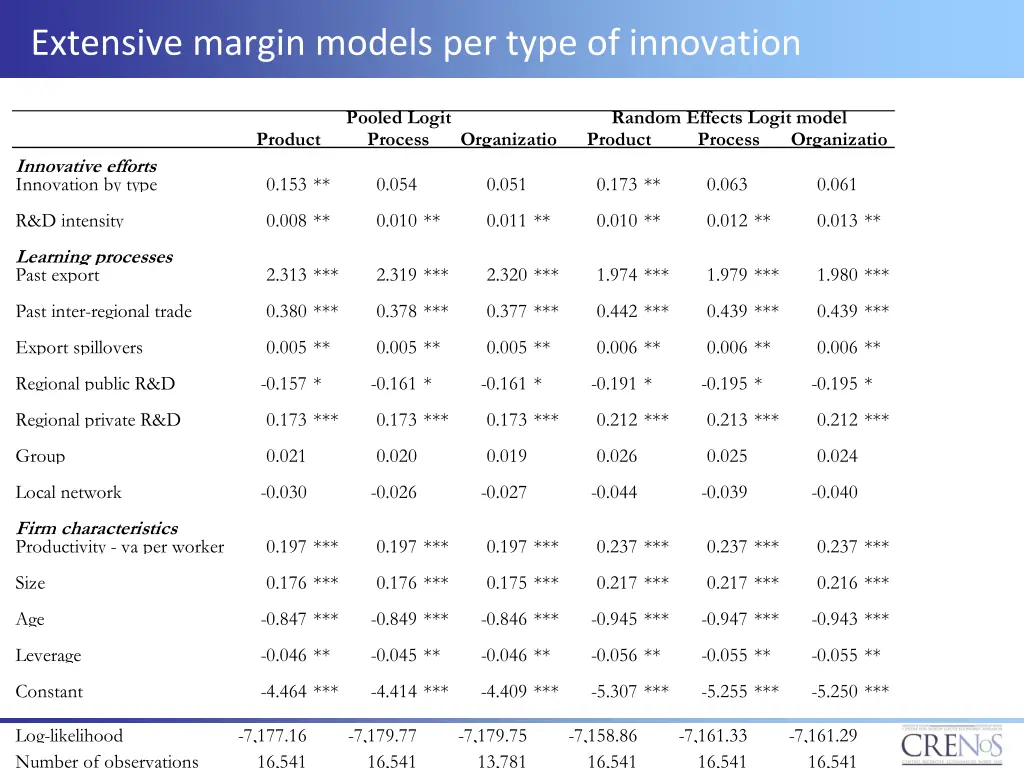
Extensive margin models per type of innovation Pooled Logit Random Effects Logit model Product Process Organizatio Product Process Organizatio Innovative efforts Innovation by type 0.153 ** 0.054 0.051 0.173 ** 0.063 0.061 R&D intensity 0.008 ** 0.010 ** 0.011 ** 0.010 ** 0.012 ** 0.013 ** Learning processes Past export 2.313 *** 2.319 *** 2.320 *** 1.974 *** 1.979 *** 1.980 *** Past inter-regional trade 0.380 *** 0.378 *** 0.377 *** 0.442 *** 0.439 *** 0.439 *** Export spillovers 0.005 ** 0.005 ** 0.005 ** 0.006 ** 0.006 ** 0.006 ** Regional public R&D -0.157 * -0.161 * -0.161 * -0.191 * -0.195 * -0.195 * Regional private R&D 0.173 *** 0.173 *** 0.173 *** 0.212 *** 0.213 *** 0.212 *** Group 0.021 0.020 0.019 0.026 0.025 0.024 Local network -0.030 -0.026 -0.027 -0.044 -0.039 -0.040 Firm characteristics Productivity - va per worker 0.197 *** 0.197 *** 0.197 *** 0.237 *** 0.237 *** 0.237 *** Size 0.176 *** 0.176 *** 0.175 *** 0.217 *** 0.217 *** 0.216 *** Age -0.847 *** -0.849 *** -0.846 *** -0.945 *** -0.947 *** -0.943 *** Leverage -0.046 ** -0.045 ** -0.046 ** -0.056 ** -0.055 ** -0.055 ** Constant -4.464 *** -4.414 *** -4.409 *** -5.307 *** -5.255 *** -5.250 *** Log-likelihood Number of observations -7,177.16 16,541 -7,179.77 16,541 -7,179.75 13,781 -7,158.86 16,541 -7,161.33 16,541 -7,161.29 16,541
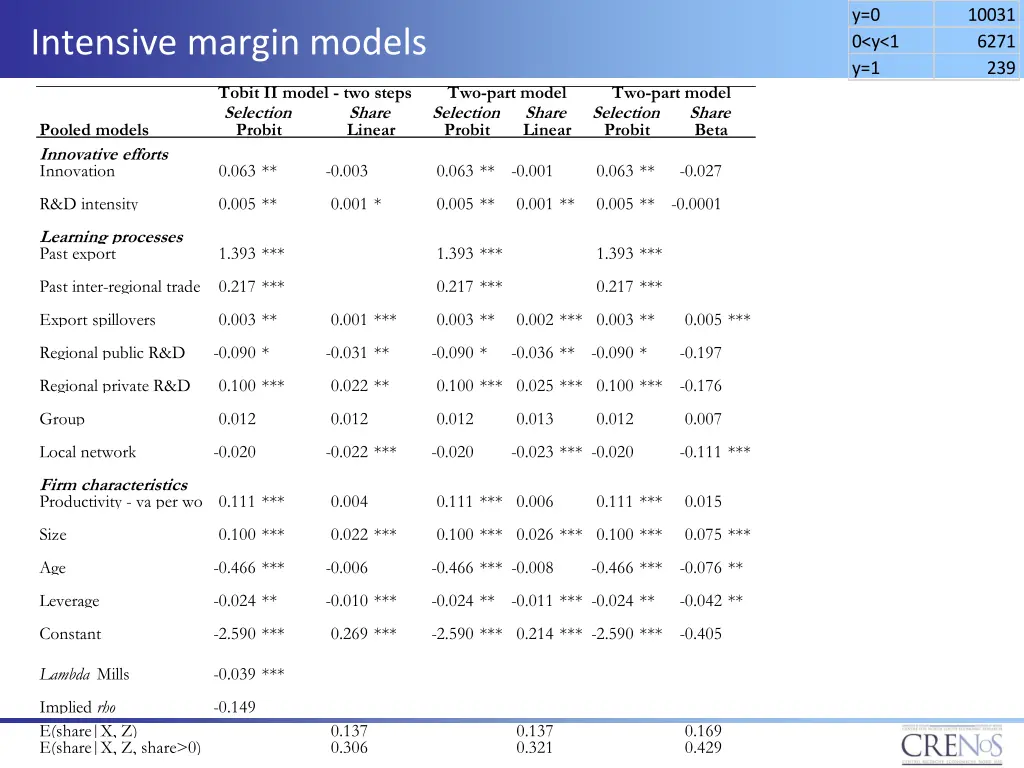
y=0 0<y<1 y=1 10031 6271 239 Intensive margin models Tobit II model - two steps Two-part model Two-part model Selection Share Selection Share Selection Share Pooled models Innovative efforts Innovation Probit Linear Probit Linear Probit Beta 0.063 ** -0.003 0.063 ** -0.001 0.063 ** -0.027 R&D intensity 0.005 ** 0.001 * 0.005 ** 0.001 ** 0.005 ** -0.0001 Learning processes Past export 1.393 *** 1.393 *** 1.393 *** Past inter-regional trade 0.217 *** 0.217 *** 0.217 *** Export spillovers 0.003 ** 0.001 *** 0.003 ** 0.002 *** 0.003 ** 0.005 *** Regional public R&D -0.090 * -0.031 ** -0.090 * -0.036 ** -0.090 * -0.197 Regional private R&D 0.100 *** 0.022 ** 0.100 *** 0.025 *** 0.100 *** -0.176 Group 0.012 0.012 0.012 0.013 0.012 0.007 Local network -0.020 -0.022 *** -0.020 -0.023 *** -0.020 -0.111 *** Firm characteristics Productivity - va per worker 0.111 *** 0.004 0.111 *** 0.006 0.111 *** 0.015 Size 0.100 *** 0.022 *** 0.100 *** 0.026 *** 0.100 *** 0.075 *** Age -0.466 *** -0.006 -0.466 *** -0.008 -0.466 *** -0.076 ** Leverage -0.024 ** -0.010 *** -0.024 ** -0.011 *** -0.024 ** -0.042 ** Constant -2.590 *** 0.269 *** -2.590 *** 0.214 *** -2.590 *** -0.405 Lambda Mills -0.039 *** Implied rho E(share|X, Z) E(share|X, Z, share>0) -0.149 0.137 0.306 0.137 0.321 0.169 0.429
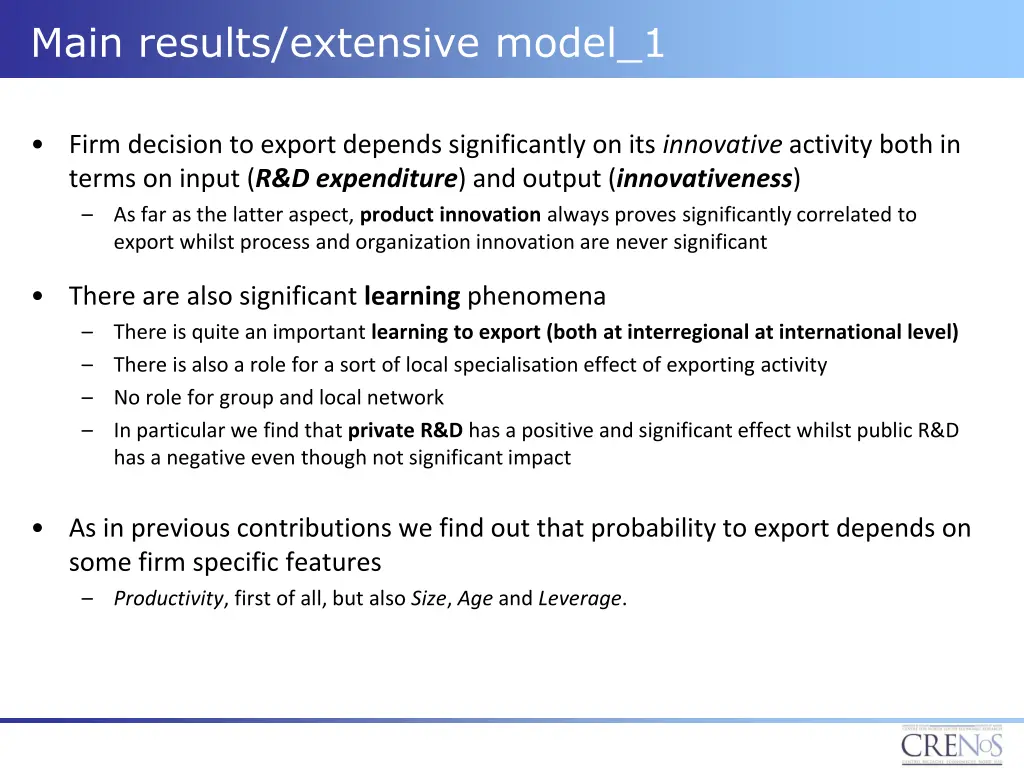
Main results/extensive model_1 Firm decision to export depends significantly on its innovative activity both in terms on input (R&D expenditure) and output (innovativeness) As far as the latter aspect, product innovation always proves significantly correlated to export whilst process and organization innovation are never significant There are also significant learning phenomena There is quite an important learning to export (both at interregional at international level) There is also a role for a sort of local specialisation effect of exporting activity No role for group and local network In particular we find that private R&D has a positive and significant effect whilst public R&D has a negative even though not significant impact As in previous contributions we find out that probability to export depends on some firm specific features Productivity, first of all, but also Size, Age and Leverage.
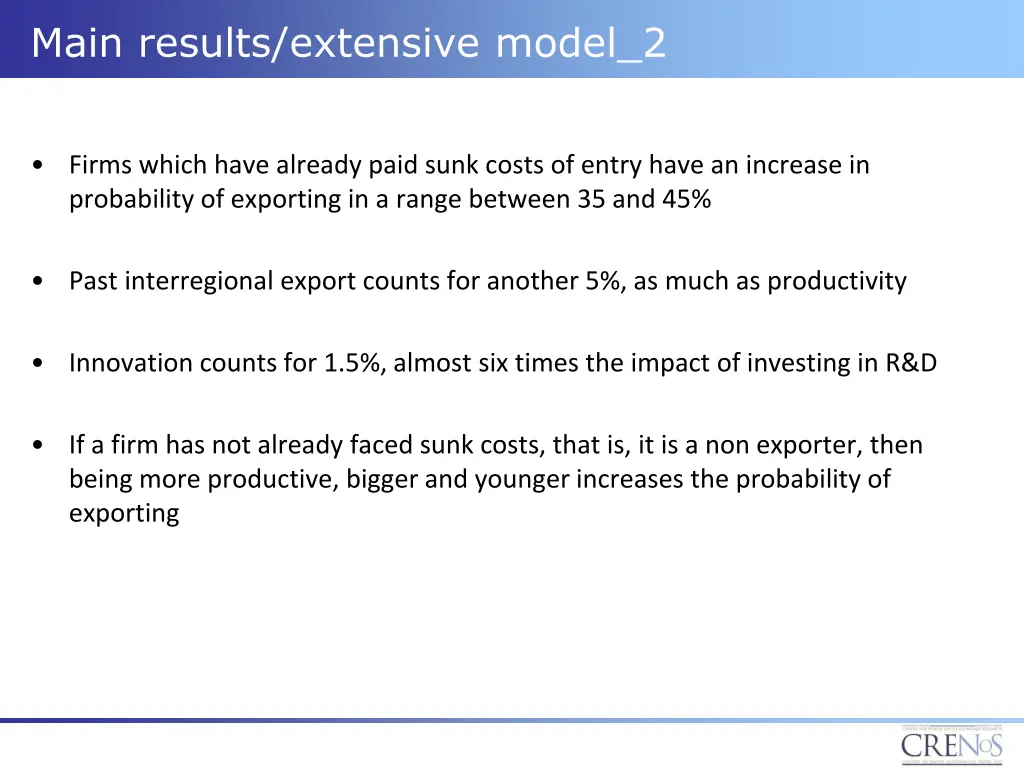
Main results/extensive model_2 Firms which have already paid sunk costs of entry have an increase in probability of exporting in a range between 35 and 45% Past interregional export counts for another 5%, as much as productivity Innovation counts for 1.5%, almost six times the impact of investing in R&D If a firm has not already faced sunk costs, that is, it is a non exporter, then being more productive, bigger and younger increases the probability of exporting
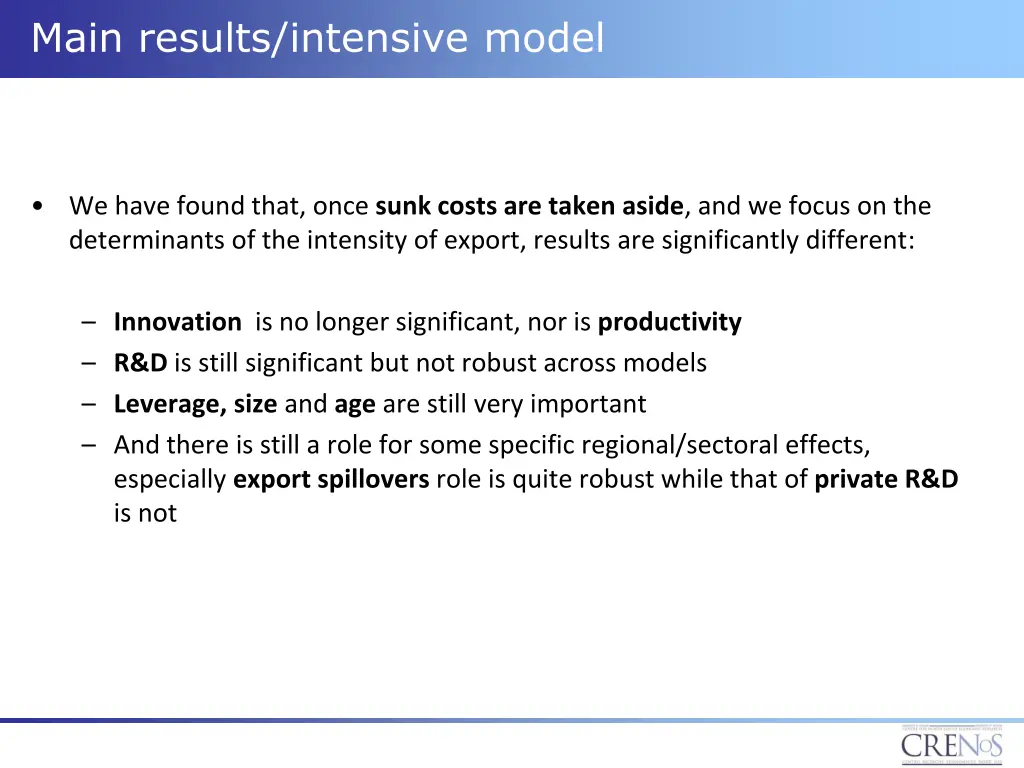
Main results/intensive model We have found that, once sunk costs are taken aside, and we focus on the determinants of the intensity of export, results are significantly different: Innovation is no longer significant, nor is productivity R&D is still significant but not robust across models Leverage, size and age are still very important And there is still a role for some specific regional/sectoral effects, especially export spillovers role is quite robust while that of private R&D is not
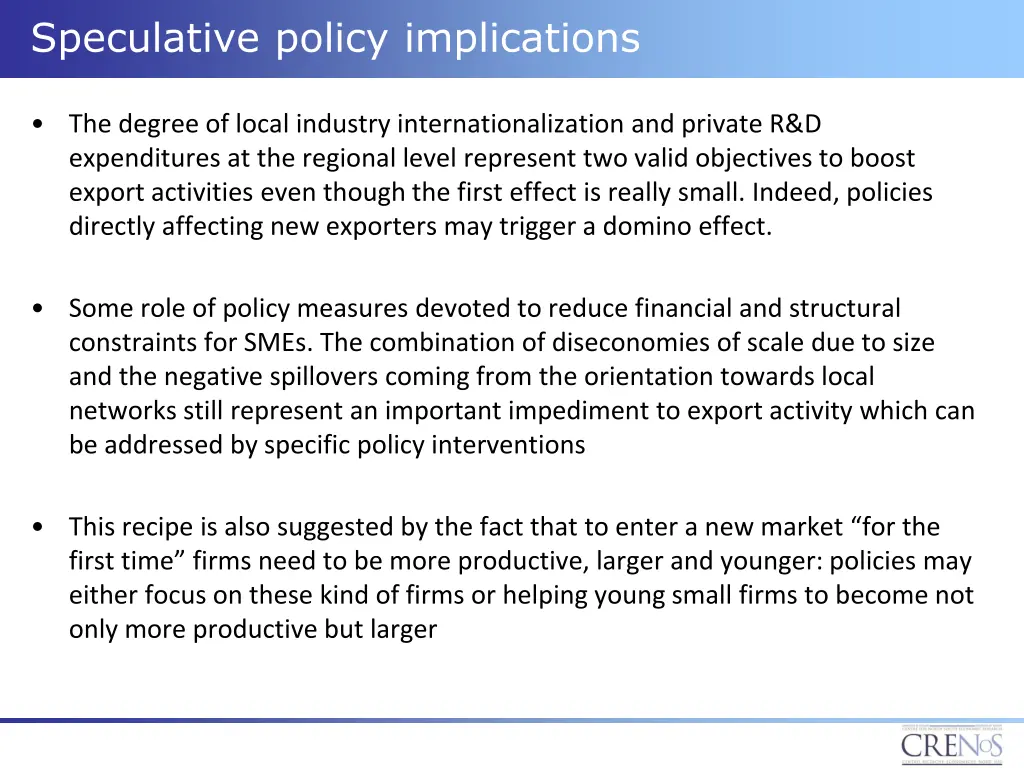
Speculative policy implications The degree of local industry internationalization and private R&D expenditures at the regional level represent two valid objectives to boost export activities even though the first effect is really small. Indeed, policies directly affecting new exporters may trigger a domino effect. Some role of policy measures devoted to reduce financial and structural constraints for SMEs. The combination of diseconomies of scale due to size and the negative spillovers coming from the orientation towards local networks still represent an important impediment to export activity which can be addressed by specific policy interventions This recipe is also suggested by the fact that to enter a new market for the first time firms need to be more productive, larger and younger: policies may either focus on these kind of firms or helping young small firms to become not only more productive but larger
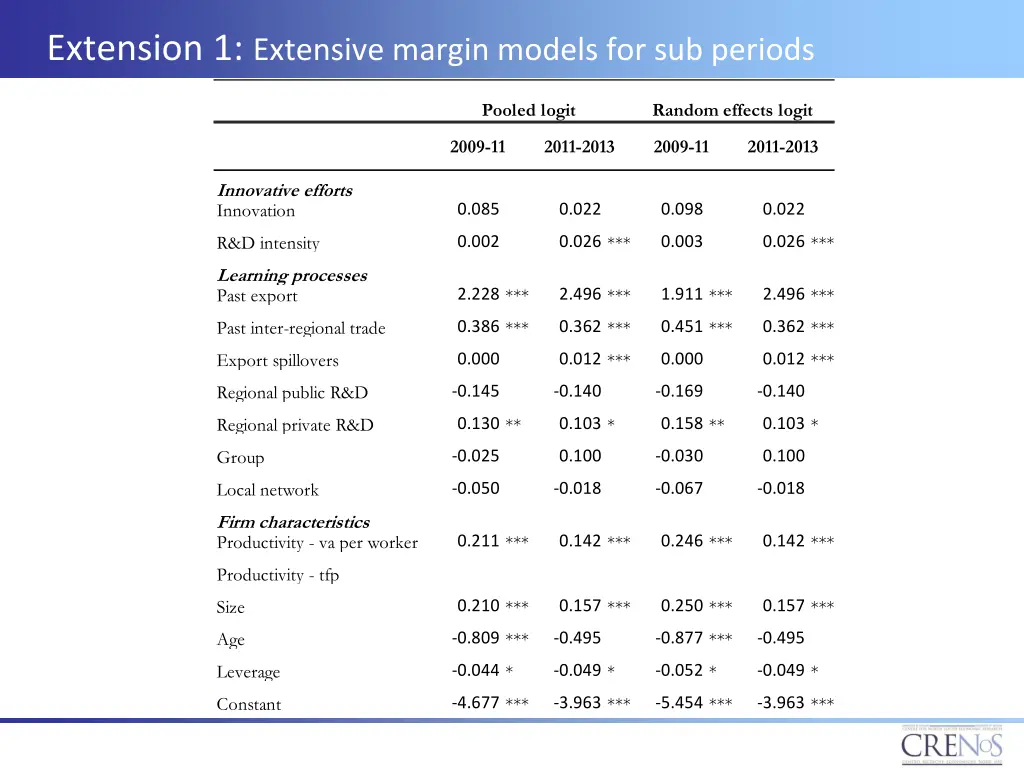
Extension 1: Extensive margin models for sub periods Pooled logit Random effects logit 2009-11 2011-2013 2009-11 2011-2013 Innovative efforts Innovation 0.085 0.022 0.098 0.022 R&D intensity 0.026 *** 0.026 *** 0.002 0.003 Learning processes Past export 2.228 *** 2.496 *** 1.911 *** 2.496 *** Past inter-regional trade 0.386 *** 0.362 *** 0.451 *** 0.362 *** Export spillovers 0.012 *** 0.012 *** 0.000 0.000 Regional public R&D -0.145 -0.140 -0.169 -0.140 Regional private R&D 0.130 ** 0.103 * 0.158 ** 0.103 * Group -0.025 0.100 -0.030 0.100 Local network -0.050 -0.018 -0.067 -0.018 Firm characteristics Productivity - va per worker 0.211 *** 0.142 *** 0.246 *** 0.142 *** Productivity - tfp Size 0.210 *** 0.157 *** 0.250 *** 0.157 *** Age -0.809 *** -0.877 *** -0.495 -0.495 Leverage -0.044 * -0.049 * -0.052 * -0.049 * Constant -4.677 *** -3.963 *** -5.454 *** -3.963 ***
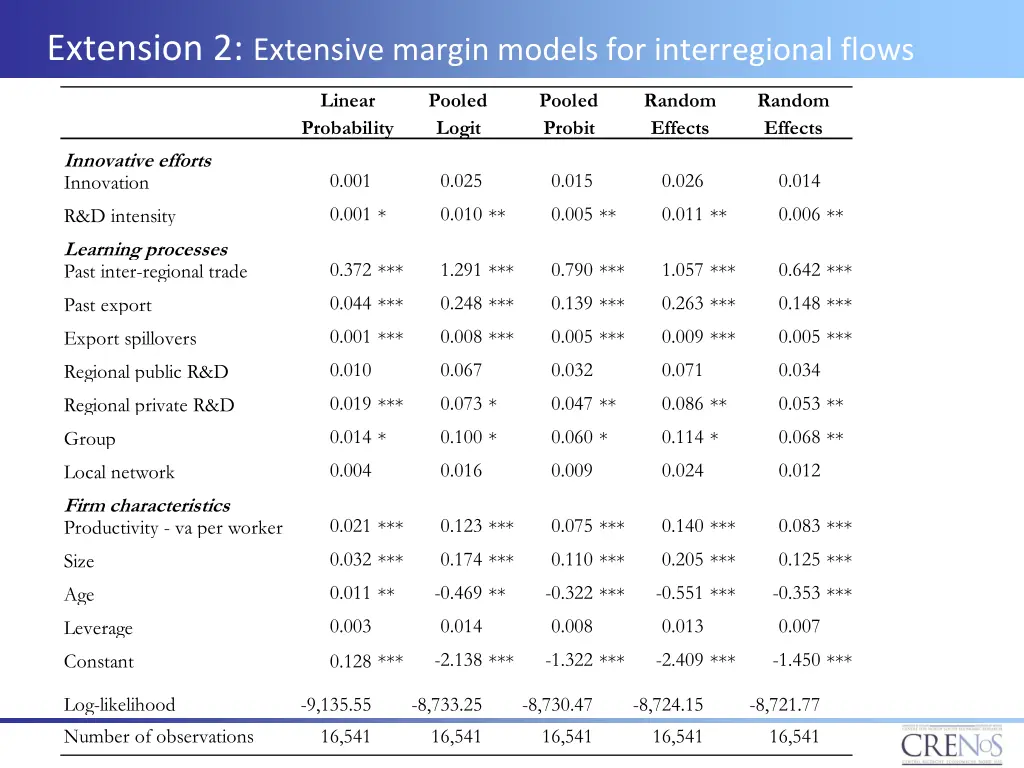
Extension 2: Extensive margin models for interregional flows Linear Probability Pooled Logit Pooled Probit Random Effects Random Effects Innovative efforts Innovation 0.001 0.025 0.015 0.026 0.014 0.001 * 0.010 ** 0.005 ** 0.011 ** 0.006 ** R&D intensity Learning processes Past inter-regional trade 0.372 *** 0.044 *** 0.001 *** 0.010 1.291 *** 0.248 *** 0.008 *** 0.067 0.790 *** 0.139 *** 0.005 *** 0.032 1.057 *** 0.263 *** 0.009 *** 0.071 0.642 *** 0.148 *** 0.005 *** 0.034 Past export Export spillovers Regional public R&D 0.019 *** 0.014 * 0.004 0.073 * 0.100 * 0.016 0.047 ** 0.060 * 0.009 0.086 ** 0.114 * 0.024 0.053 ** 0.068 ** 0.012 Regional private R&D Group Local network Firm characteristics Productivity - va per worker 0.021 *** 0.032 *** 0.011 ** 0.003 0.123 *** 0.174 *** -0.469 ** 0.014 0.075 *** 0.110 *** -0.322 *** 0.008 0.140 *** 0.205 *** -0.551 *** 0.013 0.083 *** 0.125 *** -0.353 *** 0.007 Size Age Leverage -2.138 *** -1.322 *** -2.409 *** -1.450 *** Constant 0.128 *** Log-likelihood Number of observations -9,135.55 16,541 -8,733.25 16,541 -8,730.47 16,541 -8,724.15 16,541 -8,721.77 16,541