Explore the significance of big data, data-intensive computing, and the role of parallel processing techniques like MapReduce. Delve into the evolution of data processing, from historical milestones to current paradigms, emphasizing the importance of efficient algorithms and programming models. Learn how MapReduce simplifies data processing on large clusters, showcasing Google's success in handling vast amounts of data through parallel computation.
Please find below an Image/Link to download the presentation.
The content on the website is provided AS IS for your information and personal use only. It may not be sold, licensed, or shared on other websites without obtaining consent from the author. If you encounter any issues during the download, it is possible that the publisher has removed the file from their server.
You are allowed to download the files provided on this website for personal or commercial use, subject to the condition that they are used lawfully. All files are the property of their respective owners.
The content on the website is provided AS IS for your information and personal use only. It may not be sold, licensed, or shared on other websites without obtaining consent from the author.
E N D
Presentation Transcript
An Innovative Approach to Parallel Processing Data 1 BINA RAMAMURTHY PARTIALLY SUPPORTED BY NSF DUE GRANT: 0737243, 0920335 3/17/2025 CSE4/587 B. Ramamurthy
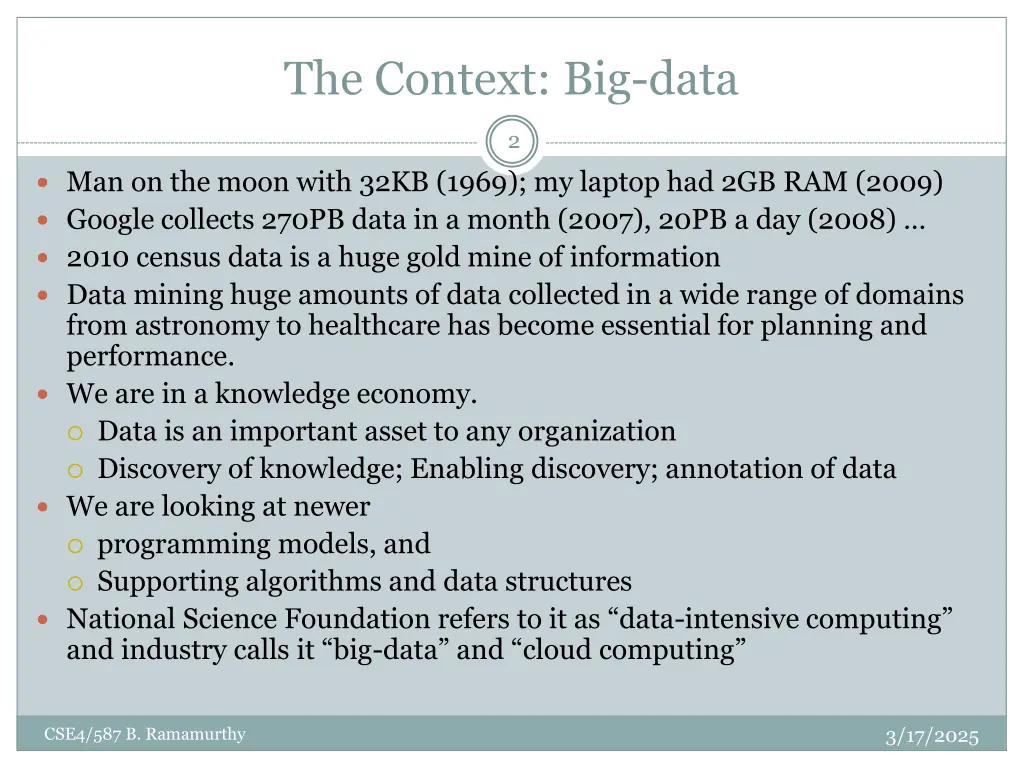
The Context: Big-data 2 Man on the moon with 32KB (1969); my laptop had 2GB RAM (2009) Google collects 270PB data in a month (2007), 20PB a day (2008) 2010 census data is a huge gold mine of information Data mining huge amounts of data collected in a wide range of domains from astronomy to healthcare has become essential for planning and performance. We are in a knowledge economy. Data is an important asset to any organization Discovery of knowledge; Enabling discovery; annotation of data We are looking at newer programming models, and Supporting algorithms and data structures National Science Foundation refers to it as data-intensive computing and industry calls it big-data and cloud computing 3/17/2025 CSE4/587 B. Ramamurthy
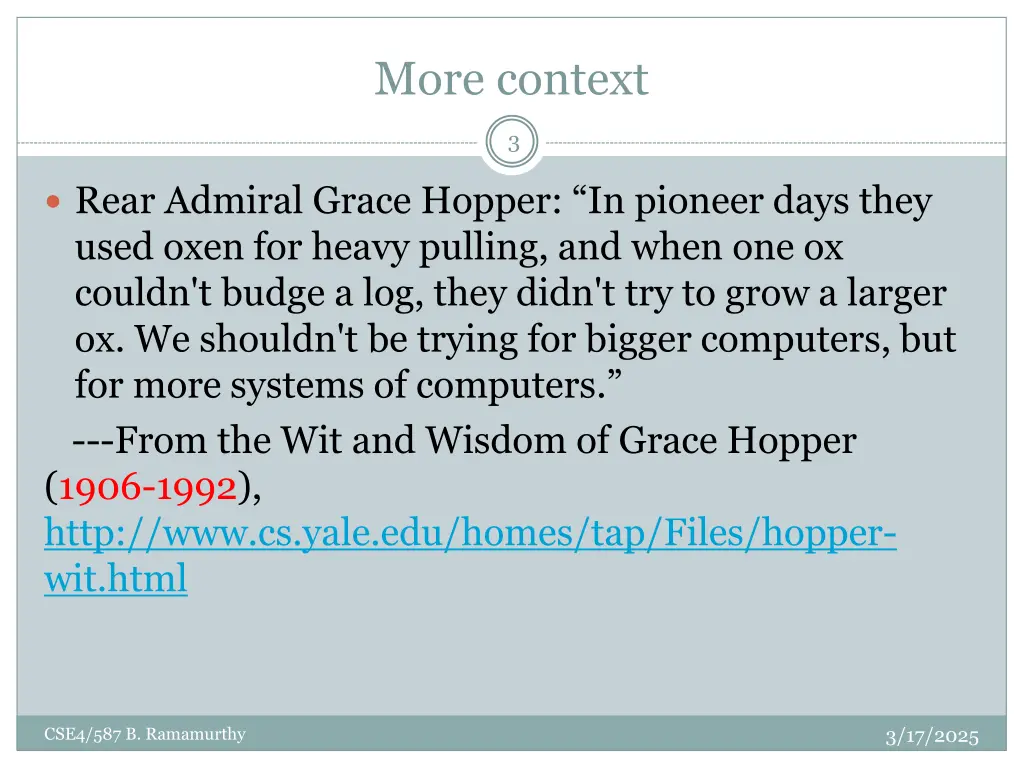
More context 3 Rear Admiral Grace Hopper: In pioneer days they used oxen for heavy pulling, and when one ox couldn't budge a log, they didn't try to grow a larger ox. We shouldn't be trying for bigger computers, but for more systems of computers. ---From the Wit and Wisdom of Grace Hopper (1906-1992), http://www.cs.yale.edu/homes/tap/Files/hopper- wit.html 3/17/2025 CSE4/587 B. Ramamurthy
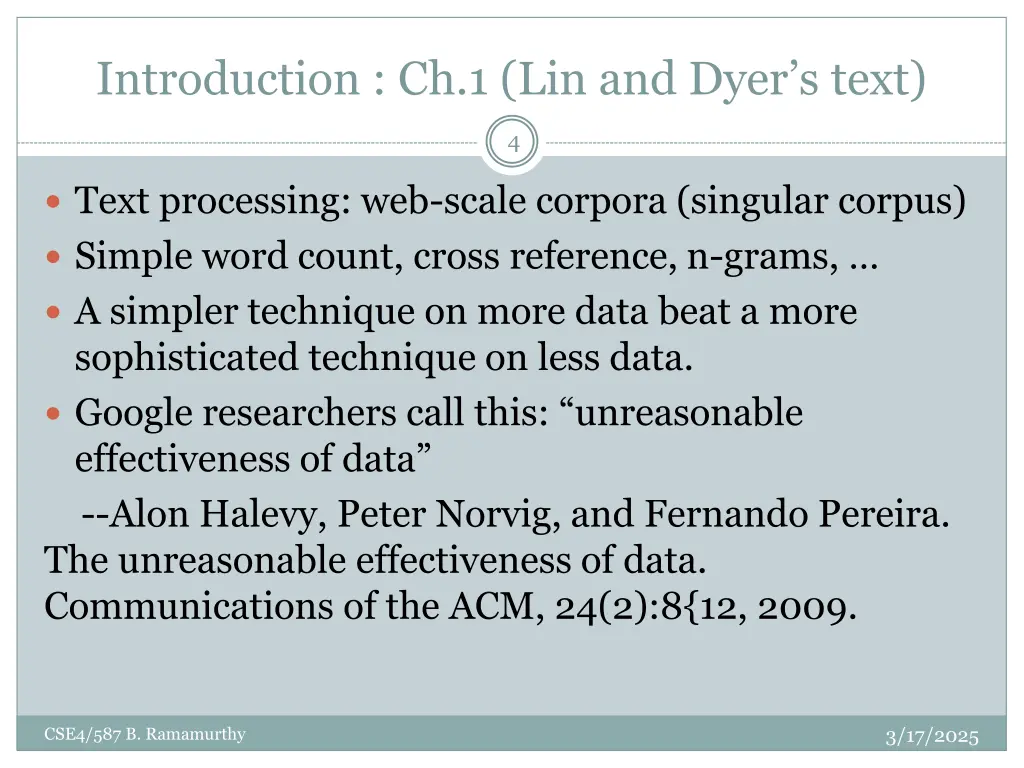
Introduction : Ch.1 (Lin and Dyers text) 4 Text processing: web-scale corpora (singular corpus) Simple word count, cross reference, n-grams, A simpler technique on more data beat a more sophisticated technique on less data. Google researchers call this: unreasonable effectiveness of data --Alon Halevy, Peter Norvig, and Fernando Pereira. The unreasonable effectiveness of data. Communications of the ACM, 24(2):8{12, 2009. 3/17/2025 CSE4/587 B. Ramamurthy
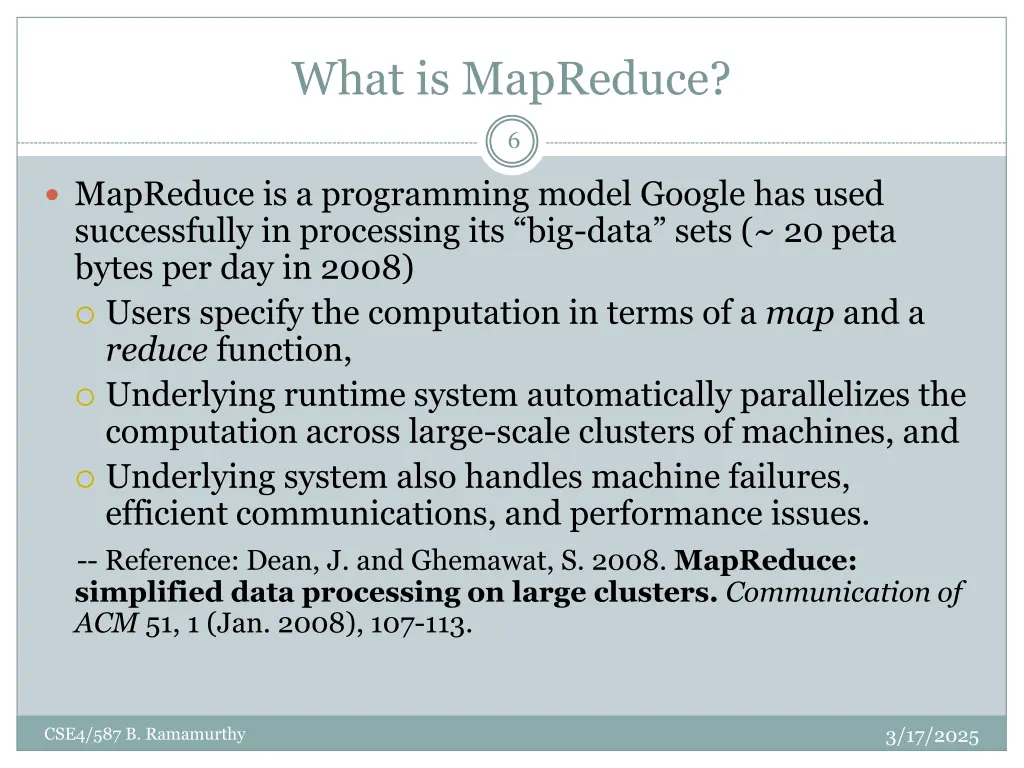
What is MapReduce? 6 MapReduce is a programming model Google has used successfully in processing its big-data sets (~ 20 peta bytes per day in 2008) Users specify the computation in terms of a map and a reduce function, Underlying runtime system automatically parallelizes the computation across large-scale clusters of machines, and Underlying system also handles machine failures, efficient communications, and performance issues. -- Reference: Dean, J. and Ghemawat, S. 2008. MapReduce: simplified data processing on large clusters.Communication of ACM 51, 1 (Jan. 2008), 107-113. 3/17/2025 CSE4/587 B. Ramamurthy
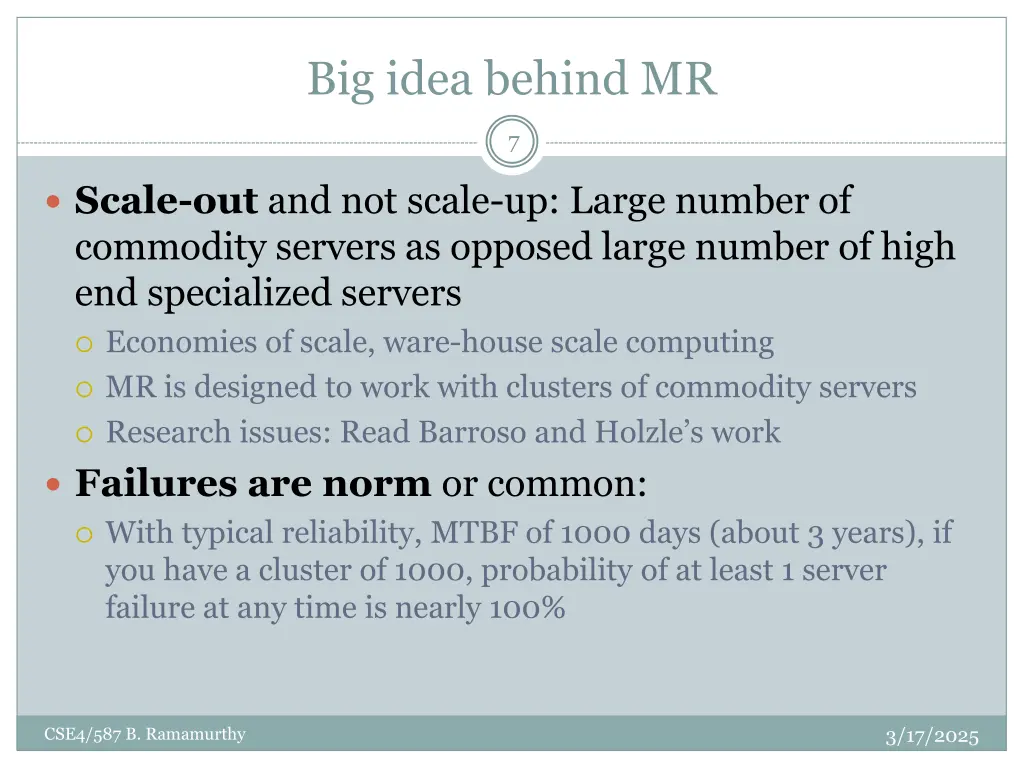
Big idea behind MR 7 Scale-out and not scale-up: Large number of commodity servers as opposed large number of high end specialized servers Economies of scale, ware-house scale computing MR is designed to work with clusters of commodity servers Research issues: Read Barroso and Holzle s work Failures are norm or common: With typical reliability, MTBF of 1000 days (about 3 years), if you have a cluster of 1000, probability of at least 1 server failure at any time is nearly 100% 3/17/2025 CSE4/587 B. Ramamurthy
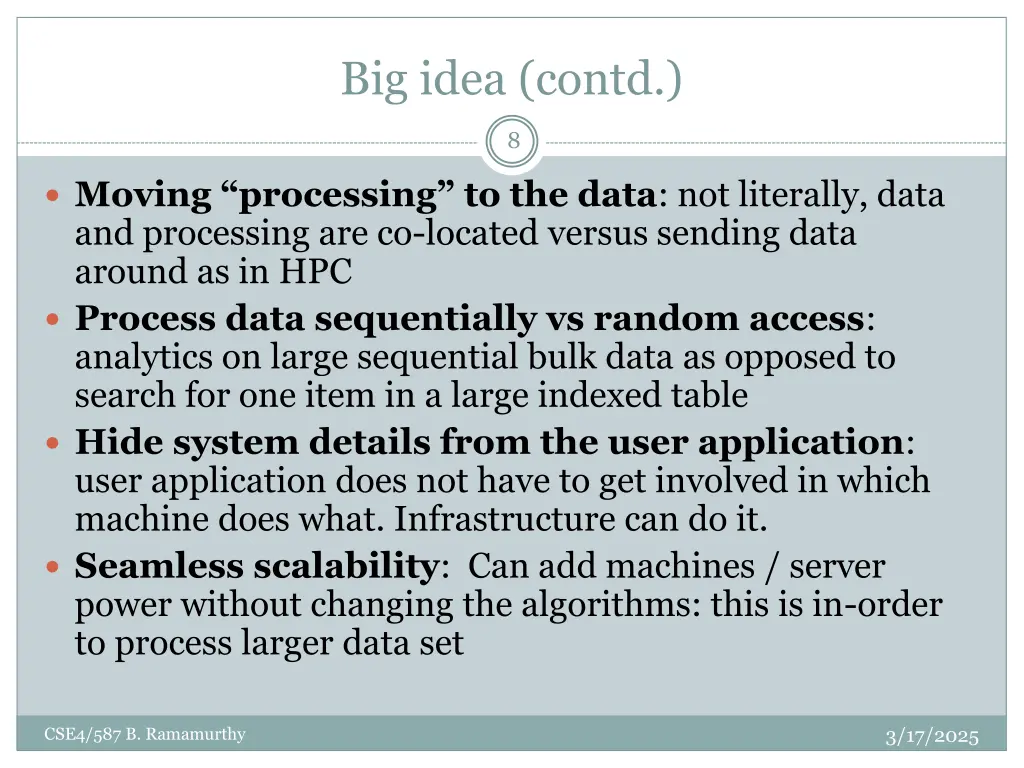
Big idea (contd.) 8 Moving processing to the data: not literally, data and processing are co-located versus sending data around as in HPC Process data sequentially vs random access: analytics on large sequential bulk data as opposed to search for one item in a large indexed table Hide system details from the user application: user application does not have to get involved in which machine does what. Infrastructure can do it. Seamless scalability: Can add machines / server power without changing the algorithms: this is in-order to process larger data set 3/17/2025 CSE4/587 B. Ramamurthy
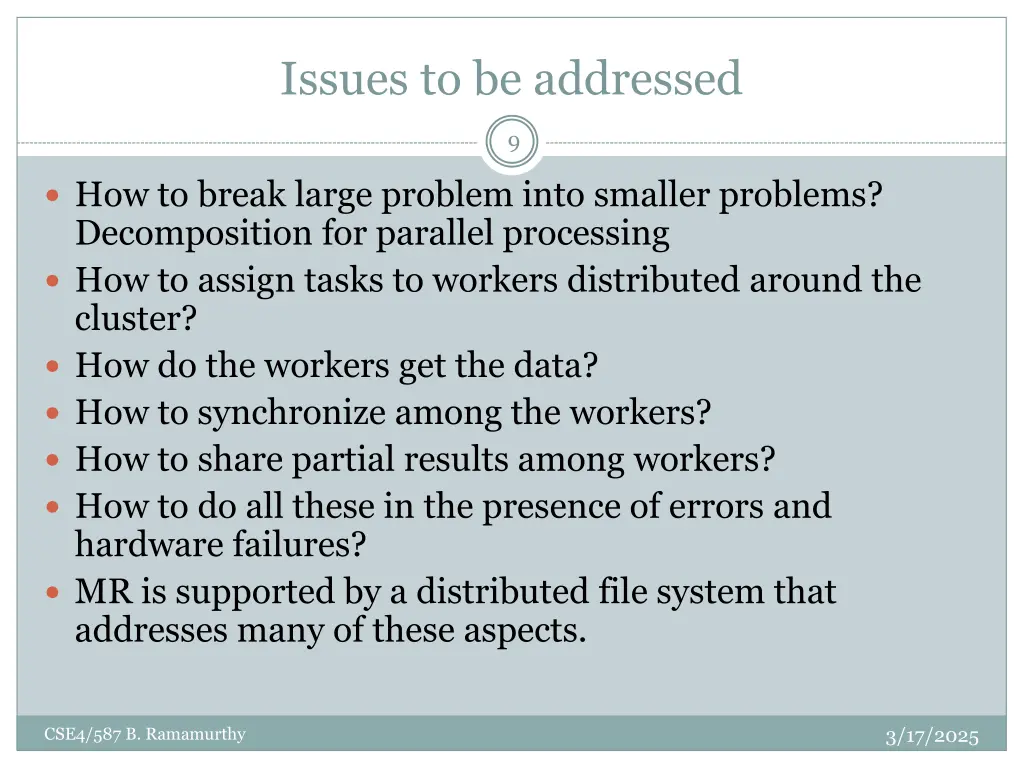
Issues to be addressed 9 How to break large problem into smaller problems? Decomposition for parallel processing How to assign tasks to workers distributed around the cluster? How do the workers get the data? How to synchronize among the workers? How to share partial results among workers? How to do all these in the presence of errors and hardware failures? MR is supported by a distributed file system that addresses many of these aspects. 3/17/2025 CSE4/587 B. Ramamurthy
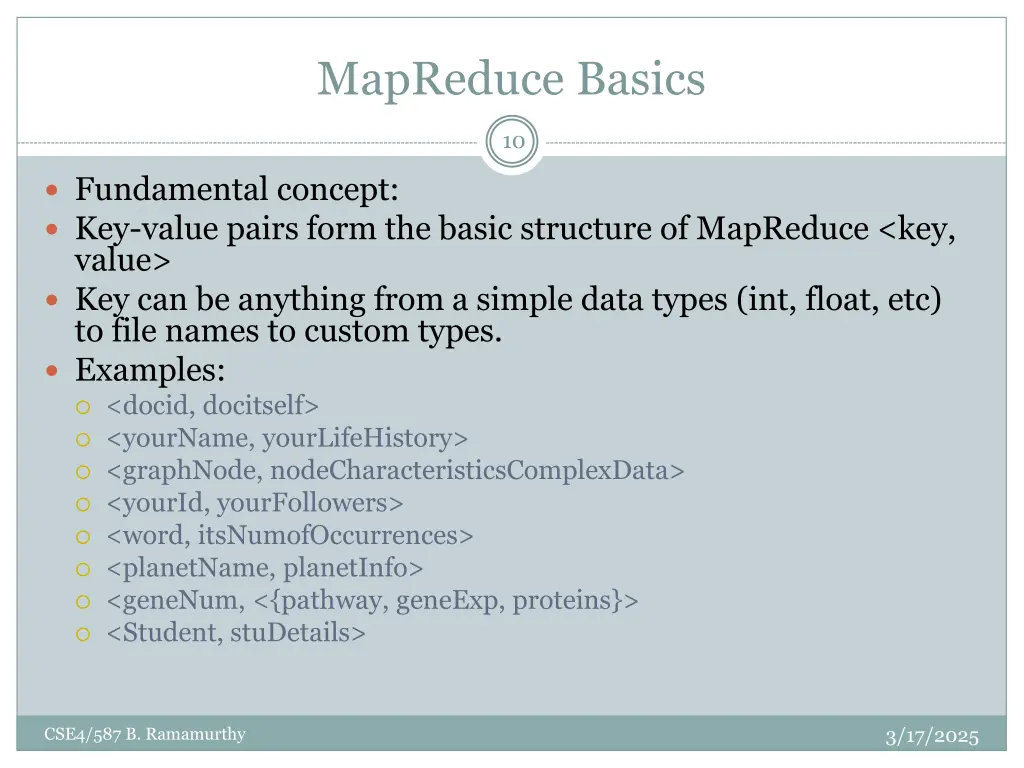
MapReduce Basics 10 Fundamental concept: Key-value pairs form the basic structure of MapReduce <key, value> Key can be anything from a simple data types (int, float, etc) to file names to custom types. Examples: <docid, docitself> <yourName, yourLifeHistory> <graphNode, nodeCharacteristicsComplexData> <yourId, yourFollowers> <word, itsNumofOccurrences> <planetName, planetInfo> <geneNum, <{pathway, geneExp, proteins}> <Student, stuDetails> 3/17/2025 CSE4/587 B. Ramamurthy
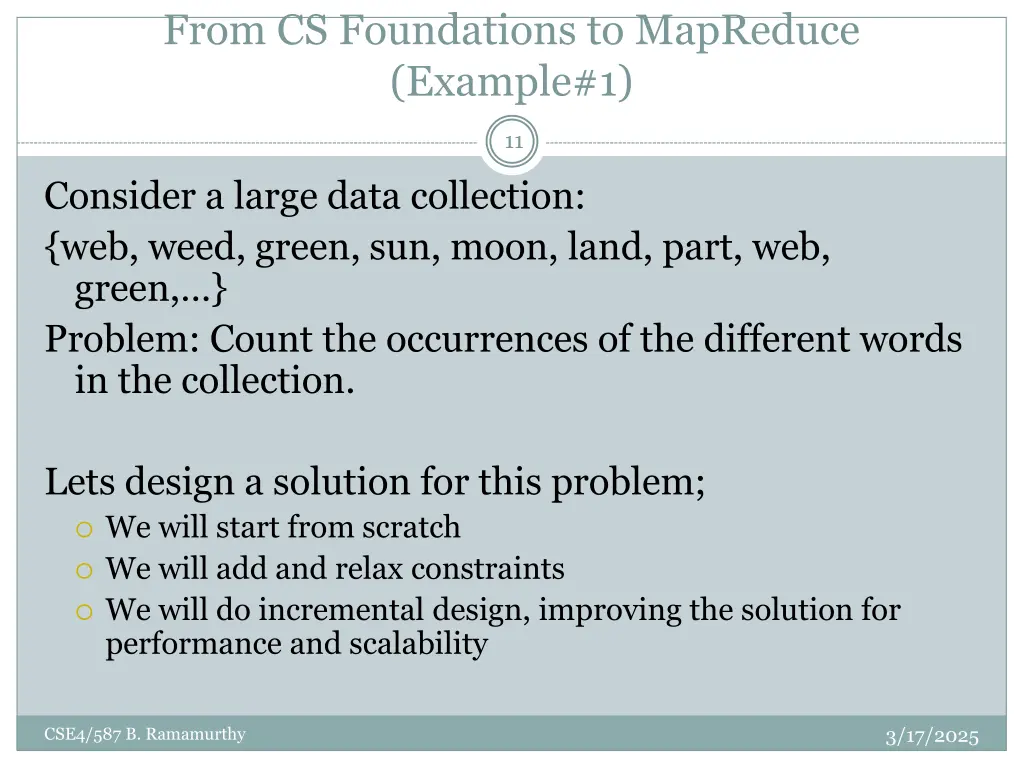
From CS Foundations to MapReduce (Example#1) 11 Consider a large data collection: {web, weed, green, sun, moon, land, part, web, green, } Problem: Count the occurrences of the different words in the collection. Lets design a solution for this problem; We will start from scratch We will add and relax constraints We will do incremental design, improving the solution for performance and scalability 3/17/2025 CSE4/587 B. Ramamurthy
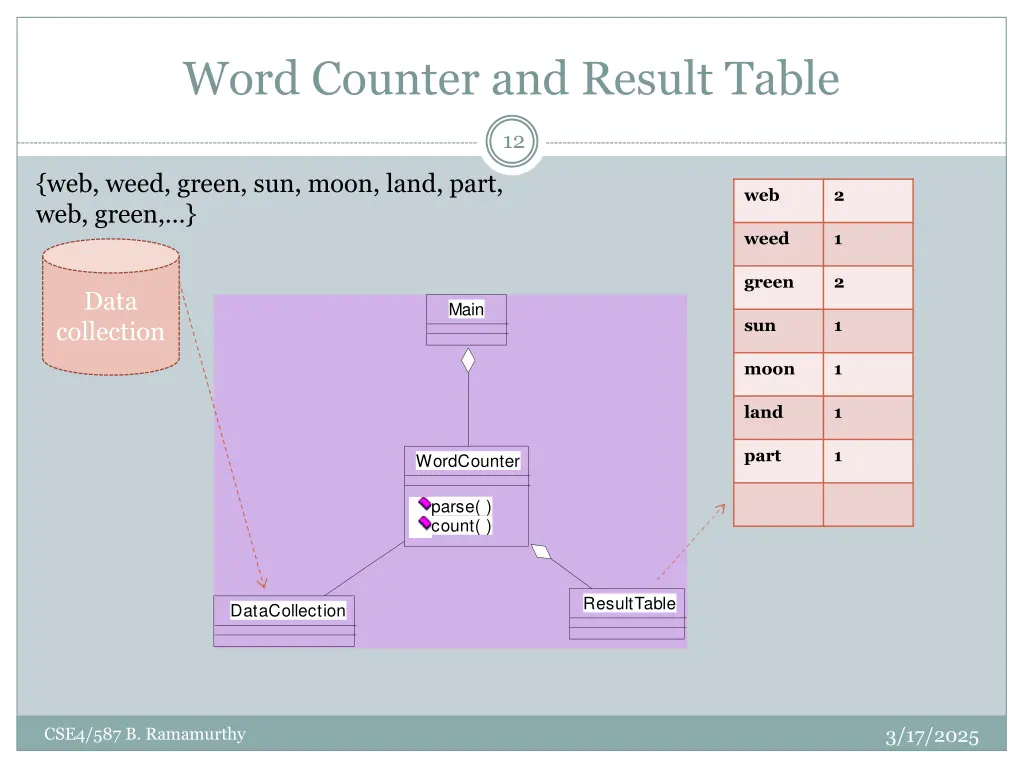
Word Counter and Result Table 12 {web, weed, green, sun, moon, land, part, web, green, } web 2 weed 1 green 2 Data Main sun 1 collection moon 1 land 1 part 1 WordCounter parse( ) count( ) ResultTable DataCollection 3/17/2025 CSE4/587 B. Ramamurthy
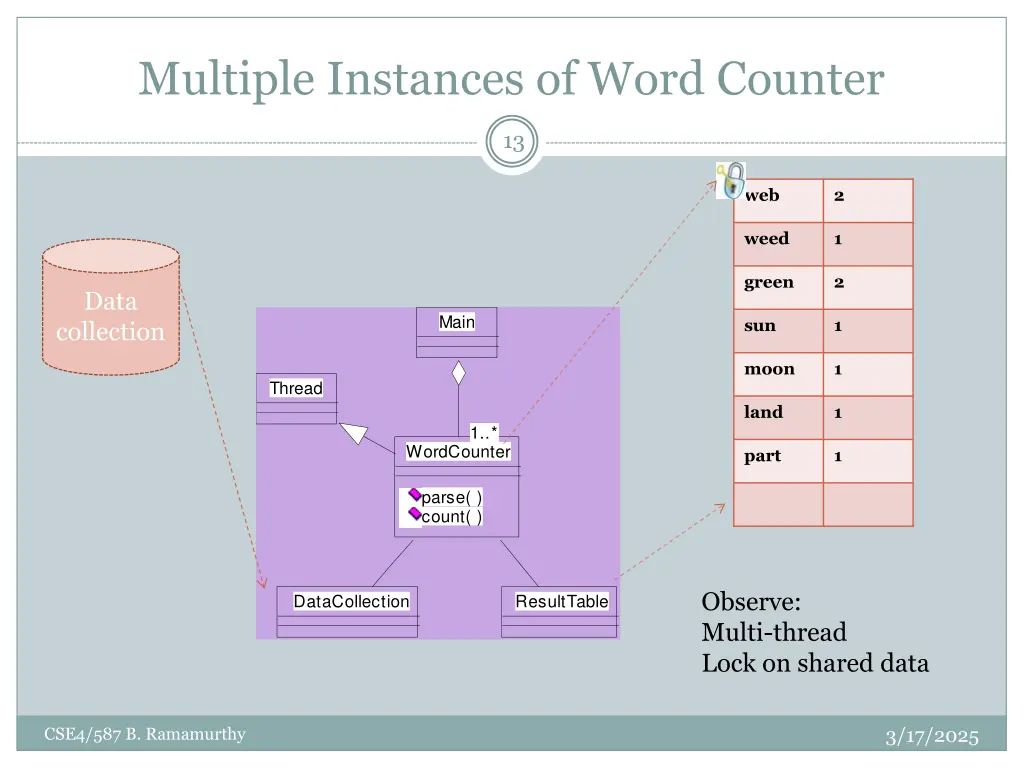
Multiple Instances of Word Counter 13 web 2 weed 1 green 2 Data Main sun 1 collection moon 1 Thread land 1 1..* 1..* WordCounter part 1 parse( ) count( ) Observe: Multi-thread Lock on shared data DataCollection ResultTable 3/17/2025 CSE4/587 B. Ramamurthy
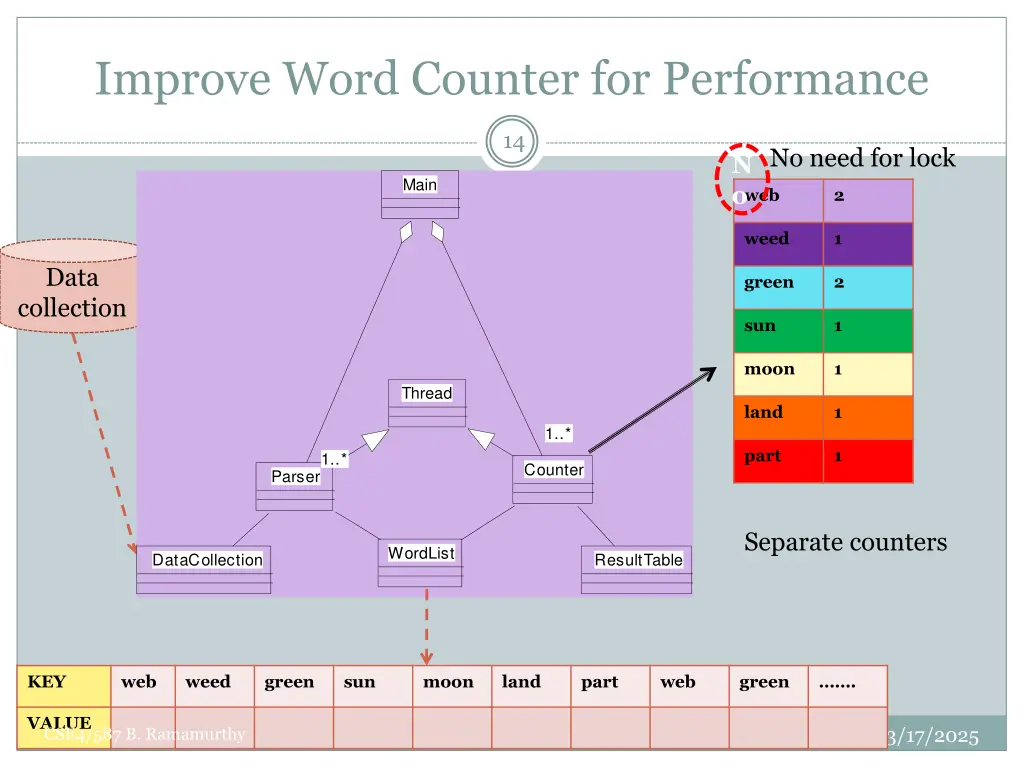
Improve Word Counter for Performance 14 No need for lock N Main web o 2 weed 1 Data green 2 collection sun 1 moon 1 Thread land 1 1..* 1..* part 1 1..* 1..* Counter Parser Separate counters WordList DataCollection ResultTable KEY web weed green sun moon land part web green . VALUE CSE4/587 B. Ramamurthy 3/17/2025
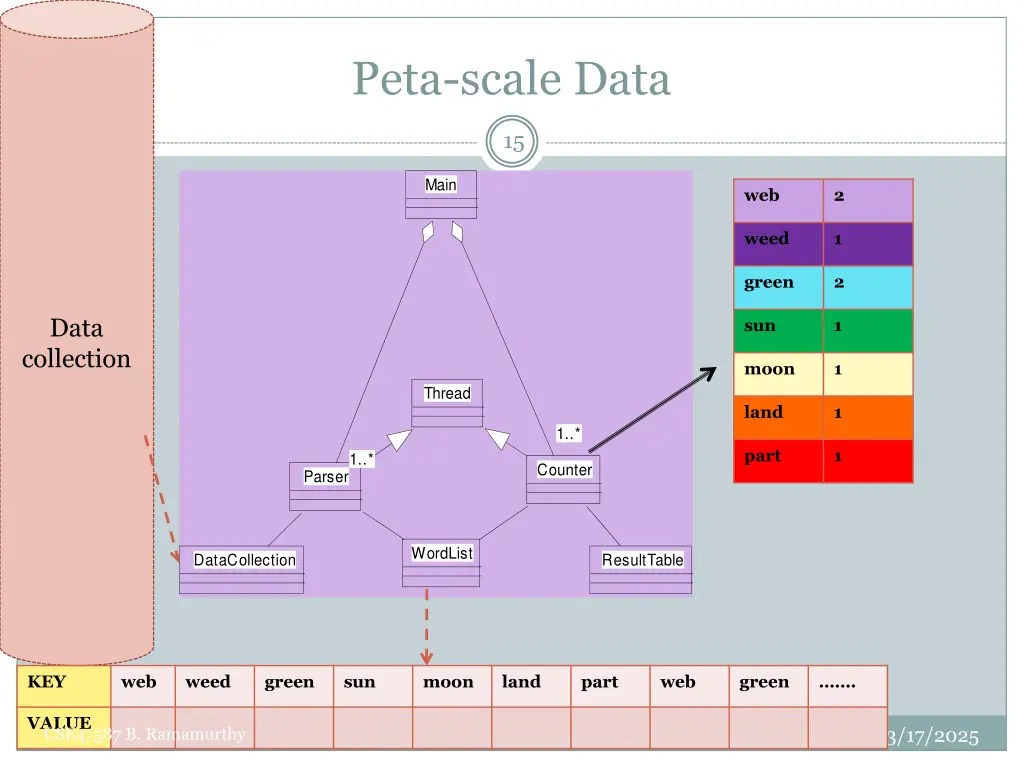
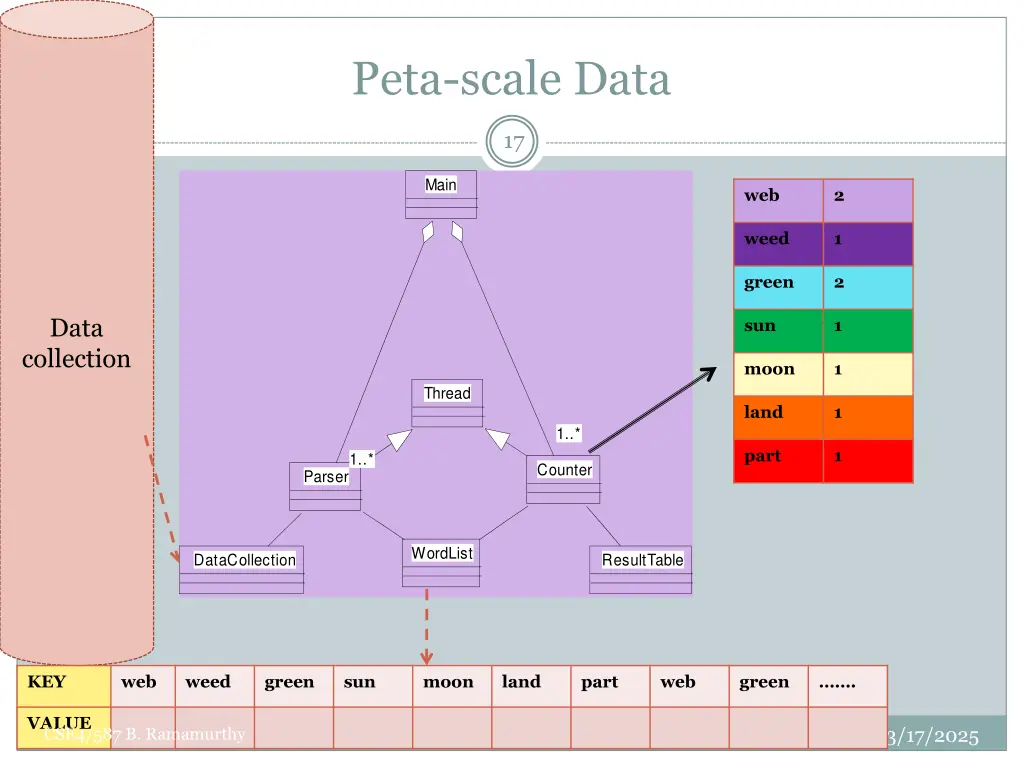
Peta-scale Data 15 Main web 2 weed 1 green 2 Data sun 1 collection moon 1 Thread land 1 1..* 1..* part 1 1..* 1..* Counter Parser WordList DataCollection ResultTable KEY web weed green sun moon land part web green . VALUE CSE4/587 B. Ramamurthy 3/17/2025
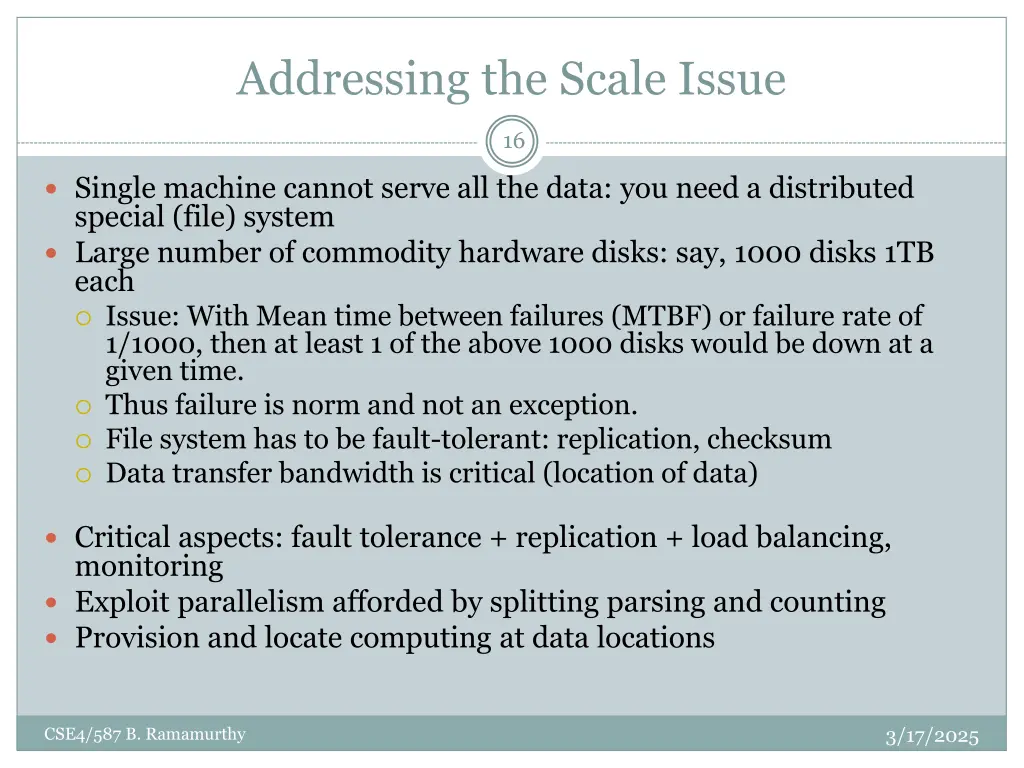
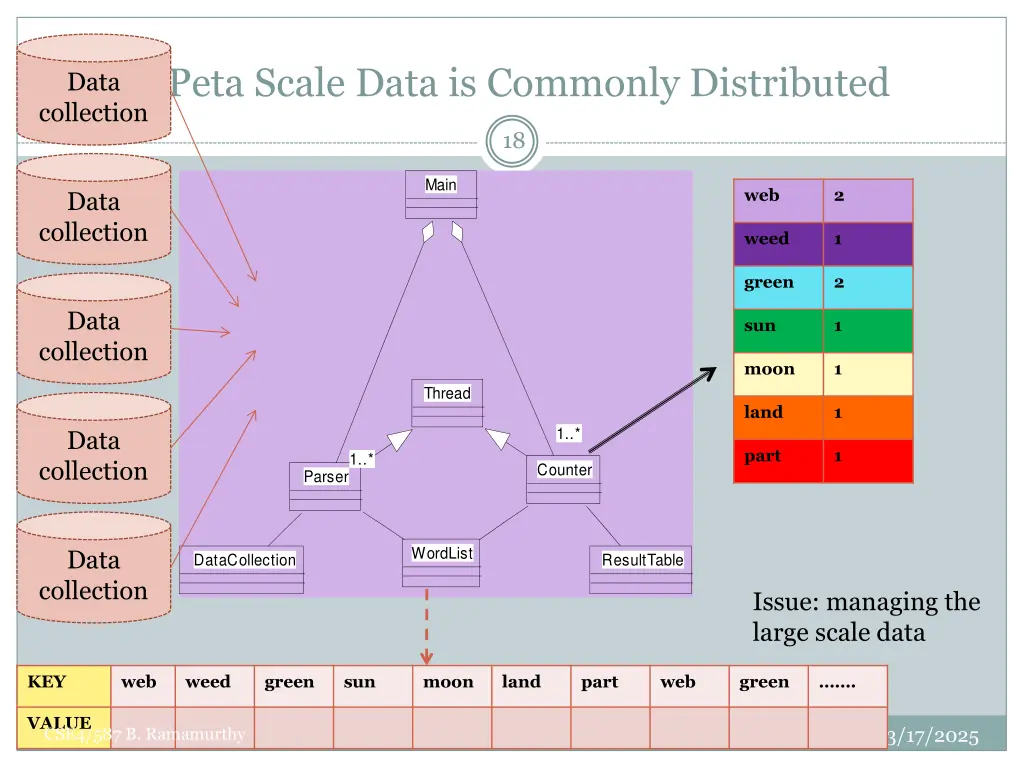
Addressing the Scale Issue 16 Single machine cannot serve all the data: you need a distributed special (file) system Large number of commodity hardware disks: say, 1000 disks 1TB each Issue: With Mean time between failures (MTBF) or failure rate of 1/1000, then at least 1 of the above 1000 disks would be down at a given time. Thus failure is norm and not an exception. File system has to be fault-tolerant: replication, checksum Data transfer bandwidth is critical (location of data) Critical aspects: fault tolerance + replication + load balancing, monitoring Exploit parallelism afforded by splitting parsing and counting Provision and locate computing at data locations 3/17/2025 CSE4/587 B. Ramamurthy
Peta-scale Data 17 Main web 2 weed 1 green 2 Data sun 1 collection moon 1 Thread land 1 1..* 1..* part 1 1..* 1..* Counter Parser WordList DataCollection ResultTable KEY web weed green sun moon land part web green . VALUE CSE4/587 B. Ramamurthy 3/17/2025
Peta Scale Data is Commonly Distributed Data collection 18 Main web 2 Data collection weed 1 green 2 Data sun 1 collection moon 1 Thread land 1 1..* 1..* Data part 1 1..* 1..* collection Counter Parser WordList Data DataCollection ResultTable collection Issue: managing the large scale data KEY web weed green sun moon land part web green . VALUE CSE4/587 B. Ramamurthy 3/17/2025
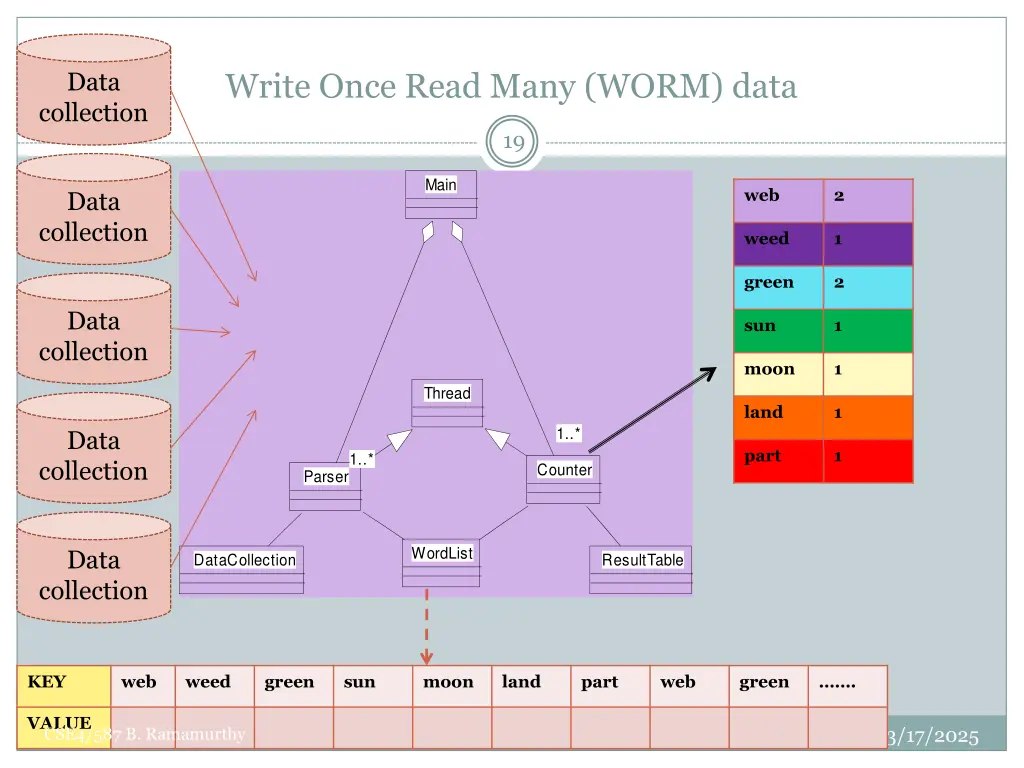
Write Once Read Many (WORM) data Data collection 19 Main web 2 Data collection weed 1 green 2 Data sun 1 collection moon 1 Thread land 1 1..* 1..* Data part 1 1..* 1..* collection Counter Parser WordList Data DataCollection ResultTable collection KEY web weed green sun moon land part web green . VALUE CSE4/587 B. Ramamurthy 3/17/2025
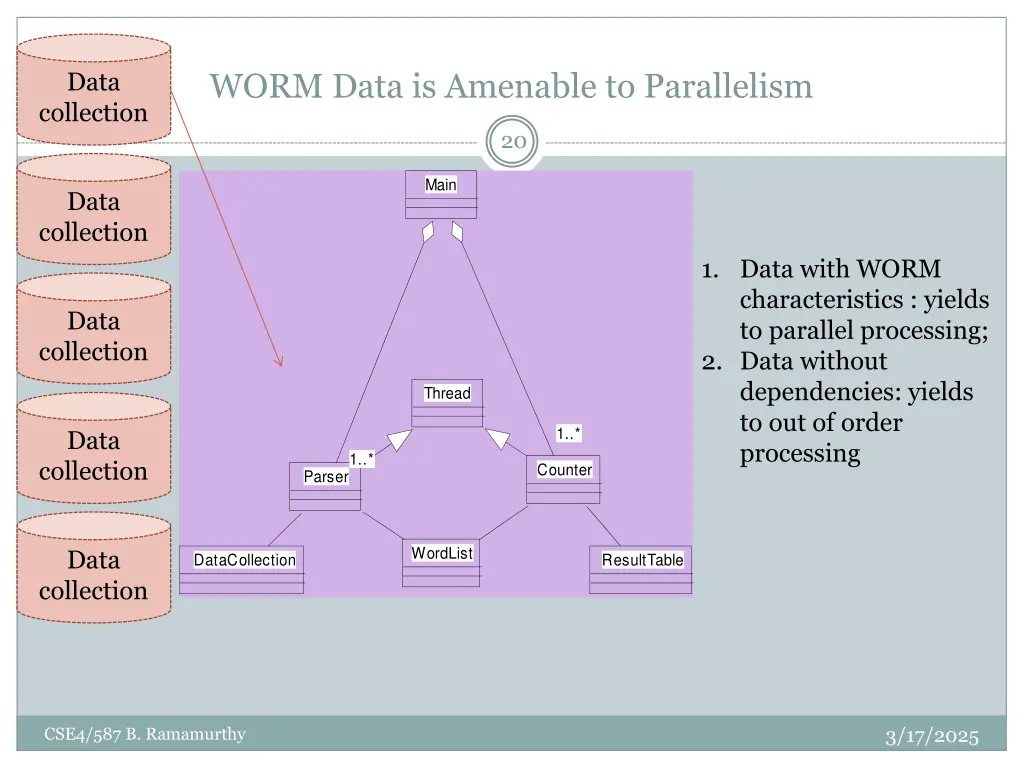
WORM Data is Amenable to Parallelism Data collection 20 Main Data collection 1. Data with WORM characteristics : yields to parallel processing; 2. Data without dependencies: yields to out of order processing Data collection Thread 1..* 1..* Data 1..* 1..* collection Counter Parser WordList Data DataCollection ResultTable collection 3/17/2025 CSE4/587 B. Ramamurthy
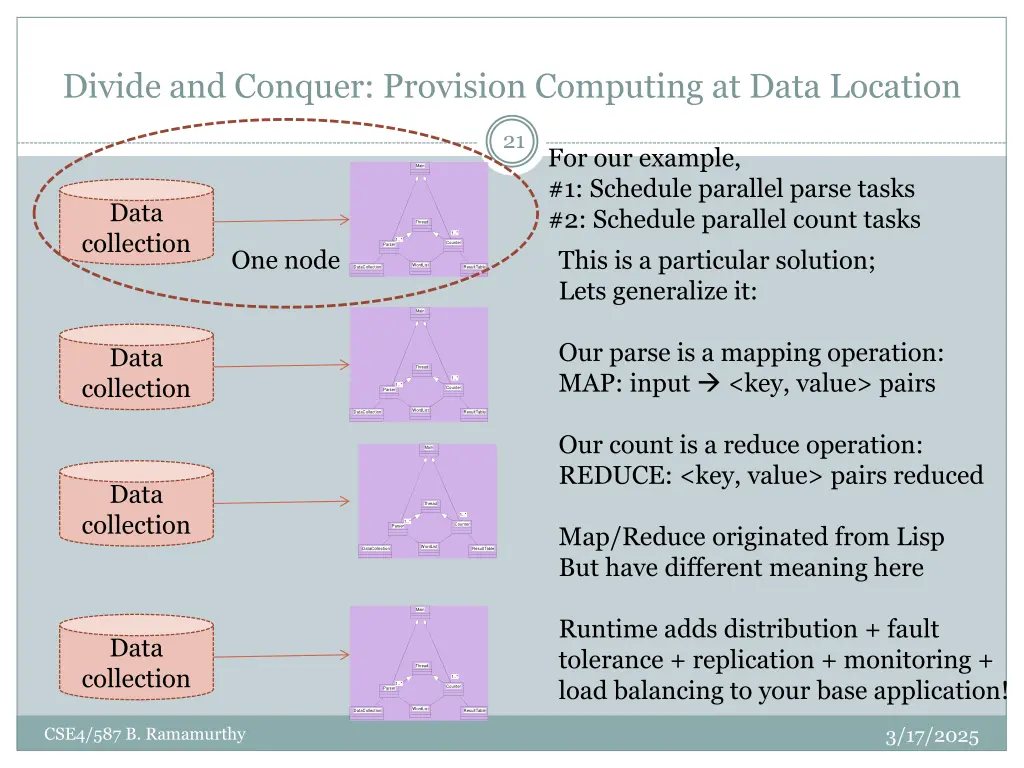
Divide and Conquer: Provision Computing at Data Location 21 For our example, #1: Schedule parallel parse tasks #2: Schedule parallel count tasks This is a particular solution; Lets generalize it: Main Data Thread collection 1..* 1..* 1..* 1..* Counter Parser One node WordList DataCollection ResultTable Main Our parse is a mapping operation: MAP: input <key, value> pairs Data Thread collection 1..* 1..* 1..* 1..* Counter Parser WordList DataCollection ResultTable Our count is a reduce operation: REDUCE: <key, value> pairs reduced Main Data Thread collection 1..* 1..* 1..* 1..* Counter Map/Reduce originated from Lisp But have different meaning here Parser WordList DataCollection ResultTable Main Runtime adds distribution + fault tolerance + replication + monitoring + load balancing to your base application! Data Thread collection 1..* 1..* 1..* 1..* Counter Parser WordList DataCollection ResultTable 3/17/2025 CSE4/587 B. Ramamurthy
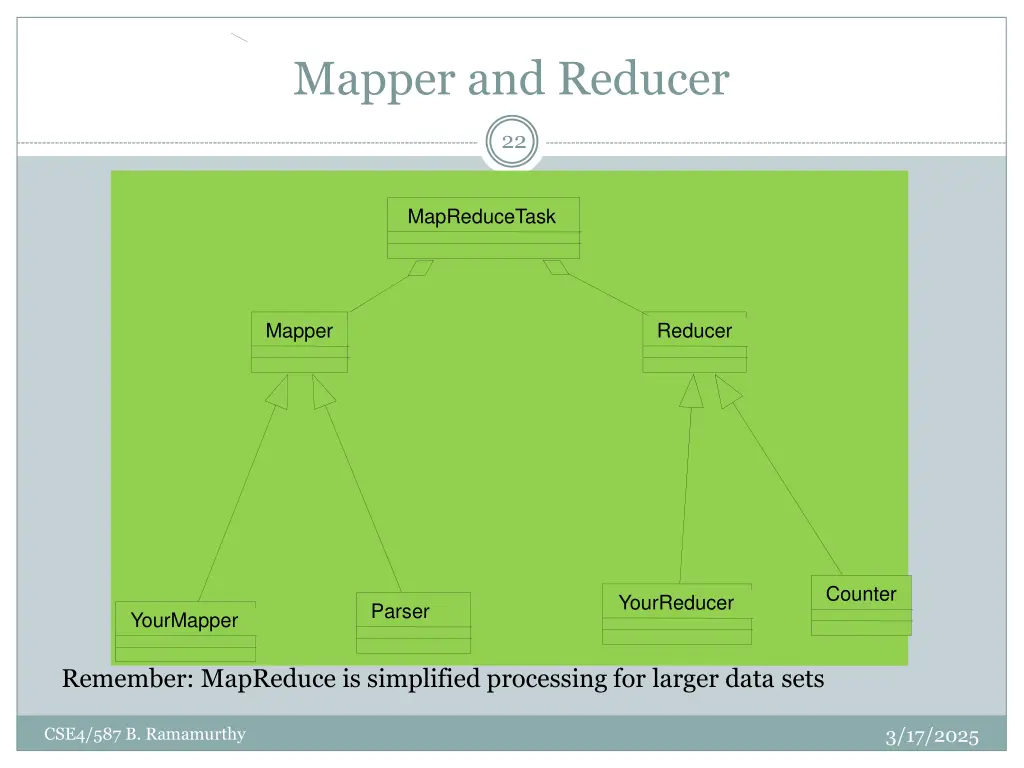
Mapper and Reducer 22 MapReduceTask Mapper Reducer Counter YourReducer Parser YourMapper Remember: MapReduce is simplified processing for larger data sets 3/17/2025 CSE4/587 B. Ramamurthy
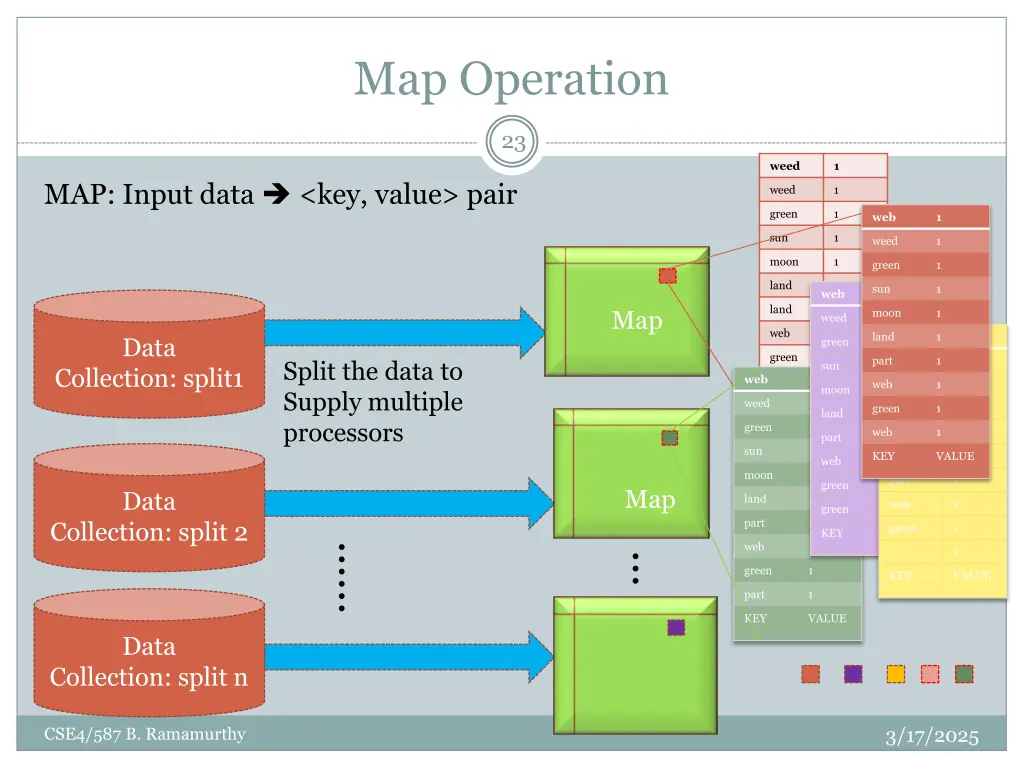
Map Operation 23 weed 1 MAP: Input data <key, value> pair weed 1 green 1 web 1 sun 1 weed 1 moon 1 green 1 land 1 sun 1 web 1 land 1 Map moon 1 weed 1 web 1 land web 1 1 Data green 1 green 1 part weed 1 1 Split the data to Supply multiple processors sun 1 Collection: split1 web 1 1 web green 1 1 moon 1 weed 1 KEY VALUE land green sun 1 1 1 green 1 web moon 1 1 part 1 sun 1 KEY land VALUE 1 web 1 moon 1 part 1 green 1 Map Data land 1 web 1 green 1 part 1 Collection: split 2 green 1 KEY VALUE web 1 1 green 1 KEY VALUE part 1 KEY VALUE Data Collection: split n 3/17/2025 CSE4/587 B. Ramamurthy
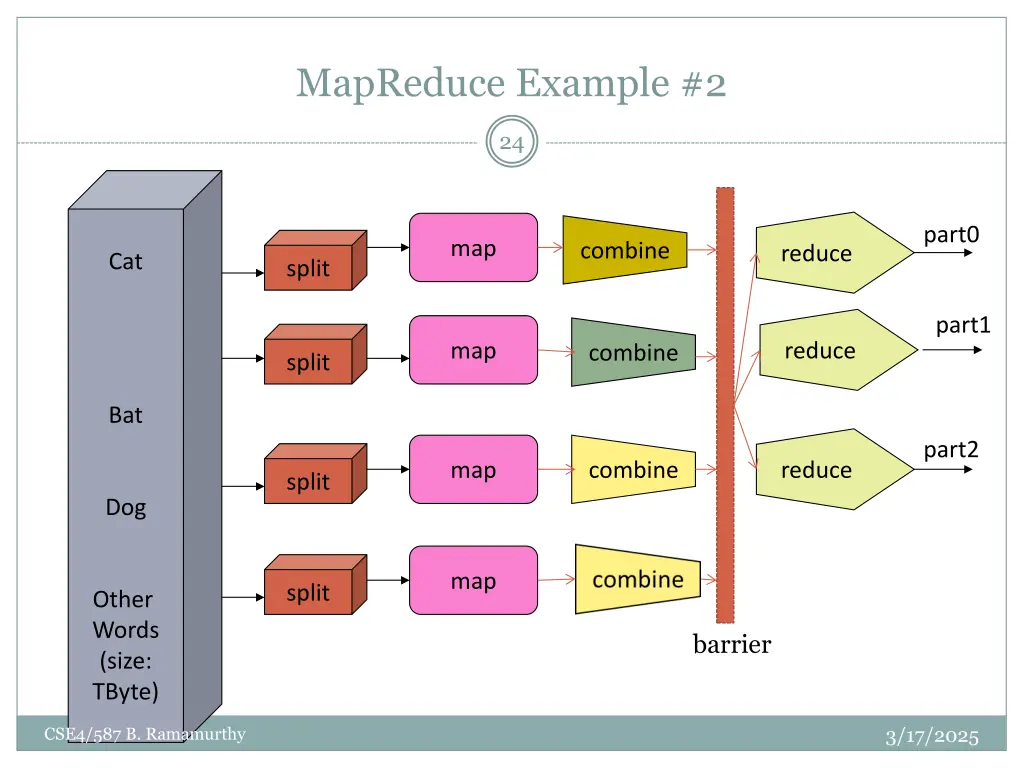
MapReduce Example #2 24 part0 map combine reduce Cat split part1 map reduce combine split Bat part2 map combine reduce split Dog map split Other Words (size: TByte) barrier 3/17/2025 CSE4/587 B. Ramamurthy
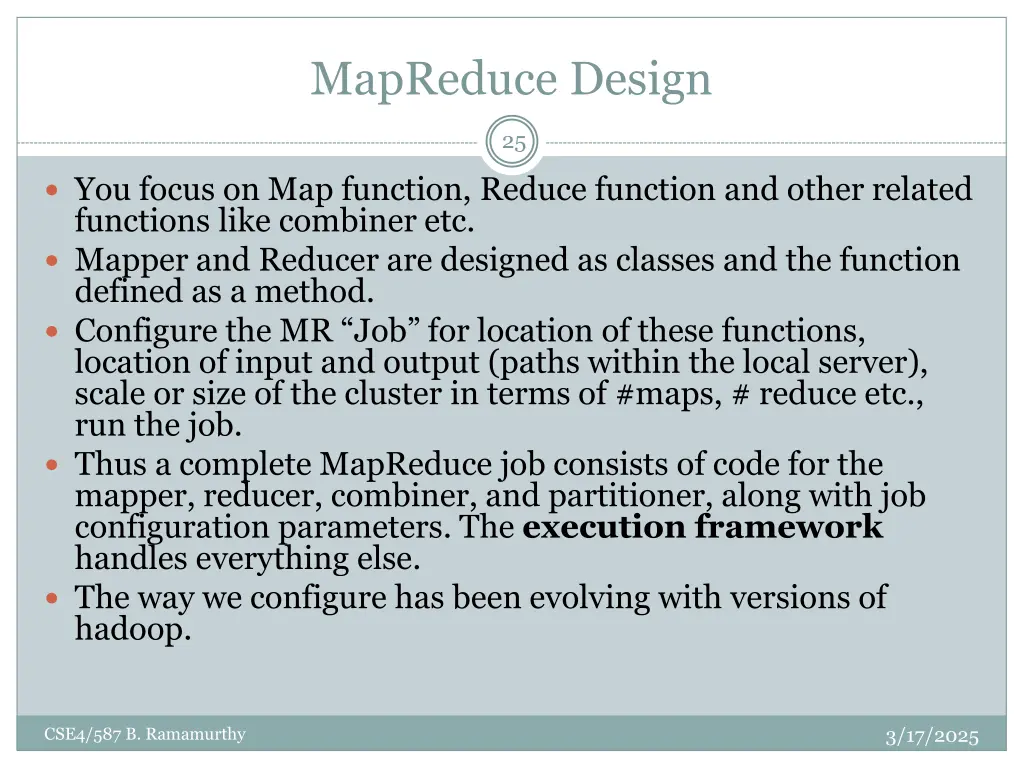
MapReduce Design 25 You focus on Map function, Reduce function and other related functions like combiner etc. Mapper and Reducer are designed as classes and the function defined as a method. Configure the MR Job for location of these functions, location of input and output (paths within the local server), scale or size of the cluster in terms of #maps, # reduce etc., run the job. Thus a complete MapReduce job consists of code for the mapper, reducer, combiner, and partitioner, along with job configuration parameters. The execution framework handles everything else. The way we configure has been evolving with versions of hadoop. 3/17/2025 CSE4/587 B. Ramamurthy
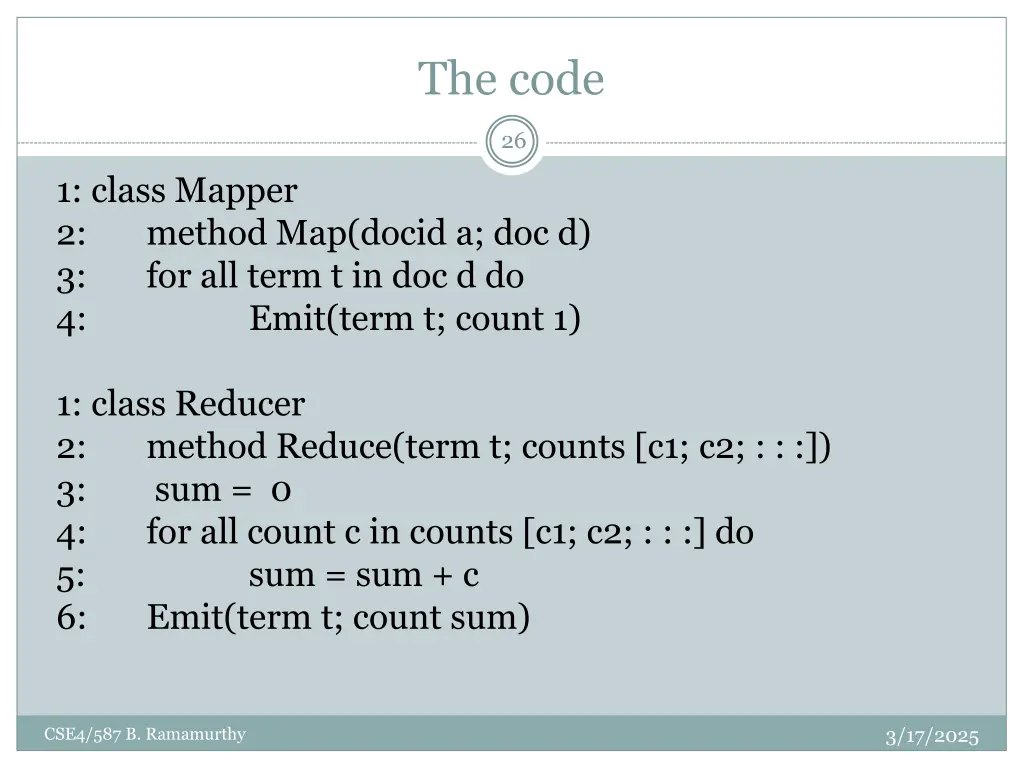
The code 26 1: class Mapper 2: method Map(docid a; doc d) 3: for all term t in doc d do 4: Emit(term t; count 1) 1: class Reducer 2: method Reduce(term t; counts [c1; c2; : : :]) 3: sum = 0 4: for all count c in counts [c1; c2; : : :] do 5: sum = sum + c 6: Emit(term t; count sum) 3/17/2025 CSE4/587 B. Ramamurthy
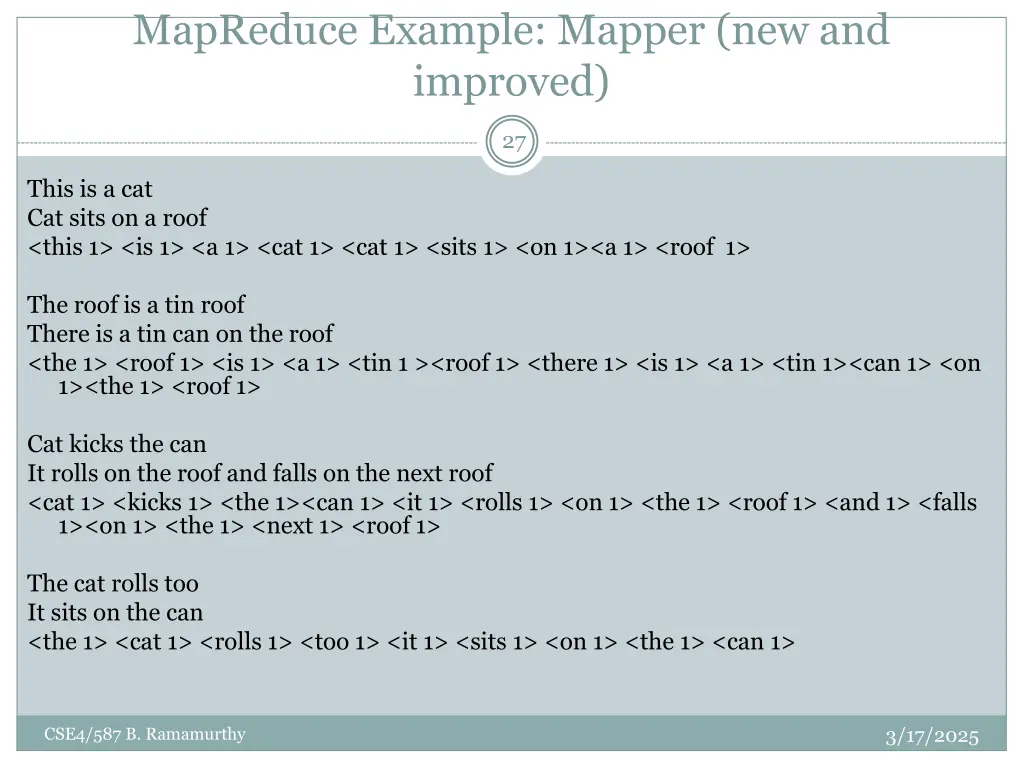
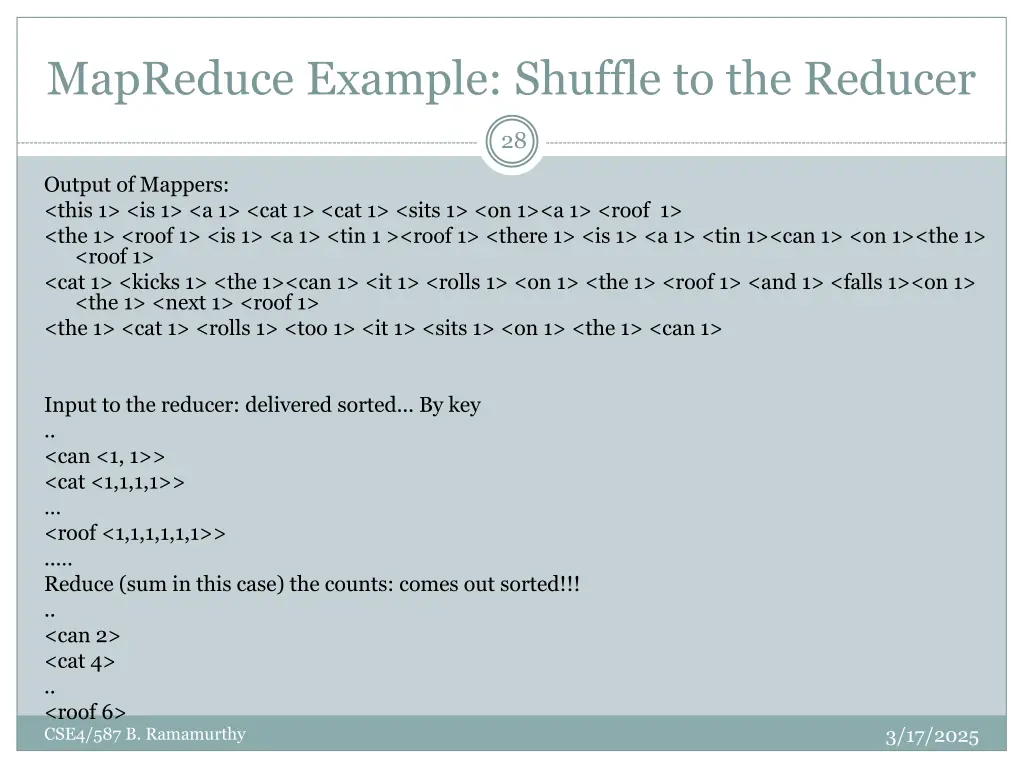
MapReduce Example: Mapper (new and improved) 27 This is a cat Cat sits on a roof <this 1> <is 1> <a 1> <cat 1> <cat 1> <sits 1> <on 1><a 1> <roof 1> The roof is a tin roof There is a tin can on the roof <the 1> <roof 1> <is 1> <a 1> <tin 1 ><roof 1> <there 1> <is 1> <a 1> <tin 1><can 1> <on 1><the 1> <roof 1> Cat kicks the can It rolls on the roof and falls on the next roof <cat 1> <kicks 1> <the 1><can 1> <it 1> <rolls 1> <on 1> <the 1> <roof 1> <and 1> <falls 1><on 1> <the 1> <next 1> <roof 1> The cat rolls too It sits on the can <the 1> <cat 1> <rolls 1> <too 1> <it 1> <sits 1> <on 1> <the 1> <can 1> 3/17/2025 CSE4/587 B. Ramamurthy
More on MR 29 All Mappers work in parallel. Barriers enforce all mappers completion before Reducers start. Mappers and Reducers typically execute on the same machine You can configure job to have other combinations besides Mapper/Reducer: ex: identify mappers/reducers for realizing sort (that happens to be a Benchmark) Mappers and reducers can have side effects; this allows for sharing information between iterations. 3/17/2025 CSE4/587 B. Ramamurthy
MapReduce Characteristics 30 Very large scale data: peta, exa bytes Write once and read many data: allows for parallelism without mutexes Map and Reduce are the main operations: simple code There are other supporting operations such as combine and partition: we will look at those later. Operations are provisioned near the data. Commodity hardware and storage. Runtime takes care of splitting and moving data for operations. Special distributed file system: Hadoop Distributed File System and Hadoop Runtime. 3/17/2025 CSE4/587 B. Ramamurthy
Classes of problems mapreducable 31 Benchmark for comparing: Jim Gray s challenge on data- intensive computing. Ex: Sort Google uses it (we think) for wordcount, adwords, pagerank, indexing data. Simple algorithms such as grep, text-indexing, reverse indexing Bayesian classification: data mining domain Facebook uses it for various operations: demographics Financial services use it for analytics Astronomy: Gaussian analysis for locating extra-terrestrial objects. Expected to play a critical role in semantic web and web3.0 3/17/2025 CSE4/587 B. Ramamurthy
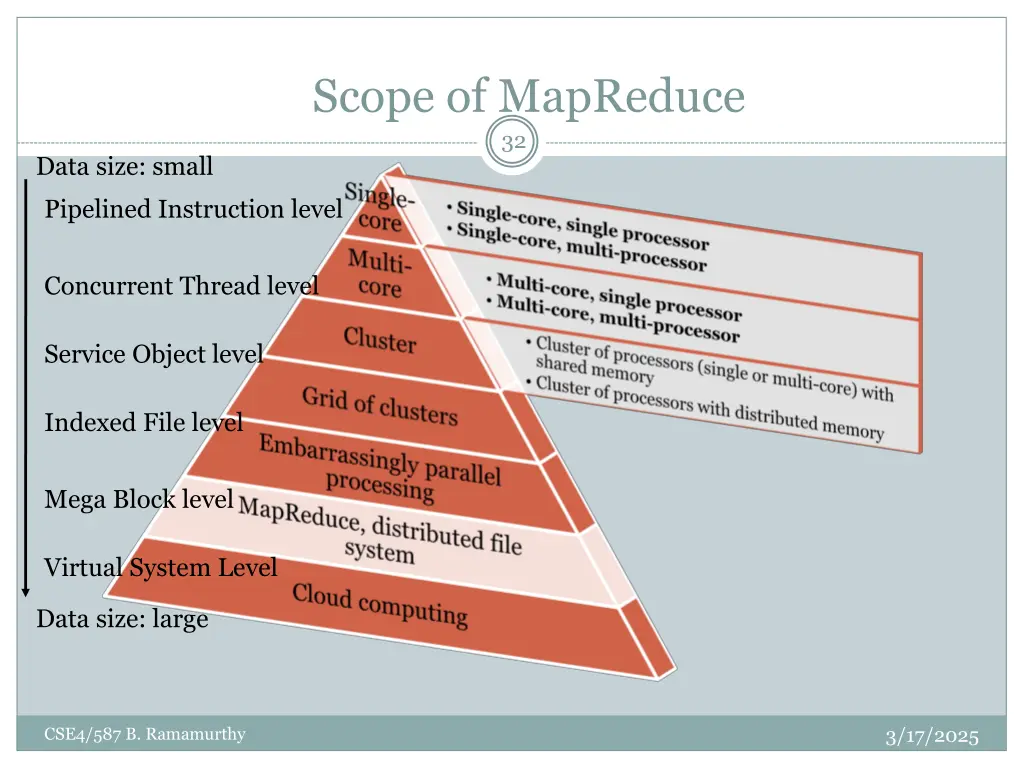
Scope of MapReduce 32 Data size: small Pipelined Instruction level Concurrent Thread level Service Object level Indexed File level Mega Block level Virtual System Level Data size: large 3/17/2025 CSE4/587 B. Ramamurthy
Lets Review Map/Reducer 33 Map function maps one <key,value> space to another. One to many: expand or divide Reduce does that too. But many to one: merge There can be multiple maps in a single machine Each mapper(map) runs parallel with and independent of the other (think of a bee hive) All the outputs from mappers are collected and the key space is partitioned among the reducers. (what do you need to partition?) Now the reducers take over. One reduce/per key (by default) Reduce operation can be anything.. Does not have to be just counting (operation [list of items]) You can do magic with this concept. 3/17/2025 CSE4/587 B. Ramamurthy
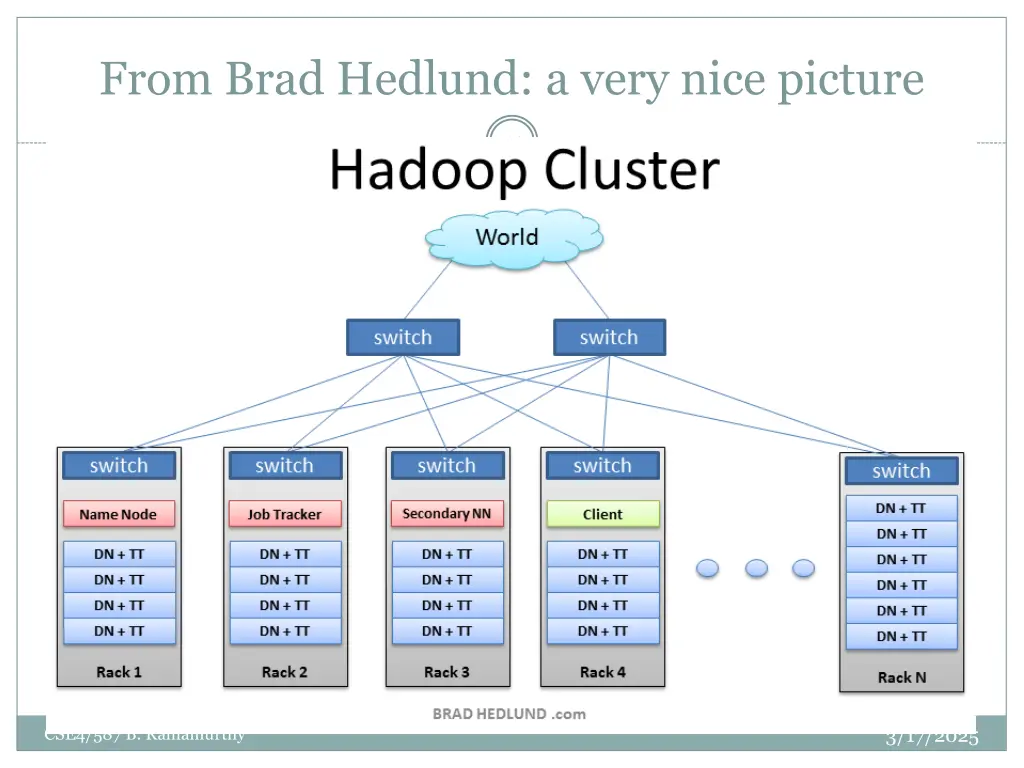
What is Hadoop? 35 At Google MapReduce operation are run on a special file system called Google File System (GFS) that is highly optimized for this purpose. GFS is not open source. Doug Cutting and Yahoo! reverse engineered the GFS and called it Hadoop Distributed File System (HDFS). The software framework that supports HDFS, MapReduce and other related entities is called the project Hadoop or simply Hadoop. This is open source and distributed by Apache. 3/17/2025 CSE4/587 B. Ramamurthy
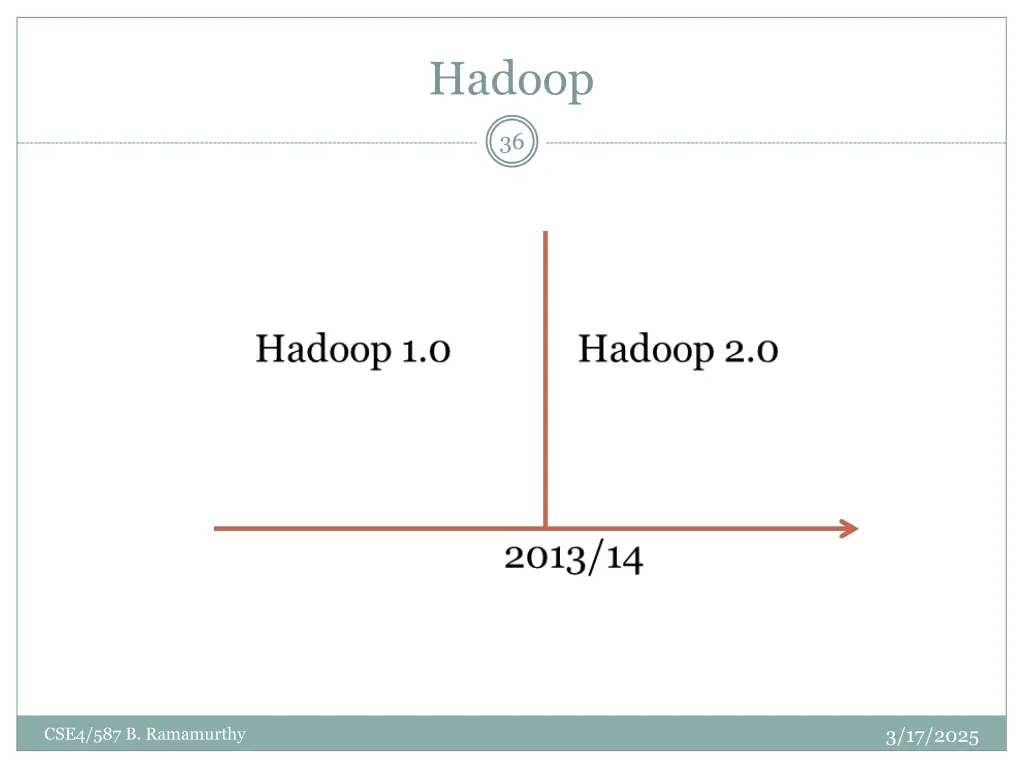
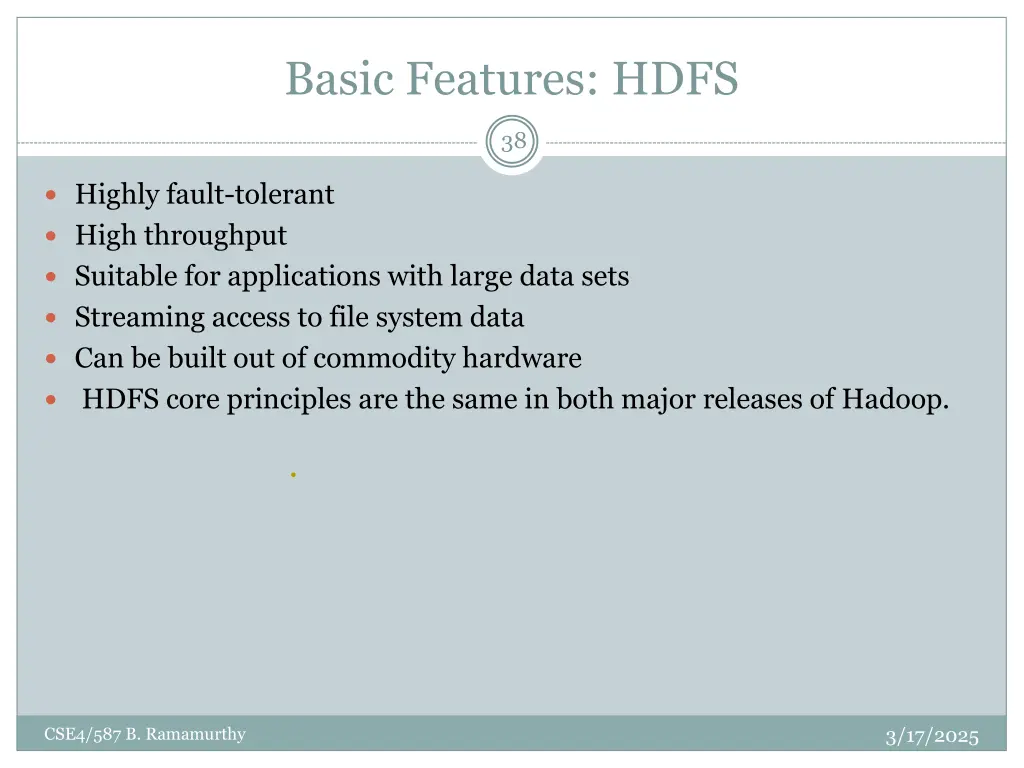
Basic Features: HDFS 38 Highly fault-tolerant High throughput Suitable for applications with large data sets Streaming access to file system data Can be built out of commodity hardware HDFS core principles are the same in both major releases of Hadoop. 3/17/2025 CSE4/587 B. Ramamurthy
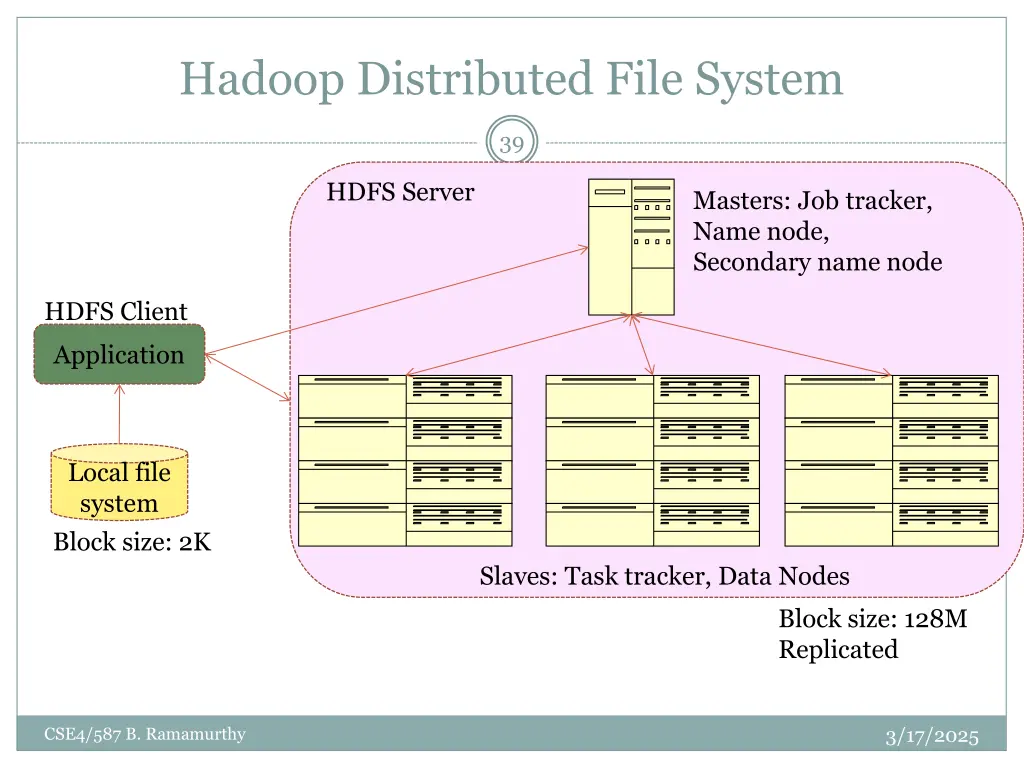
Hadoop Distributed File System 39 HDFS Server Masters: Job tracker, Name node, Secondary name node HDFS Client Application Local file system Block size: 2K Slaves: Task tracker, Data Nodes Block size: 128M Replicated 3/17/2025 CSE4/587 B. Ramamurthy
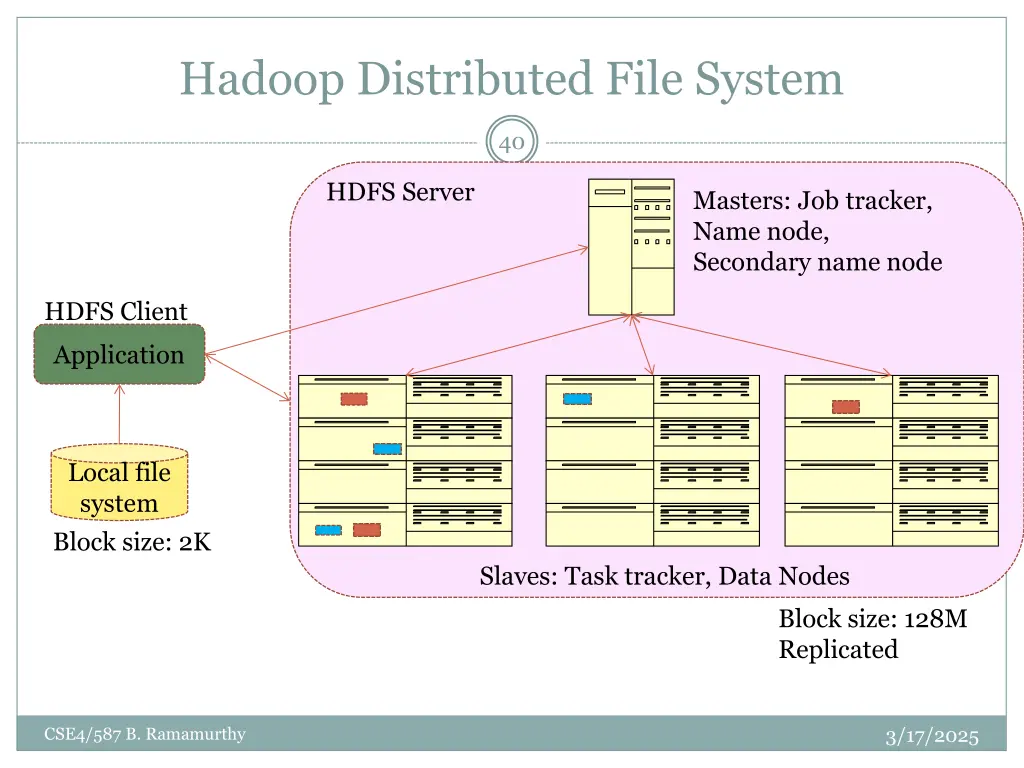
Hadoop Distributed File System 40 HDFS Server Masters: Job tracker, Name node, Secondary name node HDFS Client Application Local file system Block size: 2K Slaves: Task tracker, Data Nodes Block size: 128M Replicated 3/17/2025 CSE4/587 B. Ramamurthy
Hadoop (contd.) 42 What are : Job tracker, Name node, Secondary name node, data node, task tracker ? What are their roles? Before we discuss those: lets look a demo of mapreduce on Hadoop MapReduce 3/17/2025 CSE4/587 B. Ramamurthy