Innovative Property Assessment Using LiDAR and Photogrammetry in Ireland
Explore how LiDAR and photogrammetry technologies are revolutionizing property assessment in Ireland, overcoming traditional barriers with cost-effective 3D modelling. Discover the benefits, accuracy, and cost reductions associated with this advanced approach.

Download Presentation

Please find below an Image/Link to download the presentation.
The content on the website is provided AS IS for your information and personal use only. It may not be sold, licensed, or shared on other websites without obtaining consent from the author. If you encounter any issues during the download, it is possible that the publisher has removed the file from their server.
You are allowed to download the files provided on this website for personal or commercial use, subject to the condition that they are used lawfully. All files are the property of their respective owners.
The content on the website is provided AS IS for your information and personal use only. It may not be sold, licensed, or shared on other websites without obtaining consent from the author.
E N D
Presentation Transcript
Property Assessment of Derelict Buildings in Ireland Using LiDAR and Photogrammetry Dylan O'Donnell | South East Technological University April 2025
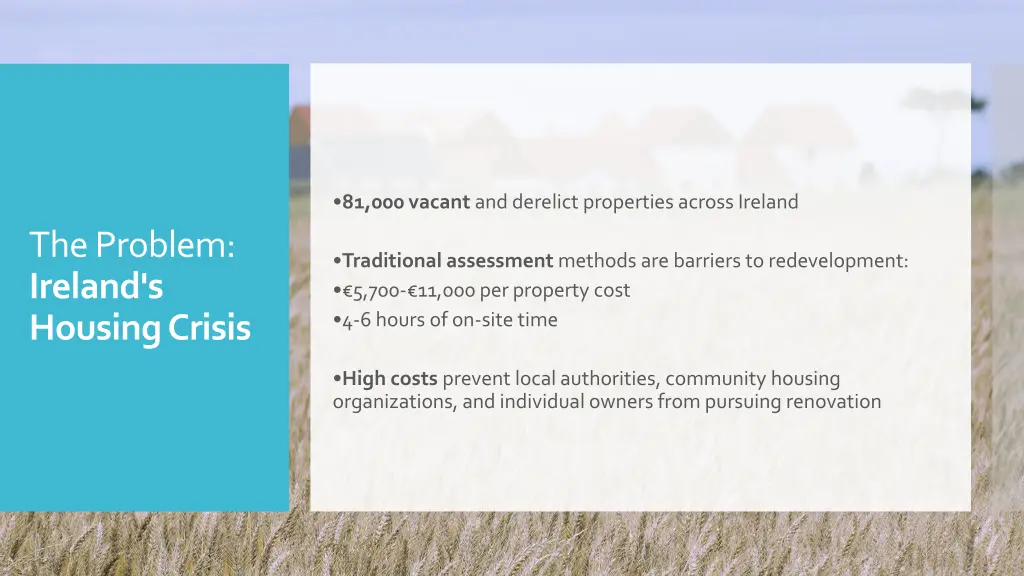
81,000 vacant and derelict properties across Ireland The Problem: Ireland's Housing Crisis Traditional assessment methods are barriers to redevelopment: 5,700- 11,000 per property cost 4-6 hours of on-site time High costs prevent local authorities, community housing organizations, and individual owners from pursuing renovation
Consumer-grade LiDAR and photogrammetry technology iPhone 16 Pro LiDAR scanner The proposed Solution Generate accurate 3D models for assessment Significantly reduces cost and time requirements Enables remote evaluation and sharing
Hardware & Software iPhone 16 Pro with built-in LiDAR sensor Polycamand Scaniversescanning apps Sketchfab for model hosting and sharing Technical Implementation Scanning Process Room-by-room approach with 25% overlap Detail capture for complex features and damage Validation against professional measuring tools
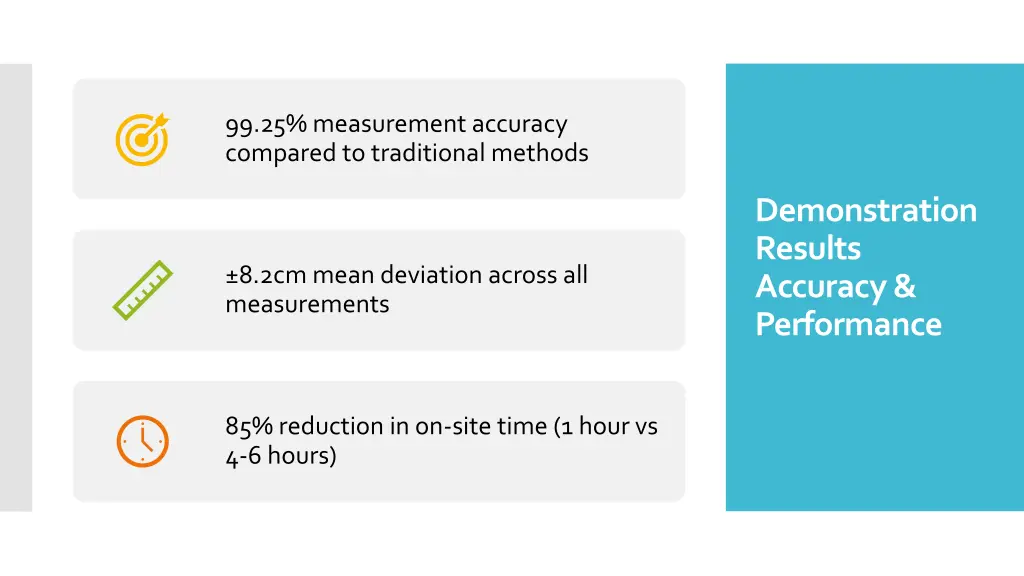
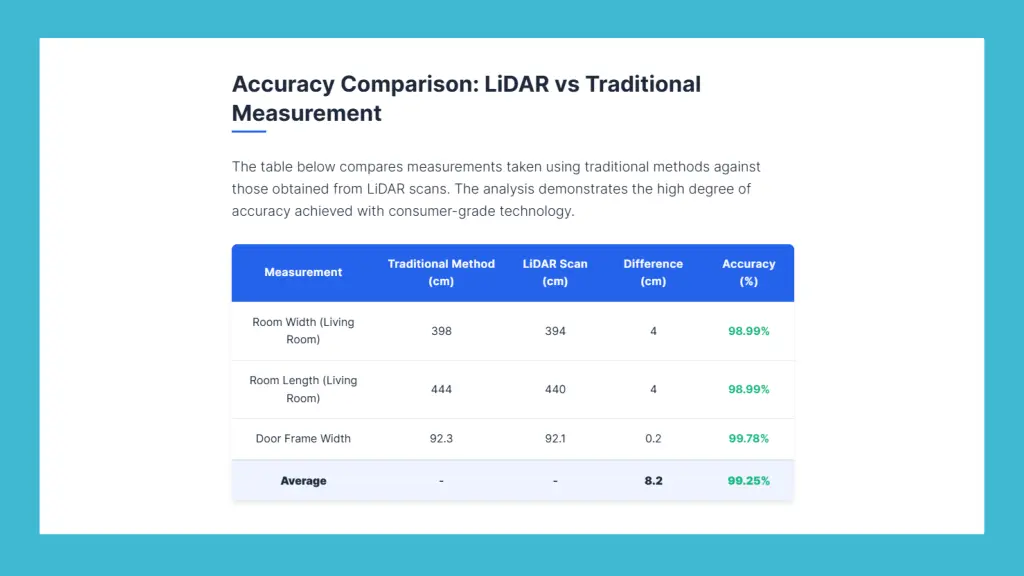
99.25% measurement accuracy compared to traditional methods Demonstration Results Accuracy & Performance 8.2cm mean deviation across all measurements 85% reduction in on-site time (1 hour vs 4-6 hours)
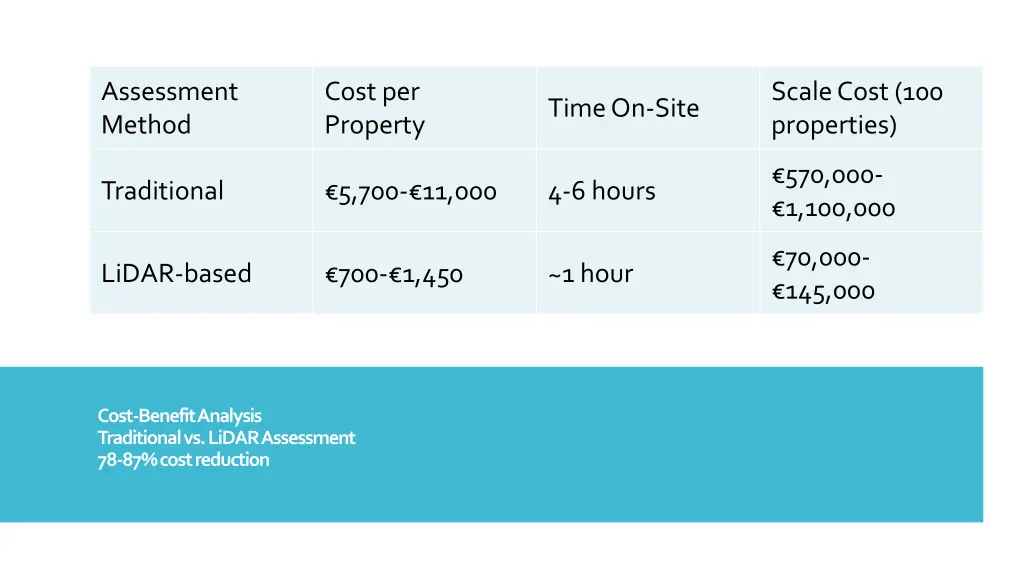
Assessment Method Cost per Property Scale Cost (100 properties) Time On-Site 570,000- 1,100,000 Traditional 5,700- 11,000 4-6 hours 70,000- 145,000 LiDAR-based 700- 1,450 ~1 hour Cost-Benefit Analysis Traditional vs. LiDAR Assessment 78-87% cost reduction
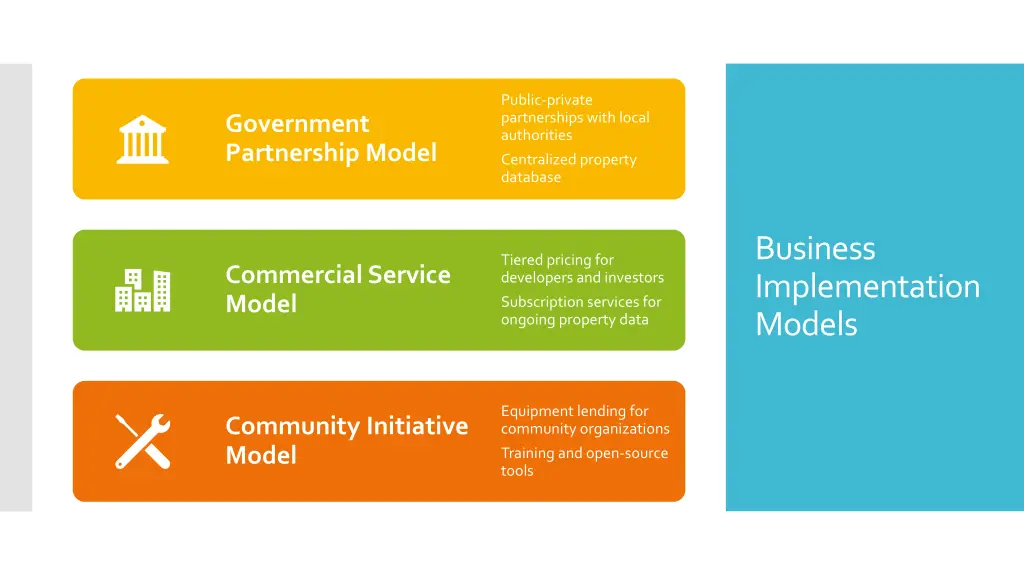
Public-private partnerships with local authorities Government Partnership Model Centralized property database Business Implementation Models Tiered pricing for developers and investors Commercial Service Model Subscription services for ongoing property data Equipment lending for community organizations Community Initiative Model Training and open-source tools
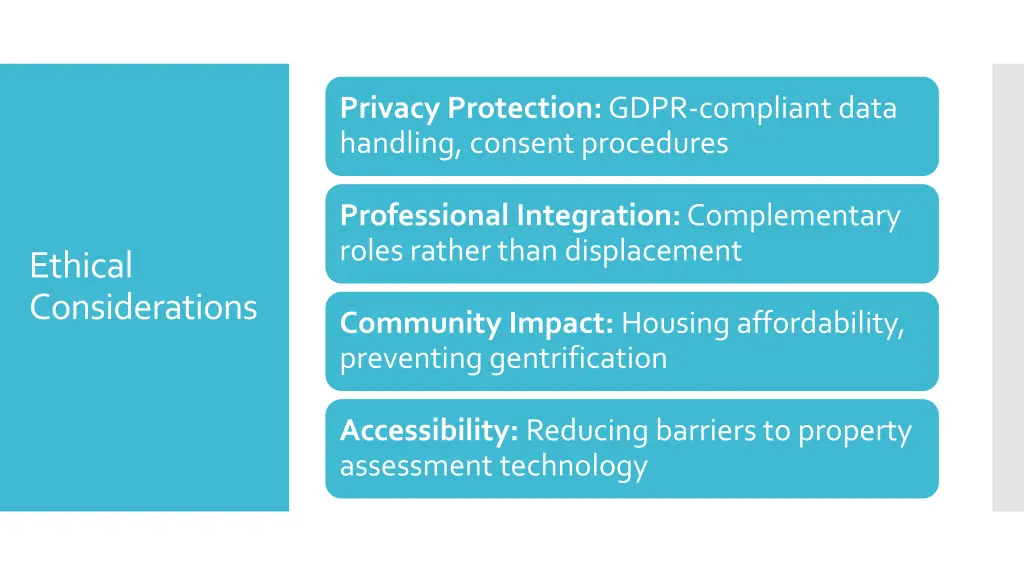
Privacy Protection: GDPR-compliant data handling, consent procedures Professional Integration: Complementary roles rather than displacement Ethical Considerations Community Impact: Housing affordability, preventing gentrification Accessibility: Reducing barriers to property assessment technology
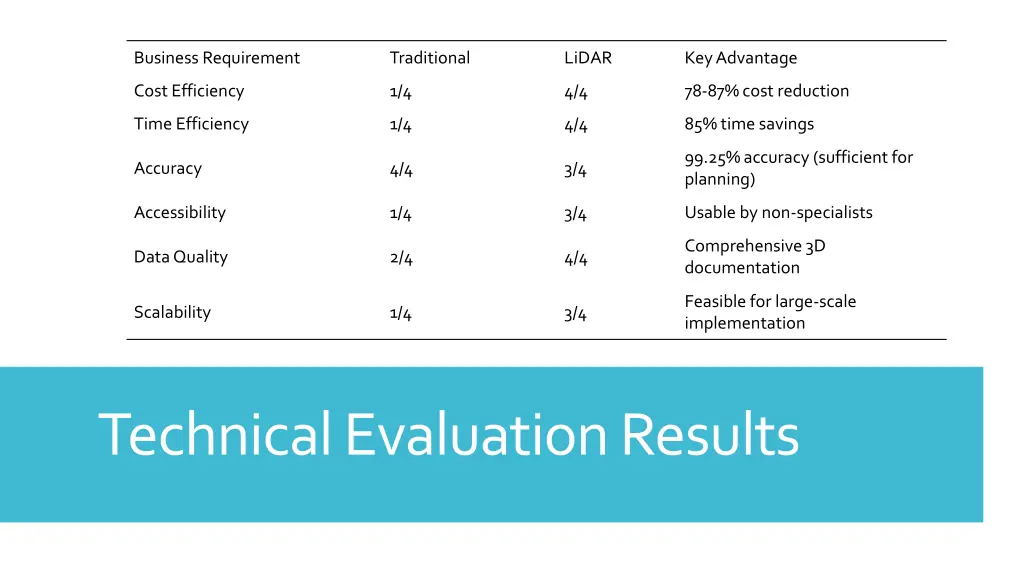
Business Requirement Traditional LiDAR Key Advantage Cost Efficiency 1/4 4/4 78-87% cost reduction Time Efficiency 1/4 4/4 85% time savings 99.25% accuracy (sufficient for planning) Accuracy 4/4 3/4 Accessibility 1/4 3/4 Usable by non-specialists Comprehensive 3D documentation Data Quality 2/4 4/4 Feasible for large-scale implementation Scalability 1/4 3/4 Technical Evaluation Results
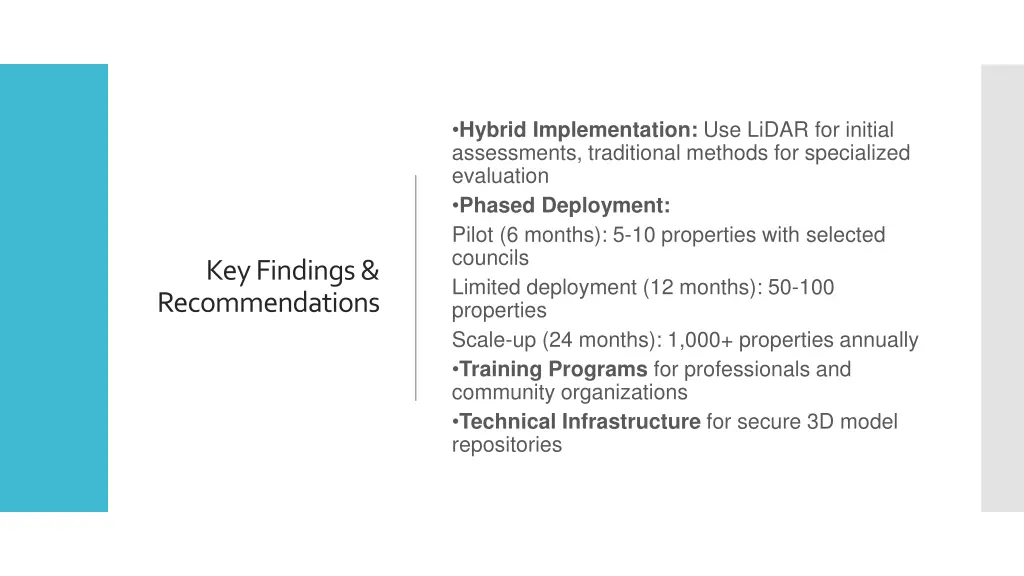
Hybrid Implementation: Use LiDAR for initial assessments, traditional methods for specialized evaluation Phased Deployment: Pilot (6 months): 5-10 properties with selected councils Limited deployment (12 months): 50-100 properties Scale-up (24 months): 1,000+ properties annually Training Programs for professionals and community organizations Technical Infrastructure for secure 3D model repositories Key Findings & Recommendations
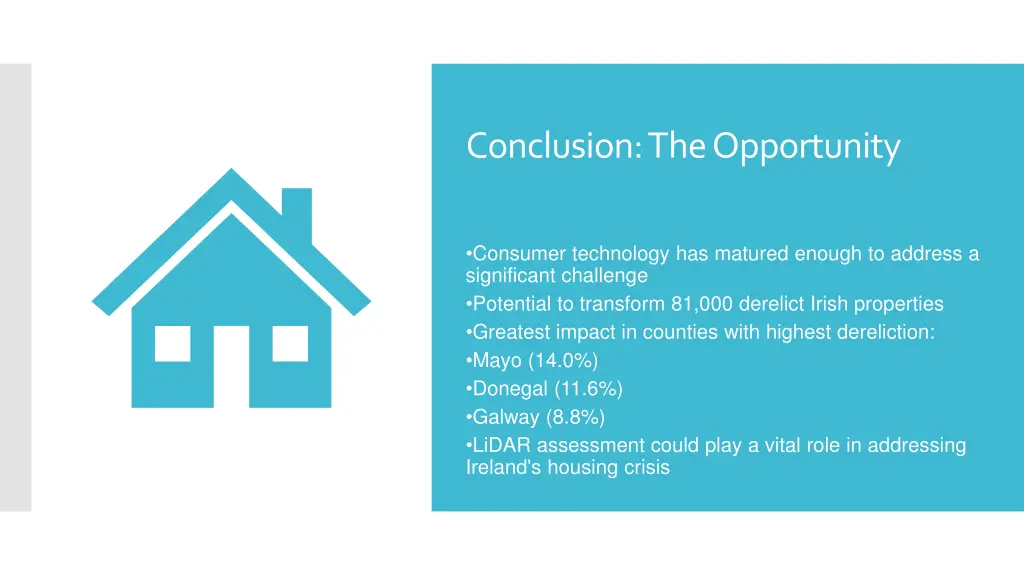
Conclusion: The Opportunity Consumer technology has matured enough to address a significant challenge Potential to transform 81,000 derelict Irish properties Greatest impact in counties with highest dereliction: Mayo (14.0%) Donegal (11.6%) Galway (8.8%) LiDAR assessment could play a vital role in addressing Ireland's housing crisis
Thank You Questions? Project website: https://showcase.itcarlow.ie/it.html Demo video: https://youtu.be/PZ28iOW5xcA Dylan O'Donnell | South East Technological University