Innovative Strategies for Model-Oriented Information Organization
Explore cutting-edge approaches to effectively organize vast amounts of information using modeling techniques beyond traditional metadata methods. Learn how to improve user interaction, text mining, and content merging for enhanced information management.

Download Presentation

Please find below an Image/Link to download the presentation.
The content on the website is provided AS IS for your information and personal use only. It may not be sold, licensed, or shared on other websites without obtaining consent from the author. If you encounter any issues during the download, it is possible that the publisher has removed the file from their server.
You are allowed to download the files provided on this website for personal or commercial use, subject to the condition that they are used lawfully. All files are the property of their respective owners.
The content on the website is provided AS IS for your information and personal use only. It may not be sold, licensed, or shared on other websites without obtaining consent from the author.
E N D
Presentation Transcript
Strategies for Model-Oriented Information Organization Robert B. ALLEN Research Center for Knowledge Communities University of Tsukuba Tsukuba, Japan rba@boballen.info
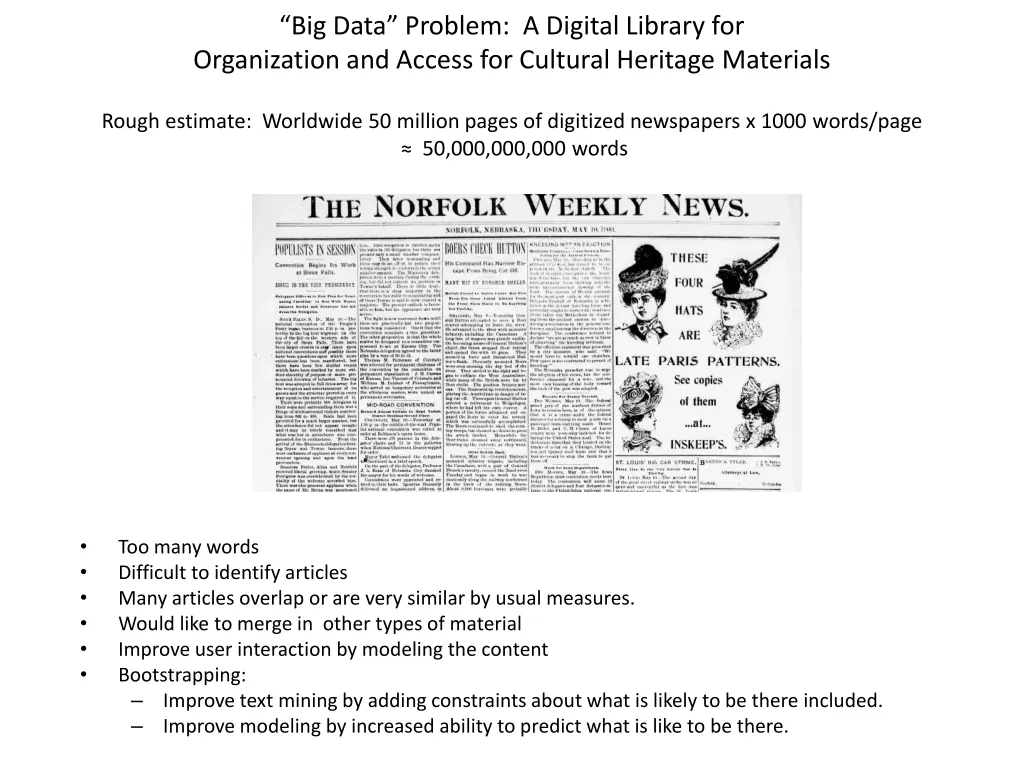
Big Data Problem: A Digital Library for Organization and Access for Cultural Heritage Materials Rough estimate: Worldwide 50 million pages of digitized newspapers x 1000 words/page 50,000,000,000 words Too many words Difficult to identify articles Many articles overlap or are very similar by usual measures. Would like to merge in other types of material Improve user interaction by modeling the content Bootstrapping: Improve text mining by adding constraints about what is likely to be there included. Improve modeling by increased ability to predict what is like to be there.
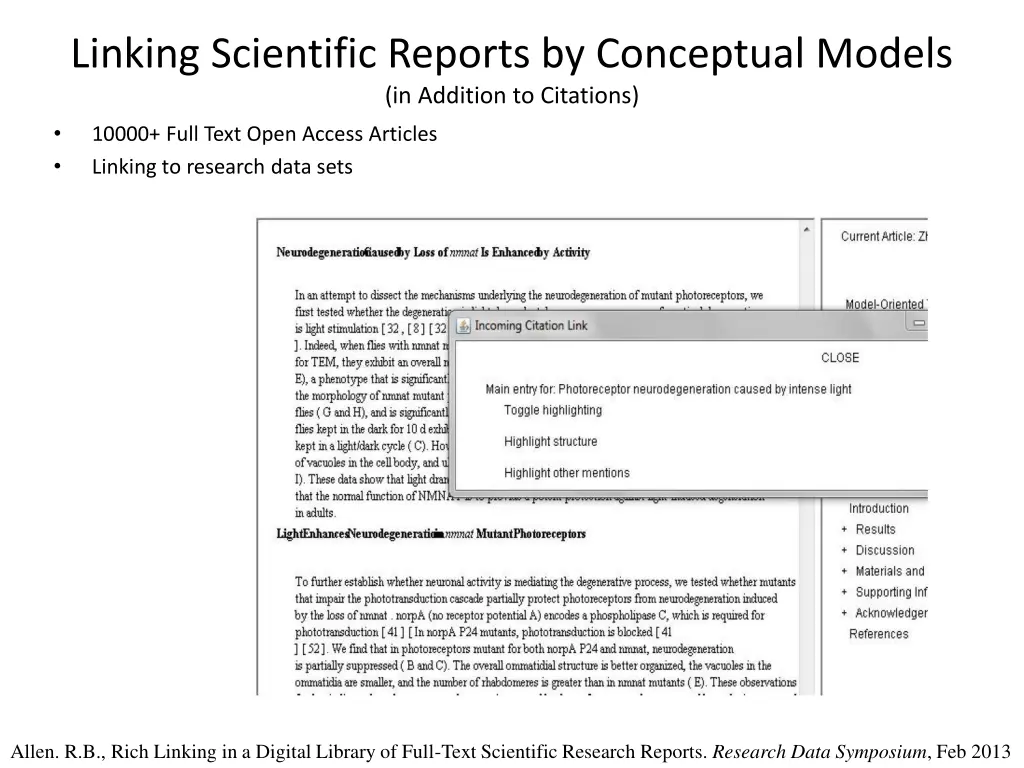
Linking Scientific Reports by Conceptual Models (in Addition to Citations) 10000+ Full Text Open Access Articles Linking to research data sets Allen. R.B., Rich Linking in a Digital Library of Full-Text Scientific Research Reports. Research Data Symposium, Feb 2013
Information Organization beyond Metadata Other Areas where improved Information Organization is needed: Other types of cultural materials (artifacts) Literature, Videos, Images, Games, Manga Sensor fusion, Internet of Things Try modeling as an approach to information organization More than simple linking of data which we have now All linked data has some sort of model Supporting new types of interaction This isn t indexing as usually conceived
What do we mean by Modeling Complex sets of relationships. Different from ontologies or LOD. Or, rather, there is an implicit model in those. Many people have looked at aspects of this problem Cognitive models, mental models Tutoring systems Business process engineering Activity theory NOT Not just data models (ER, RDF) Not fully nuanced simulations (intentionally limited) Not automatic inference Often cognitively inspired, after all, human beings a good at information organization Here we emphasize technical issues for a limited number of these
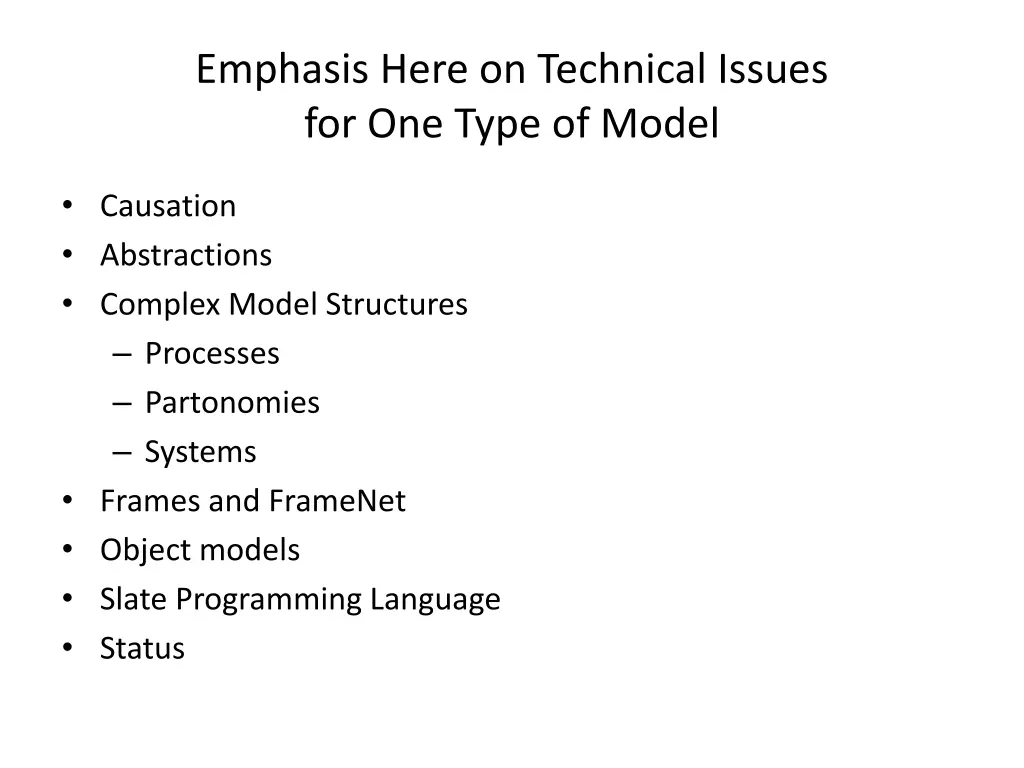
Emphasis Here on Technical Issues for One Type of Model Causation Abstractions Complex Model Structures Processes Partonomies Systems Frames and FrameNet Object models Slate Programming Language Status
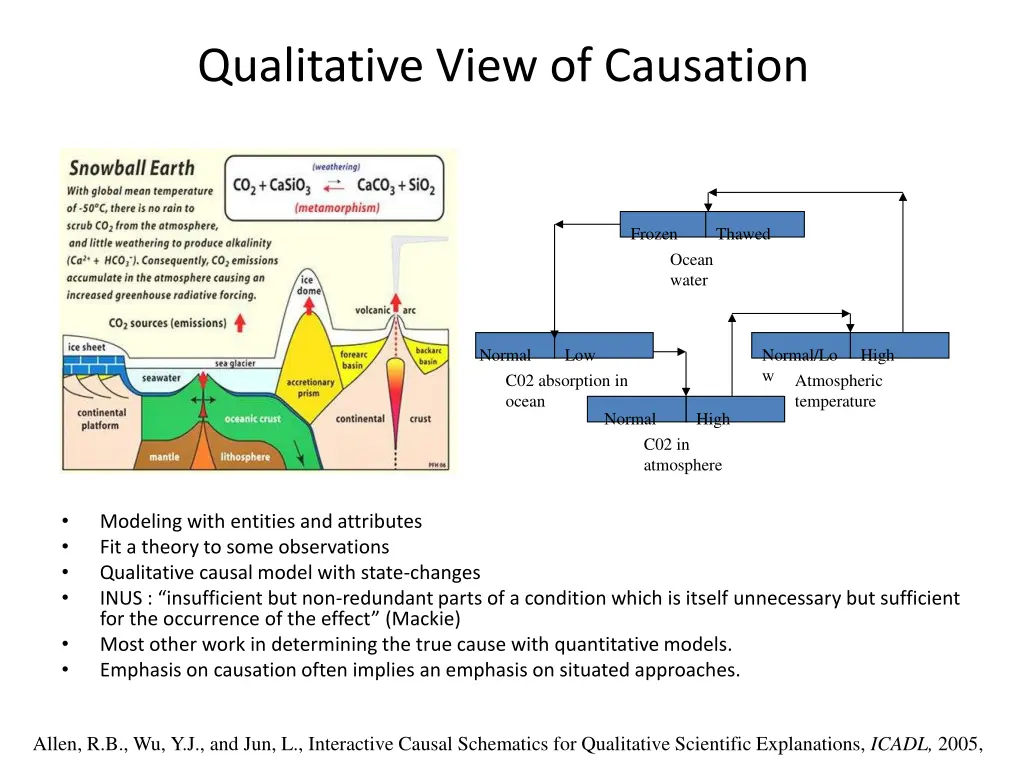
Qualitative View of Causation Frozen Thawed Ocean water Normal Low Normal/Lo w Atmospheric temperature High C02 absorption in ocean Normal High C02 in atmosphere Modeling with entities and attributes Fit a theory to some observations Qualitative causal model with state-changes INUS : insufficient but non-redundant parts of a condition which is itself unnecessary but sufficient for the occurrence of the effect (Mackie) Most other work in determining the true cause with quantitative models. Emphasis on causation often implies an emphasis on situated approaches. Allen, R.B., Wu, Y.J., and Jun, L., Interactive Causal Schematics for Qualitative Scientific Explanations, ICADL, 2005,
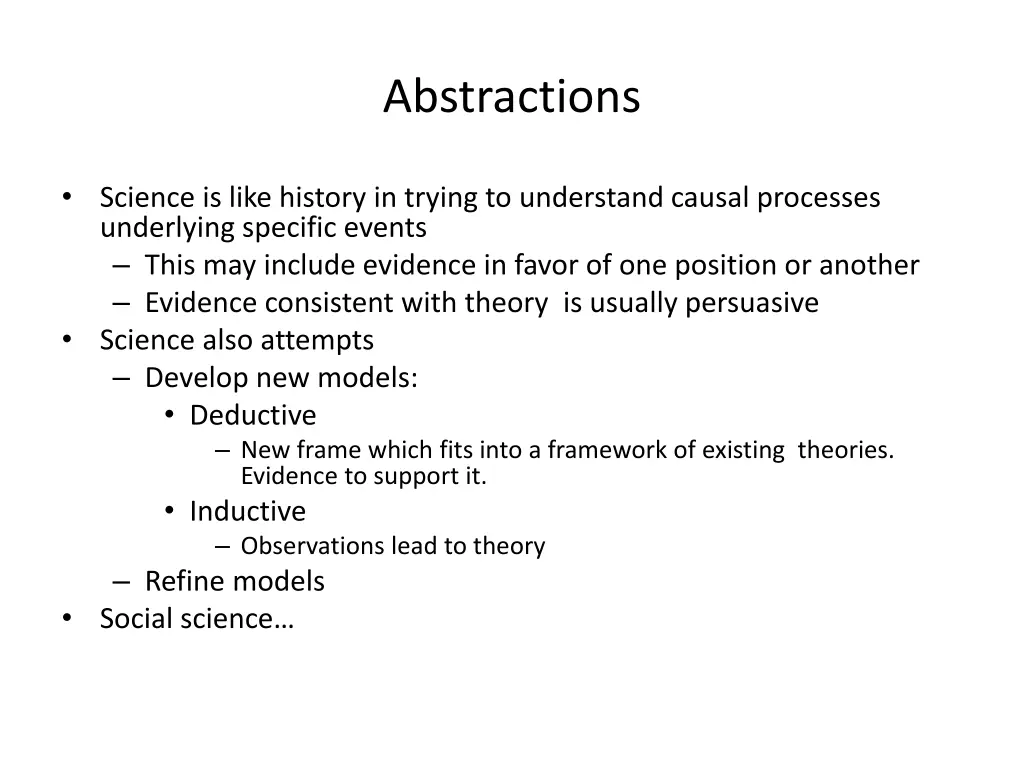
Abstractions Science is like history in trying to understand causal processes underlying specific events This may include evidence in favor of one position or another Evidence consistent with theory is usually persuasive Science also attempts Develop new models: Deductive New frame which fits into a framework of existing theories. Evidence to support it. Inductive Observations lead to theory Refine models Social science
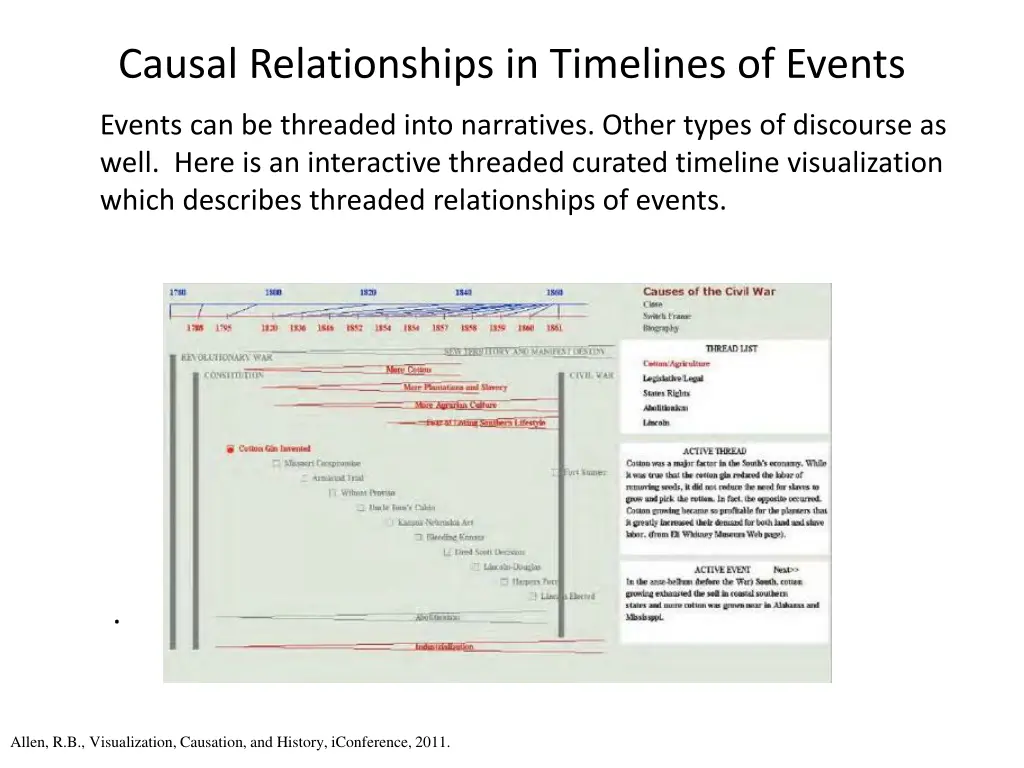
Causal Relationships in Timelines of Events Events can be threaded into narratives. Other types of discourse as well. Here is an interactive threaded curated timeline visualization which describes threaded relationships of events. . Allen, R.B., Visualization, Causation, and History, iConference, 2011.
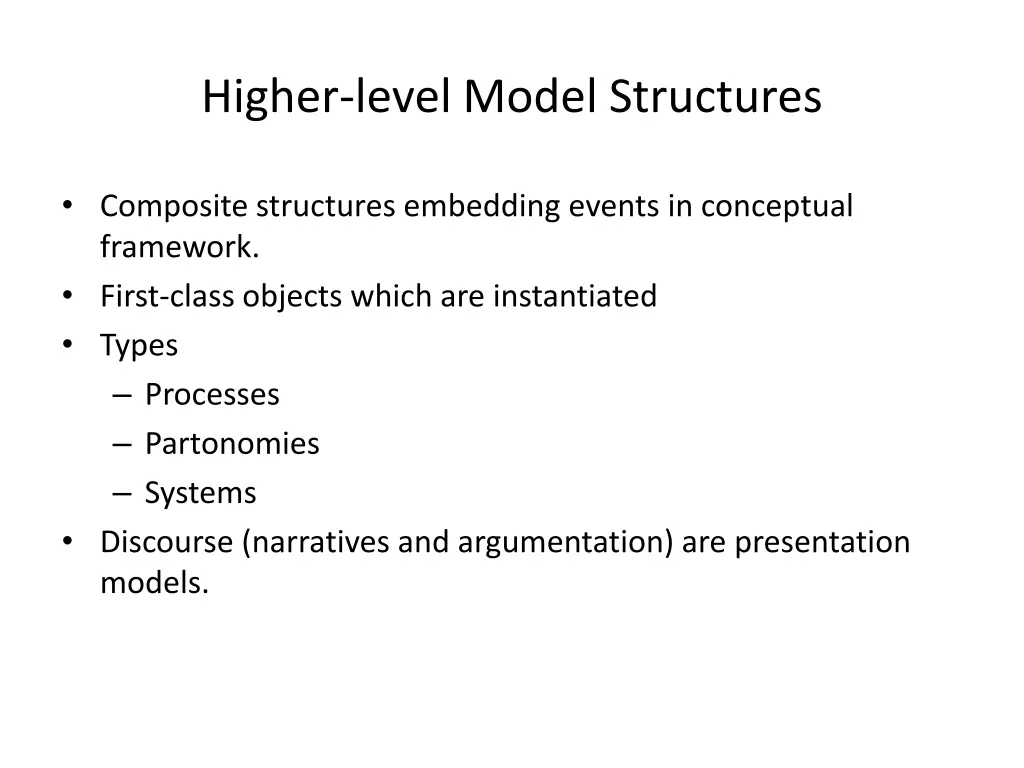
Higher-level Model Structures Composite structures embedding events in conceptual framework. First-class objects which are instantiated Types Processes Partonomies Systems Discourse (narratives and argumentation) are presentation models.
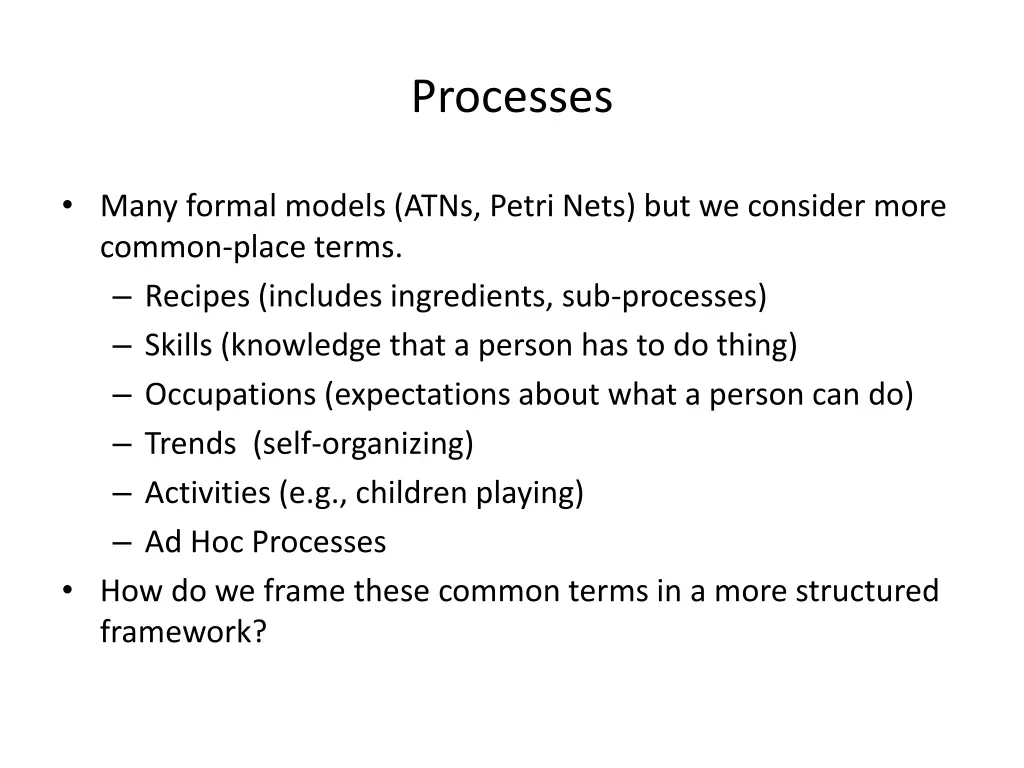
Processes Many formal models (ATNs, Petri Nets) but we consider more common-place terms. Recipes (includes ingredients, sub-processes) Skills (knowledge that a person has to do thing) Occupations (expectations about what a person can do) Trends (self-organizing) Activities (e.g., children playing) Ad Hoc Processes How do we frame these common terms in a more structured framework?
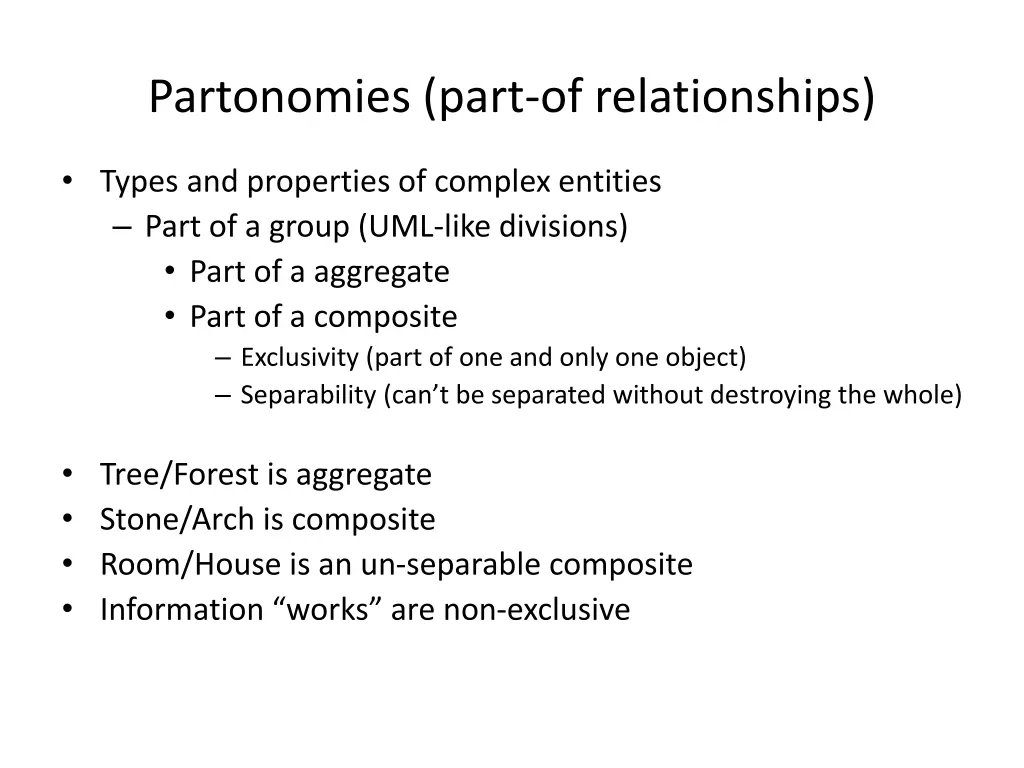
Partonomies (part-of relationships) Types and properties of complex entities Part of a group (UML-like divisions) Part of a aggregate Part of a composite Exclusivity (part of one and only one object) Separability (can t be separated without destroying the whole) Tree/Forest is aggregate Stone/Arch is composite Room/House is an un-separable composite Information works are non-exclusive
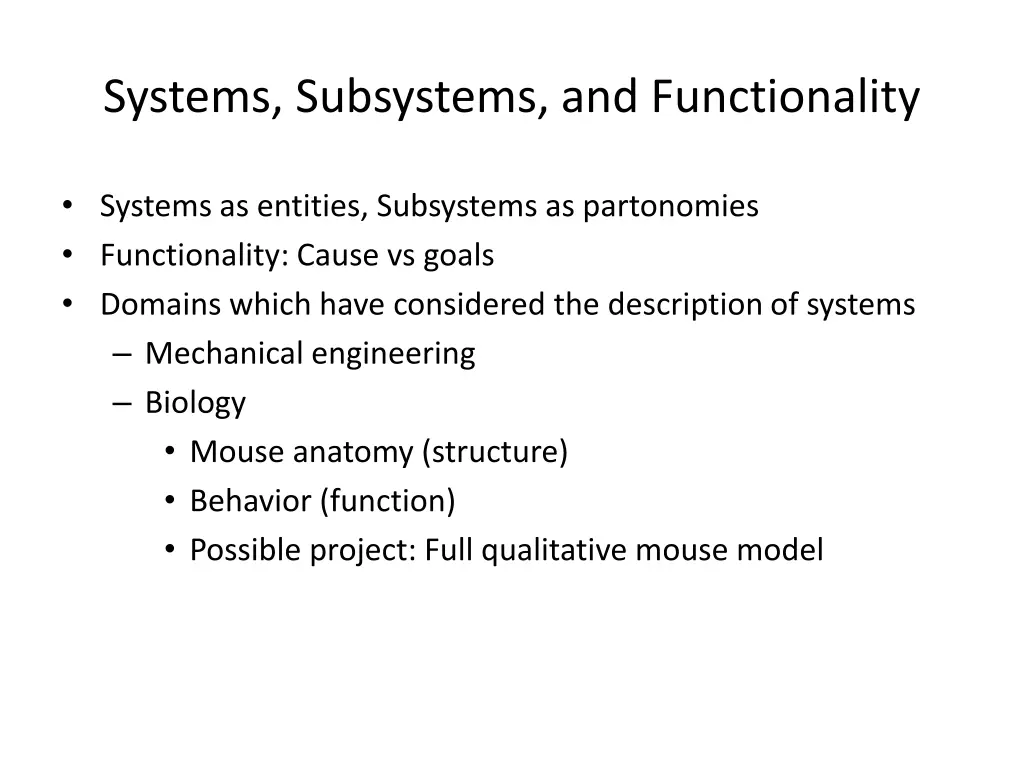
Systems, Subsystems, and Functionality Systems as entities, Subsystems as partonomies Functionality: Cause vs goals Domains which have considered the description of systems Mechanical engineering Biology Mouse anatomy (structure) Behavior (function) Possible project: Full qualitative mouse model
Communities and History Here, community has an operational definition as what s covered by a small-town newspaper Communities are relatively self-contained We focus on early 1900s because we have rich data from the newspapers. Prosopography Characteristics of a group for which we don t have detailed descriptions. Requires limited inference We emphasize the value of behavioral models
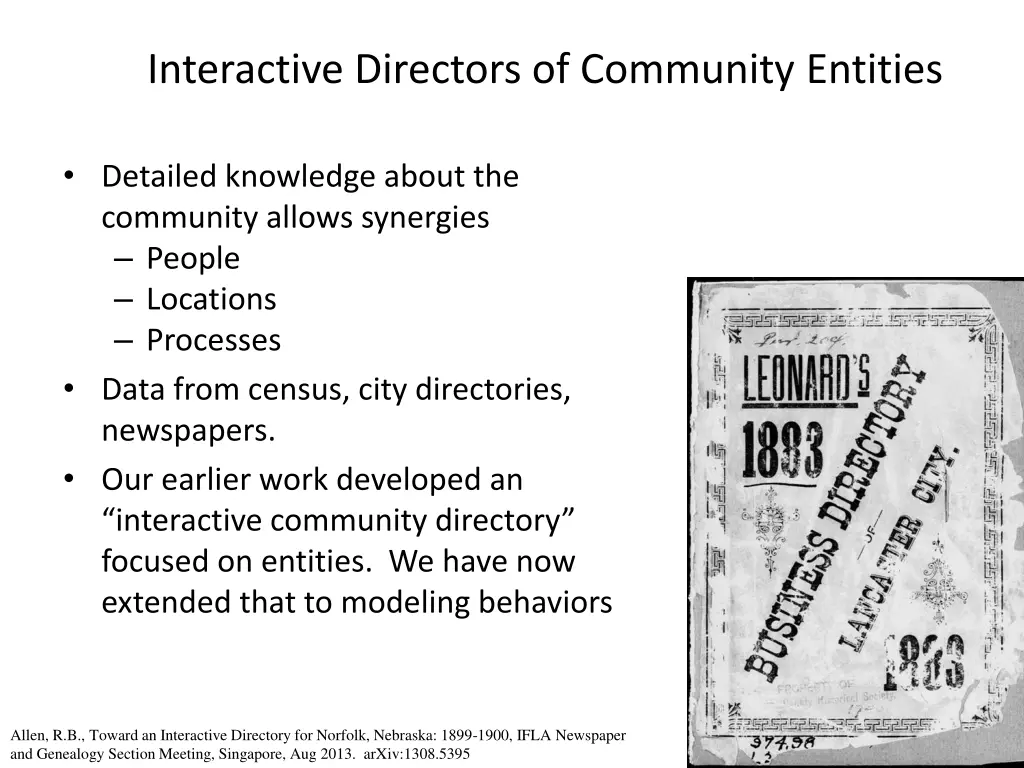
Interactive Directors of Community Entities Detailed knowledge about the community allows synergies People Locations Processes Data from census, city directories, newspapers. Our earlier work developed an interactive community directory focused on entities. We have now extended that to modeling behaviors Allen, R.B., Toward an Interactive Directory for Norfolk, Nebraska: 1899-1900, IFLA Newspaper and Genealogy Section Meeting, Singapore, Aug 2013. arXiv:1308.5395
Behavior-Based Models Fragments of knowledge are unified by models across collections and databases. Our models have conceptual units Behavior-based models go beyond ontologies and traditional approaches to knowledge representation Executable models which unfold as they are run. From behavioral models to simple simulations. Based on software engineering. Full-fledged programming languages, specifically object-oriented programming languages, are useful for representing those descriptions. Here we explore how to use Java for modeling communities and events in communities. Entities with state and behavior. Abstraction and instantiation Allen, R.B., Model-Oriented Information Organization: Part 1, The Entity-Event Fabric, D-Lib Magazine, July 2013. Allen, R.B., Model-Oriented Information Organization: Part 2, Discourse Relationships, D-Lib Magazine, July 2013.
Modeling Texts with FrameNet We have lots of rich text descriptions from cultural descriptions. Could we use that? After all, the text descriptions are representations. We know that text can be incomplete and ambiguous but some text sources are less incomplete and less ambiguous Frames and FrameNet Long term project from Charles Fillmore at Berkeley https://framenet.icsi.berkeley.edu/fndrupal/ Essential concepts in natural language described with frames. Connected semantic roles. Based on cognitive principles, but we can use it as a language resource for out modeling.
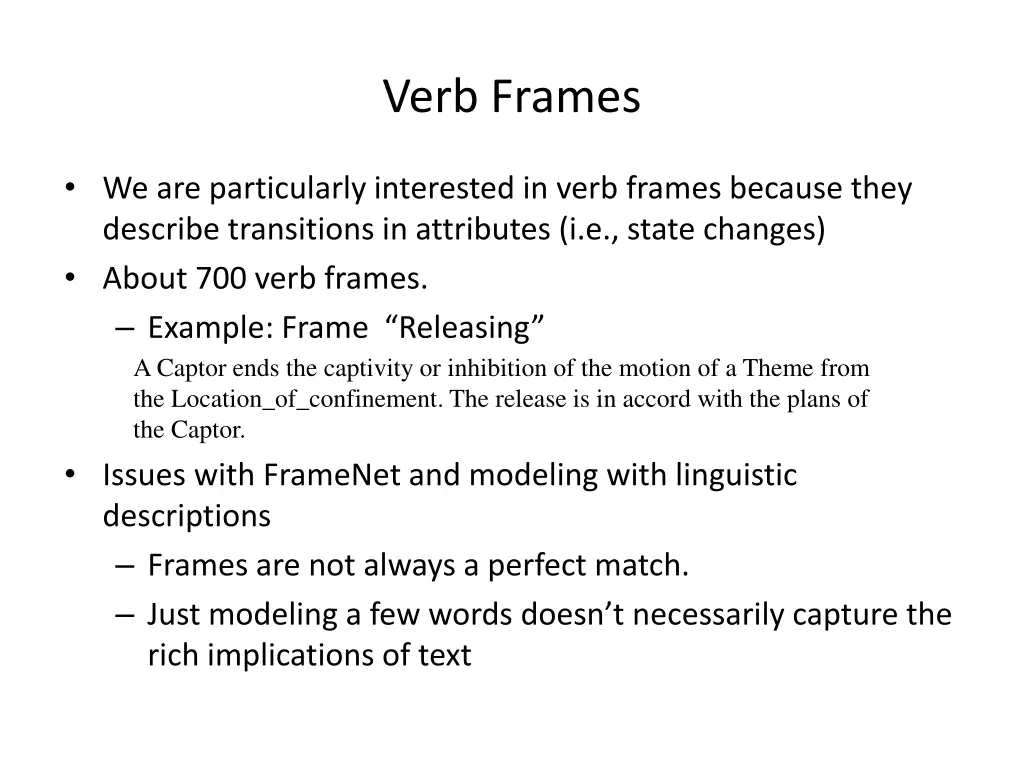
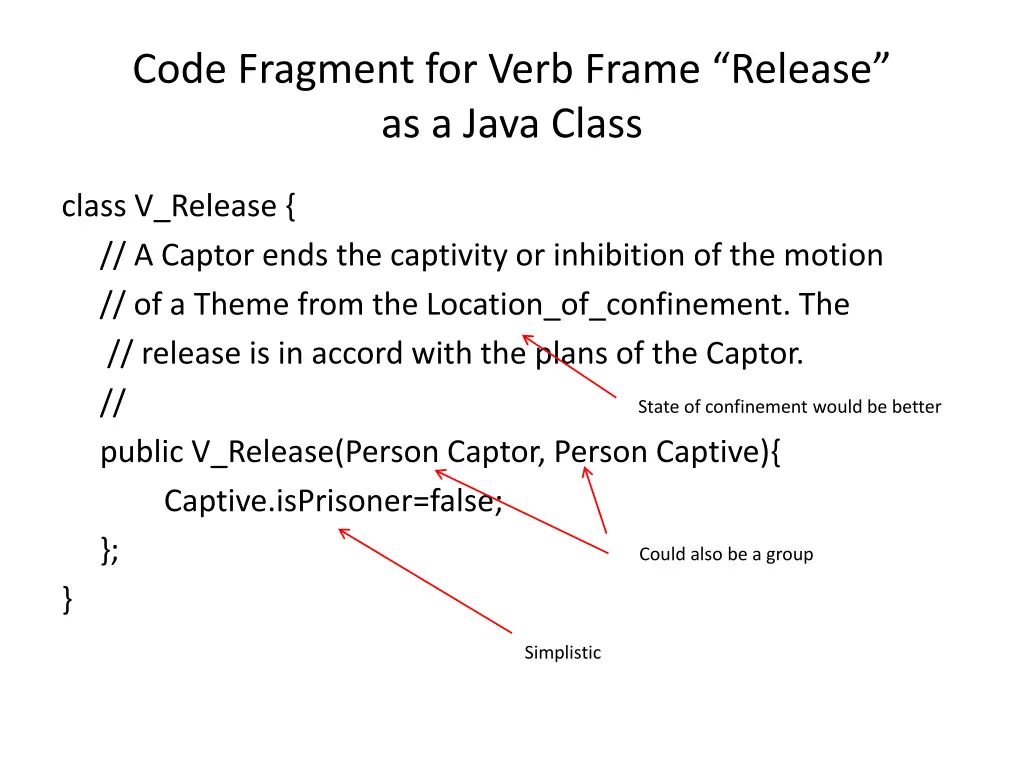
Verb Frames We are particularly interested in verb frames because they describe transitions in attributes (i.e., state changes) About 700 verb frames. Example: Frame Releasing A Captor ends the captivity or inhibition of the motion of a Theme from the Location_of_confinement. The release is in accord with the plans of the Captor. Issues with FrameNet and modeling with linguistic descriptions Frames are not always a perfect match. Just modeling a few words doesn t necessarily capture the rich implications of text
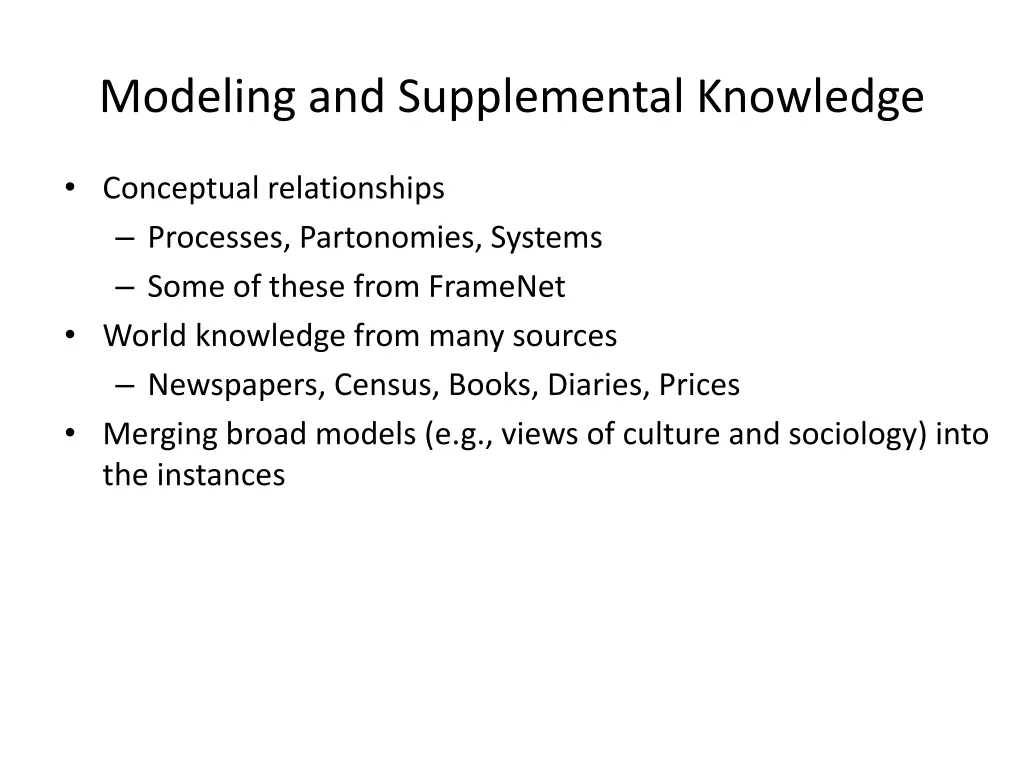
Modeling and Supplemental Knowledge Conceptual relationships Processes, Partonomies, Systems Some of these from FrameNet World knowledge from many sources Newspapers, Census, Books, Diaries, Prices Merging broad models (e.g., views of culture and sociology) into the instances
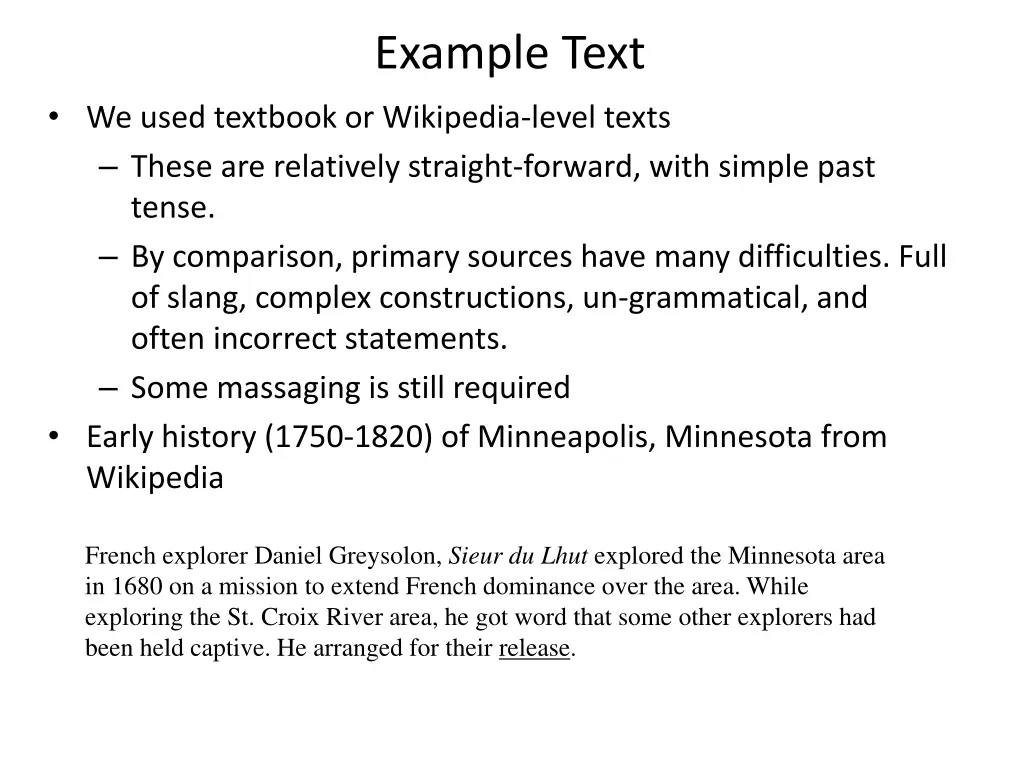
Example Text We used textbook or Wikipedia-level texts These are relatively straight-forward, with simple past tense. By comparison, primary sources have many difficulties. Full of slang, complex constructions, un-grammatical, and often incorrect statements. Some massaging is still required Early history (1750-1820) of Minneapolis, Minnesota from Wikipedia French explorer Daniel Greysolon, Sieur du Lhut explored the Minnesota area in 1680 on a mission to extend French dominance over the area. While exploring the St. Croix River area, he got word that some other explorers had been held captive. He arranged for their release.
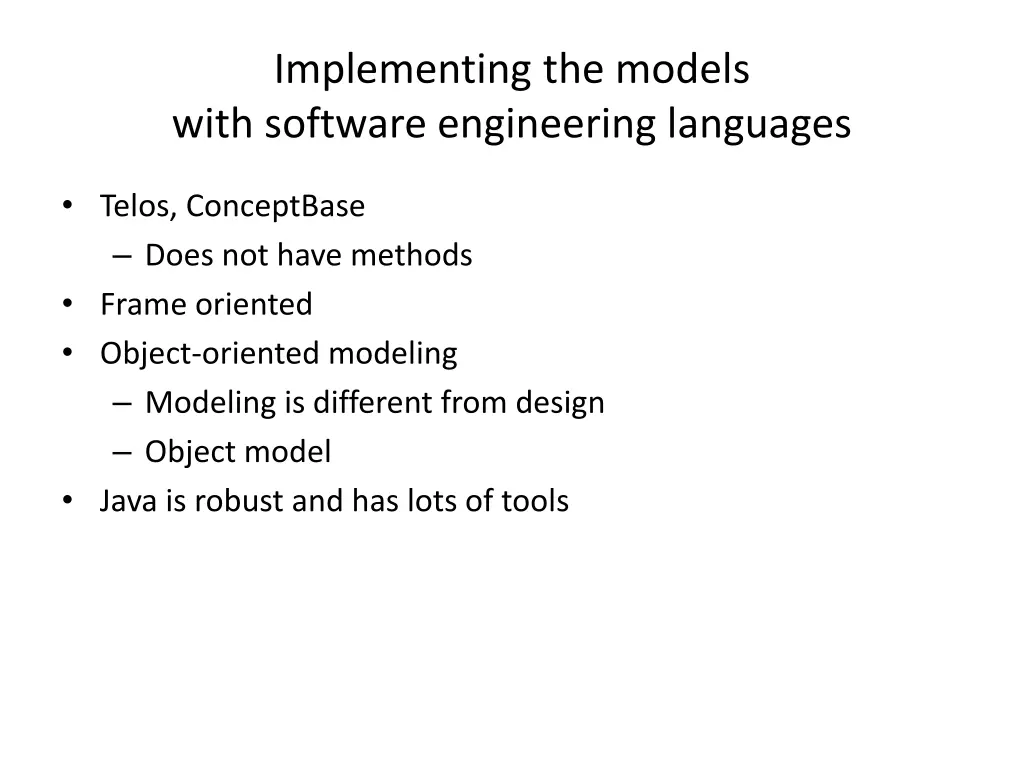
Implementing the models with software engineering languages Telos, ConceptBase Does not have methods Frame oriented Object-oriented modeling Modeling is different from design Object model Java is robust and has lots of tools
Code Fragment for Verb Frame Release as a Java Class class V_Release { // A Captor ends the captivity or inhibition of the motion // of a Theme from the Location_of_confinement. The // release is in accord with the plans of the Captor. // public V_Release(Person Captor, Person Captive){ Captive.isPrisoner=false; }; Could also be a group } Simplistic State of confinement would be better
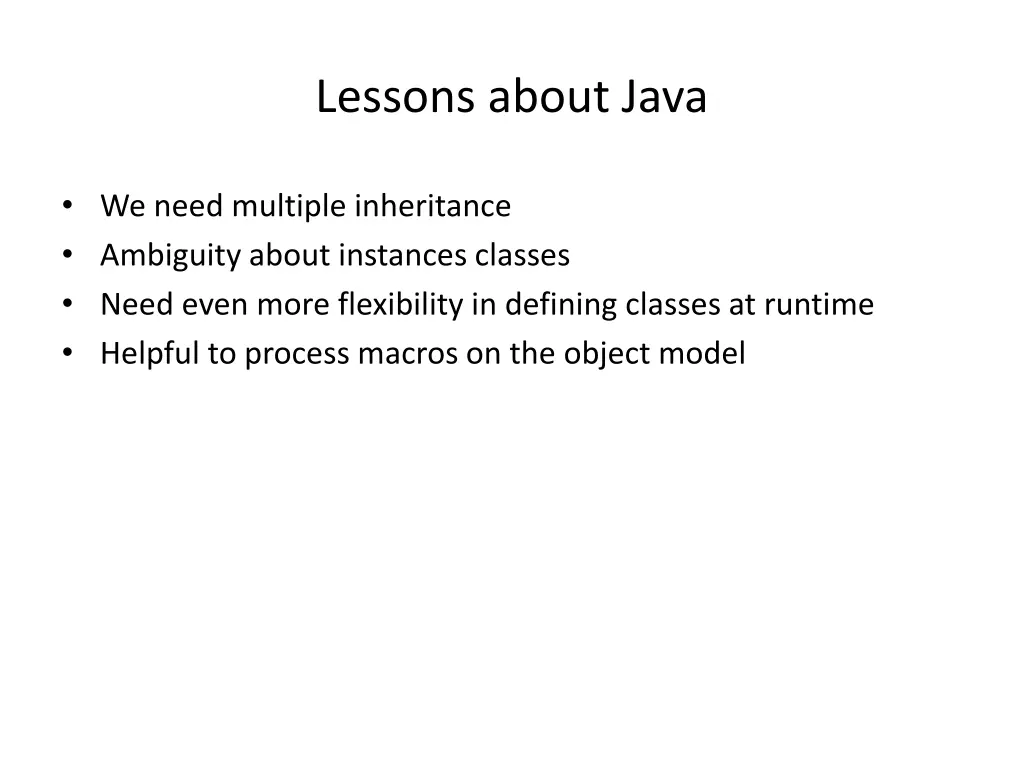
Lessons about Java We need multiple inheritance Ambiguity about instances classes Need even more flexibility in defining classes at runtime Helpful to process macros on the object model
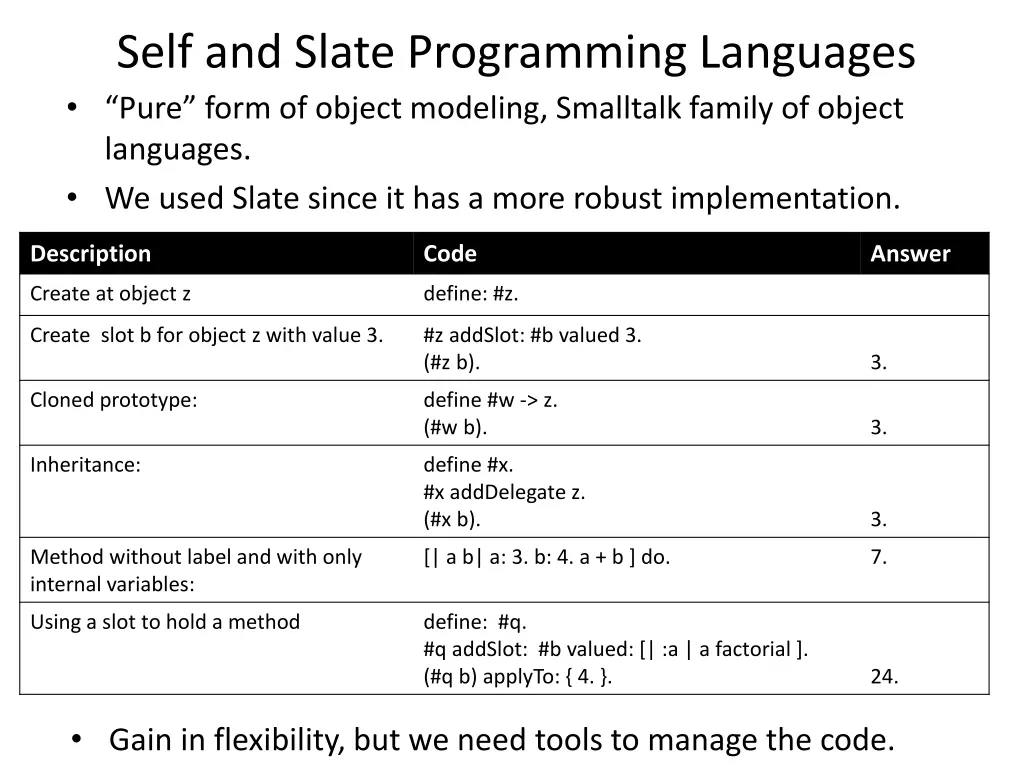
Self and Slate Programming Languages Pure form of object modeling, Smalltalk family of object languages. We used Slate since it has a more robust implementation. Description Code Answer Create at object z define: #z. Create slot b for object z with value 3. #z addSlot: #b valued 3. (#z b). 3. Cloned prototype: define #w -> z. (#w b). 3. Inheritance: define #x. #x addDelegate z. (#x b). 3. Method without label and with only internal variables: [| a b| a: 3. b: 4. a + b ] do. 7. Using a slot to hold a method define: #q. #q addSlot: #b valued: [| :a | a factorial ]. (#q b) applyTo: { 4. }. 24. Gain in flexibility, but we need tools to manage the code.
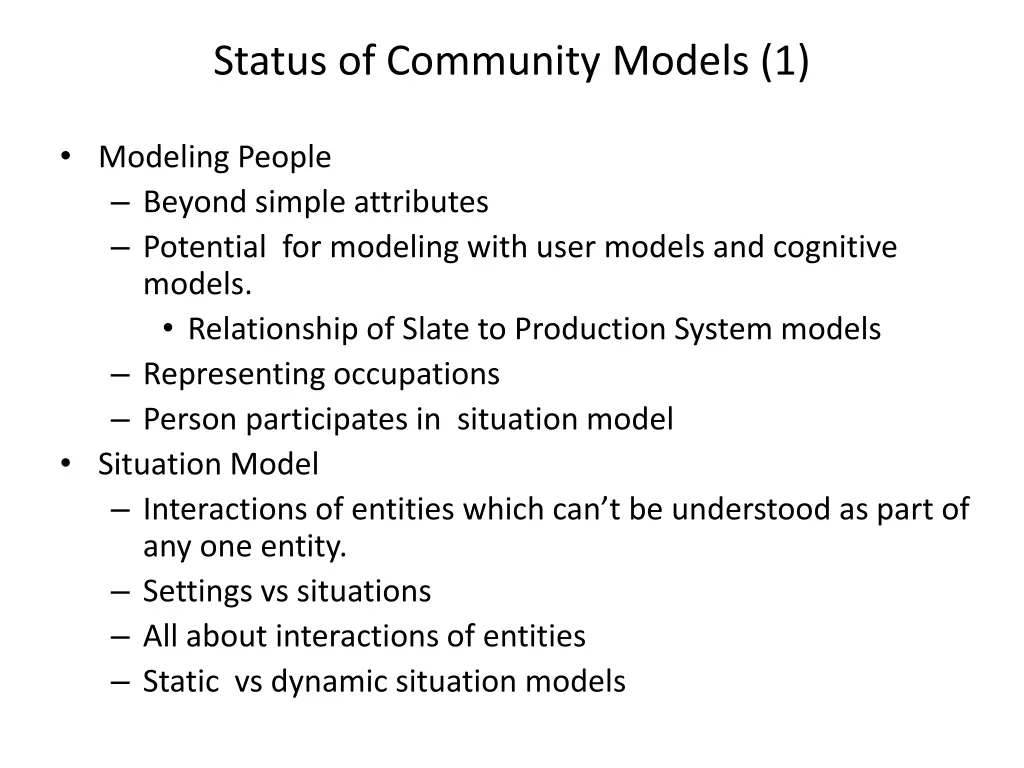
Status of Community Models (1) Modeling People Beyond simple attributes Potential for modeling with user models and cognitive models. Relationship of Slate to Production System models Representing occupations Person participates in situation model Situation Model Interactions of entities which can t be understood as part of any one entity. Settings vs situations All about interactions of entities Static vs dynamic situation models
Status of Community Models (2) Information resources These are should be treated like all other objects Somewhat related to the records continuum model from archives Many composites in natural language such as: bake-baker-baking-bakery How to represent this generally given the nuances such as baking at home vs baking in a bakery Extensions Multi-family genealogies Modeling cities Linking community and city models together (national models) Wire in additional procedures (e.g., laws).
Discourse and Presentations Discourse Narrative Conversational historical actors Argumentation Popular in hypertext community about 20 years ago Reinvented by semantic web community Evidence Types of evidence for history, science Reasoning and commenting about evidence Presentations Better support for authoring model-oriented descriptions Interactive interfaces for interaction with community histories Tutorial-like descriptions of histories or science with personalization Interactive re-enactors, games, and cyber-dramas
Future Directions Modeling the context of functional requirements Somewhat analogous to continuum for archives. Science Research Designs Complex research methods Broader effort to develop model-oriented information organization Application of model-oriented information organization to museum objects and informatics Explore relationship to cognitive modeling Frames as a protocol for agents in multi-agent systems Standards Time to consider it. Context is not such a problem if we re not doing inference. Allow versions
Themes for this Talk There is a need for a new approach of information organization. Entities are complex but they can be modeled. There are a great many objects but it s a finite number. Modeling with behaviors may be helpful. Modeling with natural language may be helpful. Models can be grounded with conceptual structures.
Strategies for Model-Oriented Information Organization Robert B. ALLEN Research Center for Knowledge Communities University of Tsukuba Tsukuba, Japan For more information see: Contact: http://boballen.info/ rba@boballen.info