Insights from A601 AGATA-Like Detector Characterisation
This study explores the characterisation and efficiency evaluation of the A601 AGATA-like detector, providing valuable insights for enhancing detector performance and reliability in nuclear structure studies. The research delves into the unique specifications, testing procedures, and efficiency measurements of the detector, aiming to identify factors contributing to its reduced efficiency and potential improvements for future detector designs.

Download Presentation

Please find below an Image/Link to download the presentation.
The content on the website is provided AS IS for your information and personal use only. It may not be sold, licensed, or shared on other websites without obtaining consent from the author.If you encounter any issues during the download, it is possible that the publisher has removed the file from their server.
You are allowed to download the files provided on this website for personal or commercial use, subject to the condition that they are used lawfully. All files are the property of their respective owners.
The content on the website is provided AS IS for your information and personal use only. It may not be sold, licensed, or shared on other websites without obtaining consent from the author.
E N D
Presentation Transcript
1 Comprehensive Characterisation of the A601 AGATA-Like Detector: Insights from Analogue, and Advanced Scanning Measurements RAYAN ALI ALNEFAIE SUPERVISOR: PROF. ANDREW BOSTON 3RDYEAR NUCLEAR PhD STUDENT AT THE UNIVERSITY OF LIVERPOOL LECTURER AT PRINCE SATTAM BIN ABDULAZIZ UNIVERSITY R.ALNEFAIE@LIVERPOOL.AC.UK RA.ALNEFAIE@PSAU.EDU.SA
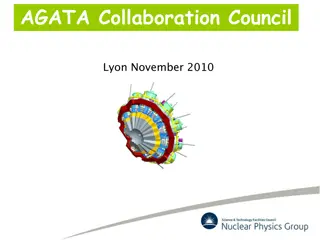
2 What is AGATA? The Advanced Gamma Tracking Array (AGATA) is a European gamma-ray spectrometer designed to study nuclear structure. It will comprise 180 electrically segmented HPGe detectors, arranged in 60 triple clusters of three asymmetric types (A, B, and C), to achieve high energy resolution and efficiency across 4 coverage.
AGATA Crystal Specification 3 AGATA detectors are closed-end, coaxial n-type HPGe crystals. Asymmetric tapered hexagonal shape. Each 90 mm long, 80 mm diameter crystal. Segmented into 36 segments (6 rings 6 segments) Figure 3 Figure 2
5 A601 Detector All AGATA crystals undergo a Consumer Acceptance Test (CAT) before purchase. Relative Efficiency >80% @ 1332 keV FWHM < 2.35 keV @ 1332 keV A601 was excluded from AGATA. Rejected by Mirion for low relative efficiency (70% < 80% threshold). Whilst it can t be used in AGATA, A601 is useful for understanding its crystals. The A601 detector in it s carrying case
6 Motivation To evaluate the true relative efficiency of the A601 detector Identify the causes behind its reduced efficiency. This could allow for Mirion to make better detectors This could improve the reliability of AGATAs simulations
7 Initial Efficiency Measurements Standard efficiency measurements were taken of A601 to evaluate its bulk performance. This setup shows the analogue signal chain for AGATA measurements:
8 Relative Efficiency Vs Standoff Distance 25 cm The compared detector with a 25cm standoff. relative efficiency to 3 3 was NaI(Tl) The A601 detector shows a relative efficiency of 74% at 1332.5 keV While the value provided by Mirion is 70%. A601 was also evaluated for a range of distances to prove 1/r2
9 A601 Efficiency Vs Energy Absolute Photopeak Efficiency of A601 AGATA detector was measured using 152Eu and 241Am. Maximum efficiency at 100 keV. Aluminium capsule Exponential tail above 100 keV. 9
10 Energy Resolution Measurements by Segment The FWHM values at 60 keV and 1332.5 keV of all segments: ???? = 2 2??2 ? 2.355?
11 Consumer Acceptance Test Summary As seen from initial measurements A601 passes in its energy resolution but fails the efficiency threshold. Where is the efficiency of A601 lost? How does the segmentation vary from other AGATA crystals? Using equipment at Liverpool I attempted to answer these questions.
12 Charge Collection Zones in AGATA AGATA detectors have three different charge collection Zones due to their tapered geometry. Different zones affect how charge carriers (electrons and holes) travel to electrodes. The segment shape is determined from simulation (ADL), but may not be completely accurate. If these segments change it may influence the efficiency.
13 The Liverpool Scanning Apparatus Liverpool has several scanning setups for detector characterisation. 137Cs source with tungsten collimators. Scanned using Parker table (100 m precision). Cooled detector in LN2 cryostat. Steel frame supports and aligns system. DAQ controls table & records x-y positions.
14 Front Singles Scan Using pencil beam scanning we can probe the positional response of the A601 detector. Here we see the intensity of the counts as a function of position. The segmentation and bore hole are clearly seen. We can use this to evaluate where in A601 the efficiency is.
15 Coincidence Scanning Measurements Uses same Parker scan setup with 137Cs source as singles scan. Secondary collimators around AGATA for 90 gamma-ray scattering to BGO. Allows for (x,y,z) characterisation. Energy deposition: 374 keV (A601), 288 keV (BGO), based on Compton scattering formula (?e?2 = 511 keV). Will allow for validation of the segmentation.
16 Conclusionand Future Work The A601 AGATA detector was studied using analogue and coincidence measurements, providing detailed insights into energy resolution and efficiency performance. Future work will focus on determining the segment geometry using the front face singles scan data, followed by validation of segment boundaries and efficiency distribution. Coincidence scanning will then be used to confirm segmentation accuracy and investigate charge collection performance.
17 References Adem Kus, Characterisation of C017 Asymmetric AGATA Detector, PhD Thesis, University of Liverpool, January 2024. Akkoyun, S. et al. (2012). "AGATA Advanced GAmma Tracking Array." Nucl. Instrum. Meth. Phys. Res. A, 668, 26 58. G. F. Knoll, Radiation Detection and Measurement, 4th ed. John Wiley, 2010. Mirion Technologies. Encapsulated Germanium Detectors for Gamma Measurements, Data Sheet, 2021. Retrieved from Mirion Technologies. This document specifies that AGATA detectors have a relative efficiency greater than 80%, as indicated under the AGATA detector specifications section.
18 Thanks For Listening Any Questions? RAYAN ALI ALNEFAIE 3RD YEAR NUCLEAR PhD STUDENT AT THE UNIVERSITY OF LIVERPOOL LECTURER AT PRINCE SATTAM BIN ABDULAZIZ UNIVERSITY R.ALNEFAIE@LIVERPOOL.AC.UK RA.ALNEFAIE@PSAU.EDU.SA