Exploring the challenges and potentials of beamforming feedback in IEEE 802.11-24 standard, including discussions on average signal-to-noise ratio (SNR) in compressed beamforming feedback, overhead reduction, and timing constraints. The content delves into the complexities of generating accurate average SNR in the compressed beamforming matrix and proposes solutions for enhancing feedback efficiency and reliability.
Please find below an Image/Link to download the presentation.
The content on the website is provided AS IS for your information and personal use only. It may not be sold, licensed, or shared on other websites without obtaining consent from the author. If you encounter any issues during the download, it is possible that the publisher has removed the file from their server.
You are allowed to download the files provided on this website for personal or commercial use, subject to the condition that they are used lawfully. All files are the property of their respective owners.
The content on the website is provided AS IS for your information and personal use only. It may not be sold, licensed, or shared on other websites without obtaining consent from the author.
E N D
Presentation Transcript
Jan. 2024 doc.: IEEE 802.11-24/180r0 Some thoughts on the beamforming feedback Date: 03/01/24 Name Affilations Address Email Xiaogang Chen Spreadtrum Communications, USA 2680 N 1st St. San Jose, CA. 95134 Xiaogang.chen1@unisoc.com Chunyu Hu William Li Submission Slide 1 Xiaogang Chen, et al. Spreadtrum
doc.: IEEE 802.11-24/180r0 Outline Average SNR in the CBF (compressed beamforming feedback); Discussions on the order of average SNR in the CBF. The potentials of CBF overhead reduction. Time domain correlation of CBFs. Submission
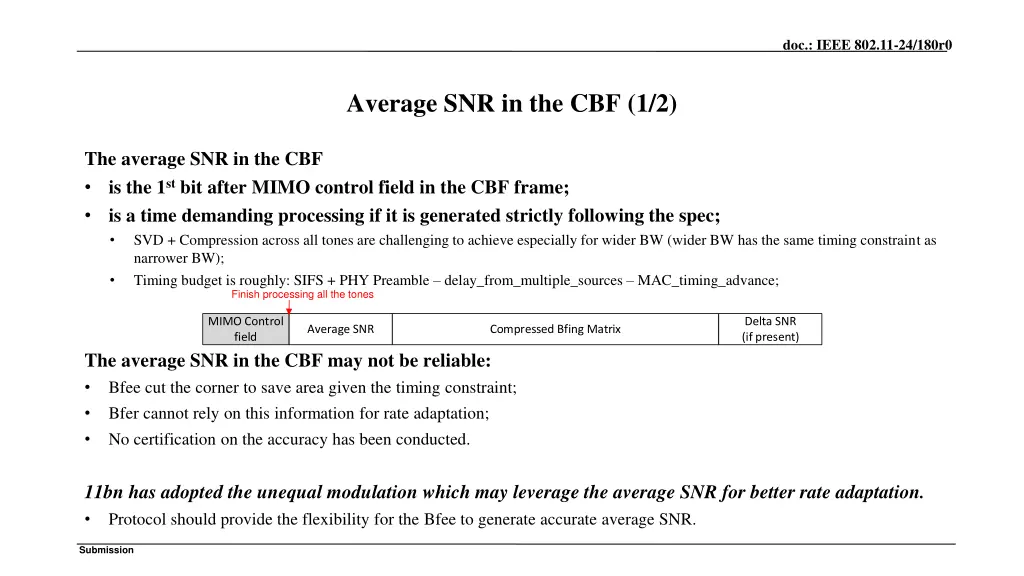
doc.: IEEE 802.11-24/180r0 Average SNR in the CBF (1/2) The average SNR in the CBF is the 1stbit after MIMO control field in the CBF frame; is a time demanding processing if it is generated strictly following the spec; SVD + Compression across all tones are challenging to achieve especially for wider BW (wider BW has the same timing constraint as narrower BW); Timing budget is roughly: SIFS + PHY Preamble delay_from_multiple_sources MAC_timing_advance; Finish processing all the tones MIMO Control field Delta SNR (if present) Average SNR Compressed Bfing Matrix The average SNR in the CBF may not be reliable: Bfee cut the corner to save area given the timing constraint; Bfer cannot rely on this information for rate adaptation; No certification on the accuracy has been conducted. 11bn has adopted the unequal modulation which may leverage the average SNR for better rate adaptation. Protocol should provide the flexibility for the Bfee to generate accurate average SNR. Submission
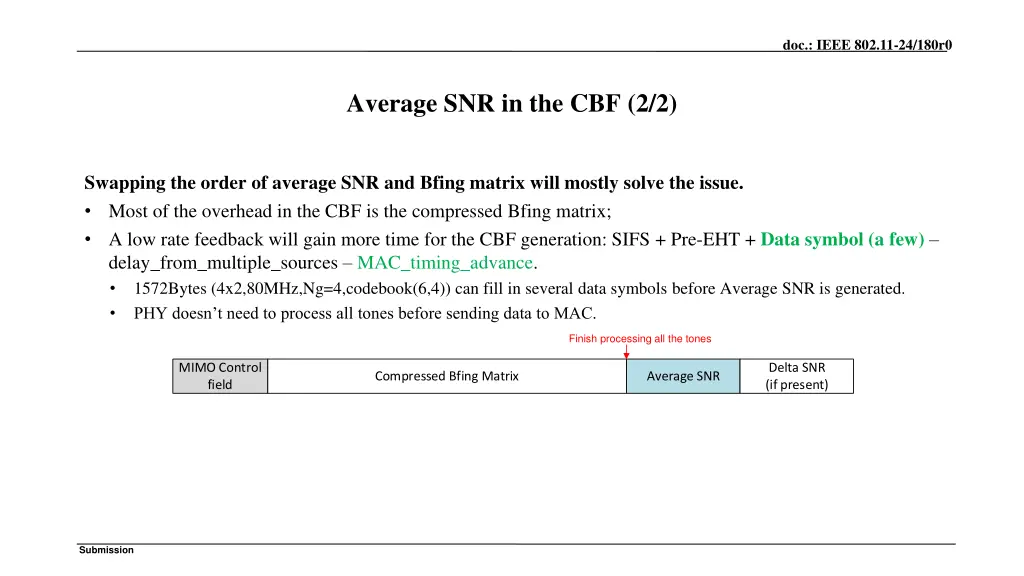
doc.: IEEE 802.11-24/180r0 Average SNR in the CBF (2/2) Swapping the order of average SNR and Bfing matrix will mostly solve the issue. Most of the overhead in the CBF is the compressed Bfing matrix; A low rate feedback will gain more time for the CBF generation: SIFS + Pre-EHT + Data symbol (a few) delay_from_multiple_sources MAC_timing_advance. 1572Bytes (4x2,80MHz,Ng=4,codebook(6,4)) can fill in several data symbols before Average SNR is generated. PHY doesn t need to process all tones before sending data to MAC. Finish processing all the tones MIMO Control field Delta SNR (if present) Compressed Bfing Matrix Average SNR Submission
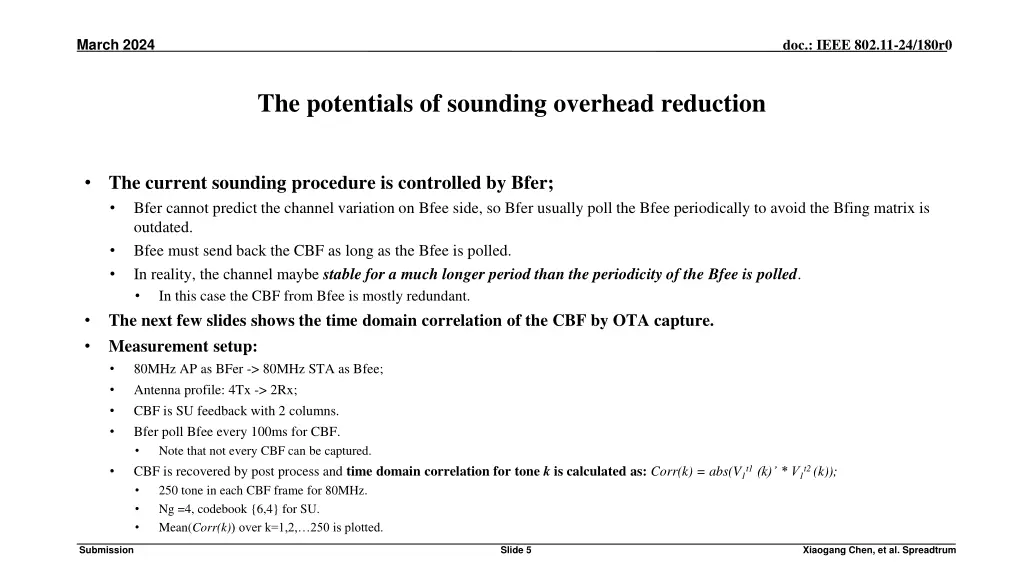
March 2024 doc.: IEEE 802.11-24/180r0 The potentials of sounding overhead reduction The current sounding procedure is controlled by Bfer; Bfer cannot predict the channel variation on Bfee side, so Bfer usually poll the Bfee periodically to avoid the Bfing matrix is outdated. Bfee must send back the CBF as long as the Bfee is polled. In reality, the channel maybe stable for a much longer period than the periodicity of the Bfee is polled. In this case the CBF from Bfee is mostly redundant. The next few slides shows the time domain correlation of the CBF by OTA capture. Measurement setup: 80MHz AP as BFer -> 80MHz STA as Bfee; Antenna profile: 4Tx -> 2Rx; CBF is SU feedback with 2 columns. Bfer poll Bfee every 100ms for CBF. Note that not every CBF can be captured. CBF is recovered by post process and time domain correlation for tone k is calculated as: Corr(k) = abs(V1t1(k) * V1t2 (k)); 250 tone in each CBF frame for 80MHz. Ng =4, codebook {6,4} for SU. Mean(Corr(k)) over k=1,2, 250 is plotted. Submission Slide 5 Xiaogang Chen, et al. Spreadtrum
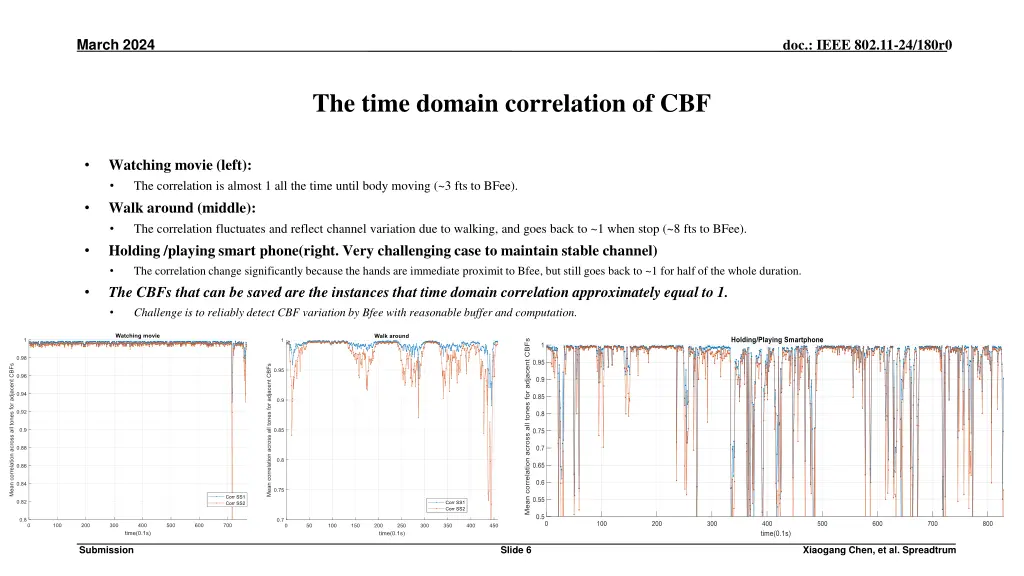
March 2024 doc.: IEEE 802.11-24/180r0 The time domain correlation of CBF Watching movie (left): The correlation is almost 1 all the time until body moving (~3 fts to BFee). Walk around (middle): The correlation fluctuates and reflect channel variation due to walking, and goes back to ~1 when stop (~8 fts to BFee). Holding /playing smart phone(right. Very challenging case to maintain stable channel) The correlation change significantly because the hands are immediate proximit to Bfee, but still goes back to ~1 for half of the whole duration. The CBFs that can be saved are the instances that time domain correlation approximately equal to 1. Challenge is to reliably detect CBF variation by Bfee with reasonable buffer and computation. Submission Slide 6 Xiaogang Chen, et al. Spreadtrum
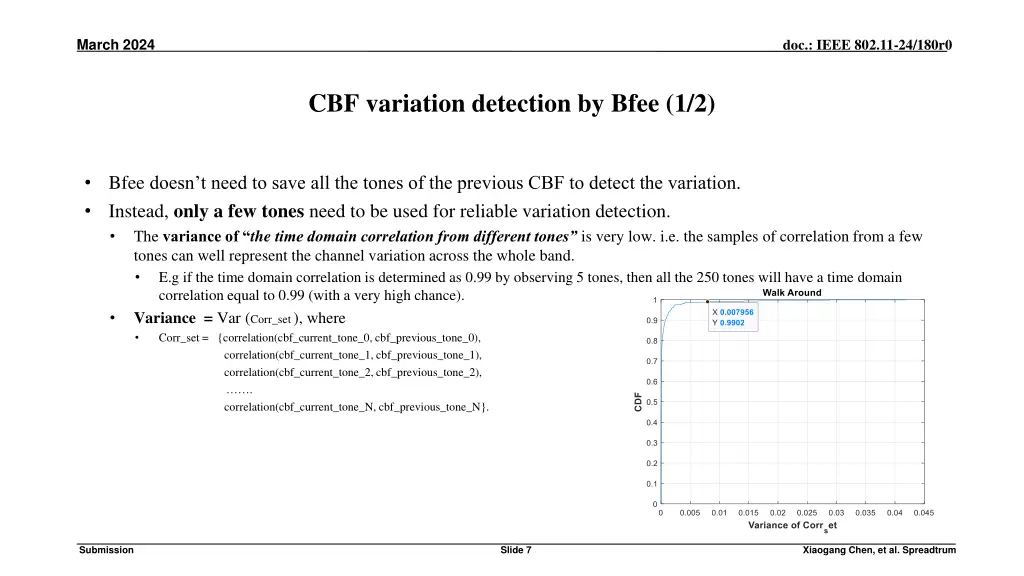
March 2024 doc.: IEEE 802.11-24/180r0 CBF variation detection by Bfee (1/2) Bfee doesn t need to save all the tones of the previous CBF to detect the variation. Instead, only a few tones need to be used for reliable variation detection. The variance of the time domain correlation from different tones is very low. i.e. the samples of correlation from a few tones can well represent the channel variation across the whole band. E.g if the time domain correlation is determined as 0.99 by observing 5 tones, then all the 250 tones will have a time domain correlation equal to 0.99 (with a very high chance). Variance = Var (Corr_set), where Corr_set = {correlation(cbf_current_tone_0, cbf_previous_tone_0), correlation(cbf_current_tone_1, cbf_previous_tone_1), correlation(cbf_current_tone_2, cbf_previous_tone_2), . correlation(cbf_current_tone_N, cbf_previous_tone_N}. Submission Slide 7 Xiaogang Chen, et al. Spreadtrum
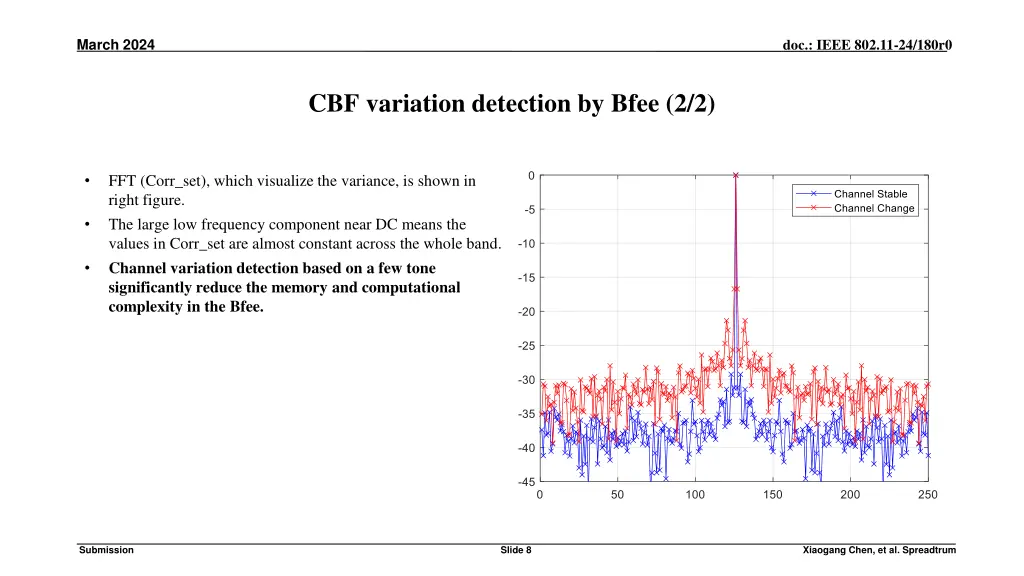
March 2024 doc.: IEEE 802.11-24/180r0 CBF variation detection by Bfee (2/2) FFT (Corr_set), which visualize the variance, is shown in right figure. The large low frequency component near DC means the values in Corr_set are almost constant across the whole band. Channel variation detection based on a few tone significantly reduce the memory and computational complexity in the Bfee. Submission Slide 8 Xiaogang Chen, et al. Spreadtrum
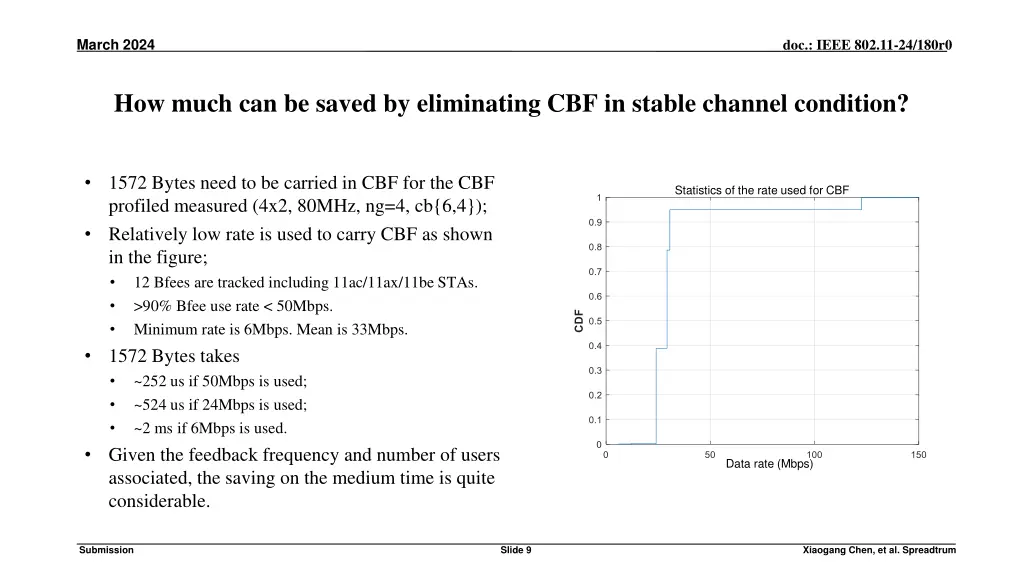
March 2024 doc.: IEEE 802.11-24/180r0 How much can be saved by eliminating CBF in stable channel condition? 1572 Bytes need to be carried in CBF for the CBF profiled measured (4x2, 80MHz, ng=4, cb{6,4}); Relatively low rate is used to carry CBF as shown in the figure; 12 Bfees are tracked including 11ac/11ax/11be STAs. >90% Bfee use rate < 50Mbps. Minimum rate is 6Mbps. Mean is 33Mbps. 1572 Bytes takes ~252 us if 50Mbps is used; ~524 us if 24Mbps is used; ~2 ms if 6Mbps is used. Given the feedback frequency and number of users associated, the saving on the medium time is quite considerable. Statistics of the rate used for CBF Data rate (Mbps) Submission Slide 9 Xiaogang Chen, et al. Spreadtrum
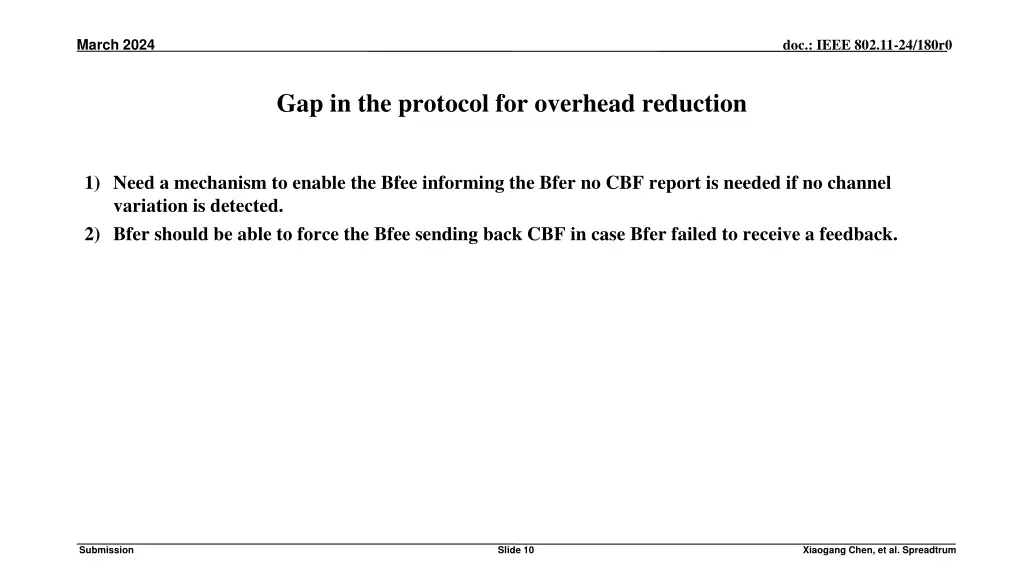
March 2024 doc.: IEEE 802.11-24/180r0 Gap in the protocol for overhead reduction 1) Need a mechanism to enable the Bfee informing the Bfer no CBF report is needed if no channel variation is detected. 2) Bfer should be able to force the Bfee sending back CBF in case Bfer failed to receive a feedback. Submission Slide 10 Xiaogang Chen, et al. Spreadtrum
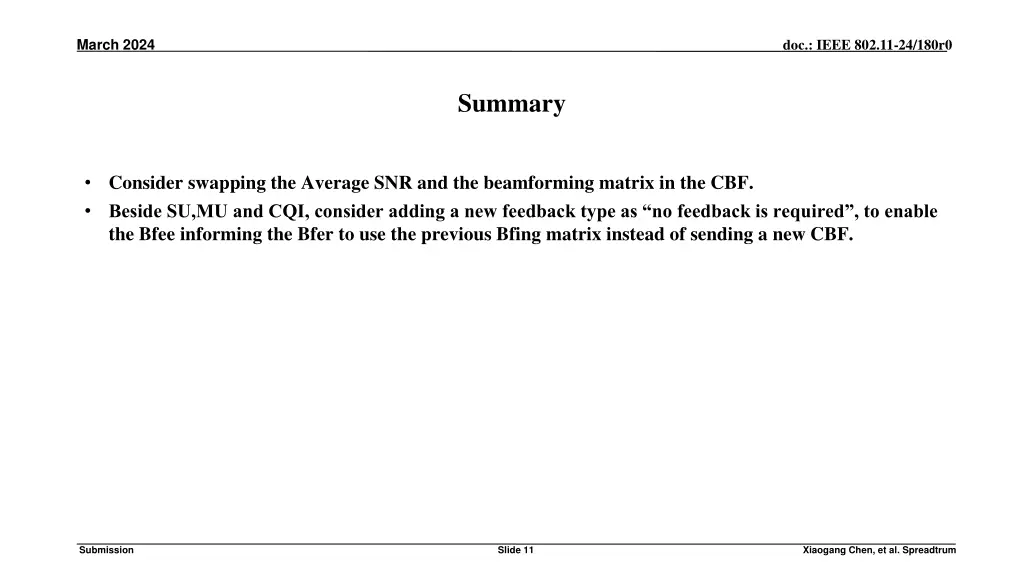
March 2024 doc.: IEEE 802.11-24/180r0 Summary Consider swapping the Average SNR and the beamforming matrix in the CBF. Beside SU,MU and CQI, consider adding a new feedback type as no feedback is required , to enable the Bfee informing the Bfer to use the previous Bfing matrix instead of sending a new CBF. Submission Slide 11 Xiaogang Chen, et al. Spreadtrum
March 2024 doc.: IEEE 802.11-24/180r0 SP1 Do you agree that the compressed beamforming matrix is the first subfield immediately following the MIMO control field in the compressed beamforming frame? Submission Slide 12 Xiaogang Chen, et al. Spreadtrum
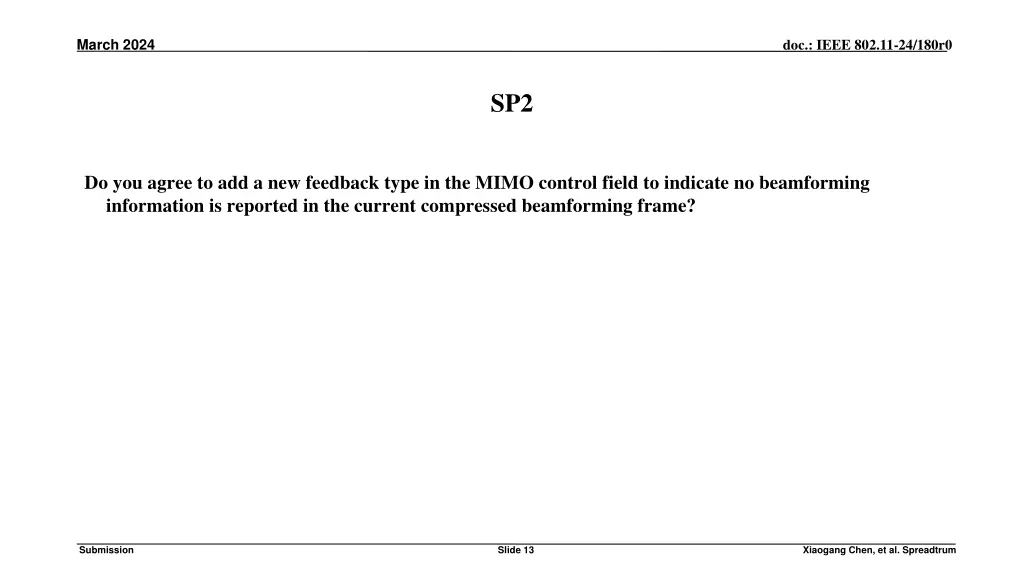
March 2024 doc.: IEEE 802.11-24/180r0 SP2 Do you agree to add a new feedback type in the MIMO control field to indicate no beamforming information is reported in the current compressed beamforming frame? Submission Slide 13 Xiaogang Chen, et al. Spreadtrum