Insights on IEEE 802.11-16/0066r3 UL-MU Features
Gain valuable insights on UL-MU features in the Jan 2016 IEEE document authored by professionals from companies like Apple, Marvell, Samsung, Newracom, Quantenna, Broadcom, Intel, Cisco, NTT, Sony, and Mediatek. This comprehensive review covers a range of perspectives on wireless communication technologies, providing a rich resource for those interested in the latest developments in the field.

Download Presentation

Please find below an Image/Link to download the presentation.
The content on the website is provided AS IS for your information and personal use only. It may not be sold, licensed, or shared on other websites without obtaining consent from the author. If you encounter any issues during the download, it is possible that the publisher has removed the file from their server.
You are allowed to download the files provided on this website for personal or commercial use, subject to the condition that they are used lawfully. All files are the property of their respective owners.
The content on the website is provided AS IS for your information and personal use only. It may not be sold, licensed, or shared on other websites without obtaining consent from the author.
E N D
Presentation Transcript
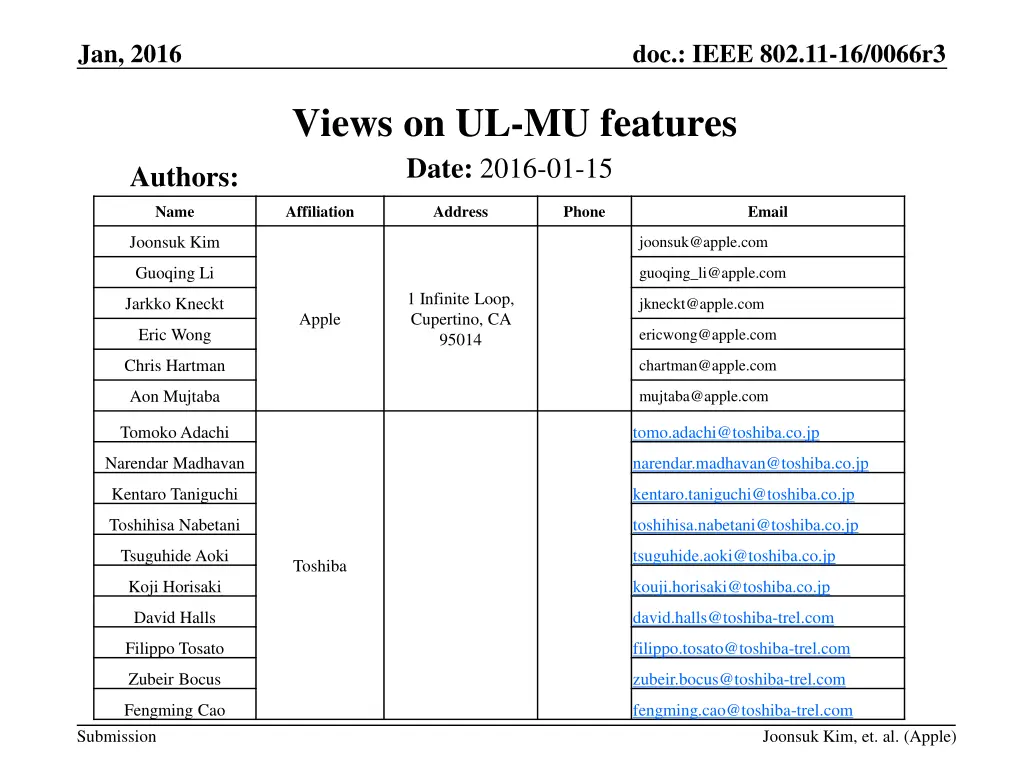
Jan, 2016 doc.: IEEE 802.11-16/0066r3 Views on UL-MU features Date: 2016-01-15 Authors: Name Affiliation Address Phone Email Joonsuk Kim joonsuk@apple.com Guoqing Li guoqing_li@apple.com 1 Infinite Loop, Cupertino, CA 95014 Jarkko Kneckt jkneckt@apple.com Apple Eric Wong ericwong@apple.com Chris Hartman chartman@apple.com Aon Mujtaba mujtaba@apple.com Tomoko Adachi tomo.adachi@toshiba.co.jp Narendar Madhavan narendar.madhavan@toshiba.co.jp Kentaro Taniguchi kentaro.taniguchi@toshiba.co.jp Toshihisa Nabetani toshihisa.nabetani@toshiba.co.jp Tsuguhide Aoki tsuguhide.aoki@toshiba.co.jp Toshiba Koji Horisaki kouji.horisaki@toshiba.co.jp David Halls david.halls@toshiba-trel.com Filippo Tosato filippo.tosato@toshiba-trel.com Zubeir Bocus zubeir.bocus@toshiba-trel.com Fengming Cao fengming.cao@toshiba-trel.com Submission Joonsuk Kim, et. al. (Apple)
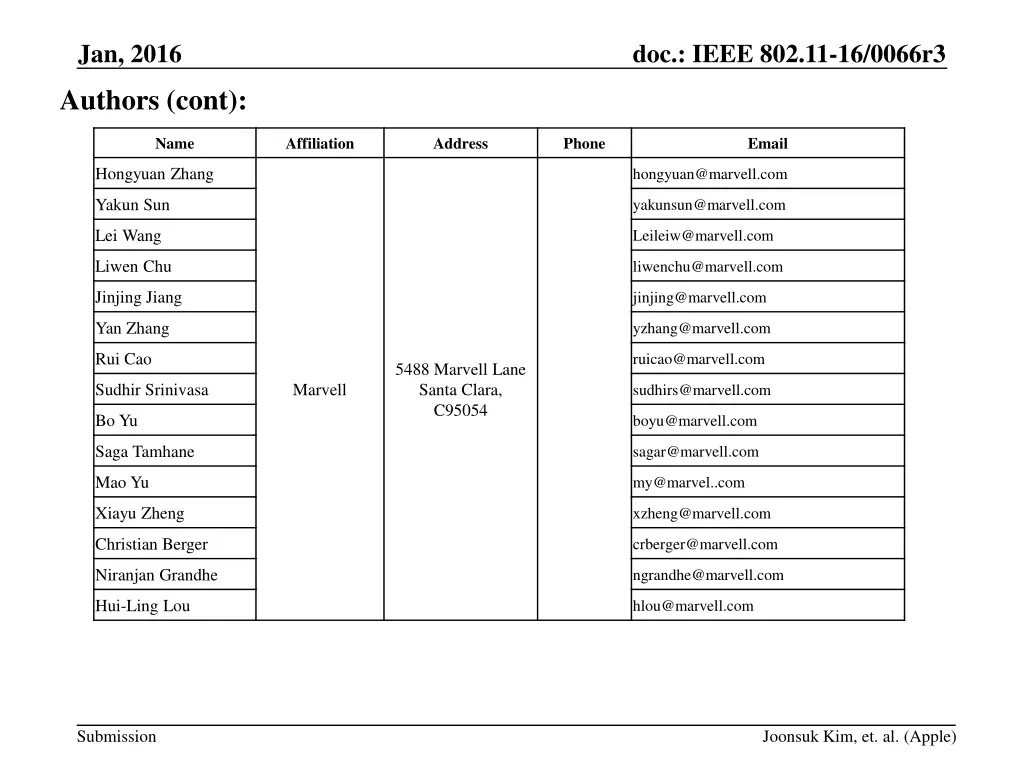
Jan, 2016 doc.: IEEE 802.11-16/0066r3 Authors (cont): Name Affiliation Address Phone Email Hongyuan Zhang hongyuan@marvell.com Yakun Sun yakunsun@marvell.com Lei Wang Leileiw@marvell.com Liwen Chu liwenchu@marvell.com Jinjing Jiang jinjing@marvell.com Yan Zhang yzhang@marvell.com Rui Cao ruicao@marvell.com 5488 Marvell Lane Santa Clara, C95054 Marvell Sudhir Srinivasa sudhirs@marvell.com Bo Yu boyu@marvell.com Saga Tamhane sagar@marvell.com Mao Yu my@marvel..com Xiayu Zheng xzheng@marvell.com Christian Berger crberger@marvell.com Niranjan Grandhe ngrandhe@marvell.com Hui-Ling Lou hlou@marvell.com Submission Joonsuk Kim, et. al. (Apple)
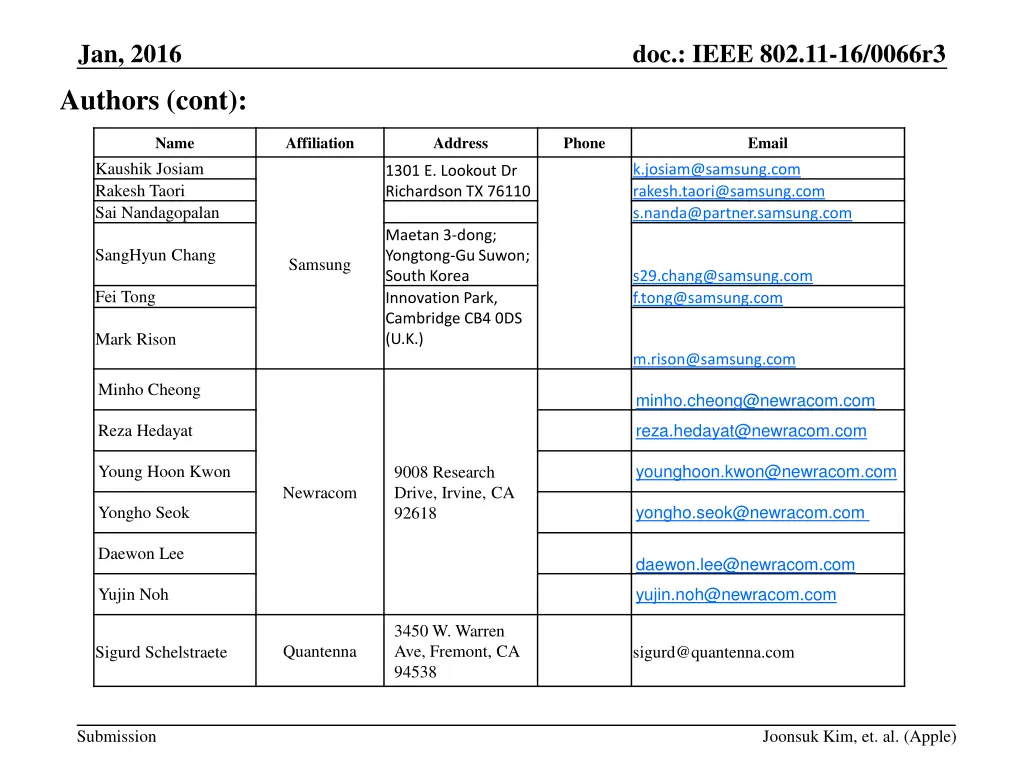
Jan, 2016 doc.: IEEE 802.11-16/0066r3 Authors (cont): Name Affiliation Address Phone Email Kaushik Josiam Rakesh Taori Sai Nandagopalan k.josiam@samsung.com rakesh.taori@samsung.com s.nanda@partner.samsung.com 1301 E. Lookout Dr Richardson TX 76110 Maetan 3-dong; Yongtong-Gu Suwon; South Korea Innovation Park, Cambridge CB4 0DS (U.K.) SangHyun Chang Samsung s29.chang@samsung.com f.tong@samsung.com Fei Tong Mark Rison m.rison@samsung.com Minho Cheong minho.cheong@newracom.com reza.hedayat@newracom.com Reza Hedayat younghoon.kwon@newracom.com Young Hoon Kwon 9008 Research Drive, Irvine, CA 92618 Newracom yongho.seok@newracom.com Yongho Seok Daewon Lee daewon.lee@newracom.com yujin.noh@newracom.com Yujin Noh 3450 W. Warren Ave, Fremont, CA 94538 Quantenna Sigurd Schelstraete sigurd@quantenna.com Submission Joonsuk Kim, et. al. (Apple)
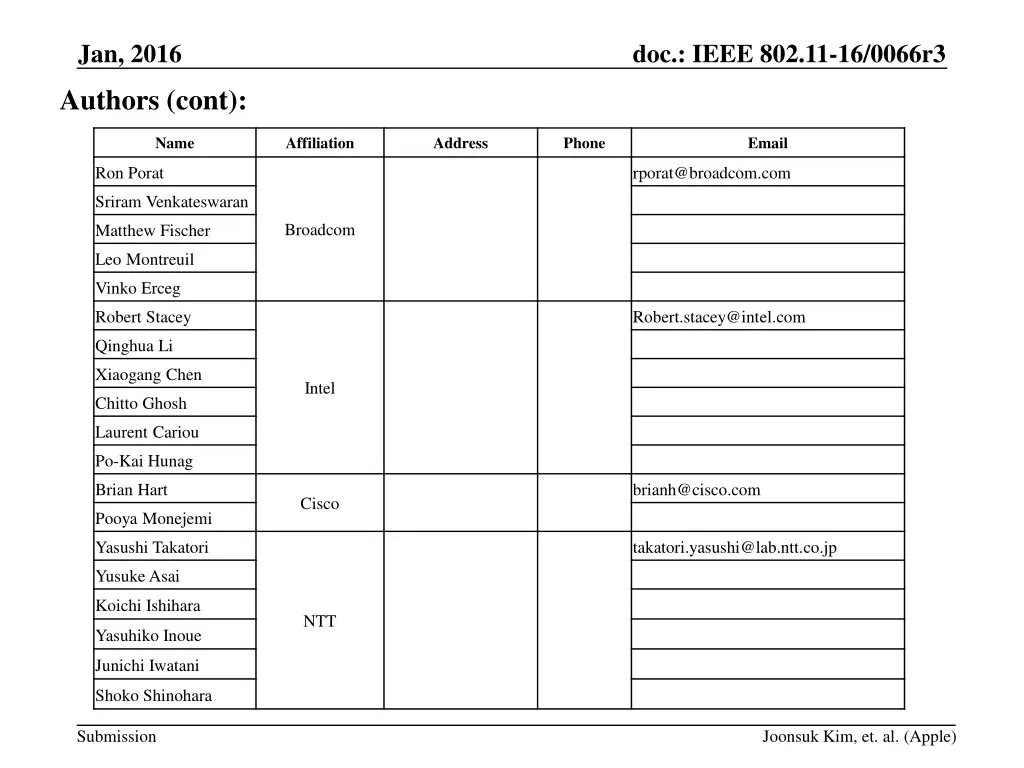
Jan, 2016 doc.: IEEE 802.11-16/0066r3 Authors (cont): Name Affiliation Address Phone Email Ron Porat rporat@broadcom.com Sriram Venkateswaran Broadcom Matthew Fischer Leo Montreuil Vinko Erceg Robert Stacey Robert.stacey@intel.com Qinghua Li Xiaogang Chen Intel Chitto Ghosh Laurent Cariou Po-Kai Hunag Brian Hart brianh@cisco.com Cisco Pooya Monejemi Yasushi Takatori takatori.yasushi@lab.ntt.co.jp Yusuke Asai Koichi Ishihara NTT Yasuhiko Inoue Junichi Iwatani Shoko Shinohara Submission Joonsuk Kim, et. al. (Apple)
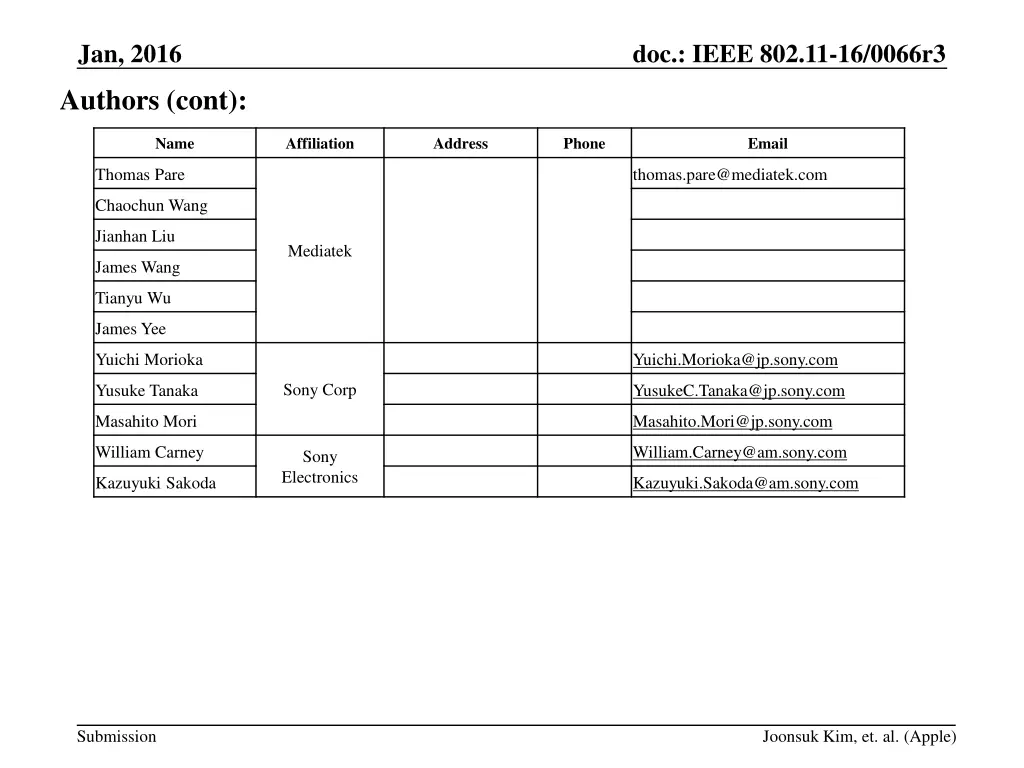
Jan, 2016 doc.: IEEE 802.11-16/0066r3 Authors (cont): Name Affiliation Address Phone Email Thomas Pare thomas.pare@mediatek.com Chaochun Wang Jianhan Liu Mediatek James Wang Tianyu Wu James Yee Yuichi Morioka Yuichi.Morioka@jp.sony.com Sony Corp Yusuke Tanaka YusukeC.Tanaka@jp.sony.com Masahito Mori Masahito.Mori@jp.sony.com William Carney William.Carney@am.sony.com Sony Electronics Kazuyuki Sakoda Kazuyuki.Sakoda@am.sony.com Submission Joonsuk Kim, et. al. (Apple)
Jan, 2016 doc.: IEEE 802.11-16/0066r3 Abstract This presentation describes the view on UL MU features in 11ax Submission Joonsuk Kim, et. al. (Apple)
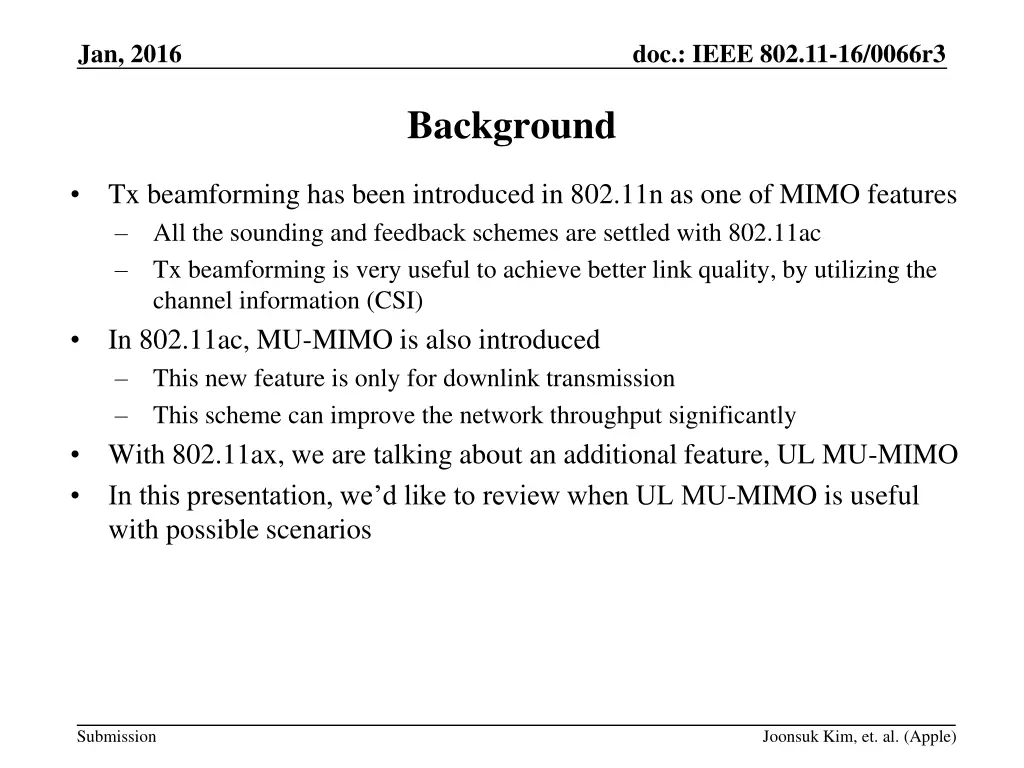
Jan, 2016 doc.: IEEE 802.11-16/0066r3 Background Tx beamforming has been introduced in 802.11n as one of MIMO features All the sounding and feedback schemes are settled with 802.11ac Tx beamforming is very useful to achieve better link quality, by utilizing the channel information (CSI) In 802.11ac, MU-MIMO is also introduced This new feature is only for downlink transmission This scheme can improve the network throughput significantly With 802.11ax, we are talking about an additional feature, UL MU-MIMO In this presentation, we d like to review when UL MU-MIMO is useful with possible scenarios Submission Joonsuk Kim, et. al. (Apple)
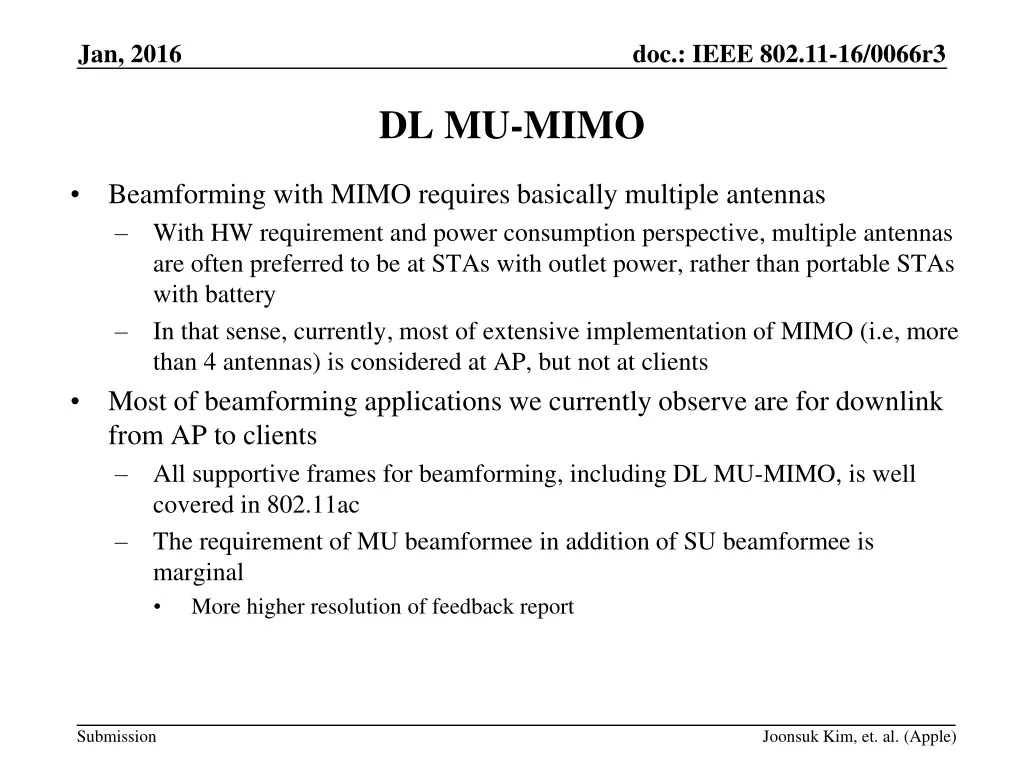
Jan, 2016 doc.: IEEE 802.11-16/0066r3 DL MU-MIMO Beamforming with MIMO requires basically multiple antennas With HW requirement and power consumption perspective, multiple antennas are often preferred to be at STAs with outlet power, rather than portable STAs with battery In that sense, currently, most of extensive implementation of MIMO (i.e, more than 4 antennas) is considered at AP, but not at clients Most of beamforming applications we currently observe are for downlink from AP to clients All supportive frames for beamforming, including DL MU-MIMO, is well covered in 802.11ac The requirement of MU beamformee in addition of SU beamformee is marginal More higher resolution of feedback report Submission Joonsuk Kim, et. al. (Apple)
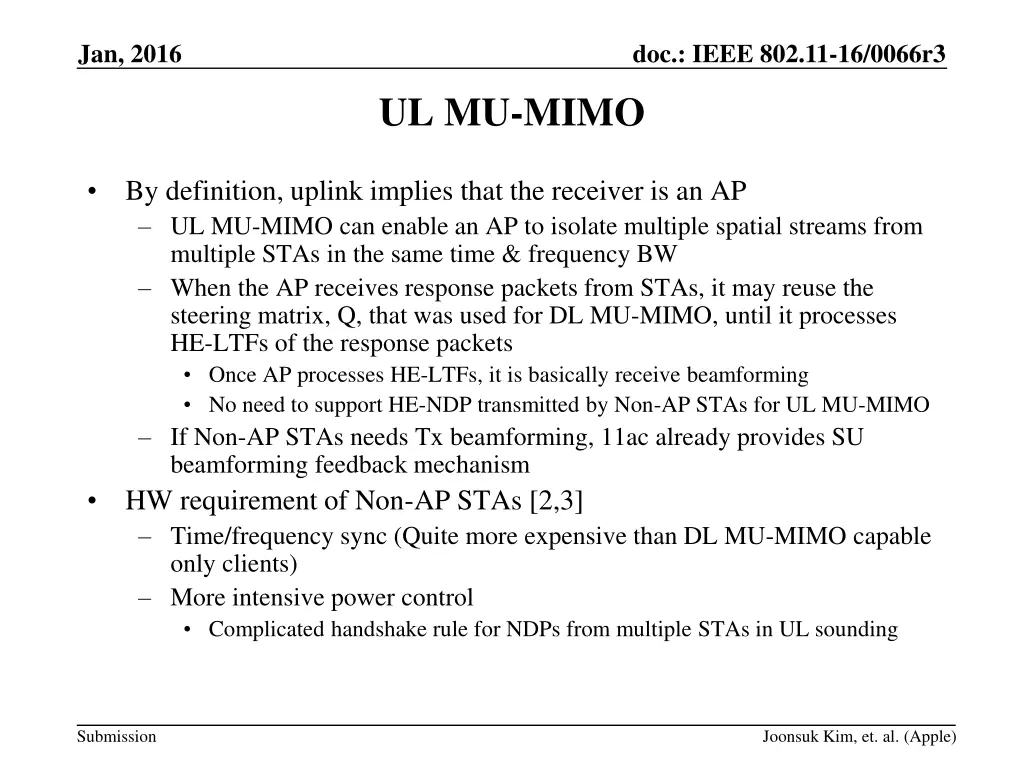
Jan, 2016 doc.: IEEE 802.11-16/0066r3 UL MU-MIMO By definition, uplink implies that the receiver is an AP UL MU-MIMO can enable an AP to isolate multiple spatial streams from multiple STAs in the same time & frequency BW When the AP receives response packets from STAs, it may reuse the steering matrix, Q, that was used for DL MU-MIMO, until it processes HE-LTFs of the response packets Once AP processes HE-LTFs, it is basically receive beamforming No need to support HE-NDP transmitted by Non-AP STAs for UL MU-MIMO If Non-AP STAs needs Tx beamforming, 11ac already provides SU beamforming feedback mechanism HW requirement of Non-AP STAs [2,3] Time/frequency sync (Quite more expensive than DL MU-MIMO capable only clients) More intensive power control Complicated handshake rule for NDPs from multiple STAs in UL sounding Submission Joonsuk Kim, et. al. (Apple)
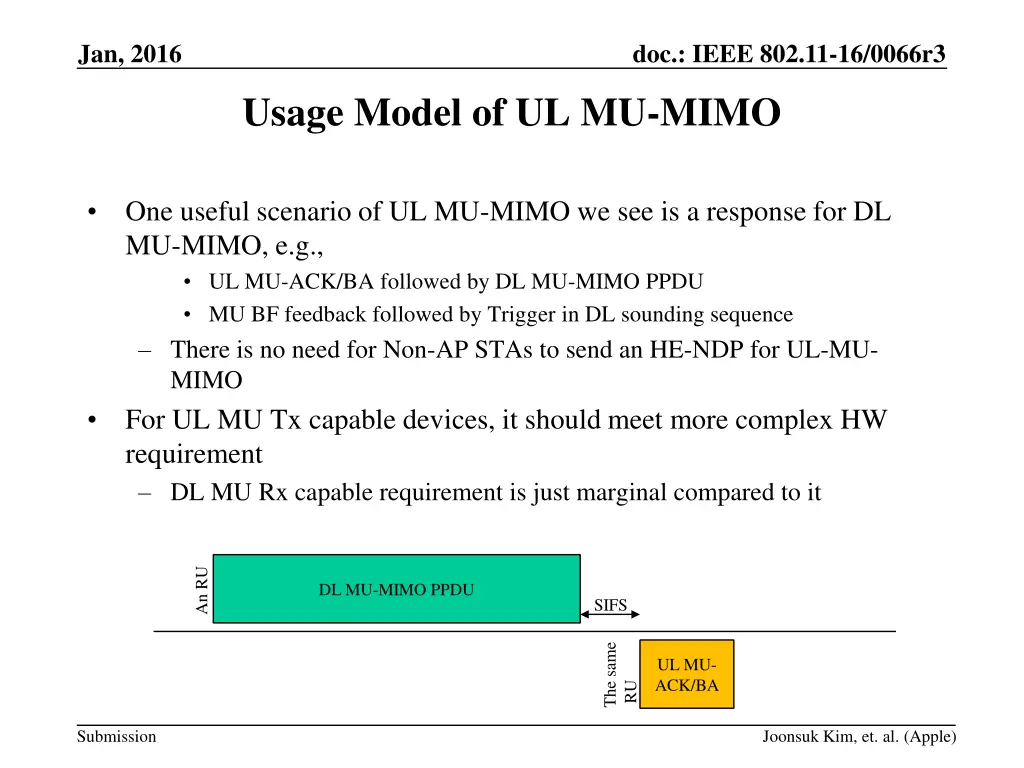
Jan, 2016 doc.: IEEE 802.11-16/0066r3 Usage Model of UL MU-MIMO One useful scenario of UL MU-MIMO we see is a response for DL MU-MIMO, e.g., UL MU-ACK/BA followed by DL MU-MIMO PPDU MU BF feedback followed by Trigger in DL sounding sequence There is no need for Non-AP STAs to send an HE-NDP for UL-MU- MIMO For UL MU Tx capable devices, it should meet more complex HW requirement DL MU Rx capable requirement is just marginal compared to it An RU DL MU-MIMO PPDU SIFS The same UL MU- ACK/BA RU Submission Joonsuk Kim, et. al. (Apple)
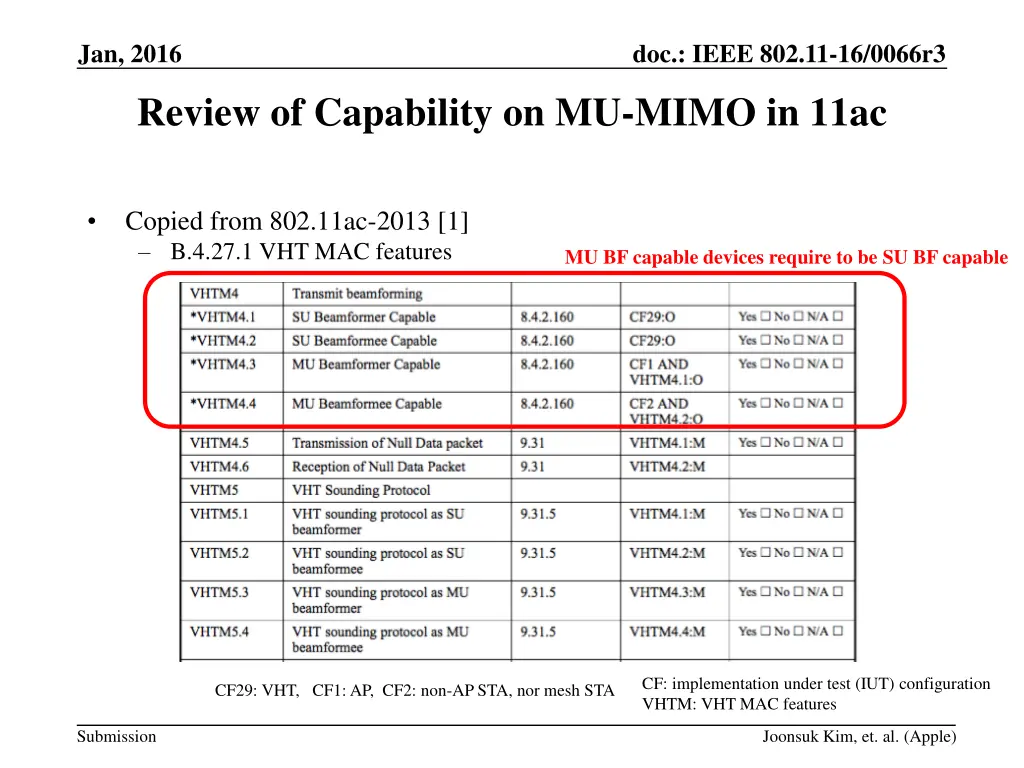
Jan, 2016 doc.: IEEE 802.11-16/0066r3 Review of Capability on MU-MIMO in 11ac Copied from 802.11ac-2013 [1] B.4.27.1 VHT MAC features MU BF capable devices require to be SU BF capable CF: implementation under test (IUT) configuration VHTM: VHT MAC features CF29: VHT, CF1: AP, CF2: non-AP STA, nor mesh STA Submission Joonsuk Kim, et. al. (Apple)
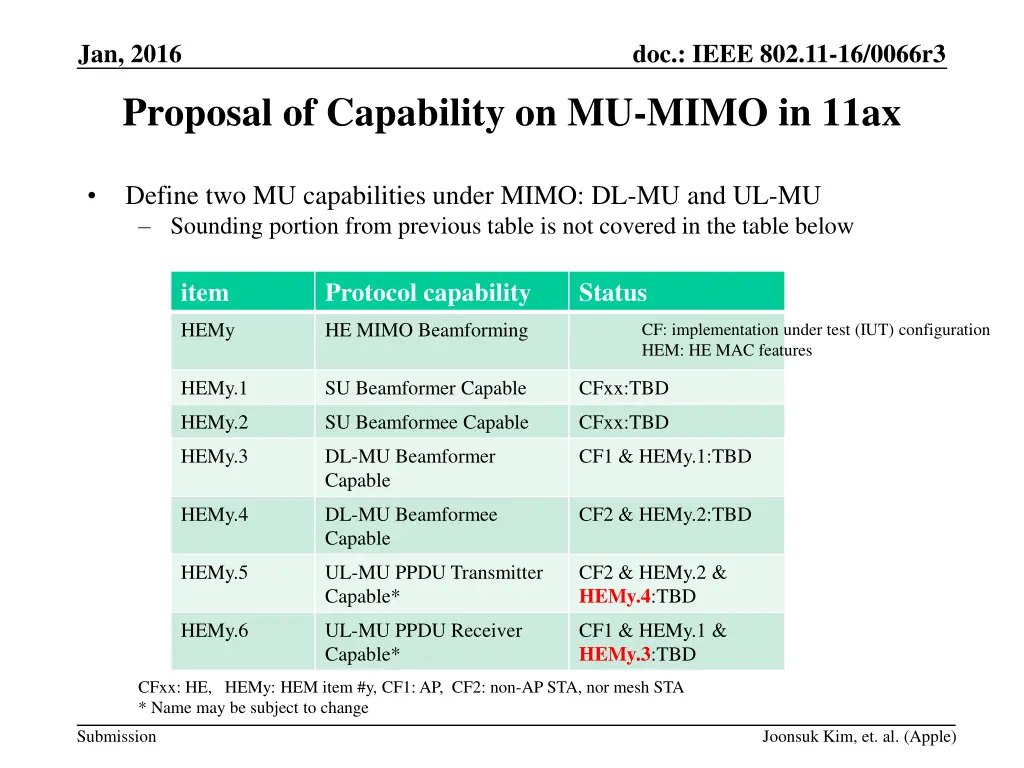
Jan, 2016 doc.: IEEE 802.11-16/0066r3 Proposal of Capability on MU-MIMO in 11ax Define two MU capabilities under MIMO: DL-MU and UL-MU Sounding portion from previous table is not covered in the table below item Protocol capability Status HEMy HE MIMO Beamforming CF: implementation under test (IUT) configuration HEM: HE MAC features HEMy.1 SU Beamformer Capable CFxx:TBD HEMy.2 SU Beamformee Capable CFxx:TBD HEMy.3 DL-MU Beamformer Capable CF1 & HEMy.1:TBD HEMy.4 DL-MU Beamformee Capable CF2 & HEMy.2:TBD HEMy.5 UL-MU PPDU Transmitter Capable* CF2 & HEMy.2 & HEMy.4:TBD HEMy.6 UL-MU PPDU Receiver Capable* CF1 & HEMy.1 & HEMy.3:TBD CFxx: HE, HEMy: HEM item #y, CF1: AP, CF2: non-AP STA, nor mesh STA * Name may be subject to change Submission Joonsuk Kim, et. al. (Apple)
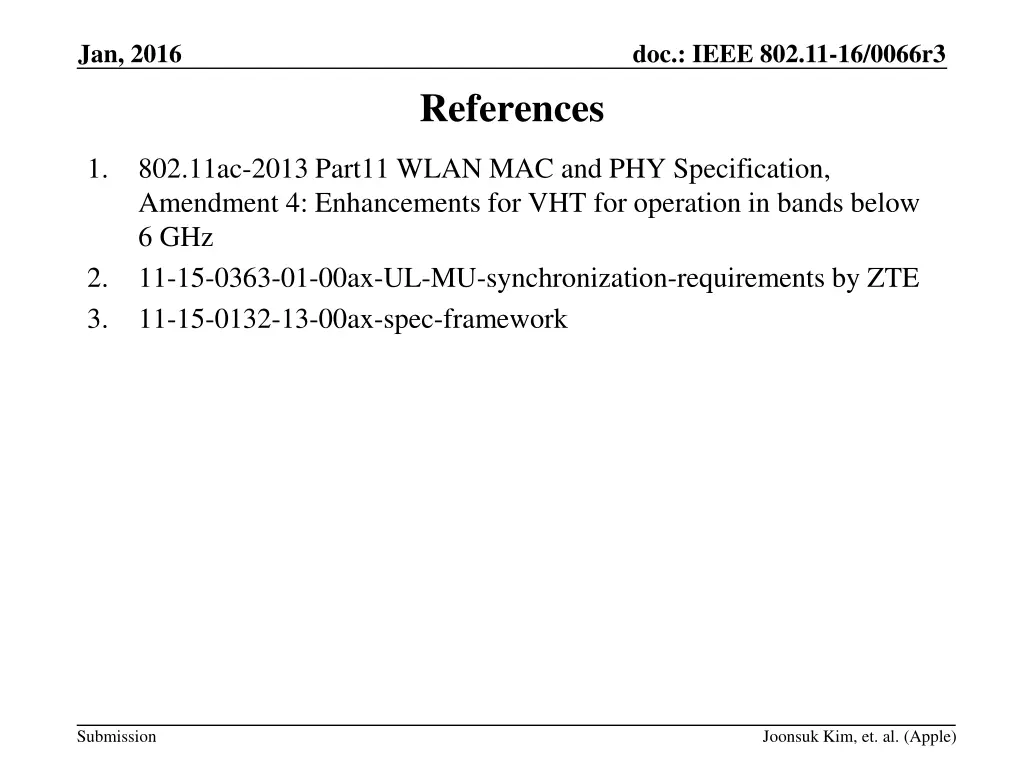
Jan, 2016 doc.: IEEE 802.11-16/0066r3 References 1. 802.11ac-2013 Part11 WLAN MAC and PHY Specification, Amendment 4: Enhancements for VHT for operation in bands below 6 GHz 11-15-0363-01-00ax-UL-MU-synchronization-requirements by ZTE 11-15-0132-13-00ax-spec-framework 2. 3. Submission Joonsuk Kim, et. al. (Apple)
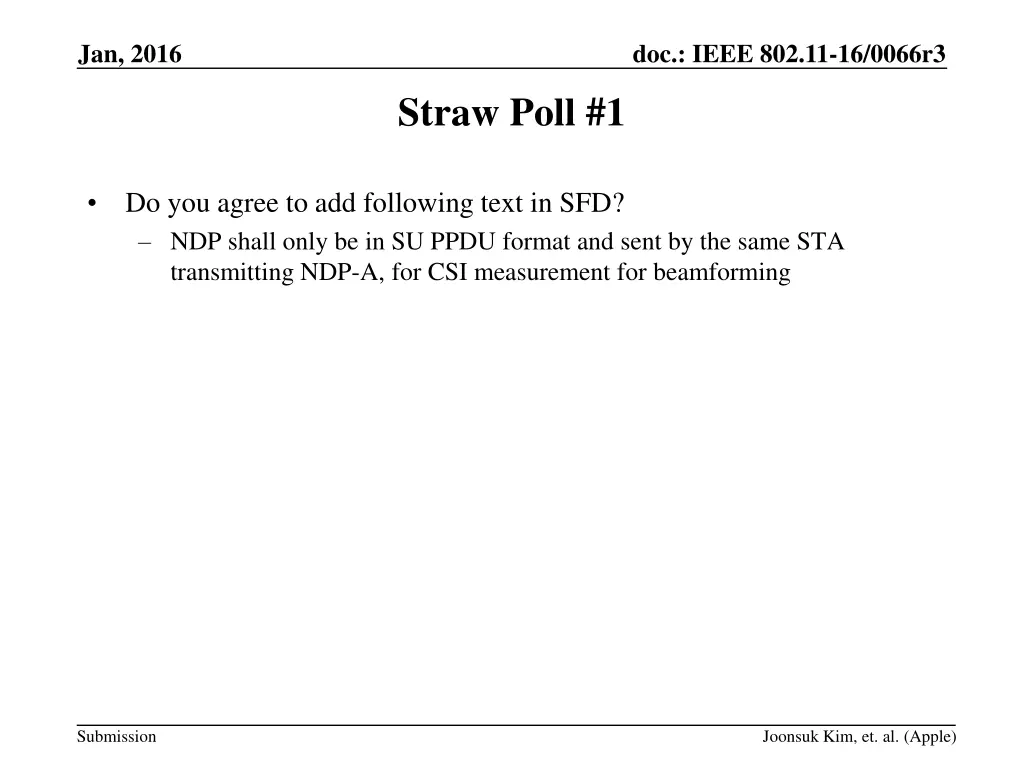
Jan, 2016 doc.: IEEE 802.11-16/0066r3 Straw Poll #1 Do you agree to add following text in SFD? NDP shall only be in SU PPDU format and sent by the same STA transmitting NDP-A, for CSI measurement for beamforming Submission Joonsuk Kim, et. al. (Apple)
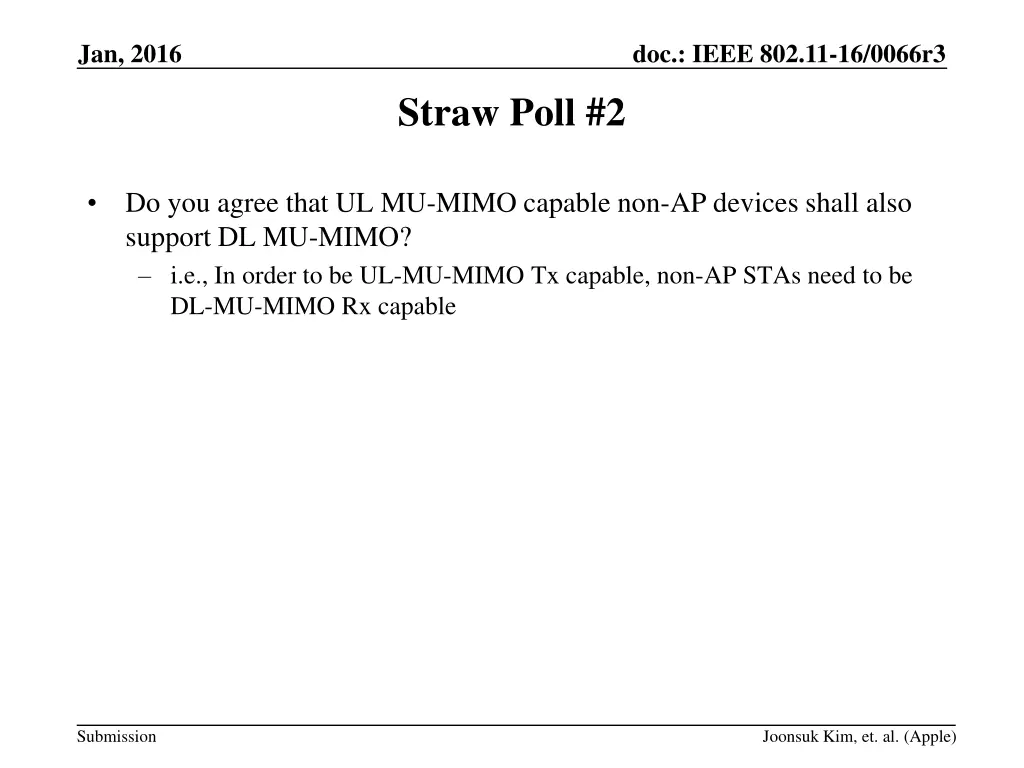
Jan, 2016 doc.: IEEE 802.11-16/0066r3 Straw Poll #2 Do you agree that UL MU-MIMO capable non-AP devices shall also support DL MU-MIMO? i.e., In order to be UL-MU-MIMO Tx capable, non-AP STAs need to be DL-MU-MIMO Rx capable Submission Joonsuk Kim, et. al. (Apple)
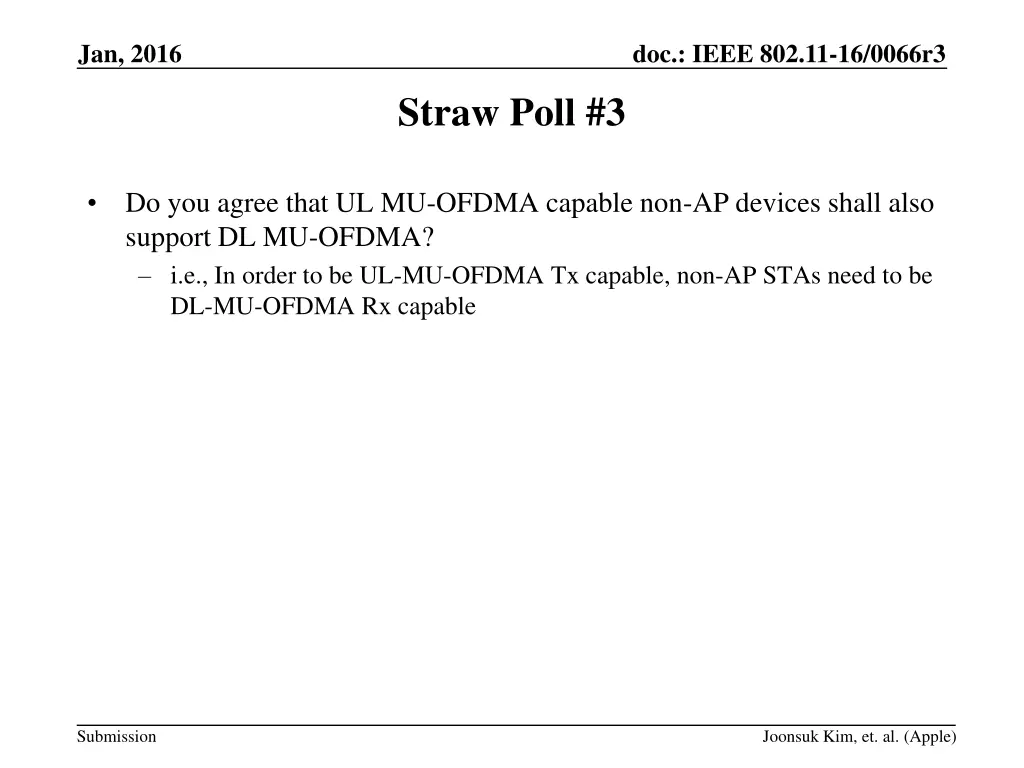
Jan, 2016 doc.: IEEE 802.11-16/0066r3 Straw Poll #3 Do you agree that UL MU-OFDMA capable non-AP devices shall also support DL MU-OFDMA? i.e., In order to be UL-MU-OFDMA Tx capable, non-AP STAs need to be DL-MU-OFDMA Rx capable Submission Joonsuk Kim, et. al. (Apple)