Integrated Modeling of High Performance Passenger and Freight Train Operation Planning
Explore the integrated modeling approach for passenger and freight train operation planning on shared rail corridors. Topics covered include hypergraphs, train schedule modeling, solution approaches, and more. Learn about the resurgence of passenger rail services in the US and the development of strategic scheduling models for mixed train operations.

Download Presentation

Please find below an Image/Link to download the presentation.
The content on the website is provided AS IS for your information and personal use only. It may not be sold, licensed, or shared on other websites without obtaining consent from the author. If you encounter any issues during the download, it is possible that the publisher has removed the file from their server.
You are allowed to download the files provided on this website for personal or commercial use, subject to the condition that they are used lawfully. All files are the property of their respective owners.
The content on the website is provided AS IS for your information and personal use only. It may not be sold, licensed, or shared on other websites without obtaining consent from the author.
E N D
Presentation Transcript
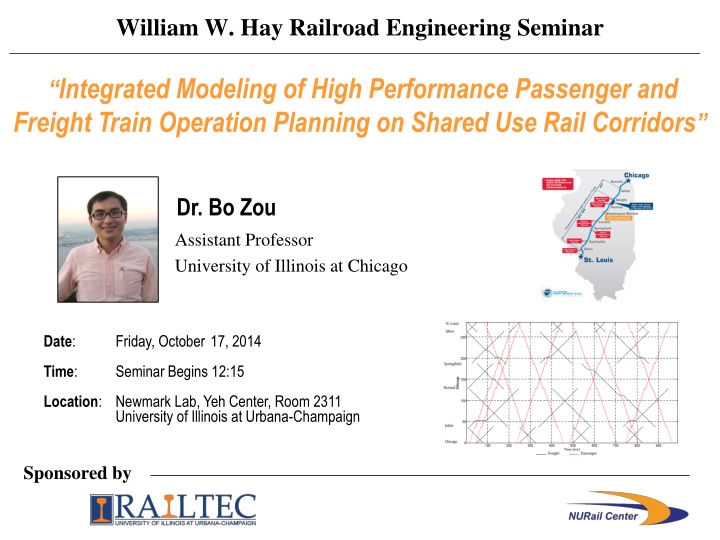
William W. Hay Railroad Engineering Seminar Integrated Modeling of High Performance Passenger and Freight Train Operation Planning on Shared Use Rail Corridors Dr. Bo Zou Assistant Professor University of Illinois at Chicago Friday, October17, 2014 Seminar Begins 12:15 Date: Time: Location: Newmark Lab, Yeh Center, Room 2311 University of Illinois at Urbana-Champaign Sponsored by
INTEGRATED MODELINGOF HIGH PERFORMANCE PASSENGERAND FREIGHT TRAIN OPERATION PLANNINGON SHARED USE RAIL CORRIDORS: A FOCUSONTHE US CONTEXT Ahmadreza Talebian, Bo Zou University of Illinois at Chicago Presentation at UIUC Oct 17, 2014 2
Outline Background Literature review Hypergraphs The train schedule model Modeling approach Passenger train scheduling Freight train scheduling Solution approach Numerical analysis Summary and conclusion 3
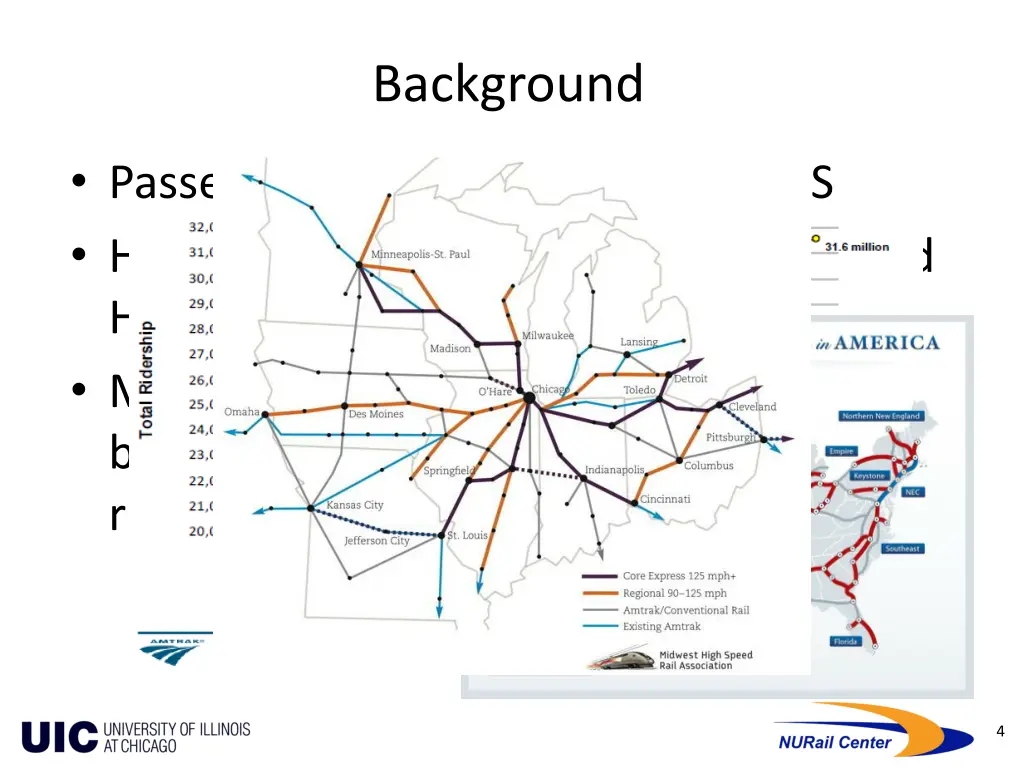
Background Passenger rail resurgence in the US High performance rail systems (HSR and HrSR services) Midwest: existing single track lines are being upgraded to accommodate trains running at a maximum speed of 110 mph 4
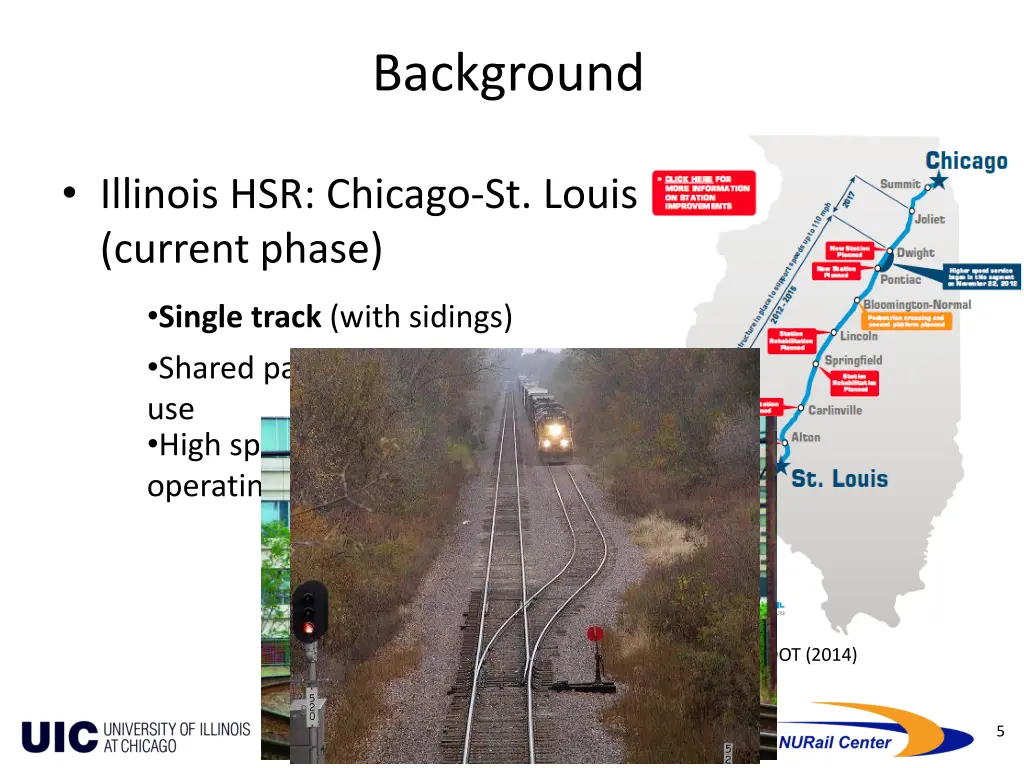
Background Illinois HSR: Chicago-St. Louis (current phase) Single track (with sidings) Shared passenger and freight use High speed passenger trains operating at 110 mph Source: IDOT (2014) 5
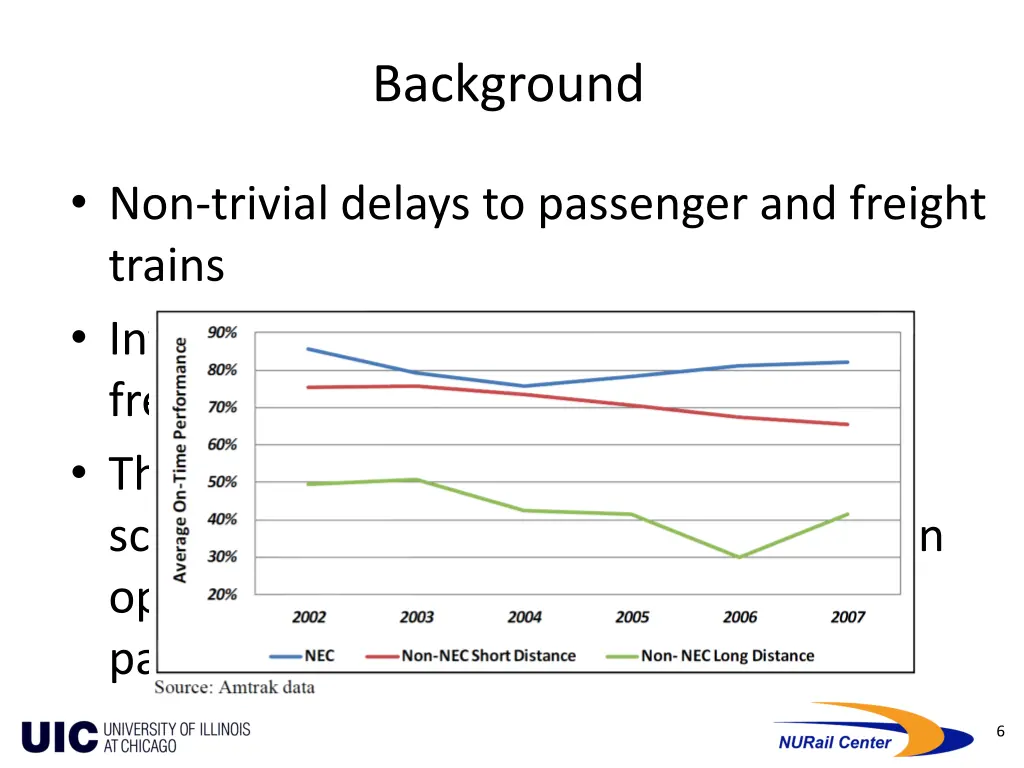
Background Non-trivial delays to passenger and freight trains Interactions between passenger and freight operations This research develops a strategic level schedule planning model for mixed train operations on single-track, shared use passenger and freight corridors 6
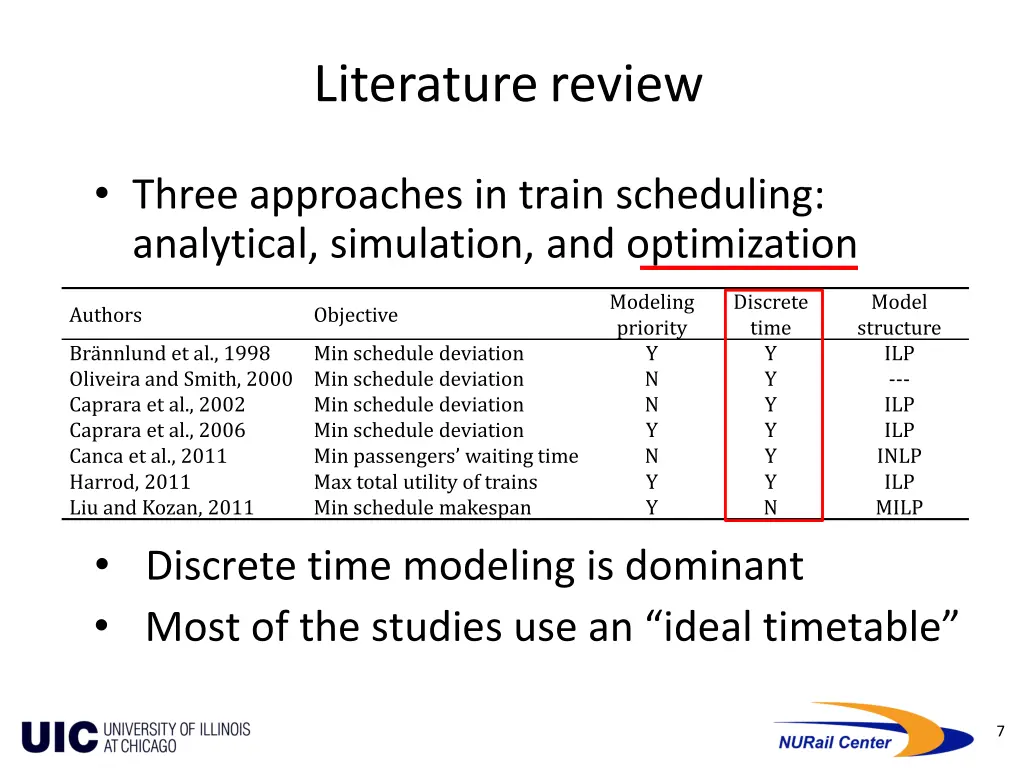
Literaturereview Three approaches in train scheduling: analytical, simulation, and optimization Modeling priority Y N N Y N Y Y Discrete time Y Y Y Y Y Y N Model structure ILP --- ILP ILP INLP ILP MILP Authors Objective Br nnlund et al., 1998 Oliveira and Smith, 2000 Caprara et al., 2002 Caprara et al., 2006 Canca et al., 2011 Harrod, 2011 Liu and Kozan, 2011 Discrete time modeling is dominant Min schedule deviation Min schedule deviation Min schedule deviation Min schedule deviation Min passengers waiting time Max total utility of trains Min schedule makespan Most of the studies use an ideal timetable 7
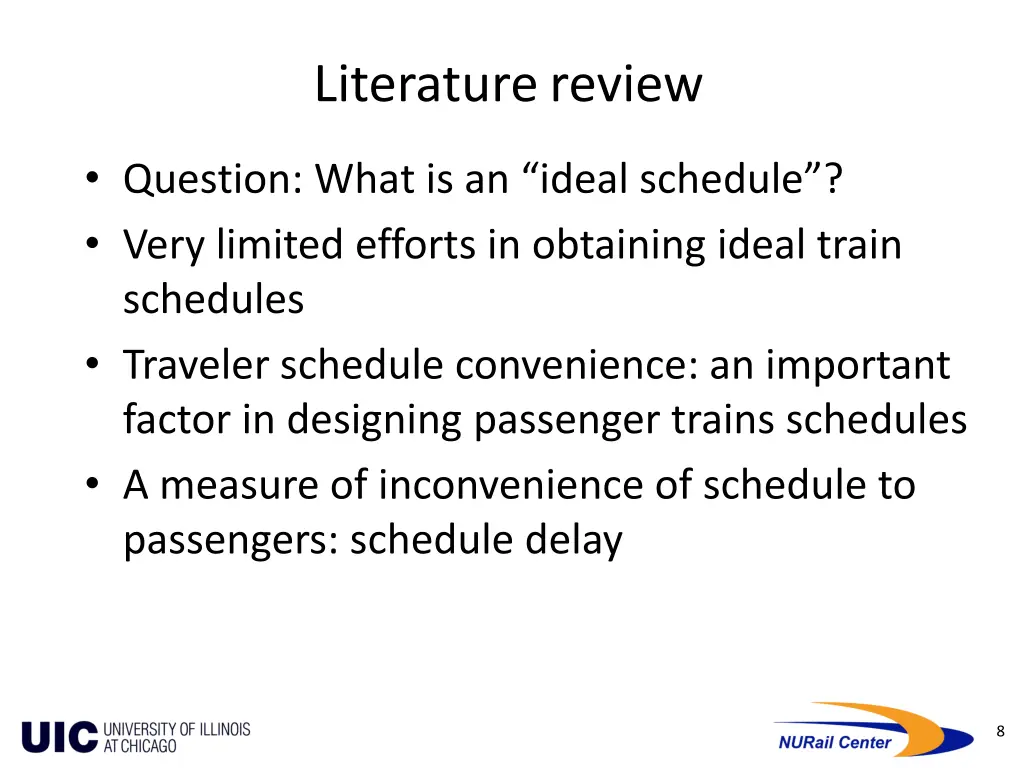
Literaturereview Question: What is an ideal schedule ? Very limited efforts in obtaining ideal train schedules Traveler schedule convenience: an important factor in designing passenger trains schedules A measure of inconvenience of schedule to passengers: schedule delay 8
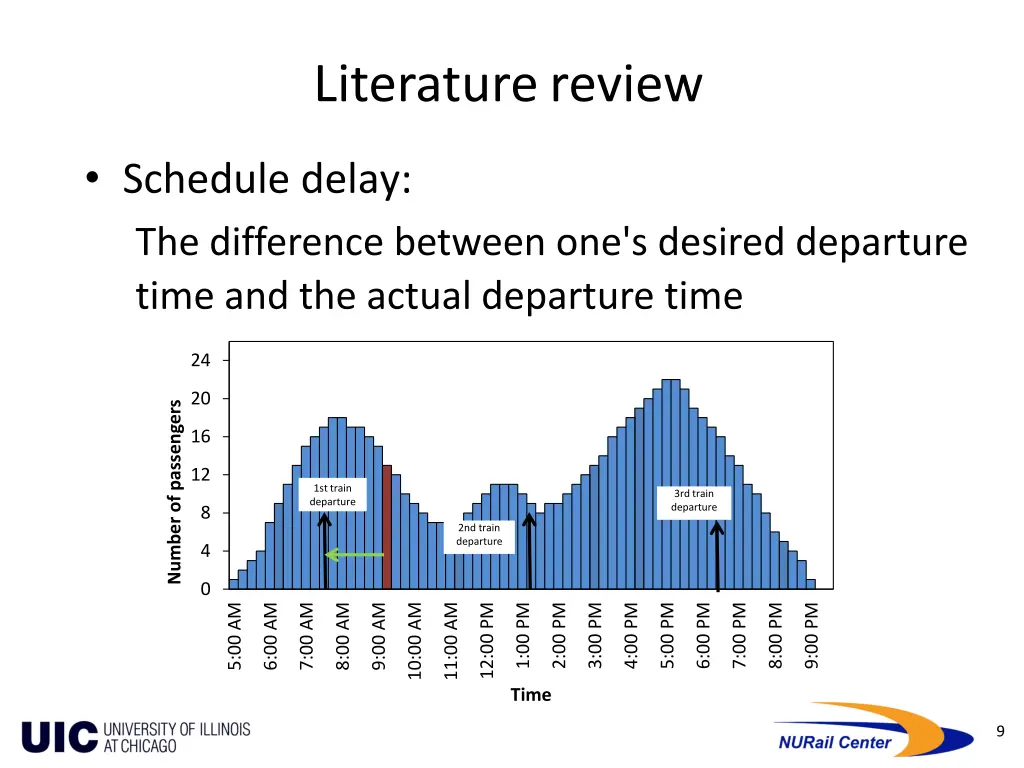
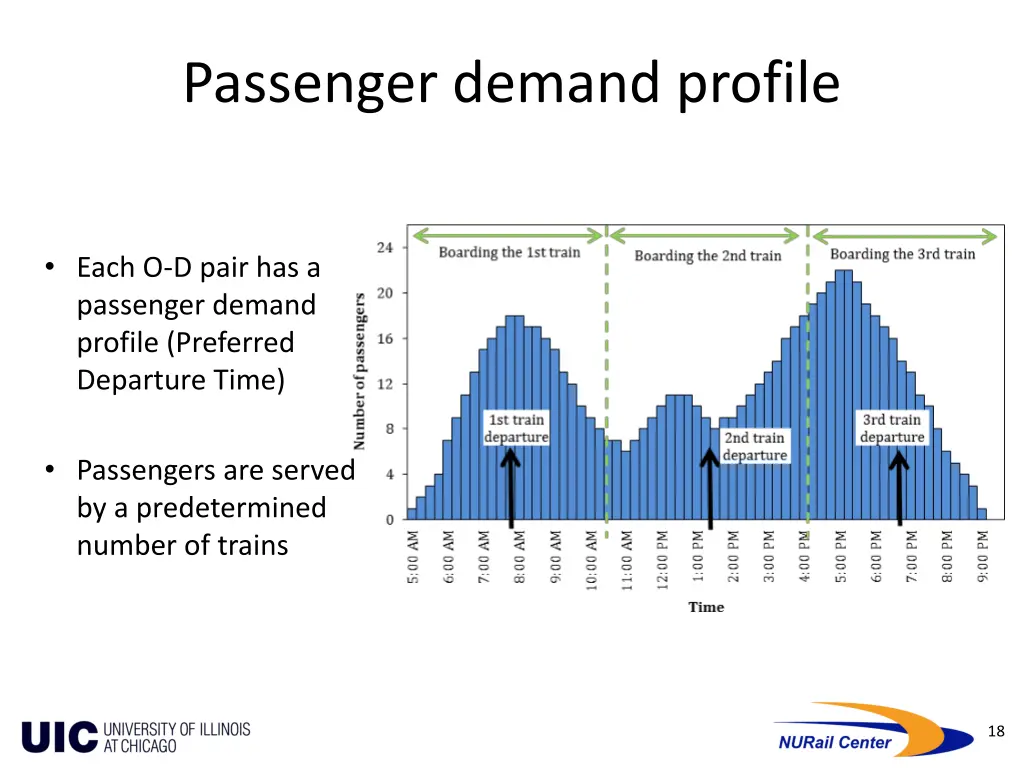
Literaturereview Schedule delay: The difference between one's desired departure time and the actual departure time 24 20 Number of passengers 16 12 1st train departure 3rd train departure 8 2nd train departure 4 0 10:00 AM 11:00 AM 3:00 PM 7:00 AM 12:00 PM 1:00 PM 2:00 PM 4:00 PM 5:00 PM 6:00 PM 7:00 PM 8:00 PM 9:00 PM 5:00 AM 6:00 AM 8:00 AM 9:00 AM Time 9
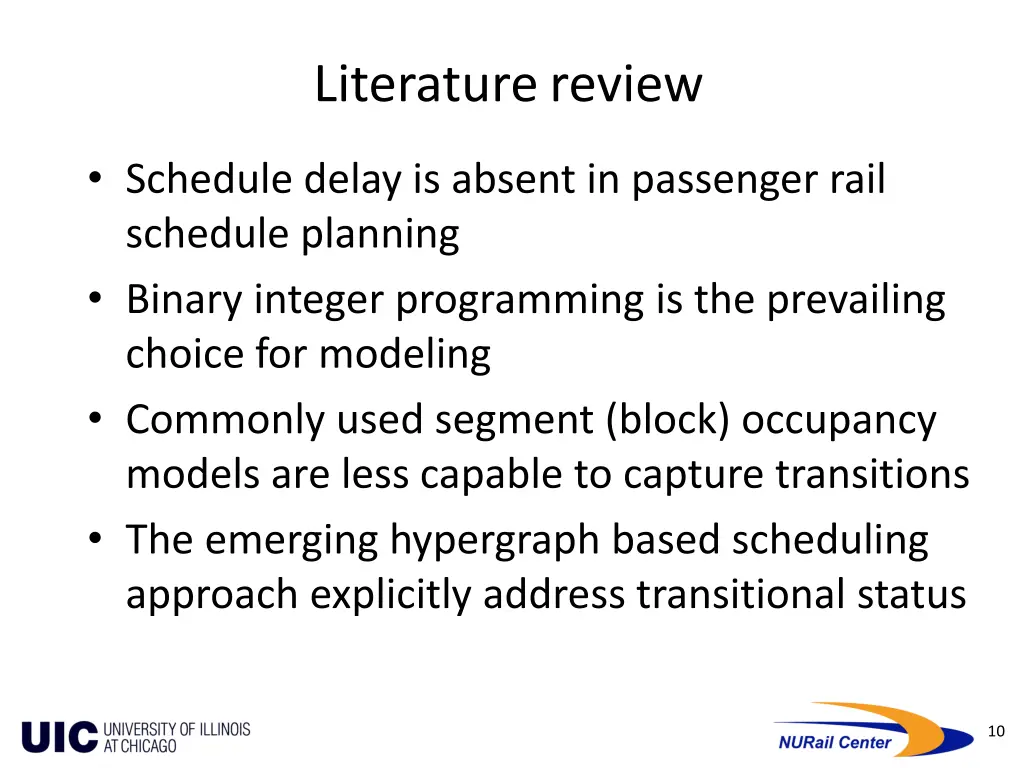
Literaturereview Schedule delay is absent in passenger rail schedule planning Binary integer programming is the prevailing choice for modeling Commonly used segment (block) occupancy models are less capable to capture transitions The emerging hypergraph based scheduling approach explicitly address transitional status 10
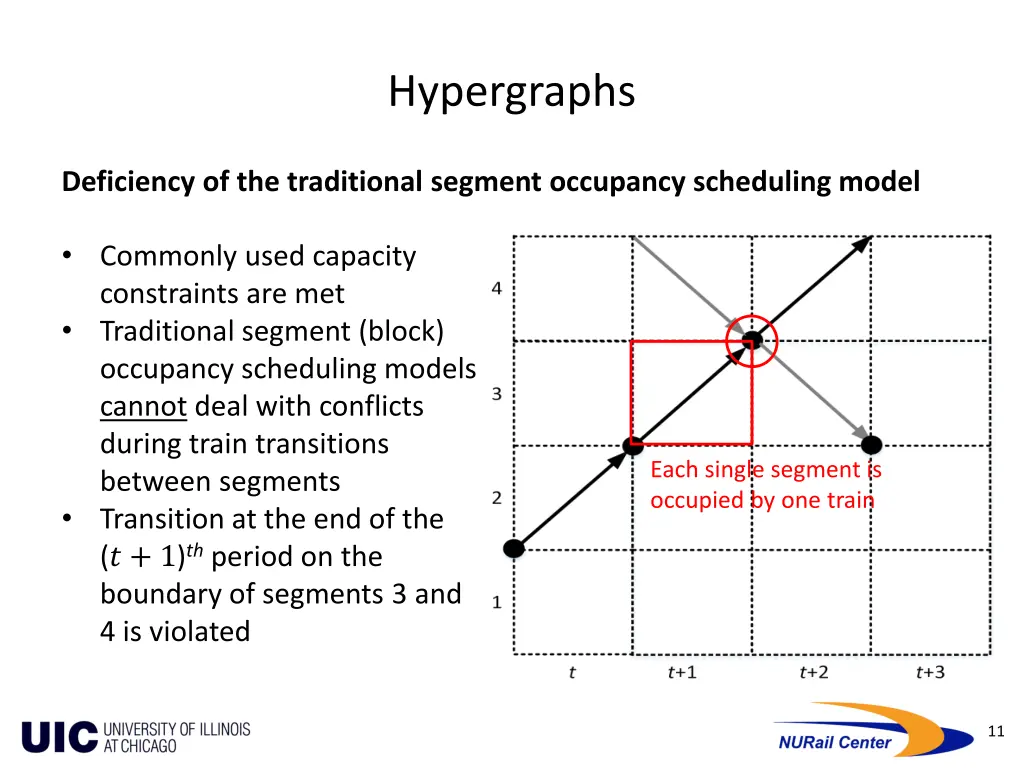
Hypergraphs Deficiency of the traditional segment occupancy scheduling model Commonly used capacity constraints are met Traditional segment (block) occupancy scheduling models cannot deal with conflicts during train transitions between segments Transition at the end of the (? + 1)th period on the boundary of segments 3 and 4 is violated Each single segment is occupied by one train 11
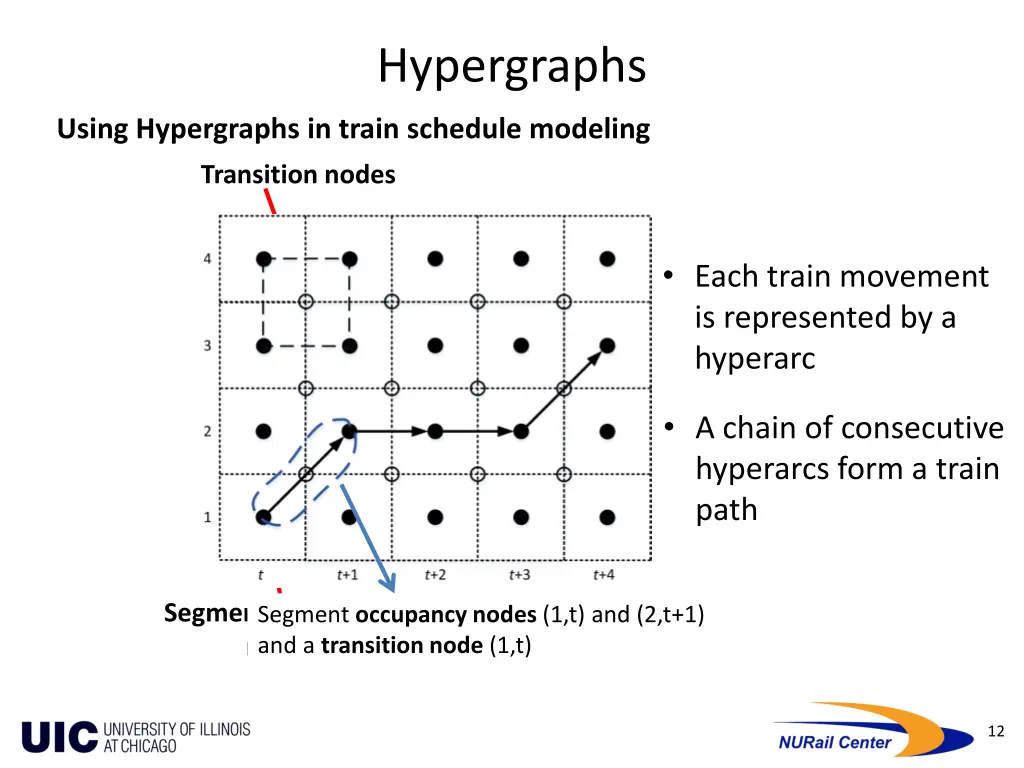
Hypergraphs Using Hypergraphs in train schedule modeling Transition nodes Each train movement is represented by a hyperarc A chain of consecutive hyperarcs form a train path Segment occupancy nodes and a transition node (1,t) Segment occupancy nodes (1,t) and (2,t+1) 12
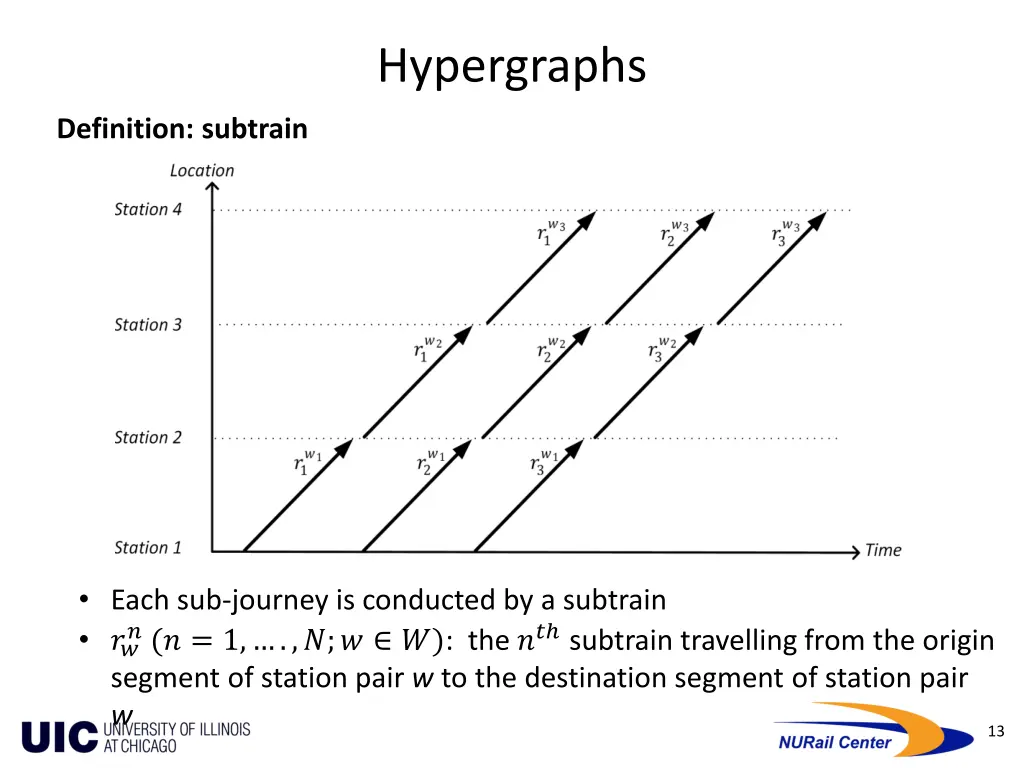
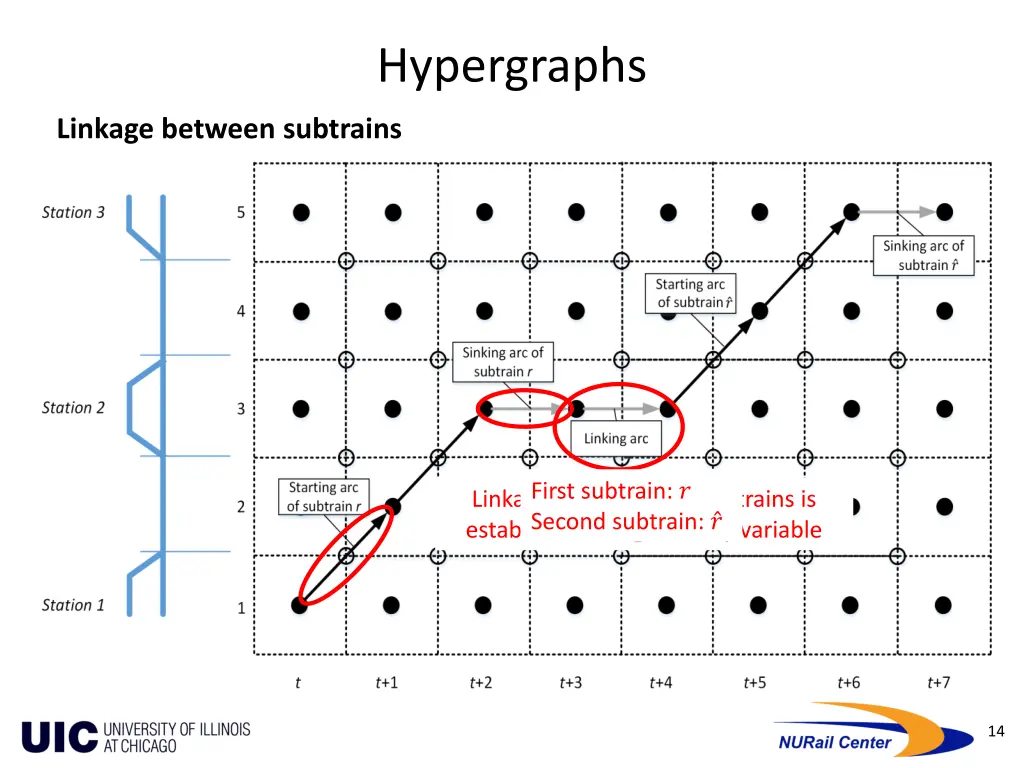
Hypergraphs Definition: subtrain Each sub-journey is conducted by a subtrain ?? segment of station pair w to the destination segment of station pair w ? (? = 1, .,?;? ?): the ?? subtrain travelling from the origin 13
Hypergraphs Linkage between subtrains First subtrain: ? Linkage between two subtrains is established using a binary variable Second subtrain: ? 14
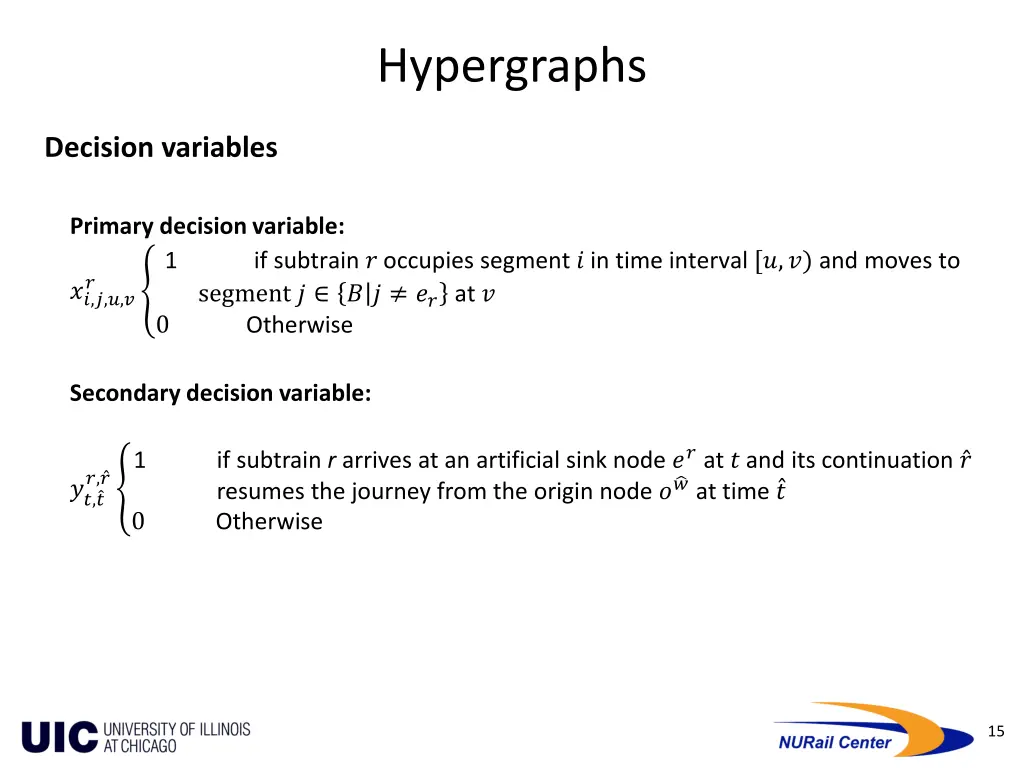
Hypergraphs Decision variables Primary decision variable: 1 segment ? ? ? ?? at ? 0 Otherwise if subtrain ? occupies segment ? in time interval [?,?) and moves to ? ??,?,?,? Secondary decision variable: 1 if subtrain r arrives at an artificial sink node ?? at ? and its continuation ? resumes the journey from the origin node ? ? at time ? 0 Otherwise ?, ? ??, ? 15
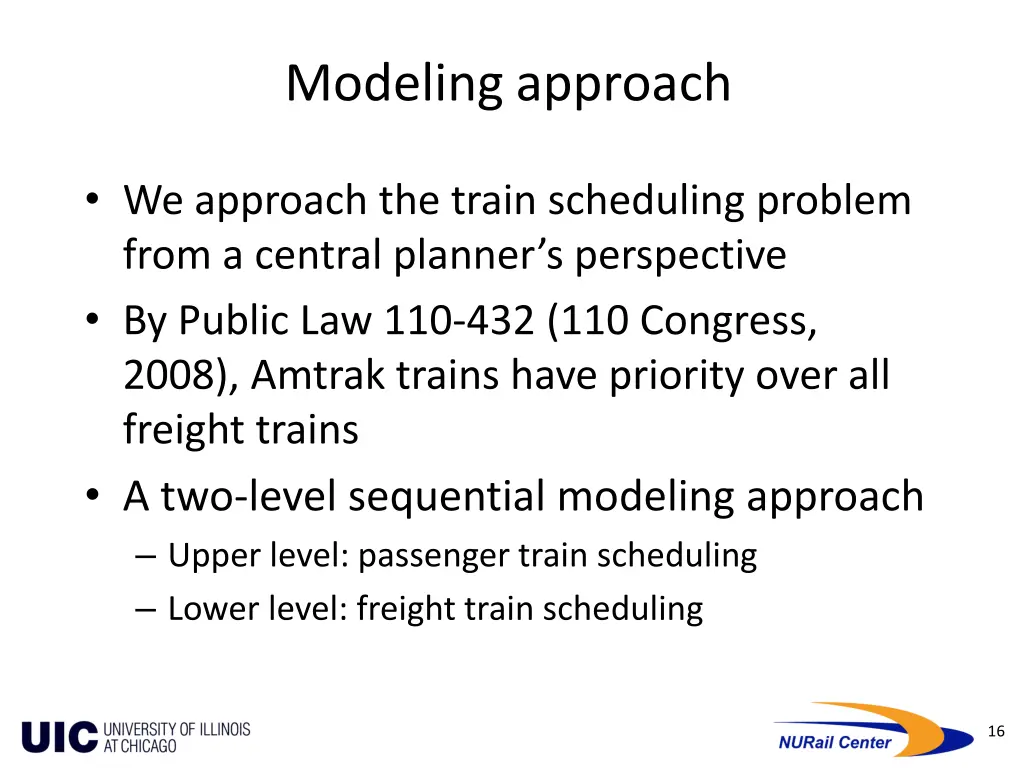
Modelingapproach We approach the train scheduling problem from a central planner s perspective By Public Law 110-432 (110 Congress, 2008), Amtrak trains have priority over all freight trains A two-level sequential modeling approach Upper level: passenger train scheduling Lower level: freight train scheduling 16
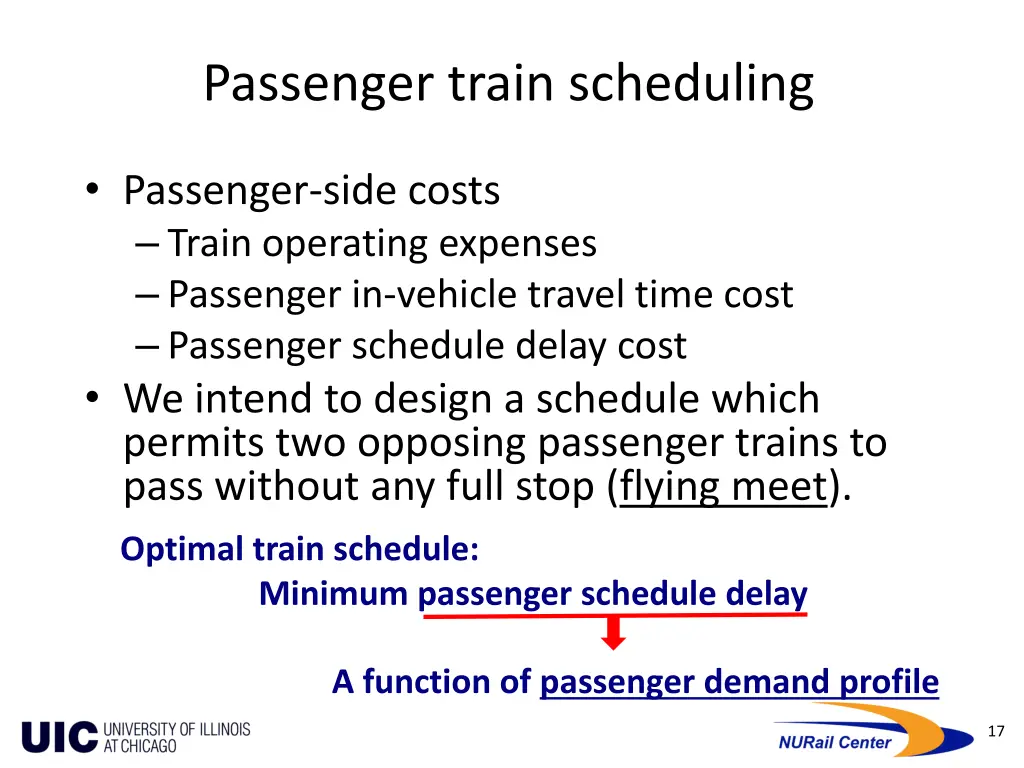
Passenger train scheduling Passenger-side costs Train operating expenses Passenger in-vehicle travel time cost Passenger schedule delay cost We intend to design a schedule which permits two opposing passenger trains to pass without any full stop (flying meet). Optimal train schedule: Minimum passenger schedule delay A function of passenger demand profile 17
Passenger demand profile Each O-D pair has a passenger demand profile (Preferred Departure Time) Passengers are served by a predetermined number of trains 18
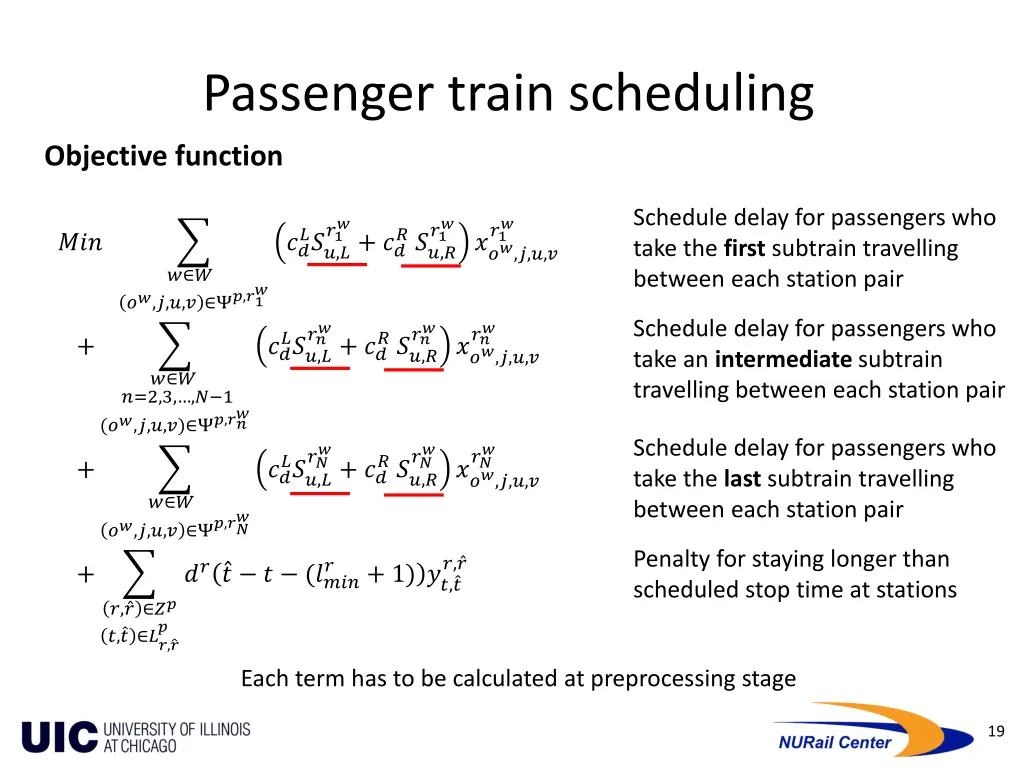
Passenger train scheduling Objective function Schedule delay for passengers who take the first subtrain travelling between each station pair ?1?+ ?? ?1? ?1? ???,? ? ??,? ??? ?? ???,?,?,? ? ? ? ??,?,?,? ?,?1 Schedule delay for passengers who take an intermediate subtrain travelling between each station pair ???+ ?? ??? ??? ???,? ? ??,? + ?? ???,?,?,? ? ? ?=2,3, ,? 1 (??,?,?,?) ?,?? ? Schedule delay for passengers who take the last subtrain travelling between each station pair ? ? ? ?? ?? ?? ???,? ? ??,? + ?? + ?? ???,?,?,? ? ? ? ??,?,?,? ?,?? Penalty for staying longer than scheduled stop time at stations ?, ? ? ?? ? ? (???? + + 1) ??, ? ?, ? ?? ?, ? ??, ? ? Each term has to be calculated at preprocessing stage 19
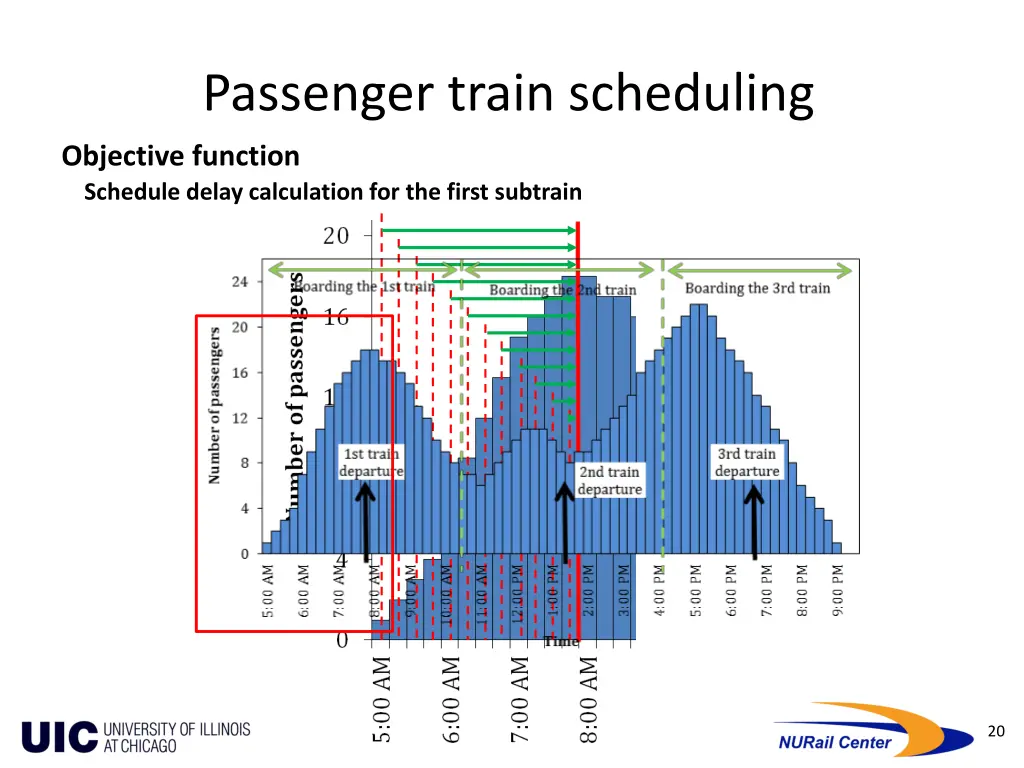
Passenger train scheduling Objective function Schedule delay calculation for the first subtrain 20
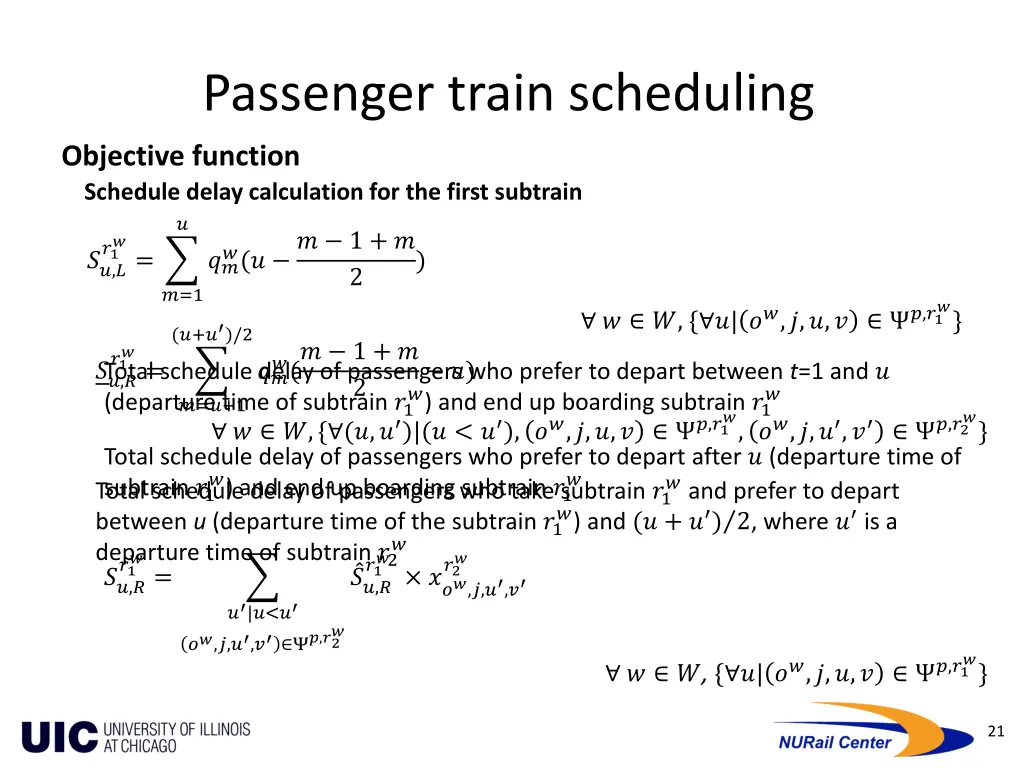
Passenger train scheduling Objective function Schedule delay calculation for the first subtrain ? ?(? ? 1 + ? ?1? ??,? = ?? ) 2 ?=1 ? ?,{ ?| ??,?,?,? ?,?1?} (?+? )/2 ?(? 1 + ? ?1? ??,? = ?? ?) Total schedule delay of passengers who prefer to depart between t=1 and ? (departure time of subtrain ?1 ?=?+1 ? ?,{ (?,? )|(? < ? ), ??,?,?,? ?,?1?, ??,?,? ,? ?,?2?} Total schedule delay of passengers who prefer to depart after ? (departure time of subtrain ?1 2 ?) and end up boarding subtrain ?1 ? ?) and end up boarding subtrain ?1 ? ? and prefer to depart (? + ? ) 2, where ? is a Total schedule delay of passengers who take subtrain ?1 between u (departure time of the subtrain ?1 departure time of subtrain ?2 ??,? = ? |?<? ??,?,? ,? ?,?2 ?) and ? ?1? ?1? ???,?,? ,? ?2? ??,? ? ? ?, { ?| ??,?,?,? ?,?1?} 21
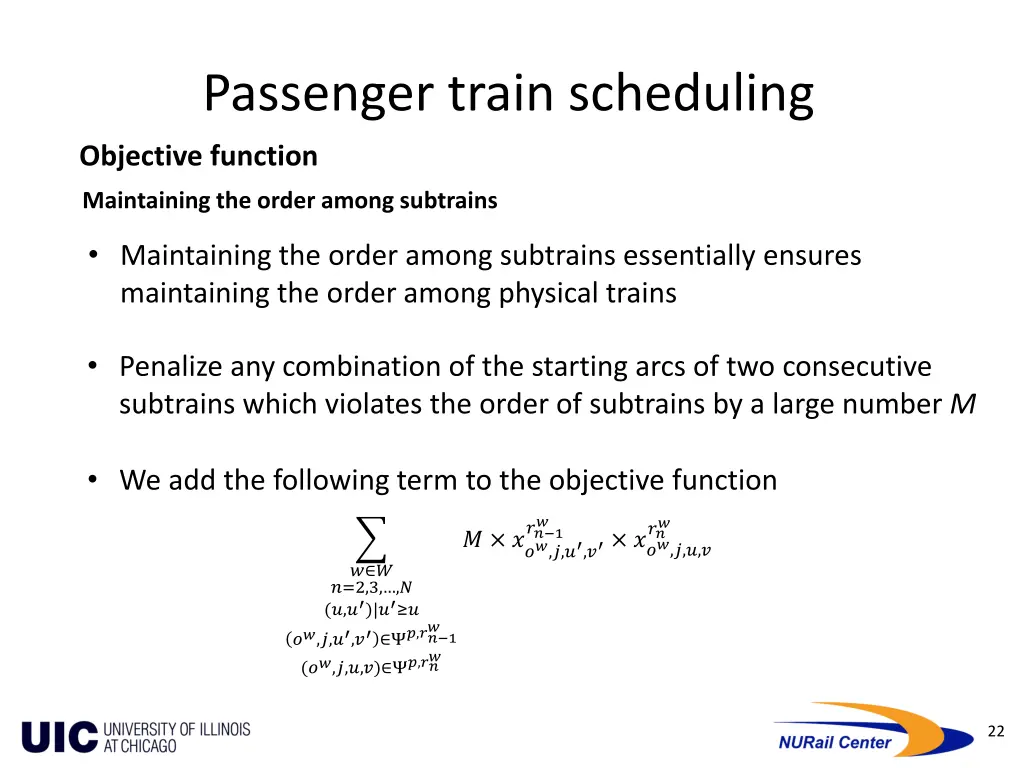
Passenger train scheduling Objective function Maintaining the order among subtrains Maintaining the order among subtrains essentially ensures maintaining the order among physical trains Penalize any combination of the starting arcs of two consecutive subtrains which violates the order of subtrains by a large number M We add the following term to the objective function ? ??? ?? 1 ? ???,?,? ,? ???,?,?,? ? ? ?=2,3, ,? (?,? )|? ? ??,?,? ,? ?,?? 1 (??,?,?,?) ?,?? ? ? 22
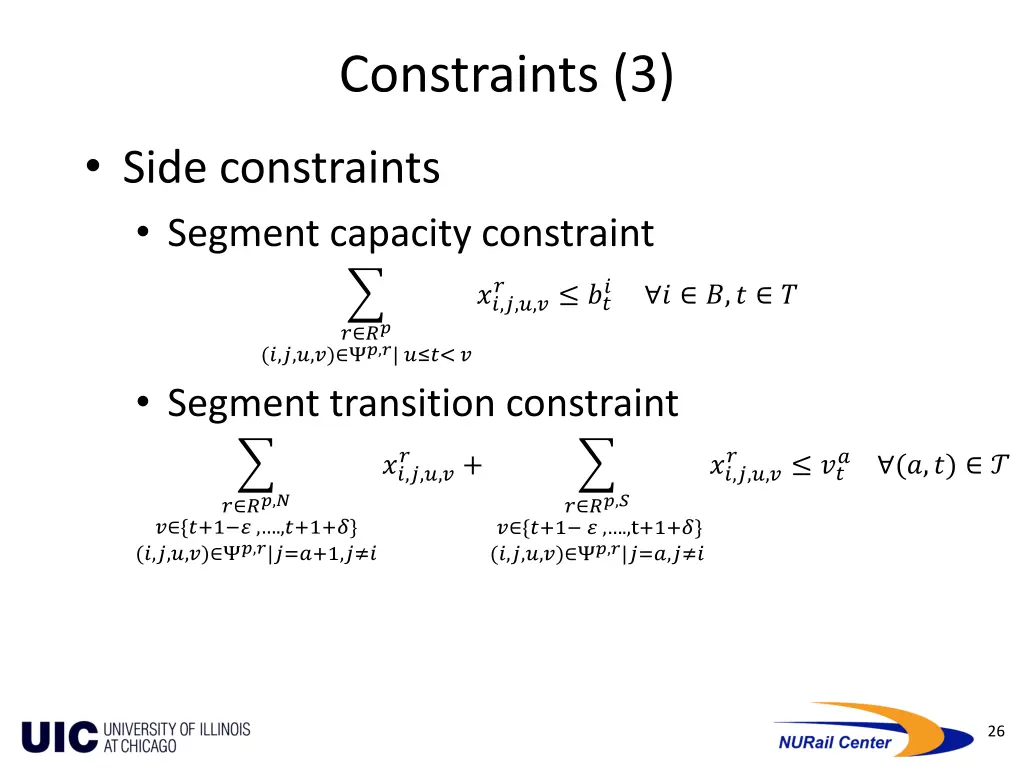
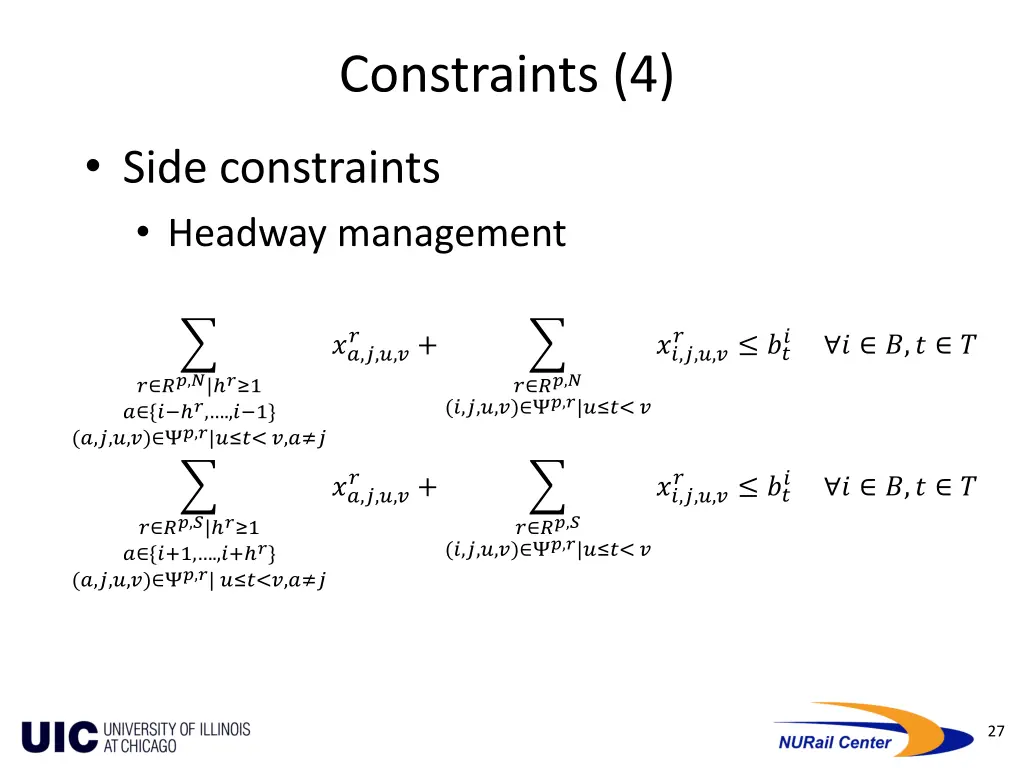
Constraints Unique departure from origin Unique sinking at the destination Flow conservation Linkage between trains Binary variables Segment capacity constraint Segment transition constraint Headway management 23
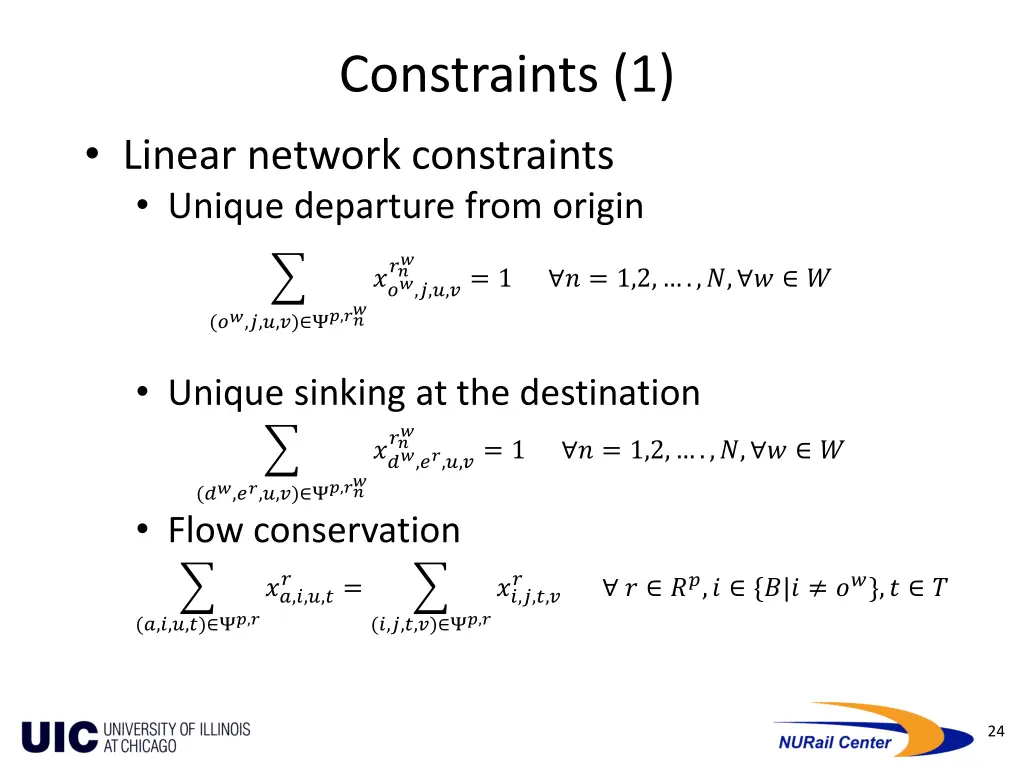
Constraints (1) Linear network constraints Unique departure from origin ??? ???,?,?,? = 1 ? = 1,2, .,?, ? ? ? (??,?,?,?) ?,?? Unique sinking at the destination ??? ???,??,?,? = 1 ? = 1,2, .,?, ? ? ? (??,??,?,?) ?,?? Flow conservation ? ? ? ??,? {?|? ??},? ? ??,?,?,? = ??,?,?,? (?,?,?,?) ?,? (?,?,?,?) ?,? 24
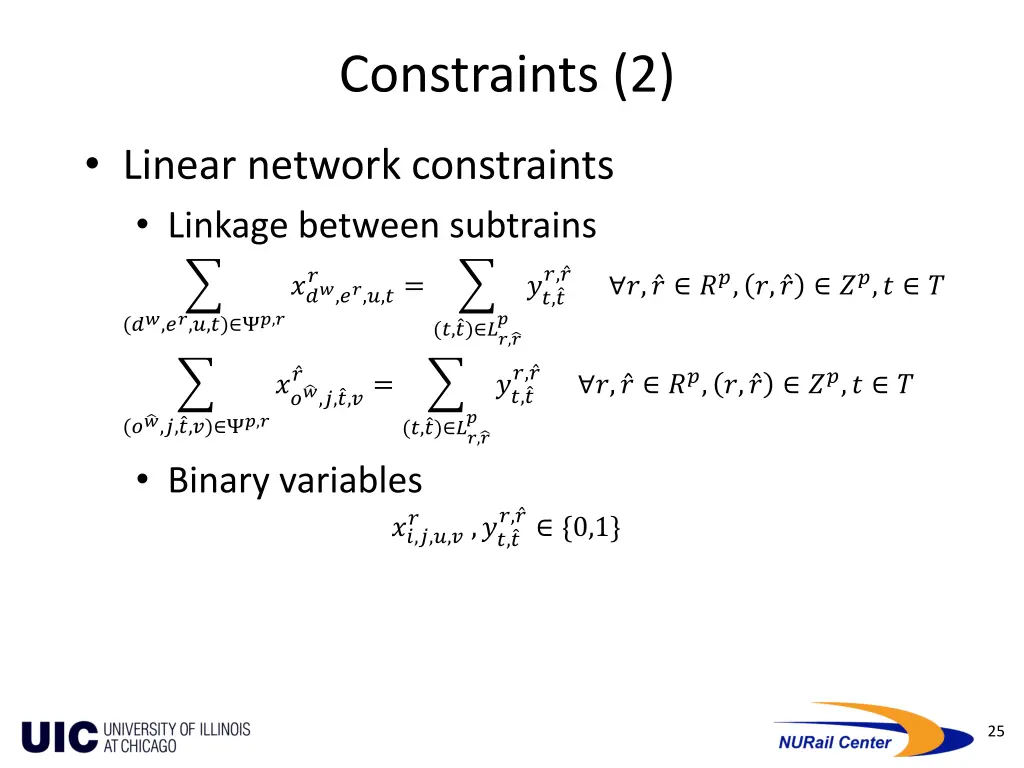
Constraints (2) Linear network constraints Linkage between subtrains ?, ? ? ?, ? ??, ?, ? ??,? ? ???,??,?,? = ??, ? ? (??,??,?,?) ?,? (?, ?) ??, ? ?, ? ? ?, ? ??, ?, ? ??,? ? ?? ?,?, ?,? = ??, ? ? (? ?,?, ?,?) ?,? Binary variables (?, ?) ??, ? ?, ? {0,1} ? ??,?,?,? ,??, ? 25
Constraints (3) Side constraints Segment capacity constraint ? ??? ? ?,? ? ? ?? ??,?,?,? (?,?,?,?) ?,?| ? ?< ? Segment transition constraint ? ? ??? (?,?) ? ??,?,?,? + ??,?,?,? ? ??,? ? ??,? ? {?+1 ? , .,?+1+?} (?,?,?,?) ?,?|?=?+1,? ? ? {?+1 ? , .,t+1+?} (?,?,?,?) ?,?|?=?,? ? 26
Constraints (4) Side constraints Headway management ? ? ??? ? ?,? ? ??,?,?,? + ??,?,?,? ? ??,?| ? 1 ? {? ?, .,? 1} (?,?,?,?) ?,?|? ?< ?,? ? ? ??,? (?,?,?,?) ?,?|? ?< ? ? ? ??? ? ?,? ? ??,?,?,? + ??,?,?,? ? ??,?| ? 1 ? {?+1, .,?+ ?} (?,?,?,?) ?,?| ? ?<?,? ? ? ??,? (?,?,?,?) ?,?|? ?< ? 27
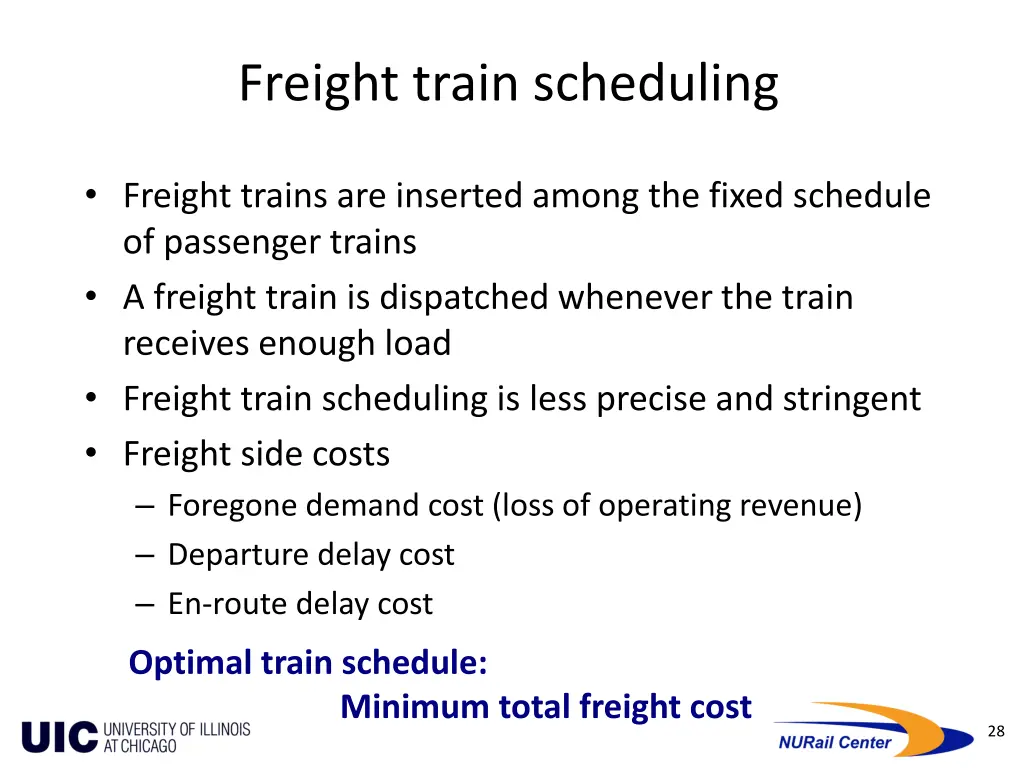
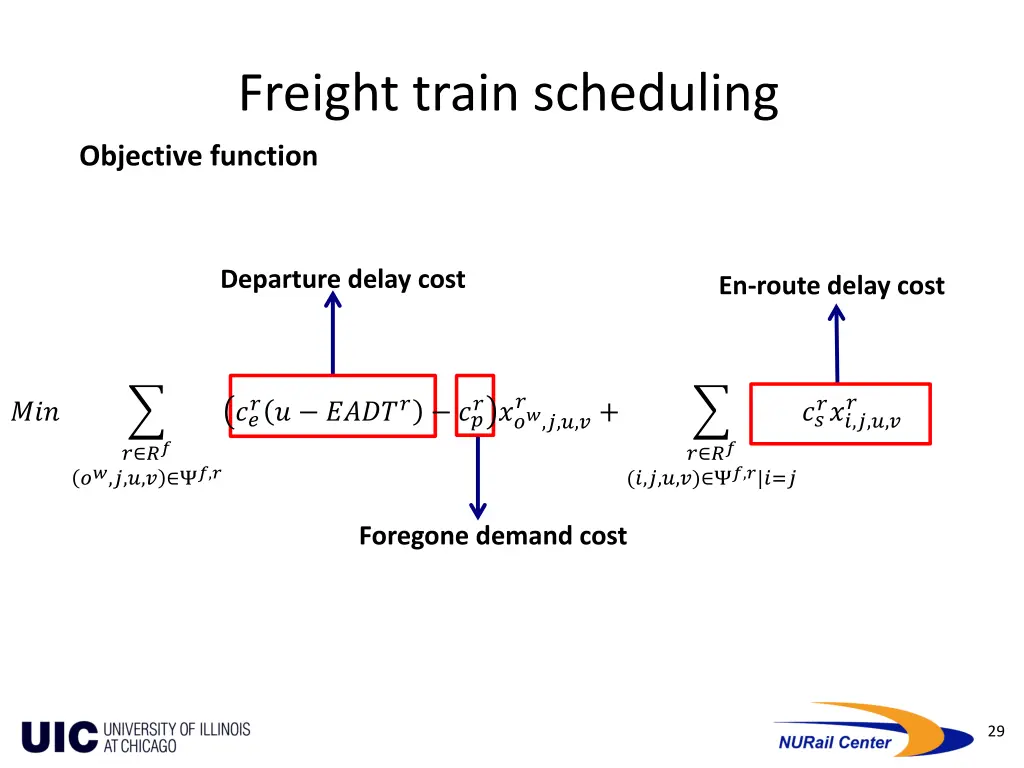
Freight train scheduling Freight trains are inserted among the fixed schedule of passenger trains A freight train is dispatched whenever the train receives enough load Freight train scheduling is less precise and stringent Freight side costs Foregone demand cost (loss of operating revenue) Departure delay cost En-route delay cost Optimal train schedule: Minimum total freight cost 28
Freight train scheduling Objective function Departure delay cost En-route delay cost ? ? ???? ????? ?? ????,?,?,? ?????,?,?,? ??? + ? ?? ? ?? ??,?,?,? ?,? (?,?,?,?) ?,?|?=? Foregone demand cost 29
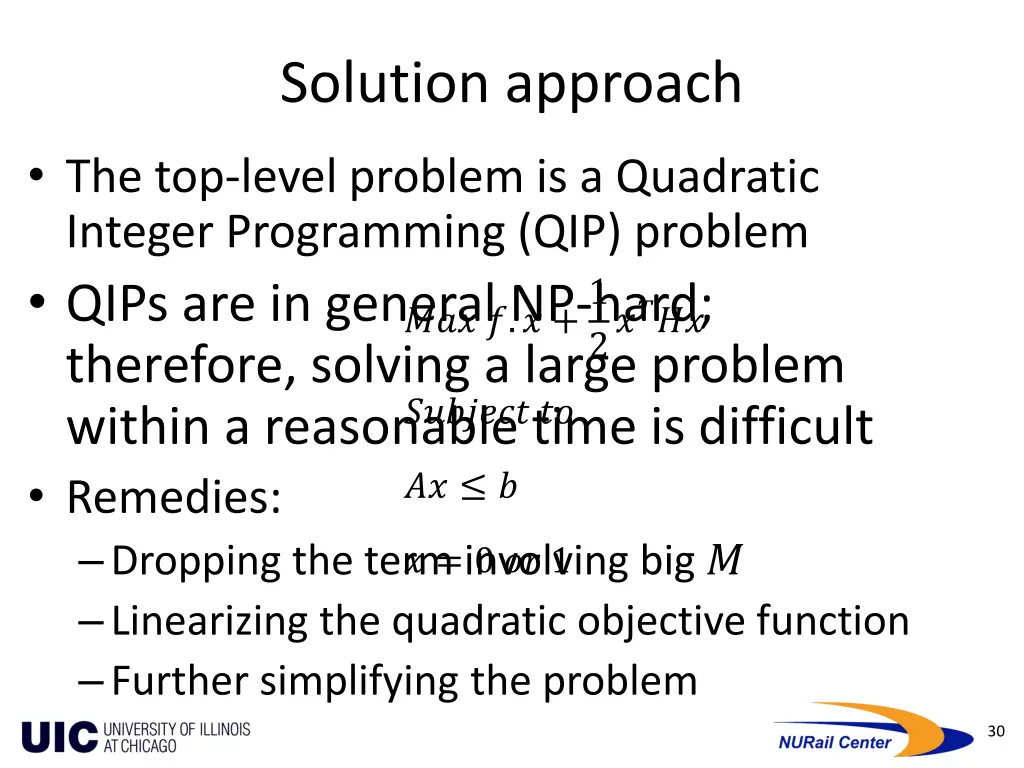
Solution approach The top-level problem is a Quadratic Integer Programming (QIP) problem QIPs are in general NP-hard; therefore, solving a large problem within a reasonable time is difficult Remedies: Dropping the term involving big ? Linearizing the quadratic objective function Further simplifying the problem ????.? +1 2???? ????????? ?? ? ? = 0 ?? 1 30
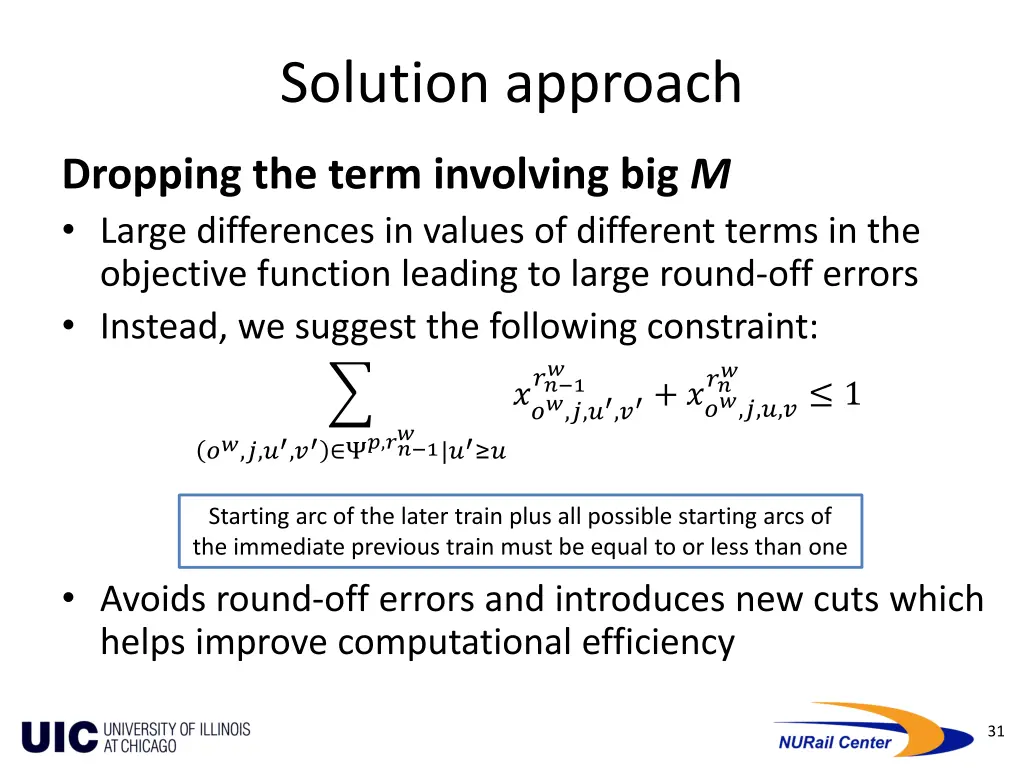
Solution approach Dropping the term involving big M Large differences in values of different terms in the objective function leading to large round-off errors Instead, we suggest the following constraint: ? ??? ?? 1 ???,?,? ,? + ???,?,?,? 1 ? ??,?,? ,? ?,?? 1 |? ? Starting arc of the later train plus all possible starting arcs of the immediate previous train must be equal to or less than one Avoids round-off errors and introduces new cuts which helps improve computational efficiency 31
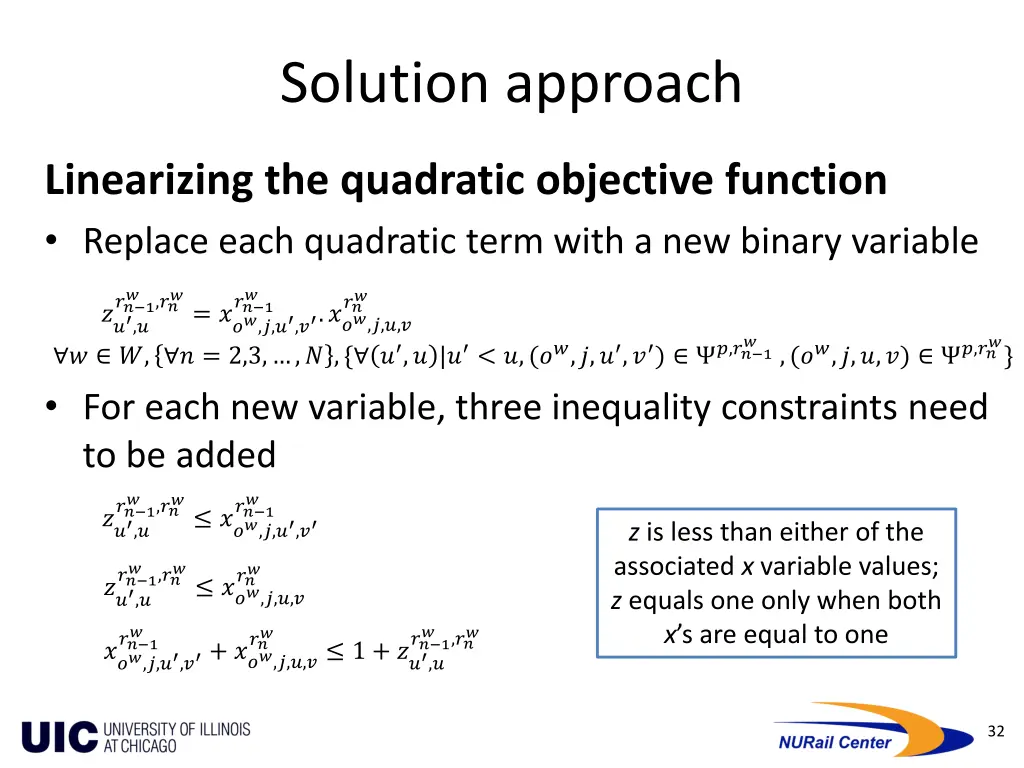
Solution approach Linearizing the quadratic objective function Replace each quadratic term with a new binary variable ? ? ,??? ??? ?? 1 ?? 1 ?? ,? = ???,?,? ,? .???,?,?,? ? ,(??,?,?,?) ?,???} ? ?, ? = 2,3, ,? ,{ ? ,? |? < ?,(??,?,? ,? ) ?,?? 1 For each new variable, three inequality constraints need to be added ? ? ,??? ?? 1 ?? 1 ?? ,? ???,?,? ,? z is less than either of the associated x variable values; z equals one only when both x s are equal to one ? ,??? ??? ?? 1 ?? ,? ???,?,?,? ? ? ,??? ??? ?? 1 ?? 1 ???,?,? ,? + ???,?,?,? 1 + ?? ,? 32
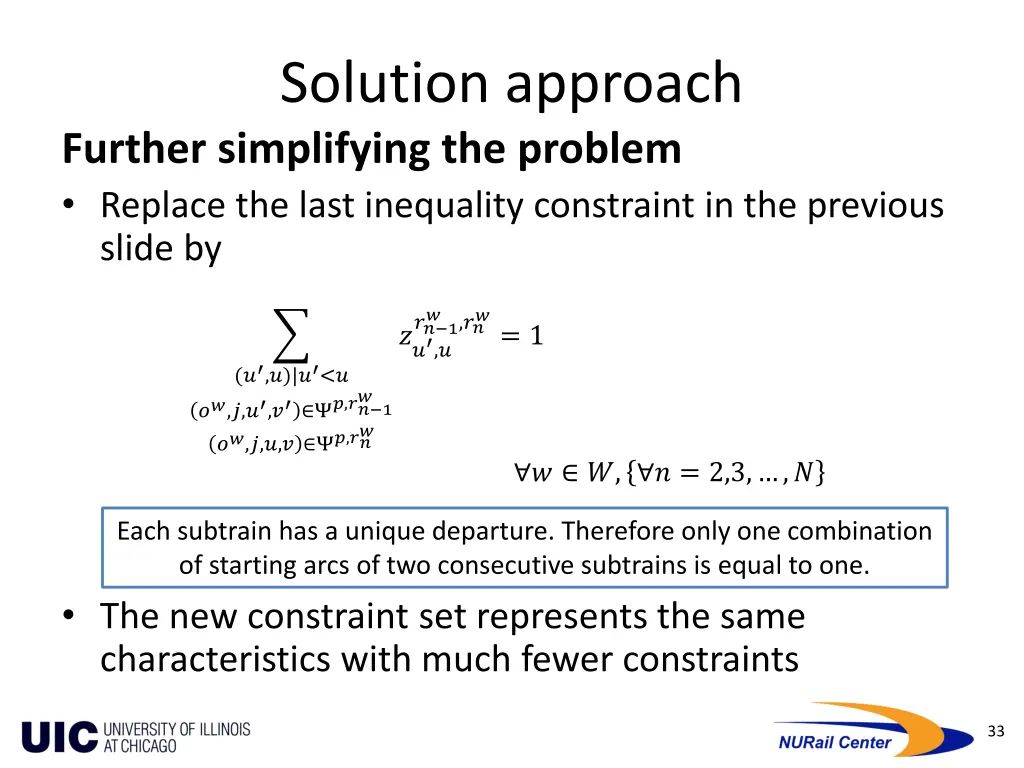
Solution approach Further simplifying the problem Replace the last inequality constraint in the previous slide by ? ,???= 1 ?? 1 ?? ,? (? ,?)|? <? ??,?,? ,? ?,?? 1 ??,?,?,? ?,?? ? ? ? ?, ? = 2,3, ,? Each subtrain has a unique departure. Therefore only one combination of starting arcs of two consecutive subtrains is equal to one. The new constraint set represents the same characteristics with much fewer constraints 33
Numerical analysis A small problem Impact of speed heterogeneity A larger problem 34
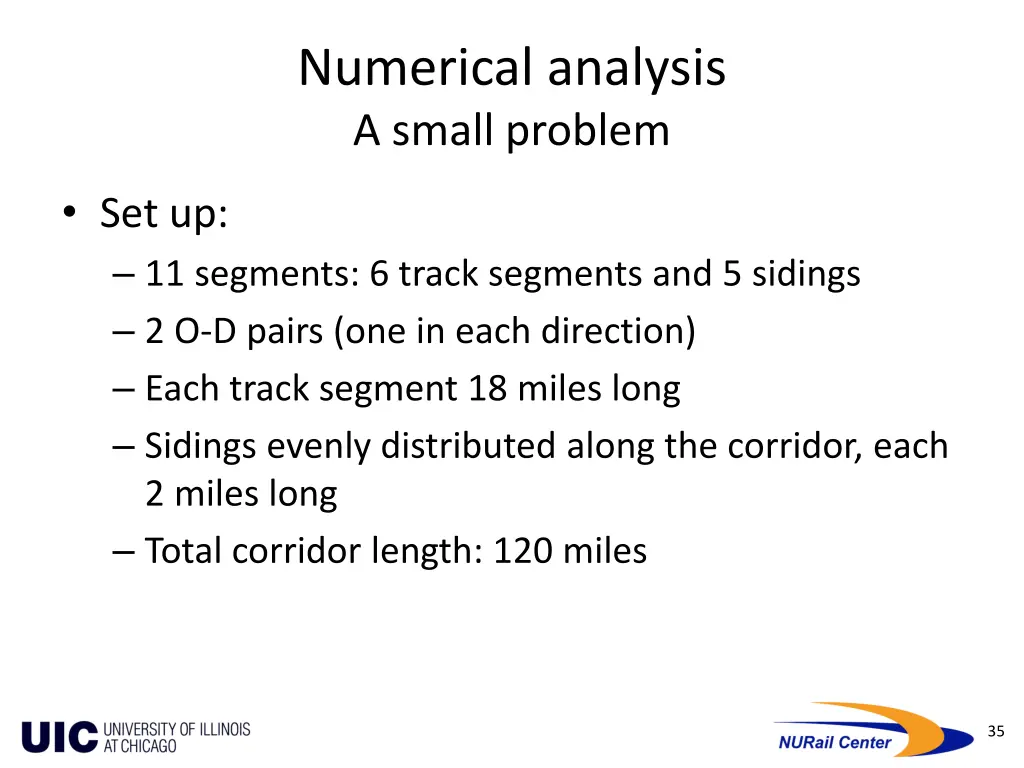
Numerical analysis A small problem Set up: 11 segments: 6 track segments and 5 sidings 2 O-D pairs (one in each direction) Each track segment 18 miles long Sidings evenly distributed along the corridor, each 2 miles long Total corridor length: 120 miles 35
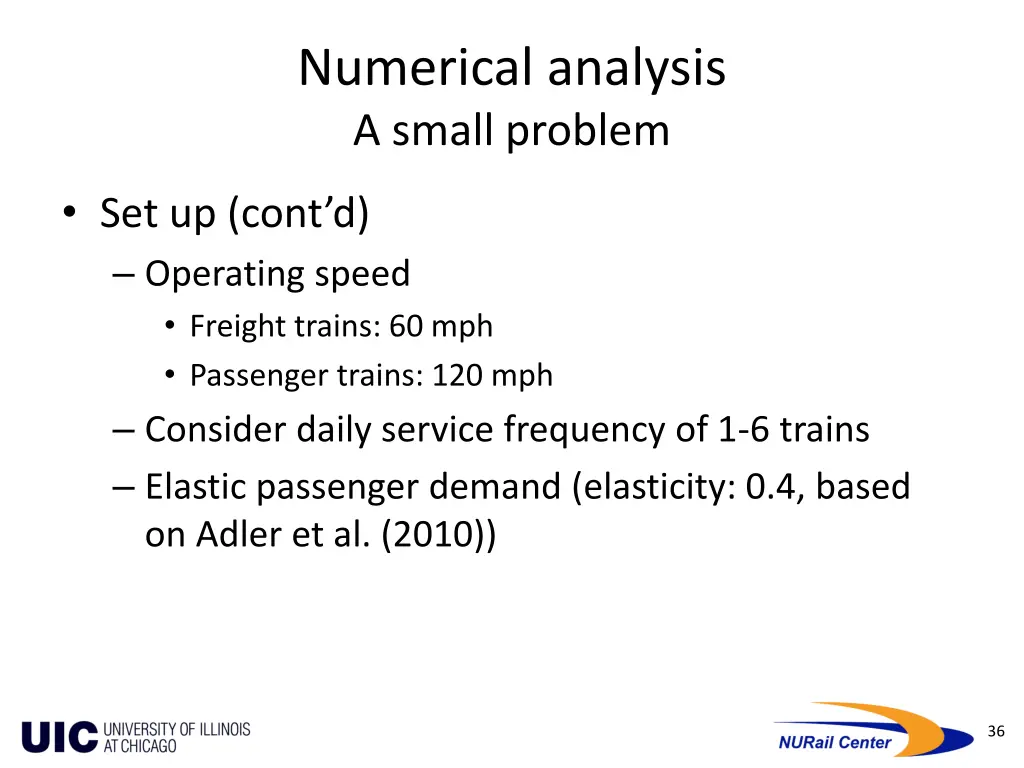
Numerical analysis A small problem Set up (cont d) Operating speed Freight trains: 60 mph Passenger trains: 120 mph Consider daily service frequency of 1-6 trains Elastic passenger demand (elasticity: 0.4, based on Adler et al. (2010)) 36
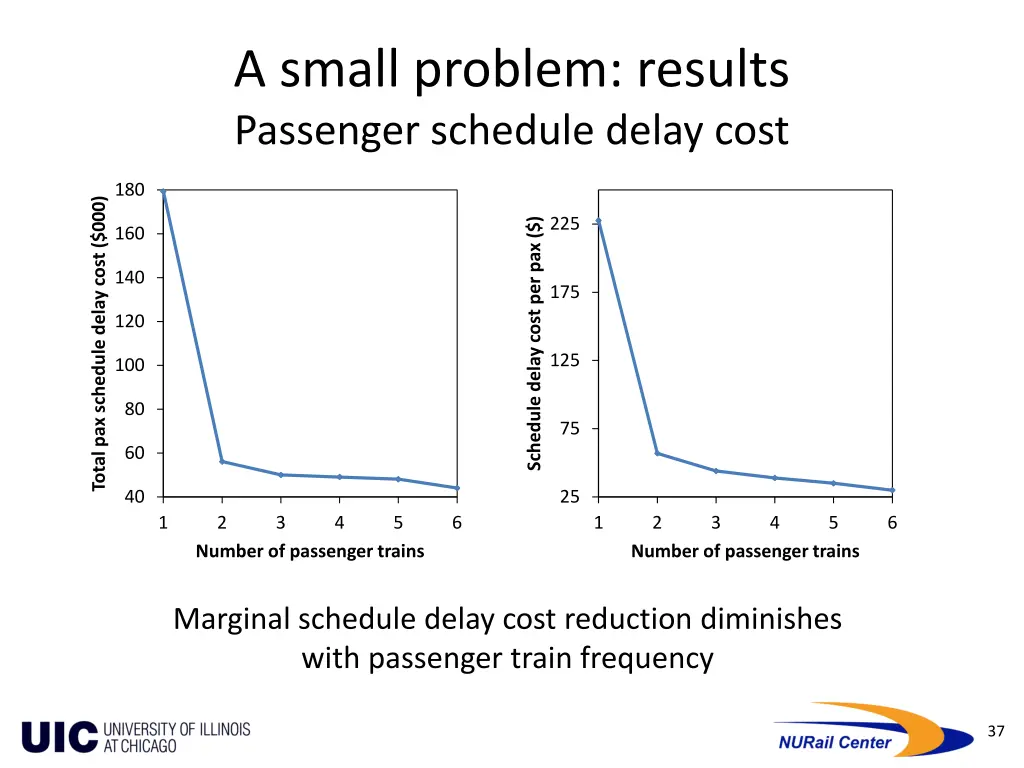
A small problem: results Passenger schedule delay cost 180 Total pax schedule delay cost ($000) 225 Schedule delay cost per pax ($) 160 140 175 120 125 100 80 75 60 40 25 1 2 3 4 5 6 1 2 3 4 5 6 Number of passenger trains Number of passenger trains Marginal schedule delay cost reduction diminishes with passenger train frequency 37
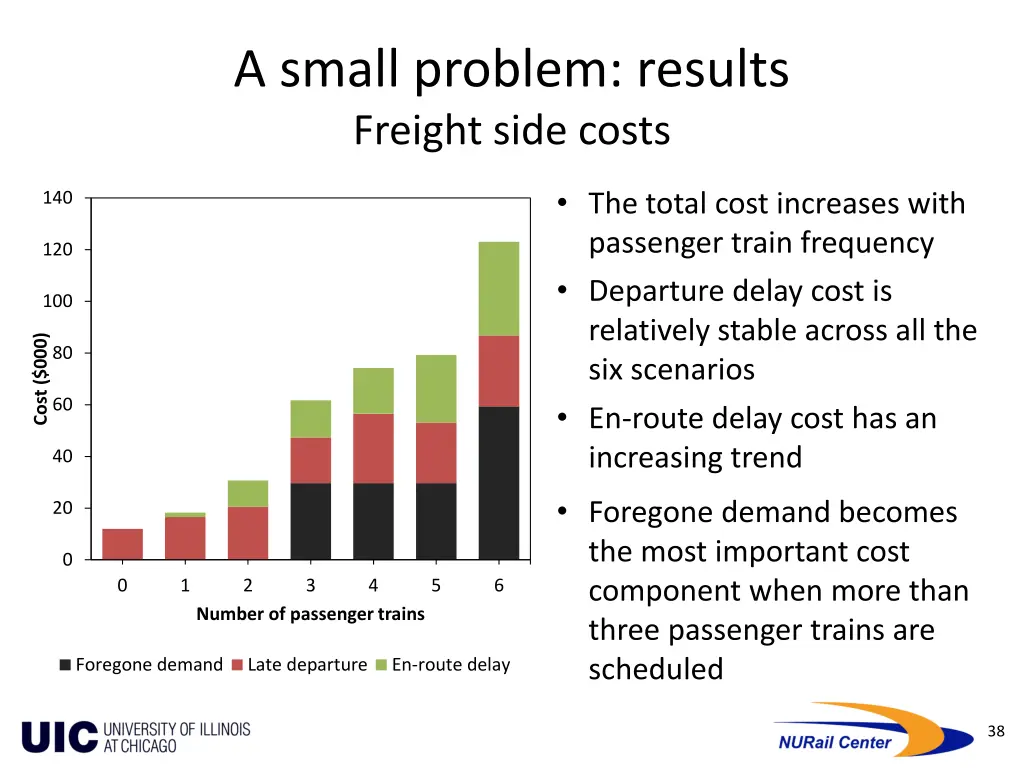
A small problem: results Freight side costs The total cost increases with passenger train frequency Departure delay cost is relatively stable across all the six scenarios En-route delay cost has an increasing trend 140 120 100 Cost ($000) 80 60 40 Foregone demand becomes the most important cost component when more than three passenger trains are scheduled 20 0 0 1 2 3 4 5 6 Number of passenger trains Foregone demand Late departure En-route delay 38
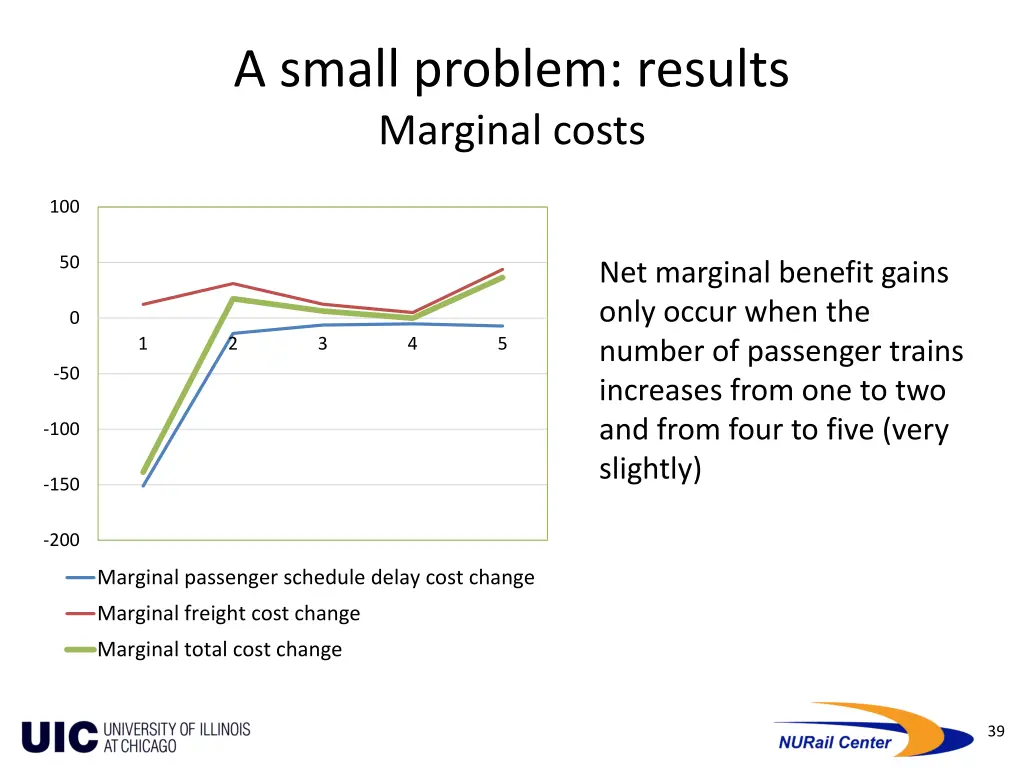
A small problem: results Marginal costs 100 50 Net marginal benefit gains only occur when the number of passenger trains increases from one to two and from four to five (very slightly) 0 1 2 3 4 5 -50 -100 -150 -200 Marginal passenger schedule delay cost change Marginal freight cost change Marginal total cost change 39
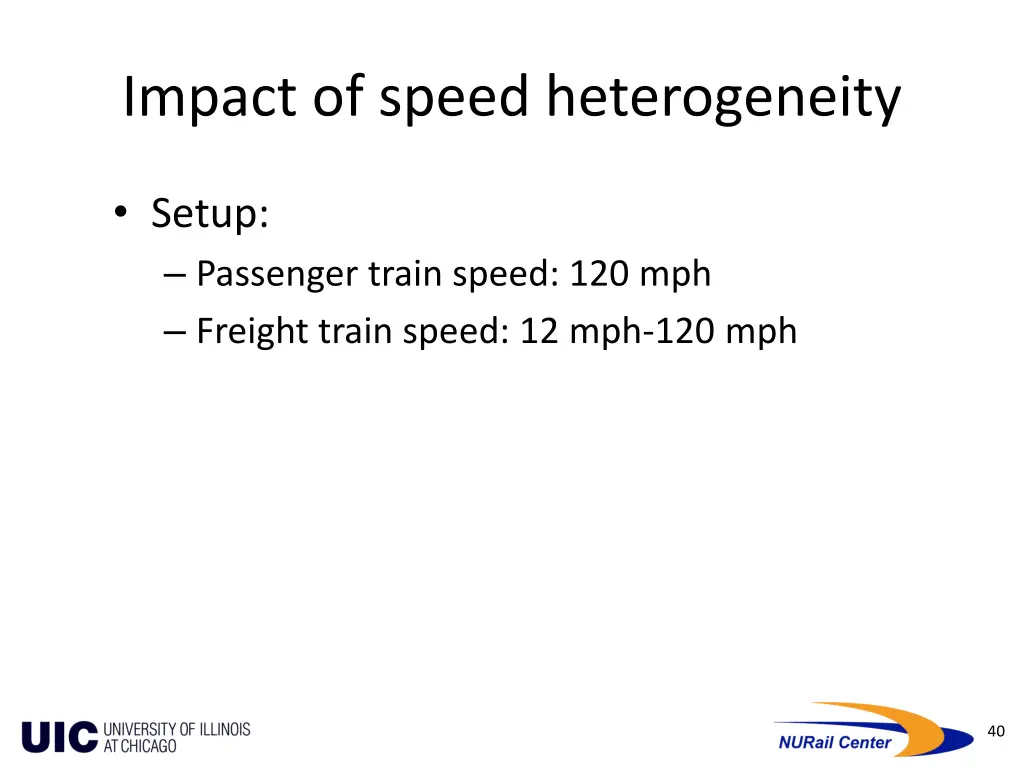
Impact of speed heterogeneity Setup: Passenger train speed: 120 mph Freight train speed: 12 mph-120 mph 40
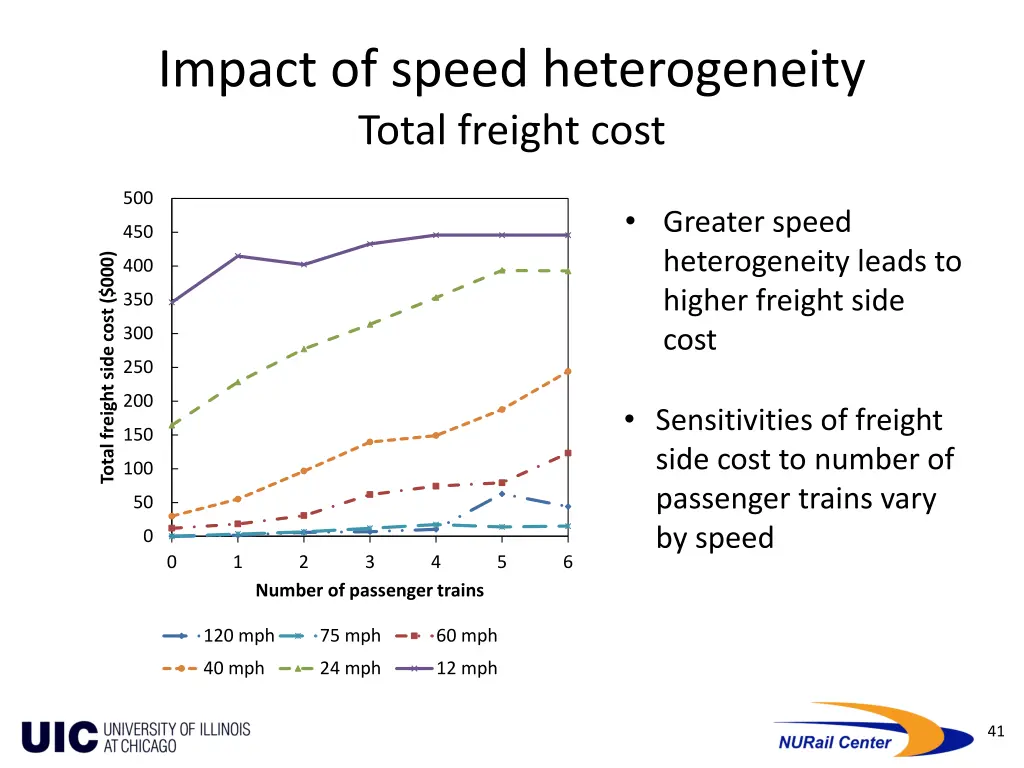
Impact of speed heterogeneity Total freight cost 500 Greater speed heterogeneity leads to higher freight side cost 450 Total freight side cost ($000) 400 350 300 250 200 Sensitivities of freight side cost to number of passenger trains vary by speed 150 100 50 0 0 1 2 3 4 5 6 Number of passenger trains 120 mph 75 mph 60 mph 40 mph 24 mph 12 mph 41
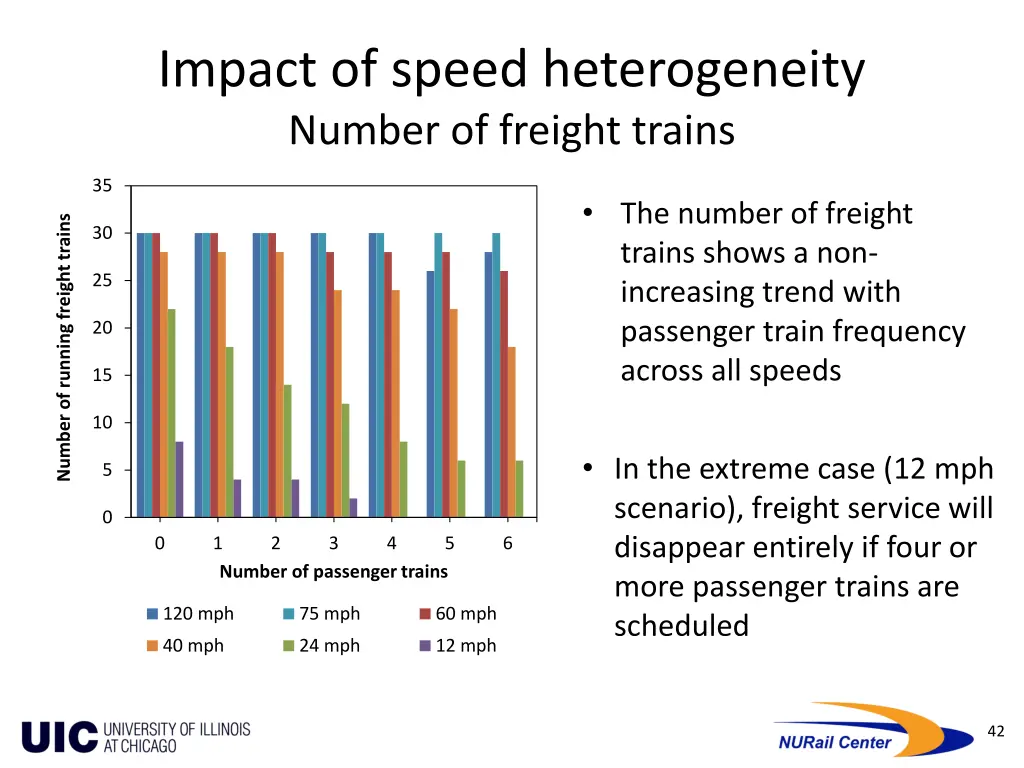
Impact of speed heterogeneity Number of freight trains 35 The number of freight trains shows a non- increasing trend with passenger train frequency across all speeds Number of running freight trains 30 25 20 15 10 In the extreme case (12 mph scenario), freight service will disappear entirely if four or more passenger trains are scheduled 5 0 0 1 2 3 4 5 6 Number of passenger trains 120 mph 75 mph 60 mph 40 mph 24 mph 12 mph 42
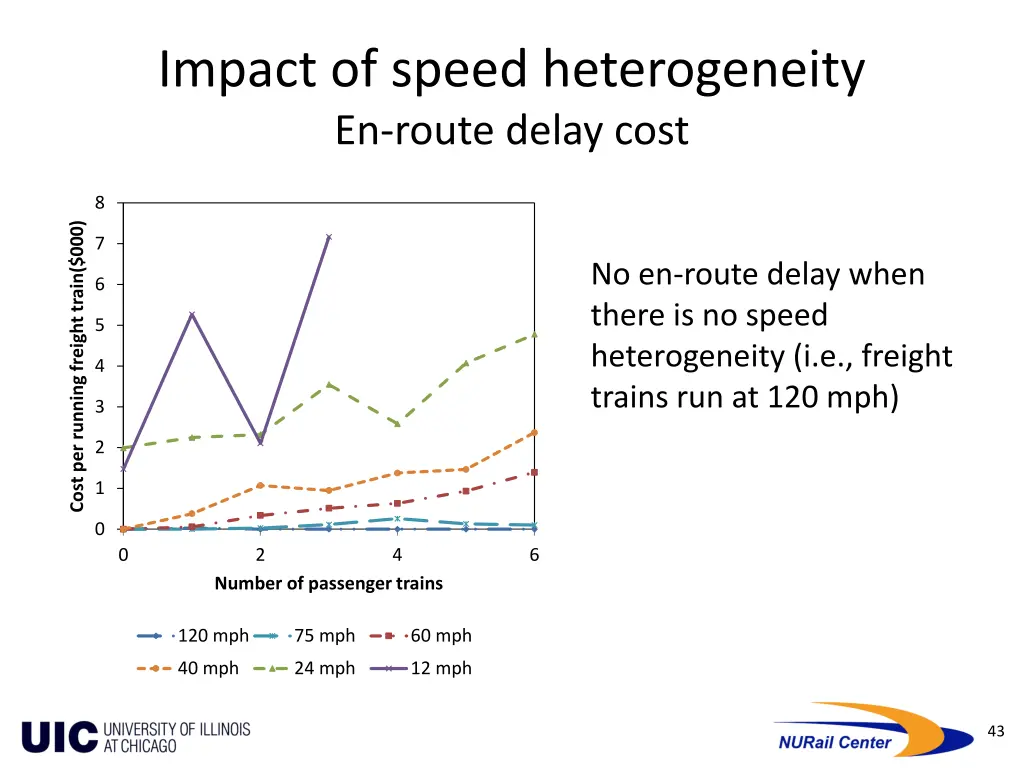
Impact of speed heterogeneity En-route delay cost 8 Cost per running freight train($000) 7 No en-route delay when there is no speed heterogeneity (i.e., freight trains run at 120 mph) 6 5 4 3 2 1 0 0 2 4 6 Number of passenger trains 120 mph 75 mph 60 mph 40 mph 24 mph 12 mph 43
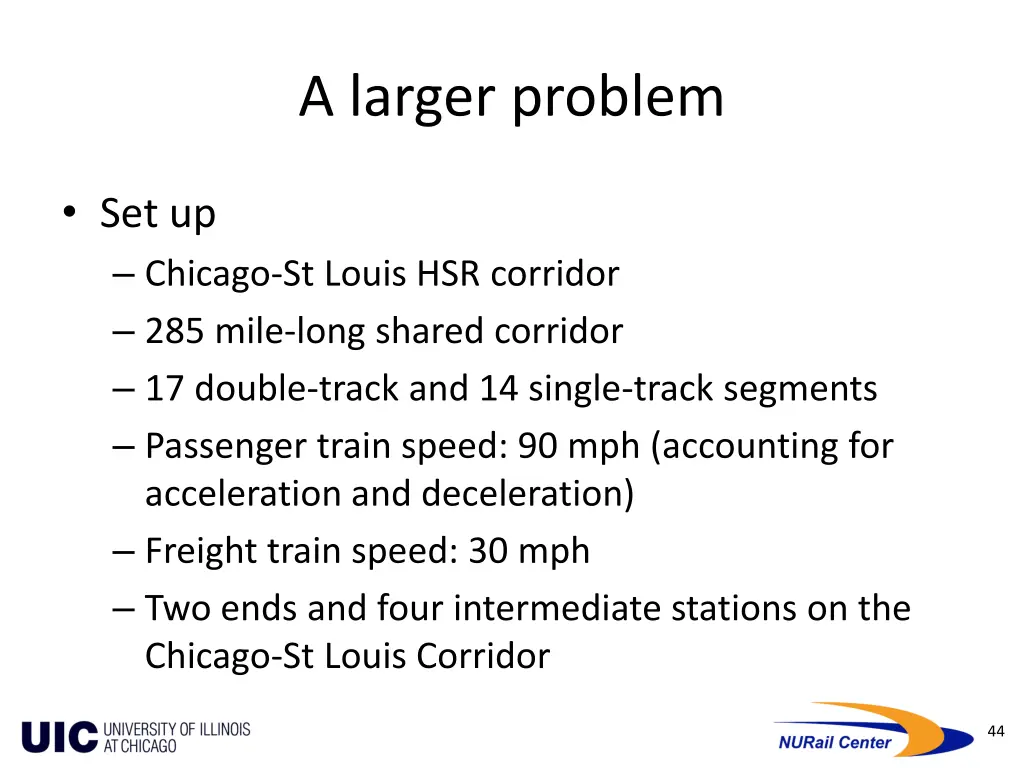
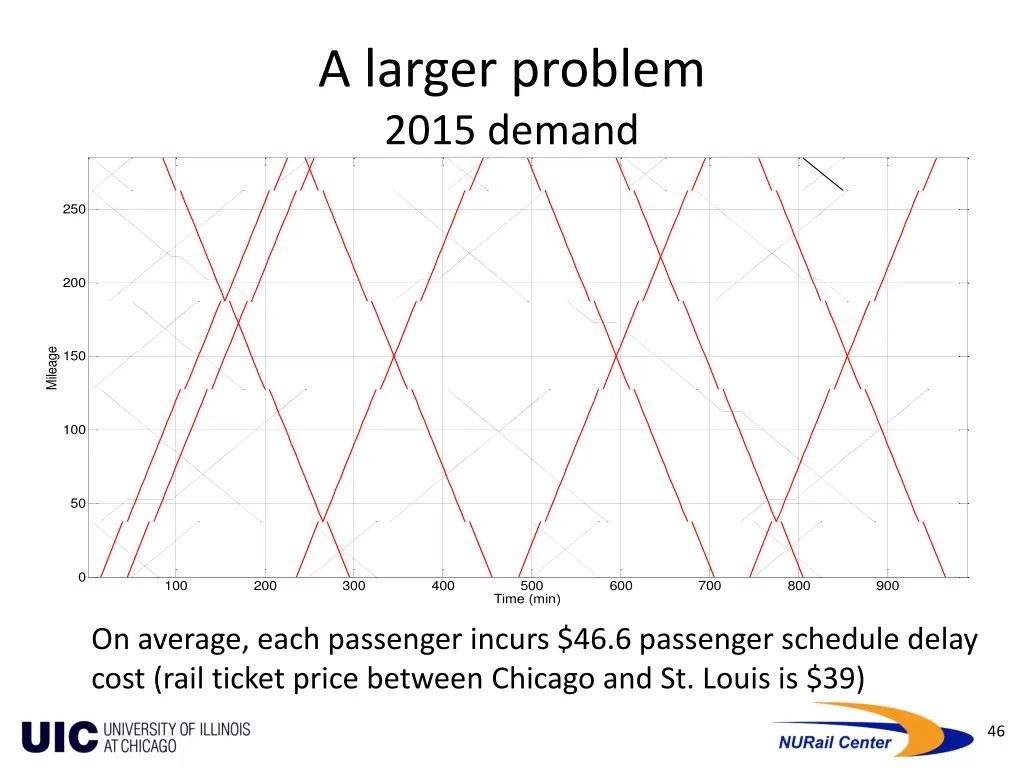
A larger problem Set up Chicago-St Louis HSR corridor 285 mile-long shared corridor 17 double-track and 14 single-track segments Passenger train speed: 90 mph (accounting for acceleration and deceleration) Freight train speed: 30 mph Two ends and four intermediate stations on the Chicago-St Louis Corridor 44
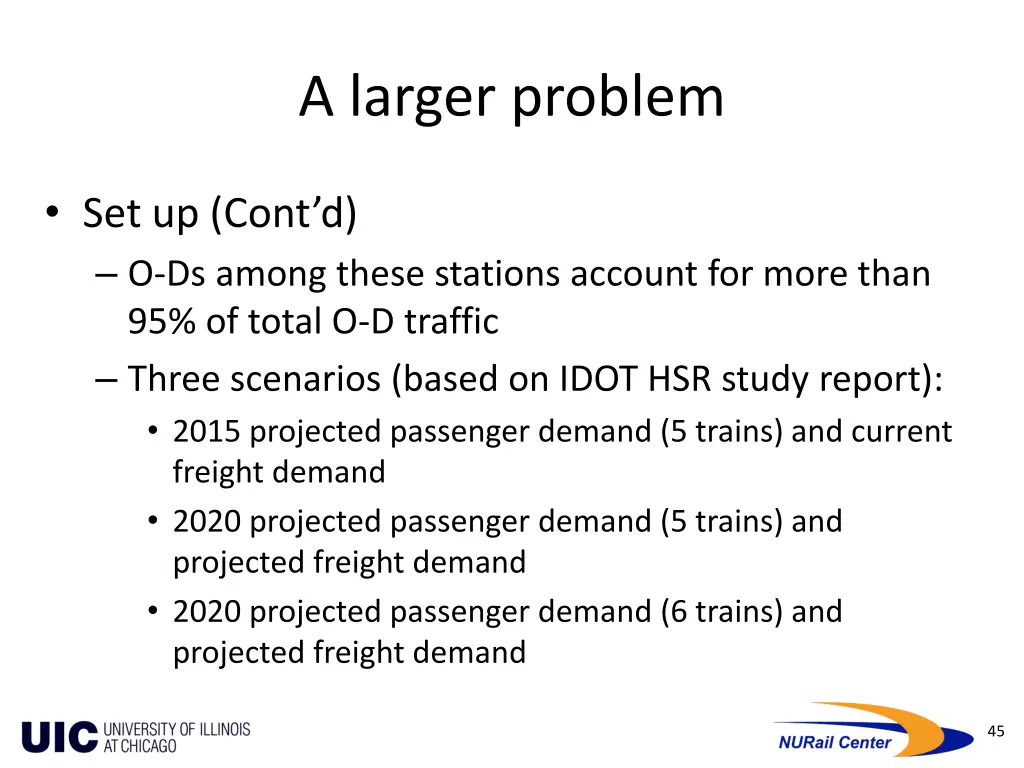
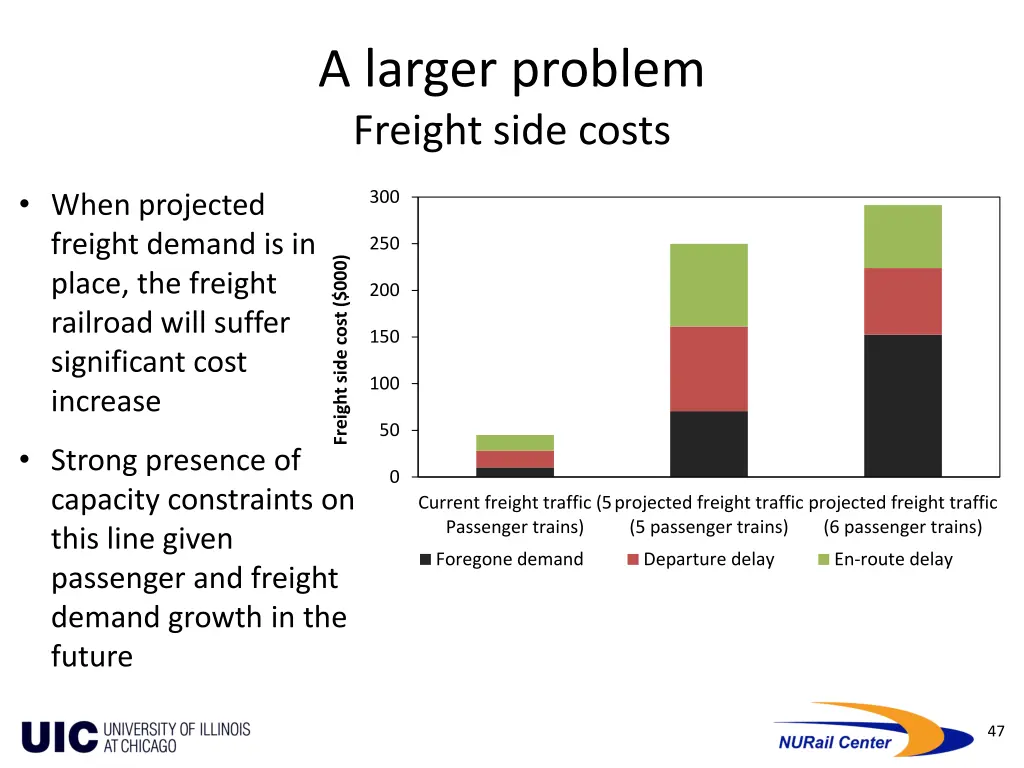
A larger problem Set up (Cont d) O-Ds among these stations account for more than 95% of total O-D traffic Three scenarios (based on IDOT HSR study report): 2015 projected passenger demand (5 trains) and current freight demand 2020 projected passenger demand (5 trains) and projected freight demand 2020 projected passenger demand (6 trains) and projected freight demand 45
A larger problem 2015 demand 250 200 Mileage 150 100 50 0 100 200 300 400 500 600 700 800 900 Time (min) On average, each passenger incurs $46.6 passenger schedule delay cost (rail ticket price between Chicago and St. Louis is $39) 46
A larger problem Freight side costs When projected freight demand is in place, the freight railroad will suffer significant cost increase 300 250 Freight side cost ($000) 200 150 100 50 Strong presence of capacity constraints on this line given passenger and freight demand growth in the future 0 Current freight traffic (5 Passenger trains) projected freight traffic (5 passenger trains) projected freight traffic (6 passenger trains) Foregone demand Departure delay En-route delay 47
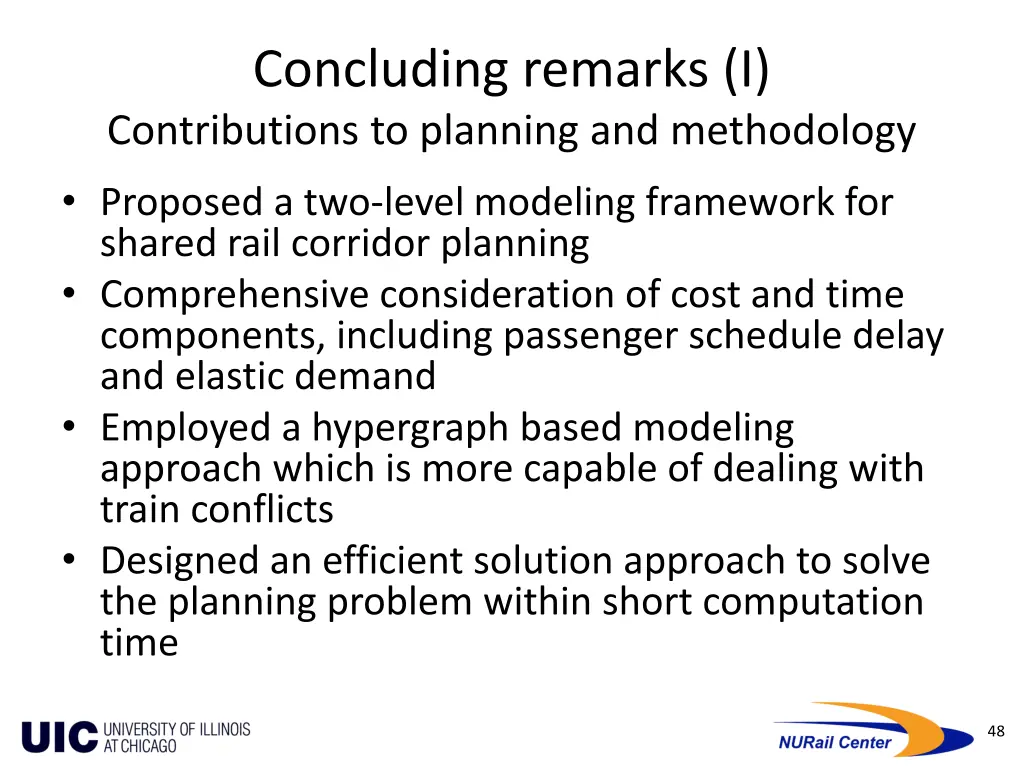
Concluding remarks (I) Contributions to planning and methodology Proposed a two-level modeling framework for shared rail corridor planning Comprehensive consideration of cost and time components, including passenger schedule delay and elastic demand Employed a hypergraph based modeling approach which is more capable of dealing with train conflicts Designed an efficient solution approach to solve the planning problem within short computation time 48
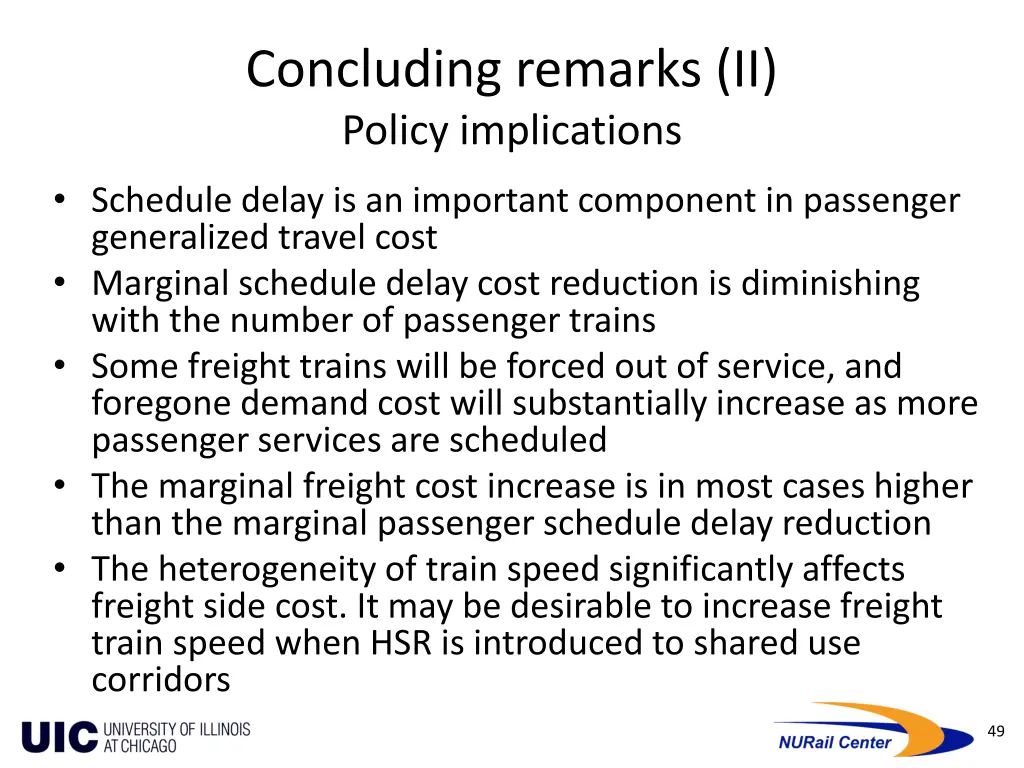
Concluding remarks (II) Policy implications Schedule delay is an important component in passenger generalized travel cost Marginal schedule delay cost reduction is diminishing with the number of passenger trains Some freight trains will be forced out of service, and foregone demand cost will substantially increase as more passenger services are scheduled The marginal freight cost increase is in most cases higher than the marginal passenger schedule delay reduction The heterogeneity of train speed significantly affects freight side cost. It may be desirable to increase freight train speed when HSR is introduced to shared use corridors 49
Ongoing research Extending hypergraph based modelling Incorporating developed scheduling models into capacity allocation schemes 50