Integrated Pest Management and Vector Control Strategies in Agriculture and Public Health
Explore the integration of IPM and IVM strategies in agriculture and public health practices to address vector-borne diseases effectively. Learn about the impact of pesticides on insects, environmental dynamics, and the importance of ecosystem-based vector control approaches. Discover the Farmer Field School approach for sustainable agriculture and environmental conservation.

Download Presentation

Please find below an Image/Link to download the presentation.
The content on the website is provided AS IS for your information and personal use only. It may not be sold, licensed, or shared on other websites without obtaining consent from the author. If you encounter any issues during the download, it is possible that the publisher has removed the file from their server.
You are allowed to download the files provided on this website for personal or commercial use, subject to the condition that they are used lawfully. All files are the property of their respective owners.
The content on the website is provided AS IS for your information and personal use only. It may not be sold, licensed, or shared on other websites without obtaining consent from the author.
E N D
Presentation Transcript
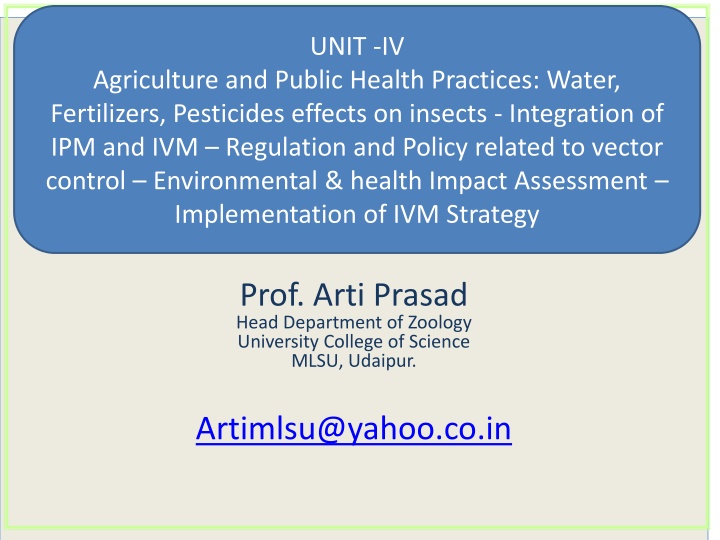
Indoor Residual Spray -INDIA UNIT -IV Agriculture and Public Health Practices: Water, Fertilizers, Pesticides effects on insects - Integration of IPM and IVM Regulation and Policy related to vector control Environmental & health Impact Assessment Implementation of IVM Strategy Prof. Arti Prasad Head Department of Zoology University College of Science MLSU, Udaipur. Artimlsu@yahoo.co.in
Agriculture and Public Health Practices Human made ecological changes which may be caused by developmental activities and expansion of Agriculture can alter environmental dynamics ,increase community vulnerability and enhance the risk of VBD Conventionally, the control of disease vectors has mainly relied on the use of chemical insecticides. The failure to effectively reduce the burden of VBD has arisen from a number of factors human, technical (including insecticidal and drug resistance), operational, ecological, and economic. Current approaches to controlling different VBD work in near isolation from each other. In certain situations, opportunities exist for optimum control of vectors of two or more diseases to be organized together and managed effectively by optimal use of available technologies, interventions and improved resources at a local level, taking into account health sector reforms wherever possible. This requires an ecosystem approach to vector control at a
IPM and IVM Agriculture and livestock-raising are important subsistence activities in South-East Asia. The link between malaria and irrigation/agriculture development has been known for a long time. Rice agroecosystems also support vectors of Japanese encephalitis in some countries. Among the main type of farming systems, modern agriculture is dependant on irrigation and inputs of fertilizers and pesticides. Against the wisdom of using traditional farming practices, excessive use of pesticides in agriculture has resulted inter alia in (a) disturbance in the natural balance between harmful crop pests and beneficial predators in local ecosystems, (b) increased occupational exposures of farming community and incidence of pesticide poisoning, (c) pesticide residues in food and environment, and (d) development of insecticide resistance of mosquito vectors. Integrated Pest Management Realizing the ill effects of excessive dependence on chemical pesticides, experimentation on the Integrated Pest Management (IPM) approach began in the late 1970s in the Philippines. IPM promotes the philosophy of healthy fields for healthy people and is a farmer-based agroecosystem management approach that uses broadly four principles: grow healthy crops using good agricultural practices, conserve natural enemies to reduce the use of chemical pesticides, conduct Framework for Implementing Integrated Vector Management (IVM) at District Level in the SEA Region: A Step-by-step Approach Page 12 regular field observations to
IPM and IVM Farmer Field School Approach Over the years, IPM led to the development of the Farmer Field School (FFS) movement, with major advancement in Indonesia in the late 1980s1 . Unlike traditional farmer education, FFS is a modern, participatory learning and community empowering approach based on season- long practical demonstration of improved farming practices to protect the farming community and the agro-ecosystems from the ill effects of pesticide use, thereby aiming to create sustainable agriculture and environment. The FFSs, comprising groups of 15-30 farmers, are facilitated by agricultural extension trainers, from land preparation right up to the harvesting stage. Farmers participate in weekly learning cycles throughout the crop-season when they collectively learn to conduct agroecosystem analysis, identify agricultural pests and beneficial predators, and make informed decisions about crop management and use of pesticides. They compare processes and outcomes in the IPM plots with those in the non-IPM plots. The IPM FFS approach was applied in rice cultivation in the mid- 1990s in Asia and later expanded to vegetables, cotton and various other crops in other regions.
IPM and IVM A wide range of benefits, including development impacts, have been reported of IPM FFS in a recent evaluation of 25 IPM studies in Asia (Bangladesh, China, Cambodia, Indonesia, Philippines, Sri Lanka, Thailand, Vietnam) and other regions2 . India has a large IPM programme, including the rice IPM. The IPM FFS programme in Sri Lanka started in 1995. External evaluations3 in 2002 reported that farmer practices resulted in substantial increase in yield and profits from rice cultivation, and reduced insecticide use causing savings in agrochemical inputs. IPM was found to be cost-effective, providing motivation, cooperation and a sense of programme ownership to farming communities. These positive FFS experiences have led to the integration of vector management with IPM leading to an Integrated Pest and Vector Management (IPVM) project since 2002.The IPVM strategy has helped farmers to reduce health risks associated with vector-borne diseases and pesticides. In its current phase, the project is expanding the curriculum to cover the health effects of pesticides and enhancing preventive community action and personal protection by participating in surveillance activities. The Malaria Control Programme plans to adopt the integrated pest and vector management strategy to prevent malaria in areas of low transmission since there is an additive effect between the use of mosquito nets and the strategy4. In addition to its suitability under Sri Lankan conditions, the
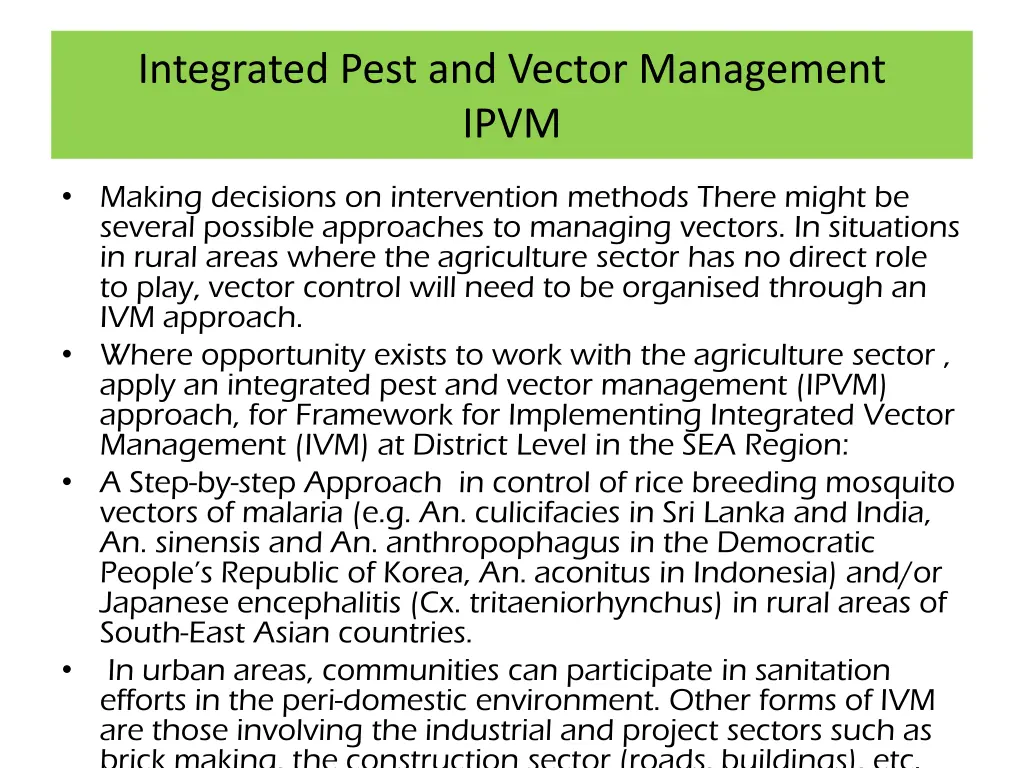
Integrated Pest and Vector Management IPVM Making decisions on intervention methods There might be several possible approaches to managing vectors. In situations in rural areas where the agriculture sector has no direct role to play, vector control will need to be organised through an IVM approach. Where opportunity exists to work with the agriculture sector , apply an integrated pest and vector management (IPVM) approach, for Framework for Implementing Integrated Vector Management (IVM) at District Level in the SEA Region: A Step-by-step Approach in control of rice breeding mosquito vectors of malaria (e.g. An. culicifacies in Sri Lanka and India, An. sinensis and An. anthropophagus in the Democratic People s Republic of Korea, An. aconitus in Indonesia) and/or Japanese encephalitis (Cx. tritaeniorhynchus) in rural areas of South-East Asian countries. In urban areas, communities can participate in sanitation efforts in the peri-domestic environment. Other forms of IVM are those involving the industrial and project sectors such as brick making, the construction sector (roads, buildings), etc.
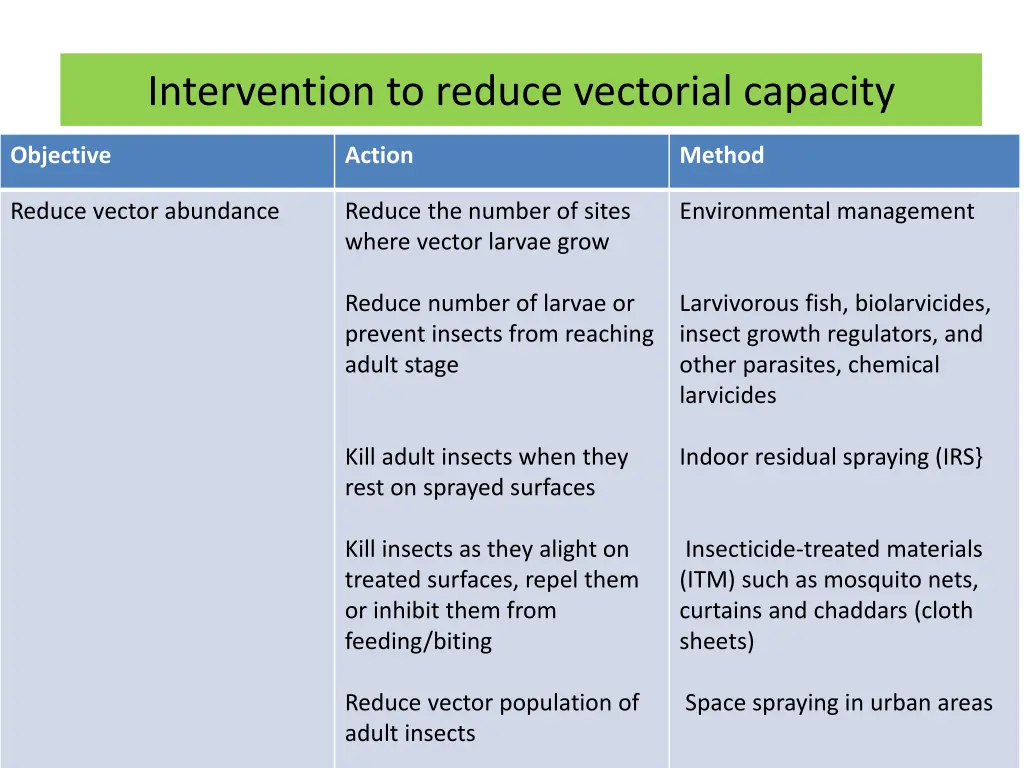
Intervention to reduce vectorial capacity Objective Action Method Reduce vector abundance Reduce the number of sites where vector larvae grow Environmental management Reduce number of larvae or prevent insects from reaching adult stage Larvivorous fish, biolarvicides, insect growth regulators, and other parasites, chemical larvicides Kill adult insects when they rest on sprayed surfaces Indoor residual spraying (IRS} Kill insects as they alight on treated surfaces, repel them or inhibit them from feeding/biting Insecticide-treated materials (ITM) such as mosquito nets, curtains and chaddars (cloth sheets) Reduce vector population of adult insects Space spraying in urban areas
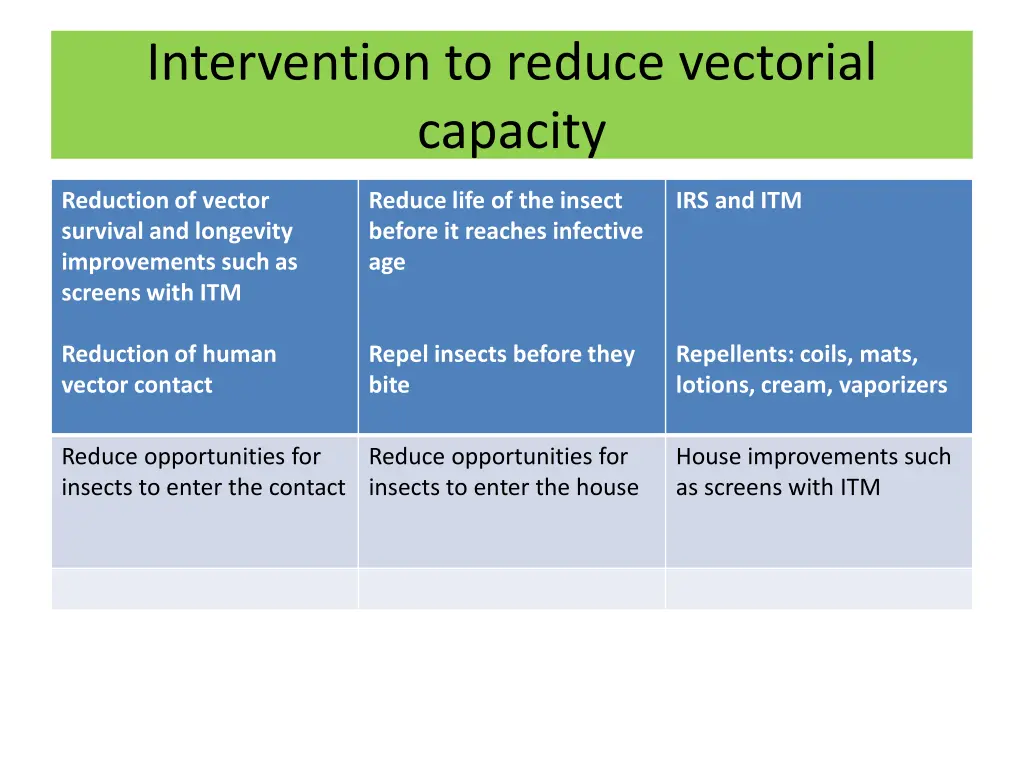
Intervention to reduce vectorial capacity Reduction of vector survival and longevity improvements such as screens with ITM Reduce life of the insect before it reaches infective age IRS and ITM Reduction of human vector contact Repel insects before they bite Repellents: coils, mats, lotions, cream, vaporizers Reduce opportunities for insects to enter the contact Reduce opportunities for insects to enter the house House improvements such as screens with ITM
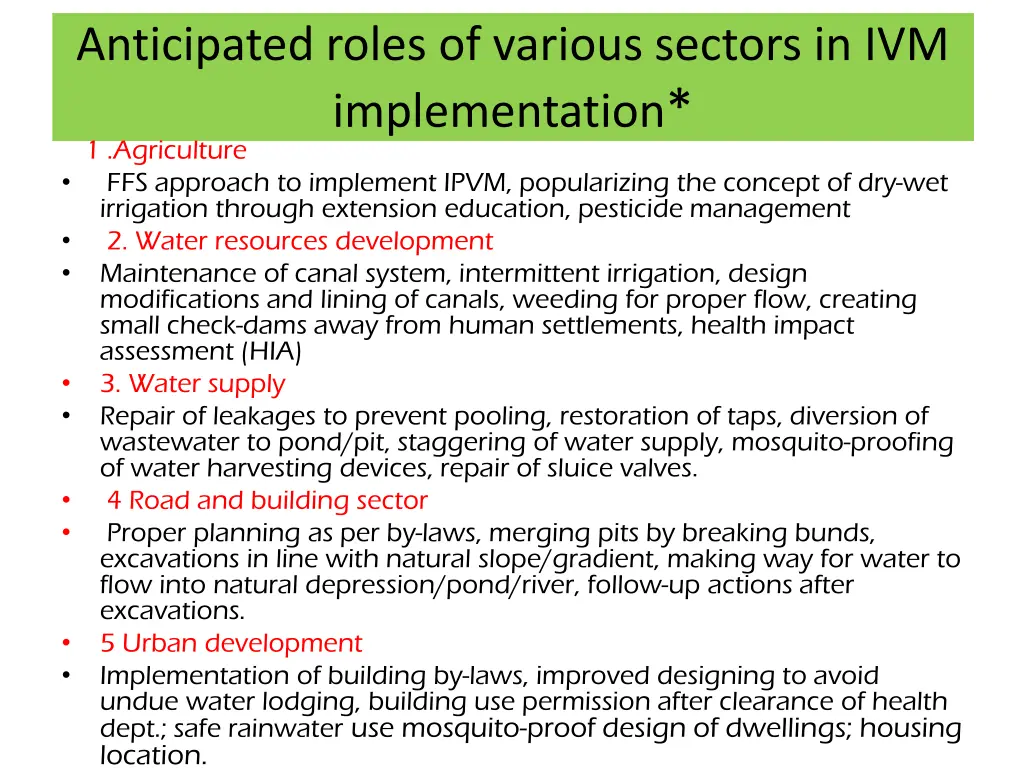
Anticipated roles of various sectors in IVM implementation* 1 .Agriculture FFS approach to implement IPVM, popularizing the concept of dry-wet irrigation through extension education, pesticide management 2. Water resources development Maintenance of canal system, intermittent irrigation, design modifications and lining of canals, weeding for proper flow, creating small check-dams away from human settlements, health impact assessment (HIA) 3. Water supply Repair of leakages to prevent pooling, restoration of taps, diversion of wastewater to pond/pit, staggering of water supply, mosquito-proofing of water harvesting devices, repair of sluice valves. 4 Road and building sector Proper planning as per by-laws, merging pits by breaking bunds, excavations in line with natural slope/gradient, making way for water to flow into natural depression/pond/river, follow-up actions after excavations. 5 Urban development Implementation of building by-laws, improved designing to avoid undue water lodging, building use permission after clearance of health dept.; safe rainwater use mosquito-proof design of dwellings; housing location.
Anticipated roles of various sectors in IVM implementation 6 Industry/mining Improving drainage/sewerage system, safe disposal of solid waste/used containers, mosquito-proofing of dwellings, safe water storage/disposal, use of ITN/LLIN. 7 Railways Proper excavations, maintenance of yards and dumps and anti-larval activities within their jurisdiction; HIA for health safeguards. 8 Environment/ Forest Pesticide management policies, environment management policies, reclamation of swampy areas, social forestry. 9 Fisheries Institutional help/training in mass producing larvivorous fishes, promotion of composite fish farming schemes at community level. 10 Remote sensing Technical/training help in mapping environmental changes and disease risk using GIS.
Anticipated roles of various sectors in IVM implementation 11 Private pest control agencies -Judicious use of insecticides, promotion of IVM-based sustainable preventive and control methods. 12 Planning departments- Involvement of health agencies at planning stage for HIA and to incorporate appropriate mitigating actions in development projects. 13 Sea/air ports Vector surveillance and control measures. 14 Education - Developing training materials in local languages, school health activities incorporating vector control. 15 Mass media -IEC activities, advocacy. 16 Village Councils -Overall cooperation in the ongoing health programme and to ensure public participation as and when needed.
Anticipated roles of various sectors in IVM implementation 18 Community Household sanitation, use of ITN/ LLIN, acceptance of IRS. 19 NGOs- Community mobilization, village-level training, distribution of IEC material, ITN promotion, orientation of architects/builders. 20 R&D - industry Development of new, safer and more effective insecticides/formulations; promoting safe use of public health pesticides. Health (Vector-Borne Disease Control Programme VBDCP) Lead sector to develop IVM guidelines, conduct situation analysis and VMNA; plan, implement, coordinate, guide, monitor and evaluate IVM activities; operational research; capacity building activities; advocacy; resource generation. 21 Health (non-VBDCP) -Promoting ITN/LLINs through health and family welfare services, integrated management of childhood illness (IMCI)
HEALTH IMPACT ASSESSMENT
Need of Health Impact Assessment (HIA) DEVELOPMENT PROJECTS Increased risk of malaria and other mosquito borne diseases associated with developmental projects in all sectors of economy is well known and documented The adverse impacts results from changes in land use, changes in local hydrology (aquatic environment being of critical importance) and, design & Technology used to build up infrastructure works, all results in increased risk for vector breeding.
Countries of the SEA region has glaring examples to prove the point & Development without HIA. 1. Bangladesh: Construction of embarkments for flood control / irrigation in 1970s. - - Malaria : Fourteen fold increase in malaria Kala Azar: Two fold increase in KA cases & geographic spread from 8 Thanas in 1981 to 102 than as in 1997
Bhutan: Hydroelectric project: 3-4 times increase in Malaria Increased surface area of moving slow waters in river bed due to diversion for An. minimus. DPR Korea: Constructed 1700 small to medium flood control/ Irrigation dams. Malaria resurfaced and reported more than 300,000 cases (1997).
India:man made malaria emerged as a single paradigm contributing 40 to 50% of total malaria related to irrigation project. Urban malaria came as a gift contributing about 15% of malaria after introduction of piped water supply. Indonesia: Transmigration project suffered severe outbreaks of malaria. Movement of susceptible person to high transmission area.
Maldives: Overlapping drainage on road for lack of space, breed Culex quinquifasciatus intensively and resulted in increased risk of transmission of filariasis. Water harvesting, without mosquito proofing of storage infrastructure led to establish of DF/DHF. Thailand: Refugee camps in Thailand, Myanmar border/ Thai Cambodia border in forested area, put the refugees to high risk of malaria transmission. An example of wrong sitting of camps.
Historical Perspective (INDIA) Before DDT era: Existing Malarious area: Developed environmental and engineering (EEM) methods of control. Priority areas: Cantonment, administrative centers, port cities commerce, commercial Tea gardens
Components of EEM Technology Selection of healthy site Construction of New Delhi 1912 Well drained site, Drainage different types Embankment Marsh clearing sluice gates Andamans Siphon flushing Legislative Measures : (Mumbai 1928) Chemoprolylaxis in organized communities Weekly dry day
Personal protection methods (screening, space spray, repellents and use of mosquito nets. Perfected EEM methods for circumsubscribed areas - (Guide lines were developed by all public sectors Defense, Railways, public work departments etc) NOT FOR RURAL MALARIA CONTROL
Rural Malaria Control - HIA (Pre DDT era) Construction of Sharda canal 1926 (Nepal India border) Requirements of cross drainage works Existing water logged areas Borrow pits canalization to natural drainage system Mandjya irrigation (Karnataka) Established Malaria Advisory Committees Mega project-DVA, Bhakara-Nangal Coal Mines
Rural Malaria Control - DDT Era NEMP EEM Technology took back seat & died its natural death with lapse of generation Emphasis shifted from larval control to adult control Indoor residual spray (DDT, HCH, Malathion) BY 1970s Vector resistance to insecticides and drug resistance to P. falciparum impeded the progress of Malaria Eradication Programme WHO declared that neither eradication nor sustainable control possible.
Global Malaria Control Strategy (GMCS) 1992 Early detection & Prompt treatment Institution of Integrated VectorManagement Evidences based control strategy deploying old and new technologies
Requirements of HIA for sustainable Development New Beginning In a developing economics, infrastructure development projects across all sector of economy require HIA to To be a part of planning process, to identify, qualify, and quantify the adverse impact and suggest mitigating measures to be included in the project cost. Use of Eco-friendly design and technology for installation of cost effective infrastructure. Works that modify/manipulate the eco friendly environment, should become integral part of the project. Capacity building Multidisciplinary approach
Urban Paradigms Mismanagement of water supply system, While water enter the home bring with the risk of malaria, and dengue and chikungunya when leaves the house give us filariasis HIA requirements Drinking water Delivery of drinking water supply in mosquito proof cisterns, tanks, other storage containers. Intermittent supply areas, storage containers should be rendered mosquito proof. Ground water sources should also be mosquito proof (well)
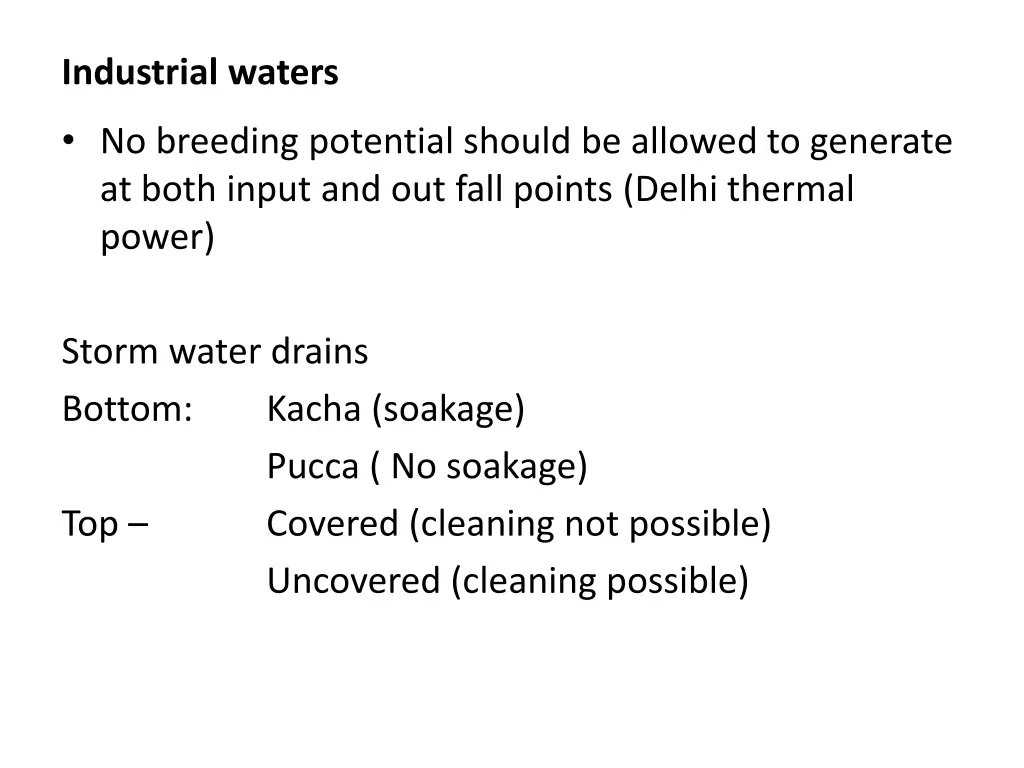
Industrial waters No breeding potential should be allowed to generate at both input and out fall points (Delhi thermal power) Storm water drains Bottom: Top Kacha (soakage) Pucca ( No soakage) Covered (cleaning not possible) Uncovered (cleaning possible)
Drain areas Cunetted drains Small drain embedded in bigger drain. Top level permit flood level flow, curette permit lean period flow Speed of flow to be >60 sec/mt. Industrial estates: Water based industries: Thermal plants Delhi/Hardwar Industrial estate -Gujarat Small scale sector curing needs
Building by law Ex texior of buildings should not collect rain water Inclusion of clauses with Builders for carrying out anti larval measures during construction. Professional solid water disposal Supportive legislation
Irrigation Project A case study (Arid zone India) Vector An.culicifacies) Irrigation project has the following major components: Up stream: Dam: Shallow water at the shore line, Stagnant pools, in withdrawal area. Down stream: Formation of pools, if rocky bed, Swamps in sandy bed
Conveyance: Seepages in banking portions of canals. Rise in subsoil water levels adjoining lands/ lower valleys Water logging of fertile lands
Command Area; On farm development Drainage of Command In the absence of drainage, swamps will be formed Water logging of command areas Swamps formation
Malaria control in tea gardens Assam (About 12,000 tea gardens) Drainage as major tool particularly contour drains to tap storm water coming from hill Shading of drain's to eliminate breeding of An.minimus First ever establishment of Ross Institute of Malaria supported by Industry for R D for control of malaria in tea gardens. First experiment on partnerships and resources sharing
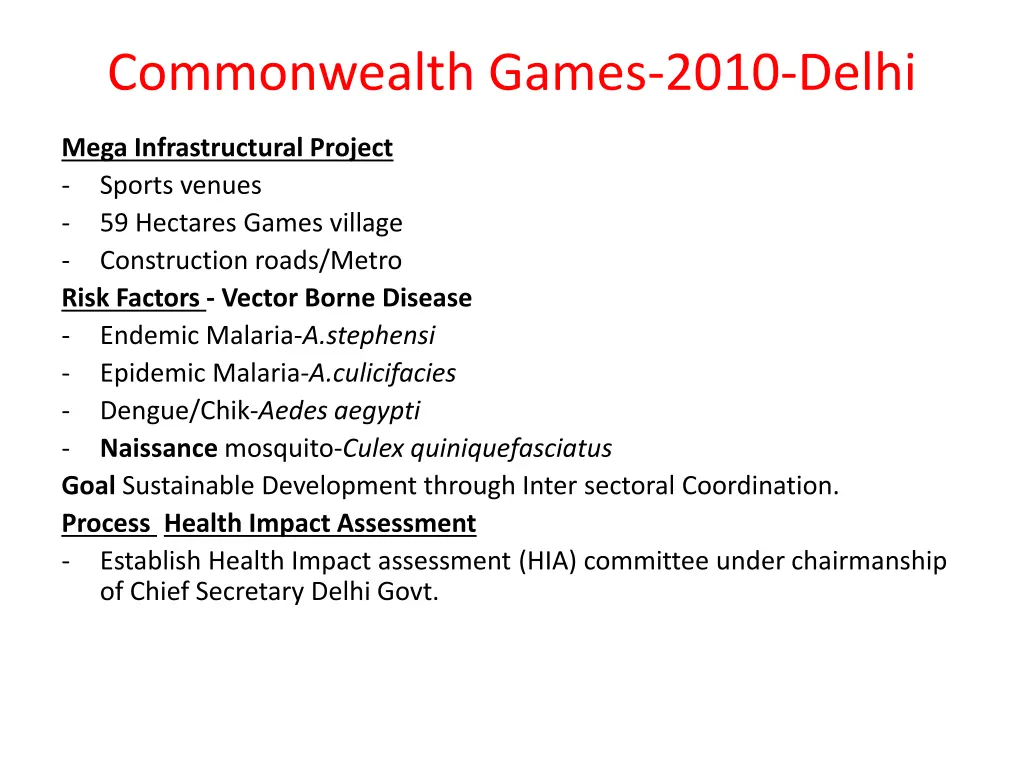
Commonwealth Games-2010-Delhi Mega Infrastructural Project - Sports venues - 59 Hectares Games village - Construction roads/Metro Risk Factors - Vector Borne Disease - Endemic Malaria-A.stephensi - Epidemic Malaria-A.culicifacies - Dengue/Chik-Aedes aegypti - Naissance mosquito-Culex quiniquefasciatus Goal Sustainable Development through Inter sectoral Coordination. Process Health Impact Assessment - Establish Health Impact assessment (HIA) committee under chairmanship of Chief Secretary Delhi Govt.
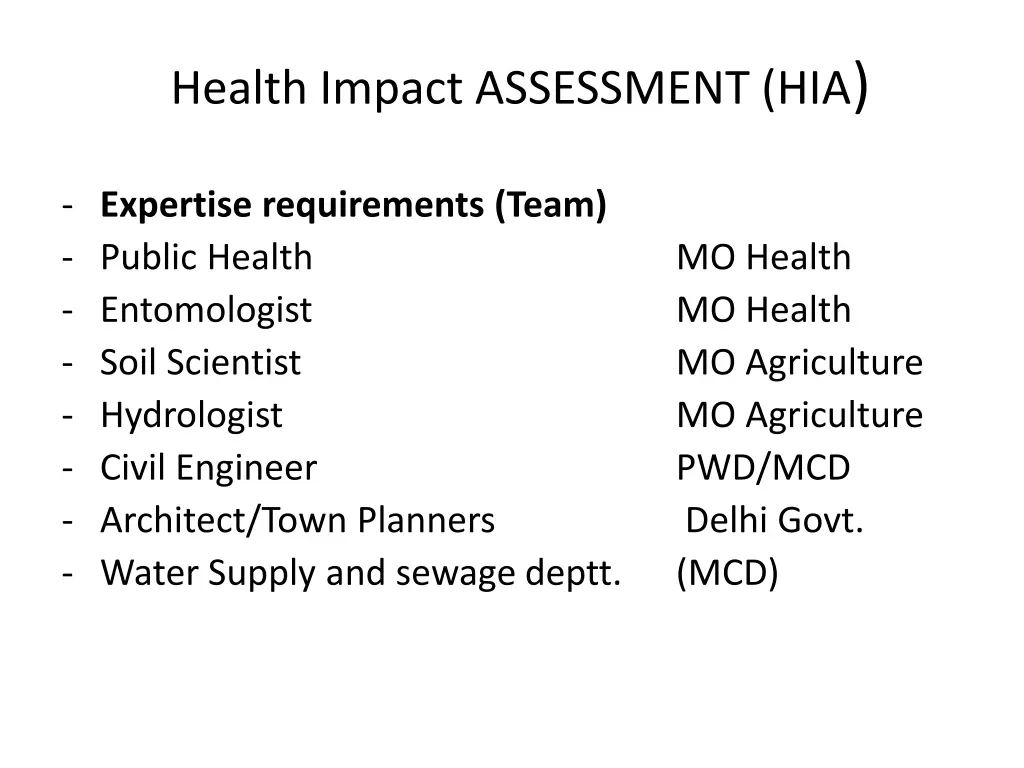
Health Impact ASSESSMENT (HIA) - Expertise requirements (Team) - Public Health - Entomologist - Soil Scientist - Hydrologist - Civil Engineer - Architect/Town Planners - Water Supply and sewage deptt. MO Health MO Health MO Agriculture MO Agriculture PWD/MCD Delhi Govt. (MCD)
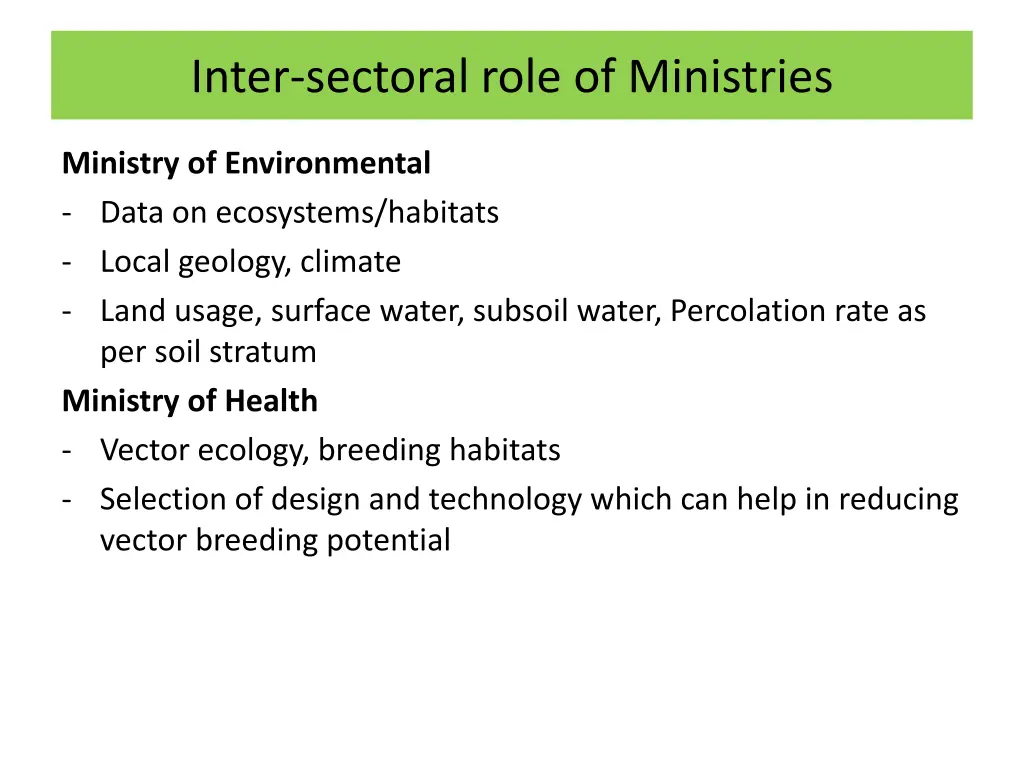
Inter-sectoral role of Ministries Ministry of Environmental - Data on ecosystems/habitats - Local geology, climate - Land usage, surface water, subsoil water, Percolation rate as per soil stratum Ministry of Health - Vector ecology, breeding habitats - Selection of design and technology which can help in reducing vector breeding potential
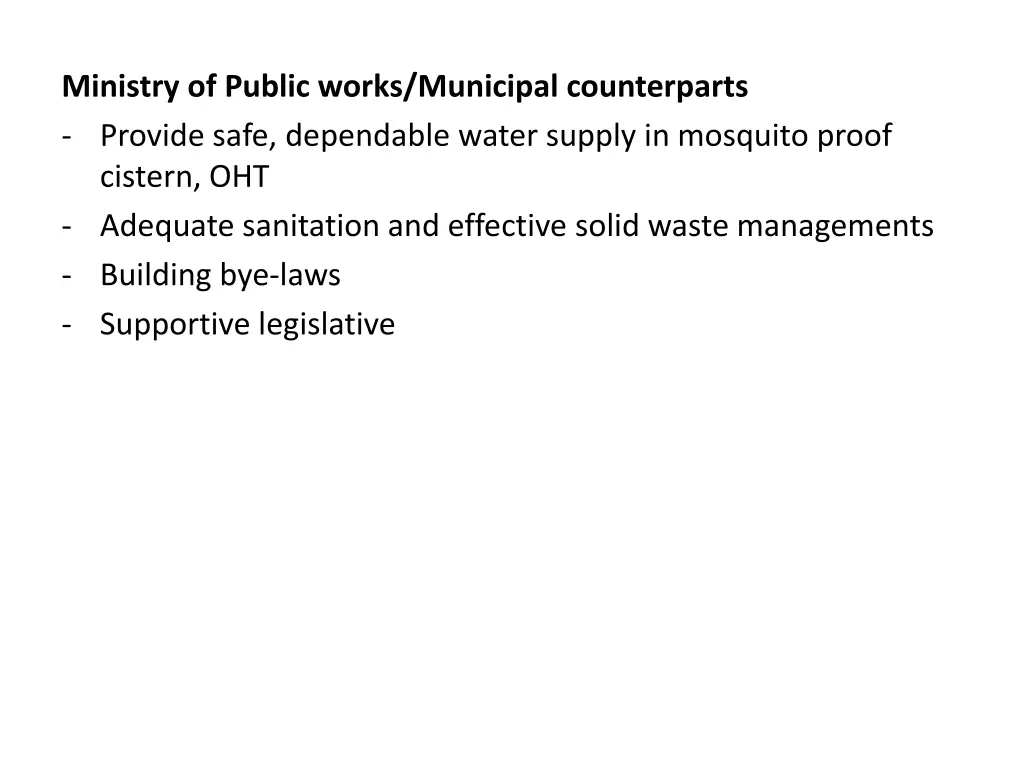
Ministry of Public works/Municipal counterparts - Provide safe, dependable water supply in mosquito proof cistern, OHT - Adequate sanitation and effective solid waste managements - Building bye-laws - Supportive legislative
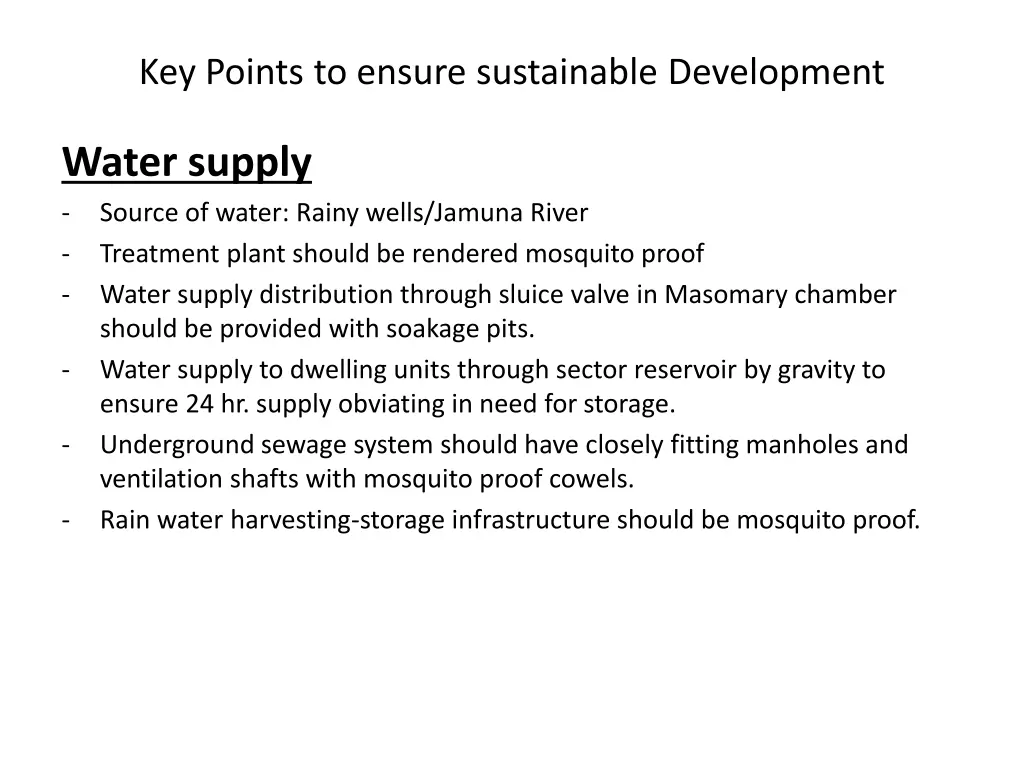
Key Points to ensure sustainable Development Water supply - Source of water: Rainy wells/Jamuna River - Treatment plant should be rendered mosquito proof - Water supply distribution through sluice valve in Masomary chamber should be provided with soakage pits. - Water supply to dwelling units through sector reservoir by gravity to ensure 24 hr. supply obviating in need for storage. - Underground sewage system should have closely fitting manholes and ventilation shafts with mosquito proof cowels. - Rain water harvesting-storage infrastructure should be mosquito proof.
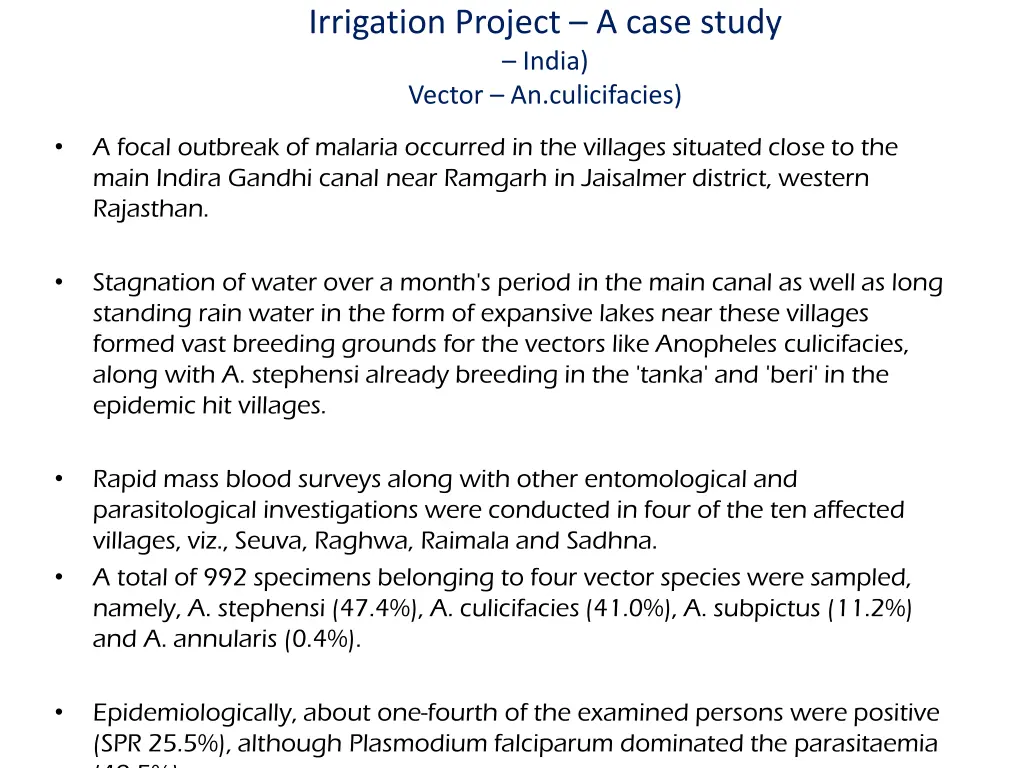
Irrigation Project A case study India) Vector An.culicifacies) A focal outbreak of malaria occurred in the villages situated close to the main Indira Gandhi canal near Ramgarh in Jaisalmer district, western Rajasthan. Stagnation of water over a month's period in the main canal as well as long standing rain water in the form of expansive lakes near these villages formed vast breeding grounds for the vectors like Anopheles culicifacies, along with A. stephensi already breeding in the 'tanka' and 'beri' in the epidemic hit villages. Rapid mass blood surveys along with other entomological and parasitological investigations were conducted in four of the ten affected villages, viz., Seuva, Raghwa, Raimala and Sadhna. A total of 992 specimens belonging to four vector species were sampled, namely, A. stephensi (47.4%), A. culicifacies (41.0%), A. subpictus (11.2%) and A. annularis (0.4%). Epidemiologically, about one-fourth of the examined persons were positive (SPR 25.5%), although Plasmodium falciparum dominated the parasitaemia (49.5%).
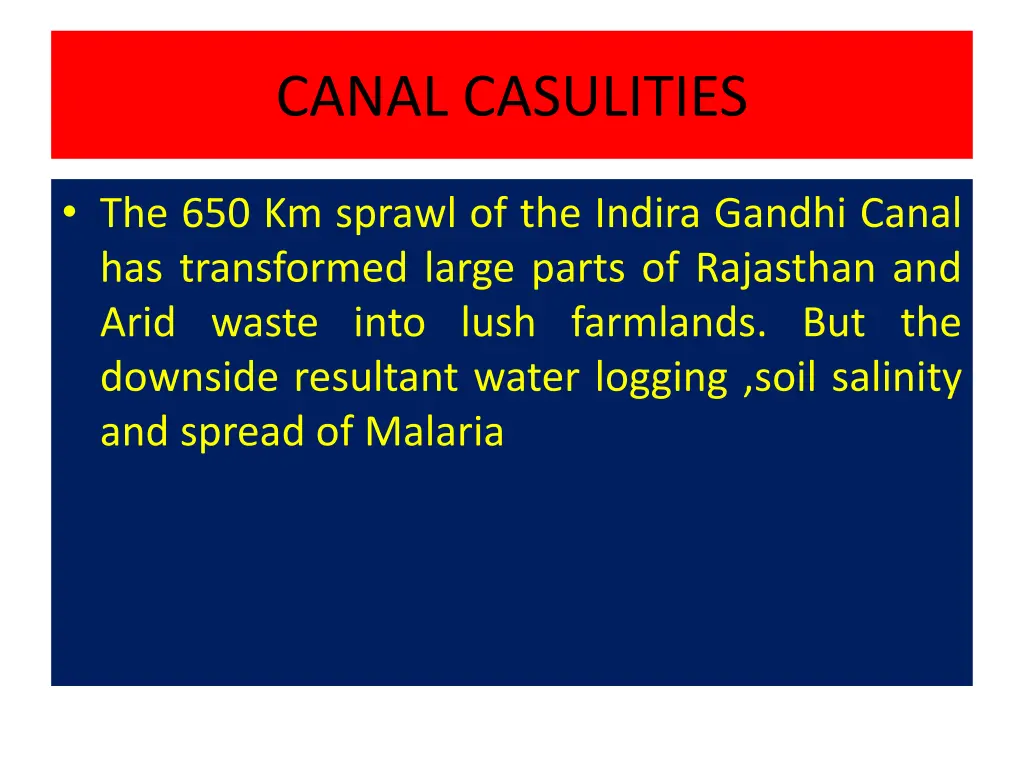
CANAL CASULITIES The 650 Km sprawl of the Indira Gandhi Canal has transformed large parts of Rajasthan and Arid waste into lush farmlands. But the downside resultant water logging ,soil salinity and spread of Malaria