Interactions Between Insects and Plants: Understanding the Dynamics
Explore the fascinating interplay between insects and plants in the ecosystem, focusing on allelochemical interactions, herbivore-predator relationships, plant stress responses, and insect performance hypotheses. Discover how plant stress influences insect behavior and uncover rare plant-insect associations that shape our understanding of ecological balance.

Download Presentation

Please find below an Image/Link to download the presentation.
The content on the website is provided AS IS for your information and personal use only. It may not be sold, licensed, or shared on other websites without obtaining consent from the author. If you encounter any issues during the download, it is possible that the publisher has removed the file from their server.
You are allowed to download the files provided on this website for personal or commercial use, subject to the condition that they are used lawfully. All files are the property of their respective owners.
The content on the website is provided AS IS for your information and personal use only. It may not be sold, licensed, or shared on other websites without obtaining consent from the author.
E N D
Presentation Transcript
PLPT 609 Title: Inter-Relationships Between Insects and Plants Credit hours= 3 (2+1) Instructor: Prof. Abdulrahman Saad Aldawood Department of Plant Protection, college of Food and Agriculture Sciences, King Saud University, Riyadh, Saudi Arabia 1
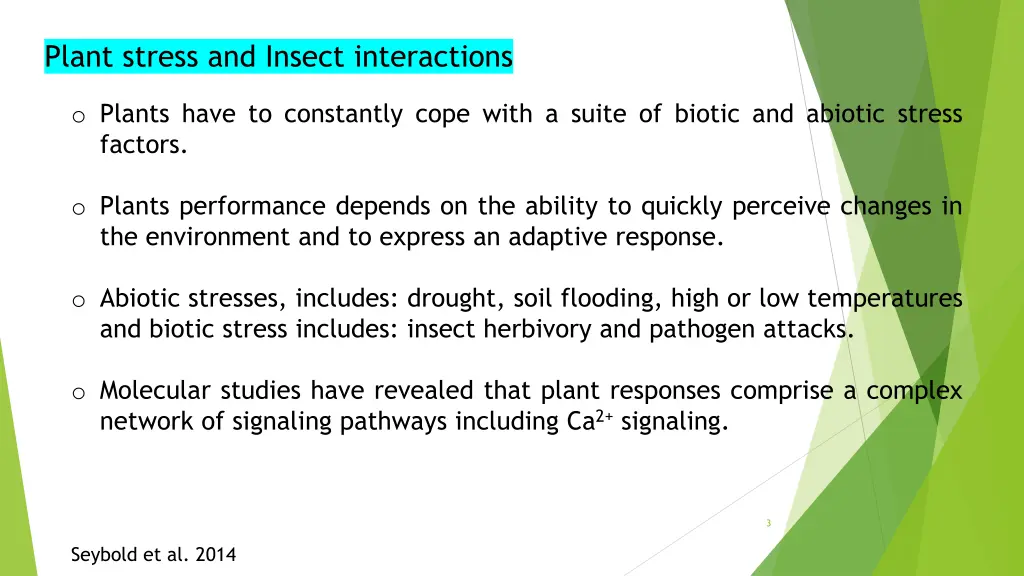
Contents Allelochemicals interactions among plants Herbivores and their predators Allelochemicals reflecting interactions between plants and pests Role of plant allelochemicals in the survival strategy of herbivores Rare plant-insect relationships Plant stress and Insect interactions 2
Plant stress and Insect interactions o Plants have to constantly cope with a suite of biotic and abiotic stress factors. o Plants performance depends on the ability to quickly perceive changes in the environment and to express an adaptive response. o Abiotic stresses, includes: drought, soil flooding, high or low temperatures and biotic stress includes: insect herbivory and pathogen attacks. o Molecular studies have revealed that plant responses comprise a complex network of signaling pathways including Ca2+ signaling. 3 Seybold et al. 2014
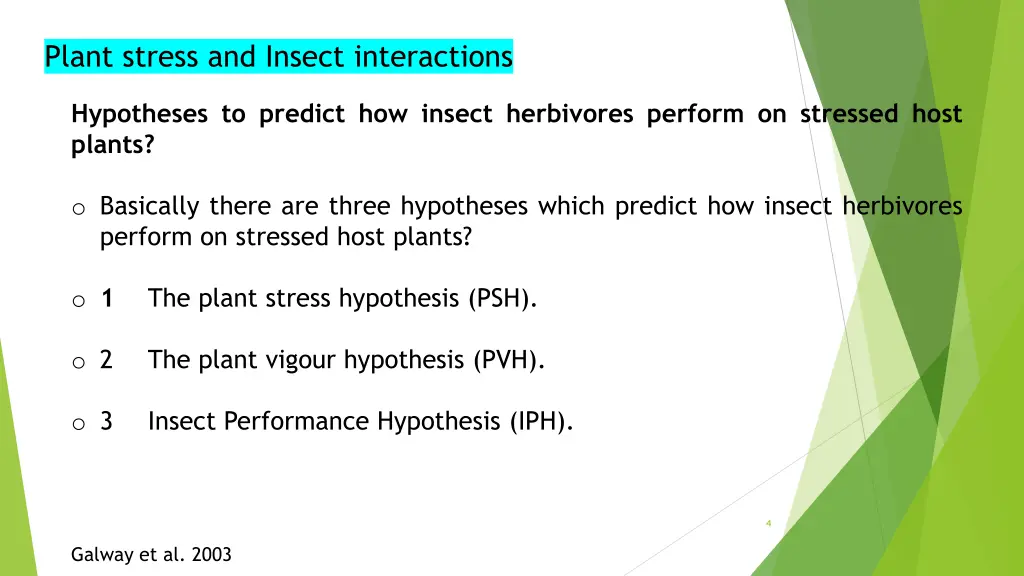
Plant stress and Insect interactions Hypotheses to predict how insect herbivores perform on stressed host plants? o Basically there are three hypotheses which predict how insect herbivores perform on stressed host plants? o 1 The plant stress hypothesis (PSH). o 2 The plant vigour hypothesis (PVH). o 3 Insect Performance Hypothesis (IPH). 4 Galway et al. 2003
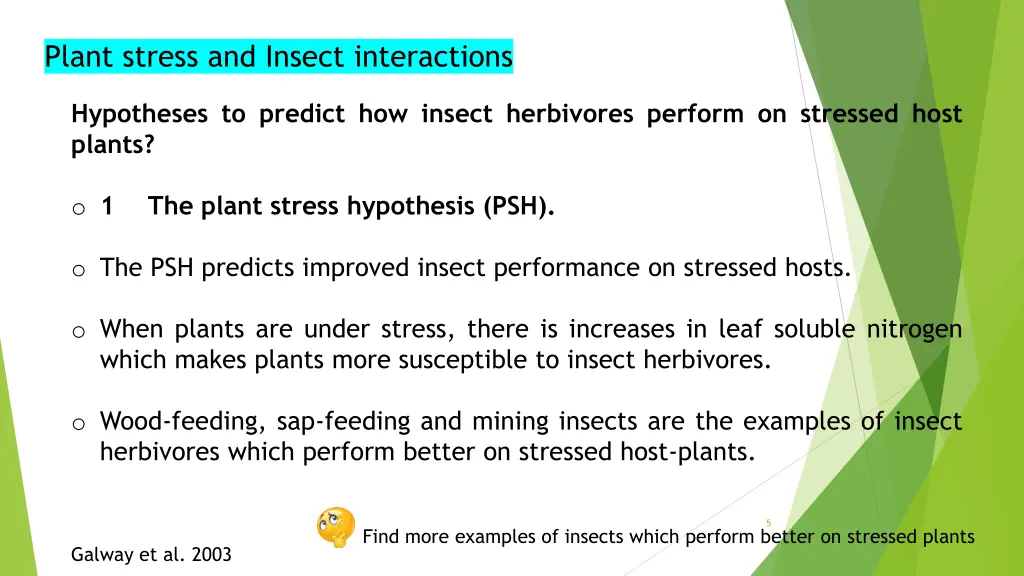
Plant stress and Insect interactions Hypotheses to predict how insect herbivores perform on stressed host plants? o 1 The plant stress hypothesis (PSH). o The PSH predicts improved insect performance on stressed hosts. o When plants are under stress, there is increases in leaf soluble nitrogen which makes plants more susceptible to insect herbivores. o Wood-feeding, sap-feeding and mining insects are the examples of insect herbivores which perform better on stressed host-plants. 5 Find more examples of insects which perform better on stressed plants Galway et al. 2003
Plant stress and Insect interactions o 1 The plant stress hypothesis (PSH) conti---. o The plant stress hypothesis was formulated Based on the observed outbreak dynamics of psyllids on water-stressed Eucalyptus trees. o Nitrogen is generally limiting for many insect herbivores. o Because increases in available plant nitrogen during periods of water stress could result in the improved growth and reproduction of phytophagous insects and thus promote population outbreaks. 6 White 1969; Galway et al. 2003
Plant stress and Insect interactions 2 The plant vigour hypothesis (PVH). o Certain insects would perform better on more vigorously growing host- plants particularly herbivores closely associated with their host-plant. o Such insect herbivores particularly attack young and vigorously growing plants and plant parts. o It includes the insects where the female selects the oviposition site within a few centimeters, where larvae will feed immediately upon hatching. o Leaf-feeding and gall-forming insects are the examples of insect that perform better on more vigorously growing host-plants. 7 Price 1991
Plant stress and Insect interactions 3 The insect performance hypothesis (IPH). o Combining elements of both the PSH and the PVH, Larsson (1989) suggested that certain insect feeding-guilds (wood-feeding, sap-feeding and mining insects) perform better on stressed host-plants, o Whereas other insect feeding-guilds (leaf-feeding and gall-forming insects) perform better on vigorously growing host plants. 8 Larsson 1989; Galway et al., 2003
Plant stress and Insect interactions 3 The insect performance hypothesis (IPH) conti----. The rationale for IPH hypothesis was based on: o a) Woody plants under stress have reduced defensive compound flow, making them less resistant to attack by wood-feeders; o b) Sap-feeding insects generally encounter low nitrogen levels so that when a plant is stressed, with resulting higher nitrogen levels, insect performance improves; 9 Larsson 1989; Galway et al., 2003
Plant stress and Insect interactions 3 The insect performance hypothesis (IPH) conti----. o c) Miners are able to avoid consuming harmful defensive compounds produced by the plant while taking advantage of the higher nitrogen content of stressed plants; o d) Leaf-feeders do not separate out the chemical fractions in their food as efficiently as other feeding guilds that discriminate against defensive compounds in stressed plants, so do better on vigorously growing plants; and o e) Galling insects prefer large-sized buds, which are found on vigorously growing plants. 10 Larsson 1989; Galway et al., 2003
Plant stress and Insect interactions The effects of drought on plant pollinator interactions o About 78 % of plant species are pollinated by animals in temperate regions and these animals are largely dominated by insects, especially bees. o Drought will alter plant pollinator interactions via: o (i) Signals or cues for insect visitors (floral display, plant height, number of flowers per plant, flower color, shape and size, olfactory compound quantity and composition) and o (ii) Floral rewards (nectar volume, total sugar concentration, sugar composition, pollen quantity and chemical composition). 11 Ollerton et al., 2011; Potts et al., 2016; Descamps et al., 2021
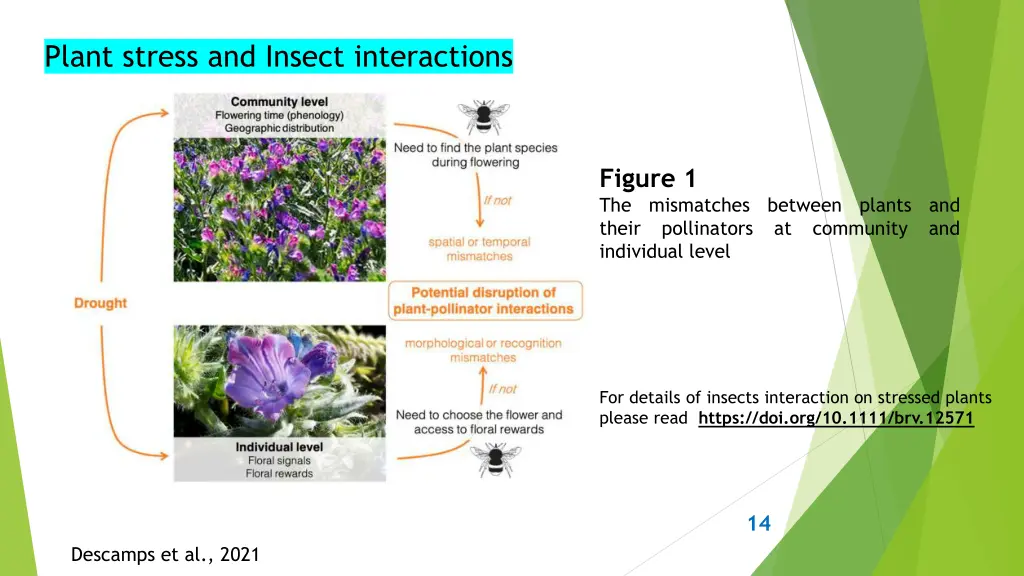
Plant stress and Insect interactions The effects of drought on plant pollinator interactions-conti--- o Mismatches between plants and their pollinators can occur due to climate change and particularly due to extreme events such as drought. o At community level, o Drought may influence flowering time and/ or geographic distribution of plant species, which may create temporal and/or spatial mismatches between plant species and insect pollinators if they don t find the plant species in their environment when they emerge in spring or summer (Figure 1, slide no 14). 12 Ollerton et al., 2011; Potts et al., 2016; Descamps et al., 2021
Plant stress and Insect interactions The effects of drought on plant pollinator interactions-conti---- o Mismatches between plants and their pollinators can occur due to climate change and particularly due to extreme events such as drought. o At individual level, o Drought may influence floral signals and/or rewards, which may create morphological and/or recognition mismatches between plant species and insect pollinators if they change their foraging behavior or if their morphology do not allow them to forage on drought-modified flowers (Figure 1, slide no 14). 13 Descamps et al., 2021
Plant stress and Insect interactions Figure 1 The mismatches between plants and their pollinators at community and individual level For details of insects interaction on stressed plants please read https://doi.org/10.1111/brv.12571 14 Descamps et al., 2021
Conclusion When plants are under stress, there is increases in leaf soluble nitrogen which makes plants more susceptible to insect herbivores. Leaf-feeding and gall-forming insects perform better on more vigorously growing host-plants. Woody plants under stress have reduced defensive compound flow, making them less resistant to attack by wood-feeders. Drought will alter plant pollinator interactions which might affect the crop production. Extensive research is needed to investigate stressed plants other than drought and insect interactions and associate them with sustainable pest management. 15
References Seybold, H., Trempel, F., Ranf, S., Scheel, D., Romeis, T., & Lee, J. (2014). Ca2+ signalling in plant immune response: from pattern recognition receptors to Ca2+ decoding mechanisms. New Phytologist, 204(4), 782-790. Galway, K. E., Duncan, R. P., Syrett, P., Emberson, R. M., & Shephard, A. (2003). Insect performance and host-plant stress: a review from a biological control perspective. White, T. C. R. (1969). An index to measure weather induced stress of trees associated with outbreaks of psyllids in Australia. Ecology, 50(5), 905-909. Larsson, S. (1989). Stressful times for the plant stress: insect performance hypothesis. Oikos, 277- 283. Price, P. W. (1991). The plant vigor hypothesis and herbivore attack. Oikos, 244-251. Galway, K. E., Duncan, R. P., Syrett, P., Emberson, R. M., & Shephard, A. (2003). Insect performance and host-plant stress: a review from a biological control perspective. 16
References Descamps, C., Quinet, M., & Jacquemart, A. L. (2021). The effects of drought on plant pollinator interactions: What to expect?. Environmental and Experimental Botany, 182, 104297. Ollerton, J., Winfree, R., & Tarrant, S. (2011). How many flowering plants are pollinated by animals?. Oikos, 120(3), 321-326. Potts, S. G., Imperatriz-Fonseca, V., Ngo, H. T., Biesmeijer, J. C., Breeze, T. D., Dicks, L. V., ... & Vanbergen, A. J. (2016). The assessment report on pollinators, pollination and food production: summary for policymakers. Secretariat of the Intergovernmental Science-Policy Platform on Biodiversity and Ecosystem Services. 17